Lawmakers Introduce SHIPS Act to Revitalize Shipbuilding, Commercial Maritime Industries

U.S. Merchant Marine Academy graduates throw their covers in celebration during the Merchant Marine Academy Commencement Ceremony in Kings Point, New York, June 22, 2024. Credit: U.S. Marine Corps | Staff Sgt. Kelsey Dornfeld

A bipartisan group of U.S. Senators and Representatives on Dec. 19 introduced introduced the Shipbuilding and Harbor Infrastructure for Prosperity and Security (SHIPS) for America Act, comprehensive legislation to revitalize the United States shipbuilding and commercial maritime industries.

The SHIPS for America Act was introduced by Sens. Mark Kelly (D-Arizona) and Todd Young (R-Indiana) and Reps. John Garamendi (D-California) and Trent Kelly (R-Mississippi). After decades of neglect, the United States has a weakened shipbuilding capacity, a declining commercial shipping fleet dwarfed by China and a diminished ability to supply the U.S. military during wartime, the lawmakers said.

They said the bipartisan proposal would restore American leadership across the oceans by establishing national oversight and consistent funding for U.S. maritime policy, incentivizing domestic shipbuilding, enabling U.S.-flagged vessels to better compete in international commerce, rebuilding the U.S. shipyard industrial base and expanding the mariner and shipyard workforce.

“We’ve always been a maritime nation, but the truth is we’ve lost ground to China, who now dominates international shipping and can build merchant and military ships much more quickly than we can,” said Kelly, a U.S. Navy veteran and the first U.S Merchant Marine Academy graduate to serve in Congress.

“The SHIPS for America Act is the answer to this challenge. By supporting shipbuilding, shipping, and workforce development, it will strengthen supply chains, reduce our reliance on foreign vessels, put Americans to work in good-paying jobs, and support the Navy and Coast Guard’s shipbuilding needs. I’m excited to introduce this comprehensive, fully paid for legislation today alongside my Republican and Democratic colleagues and our partners representing all parts of the industry, and together we’re going to work to get this effort across the finish line.”

“America has been a maritime nation since our founding, and seapower was a significant contributor to our rise to being the most powerful nation on earth. Unfortunately, the bottom line now is America needs more ships. Shipbuilding is a national security priority and a stopgap against foreign threats and coercion. Our bill will revitalize the U.S. maritime industry, grow our shipbuilding capacity, rebuild America’s shipyard industrial base, and support nationwide workforce development in this industry. This legislation is critical to our warfighting capabilities and keeping pace with China,” Young said.

The move drew support from a wide variety of maritime-related groups and is backed by the Navy League of the United States.

“The Navy League applauds the introduction of the SHIPS for America Act, a landmark legislative achievement that will comprehensively meet the needs of the U.S. merchant marine and bolster our shipbuilding industrial base,” said Mike Stevens, CEO of the Navy League.

“In today’s global threat environment, arguably the most perilous since the end of the Cold War, the United States must not only maintain the finest Navy, Marine Corps, and Coast Guard on the seas, but also ensure a robust U.S.-flag merchant marine and a resilient shipbuilding industrial base. These elements are crucial for safeguarding our national and economic security in the event of large-scale military conflict. The SHIPS for America Act addresses these vital considerations and reaffirms that America is, and always will be, a maritime nation.”

The SHIPS for America Act would:

Coordinate U.S. maritime policy by establishing the position of Maritime Security Advisor within the White House, who would lead an interagency Maritime Security Board tasked with making whole-of-government strategic decisions for how to implement a National Maritime Strategy. The bill also establishes a Maritime Security Trust Fund that would reinvest duties and fees paid by the maritime industry into maritime security programs and infrastructure supporting maritime commerce.

Establish a national goal of expanding the U.S.-flag international fleet by 250 ships in 10 years by creating the Strategic Commercial Fleet Program, which would facilitate the development of a fleet of commercially operated, U.S.-flagged, American crewed, and domestically built merchant vessels that can operate competitively in international commerce.

Enhance the competitiveness of U.S.-flagged vessels in international commerce by establishing a Rulemaking Committee on Commercial Maritime Regulations and Standards to cut through the U.S. Coast Guard’s bureaucracy and red tape that limits the international competitiveness of U.S.-flagged vessels, requiring that government-funded cargo move aboard U.S.-flag vessels, and requiring a portion of commercial goods imported from China to move aboard U.S.-flag vessels starting in 2029.

Expand the U.S. shipyard industrial base, for both military and commercial oceangoing vessels, by establishing a 25 percent investment tax credit for shipyard investments, transforming the Title XI Federal Ship Financing Program into a revolving fund, and establishing a Shipbuilding Financial Incentives program to support innovative approaches to domestic ship building and ship repair.

Accelerate U.S. leadership in next-generation ship design, manufacturing processes, and ship energy systems by establishing the U.S. Center for Maritime Innovation, which would create regional hubs across the country.

Make historic investments in maritime workforce by establishing a Maritime and Shipbuilding Recruiting Campaign, allowing mariners to retain their credentials through a newly established Merchant Marine Career Retention Program, investing in long-overdue infrastructure needs for the U.S. Merchant Marine Academy, and supporting State Maritime Academies and Centers for Excellence for Domestic Maritime Workforce Training and Education. The bill also would streamline and modernize the U.S. Coast Guard’s Merchant Mariner Credentialing system.


VAQ-133 “Wizards” complete historic first Next Generation Jammer Deployment  

An EA-18G Growler from VAQ-133 launches from USS Abraham Lincoln (CVN 72). (U.S. Navy photo)

From VAQ-133, Dec. 16, 2024 

VAQ-133 returns from a five-month deployment as the first Navy squadron to tactically employ the ALQ-249 Next Generation Jammer. 

WHIDBEY ISLAND, Wash.- Electronic Attack Squadron 133 (VAQ-133), assigned to Carrier Air Wing Nine (CVW) 9, returned from the Abraham Lincoln Carrier Strike Group’s (ABECSG) five-month deployment to the Middle East and Eastern Pacific to Naval Air Station Whidbey Island in time for the holidays, Dec. 14, 2024. 

The 153 Sailors, 18 aircrew, and seven EA-18G Growlers of the “Wizards” of VAQ 133 departed Naval Air Station North Island, San Diego, July 13, 2024. 
 

The Wizard’s deployment marked a historic milestone, as the squadron became the first in the Navy to deploy with the ALQ-249 Next Generation Jammer (NGJ). Throughout their rigorous training and deployment, the Wizards demonstrated the future of Airborne Electronic Attack (AEA) by developing new tactics, achieving the first NGJ arrested landing, and tactically employing the system. 
 
“This deployment showcased the cutting-edge capabilities of the NGJ and reinforced the critical role of the Growler community in modern warfare,” said Cmdr. Erik Dente, commanding officer, VAQ-133. “More importantly, it demonstrated the skill, dedication, and perseverance of every VAQ-133 Sailor and the families, friends, and loved ones who supported them at home. I could not be more proud of the Sailors, aircrew, and support teams who made this deployment an overwhelming success.” 
 
The Wizards began and concluded their deployment in U.S. 7th Fleet, executing key training missions in support of U.S. Indo-Pacific Command and participating in a Multi-Large Deck Exercise (MLDE) with the Italian Navy’s ITS Cavour Carrier Strike Group and conducting operations in the South China Sea to promote a free and open Indo-Pacific. 
 
The strike group was ordered to the U.S. Central Command (CENTCOM) area of responsibility to bolster U.S. military force posture in the Middle East, deter regional escalation, degrade Iranian-backed Houthi capabilities, defend U.S. forces to promote security, stability and prosperity. 
 
While operating in the Middle East, the Wizards played a key role in supporting CENTCOM objectives, participating in dual-carrier operations with the USS Theodore Roosevelt (CVN 71), flying critical combat missions to ensure the safety of deployed U.S. Forces, and aiding in strikes to degrade Iranian-backed Houthi weapons storage capabilities. 
 
“This deployment will go down in history,” said Command Master Chief Frederick Tuiel command master chief, VAQ-133, summing up the deployment. “While it wasn’t filled with port visits, it was defined by impactful combat operations—experiences our Sailors will share for years to come. Bringing everyone home safely makes the accomplishment even sweeter.” 
 
The squadron earned the Commander Electronic Attack Wing Pacific (CVWP) Golden Wrench Award for maintenance excellence demonstrating the Wizard’s dedication to excellence. Wizard maintainers sustained 100% Growler mission-readiness throughout the deployment enabling the successful completion of all assigned missions. 
 
“The dedication of the sailors of VAQ-133 was second to none,” said Dente. “Their hard work kept our Growlers fully mission capable and ensured every mission was a success. Whether from administration, operations, safety, maintenance, intelligence, or food service and support divisions – it took every sailor to build and maintain the combat power required during our operations.” 
 
In addition to operational accomplishments, the deployment included port calls to Guam in August and Kuala Lumpur in November, offering Sailors a chance to recharge and experience diverse cultures while supporting U.S. partner nations. 
 
Returning home before the holidays, VAQ-133 is looking forward to reuniting with their families and friends, reflecting on their achievements and continuing to embody the squadron catch phrase to “Push it up!” 
ABECSG completed more than 11,600 flight hours comprised of 5,500 sorties and over 4.400 fixed-wing aircraft launches and arrestments throughout its five-month deployment. The embarked CVW-9 is next-generation, multiplatform capable that enables advance mobile projection of naval air power and forward operational presence. 
 
CVW 9 consists of nine squadrons flying the F-35C Lightning II, F/A-18E/F Super Hornet, EA-18G Growler, E-2D Hawkeye, C-2A Greyhound, and MH-60R/S Sea Hawk. The squadrons are the “Tophatters” of Strike Fighter Squadron (VFA) 14, the “Black Aces” of VFA 41, the “Vigilantes” of VFA 151, the “Black Knights” of VMFA 314, the “Wallbangers” of Airborne Command and Control Squadron (VAW) 117, the “Wizards” of Electronic Attack Squadron (VAQ) 133, the “Raptors” of Helicopter Maritime Strike Squadron (HSM) 71, the “Chargers” of Helicopter Sea Combat Squadron (HSC) 14, and the “Rawhides” of Fleet Logistics Support Squadron (VRC) 40. 
 
ABECSG consists of the flagship USS Abraham Lincoln (CVN 72), embarked staffs of Carrier Strike Group (CSG) Three and Destroyer Squadron (DESRON) 21, Carrier Air Wing (CVW) Nine, integrated air and missile defense Arleigh Burke-class guided missile destroyer USS Frank E. Petersen Jr. (DDG 121), and DESRON 21’s USS Spruance (DDG 111) and USS Michael Murphy (DDG 112). 
 
Arleigh Burke-class guided-missile destroyers USS O’Kane (DDG 77) and USS Stockdale (DDG 106) remain deployed in the 5th Fleet area of operations supporting global maritime security operations. 


Navy’s NEPTUNE Program Accelerates Maritime Innovation Through University Partnerships 

Stanford’s Hacking for Defense Program Helps Drive Rapid Technology Transition from Lab to Fleet 

From the Office of Naval Research 

STANFORD, Calif., December 18, 2024 — The U.S. Navy’s Office of Naval Research (ONR) is revolutionizing maritime technology development through its NEPTUNE program (Naval Enterprise Partnership Teaming with Universities for National Excellence), by demonstrating the vital role of academic-military collaboration in advancing national defense capabilities. Led by Dr. Corey Love, NEPTUNE has established strategic partnerships with leading institutions including Stanford University, MIT, Purdue University, UC Davis, Arizona State University, Old Dominion University, and the Naval Postgraduate School. These partnerships are proving instrumental in rapidly transitioning innovative technologies from laboratory concepts to operational naval assets. This initiative is not just about developing new technologies; it’s about shaping the future of naval warfighting capabilities and ensuring the resilience of our forces in the face of evolving threats. This is particularly important given hostilities in Ukraine and the Middle East, as well as rising tensions with China, Iran, Russia and North Korea. 

“The NEPTUNE program exemplifies the kind of innovative partnerships we need to accelerate defense technology development,” says Dr. Jeff Decker, managing director of the Tech Transfer for Defense program at Stanford University’s Doerr School of Sustainability, and program director and co-instructor of Stanford University’s Hacking for Defense® program, as well as author of “The Hacking for Defense Manual.” “By connecting academic researchers directly with military end-users, we’re seeing remarkable acceleration in the development and deployment of critical technologies.” 

A standout example of NEPTUNE’s success comes from MIT, where Professor Steven Leeb’s team has developed a groundbreaking Combat Power Monitor (CPM) system, using their research in energy management and monitoring to demonstrate progress in technology readiness in an area that is critical to the operational readiness, effectiveness and efficiency of naval vessels and U.S. Coast Guard (USCG) warships. The team’s contributions, particularly in the development of technologies for supporting condition-based maintenance and energy economization, are proving to be invaluable assets to the U.S. Navy and U.S. Coast Guard. Active demonstrations have been conducted and are continuing on serving USN warships and U.S. Coast Guard cutters. 

“We are now seeing game-changers flow through the innovation pipeline in less time,” says Justin Fanelli, acting chief technology officer for the U.S. Department of Navy. “We have implemented and are looking for more ways to improve the time from concepts to outcomes; one thing is certain – great ideas and hustlers are essential for us to move at the speed of relevance. With Professor Leeb’s work, the ability to monitor and manage energy usage on ships ensures that our vessels can operate longer, with greater endurance, and with reduced logistical footprints. This is particularly crucial in scenarios where resupply may be challenging or in stealth operations where minimizing energy signatures is vital.”  

The NEPTUNE program plays a pivotal role in advancing research from early-stage concepts to more mature, deployable technologies. By propelling basic scientific research (Technology Readiness Level, or TRL 2) towards prototype demonstration in an operational environment (TRL 7), NEPTUNE ensures that innovative ideas are not left in the laboratory but are instead developed into practical solutions to naval challenges. This progression involves a systematic approach to technology development, where initial theoretical studies and proof-of-concept (TRLs 2-4) are followed by increasing levels of integration and testing in relevant environments (TRLs 5-6), culminating in prototype demonstrations that prove the technology’s effectiveness in real-world naval settings (TRL 7). Through this structured pathway, NEPTUNE accelerates the transition of cutting-edge research into tangible assets that enhance the Navy’s warfighting capabilities and operational resilience. 

This initiative demonstrates how academic-military partnerships can yield transformative results, particularly vital given current global challenges including situations in Ukraine and the Middle East, as well as evolving maritime security needs. 

NEPTUNE support made it possible for the MIT team to move from an advanced concept to a deployed prototype in 24 months.  The NEPTUNE partnership between the Navy and academia is a powerful formula for innovation. By leveraging the expertise and creativity of university researchers, the Navy is able to accelerate the development of technologies that are essential for maintaining its edge in an increasingly competitive and complex global security environment. 

“As we look to the future, the importance of programs like NEPTUNE cannot be overstated,” noted Fanelli. “The challenges facing the Navy and the broader national security landscape are becoming more diverse and sophisticated. Adversaries are rapidly advancing their capabilities, and the technological gap is narrowing. In this context, the Navy’s ability to innovate and adapt is not just a matter of maintaining superiority; it’s a matter of national security.” 

The NEPTUNE program represents a strategic investment in the future of naval warfare. It is a model of how collaboration between the military and academia can yield transformative results. As we continue to navigate the uncertain waters of the 21st century, initiatives like NEPTUNE will be the beacon that guides the Navy toward a future where it remains the preeminent maritime force, capable of ensuring peace and security in an ever-changing world. 

To learn more about the ONR Investment Horizons framework, visit onr.navy.mil; for more information on the Technology Transfer for Defense program at Stanford University, visit techtransferfordefense.stanford.edu


Kaine Applauds Senate Passage Of Fiscal Year 2025 National Defense Bill 

Kaine successfully secured key provisions to support servicemembers and Virginia’s defense community 

WASHINGTON, D.C. – Today, U.S. Senator Tim Kaine (D-VA), a member of the Senate Armed Services Committee (SASC) and Chair of the SASC Subcommittee on Seapower, applauded the Senate’s passage of the Fiscal Year 2025 National Defense Authorization Act (NDAA). As a member of SASC, Kaine worked to secure key provisions in the legislation to advance U.S. national security, support servicemembers and their families, benefit Virginia’s defense community, and boost efforts to work collaboratively with allies and partners. The bill now heads to the President’s desk to be signed into law. 


“As a senator from Virginia and member of the Senate Armed Services Committee, I’m proud to go to bat every year to advocate on behalf of Virginia’s servicemembers and defense community. We are facing a number of global challenges, and this legislation is critical to ensuring our military remains the strongest in the world. It includes key provisions I secured to improve quality of life for servicemembers and their families, support improvements at military installations across Virginia, and advance our national security interests. It also makes important shipbuilding investments, including by authorizing funding for Virginia-class submarine construction, a substantial portion of which happens in Hampton Roads. I will keep working with my colleagues to pass full-year government funding legislation for Fiscal Year 2025 as soon as possible,” said Kaine. 


Kaine successfully secured the following provisions: 

Pay Raises: Authorizes a 4.5% pay raise for military personnel and an additional 10% pay raise for junior enlisted servicemembers with paygrades E-1 through E-4, resulting in a 14.5% total pay raise. Authorizes a 2% pay raise for Department of Defense (DOD) personnel. 

Shipbuilding Investments: 

  • Authorizes funding for one Virginia-class submarine, incremental funding authority for a second Virginia-class submarine, and funding for additional material and support for the submarine industrial base. 

  • Authorizes funding for the Columbia-class submarine program. 

  • Authorizes funding for carriers, surface vessels, undersea vessels, aircraft, and munitions. 

  • Directs the Secretary of Defense to develop and implement a strategy to promote the development of a skilled manufacturing and high-vocational trade workforce to support the expansion of the defense industrial base. 

  • Authorizes funding for a recruiting, marketing, and public messaging campaign to expand the maritime workforce. 

  • Requires the Secretary of Defense to consider novel methods for recruiting and developing the defense industrial base workforce, including replicating established training programs and educating service-oriented populations about the variety of opportunities for national service. 

  • Supports investments in shipyard infrastructure and the defense industrial base. 

  • Directs the Secretary of Defense to assess U.S. sealift capability to include an evaluation of the maritime infrastructure. 

Military Construction: Authorizes $540,481,000 for military construction (MILCON) projects in Virginia. 

  • $180,000,000 for barracks at Joint Base Myer-Henderson Hall  

  • $81,000,000 for a dormitory at Joint Base Langley-Eustis  

  • $52,610,000 for long weapons storage at Naval Weapons Station Yorktown  

  • $52,110,000 for the Conventional Prompt Strike Weapons Maintenance, Ops & Storage Facility at Naval Weapons Station Yorktown  

  • $47,130,000 for the Conventional Prompt Strike Test Facility at Naval Weapons Station Yorktown  

  • $36,800,000 for the Metro Entrance Pedestrian Access Control Point at the Pentagon  

  • $35,000,000 for Special Operations Forces Human Performance Training Center at Joint Expeditionary Base Little Creek-Fort Story  

  • $23,000,000 for Area Maintenance Support Activity/a Vehicle Maintenance Shop in Richmond  

  • $16,000,000 for unaccompanied housing at Naval Air Station Oceana  

  • $10,000,000 for Dry Dock 3 Modernization at Norfolk Naval Shipyard  

  • $4,080,000 for a Child Development Center at Naval Air Station Oceana  

  • $2,751,000 for a Child Development Center at Joint Expeditionary Base Little Creek-Fort Story 

Health Care: 

  • Directs the Secretary of Defense to provide data on servicemember suicides by military occupational skill (MOS). This will allow DOD to identify which military career fields have higher per capita suicide rates. 

  • Authorizes TRICARE health providers to provide tele-mental health care services to military personnel and their dependents regardless of the location of the provider or patient. 

  • Establishes the Defense Intrepid Network for Traumatic Brain Injury and Brain Health to provide clinical care to prevent, diagnose, treat, and rehabilitate servicemembers with post-traumatic stress disorder (PTSD), symptoms from blast overpressure or blast exposure, and other mental health conditions. 

  • Directs the Secretary of Defense to provide a report on the Department’s efforts to diagnose, treat, and measure traumatic brain injuries throughout a member’s service from the time of entry until transition to veteran status. 

  • Directs the Comptroller General to conduct a review and research on DOD efforts to address traumatic brain injuries related to blast overpressure and exposure. Kaine has introduced legislation and urged the Biden Administration to mitigate and protect servicemembers from these injuries. 

  • Increases the maximum accession bonus for the Health Professions Scholarship Program from $20,000 to $100,000 to recruit more medical and dental providers. 

Military Housing: 

  • Authorizes increased funding to repair and improve enlisted barracks across the services.  

  • Requires the Secretary of Defense to develop a policy for the services to provide free internet to servicemembers living in barracks.  

  • Authorizes servicemembers who are below the grade of E-6, do not have dependents, and are assigned to sea duty to be paid a Basic Allowance for Housing. 

Child Care and Education for Military Families: 

  • Provides for competitive rates of pay for child development programs’ employees to improve recruitment and retention.  

  • Includes a provision based off of Kaine’s bipartisan bill to extend the maximum student to teacher ratio directive for Department of Defense Education Activity (DODEA) schools around the world. Sets the maximum teacher to student ratio at 1:18 for grades K-3 and maintain an average of 1:24 for grades 4-12 across all DODEA schools. 

  • Authorizes funding for Impact Aid, including funding to support military children with severe disabilities. Impact Aid reimburses school districts for the cost of educating children who reside on military installations or have a parent that works on a military installation or federal property. Because military families may not pay certain state or local taxes where they are stationed, Impact Aid helps offset these costs and is critical to supporting schools.  

Military Spouses: 

  • Permanently grants authority to DOD to make transferring professional licenses between states easier for military spouses.  

  • Extends the Military Spouse Career Accelerator Pilot, which provides employment support to military spouses through a paid fellowship program.  

  • Extends the authority to hire military spouses in noncompetitive appointments in the civil service.  

Countering Fentanyl: Includes the Strengthening Tracking Of Poisonous Tranq Requiring Analyzed National Quantification Act (STOP TRANQ), bipartisan legislation Kaine led alongside U.S. Senator Ted Cruz (R-TX) to add a statutory requirement for the State Department to include reporting on xylazine, or “tranq,” in its annual International Narcotics Control Strategy Report (INCSR), a country-by-country report that tracks efforts to counter all aspects of the international drug trade. Tranq is a powerful sedative that is increasingly used as an additive to fentanyl. 

Resilience of Military Installations: Authorizes funding for the Readiness and Environmental Protection Integration (REPI) Program to support base resiliency. Kaine called for robust funding for REPI. 


Support for Veterans: Extends and authorizes funding for the Troops to Teachers (TTT) program to help transitioning servicemembers and veterans become K-12 teachers. 

U.S. Posture in Indo-Pacific: 

  • Authorizes funding for the Pacific Deterrence Initiative (PDI), which enhances U.S. force posture, infrastructure, readiness, capacity, and capabilities in the Indo-Pacific. 

  • Requires a plan for the establishment of joint force headquarters subordinate to U.S. Indo-Pacific Command (INDOPACOM) in Japan.  

  • Authorizes the Indo-Pacific Security Assistance Initiative and authorizes DOD to provide defense articles and services to allies and partners in the Indo-Pacific. 

Australia-U.K.-U.S. (AUKUS) Partnership: Includes Kaine’s bipartisan Coordinating AUKUS Engagement with Japan Act to require AUKUS coordinators at the State Department and DOD to engage with the Japanese government, as well as consult with counterparts in Australia and the U.K. to assess Japan’s potential for inclusion in key advanced technology cooperation activities under the AUKUS framework. Kaine has been a strong champion of AUKUS in Congress. 


Taiwan: Authorizes the Taiwan Security Cooperation Initiative to enable Taiwan to maintain sufficient self-defense capabilities.    


Israel: Authorizes funding for the Israeli Cooperative Missile Defense Program, including the Iron Dome, David’s Sling, and Arrow.  


Ukraine: Requires a report on DOD efforts to identify, disseminate, and implement lessons learned from the war in Ukraine. 


Iran: Requires congressional notification for any weapons or related materials transferred by Iran to an Iranian-linked group or second country. Requires an annual report on actions the U.S. is taking to counter and deter weapons transfers. 

Uncrewed Aircraft Systems: 

  • Authorizes DOD to support civil authorities to detect, identify, and monitor uncrewed aircraft systems (UAS) that cross international land borders of the United States. 

  • Requires the establishment of a counter-uncrewed aircraft system (c-UAS) task force to review guidance relating to c-UAS activities. 

  • Requires a strategy for countering drone technologies, referring drone offenses for investigation and prosecution, and assessing resources or authorities necessary for drone incursion response. 

  • Directs the Army, Navy, and Air Force to provide briefings on respective service plans for counter-UAS capabilities.  

Counternarcotics: Requires DOD to report on improvements to combatant command coordination to its counternarcotic and counter-transnational organized crime activities. 

Illegal, Unreported, and Unregulated (IUU) Fishing:  

  • Authorizes the Secretary of Defense to support the U.S. Coast Guard in executing existing maritime laws to combat transnational crimes, including IUU fishing. 

  • Includes a key provision from bipartisan legislation Kaine introduced to expand existing authorities to allow the U.S. government to work with partners and allies around the world to support the enforcement of maritime law enforcement agreements that combat IUU fishing. 

Countering Human Trafficking: Includes a provision from Kaine’s bipartisan bill authorizing the State Department to investigate human trafficking. 

Support for Historically Black Colleges and Universities (HBCUs): Includes several provisions from Kaine’s bipartisan legislation to encourage growth of research partnerships between HBCUs and federal agencies to advance development in sub-Saharan Africa.  


Response to Conflict in Sudan Act: Includes Kaine’s legislation to bolster and coordinate the U.S. response to the worsening conflict in Sudan by creating and codifying the Office of the Special Envoy for Sudan at the U.S. Department of State. The Envoy would be confirmed by the Senate. 


COMMAND Act: Includes Kaine’s bipartisan bill to require commissioned officers to receive training on the U.S. Constitution, including instruction on civilian control of the military.  


A Week in the Life of Protecting American Fish and Seafood 

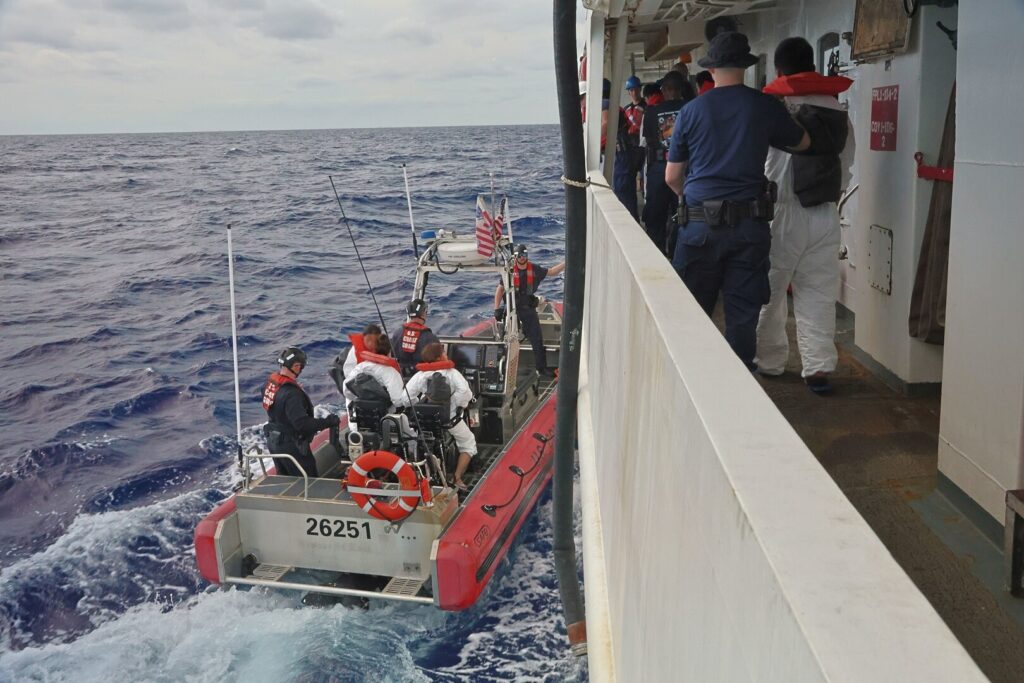
U.S. Coast Guard Petty Officer 1st Class Christopher Banka, a boarding officer aboard U.S. Coast Guard Cutter ANGELA McSHAN, completes a living marine resources fisheries inspection, Atlantic Ocean, Dec. 10, 2024. The crew of 25 completed a five-day living marine resource law enforcement patrol 100 miles off the coast of New Jersey. (U.S. Coast Guard photo by Petty Officer 3rd Class Christopher Bokum)

From U.S. Coast Guard 5th District, Dec. 18,2024 

PHILADELPHIA – One hundred miles off the New Jersey coastline, the waters were vast and seemingly endless.   

To the untrained eye, it was a serene stretch of blue, a world away from the bustling Jersey Shore. But amongst waves was a high-stakes arena where living marine resources (LMR) law enforcement took place.   

The Coast Guard’s LMR mission affects seafood enthusiasts and fishermen alike. A succulent seafood dinner cannot make it to a plate until the fishermen catch it, and it’s the Coast Guard’s mission to ensure those fish are caught legally.   

From Dec. 9 to Dec. 13, U.S. Coast Guard Cutter Angela McShan and its 25 crewmembers took to the Atlantic to carry out an LMR law enforcement patrol, ensuring the sustainability of the ocean’s resources and enforcing federal regulations designed to protect marine ecosystems and commercial fishing livelihoods.  

“Our mission is critical to protecting the natural resources within the mid-Atlantic fisheries,” said the cutter’s commanding officer, Lt. Gregory Schmidt, “especially ensuring the natural resources are sustained and also that there’s a balance of the economic profit and the balance of the commercial fisheries within the area.”  

The Coast Guard is the lead federal maritime law enforcement agency and the only agency with both the authority and capability to enforce national and international law on the high seas, outer continental shelf, and inward from the U.S. Exclusive Economic Zone (EEZ) to inland waters.    

During this deployment, the crew conducted five boardings for fisheries and served as a stronghold of maritime law enforcement.   

Armed Coast Guardsmen boarded the fishing vessels using the cutter’s over the horizon (OTH V) small boat, the only fast response cutter (FRC) in the fleet currently using this updated prototype OTH.   

“Out here we’re conducting inspections on commercial fishing vessels,” said Petty Officer First Class Christopher Banka, a boarding officer. “As far as the fish, we’re looking at sizes, quantity, and ensuring that the vessels have their proper certifications and documentation.”   

The goal for the week was clear: to ensure fishing operators complied with federal regulations while fostering mutual respect and cooperation.  

“The biggest thing we’re looking for are the targeted species,” said the cutter’s executive officer, LTJG Joseph Roth. “District Five provides us with a lookout list with known high-risk targets and repeat offenders. We’re also looking for those targeted species and the area of the ocean where typical good fishing grounds are.”   

While some vessels were found to be fully compliant, other were not.   

“A lot of times we’ve run into people just fishing with the wrong type of gear,” said Roth. “This trip, we had someone fishing with a net that was too small. We caught it and we’re protecting our fisheries by doing that. With a smaller net, they’re catching a lot more things that they’re not supposed to be catching.”  

As the crew’s deployment showed, it’s not just the fish themselves that are of interest, but also the equipment on the vessels.   

“We’ve also run into some safety equipment violations,” said Roth. “There’s been expired flares, personal flotation devices that are unserviceable. So, we’re indirectly saving a life by ensuring these vessels have the correct equipment on board.”   

As Schmidt explained, the Coast Guard is not only searching for illegal fishing during these boardings but also inspecting the vessels to prevent casualties.   

“This fisheries mission is important because we get to see immediate impact on the federal fisheries and safety aspect,” said Schmidt. “When we get on these boats, we not only check their fish but also check they are in compliance with their safety equipment. Ultimately, we’re protecting their lives to make sure they’re not a search and rescue case.”   

According to Roth, every single crew member contributes to the fisheries mission while underway.   

“We have our cooks out there helping to launch the small boat,” said Roth. “We’ve got our engineers on the small boat and out doing boardings. Our boatswain’s mates are doing the same thing. Every single person is involved in the law enforcement effort as well as the effort to keep the ship running and conducting maintenance.”   

Amid the patrol, swells reached upwards of 10 feet with subfreezing temperatures.   

For the crew, the Atlantic conditions are simply part of the job.  

“It can get pretty rough out there,” said Roth. “Especially getting on and off the small boat and onto the vessels. You’ve really got to take precautions, and you don’t know what kind of deck you’re climbing on to.”   

Despite the challenges, the crew successfully conducted the five boardings over the five-day deployment.   

“One of the biggest challenges we face is the weather windows when these fisheries are open,” said Schmidt. “Often, we have to strategically plan to get offshore amidst the weather. Our main goal is to be able to target these guys when it’s safe to go out there and the maximum available targets out there with the weather and fisheries being open.”  

LMR law enforcement is a duty under the Magnuson-Stevens Fishery Conservation and Management Act, the Endangered Species Act and several other federal laws focused on the protection of marine resources.   

The core objective of these efforts is to provide enforcement to advance national goals for the conservation, management, and recovery of living marine resources, marine protected species, and national marine sanctuaries and monuments. This includes the enforcement of LMR regulations in addition to numerous other activities that strengthen both domestic and international fisheries management regimes.  

The Maritime Law Enforcement program protects America’s maritime borders from encroachment, defends the country’s maritime sovereignty from illicit activity, facilitates legitimate use of the waterways, and suppresses violations of federal law on, under and over the high seas and waters subject to the jurisdiction of the United States.   

The Angela McShan, a Sentinel-class FRC homeported in Cape May, New Jersey, is named after the first African American female master chief in Coast Guard history. True to its namesake’s legacy, the vessel exemplifies service, vigilance, and dedication.  

The FRC’s have recently been tasked and given the tools to find the top producers of the commercial fisheries, which allows them to target the vessels that are seeking the most fish.  

“The crew are skilled operators fully aware of the challenges, risk, and importance of the enforcement efforts,” said Schmidt. “It’s something that we take pride in and something that we know has an immediate impact economically—not only among the Coast Guard’s statutory missions but also in terms of protecting the natural resources.”   


For First Time, Australian Submariner Earns US Dolphins

YOKOSUKA, Japan (Dec. 12, 2024) – Rear Adm. Chris Cavanaugh, commander, Submarine Group 7, and Royal Australian Navy Lt. Cmdr. James pose for a photo during pier-side quarters for the Virginia-class fast-attack submarine USS Vermont (SSN 792) at Commander, Fleet Activities Yokosuka, Dec. 12. (U.S. Navy photo by Mass Communication Specialist 2nd Class Daniel G. Providakes) (This photo has been altered and last name withheld per Royal Australian Navy protocols) 

From Lt. Cmdr. Samuel Boyle, Submarine Group 7 Public Affairs, Dec. 17, 2024 

YOKOSUKA, Japan— The U.S. Navy qualified the first Royal Australian Navy officer on a nuclear-powered Virginia-class submarine at Commander, Fleet Activities Yokosuka, Dec. 12. In a pier-side ceremony, Rear Adm. Chris Cavanaugh, commander, Submarine Group 7 awarded Royal Australian Navy Lt. Cmdr. James* the first U.S. Navy Submarine Warfare Device earned by a Royal Australian Navy submariner. 

James earned the warfare device, or “dolphins”, while embarked aboard the Virginia-class fast-attack submarine USS Vermont (SSN 792) during a deployment to the U.S. 7th Fleet area of operations, demonstrating another significant milestone for the Australia, United Kingdom, United States (AUKUS) trilateral security partnership. 

“It is always an honor to pin dolphins on a Sailor’s uniform and welcome them into an elite community of undersea warfighters,” said Cavanaugh. “Today’s pinning represents the strength of the alliance and our continued progress under the AUKUS agreement. This was an historic pinning, but it is only the first of many to come.” 

In order to qualify, a Sailor must exhibit a strong understanding of all submarines systems, compartments, and equipment. James had already qualified on a diesel electric Collins-class submarine but was the first Royal Australian Navy submariner to qualify on a nuclear-powered Virginia-class submarine. 

“All of the extra sensors that the boat has, and the fact that we can remain deployed for so long at such high speeds will be game changing for Australia,” said James. “[Qualifying] is a culmination of a lot of hard work and a lot of support from the crew. I’m incredibly thankful to everybody that has supported me through this adventure. And it makes me incredibly proud to serve both my navy and your navy.” 

There are currently more than 100 Royal Australian Navy officers in the U.S. Navy submarine training pipeline or assigned to U.S. Virginia-class SSNs. Military training efforts under the AUKUS Pillar 1 effort are designed to enable Australia to operate, maintain, and support a sovereign fleet of conventionally armed, nuclear-powered submarines to deter aggression and enhance stability in the Indo-Pacific region. 

Vermont, part of Submarine Squadron 1, has been on deployment since it departed its homeport of Joint Base Pearl Harbor-Hickam, Hawaii, Aug. 8, and arrived in Yokosuka, Japan, Dec. 9, for a port visit. 

Submarine Group 7 directs forward-deployed, combat capable forces across the full spectrum of undersea warfare throughout the Western Pacific, Indian Ocean, and Arabian Sea. 

U.S. 7th Fleet is the U.S. Navy’s largest forward-deployed numbered fleet, and routinely interacts and operates with allies and partners in preserving a free and open Indo-Pacific region. 

*Per Royal Australian Navy protocols, submariners’ last names are not publicly released. 


CENTCOM Conducts Precision Airstrike Against Iran-Backed Houthi Facility in Yemen

From U.S. Central Command, Dec. 16, 2024

TAMPA, Fla. – On Dec. 16 Yemen time, U.S. Central Command (CENTCOM) forces conducted a precision airstrike against a key command and control facility operated by Iran-backed Houthis within Houthi-controlled territory in Sana’a, Yemen. 

The targeted facility was a hub for coordinating Houthi operations, such as attacks against U.S. Navy warships and merchant vessels in the Southern Red Sea and Gulf of Aden. 

The strike reflects CENTCOM’s ongoing commitment to protect U.S. and coalition personnel, regional partners, and international shipping. 


Harry S. Truman Strike Group Enters U.S. Central Command Area of Responsibility

From Commander U.S. Naval Forces Central Command Public Affairs, Dec. 16, 2024 

MANAMA, Bahrain – The Harry S. Truman Carrier Strike Group (HSTCSG) entered the U.S. Central command area of responsibility, Dec 14. 

The carrier strike group consists of the flagship Nimitz-class aircraft carrier USS Harry S. Truman (CVN 75); Carrier Air Wing (CVW) 1 with nine embarked aviation squadrons; staffs from Carrier Strike Group (CSG) 8, CVW-1, and Destroyer Squadron (DESRON) 28; the Ticonderoga-class guided-missile cruiser USS Gettysburg (CG 64); and two Arleigh Burke-class guided-missile destroyers, USS Stout (DDG 55) and USS Jason Dunham (DDG 109).  

The HSTCSG last deployed in the U.S. Central command area of responsibility in March 2020.  

The Harry S. Truman Carrier Strike Group is ready, if called upon, to execute the full spectrum of carrier operations essential to U.S. national security, including the defense of U.S. and partner forces and personnel and freedom of navigation to ensure maritime security and stability in the U.S. Central command area of responsibility.  

The U.S. 5th Fleet area of operations encompasses approximately 2.5 million square miles of water space and includes the Arabian Gulf, Gulf of Oman, Red Sea, parts of the Indian Ocean and three critical choke points at the Strait of Hormuz, Suez Canal and Strait of Bab al-Mandeb. 


SECNAV Del Toro Names Future Frigate USS Joy Bright Hancock (FFG 69)

From SECNAV Public Affairs, Dec. 16, 2024

NEWPORT, R.I. – Secretary of the Navy Carlos Del Toro announced that a future Constellation-class Guided Missile Frigate, FFG 69, will be named USS Joy Bright Hancock, Dec. 16.  

Secretary Del Toro made the announcement at the 11th Women, Peace and Security Symposium, hosted by the U.S. Naval War College in Newport, R.I. 

The future USS Joy Bright Hancock honors her namesake’s trailblazing service beginning as a Yeoman in World War I, and her integral role in passage of the Women’s Armed Services Integration Act in 1948.  This will be the first U.S. Navy vessel named for Hancock. 

“We—men and women alike—must contribute to the meaningful participation of women in the armed forces to increase combat readiness and operational effectiveness. Captain Joy Bright Hancock was a trailblazer who paved the way for generations of women to proudly serve this great Nation,” said Secretary Del Toro. “That is why, I am incredibly pleased to announce that a Constellation-class frigate, FFG 69, will be named the USS Joy Bright Hancock.” 

The naming selection honors Captain Joy Bright Hancock (1898–1986). Born in New Jersey, Hancock received degrees from the George Washington University and the Crawford School of Foreign Service in Washington, DC; the Pierce School of Business Administration in Philadelphia; and the Paris Branch of the New York School of Fine Arts.  

During World War I, Hancock was a Yeoman (F) First Class on duty at the New York Shipbuilding Corporation in Camden, New Jersey. By then end of the war she was Chief Yeoman at the U.S. Naval Air Station in Cape May, New Jersey. Between 1934 and 1942 she was the civilian head of Editorial and Research Section of the Navy Bureau of Aeronautics and the Special Assistant to the Bureau’s Chief. In the first year of World War II she was commissioned Lieutenant, Women’s Reserve, U.S. Naval Reserve, also known as WAVES. In February 1946 she became the director of WAVES and advanced through rank to Captain in the Naval Reserve by 26 July 1946.  

Captain Hancock, who was instrumental in the passage of the Women’s Armed Service Integration Act of 1948, was one of eight women to be sworn into the regular Navy and was subsequently appointed Assistant Chief of Naval Personnel for Women. She retired from active duty in June 1953. During her long career, Captain Hancock received commendations for her service to the Bureau of Naval Aeronautics and the Deputy Chief of Naval Operations (Air) during WWII, as well as for her assistance in expanding opportunities for women in the Navy. In recognition of her trailblazing career, the Navy now annually awards the Joy Bright Hancock Award to honor the visionary leadership of officers whose ideals foster an inclusive culture while furthering the integration of women in the Navy. There have been no previous Navy vessels named for Joy Bright Hancock. 

The future USS Joy Bright Hancock will be the tenth of the new Constellation-class frigates. The other ships in the class are USS Constellation (FFG 62), USS Congress (FFG 63), USS Chesapeake (FFG 64), USS Lafayette (FFG 65), and USS Hamilton (FFG 66). Secretary Del Toro named the future USS Lafayette (FFG 65) in 2023, and the future USS Hamilton (FFG 66) and future USS Galvez (FFG 67) in 2024.  FFG 68 will be named in 2025. 

The Constellation-class guided-missile frigate represents the Navy’s next generation small surface combatant. This ship class will be an agile, multi-mission warship, capable of operations in both blue-water and littoral environments, providing increased combat-credible forward presence that provides a military advantage at sea. 

The Constellation-class will have multi-mission capability to conduct air warfare, anti-submarine warfare, surface warfare, electronic warfare, and information operations. 

More information on guided missile frigates can be found here.  

Read Secretary Del Toro’s full remarks online.  


Skydweller Aero Continues Autonomous Flight Tests with Operational Military Payloads

From Skydweller Aero, Dec. 16, 2024 

OKLAHOMA CITY | 16 December 2024 – Skydweller Aero Inc., a global leader in Perpetual Flight® uncrewed solar aircraft (USA), continues its Autonomous Maritime Patrol Aircraft (AMPA) flight tests of the Skydweller unmanned aerial system (UAS) with operational military payloads integrated onboard. 

 
“Skydweller is equipped with a variety of sensor systems and is conducting flight tests out of Stennis International Airport in preparation for operations during 2025,” said Dr. Robert Miller, CEO and Co-founder of Skydweller Aero. “The resilience and robust design of our aircraft allow us to operate a multi-INT sensor suite of payloads throughout the winter, and we expect to conduct multi-day demonstrations in early 2025 over operationally relevant areas.” 

 
These flights build upon Skydweller Aero’s successful autonomous flight trials conducted in late summer and fall 2024. Despite the challenging Gulf Coast weather—including two hurricanes—the company completed six flights between August 22 and September 22, four of which were fully autonomous. The longest missions lasted 16 and 22.5 hours respectively, demonstrating the aircraft’s operational effectiveness over land and offshore environments, as well as at altitudes of up to 33,000 feet. 

 
“The aircraft maintained an impressive operational tempo, flying on average one mission every five days,” Dr. Miller added. “This performance showcases the reliability and ease of maintenance of our platform.” 

 
Operating amid peak Atlantic hurricane season, Skydweller’s Flight Operations, Weather Scientists, and Ground Support teams worked together to fine-tune the aircraft’s autonomous capabilities, ensuring a rapid response to shifting weather conditions. 

 
“Flying in close proximity to Mississippi thunderstorms allowed us to test and enhance our weather-avoidance systems. Skydweller’s ability to navigate these conditions highlights its operational value, especially in tropical regions during hurricane and typhoon seasons.” explained Dr. Miller. “This ability to navigate around dynamic weather patterns is vital for missions that require flight in challenging environments; avoiding sudden thunderstorms is similar to evading air defenses.”  

 
“And unlike many other uncrewed aircraft, we are not limited to clear-sky operations in controlled environments, like the Arizona or New Mexico deserts, but will operate in operationally relevant theaters,” he added. 

The Skydweller is distinguished by its durable design, exceptional payload capacity and substantial power output for mission-critical systems, offering kilowatts of continuous power for payloads. This unique combination enables Skydweller to undertake extreme duration missions across diverse and challenging environmental conditions. 

“Skydweller’s capabilities have been consistently validated through rigorous flight testing, achieving significant milestones without any safety incidents,” said Barry Matsumori, President & COO of Skydweller Aero. “By leveraging our team’s deep expertise in aeroelastics, flight control systems, mission systems, and autonomy, we are developing what we believe to be the world’s first operationally viable perpetual flight platform—designed to serve the needs of both government and commercial markets.”