Task Force 51/5-Led Operation Leads to Seizure of Narcotics At Sea

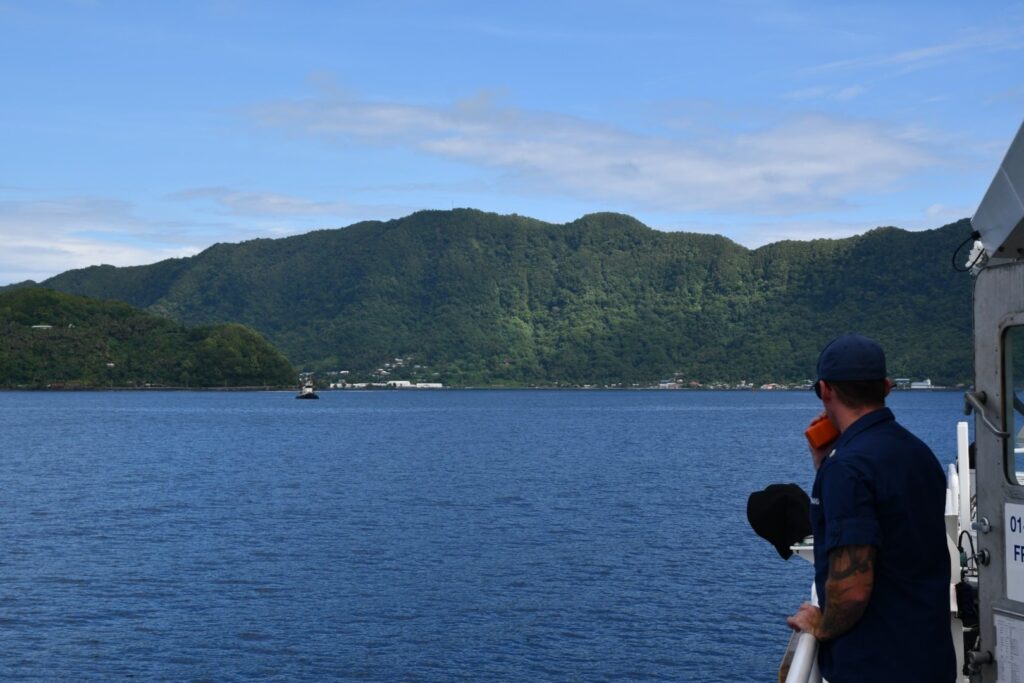
ARABIAN GULF (Oct. 24, 2023) U.S. Coast Guard Sentinel-class fast response cutter USCGC Glen Harris (WPC 1144) sails in the Arabian Gulf, Oct. 24. Glen Harris operates in the U.S. 5th Fleet area of operations to help ensure maritime security and stability in the Middle East region. (Official U.S. Army photo) 

By Commander U.S. Naval Forces Central Command Public Affairs | December 06, 2024 

U.S. 5TH FLEET AREA OF OPERATIONS — The boarding team discovered and seized 5,316.1 kilograms of hashish, 181.4 kilograms of heroin and 1.3 kilograms of methamphetamine and, after documenting and weighing the illicit haul, properly disposed of it. Total estimated market value of the narcotics is $4.6 million. 
 
Glen Harris was supporting a Task Force (TF) 51/5 mission at the time of the seizure. 
 
U.S. Marine Corps Brig. Gen. Stephen J. Lightfoot, commanding general of TF 51/5, said operations such as these help maintain freedom of the seas and is part of a larger effort with partner nations in the region. 
 
“The collaboration between our Coast Guardsmen, Marines and Sailors is outstanding,” Lightfoot said. “I’m proud of our interoperability. We are disrupting criminal acts at sea and keeping over five tons of narcotics from hurting more people.” 
 
“Glen Harris is one of six U.S. Coast Guard Fast Response Cutters performing maritime security operations throughout the region,” said U.S. Navy Capt. Patrick Murphy, commodore of TF 55, also known as Destroyer Squadron (DESRON) 50, which has tactical control of Glen Harris. “The U.S. Coast Guard brings expertise and flexibility to the wide range of missions we execute.” 
 
Glen Harris is forward deployed to Bahrain as part of a Patrol Forces Southwest Asia under tactical control of TF 55, consisting of surface forces, including U.S. Coast Guard patrol boats and independently deployed ships in the U.S. 5th Fleet area of operations. 
 
Task Force 51/5 executes operations, responds to contingencies and crises, and conducts theater security cooperation at sea, from the sea and ashore in support of U.S. Central Command, 5th Fleet and Marine Forces, Central Command theater objectives. 


Keel Laid for Future USNS Thurgood Marshall

San Diego, Calif. – USNS Thurgood Marshall (T-AO 211) Keel Laying Ceremony. 

By Team Ships Strategic Operations, Dec. 5, 2024 

SAN DIEGO – The keel for the future USNS Thurgood Marshall (T-AO 211), a John Lewis-class Replenishment Oiler, was laid during a ceremony on Dec 5 at General Dynamics (GD) NASSCO. 

The ship’s namesake, former Justice Thurgood Marshall, was the first African American justice to serve on the U.S. Supreme Court. As an Associate Justice for nearly 25 years, Marshall fought for affirmative action, opposed the death penalty, and supported a woman’s right to choose. Prior to becoming a Justice, Marshall was a civil rights lawyer, who argued cases against racial disparity. Marshall argued a variety of civil and human rights cases including; Smith v. Allwright, which found that states could not exclude Black voters from primaries; Shelley v. Kraemer, which struck down race-based restrictive housing covenants; and Brown V. Board of Education where the Supreme Court ruled that racially segregating children in public schools was unconstitutional. 

“Thurgood Marshall’s legacy is one of unwavering courage, intellectual brilliance, and an unyielding commitment to justice,” said Secretary of the Navy Carlos Del Toro. “His efforts helped to shape a more equitable society—and the future USNS Thurgood Marshall will carry that legacy forward.” 

Each keel laying ceremony represents the joining together of the ship’s modular components at land level. During the ceremony, the keel will be authenticated by the ship’s sponsors welding their initials into the keel plate. The ship’s sponsors are Justice Marshall’s granddaughters, Cecilla L. Marshall and Melonie Tibbs, and his granddaughter-in-law, Alissa Kamens Marshall. 

“USNS Thurgood Marshall honors the legacy of an extraordinary civil and human rights leader who is an example of perseverance to all,” said John Lighthammer, Program Executive Office, Ships (PEO Ships) program manager for Auxiliary and Special Mission Ships. “This keel laying marks the first of many significant milestones for this ship and we will work with a sense of urgency to deliver this ship to the Fleet.” 

John Lewis-class ships (T-AOs) are operated by Military Sealift Command and feature substantial volume for oil; significant dry cargo capacity; and aviation capability. T-AOs provide additional capacity to the Navy’s Combat Logistics Force and are a cornerstone of the Navy’s fuel delivery system. 

PEO Ships, one of the Department of Defense’s largest acquisition organizations, is responsible for executing the development and procurement of all destroyers, amphibious ships and craft, and auxiliary ships, including special mission ships, sealift ships and support ships. 


VUP-19 First Robotics Specialists Discuss Their Contribution to History

NAVAL STATION MAYPORT, Fla. (December 16, 2021) An MQ-4C Triton Unmanned Aircraft System (UAS), assigned to Unmanned Patrol Squadron 19 (VUP-19), lands at Naval Station Mayport, Florida, Dec. 16, 2021. VUP-19, the Navy’s first Triton squadron, will continue to maintain and operate the aircraft off the East Coast to further develop the concept of operations and refine tactics, techniques, and procedures. (U.S. Navy photo by Mass Communication Specialist 2nd Class Nathan T. Beard/ Released) 

by Commander, Naval Air Force Atlantic, 6 December 2024 

JACKSONVILLE, Fla. – The first crop of Robotics Warfare Specialists (RW) is contributing to the stand-up of their rating as they support MQ-4C Triton unmanned aircraft worldwide operations. The Robotics Warfare Specialists rating was created in March 2024.  

Chief Robotics Warfare Specialist Ryan Fox, assigned to Unmanned Patrol Squadron (VUP) 19 aboard Naval Air Station (NAS) Jacksonville, Florida, highlighted the need to build the team for the future. 
  
“In the history of the Navy, there are moments where you can start something new – be on the leading edge and make a big impact,” Fox said. “The United States Navy is working concept and requirements analysis for larger robotic systems, as well as the artificial intelligence applications that elevate the Navy’s lethality in an information-centric battlespace, and we have a seat at the table to experience these advances in technology.” 
  
The Chief of Naval Operations (CNO) Navigation Plan 2024, Navy’s strategic guidance from the 33rd CNO, specifically calls out the operationalization of robotic and autonomous systems. Additionally, CNO Adm. Lisa Franchetti’s Project 33 sets priorities for accelerated implementation and seeks to move proven autonomous systems into the hands of the warfighters like Fox and Robotics Warfare Specialist 1st Class Brandon Walker. 
  
Prior to converting into the RW rating, Walker served as an Information Systems Technician and joined the RW Community in May 2024. Walker emphasized how the Navy now leads the joint force in operationalizing robotic and autonomous systems. 
  
“It is incredible that we can take a multi-million-dollar aircraft flown on another side of the world and manage it from Jacksonville,” Walker said. 
 
The primary source ratings for RW conversions will be for those currently or previously assigned to billets in unmanned vehicle divisions, such as Fox and Walker and who hold an RW-identified specialty or Navy Enlisted Classification. 
 
The RW rating requires technicians to manage everything from deskwork to managing the operations required for the aircraft as well as trouble shooting and technical experience, servers, and equipment. The Navy will command and integrate distributed manned and robotic platforms across enormous distances in contested information warfare environments through resilient Maritime Operations Centers. 
 
Falling under Commander Patrol and Reconnaissance Group (CPRG), headquartered in Norfolk Virginia, VUP-19 is part of the Maritime Patrol Reconnaissance Force (MPRF) which is administratively organized into two continental U.S. units, Patrol and Reconnaissance Wings at NAS Jacksonville, Florida, and NAS Whidbey Island, Washington: including 14 Patrol and Reconnaissance squadrons, one Fleet Replacement Squadron and over 45 subordinate commands. The forward-deployed MPRF consists of three Patrol and Reconnaissance Wings in Manama, Bahrain, (CTF-57); Sigonella, Sicily, (CTF-67) and Atsugi, Japan (CTF-72). The MPRF is the Navy’s premiere provider for airborne anti-submarine warfare, anti-surface warfare, and maritime intelligence, surveillance, and reconnaissance operations. 


RTX’s Raytheon Awarded $590 Million Production Contract for Next Generation Jammer Mid-Band

An NGJ-MB pod is flown on the middle starboard wing station of an EA-18G Growler electronic attack aircraft. 

From RTX Raytheon, Dec. 5, 2024 

System plays critical role delivering revolutionary combat capability 

MCKINNEY, Texas, Dec. 5, 2024 /PRNewswire/ — Raytheon, an RTX (NYSE: RTX) business, has been awarded a $590 million follow-on production contract from the U.S. Navy for the Next Generation Jammer Mid-Band (NGJ-MB) system. 

NGJ-MB is a cooperative development and production program with the Royal Australian Air Force (RAAF). The contract includes delivery of shipsets, support equipment, spares and non-recurring engineering support.  

“NGJ-MB is a revolutionary offensive electronic attack system for the joint force that puts a critical combat capability in the hands of our Navy warfighters,” said Barbara Borgonovi, president of Naval Power at Raytheon. “We’re working with the U.S. Navy to ensure NGJ-MB provides the advanced electronic warfare solution needed as quickly as possible.” 

The U.S. Navy and RAAF will employ NGJ-MB on the EA-18G GROWLER® to target advanced radar threats, communications, data links and non-traditional radio frequency threats. The system reduces adversary targeting ranges, disrupts adversary kill chains and supports kinetic weapons to target. NGJ-MB allows naval crews to operate effectively at extended ranges and attack multiple targets simultaneously with advanced techniques. 

Work under this contract will take place in McKinney, Texas; Forest, Mississippi; El Segundo, California; and Fort Wayne, Indiana through 2028. 


Northrop Grumman Modernizes LITENING Secure Data Links for US Marine Corps Aircraft

Integrated on the LITENING pod (centerline), the Advanced Tactical Datalink (ATDL) enables fast, secure, two-way transfer of video and data from the F/A-18 strike fighter. (Photo Credit: U.S. Marine Corps) 

Updated data link is the first to incorporate the BE-CDL waveform, which enables faster communications 

From Northrop Grumman 

ROLLING MEADOWS, Ill. – Dec. 5, 2024 –Northrop Grumman Corporation (NYSE: NOC) has been selected by the U.S. Marine Corps to provide Advanced Tactical Data Links (ATDL) in LITENING electro-optical/infrared (EO/IR) targeting pods on F/A-18 aircraft. ATDL’s technology allows for faster transfer speeds compared to previous waveforms, enabling more rapid decision making. 

The LITENING pod’s ATDL is the first tactical aircraft data link to use the Bandwidth Efficient Common Data Link (BE-CDL) waveform, which enables faster communications. 

ATDL’s secure, two-way, multi-band link allows for the transmission of video, still images and metadata to enhance mission precision. 

Operators in the air and on the ground can view the same live video feed simultaneously. 

Expert:  

James Conroy, vice president, navigation, targeting and survivability, Northrop Grumman: “LITENING’s high-definition sensors on the advanced EO/IR targeting pod gather critical information, enabling more rapid decision making. The ATDL enhancement is like upgrading to better Wi-Fi by building on LITENING’s already proven data links, making live feeds immediately available on the ground – a critical capability in our modern environment.” 

Details:  

The ATDL is a replacement for the Plug-and-Play II data link and can be added to any fourth generation or newer LITENING pod, including the G4, SE, LDP, Color and Large Aperture variants. It incorporates an updated processor, software-defined radio, wideband antenna and improved data recorder. LITENING is the first targeting pod to include the BE-CDL waveform, which enhances interoperability and increases data transfer rates for video, still images and metadata. Previous LITENING data link integrations include NET-T, which functions like a secure airborne Wi-Fi router, and other data terminals including the Mobile Ad-hoc Network and Freedom 550 radios which can connect multiple users across aircraft generations and domains. 

LITENING is an electro-optical/infrared targeting pod on aircrafts that detects, acquires, identifies and tracks targets at extended ranges. LITENING enables a wide range of missions, including precision targeting, air superiority, close air support, surveillance and humanitarian assistance. The pod’s modular design allows for upgrades over time to keep pace with evolving mission needs. Northrop Grumman has delivered more than 900 LITENING pods to U.S. and international customers. 


USS Carney: a Destroyer at War

USS Carney (DDG 64) fires a Standard Missile (SM) 2, Oct. 19, 2023, to defeat a combination of Houthi missiles and unmanned aerial vehicles in the Red Sea. (MC2 Aaron Lau) 

From Austin Rooney, Dec. 4, 2024 

On Oct. 19, 2023, USS Carney (DDG 64) was involved on in the most intense combat engagement by a U.S. Navy warship since WWII.

WASHINGTON – October 19, 2023, started out as a routine day underway for Sailors aboard USS Carney (DDG 64) as the ship steamed through the Red Sea on its scheduled deployment to the 5th Fleet area of responsibility. However, starting at around 4 p.m. local time, things abruptly changed. 

“We were in berthing and heard [an announcement over the ship’s 1MC intercom system] ‘clear the weatherdecks,’ and I remember thinking, ‘what does that mean? I’ve never heard that before,’” recalled Fire Controlman (AEGIS) 2nd Class Justin Parker, a SPY radar technician assigned to Carney. 

Immediately after hearing the announcement, Parker said he heard the unmistakable sound of missiles being fired off the ship, as well as the destroyer’s main 5-inch gun being fired. With no scheduled live fire drills that day, he said he instantly realized something was wrong. 

“We had never done anything like this before – we had only trained to it,” said Gunner’s Mate 1st Class Charles Currie, a Mk. 45 gun technician assigned to Carney. “There was a lot of adrenaline going on – this was real-world now.” 

By the end of what became a 10-hour standoff, Carney had shot down 15 drones and four land-attack cruise missiles fired by Houthi rebels in Yemen, marking the most intense combat engagement by a U.S. Navy warship since WWII. 

Carney departed for deployment Sept. 27, 2023, before the now-infamous Hamas terror attack on Israel Oct. 7. Looking back, crewmembers said they had no idea what was in store for them as they departed their homeport of Naval Station Mayport, Florida. 

“I’ve only heard stories, but I expected to pull into ports and party a little bit,” laughed Fire Controlman 2nd Class Kameron Miller, a Mk. 160 gun console technician onboard, for whom this would be his first deployment. “That was not quite the case.” 

On Oct. 7, after the deadly terror attack that killed more than 1,200 people in Israel, crewmembers said they realized that the situation in the region would potentially be more complicated than they had anticipated, although the prospect of actual combat still wasn’t on their minds. 

“The XO told us flat out what the situation was, and what we could be facing,” recalled Currie. “At that point the crew just started to get ready.” 

Following Israel’s response to the Hamas attacks and its subsequent military operations in the Gaza strip aiming to free hostages and destroy the terror group responsible, the Iran-backed and Hamas-aligned Houthi rebels in Yemen began a terror campaign against civilian mariners and cargo shipping in the Red Sea, aiming to disrupt international trade to leverage an end to the operation in Gaza.  

National Security Council spokesperson John Kirby called the attacks “a clear example of terrorism and a violation of international law” and pledged that the U.S. and its allies would “do what we need to do to counter these threats and protect these ships.  

After the initial combat engagement on Oct. 17, Carney spent much of the remainder of its deployment on high alert, closing out its time in the Red Sea with a total of 51 combat engagements. 

“The entire crew definitely fell back on their training, starting from the very beginning,” said Lt. j.g. Haven Vickers, the Anti-Submarine Warfare Officer assigned to Carney. “Every single training experience we did before deployment – that’s what we fell back on.” 

Vickers said she credits the intensity of the crew’s training along with the camaraderie shared among her shipmates with the success they experienced in combat. While many admitted to being nervous at first, she said as time went on, they fell into a rhythm and were able to effectively react to and defend the ship from threats. 

“As nervous as you get, it’s not about you,” said Ens. William Hinckley, the Administrative/Legal Officer onboard Carney. “It’s about keeping everybody else safe. Thinking about everybody else and not just yourself is crucial.” 

Upon returning to their homeport following deployment May 10, 2024, the entire crew was awarded the Combat Action Ribbon (CAR), the first time a Navy crew has received the decoration since 1991 in the Gulf War. 

“I could not be more proud of what the Carney team has done since September,” said Chief of Naval Operations Adm. Lisa Franchetti, who attended the ship’s homecoming. “It has been eye-watering to watch; you truly are America’s Warfighting Navy in action.” 

For some of the crew, they said the impact of the deployment still hasn’t fully set in. 

“It’s really neat to know that we made history,” said OSC Noah Wicks, the Air Intercept Controller assigned to USS Carney (DDG 64). “Even though we’re a small ship, we had a very big impact on the world.” 

For the young crewmembers like Miller, who’s expectations of a routine deployment were shattered, he said the experience was a stark reminder of why he joined the Navy in the first place. 

“It was probably one of the most rewarding experiences I’ll ever have in my entire life,” said Miller. “It wasn’t just about traveling the world; it was about saving people’s lives and getting a job done.” 


NPS, NVIDIA Sign New CRADA

President of the Naval Postgraduate School (NPS) retired U.S. Navy Vice Adm. Ann Rondeau, left, and NVIDIA Vice President of External Affairs Ned Finkle, right, sign a Cooperative Research and Development Agreement (CRADA) at NVIDIA Corporation’s headquarters in Santa Clara, California. The CRADA between NPS and NVIDIA outlines plans for collaboration on the development of artificial intelligence-based technologies for learning and other real-world applications. 

From The Naval Postgraduate School 

ORLANDO, Fla. (NPS) – The Naval Postgraduate School (NPS) and NVIDIA are pleased to announce a new Cooperative Research and Development Agreement (CRADA) to collaborate on the development of AI-based technologies for learning and real-world applications leveraging NVIDIA’s AI Technology Center Program. 

In a ceremony held last month at NVIDIA’s headquarters in Santa Clara, California, NPS President retired U.S. Navy Vice Adm. Ann Rondeau and NVIDIA Vice President of External Affairs Ned Finkle signed the new CRADA.  NPS and NVIDIA will collaborate on research, educational efforts, and industry talks. The first project will focus on ‘Non-Physics Modeling and Scenario Generation’ to create a tool for simulation and mission planning purposes specific to naval end-user domain requirements. 

NPS students and faculty will meet with NVIDIA team members at the Interservice/Industry Training, Simulation and Education Conference (I/ITSEC) in Orlando, Florida, Dec. 3 to share current research and kick-off discussions of technology applications that will form the cornerstone of the CRADA partnership. 


USS Wasp Amphibious Ready Group Returning from Deployment 

Aircraft assigned to the “Blue Knights” of Marine Medium Tiltrotor Squadron (VMM) 365 (Reinforced) operate with the amphibious assault ship USS Wasp (LHD 1) in the Atlantic Ocean, Nov. 22, 2024. (U.S. Navy photo by MCC Ruben Reed)

From Commander, U.S. Fleet Forces Command 

The USS Wasp Amphibious Ready Group, consisting of warships USS Wasp (LHD 1), USS New York (LPD 21), and USS Oak Hill (LSD 51), is scheduled to return to Hampton Roads on Dec. 6 following a seven-month deployment to the U.S. 6th Fleet areas of operations. 

Marines assigned to the 24th Marine Expeditionary Unit (Special Operations Capable) previously departed the ARG ships and returned to Camp Lejeune, North Carolina. 

While deployed, the Wasp ARG and 24th MEU (SOC) team supported a wide range of interoperability opportunities and exercises across the North Atlantic, Eastern Mediterranean, and Baltic region, increasing combat readiness and crisis response capabilities while strengthening relationships with both Allies and partners.  


GA-ASI Awarded Next-Generation HF Modem Contract  

From General Atomics Aeronautical Systems, Inc. 

SAN DIEGO – Dec. 4, 2024 – General Atomics Aeronautical Systems, Inc. (GA-ASI) was awarded a contract on October 4, 2024, to develop a next generation high-frequency (HF) modem for the U.S. Naval Information Warfare (NAVWAR) Program Executive Office Command, Control, Communications, Computers and Intelligence (PEO C4I). The task order was issued by the Naval Information Warfare Center (NIWC) Pacific. 

GA-ASI will develop a cost-efficient, software-defined Generation 2 HF modem that meets U.S. Navy ship, sub, and shore environmental requirements and supports a rapid fielding schedule. GA-ASI will provide waveform and modem development, test and evaluation, as well as onsite technical assistance for the NAVWAR PEO C4I program. 

“The Gen2 Modem delivers the security and resilience the U.S. Navy needs for its tactical radio fleet modernization efforts,” said Jeff Hettick, GA-ASI vice president of Agile Mission Systems. “These modems will be the heart of the HF system, providing high-speed, long-range HF communications that meets the Navy’s demanding program of record requirements, which includes beyond-line-of-sight communications in a satellite-denied environment.”  

The work will be performed by GA-ASI over a 16-month base development timeline.  


Raytheon Completes Delta Design Review for F/A-18E/F Electronic Warfare Prototype 

An F/A-18F Super Hornet from the “Red Rippers” of Strike Fighter Squadron (VFA) 11 flies past the Nimitz-class aircraft carrier USS Harry S. Truman (CVN 75) in the Mediterranean Sea, Nov. 27, 2024. (U.S. Navy photo by Lt. Lily Moorhead)

System will integrate 6th generation capabilities into the Navy’s primary strike fighter aircraft 

From Raytheon  

MCKINNEY, Texas, (December 4, 2024) — Raytheon, an RTX (NYSE: RTX) business, has successfully completed a Delta Design Review of its Advanced Electronic Warfare, or ADVEW, prototype for the U.S. Navy’s F/A-18 E/F Super Hornet. ADVEW is being developed to replace existing electronic warfare components on the aircraft to improve survivability and long-term sustainability. 

Executed ahead of schedule, the review assessed the weapons replaceable assemblies, or WRAs, and how each part of the hardware system works together to meet required specifications. The review confirmed that the system can provide critical electronic attack and electronic support measures capabilities. 

“This event is a significant milestone that demonstrates our multi-function approach of integrating electronic support and electronic attack to revolutionize modern electronic warfare systems,” said Bryan Rosselli, president of Advanced Products & Solutions at Raytheon. “Our solution provides the needed capabilities to defeat the ever-evolving threats of the world’s most dangerous adversaries now and well into the future.” 

Raytheon’s integration of digital and model-based systems engineering tools in the development of ADVEW provides requirements traceability, streamlines system integration, and mitigates risk to enable rapid aircraft integration. The company’s approach leverages common material base and manufacturing processes to efficiently scale, reduce cost, minimize supply chain disruption, and deliver ahead of schedule. 

In December of last year, Raytheon was awarded a $80 million contract in a down select to prototype the system for the U.S. Navy. The successful completion of this Delta Design Review marks another milestone of ADVEW development and begins the next phase, which includes government laboratory testing to validate Open Mission Systems compliance and to demonstrate advanced system attributes.