FRCE Marks 150th F-35 Induction 

Workers on the Fleet Readiness Center East (FRCE) F-35 Lightning II aircraft modification line confer with the pilot prior to conducting a functional check flight inspection on an F-35B at Marine Corps Air Station Cherry Point. This aircraft is the 150th fifth-generation fighter inducted by the depot. 

From Fleet Readiness Center East, Dec. 2, 2024 

MARINE CORPS AIR STATION CHERRY POINT, N.C. — Fleet Readiness Center East (FRCE) marked a milestone in its support of the F-35 Lightning II program when the depot recently inducted and completed modifications on its 150th F-35 and returned the aircraft to the Fleet. 

FRCE is the lead site for depot-level maintenance on the F-35B Lightning II and has conducted modifications and repair on the Marine Corps’ short takeoff-vertical landing variant of the aircraft since 2013. The depot has also worked with the F-35A (conventional takeoff and landing) and F-35C (carrier) variants. 

“The F-35 plays such a crucial role in our national defense,” said FRCE Commanding Officer Capt. Randy Berti. “It is the next-generation strike aircraft weapon systems for the Navy, Air Force, Marines and our allies. It gives our warfighters unprecedented capabilities. We’re extremely proud of the support we provide for this aircraft. 

“The F-35 was completely new when the first aircraft was inducted in 2013,” continued Berti. “There were a lot of unknowns. Inducting our 150th F-35 highlights how far we’ve come and how dedicated and innovative our people are. They were constantly breaking new ground and they continue to do that today.” 

Dustin Schultz, an aircraft planner and estimator with FRCE’s F-35 team, was one of those trailblazers. 

“Everything was brand new in the beginning,” said Schultz. “From engineering support to tooling and logistics, we were starting from scratch. We had one aircraft with six of us working on it. Now we have 130 artisans working on the F-35 alone. That’s a lot of growth. 

“We have other aircraft programs that are sundowning,” he continued. “The F-35 is filling that gap now as we move forward.” 

According to Ike Rettenmair, FRCE’s F-35 branch head, the depots F-35 workload has grown exponentially over the years and is expected to expand further. 

“I was in the hangar as a Harrier mechanic when the first F-35 rolled in,” said Rettenmair. “We’ve grown from that one stall to what will soon be multiple hangars of F-35s. The F-35 plays such a significant role in the U.S. military with more and more continuing to enter the Fleet. The number of F-35s used by international partners is also growing. Our F-35 workload goes hand in hand with all of this.” 

As the F-35 program continues to grow at the depot, Rettenmair said FRCE continues to expand and develop key F-35 support elements. 

FRCE declared capability on its first F-35 component – meaning FRCE is now a verified source of repair and testing for that item – in 2020. Since then, the depot has declared capability on approximately 76 different components for the Lightning II and continues to stand up capability. 

In 2023, FRCE personnel became the first within the Department of Defense to perform the successful assembly of a lift fan clutch for the F-35B Lightning II aircraft outside of the original manufacturer’s facility. Additionally, F-35B vertical lift fan testing and processing facilities are scheduled to come online at FRCE in early 2025. 

The depot is also capable of bringing F-35 support to the warfighter when and where it’s needed. FRCE’s F-35 Rapid Response Team, made up of highly skilled, cross-trained aircraft maintenance professionals, can deploy at a moment’s notice to any location, from a Marine Corps Air Station halfway around the globe to a Navy aircraft carrier afloat in the Indo-Pacific region. 

FRCE’s F-35 support isn’t limited to aircraft repair and modification or component capabilities. Don Werner, an aircraft planner and estimator with FRCE’s F-35 team,  said the lessons learned and the innovation that occurred over the years while expanding FRCE’s F-35 program have also found their way to the warfighter. 

“There are so many entities within FRC East working on things you would never even think of,” said Werner. “They create things and come up with ideas that enable us to get aircraft to the warfighter even faster while saving money in the long run. They create things that make the job easier and these go out to the whole Fleet.” 

In addition to mechanics, Werner said the team includes quality assurance personnel, parts and logistics experts, planners, engineers and even fabric workers who design and produce heavy-duty protective covers for the aircraft’s tires, intakes and other parts. 

“You can see people right here at the depot working on all these things,” said Werner. “They’re designing it, going down to manufacturing and coming up with the tools or equipment our people need because there’s nobody out there that’s going to get it to us in such a timely manner.” 

Schultz said the warfighter benefits from the innovative processes and procedures the depot’s F-35 team has come up with over the years. 

“We’ve had many modifications that come through here that we were performing for the first time ever,” said Schultz. “The manufacturer would say this mod is going to take 10,000 hours and our artisans and engineers would go look at it and end up saving thousands of hours because they came up with a new way to do the job that nobody else had thought of.” 

According to Rettenmair, the success and expansion of the F-35 program at FRCE, lies with the depot’s personnel. He credited their dedication and innovation as instrumental in establishing the reputation of FRCE’s F-35 program. 

“We’ve made a name for ourselves as the F-35 facility for depot maintenance,” said Rettenmair. ”It shows the trust and confidence the enterprise has in FRC East to do this work. That trust is a testament to the people working here who’ve earned us this reputation.” 

He said everyone at FRCE, no matter what their job, is committed to supporting the Fleet by providing the highest quality, combat ready aircraft and components. 

“Every day when we come to work, we know why we’re here,” said Rettenmair. “We deliver product back to the Fleet so the warfighter has what he or she needs to fight and win. The people working here take a lot of pride in that.” 

FRCE is North Carolina’s largest maintenance, repair, overhaul and technical services provider, with more than 4,000 civilian, military and contract workers. Its annual revenue exceeds $1 billion. The depot provides service to the fleet while functioning as an integral part of the greater U.S. Navy; Naval Air Systems Command; and Commander, Fleet Readiness Centers.


HII to Acquire South Carolina Advanced Metal Fabricator Assets and Workforce 

From HII 
 

NEWPORT NEWS, Va., Dec. 04, 2024 (GLOBE NEWSWIRE) — HII (NYSE: HII) announced today that it has entered into a definitive agreement to acquire substantially all of the assets of W International SC, LLC and Vivid Empire SC, LLC (collectively “W International”), a South Carolina-based complex metal fabricator specializing in the manufacture of shipbuilding structures, modules and assemblies. 

Upon completion of the transaction, the manufacturing facility in Goose Creek, South Carolina, will operate within HII’s Newport News Shipbuilding (NNS) division. The site will support the construction of nuclear-powered submarine and aircraft carrier modules and structures for U.S. Navy programs. Substantially all current employees will be offered positions with HII to continue to work on site. 

“HII is committed to increasing build rates for our Navy customer, and this investment in capacity alongside the Navy will help us do that,” HII President and CEO Chris Kastner said. “It lets us efficiently add trained talent and state-of-the-art manufacturing capabilities to the urgent job of building ships, making it a unique opportunity to accelerate throughput at Newport News Shipbuilding in support of the Navy and AUKUS.” 

A photo accompanying this release is available at: https://hii.com/news/hii-expands-shipbuilding-capacity-announcing-intent-to-acquire-south-carolina-advanced-metal-fabricator-assets-and-workforce/

The acquired assets include advanced production facilities with state-of-the-art equipment, tooling and infrastructure used to fabricate complex metal modules and structures, and are located on a leased 45-acre site with more than 480,000 square feet of manufacturing space. The site has barge and rail access, and is strategically located near Charleston, in a region with a rapidly growing shipbuilding ecosystem and highly skilled trades workforce. 

The facility in Goose Creek will be known as Newport News Shipbuilding – Charleston Operations, operating within HII’s Newport News Shipbuilding division. 

Current NNS Vice President and Chief Transformation Officer Matt Needy will become general manager of the site. NNS is the nation’s designer, builder and refueler of nuclear-powered aircraft carriers and one of only two shipyards capable of designing and building nuclear‐powered submarines. 

The transaction is expected to close in the fourth quarter of 2024, subject to the satisfaction of certain closing conditions, including receipt of regulatory approvals and required contractual modifications from our Navy customer and other third parties. 


General Atomics Awarded Navy Contract to Advance Long Range Maneuvering Projectile

SAN DIEGO – Dec. 2, 2024 – General Atomics Electromagnetic Systems (GA-EMS) announced today that it has been awarded a contract from the U.S. Navy via Advanced Technology International (ATI) for its Long Range Maneuvering Projectile (LRMP) Common Round.  GA-EMS received the award under the Naval Surface Technology Innovation Consortium (NSTIC) Other Transaction Authority (OTA) contract vehicle to mature and further demonstrate the company’s LRMP prototype system to perform the Navy’s Common Round offensive strike capabilities at increased range using fielded 155 mm artillery systems.  

“The LRMP is truly an innovative design, delivering greater range and maneuverability, precision, and payload flexibility to support a variety of missions, including strike and Intelligence, Surveillance, and Reconnaissance missions,” said Scott Forney, president of GA-EMS. “The LRMP’s capabilities have the potential to deliver lethal effects to defeat static and moving targets at 120 km and beyond. This represents a factor of 4 increase in range from conventional artillery systems beyond what is currently available today.”  

The LRMP’s simplified design and unique projectile shape enables very long glide ranges without the need for auxiliary propulsion or rocket assist. It is scalable for use in all existing artillery systems, ensuring compatibility with legacy launchers, autoloaders and handling equipment. With greater maneuverability, accuracy, and payload options, LRMP offers additional cross range benefits to increase the engagement zone without having to reposition the launcher.  

“GA-EMS has conducted successful LRMP testing to ensure survivability, performance, and aerodynamics,” said Mike Rucker, head of GA-EMS Weapon Programs. “We are in preparations for upcoming LRMP Common Round glide testing at Dugway Proving Grounds in Utah as part of the first contract task order. Additional milestone testing and follow on tasks will be completed throughout the contract’s five-year period of performance to design, manufacture, assemble and test LRMP rounds for 155 mm artillery systems as well as other platforms.”      


CENTCOM Forces Defeat Houthi Attacks on U.S. Navy and U.S.-Flagged Ships in Gulf of Aden 

From U.S. Central Command, Dec. 1, 2024

TAMPA, Fla – U.S. Navy destroyers USS Stockdale (DDG 106) and the USS O’Kane (DDG 77) successfully defeated a range of Houthi-launched weapons while transiting the Gulf of Aden, Nov. 30 – Dec. 1.  The destroyers were escorting three U.S. owned, operated, flagged merchant vessels and the reckless attacks resulted in no injuries and no damage to any vessels, civilian or U.S. Naval. 
 
The destroyers successfully engaged and defeated three anti-ship ballistic missiles (ASBMs), three one-way attack uncrewed aerial systems (OWA UAS), and one anti-ship cruise missile (ASCM), ensuring the safety of the ships and their personnel, as well as civilian vessels and their crews. 
 
These actions reflect the ongoing commitment of CENTCOM forces to protect U.S. personnel, regional partners, and international shipping, against attacks by Iran-backed Houthis. 


Coast Guard Cutter Hamilton Offloads $182.8M In Counternarcotics At Port Everglades

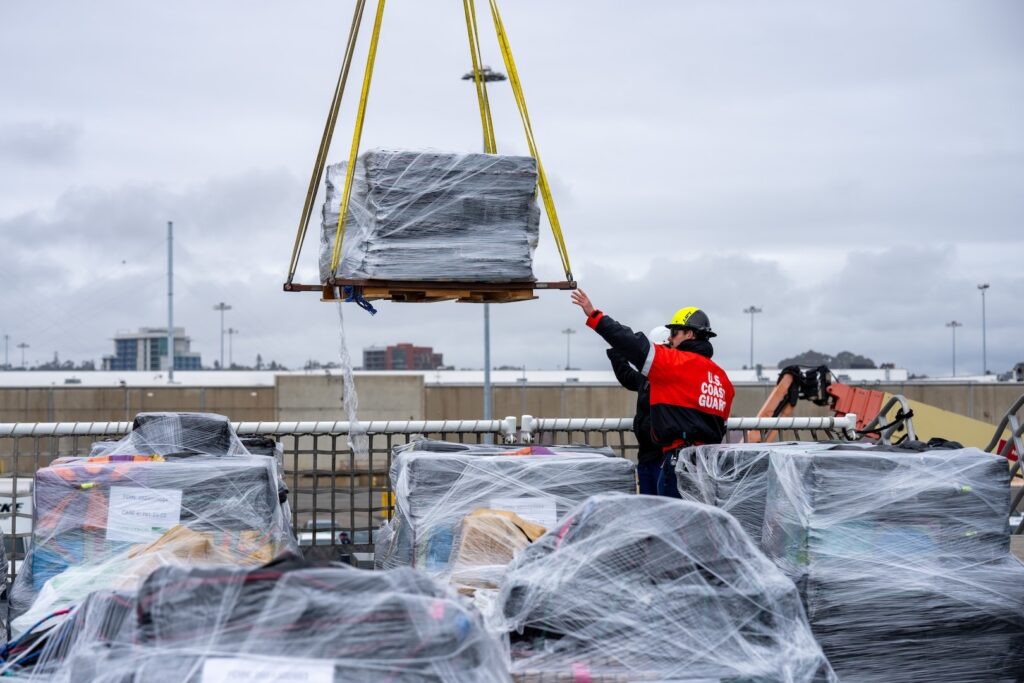
The crew of Coast Guard Cutter Hamilton pose with more than 16,100 pounds of cocaine worth an assessed street value of approximately $182.8 million in Port Everglades, Florida, Dec. 2, 2024. (U.S. Coast Guard photo by Petty Officer 3rd Class Eric Rodriguez)

From Coast Guard 7th District, Dec. 3, 2024 

MIAMI – Coast Guard Cutter Hamilton’s crew offloaded more than 16,100 pounds of cocaine worth an assessed street value of approximately $182.8 million in Port Everglades, Monday.   

The crew worked alongside interagency and international partners to interdict the illicit narcotics in international waters of the Eastern Pacific Ocean off South and Central America.   

Coast Guard crews often deploy to the U.S. Southern Command joint operating area, which includes the Caribbean Sea and the Eastern Pacific Ocean, to conduct counter drug missions in support of Joint Interagency Task Force-South. Deployments for cutters assigned to the Coast Guard Atlantic Area Command include Panama Canal transits to deny transnational criminal organizations access to maritime trafficking routes in the Eastern Pacific Ocean.  

“I’m proud of our accomplishments during this three-and-a-half-month deployment,” said Capt. Justin Carter, commanding officer of Coast Guard Cutter Hamilton. “The exceptional crew of Hamilton, with the support of an aircrew from Coast Guard Helicopter Interdiction Squadron, demonstrated the greatest professionalism, seamanship and airmanship while executing this important and challenging mission at sea in service to nation.”   

The following assets and crews were involved in the interdictions:    

  • Coast Guard Cutter Hamilton    

  • Coast Guard Helicopter Interdiction Tactical Squadron   

  • Joint Interagency Task Force-South   

  • Eleventh Coast Guard District    

Six suspected smugglers were also transferred to federal custody and face prosecution by the U.S. Department of Justice.    

Detecting and interdicting illicit drug traffickers on the high seas involves significant interagency and international coordination. The Joint Interagency Task Force-South based in Key West conducts the detection and monitoring of aerial and maritime transit of illegal drugs. Once interdiction becomes imminent, the law enforcement phase of the operation begins, and control of the operation shifts to the U.S. Coast Guard throughout the interdiction and apprehension. Interdictions in the Eastern Pacific Ocean are performed by members of the U.S. Coast Guard under the authority and control of the Coast Guard’s Eleventh District, headquartered in Alameda, California.   

These interdictions relate to Organized Crime Drug Enforcement Task Forces’ Strike Force Initiatives and designated investigations. OCDETF identifies, disrupts, and dismantles the highest-level criminal organizations that threaten the United States using a prosecutor-led, intelligence-driven, multi-agency approach. Additional information about the OCDETF program can be found at https://www.justice.gov/OCDETF.    

The Coast Guard is the United States’ lead federal maritime law enforcement agency with authority to enforce national and international laws on the high seas and waters within U.S. jurisdiction. Coast Guard HITRON aircrews are uniquely qualified to conduct airborne use of force for non-compliant vessels, enhancing the Coast Guard’s ability to react to maritime security threats and to better secure our maritime borders since the program’s inception in 1999. For 25 years, HITRON crews have forward deployed aboard Coast Guard cutters and U.S. Navy ships or foreign allied warships to conduct drug interdiction operations.   

Hamilton is one of four 418-foot National Security Cutters homeported in Charleston, South Carolina. NSCs are a world-wide deployable asset that supports Department of Homeland Security, Department of Defense, and national objectives through drug interdiction, migrant interdiction, national defense, search and rescue, fisheries enforcement, and national intelligence collection. The ship’s crew of approximately 150 personnel leverage robust sensor, electronic, engineering, weapons systems, pursuit boats and aircraft to complete their missions anywhere.   

For more information, follow U.S. Coast Guard Southeast on “X” (formerly Twitter), Facebook and Instagram, and find U.S. Coast Guard Pacific Southwest on “X” (formerly Twitter), Facebook and Instagram.    

Visit GoCoastGuard.com to learn about active duty and reserve, officer and enlisted opportunities in the U.S. Coast Guard. Information on how to apply to the U.S. Coast Guard Academy can be found here.    


U.S. Navy Selects X-Bow Systems to Modernize and Automate Energetics Industrial Base

PACIFIC OCEAN (Oct. 24, 2023) The littoral combat ship USS Savannah (LCS 28) launches an SM-6 missile from a containerized launching system at a designated target during a live-fire demonstration in the eastern Pacific Ocean, Oct. 24, 2023. (U.S. Navy photo) 

Initial $60 Million Award to Expand Solid Rocket Motor Production Capacity 

INDIAN HEAD, MD, Dec. 3, 2024 — X-Bow Systems Inc (X-Bow), a leading non-traditional producer of advanced solid rocket motors (SRMs) and defense technologies, and Naval Surface Warfare Center Indian Head Division (NSWC IHD) today announced five contracts to-date totaling $60 million for phase 1 design, development, and long-lead procurement to advance the readiness and capacity of the energetics industrial base. The contracts have a period of performance of up to two years. 

X-Bow is working several OTA efforts as a key partner to NSWC IHD focused on modernizing and automating key facilities and capabilities related to SRM production. As part of the U.S. Navy’s $2.7 billion 15-year modernization plan for NSWC IHD (a piece of the Department of Defense’s national defense strategy), this work will help unlock, expand and modernize the nation’s energetics manufacturing capabilities while strengthening the Organic Industrial Base’s ability to meet solid propellant rocket motor propulsion needs. 

Under this initial phase, X-Bow will design, develop, and procure long-lead equipment to modernize and automate several capabilities at Indian Head including inert preparation facilities, propellant casting, automated propellant ingredient feeding, live rocket motor processing, and prototype premixing and curative slurry operations. 

“Ensuring our warfighters are prepared for any situation requires a robust organic industrial base,” said Jason Hundley, CEO of X-Bow Systems. “Our work to help modernize NSWC Indian Head will increase production capacity of solid rocket motors and other energetics systems to meet the growing needs of the U.S. military.” 

“Partnerships such as ours with X-Bow are vital in helping us reenergize and ultimately bolster the nation’s munitions industrial base,” said Dr. Phillip J. Cole, Energetics Manufacturing Department Head of the Naval Surface Warfare Center Indian Head Division. 

X-Bow has assembled a team of industry subject matter experts, each with decades of experience in all areas of SRMs, working to help unlock NSWC IHD’s latent capacity as a world-class facility for energetics processing and manufacture. X-Bow has already successfully completed several milestones, including completion of the design phase for inert preparation facility and automated propellant ingredient feeding facility on time and within budget, earning a reputation as a trusted partner for NSWC IHD. 

In addition to its work at NSWC IHD, X-Bow supplies new SRMs in both strategic and tactical sizes to multiple armed services and commercial customers, while also nearing completion of the world’s most affordable production campus for SRMs coming on-line in early 2025. 

The United States Navy has awarded X-Bow both the Mk 72 booster and Mk 104 dual-thrust SRM development contracts to further enhance performance and increase capacitance for the service’s Standard Missile program. The Office of the Assistant Secretary of Defense for Industrial Base Policy also selected X-Bow to provide boost propulsion for the Navy-designed hypersonic All Up Round utilized by the Navy’s Conventional Prompt Strike weapon system and the Army’s Long Range Hypersonic Weapon System. 


Japan Maritime Self-Defense Force Selects SeaGuardians from GA-ASI 

From General Atomics Aeronautical Systems, Inc.  

SAN DIEGO – Dec. 3, 2024 – The Japan Maritime Self-Defense Force (JMSDF) has selected the General Atomics Aeronautical Systems, Inc. (GA-ASI) SeaGuardian® Remotely Piloted Aircraft (RPA) systems for its Long Endurance Unmanned Aerial Vehicle program. This follows JMSDF use of SeaGuardian since May 2023 as part of its Medium-Altitude, Long Endurance (MALE) RPA System Trial Operations Project.  

SeaGuardian has been used by JMSDF to conduct various tests including whether unmanned aircraft can supplant some of the missions currently accomplished with manned aircraft. SeaGuardian is a MALE RPA system that can fly for 24 hours or more, depending on the configuration.  

GA-ASI has strengthened its Maritime Wide Area Surveillance (MWAS) for Japan with Optix+, which gathers information from the SeaGuardian sensors, as well as other data sources, displaying the full picture of surveillance information for its operator. This functionality makes it easy to task and direct its Intelligence, Surveillance and Reconnaissance (ISR) information in real time. GA-ASI’s Optix+ software suite rapidly correlates and exploits collected data into an easily shared common operational picture. Having multi-source correlated data enables automatic detection of anomalous behaviors over waters. 

SeaGuardian features two multi-mode maritime surface-search radars with an Inverse Synthetic Aperture Radar (ISAR) imaging mode, an Automatic Identification System (AIS) receiver, and a High-Definition – Full-Motion Video sensor equipped with optical and infrared cameras as well as electronic intelligence receivers. This sensor suite enables real-time detection and identification of surface vessels over thousands of square nautical miles and provides automatic tracking of maritime targets and correlation of AIS transmitters with radar and electronic intelligence tracks. 


Ready to Dive: ROV Pioneer Shares Seafaring Stories in New Book

A remotely operated vehicle prepares to go on a dive. Credit: Curt Newport

Curt Newport spent his career as a member of an elite club — as an underwater salvage expert, he has participated in more than 150 undersea operations, ranging from the recovery of astronaut Gus Grissom’s Liberty Bell 7 suborbital spacecraft to salvaging Air India Flight 182, the space shuttle Challenger and even sending images back from the RMS Titanic.

After 47 years as a trailblazer for using robotics for underwater salvage, Newport retired in 2022 and is the author of a new memoir, “Ready to Dive,” about his career, published by Purdue University Press. (He has also been a race car driver and musician, but there is only so much room in the magazine.)
Underwater explorers such as Jacques Cousteau and TV shows such as “Sea Hunt” helped stoke Newport’s early interest in the undersea world. He got a job building ship fenders for $3.50 an hour, then graduated to building and maintaining saturation diving systems before deciding to attend commercial diving school in California.

When he graduated, the company Ocean Systems had purchased a remotely operated vehicle (ROV) named Scorpio One, and Newport was hired to work on that team. He worked on oilfields with ROVs, did submarine cable work for communications companies such as AT&T, “and eventually graduated up into doing deep-ocean search and recovery, mostly for the Navy,” he told Seapower. With that, he was off to the races for a career stretching nearly five decades.

Undersea Technology

Technology has long been used in deep-ocean work, from towed sonar arrays to ROVs, each with their own strengths and weaknesses.

Towed arrays or camera sleds are useful and can provide real-time data but have a sizable turning radius. “The downside of those towed systems is if you’re working in deep water you’re going to have some very long turnaround times. When you get to the end of a search line, you’re going to make a turn, and in deep water, that can take anywhere from nine to 12 hours,” he said.

ROVs are nimbler to deploy and have gotten larger and more capable over the years, being able to dive anywhere from 300 meters down to 7,000 meters (almost 23,000 feet). They have been joined by autonomous underwater vehicles that require no tether.

There are also manned submersibles, which hit the news again last summer when the Titan submersible imploded during a dive to the ruins of the Titanic. Newport has done two dives in the Russian Mir 1 manned submersible, to 4,800 meters (including a dive to a sunken ship) but now it and the Mir 2 have been decommissioned and are displayed in museums.

“Really for the deep work, the advantage of an autonomous vehicle is you don’t have those long turn times. And actually, the quality of the side-scan data is better because you’re not being towed by a ship. It’s a very stable imaging platform,” he said. “The problem is, you can’t see any of the side scan data until you’ve recovered the vehicle and downloaded the data. That’s a disadvantage. And they tend to be kind of complicated.”

In the early days, the crews spent as much time wrestling with the vehicles as they did diving, Newport said.

“When I first started out with the Scorpio One vehicle, we spent most of our time broken down as opposed to diving because they were just complicated vehicles there, it was a new technology and we had a lot of problems with them. And you still have problems with it, but they’ve gotten to be a lot more reliable,” especially with their communication systems and sensors.

“And the imaging systems were nothing like what we have now,” he said. “I mean, the first vehicle I worked with, we didn’t even have a colored camera. We had a black and white. We had one black and white SIT camera, SIT means silicon, silicon intensified target. It’s a low-light camera,” Newport said.
“And you know, nowadays vehicles will have four or five, six cameras. You got cameras all over the place. And we didn’t have that. And the manipulators we had back then were fairly crude. But, you know, for the type of salvage work we were doing, you don’t need a really sophisticated manipulator. In fact, it’s better to not have one.”

Newport suits up for a dive in 1977. Credit: Curt Newport

Now there are also sophisticated acoustic tracking systems that can operate as deep as 11,000 meters. In a nutshell, the differences between now and when Newport started in the diving business are “reliability and the ability to tell where the heck the vehicle is relative to the ship,” he said.

The Subsea Bounty

There are a great many things at the bottom of the world’s oceans waiting to be recovered or discovered.
It’s “just limitless,” he said. “When you think about human history, how long humans have been using the ocean to go from one place or another, thousands of years, and the things that are lost in deep water are generally well preserved.”

At one wooden shipwreck in 16,000 feet of water, he found silk fabric still intact and gold wrapped in newspaper that was still readable. In the deep ocean environment, “it’s only 36 degrees down there forever, pretty much. There’s no light. There’s no oxygen. So, everything is really well preserved. … Airplanes, ships, whatever, it’s all down there, but it costs money to do that stuff.”

Newport said the most interesting salvage of his career “has got to be Grissom’s Liberty Bell 7 spacecraft.”

That cramped vehicle was launched on July 21, 1961, in the early days of the space race with the Soviet Union. It conducted a short, sub-orbital flight and made Virgil “Gus” Grissom the second American to fly in space, but it started to sink after splashdown and nearly drowned him. It stayed below the waves for nearly four decades until Newport’s team found it in an expedition funded by the Discovery Channel.
“It’s one of those things that no one really expected us to ever be able to find it,” he said. “You know, the thing is only nine feet tall, six feet in diameter, is lost in deep water, about 6,000 feet. And everybody who knew anything about this said, ‘well, it’s lost and gone forever.’”

The salvage team was just starting their work “and it was the first target we dove on. It just came out of the gloom down there, there it was. So that, that was the most amazing ever,” he said.

Now that he’s retired, one thing Newport doesn’t do is spend time on boats.

“Ever since I started in this business, I have very rarely ever got on a boat for recreation. It just seems too much like work,” he said. “If you’re a bus driver, and then [on] your vacation time, you don’t go on a cross-country trip. You stay home. The same thing with boats, with ships, you know. People can go out in little liners and whatever all they want, I’ll just stay here and have my cocktail or something.”

Curt Newport, author of “Ready to Dive.” Credit: Curt Newport

Book Excerpt from ‘Ready to Dive’

On Finding the Wreck of the Challenger

I was in California visiting my brother when Challenger was lost. Like other Americans, I watched with a heavy heart as another American spacecraft was lost at sea. Unlike Liberty Bell 7, this one did not remain intact, and its location would be marked by tangled debris drifting in the Gulf Stream currents. Tons of wreckage peppered the seafloor, much like the Air India jetliner, and once again, it would be up to people like me to help find the one piece of wreckage that provides conclusive proof of the cause of the disaster. The salvage of Challenger was the largest search and recovery operation in history and required the use of a mixture of underwater technologies: side-scan sonars to map the debris field, manned submersibles to identify wreckage, and divers and remote vehicles to recover the evidence.

The task confronting the Navy was overwhelming: Search an area encompassing about 470 square nautical miles and identify all targets as being Challenger or non-Challenger, inspect and categorize the targets, then recover all wreckage that might bear evidence of the disaster. Unfortunately, the location where Challenger went down was heavily traveled by ship and air traffic and drug smugglers, and it had been the repository of a large percentage of NASA’s launch failures. There was a lot of space junk littering the seafloor.

The Navy set up their priorities as follows. First, they simply had to find the smoking gun. While it was strongly suspected that a segment of Challenger’s right-hand booster had failed, NASA had to be sure. In the tons of debris stuck on the bottom, we had to find that one piece. Second, for humanitarian purposes, the Navy had to recover the astronauts’ remains. Based on my Air India experience, I knew there would not be much left to recover. Challenger’s crew compartment had struck the ocean at over 200 miles per hour and broken up into several pieces. Third, we had to find and recover the tracking and data relay satellite located in the shuttle’s cargo bay. If it was not found, the government would have to spend millions of dollars to change satellite communication codes so the Soviets could not find the TDRS and subsequently monitor our military communications.

And finally, we found what everyone wanted to see: a 6,000-pound chunk of steel. On one edge was an opening unlike what we had seen before. It was rounded and melted, not broken and sharp. This was how Challenger had perished.


First Forward-Deployed Virginia-Class Submarine Arrives in Guam 

USS Minnesota (SSN 783) arrives at U.S. Naval Base Guam. (MC1 Justin Wolpert) 

From Lt. James Caliva, Nov. 26, 2024 

NAVAL BASE GUAM (Nov. 26, 2024) – The Virginia-class fast-attack submarine USS Minnesota (SSN 783) arrived to its new homeport of Naval Base Guam, Nov. 26, as part of the U.S. Navy’s strategic laydown plan for naval forces in the Indo-Pacific region. 

The Virginia-class fast attack submarine USS Minnesota (SSN 783) arrives at U.S. Naval Base Guam, Nov 26, 2024. Minnesota, the first Virginia-class fast-attack submarine to be forward deployed to Guam, joins four Los Angeles-class fast-attack submarines forward deployed in the Pacific. Regarded as apex predators of the sea, Guam’s fast-attack submarines serve at the tip of the spear, helping to reaffirm the submarine forces’ forward-deployed presence in support of a free and open Indo-Pacific. (U.S. Navy photo by Mass Communication Specialist 1st Class Justin Wolpert) 

 
Minnesota arrives as the first Virginia-class fast-attack submarine to be forward deployed to Guam. 
 
“The entire crew is thrilled to be in Guam,” said Cmdr. Isaac Pelt, commanding officer, USS Minnesota. “Minnesota is composed of exemplary individuals who represent some of our brightest Sailors in the Fleet. They’re eager to get out into the local community and stand ready to contribute to our strategic objectives and maintain warfighting readiness in the Pacific.” 
 
Commissioned Sept. 7, 2013, in Norfolk, Virginia, Minnesota was the 10th Virginia-class submarine commissioned for service. Virginia-class submarines are the Navy’s next-generation attack submarines and are set to replace Los Angeles-class submarines as they retire. Minnesota has a crew of approximately 140 Sailors and is capable of supporting various missions, including anti-submarine warfare, anti-surface ship warfare, strike warfare, and intelligence, surveillance, and reconnaissance. 
 
The security environment in the Indo-Pacific requires that the U.S. Navy station the most capable units forward. This posture allows flexibility for maritime and joint force operations, with forward-deployed units ready to rapidly respond to deter aggression and promote a peaceful and prosperous Indo-Pacific region. 
 

“I would like to personally extend a warm welcome to the Sailors and families of Minnesota,” said Capt. Neil Steinhagen, commander, Submarine Squadron 15. “Guam serves as a strategic outpost in the Western Pacific, playing a vital role in maintaining stability across the region. With its motto, ‘From the North, Power,’ Minnesota embodies the strength and resolve that will make it an exceptional addition to our forward-deployed submarine force. Its presence will enhance our operational capabilities and further strengthen deterrence efforts throughout the Indo-Pacific. We are excited to have Minnesota as part of the team and look forward to the great accomplishments it will achieve while deployed forward.” 
 
Minnesota joins four Los Angeles-class fast-attack submarines forward deployed in the Pacific. Regarded as apex predators of the sea, Guam’s fast-attack submarines serve at the tip of the spear, helping to reaffirm the submarine forces’ forward-deployed presence in support of a free and open Indo-Pacific. 
 
For more information about Commander, Submarine Squadron 15, visit www.csp.navy.mil/css15/ 


Coast Guard Heavy Icebreaker Departs Seattle for Deployment Bound for Antarctica 

U.S. Coast Guard Cutter Polar Star (WAGB 10) transits across Elliott Bay after departing Coast Guard Base Seattle, Washington, Nov. 22, 2024. (U.S. Coast Guard photo by Petty Officer 2nd Class Briana Carter)

From U.S. Coast Guard Pacific Area, Nov. 26, 2024 

SEATTLE – The U.S. Coast Guard Cutter Polar Star (WAGB 10) and crew departed Seattle, Friday, beginning their deployment to Antarctica in support of Operation Deep Freeze.  

Operation Deep Freeze (ODF) is an annual joint military mission to resupply the United States Antarctic stations in support of the National Science Foundation (NSF), the lead agency for the United States Antarctic Program (USAP). This marks the 28th year that the Polar Star has supported ODF.  

Each year, the Polar Star breaks a navigable channel through the ice, allowing fuel and supply ships to reach McMurdo Station, which is the largest Antarctic station and the logistics hub of the USAP.  

“I am thrilled to lead Polar Star back to Antarctica for ODF 25. After months of pre-deployment preparation and working together through various challenges, the cutter and crew are ready to embark on this enduring and critical mission,” said Capt. Jeff Rasnake, Polar Star’s commanding officer. “I couldn’t be prouder of this crew’s tremendous dedication and teamwork. They have met or exceeded all my expectations in the maintenance and training phases and continue to push themselves to build upon those successes as we now shift into the cutter’s operations phase.”   

The U.S. Coast Guard is recapitalizing its polar icebreaker fleet to ensure continued access to the polar regions and to protect the country’s economic, environmental, and national security interests in the high latitudes. Each year, the Polar Star’s crew commits significant time and effort preparing the 48-year-old cutter for the annual deployment in support of ODF. This year the Polar Star completed the fourth of five planned phases of the service life extension project (SLEP).  

The U.S. Coast Guard provides direct logistical support to the NSF and maintains a regional presence that preserves Antarctica as a scientific refuge working under Joint Task Force-Support Forces Antarctica (JTF-SFA). JTF-SFA provides Department of Defense support to the NSF and the USAP through ODF. Every year, a joint and total force team works together to complete a successful ODF season. Active, Guard, Reserve service members from the U.S. Air Force, Army, Coast Guard, and Navy work together to forge a strong JTF-SFA that continues the proud tradition of U.S. military support to the USAP.