Navy Retires Last EP-3E Electronic Reconnaissance Aircraft
EAST CHINA SEA (Sept. 24, 2020) An EP-3E Airborne Reconnaissance Integrated Electronic System (ARIES) II, assigned to the “World Watchers” of Fleet Air Reconnaissance Squadron 1 (VQ-1), transits over the East China Sea. (U.S. Navy photo by MC3 Andrew Langholf)
By Richard R. Burgess, Senior Editor
ARLINGTON, Va. — The Navy has retired its last EP-3E Aries II electronic reconnaissance aircraft after the type’s 45 years of service to the fleet.
In an informal Feb. 12, 2025, ceremony, at Naval Air Station Whidbey Island, Washington, Fleet Air Reconnaissance Squadron One (VQ-1), the sole remaining operator of the EP-3E, farewelled the last EP-3E. The aircraft was flown away on Feb. 13 for the last time.
The aircraft, BuNo 159893, was the last of 26 EP-3Es that served the fleet beginning in 1970. Ten P-3A Orion patrol aircraft were converted to EP-3Es for operation by VQ-1 and VQ-1, joining two earlier EP-3B versions in service. This batch of EP-3Es were replaced beginning the 1990s by a new generation of EP-3Es converted from P-3C Orions, with ultimately 17 aircraft converted to sustain an operational fleet of 12 aircraft.
The EP-3E fleet provided multi-intelligence support to the fleets and to theater combatant commanders with near-real-time signals intelligence and full-motion video, the Naval Air Systems Command said. The aircraft was equipped with sensitive electronic receivers and high-gain dish antennas. The large crew was able to fuse the intelligence it collected with offboard intelligence and provide threat warning and situational awareness in support of suppression of enemy air defenses, anti-air warfare, anti-submarine warfare, and anti-surface warfare.
The EP-3E has been succeeded by the MQ-4C Triton high-altitude, long-endurance unmanned aerial vehicle operated by Unmanned Patrol Squadron 19.
VQ-1 has one P-3C remaining, which it used as a utility training and transport aircraft. The aircraft, BuNO 161588, will be retired in an informal ceremony to be held at NAS Whidbey Island on Feb. 20, 2025.
VQ-1 will hold its deactivation ceremony at Whidbey Island on March 28, 2025. The official date for the deactivation is March 31.
Successful Test of Long-Range Precision Fires
Long Range Precision Fires (LRPF) was successfully executed at Yuma Proving Grounds (YPG) in Yuma, AZ, Nov 2024. The event was completed with an AH-1Z Viper launching a single weapon by way of a wireless application.
From Naval Air Systems Command, Feb 13, 2025
PATUXENT RIVER, Md. — Late last year, the Marine Corps successfully executed its first live employment test of a new Long Range Precision Fire (LRPF) capability. The event was successfully executed at Yuma Proving Grounds (YPG) in Yuma, Arizona, where an AH-1Z conducted single launch by way of a wireless application via Marine Air-Ground Tablet (MAGTAB).
The November test at YPG exceeded the threshold requirements with regards to position, navigation, and timing. This activity marks the first time a Marine Corps rotary-wing platform has employed a weapon system using a tablet-controlled device.
“Assessments of current and future capability gaps of the fleets needs identified this LRPF initiative as a cost-effective, long-range precision weapon for use against maritime and land-based targets,” said Col Scott Shadforth, Director, Expeditionary Maritime Aviation – Advanced Development Team (XMA-ADT).
This project is an Office of the Under Secretary of Defense for Research and Engineering (OUSD R&E) sponsored Defense Innovation Acceleration (DIA) project led by the XMA-ADT to evaluate cost-effective, long-range disparate effects in expeditionary and maritime environments.
Coast Guard Offloads More Than $275 Million Worth Of Illegal Cocaine In San Diego
U.S. Coast Guard Cutter Waesche (WMSL 751) crewmembers offload bales of seized narcotics in San Diego, Feb. 13, 2025. The drugs, worth an estimated $275 million, were seized in international waters of the Eastern Pacific Ocean. (U.S. Coast Guard photo by Petty Officer 3rd Christopher Sappey)
U.S. Coast Guard Pacific Southwest, Feb. 13, 2025
SAN DIEGO — The crew of the U.S. Coast Guard Cutter Waesche (WMSL 751) offloaded approximately 37,256 pounds of cocaine, with an estimated value of more than $275 million, on Thursday in San Diego.
The offload is a result of 11 separate suspected drug smuggling vessel interdictions or events off the coasts of Mexico and Central and South America by the Coast Guard Cutter Waesche in December through February.
“The Waesche crew faced numerous challenges during this patrol, overcoming the hardest adversities and still had 11 successful drug interdictions,” said Capt. Tyson Scofield, commanding officer of the Coast Guard Cutter Waesche. “Their dedication, strength of character, and resilience ensured the success of our mission, preventing over $275 million worth of illicit narcotics from reaching the United States and protecting our communities from the devastating effects of transnational crime.”
Multiple U.S. agencies, including the Departments of Defense, Justice, and Homeland Security, collaborate in the effort to combat transnational organized crime. The Coast Guard, Navy, Customs and Border Protection, FBI, Drug Enforcement Administration, and Immigration and Customs Enforcement, along with allied and international partner agencies, all play a role in counter-narcotic operations.
The fight against drug cartels in the Eastern Pacific Ocean requires unity of effort in all phases, from detection, monitoring and interdictions to criminal prosecutions by international partners and U.S. Attorneys’ Offices in districts across the nation. The law enforcement phase of counter-smuggling operations in the Eastern Pacific Ocean is conducted under the authority of the Eleventh Coast Guard District, headquartered in Alameda, California. The interdictions, including the actual boardings, are led and conducted by members of the U.S. Coast Guard. The Coast Guard continues to increase operations to interdict, seize, and disrupt transshipment of cocaine and other bulk illicit drugs by sea. These drugs fuel and enable cartels and Transnational Criminal Organizations to produce and traffic illegal fentanyl threatening the U.S.
The Coast Guard Cutter Waesche is one of four legend-class national security cutters homeported in Alameda, California.
The Coast Guard Cutter Waesche’s crew can operate in the most demanding open ocean environments, and the vast approaches of the Southern Pacific, where significant narcotics trafficking occurs.
USS Tripoli to forward deploy to Japan
220917-M-MJ391-1231 Amphibious assault carrier USS Tripoli (LHA 7), right, sails next to amphibious assault carrier USS America (LHA 6) during a photo exercise in the East China Sea, Sept. 17, 2022. (U.S. Marine Corps photo by Lance Cpl. Christopher Lape)
From Ladonna Singleton, Feb. 13, 2025
The America-class amphibious assault ship USS Tripoli (LHA 7) will move to Sasebo, Japan, as part of a scheduled rotation of forces in the Pacific, the U.S. Navy announced today.
Tripoli will replace USS America (LHA 6), which will depart Sasebo and move to San Diego.
The forward presence of Tripoli supports the United States’ commitment to the defense of Japan, enhances the national security of the United States and improves its ability to protect strategic interests. Tripoli will directly support the Defense Strategic Guidance to posture the most capable units forward in the Indo-Pacific Region.
The United States values Japan’s contributions to the peace, security and stability of the Indo-Pacific and its long-term commitment and hospitality in hosting U.S. forces forward deployed there. These forces, along with their counterparts in the Japan Self-Defense Forces, make up the core capabilities needed by the alliance to meet our common strategic objectives.
The security environment in the Indo-Pacific requires that the U.S. Navy station the most capable ships forward. This posture allows the most rapid response times for maritime and joint forces, and brings our most capable ships with the greatest amount of striking power and operational capability to bear in the timeliest manner.
Maintaining a forward-deployed naval force capability with the most advanced ships supports the United States’ commitment to the defense of Japan and the security and stability of the vital Indo-Pacific region.
USS Harry S. Truman Involved in Collision at Sea
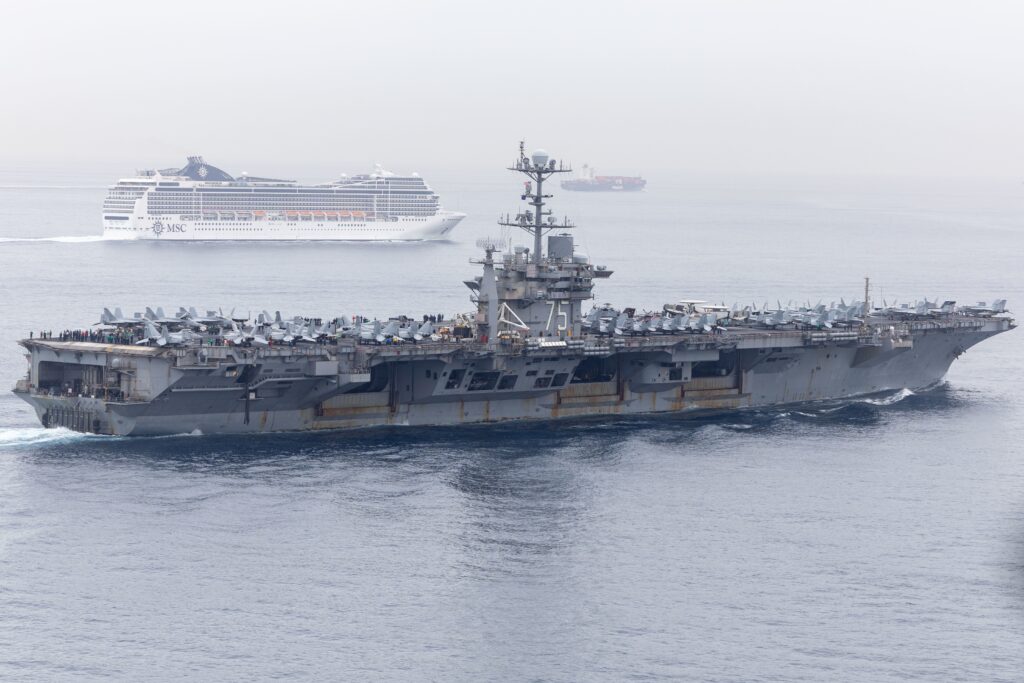
The Nimitz-class aircraft carrier USS Harry S. Truman (CVN 75), transits the Strait of Gibraltar, Nov. 25. (U.S. Navy Photo by MCSN Michael Gomez)
By U.S. Sixth Fleet Public Affairs, Feb. 13, 2025
MEDITERRANEAN SEA – The Nimitz-class aircraft carrier USS Harry S. Truman (CVN 75) was involved in a collision with the merchant vessel Besiktas-M at approximately 11:46 p.m. local time, Feb. 12, while operating in the vicinity of Port Said, Egypt, in the Mediterranean Sea.
The collision did not endanger the Harry S. Truman (CVN 75) as there are no reports of flooding or injuries. The propulsion plants are unaffected and in a safe and stable condition. The incident is under investigation. More information will be released as it becomes available.
NPS Develops AI Solution to Automate Drone Defense with High Energy Lasers
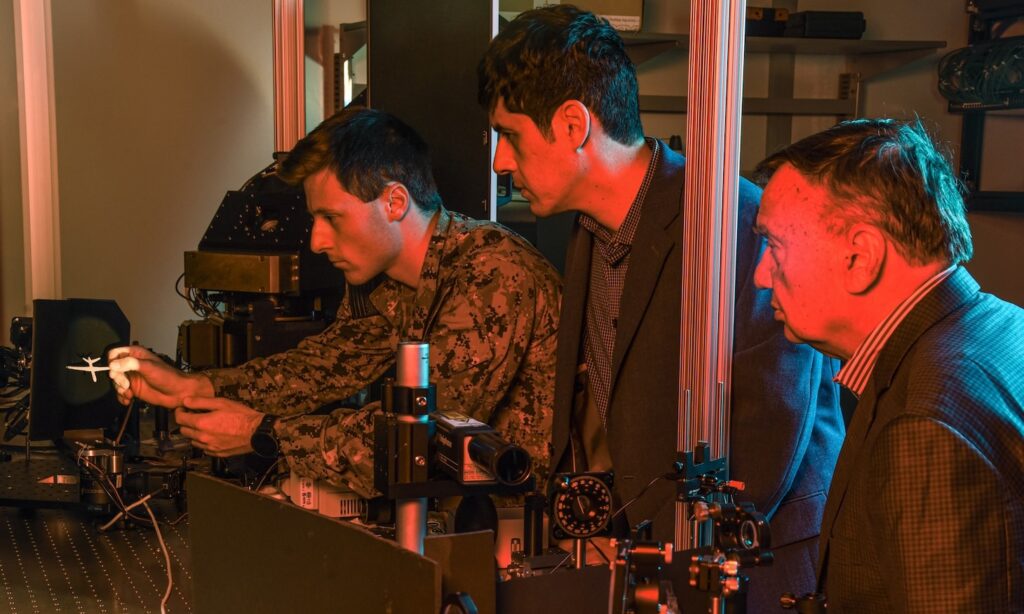
Naval Postgraduate School faculty researchers Brij Agrawal, right, and Leonardo Herrera, center, observe U.S. Navy Ensign Nicholas Messina as he positions a Reaper drone model in an optical beam path that simulates how a laser weapon system engages a distant flying drone. (Javier Chagoya)
From Dan Linehan, Feb. 12, 2025
MONTEREY, Calif.– Lasers enable the U.S. Navy to fight at the speed of light. Armed with artificial intelligence (AI), ship defensive laser systems can make rapid, accurate targeting assessments necessary for today’s complex and fast-paced operating environment where drones have become an increasing threat.
To counter the rapidly mounting threats posed by the proliferation of inexpensive uncrewed autonomous systems (UAS), or drones, Naval Postgraduate School (NPS) researchers and collaborators are applying AI to automate critical parts of the tracking system used by laser weapon systems (LWS). By improving target classification, pose estimation, aimpoint selection and aimpoint maintenance, the ability of an LWS to assess and neutralize a hostile UAS greatly increases. Enhanced decision advantage is the goal.
The tracking system of an LWS follows a sequence of demanding steps to successfully engage an adversarial UAS. When conducted by a human operator, the steps can be time consuming, especially when facing numerous drones in a swarm. Add in the challenges of an adversary’s missiles and rockets traveling at hypersonic speeds, efforts to mount proper defenses become even more complicated, and urgent.
Directed energy and AI are both considered DOD Critical Technology Areas. By automating and accelerating the sequence for targeting drones with an AI-enabled LWS, a research team from NPS, Naval Surface Warfare Center Dahlgren Division, Lockheed Martin, Boeing and the Air Force Research Laboratory (AFRL) developed an approach to have the operator on-the-loop overseeing the tracking system instead of in-the-loop manually controlling it.
“Defending against one drone isn’t a problem. But if there are multiple drones, then sending million-dollar interceptor missiles becomes a very expensive tradeoff because the drones are very cheap,” says Distinguished Professor Brij Agrawal, NPS Department of Mechanical and Aerospace Engineering, who leads the NPS team. “The Navy has several LWS being developed and tested. LWS are cheap to fire but expensive to build. But once it’s built, then it can keep on firing, like a few dollars per shot.”
To achieve this level of automation, the researchers generated two datasets that contained thousands of drone images and then applied AI training to the datasets. This produced an AI model that was validated in the laboratory and then transferred to Dahlgren for field testing with its LWS tracking system.
Funded by the Joint Directed Energy Transition Office (DE-JTO) and the Office of Naval Research (ONR), this research addresses advanced AI and directed energy technology applications cited in the CNO NAVPLAN.
During a typical engagement with a hostile drone, radar makes the initial detection and then the contact information is fed over to the LWS. The operator of the LWS uses its infrared sensor, which has a wide field of view, to start tracking the drone. Next, the high magnification and narrow field of view of its high energy laser (HEL) telescope continues the tracking as its fast-steering mirrors maintain the lock on the drone.
With a video screen showing the image of the drone in the distance, the operator compares it to a target reference to classify the type of drone and identify its unique aimpoints. Each drone type has different characteristics, and its aimpoints are the locations where that particular drone is most vulnerable to incoming laser fire.
Along with the drone type and aimpoint determinations, the operator must identify the drone’s pose, or relative orientation to the LWS, necessary for locating its aimpoints. The operator looks at the drone’s image on the screen to determine where to point the LWS and then fires the laser beam.
Long distances and atmospheric conditions between the LWS and the drone can adversely affect the image quality, making all these identifications more challenging and time consuming to conduct.
After all these preparations, the operator cannot just simply move a computerized crosshair across the screen onto an aimpoint and press the fire button as if it were a kinetic weapon system, like an anti-aircraft gun or interceptor missile.
Though lasers move at the speed of light, they don’t instantaneously destroy a drone like the way lasers are depicted in sci-fi movies. The more powerful the laser, the more energy it delivers in a given time. To heat a drone enough to cause catastrophic damage, the laser must be firing the entire time.
If the drone continuously moves, then the laser beam will wander along its surface if not continuously re-aimed. In this case, the laser’s energy will be distributed across a large area instead of concentrated at a single point. This process of continuously firing the laser beam at one spot is called aimpoint maintenance.
In 2016, construction of the High Energy Laser Beam Control Research Testbed (HBCRT) was completed by the NPS research team. The HBCRT was designed to replicate the functions of an LWS found aboard a ship, such as the 30-kilowatt, XN-1 Laser Weapon System operated on USS Ponce (LPD 15) from 2014 to 2017.
Over the years, 15 masters and 2 PhD degrees have been earned by NPS officer-students contributing their interdisciplinary research into hardware and software related to the HBCRT. Investigations by U.S. Navy Ensigns Raymond Turner, MS astronautical engineering in 2022, and Raven Heath, MS aeronautical engineering in 2023, added to this research. Turner helped integrate AI algorithms into the HBCRT for aimpoint selection and maintenance, and Heath used deep learning to research AI target key points estimation.
Now the HBCRT is also being used to create catalogs of drone images to make real-world datasets for AI training.
Built by Boeing, the HBCRT has a 30 cm diameter, fine-tracking, HEL telescope and a course-tracking, mid-wavelength infrared (MWIR) sensor. The pair is called the beam director when coupled together on a large gimble that swivels them in unison up-and-down and side-to-side.
“The MWIR is thermal,” says Research Associate Professor Jae Jun Kim, NPS Department of Mechanical and Aerospace Engineering, who specializes in optical beam control. “It looks at the mid-wavelength infrared signal of light, which is related to the heat signature of the target. It has a wide field of view. The gimbal moves to lock onto the target. Then the target is seen through the telescope, which has very small field of view.”
A 1-kilowatt laser beam (roughly a million times more powerful than a classroom laser pointer) can fire from the telescope. If the laser beam were to be used, it’s generated by a separate external unit and then directed into the telescope, which then projects the laser beam onto the target. However, its use with the HBCRT isn’t required for the initial development of this research, which allows the work to be easily conducted inside a laboratory.
With a short-wavelength infrared (SWIR) tracking camera, the telescope can record images of a drone that is miles away. Although necessary, replicating the view of a distant drone in a small laboratory is impossible. To resolve this dilemma, researchers mounted 3D-printed, titanium miniature models of drones fabricated by AFRL into a range-in-a-box (RIAB).
Constructed on an optical bench, the RIAB accurately replicates a drone flying miles away from the telescope by using a large parabolic mirror and other optical components. This research used a miniature model of a Reaper drone. When a SWIR image is taken of the drone model by the telescope, it appears to the telescope as if it were seeing an actual full-sized Reaper drone.
The drone model is attached to a gimble with motors that can change its pose along the three rotational flight axes of roll (x), pitch (y) and yaw (z). This allows the telescope to observe real-time changes in the direction that the drone model faces.
Simply put, pose is the orientation of the drone that the telescope “sees” in its direct line of sight. Is the drone heading straight-on or flying away, diving or climbing, banking or cruising straight and level, or moving in some other way?
By measuring the angles about the x-, y- and z-axes for a drone model in a specific orientation, the pose of the drone can be precisely defined and recorded. This important measurement is called the pose label.
The NPS researchers created two large representative datasets for AI training to produce the AI model for automating target classification, pose estimation, aimpoint selection and aimpoint maintenance. The AI training used convolutional neural networks with deep learning, which is a machine learning technique based on the understanding of neuropathways in the human brain. A recent journal article in Machine Vision and Applications by NPS faculty Leonardo Herrera, Jae Jun Kim, and Brij Agrawal describes the datasets and AI training in detail.
Each piece of data in the dataset contained a 256´256-pixel image of a Reaper drone in a unique pose with its corresponding pose label. Lockheed Martin used computer generation to create the synthetic dataset, which contained 100,000 images. Created with the HBCRT and RIAB at NPS, the real-world dataset contained 77,077 images.
“If we train on only clean pictures, it won’t work. That is a limitation,” says Agrawal. “We need a lot of data with different backgrounds, intensities of the sun, turbulence and more. That’s why when using AI, it takes a lot of work to create the data. And the more data you have, the higher the fidelity.”
For the AI model, three different AI training scenarios were generated and compared to determine which scenario performed the best. The first scenario only used the synthetic dataset, the second used both the synthetic and real-world datasets, and the third only used the real-world dataset.
Because the large sizes of datasets and their individual pieces of data required enormous amounts of computational power for the AI training, the researchers used an NVIDIA DGX workstation with four Tesla V100 GPUs. NPS operates numerous NVIDIA workstations. And in December 2024, to continue advancing AI-based technologies, NPS formed a partnership with NVIDIA to become one of its AI Technology Centers.
“Once we’ve generated a model, we want to test how good it is,” says Agrawal. “Assume you have a dataset with 100,000 data. We’ll train on 80,000 data and test on 20,000 data. Once it’s good with 20,000 data, we’re finished training it.”
U.S. Navy Ensign Alex Hooker, a Shoemaker Scholar who recently earned his M.S. in astronautical engineering from NPS and is now a student naval aviator, contributed to testing the pose estimations of the AI model.
“A way to improve the reliability of the model at predicting the pose of a UAS in 3D space by taking 2D input images is detecting what’s called out of distribution data,” he says. “There are different ways to detect whether an image can be trusted or whether it is out of distribution.”
By feeding the test data images from the dataset into the existing AI model and then comparing the output poses from the AI model to pose labels of the test data images, Hooker could continually train and refine the AI model itself.
Working now with Agrawal is NPS Space Systems Engineering student U.S. Navy Ensign Nicholas Messina, who graduated from the U.S. Naval Academy in aerospace engineering last year and is a Boman Scholar headed for the Nuclear Navy career track after NPS.
“My thesis is a little bit of a sidestep in the way that I am working with artificial intelligence and optics, but Dr. Agrawal and Dr. Herrera have been great,” said Messina. “My research is specifically working on optical turbulence prediction and classification. I train my AI models off large image datasets and am working to improve accuracy in how the model predicts the wavefronts from a picture.”
Because an LWS views the 3D drone flying far away as 2D images in the infrared spectrum, the features of the drone’s shape effectively disappear into a silhouette. For example, the silhouette of a drone flying directly head-on would look the same as if it were flying away in the exact opposite direction.
The researchers solved pose ambiguity for the AI model by introducing radar cueing. Tracking data from a radar can reveal if a drone is approaching, withdrawing or moving in some other way. For the AI training, the pose labels of the drone images were used to mimic real radar sensor output. The team also developed a separate method to simulate the radar data and provide radar cuing during LWS operation if actual radar data is not available.
Overall, the AI model from the scenario using only the real-world dataset performed best by producing the least amount of error.
For the next phase of the research, the team transferred the AI model to Dahlgren for field testing on its LWS tracking system.
“Dahlgren has our model, which we trained on the dataset collected indoors on the HBCRT and complemented with synthetic data,” says Leonardo Herrara, who runs the AI laboratory at NPS and is a faculty associate in the Department of Mechanical and Aerospace Engineering. “They can collect live data using a drone and create a new dataset to train on top of ours. That’s called transfer learning.”
Creating more data under additional conditions and of other drone types will also continue at NPS. Just because the AI model is already trained on a Reaper doesn’t mean it’s reliable for other drones. But even before the AI model can be deployed, it must first be integrated into Dahlgren’s tracking system.
“We now have the model running in real-time inside of our tracking system,” says Eric Montag, an imaging scientist at Dahlgren and leader of a group that developed an LWS tracking system currently in use by High Energy Laser Expeditionary (HELEX), which is an LWS mounted on a land-based demonstrator.
“Sometime this calendar year, we’re planning a demo of the automatic aimpoint selection inside the tracking framework for a simple proof of concept,” Montag adds. “We don’t need to shoot a laser to test the automatic aimpoint capabilities. There are already projects—HELEX being one of them—that are interested in this technology. We’ve been partnering with them and shooting from their platform with our tracking system.”
When field testing occurs, HELEX will start tracking from radar cues and use pose estimation to automatically select an aimpoint. The tracking system of HELEX will be semi-autonomous. So, instead of manually controlling aspects of the tracking system from in-the-loop, the operator will oversee it from on-the-loop.
Besides LWS, this research also opens other possibilities for use throughout the fleet. Tracking systems across other platforms could also see potential benefit from this type of AI-enabled automation. At a time when shipboard defenses can be threatened by massive waves of drones, missiles and rockets, a jump in the efficiency of determining friend or foe, and engaging hostile threats, could be a game-changer to speed decision-advantage.
Australian MQ-4C Triton Program on Track and Preparing Next Aircraft for Delivery
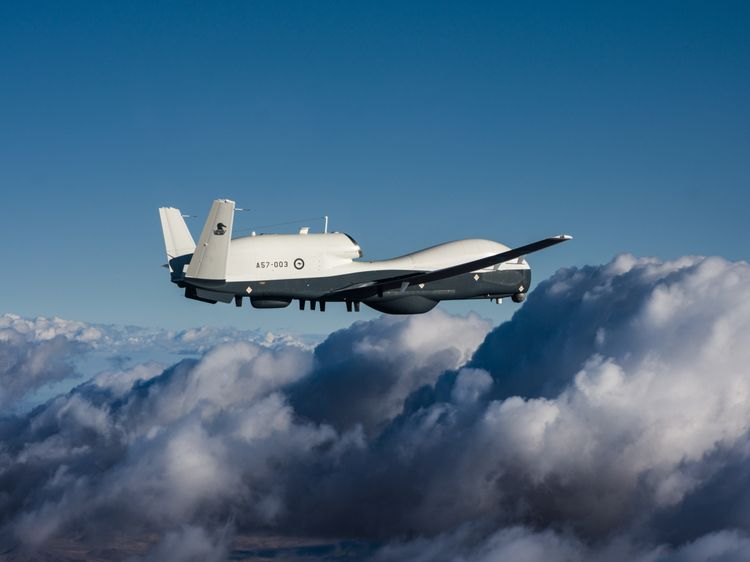
Australia’s third multi-intelligence MQ-4C Triton, also known as “AUS3,” takes to the skies for its first flight at Northrop Grumman’s Palmdale, California, facility on October 29, 2024. (Photo Credit: Northrop Grumman)
From Northrop Grumman
PALMDALE, Calif. – Feb. 6, 2025 – (PHOTO RELEASE) Northrop Grumman Corporation (NYSE: NOC) successfully completed testing of Australia’s third MQ-4C Triton at the company’s Palmdale, California, facility. The company is preparing to ferry the aircraft to Naval Air Station in Patuxent River, Maryland, where it will join Australia’s second Triton for calibration testing before delivery of both aircraft to the Royal Australian Air Force. Robust flight testing and validation of these uncrewed high-altitude, long endurance aircraft are key milestones ahead of delivery to Australia this year. Australia’s air force is collaborating with Northrop Grumman and the U.S. Navy to field the most advanced maritime intelligence, surveillance, reconnaissance and targeting capability available today.
General Dynamics Land Systems successfully demonstrates ARV prototype to U.S. Marine Corps
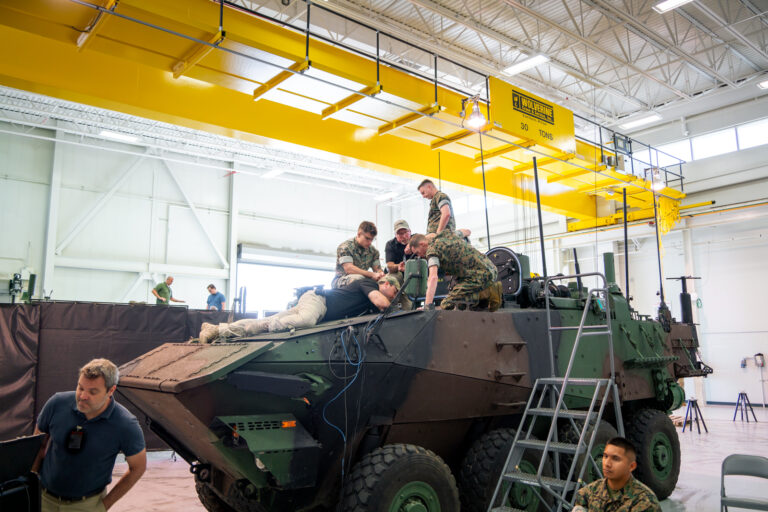
U.S. Marines from various Light Armored Reconnaissance battalions perform maintenance exercises with Field Service Representatives during a demo for the Advanced Reconnaissance Vehicle on June 14, 2024, at Detroit Arsenal. (Photo by David Jordan, Program Executive Officer Land Systems.)
On track to deliver SIL2.0 and 30mm variant of Advanced Reconnaissance Vehicle
From General Dynamics Land Systems, Feb. 3, 2025
STERLING HEIGHTS, Mich. – General Dynamics Land Systems announced today that it has successfully completed further testing of its Advanced Reconnaissance Vehicle (ARV) Command, Control, Communications, Computers/Unmanned Aerial Systems (C4/UAS) variant with the U.S. Marine Corps. The ARV is designed for the Marine Corps’ future Mobile Reconnaissance Battalions.
Principal test locations from March to December 2024 included the Michigan Technological University Keweenaw Research Center (KRC) in Calumet, Mich., and the U.S. Army’s Ground Vehicle Systems Center (GVSC), Detroit Arsenal in Warren, Mich.
General Dynamics Land Systems’ C4/UAS ARV variant is built to serve as the Marine Corps’ “quarterback” on the mobile and multi-domain battlefield. It connects to an array of onboard and off-board sensors, plus UAS and, in the future, ground and water robotic systems. The General Dynamics Land Systems design ensures growth margins and modular open architecture to rapidly incorporate new technology as it develops. In anticipation of potential future requirements, it also incorporates the company’s Next Generation Electronic Architecture, enabling artificial intelligence functionality and control of robotic systems.
Marine Corps-directed and company-led tests and demonstrations in 2024 included land mobility, maintenance, logistics and training systems, as well as automotive and mission-profile performance assessments.
A focus area in 2024 involved a maintenance and logistics capability assessment by Marines using the ARV. To this end, General Dynamics Land Systems has incorporated modern digital maintenance and prognostic monitoring systems in the ARV. In addition to Marine Corps-directed testing, General Dynamics Land Systems enhanced its demonstrations by introducing its next-generation Digital Training System (DTS), which eventually will enable ARV training at the individual, crew and unit levels for tactical operations and maintenance activities.
“The testing and demonstration activities last year helped us collect additional data to ensure we can meet or exceed the Marine Corps’ requirements for ARV, especially in the critical area of maintenance, logistics and training,” said Richard Trotter, ARV Program Director at General Dynamics Land Systems. “We are confident we can achieve key performance requirements in these areas as we wholistically design the strategic ARV capability and competitively position ourselves for the next phase of the program.”
Testing has included Marines from across the Light Armored Reconnaissance (LAR) and maintenance communities.
“Partnering with the Marines in the ARV testing and demonstrations provides very valuable feedback,” said Marc Shepard, ARV Program Manager at General Dynamics Land Systems. “Their collaborative, constructive feedback is invaluable as we aim for a transformational, 21st century solution.”
“We have said this before, and it is worth repeating: The ARV is highly mobile on land and in the water, allowing Marines to sense, communicate and connect to kill webs on the future battlefield like never before,” Trotter added. “Recent tests were some of the most extensive to date for us to trial our innovative technologies. We pride ourselves on delivering capabilities for today and also are thoughtful, deliberate and innovative about realizing the future vision of the Marine Corps. We look forward to continuing our long partnership with the Marines and contributing to their efforts to ensure that ARV is a transformational reconnaissance capability.”
In 2025, General Dynamics Land Systems will complete manufacturing and delivery of an ARV-30mm prototype for testing and evaluation. The company also will deliver a second Systems Integration Lab (SIL) for the ARV program. The primary purpose of the SIL, designed to replicate the interior of the company’s C4/UAS vehicle, is to validate the integration of the Command, Control, Communications, Computers and Intelligence (C4/I) systems and software. It is envisioned that the SIL also will serve as an immersive experience for ARV mission operators and crew to train and simulate real-world missions with full, representative vehicle functionality.
MSC chartered ship MV Ocean Giant completes cargo offload in support of Operation Deep Freeze 2025
From Sarah Cannon, Feb. 12, 2025
MCMURDO STATION, Antarctica – The Military Sealift Command chartered ship MV Ocean Giant has completed a cargo offload of supplies at McMurdo Station, Antarctica in support of the annual resupply mission Operation Deep Freeze 2025.
Ocean Giant arrived at McMurdo Station Jan. 26, delivering a floating marine causeway system along with 380 pieces of cargo, consisting of containers filled with mechanical parts, vehicles, construction materials, office supplies and electronics equipment, and mobile office units; supplies needed to sustain the next year of operations at McMurdo Station, Antarctica.
Following the offload, Ocean Giant was loaded with 360 containers of retrograde cargo for transportation off the continent. This includes trash and recyclable materials for disposal and equipment no longer required on the station.
The MSC chartered ship MV Ocean Gladiator is scheduled to arrive in McMurdo Station later this week, and will begin a cargo offload as well as retrieving the causeway.
Operation Deep Freeze is a joint service, on-going Defense Support to Civilian Authorities activity in support of the National Science Foundation (NSF), lead agency for the United States Antarctic Program. Mission support consists of active duty, Guard and Reserve personnel from the U.S. Air Force, Navy, Army, and Coast Guard as well as Department of Defense civilians and attached non-DOD civilians. ODF operates from two primary locations situated at Christchurch, New Zealand and McMurdo Station, Antarctica. An MSC-chartered cargo ship and tanker have made the challenging voyage to Antarctica every year since the station and its resupply mission were established in 1955.
L3Harris Technology Enhances US Torpedo Capability
From L3Harris, Feb. 4 2025
Improved Post-Launch Communications System (IPLCS) cleared sub-system testing to move closer to providing innovative tool to submarine fleets.
As great power competition increases and the U.S. Navy prioritizes strengthening undersea dominance, improved weapon reliability and lethality is more important than ever. L3Harris is answering the call with innovation to make the next generation of heavyweight torpedoes more effective for U.S. and allied naval forces.
The Improved Post-Launch Communications System (IPLCS) is a fiber-optic cable tether that connects the torpedo to its origin submarine, providing increased bandwidth for real-time data, a greater communications range along with better strength and reliability. The system is designed for the newest iteration of the MK-48 (Mod 8) torpedo, which will be the Navy’s next generation submarine-launched weapon system with upgrades beginning in 2029.
“It’s imperative we provide the U.S. Navy with technology to improve adversary targeting,” said Jahmar Ignacio, Vice President and General Manager, L3Harris Strategic Missions. “This L3Harris advanced technology is key to ensuring warfighters have the right data at the right time for increased advantages over adversaries in the undersea domain.”
IPLCS cleared Design Verification Testing and is now proving L3Harris’ ability to manufacture the technology. Upon successful testing, L3Harris will work with Naval Sea Systems Command (NAVSEA) and Program Executive Office Undersea Warfare Systems (PEO UWS) toward system production.
Countering threats in the Indo-Pacific region is a key priority for the United States. During a visit to Guam and Hawaii earlier this year, Under Secretary of the Navy Erik Raven said U.S. prosperity is built upon free and open oceans and that the U.S. will defend American, ally and partner interests in the region.
“We are steadfast in our commitment to the security, stability and prosperity of the Indo-Pacific region,” Raven said.
The U.S. Navy Science and Technology Strategy identifies Strengthening Maritime Technological Dominance as one of its three main priorities, with Undersea Systems as a focus. The L3Harris IPLCS system ties into that priority directly, giving warfighters enhanced capabilities to confront potential adversaries.
The Royal Australian Navy (RAN) is a partner on the IPLCS program and works within the Undersea Weapons Joint Program Office (PMS 404), with the tether system set to be incorporated into RAN Colins Class submarines in addition to U.S. Navy subs.
The IPLCS system replaces legacy copper wire tethers and offers dramatically better communication ranges and thousands of times more bandwidth. Warfighters on the submarine are able to guide the torpedo, working along with automated systems built into the weapon.
The fiber-optic cable is smaller than the copper wire it is replacing, but stronger, allowing for more reliable performance in contested environments. IPLCS began as a DARPA-funded program in partnership with the University of Central Florida pursuing ultra small, very strong highly integrated optical fiber cable.