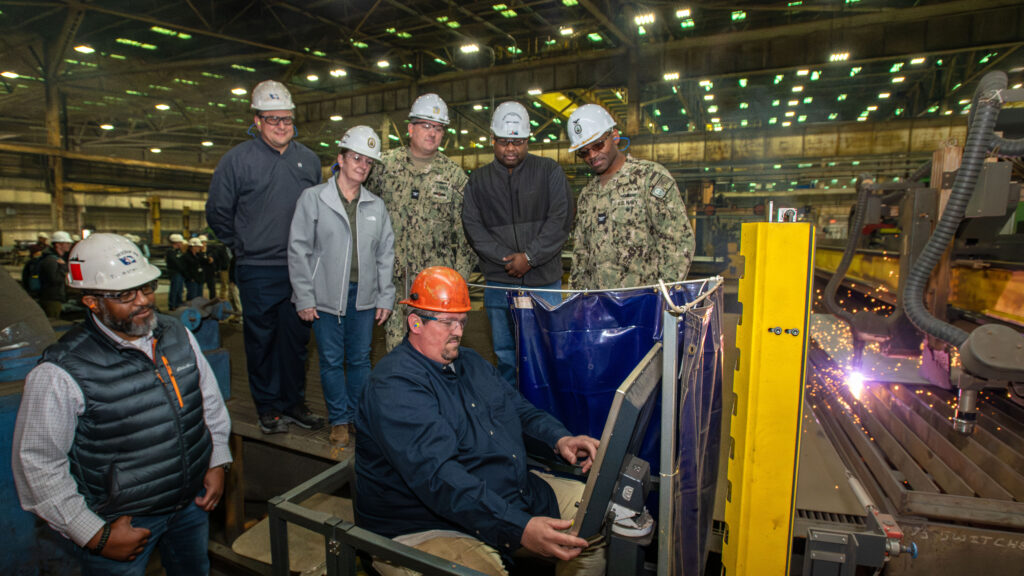
Navy Leader Highlights Shipyards’ Vital Role in Fleet Readiness During Pacific Northwest Visit

From SECNAV Public Affairs, Nov. 18, 2024 

ARLINGTON, Va. – Acting Under Secretary of the Navy Tom Mancinelli visited Puget Sound Naval Shipyard & Intermediate Maintenance Facility (PSNS & IMF) in Bremerton, Washington, Nov. 18, where he engaged with shipyard leadership, employees, and Sailors, emphasizing the critical role the Navy’s public shipyards have in maintaining maritime readiness. 

Mancinelli’s visit focused on the Shipyard Infrastructure Optimization Program (SIOP), a long-term effort to modernize the Navy’s four public shipyards, and also included a tour of the USS Jimmy Carter (SSN 23), a Seawolf-class submarine currently undergoing maintenance. 

During his visit, Mancinelli met with Capt. JD Crinklaw, PSNS & IMF commander, and other senior leaders to discuss shipyard operations, infrastructure updates, and challenges.  They also discussed programmatic improvements, technical innovations, and Quality of Service initiatives.  As the Navy’s largest public shipyard, and the only shipyard capable of servicing Nimitz-class carriers on the West Coast, PSNS & IMF is essential to help ensure fleet readiness. 

“We must continue to build, maintain, and modernize ships, submarines and aircraft to meet the challenges of today and tomorrow,” said Mancinelli. “What you do here matters deeply to the Navy and to our nation’s security.  Your work is vital to defending our country and our way of life.” 

Mancinelli toured Dry Docks 3, 5, and 6, where he observed seismic upgrades and discussed planned improvements under SIOP. 

“The Shipyard Infrastructure Optimization Plan is a once-in-a-century investment that reflects the Department of Navy’s commitment to ensuring our fleet remains ready for future challenges,” said Mancinelli.  “These upgrades are critical to the overall strength of the Navy and are critical to our effort to keep our fleet ready.”    

SIOP is an investment plan at the Navy’s four public shipyards to meet nuclear fleet maintenance requirements and improve Navy maintenance capabilities by expanding shipyard capacity, optimizing shipyard configuration, creating resilient infrastructure, and modernizing industrial plant equipment. SIOP upgrades enable shipyard to improve efficiency and reduce the amount of time vessels spend in a maintenance period. 

The Acting Under Secretary also visited the USS Jimmy Carter, the last and most advanced of the Seawolf-class attack submarines.  The submarine features a unique 100-foot hull extension, known as the multi-mission platform, which enables it to carry advanced technology and enhanced warfighting capabilities. 

On board, Mancinelli met with the submarine’s leadership and crew, toured the vessel, and dined with Sailors while learning more about the submarine’s capabilities. 

“It is always inspiring to meet the extraordinary Sailors who bring our platforms to life,” said Mancinelli.  “The crew of the Jimmy Carter exemplifies the innovation, dedication, and selflessness that define our Navy.  I have no doubt they will continue to do great things for our nation.” 

Throughout his visit, Mancinelli reinforced maritime statecraft and Secretary of the Navy Carlos Del Toro’s priorities:  strengthening maritime dominance, building a culture of warfighting excellence, and enhancing strategic partnerships. 

“Our shipyard workers here at Puget Sound Naval Shipyard directly support the strength and readiness of the fleet,” said Mancinelli.  “Your dedication and hard work ensure that our nation maintains the strongest Navy in the world.  Thank you for your contributions to the security of our nation.” 

The visit marked Mancielli’s first trip to the Pacific Northwest, underscoring the Navy’s focus on maintaining a ready and modern fleet capable of meeting global and strategic challenges. 


Coast Guard Cutter Seneca Returns Home After 61-Day Patrol in the Eastern Pacific Ocean

The Coast Guard Cutter Seneca (WMEC-906) crew underway on the Eastern Pacific Ocean, Sept. 22, 2018. The cutter Seneca is the sixth of thirteen 270′ Famous Class medium endurance cutters in the United States Coast Guard fleet. (Coast Guard Photo) 

U.S. Coast Guard Atlantic Area, Nov. 19, 2024 

PORTSMOUTH, Va. — The crew of Coast Guard Cutter Seneca (WMEC 906) returned to their home port of Portsmouth, Oct. 30, following a 61-day counter-drug patrol in the Eastern Pacific Ocean. 

During the deployment, Seneca’s crew conducted law enforcement operations on the high seas to disrupt illegal narcotics smuggling. 

Patrolling in support of Joint Interagency Task Force – South’s (JIATF-S) counter-drug mission, Seneca worked to counter illicit maritime activities, strengthen partner nation ties and facilitate the safety of life at sea. While deployed in the Coast Guard Eleventh District area of operations, Seneca’s crew worked alongside an embarked aviation unit from the Coast Guard Helicopter Interdiction Tactical Squadron and law enforcement detachment (LEDET) personnel from the Tactical Law Enforcement Team – South (TACLET-S). 

While at sea, Seneca’s crew provided assistance during a Costa Rican forces interdiction of a vessel carrying illegal drugs. The joint interdiction prevented approximately 3,376 pounds of marijuana, worth an estimated street-value of over $3.2 million, from illicit distribution. 
 
This interdiction displayed how U.S. Coast Guard units work effectively with partner nations to combat illicit transnational activities. While on patrol in the Eastern Pacific Ocean, Seneca also operated alongside Coast Guard Cutters Munro (WMSL 755), Hamilton (WMSL 753), Vigorous (WMEC 627) and U.S. Navy Independence-variant littoral combat ship USS St. Louis (LCS 19). 

“Our deployment is representative of the combined efforts of U.S. and allied military units from a coalition of partners working together to deny drug trafficking organizations access to maritime smuggling routes,” said Cmdr. Lee Jones, commanding officer of Seneca.  “The U.S. Coast Guard’s ability to forge strong and lasting international partnerships that further the national interest is what makes our service such a unique instrument of national security.  I am proud of the hard work, resiliency, and dedication to duty exhibited by the crew of Seneca.” 

Detecting and interdicting illicit drug traffickers on the high seas involves significant interagency and international coordination. JIATF-S based in Key West, Florida conducts the detection and monitoring of aerial and maritime transit of illegal drugs. Support from TACLET-S, which is based in Miami, improves mission capability.  

Seneca is a 270-foot, Famous-class medium endurance cutter. Commissioned in 1987, the cutter has called Portsmouth home for the past four years. The cutter’s primary missions are counter-drug and migrant interdiction operations, enforcement of laws and treaties, and search and rescue in support of U.S. Coast Guard operations throughout the Western Hemisphere.  

For information on how to join the U.S. Coast Guard, visit GoCoastGuard.com to learn about active duty, reserve, officer and enlisted opportunities. Information on how to apply to the U.S. Coast Guard Academy can be found here.  


Marine Squadron Circles Globe, Aiding International Mission in Africa

MARINE CORPS AIR STATION MIRAMAR, Calif. — Marines with Marine Aerial Refueler Transport Squadron (VMGR) 352 circumnavigated the globe aboard a KC-130J Super Hercules. The flight began and ended at the squadron’s home base of Marine Corps Air Station Miramar, California, and involved 11 strategic stops across Europe, Africa, the Middle East, and the Indo-Pacific regions. 
 
The primary mission of the VMGR-352 “Raiders” was to deliver equipment and Marines to 3rd Marine Aircraft Wing squadrons deployed to Camp Lemonnier, Djibouti, in support of Combined Joint Task Force-Horn of Africa. The 10 pilots and crewmembers that participated enhanced their proficiency and earned critical qualifications through long-distance flights, honing their skills in navigation and logistical operations over extended ranges and varied conditions. 
 
“Our global flight showcased the capability of the KC-130J to extend the operational reach of Third MAW,” said Lt. Col. Mark Bock, commanding officer of VMGR-352. “More importantly, the operation demonstrated the readiness and skill of the Marines who fix and fly our aircraft.” 
 
Headquartered at Camp Lemonnier in Djibouti, CJTF-HOA is the only enduring U.S. military presence in Africa, tasked to promote regional stability, build partner nation military capacity, and protect U.S. and partner interests. A detachment from VMGR-352 has been deployed to Camp Lemonnier since May 2024 providing air-to-air refueling, combat assault transport, and air drop capability to CJTF-HOA and other partners in the region. 
 
“CJTF-HOA is made up of various units throughout the joint force,” said U.S. Marine Corps Maj. Nathan Fluker, KC-130J Detachment OIC at Camp Lemonnier. “The capabilities Third MAW brings are unique and play a vital role in crisis response as well as supporting partner nations.” 
 
The mission spotlighted the versatility of the Marine Corps’ KC-130J Super Hercules. With a range exceeding 3,500 nautical miles and a 57,500-pound fuel offload capacity using wing and external tanks, “hercs” excel in long-distance logistics and refueling of both fixed-wing and rotary-wing aircraft, on the ground and in the air. The KC-130J’s ability to carry up to 92 troops while also serving as a flying gas station and cargo bay made it ideal for delivering Marines and equipment to Camp Lemonnier. Its multi-role nature, capable of tactical transport, air delivery, and air-to-air refueling, underscores its value in supporting diverse missions across the globe. 
 
“The flight in support of deployed units enabled mission success by delivering required bulky supply parts that would have taken weeks to ship by other means,” Fluker said. 
 
The flight path to Djibouti comprised stops in the Indo-Pacific region, among them Wake Island, Guam, Singapore, and Diego Garcia. The return to Miramar included stops in Qatar, Greece, England, and Maine. 
 
These stops were not only logistically necessary, ensuring refueling and resupply needed to traverse vast distances, but also strategically impactful, showcasing the Marine Corps’ ability to operate seamlessly across different continents and strengthen relationships with partner nations. 
 
“Disparate stops require us to comply with different national rules and regulations and build relationships,” Bock said. “This experience and those relationships make our squadron better prepared to operate globally.” 
 
VMGR-352’s successful global flight underscores the vital role of Marine Corps aviation in supporting U.S. operations across multiple theaters. As both a deliberate mission and a training opportunity, the Raiders increased their proficiency and global deployment readiness. 
 
“Marines are ready to win in any clime or place, and the Raiders of VMGR-352 are no exception,” Bock said. “It’s an honor to be leading this team.” 


Marine Corps General Officer Announcements

From the U.S. Department of Defense, Nov. 19, 2024 

Secretary of Defense Lloyd J. Austin III announced today that the president has made the following nominations: 

Marine Corps Col. Timothy S. Brady Jr. for appointment to the grade of brigadier general.  Brady is currently serving as assistant chief of staff, G-3, Marine Forces Pacific, Camp H. M. Smith, Hawaii. 

Marine Corps Col. Dustin J. Byrum for appointment to the grade of brigadier general. Byrum is currently serving as executive assistant to the deputy commandant, Aviation, Headquarters, U.S. Marine Corps, Pentagon, Washington, D.C. 

Marine Corps Col. Henry Dolberry Jr. for appointment to the grade of brigadier general.  Dolberry is currently serving as chief of staff, 1st Marine Aircraft Wing, Okinawa, Japan. 

Marine Corps Col. Lauren S. Edwards for appointment to the grade of brigadier general.  Edwards is currently serving as senior military advisor, Office of the Secretary of the Navy, Pentagon, Washington, D.C. 

Marine Corps Col. Christopher M. Haar for appointment to the grade of brigadier general. Haar is currently serving as executive assistant to the deputy commandant, Installations and Logistics Department, Headquarters, U.S. Marine Corps, Pentagon, Washington, D.C. 

Marine Corps Col. Sean P. Hoewing for appointment to the grade of brigadier general. Hoewing is currently serving as director, Air Combat Element, Capabilities Development Directorate, Combat Development and Integration, Headquarters, U.S. Marine Corps, Quantico, Virginia. 

Marine Corps Col. Ryan M. Hoyle for appointment to the grade of brigadier general. Hoyle is currently serving as assistant chief of staff, G-3, I Marine Expeditionary Force, Camp Pendleton, California. 

Marine Corps Col. David C. Hyman for appointment to the grade of brigadier general. Hyman is currently serving as branch head, Manpower Management Officer Assignments, Manpower and Reserve Affairs, Headquarters, U.S. Marine Corps, Quantico, Virginia. 

Marine Corps Col. Robert T. Meade for appointment to the grade of brigadier general. Meade is currently serving as military assistant to the Assistant Commandant of the Marine Corps, Pentagon, Washington, D.C. 

Marine Corps Col. Joel F. Schmidt for appointment to the grade of brigadier general. Schmidt is currently serving as executive assistant to the deputy commandant, Manpower and Reserve Affairs, Headquarters, U.S. Marine Corps, Quantico, Virginia. 

Marine Corps Col. Jeremy S. Winters for appointment to the grade of brigadier general. Winters is currently serving as assistant chief of staff, Joint Force Headquarters, U.S. Cyber Command, Fort Meade, Maryland. 


HII Moves Enterprise (CVN 80) for First Time, Enabling Construction of Two Aircraft Carriers at Once

From HII, Nov. 19, 2024 

NEWPORT NEWS, Va., Nov. 19, 2024 (GLOBE NEWSWIRE) — HII (NYSE: HII) announced today that its Newport News Shipbuilding division has successfully transferred the mid-body hull section of Gerald R. Ford-class aircraft carrier Enterprise (CVN 80), allowing the shipyard to begin the concurrent assembly of two Gerald R. Ford-class aircraft carriers in the same dry dock. 

The evolution began Thursday, Oct. 31 with the controlled process of slowly filling the dry dock with more than 100 million gallons of water, marking the first time CVN 80 has been floated. It was then transferred to the west end of the dry dock, where construction on the ship will continue.   

Early next year, the shipyard expects to commence assembling Doris Miller (CVN 81) in the east end of the dry dock, marking a historic first that two Gerald R. Ford-class aircraft carriers will be under construction in the dry dock at the same time. The dual construction of Enterprise (CVN 80) and Doris Miller (CVN 81) is enabled by the successful implementation of the CVN 80/81 two-ship contract modification awarded in 2019 and modifications made to the dry dock by NNS with investment by HII and the U.S. Navy. 

Photos and a video accompany this release are available at: https://hii.com/news/hii-moves-enterprise-cvn-80-for-first-time-enabling-construction-of-two-aircraft-carriers-at-once/

“It is only fitting for this Enterprise, CVN 80, to be part of a historic first at NNS, considering the previous Enterprise, CVN 65, was the world’s first nuclear-powered aircraft carrier, proudly built here at the shipyard,” said Les Smith, NNS vice president Enterprise (CVN 80), Doris Miller (CVN 81) and future aircraft carrier programs. “Thousands of dedicated shipbuilders are working with urgency on these aircraft carriers that we know will play a vital role in the Navy’s fleet.” 

NNS is the only shipyard capable of designing, building and refueling nuclear-powered aircraft carriers for the Navy. Enterprise is the first aircraft carrier designed digitally and built digitally using visual work instructions on laptops and tablets rather than paper drawings. 


U.S. Marine Squadron Conducts First Combat Strikes Using F-35Cs Against Houthi Targets in Yemen 

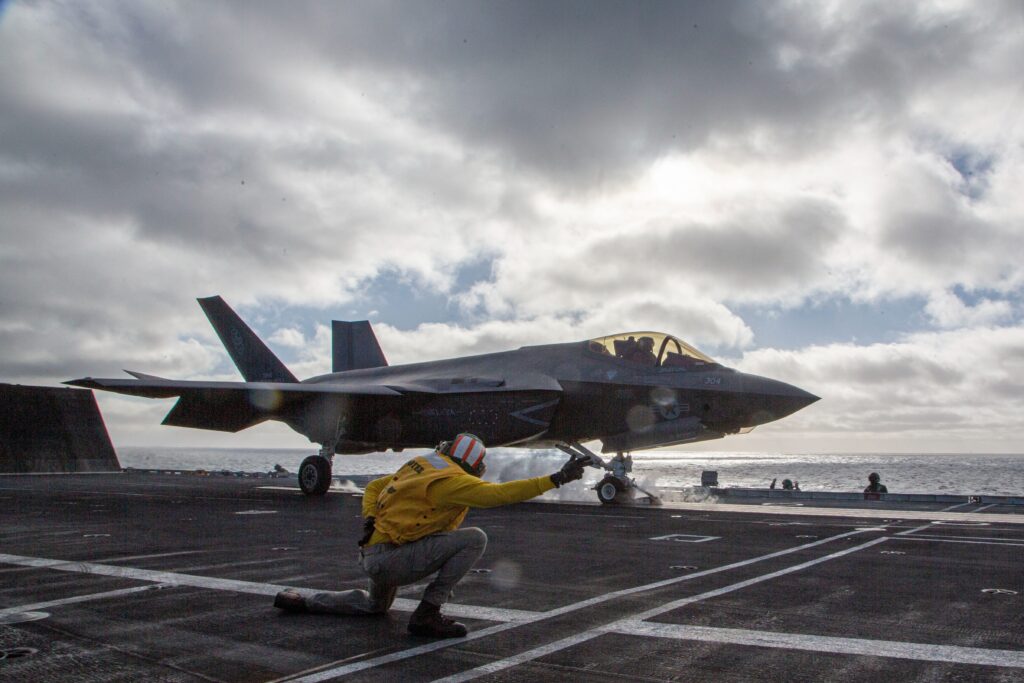
U.S. CENTRAL COMMAND AREA OF RESPONSIBILITY (Nov. 11, 2024) An F-35C Lightning II, attached to Marine Fighter Attack Squadron (VMFA) 314, prepares to launch from the flight deck of the Nimitz-class aircraft carrier USS Abraham Lincoln (CVN 72). (This photo has been altered for security purposes by blurring out names on aircraft) (Official U.S. Navy Photo)

By Carrier Strike Group 3 Public Affairs | November 18, 2024 

U.S. CENTRAL COMMAND AREA OF RESPONSIBILITY — U.S. Marine Corps F-35C Lightning II aircraft, assigned to Marine Fighter Attack Squadron (VMFA) 314, conducted the first F-35C combat air strikes for the platform, Nov. 9-10. 

VMFA 314, assigned to Carrier Air Wing (CVW) 9 aboard the Nimitz-class aircraft carrier USS Abraham Lincoln (CVN 72), conducted multiple strikes on Houthi weapons storage facilities within Houthi-controlled territories in Yemen. The facilities housed conventional weapons, including anti-ship missiles. The Iranian-backed Houthis used these weapons to target U.S. and international military and civilian vessels navigating international waters in the Red Sea and Gulf of Aden. 

“The F-35C demonstrated its warfighting advantage by transiting contested airspace and striking targets in the heart of Houthi territory over multiple days,” said U.S. Marine Lt. Col. Jeffrey “Wiki” Davis, commanding officer of VMFA 314. “My Marines are honored to be first to fight with the F-35C.” 

The F-35C is a fifth-generation, long-range stealth fighter jet used by the U.S. Navy, Marine Corps and Air Force, and is a multi-role aircraft able to perform a variety of missions, including air-to-air combat, air-to-ground strikes, reconnaissance and electronic warfare. 

“The offensive and defensive capabilities of the F-35C absolutely enhance our air wing’s striking arm,” said U.S. Navy Capt. Gerald “Dutch” Tritz, commander, CVW 9. “The now battle-tested Air Wing of the Future has proven itself a game changer across all carrier air wing missions.” 

Other variants of the aircraft include the F-35A and the F-35B. The F-35B first saw combat in 2018 when units assigned to the Essex Amphibious Ready Group conducted airstrikes against the Taliban in Afghanistan and ISIS in Syria. Air Force F-35A’s first combat mission was completed the year after against ISIS targets in Iraq. 

The “Black Knights” of VMFA 314, based out of Miramar, Calif., transitioned from the F-18 to the F-35C in 2020, making them the first fleet squadron in both the Navy and Marine Corps to operate the 5th Generation fighter aircraft. VMFA 314 was also the first operational Marine squadron to fly the F-4 Phantom and F-18 Hornet. 

VMFA 314, part of 3rd Marine Aircraft Wing, is the only deployed F-35C squadron in the Marine Corps. 


Coast Guard Establishes New JROTC Program at Veterans Memorial High School in Corpus Christi  

From U.S. Coast Guard Public Affairs Detachment Corpus Christi, Texas 

Nov. 15, 2024 

CORPUS CHRISTI, Texas – The Coast Guard established a new Junior Reserve Officers’ Training Corps Program at Veterans Memorial High School in Corpus Christi, Nov. 14.   

Veterans Memorial High School’s Coast Guard JROTC unit is the 13th in the nation and has over 50 cadets enrolled in the inaugural semester.   

“We’re excited to be at Veterans Memorial High School today. They’re off to an excellent start with Commander Gully and Chief O’Leary,” said Cmdr. Clay Cromer, Coast Guard JROTC program manager.  “We’re thrilled with the cadets’ leadership, enthusiasm, and the initiative they’re bringing to the table early on.”  

Coast Guard JROTC instructors are hired and employed by the school district and certified by the service. Instructors must be Coast Guard retired, selected reserve, or qualified veterans with at least eight years of service. Veterans Memorial High School’s Coast Guard JROTC instructors are Cmdr. Matthew Gully (USCG, Ret.) and Chief Petty Officer Mike O’leary (USCG, Ret.).   

The National Defense Authorization Act of 2023 mandated the Coast Guard to establish and maintain JROTC programs in each of the nine Coast Guard districts by Dec. 31, 2025.  The Coast Guard is establishing four new JROTC units this fall, bringing the total to 14 JROTC units, with program-wide enrollment of over 1200 cadets.  These new units are at the following host schools:   

  • Barnstable High School – Barnstable, MA   

  • Innovation High School – Orlando, FL 

  • Veterans Memorial High School – Corpus Christi, TX   

  • Kalani High School – Honolulu, HI   


Coast Guard JROTC is not a recruiting program. Cadets incur no military service obligation by participation in JROTC, but they may be eligible for advanced enlistment opportunities with 2 or more years of participation in the program. The program helps equip cadets with the skills necessary to be more prepared for tomorrow’s challenges, no matter what path they take.   

To learn more about the Coast Guard JROTC program, visit their website:  U.S. Coast Guard Junior Reserve Officers’ Training Corps (CGJROTC).   


Norfolk Naval Shipyard Delivers USS George H.W. Bush to Fleet on Time After PIA

The Nimitz-class aircraft carrier USS George H.W. Bush (CVN 77), transits to Naval Station Norfolk after on-time completion of an 11-month maintenance period at Norfolk Naval Shipyard and sea trials, Nov. 16, 2024. (U.S. Navy photo by MC2 Samuel Wagner)

By NAVSEA Office of Corporate Communications, Nov. 18, 2024 

NORFOLK, Virginia – USS George H.W. Bush (CVN 77) successfully completed sea trials off the coast of Virginia this weekend, marking the successful on-time conclusion of its ten-month Planned Incremental Availability (PIA) at Norfolk Naval Shipyard (NNSY). The nation’s tenth Nimitz-class nuclear-powered aircraft carrier entered its PIA in January 2024. 

In returning George H.W. Bush to the fleet on schedule, NNSY applied a series of innovative strategies and engineering solutions to modernize the ship’s safety, communications, and combat systems—scheduling a significant volume of advance work at nearby Naval Station Norfolk (NAVSTA Norfolk) prior to the carrier’s arrival at NNSY. 

Key trades workers and shop mechanics worked alongside engineering and material support personnel at NAVSTA Norfolk, augmented by NNSY’s off-yard carrier team. More than 550 personnel supported the project at the peak of the maintenance availability. NNSY also employed experienced zone managers, who conducted the PIA for USS Dwight D. Eisenhower (CVN 69), completed in December 2022, to improve overall learning and performance. 

As part of the modernization and maintenance work for George H.W. Bush, crews installed combination ovens in the ship’s galley; modular refrigeration equipment to improve system reliability; and upgrades to the Consolidated Afloat Networks and Enterprise Services system—a program the Navy has implemented across the Fleet to enhance shipboard computing systems and to consolidate multiple legacy networks. 

The modernization effort also involved installing the Network Tactical Common Data Link (NTCDL) system, which enables the ship to simultaneously transmit and receive real-time intelligence, surveillance, and reconnaissance data from multiple sources. NTCDL also facilitates the exchange of command and control information over multiple data links, enhancing situational awareness and operational advantage. 

NNSY’s success in delivering George H.W. Bush on time demonstrates how the nation’s public shipyards are looking beyond traditional workflows to meet the Chief of Naval Operations’ objective of putting more ready players—combat-ready platforms—on the field. 

“The Bush team and crew supported this availability with capability and commitment,” said Capt. Jip Mosman, NNSY Commanding Officer. “Their teamwork and dedication to returning this critical asset to the fleet will serve as the model for future maintenance and modernization programs in America’s shipyards.” 

Getting advanced systems and capabilities into the hands of warfighters at speed and scale requires people at every level of the shipbuilding and maintenance enterprise to think, act, and operate differently. NNSY’s culture of collaborative planning among its highly skilled workforce enabled the shipyard to marshal the material and alternative resources necessary to deliver the aircraft carrier’s complex work packages on schedule. 

NNSY’s on-time completion of the George H.W. Bush PIA adds to a recent list of successes at the shipyard, including the undocking of USS Toledo (SSN 769) undergoing Engineered Overhaul (EOH) and USS Montpelier (SSN 765) docking for its EOH. 

For more information on NNSY and the other U.S. Naval Shipyards—Portsmouth Naval Shipyard, Puget Sound Naval Shipyard and Intermediate Maintenance Facility, and Pearl Harbor Naval Shipyard and Intermediate Maintenance Facility—please visit https://www.navsea.navy.mil/Home/Shipyards/


Coast Guard Cutter Stratton Returns Home Following 110-day Arctic Deployment 

The Coast Guard Cutter Stratton (WMSL 752) transits Glacier Bay, Alaska, Aug. 1, 2024, while patrolling the region. Stratton’s crew returned to its homeport in Alameda, Calif., on Nov. 4, after completing a 110-day patrol in the Arctic Ocean, Chukchi Sea and Bering Sea. (U.S. Coast Guard courtesy photo)

From U.S. Coast Guard Pacific Area, Nov. 15, 2024 

ALAMEDA, Calif. — The crew of Coast Guard Cutter Stratton (WMSL 752) returned to its Alameda homeport on Nov. 4, after completing a 110-day patrol in the Arctic Ocean, Chukchi Sea and Bering Sea. 
 
Stratton departed Alameda on July 18 and patrolled the Alaskan Inside Passage to Juneau, Alaska, throughout the Gulf of Alaska, the Bering Sea and into the Arctic Ocean. The crew supported U.S. strategic interests in the high latitudes and ensured the safety and compliance of domestic fishery operators. This was Stratton’s second 110-day Alaska patrol in 2024. 
 
During the patrol, Stratton’s crew tracked and observed two Russian Federation Navy surface action groups transiting through U.S. waters above the Arctic Circle. Stratton patrolled under Operation Frontier Sentinel, an operation designed to meet presence with presence when strategic competitors operate in and around U.S. waters. The Coast Guard’s presence strengthens the international rules-based order and promotes the conduct of operations in a manner consistent with international law and norms. 
 
While patrolling the Arctic, Stratton conducted the first at-sea refueling evolutions for a national security cutter in the high latitudes. The at-sea refueling extended patrol times in the Arctic and enabled persistent Coast Guard presence in the remote region. 
 
Stratton conducted 20 boardings of commercial fishing vessels and foreign trans-shipment vessels enforcing safety and fishing regulations. Alaska’s fisheries are some of the nation’s largest providers of seafood and are a critical component of the U.S. economy. The Coast Guard’s efforts in ensuring safe fishing practices are essential to support this vital industry. 
 
Stratton’s crew also conducted search and rescue (SAR) operations while deployed to the region. Stratton responded to the fishing vessel Galatea, which was adrift in a storm without propulsion due to a severed engine cooling line. Stratton crew deployed to the fishing vessel, repaired the casualty, and safely escorted Galatea to Dutch Harbor. 
 
Stratton also responded to the 738-foot cargo tanker Pan Viva beset by a storm north of Dutch Harbor. After losing propulsion, the vessel was in danger of running aground in seas greater than 30’ and 90-mile-per-hour winds. Stratton provided operational oversight to Pan Viva as Coast Guard MH-60 helicopter air crews evacuated non-essential personnel and commercial tugs aided the vessel. 
 
Throughout the patrol, Stratton conducted 334 deck landings qualifications with Air Station Kodiak’s MH-60 helicopter air crews operating near the Alaskan towns of Utqiagvik and Kotzebue above the Arctic Circle, to Cold Bay and Dutch Harbor in the Bering Sea. Stratton’s coordination of these flight operations provided training opportunities for the crews to enhance their SAR capabilities in the remote areas of Alaska, which tripled the number of shipboard-qualified pilots in the Alaska region. 
 
“I am extremely proud of the resilience and professionalism of Stratton’s crew who’ve spent eight of the last ten months at sea in Alaska, conducting missions to safeguard our nation and people throughout two deployments to the region,” said Capt. Brian Krautler, Stratton’s commanding officer. “We met foreign presence in the Arctic, demonstrating our ability and resolve to protect our most challenging border and we found new ways to extend our presence, devising means to refuel at sea in the high latitudes. We boarded U.S. and foreign vessels to ensure compliance with legal and safety regulations, we enhanced SAR capabilities through rigorous flight training and conducted important search and rescue cases in our most demanding area of operations.” 
 
Stratton also met with the Royal Canadian Navy leadership during a port call in Victoria, Canada, to discuss strategic interests and cooperative efforts in the region. Stratton hosted three Royal Canadian Navy members during the patrol, enhancing U.S. and Canadian interoperability.  
 
Additionally, Stratton conducted community relations engagements in the remote Alaskan communities of Savoonga, Teller and Brevig Mission. During these engagements, crew members met with tribal and city council leadership, volunteered at elementary schools, provided training in water and boating safety, participated in community-wide events including a high-latitude half-marathon, and learned about Inupiat culture, aiding in the service’s understanding of the communities and how to optimize support for remote Alaskan villages. 
 
Commissioned in 2012, Stratton is one of ten commissioned legend-class national security cutters and one of four homeported in Alameda. National security cutters are 418-feet long, 54-feet wide, and have a 4,600 long-ton displacement. They have a top speed of 28 knots, a range of 12,000 nautical miles, and can hold a crew of up to 170. Stratton routinely conducts operations throughout the Pacific, where the cutter’s combination of range, speed, and ability to operate in extreme weather provides the mission flexibility necessary to conduct vital strategic missions.  
 
Stratton’s namesake is Capt. Dorothy Stratton, who led the service’s all-female reserve force during World War II. Dorothy Stratton was the first female commissioned officer in the Coast Guard and commanded more than 10,000 personnel. The ship’s motto is “we can’t afford not to.” 


USS Nantucket Commissioned 

The crew of USS Nantucket (LCS 27) salutes as they bring the ship to life during its commissioning ceremony in Boston. (EJ Hersom) 

Nov. 18, 2024 

From Lt. Ayifa Brooks 

BOSTON — The U.S. Navy commissioned its newest Freedom-variant littoral combat ship, USS Nantucket (LCS 27), Nov. 16, 2024, in Boston. To honor naval history, Nantucket became the newest ship in the fleet while moored stern-to-stern with USS Constitution, the U.S. Navy’s oldest commissioned ship. 

“I want to thank all of you for your service and your dedication, I know it’s been a long journey to get to this point. In the past few weeks alone, you’ve traveled over 2,000 nautical miles through four Great Lakes and 15 locks to get here.” said the Honorable Michelle Wu, mayor of Boston, Massachusetts. “While we know the Charlestown Navy Ship Yard isn’t your final stop, it’s a source of great pride for this city and the people of Boston to be granted the privilege of sending you off to your homeport.” 
 
Guest speakers for the event also included the Honorable Maura Healey, Governor of the Commonwealth of Massachusetts, who delivered the commissioning ceremony’s principal address. Remarks were also provided by the Honorable Polly Spencer, ship’s sponsor; the Honorable Bill Keating, U.S. Representative, Massachusetts’ 8th District; the Honorable Meredith Berger, Assistant Secretary of the Navy for Energy, Installations and Environment; Vice Adm. Michael Boyle, Director of Navy Staff; and Mr. Paul Lemmo, Vice President and General Manager, Lockheed Martin Integrated Warfare Systems and Sensors. 
 
“Today we gather to celebrate a remarkable addition to our naval fleet, USS Nantucket. I’m honored to represent Lockheed Martin and we’re proud to partner with the U.S. Navy to build the Freedom-variant littoral combat ships,” said Lemmo. “USS Nantucket is not just a ship, it embodies innovation, resilience, and the spirit of our maritime forces.” 
 
The ship’s sponsor, The Honorable Polly Spencer, wife of the 76th Secretary of the Navy, joined by her two daughters, Sarah Minella and Amy Ambrecht gave the order to “man our ship and bring her to life!” 
 
“I’m so heartened to look out and see young boys and girls here and I hope they leave today inspired to answer the call to service,” said Healy. “The freedom – all the freedoms, all the privileges that we enjoy today as Americans are only possible because of those who have served and those who continue to serve.” 
 
Nantucket is the 14th Freedom-variant littoral combat ship (LCS) commissioned in the United States Navy and the third to be commissioned in naval service to bear this namesake. 
 
USS Nantucket (LCS 27) was built by the Lockheed Martin and Fincantieri Marinette Marine in Marinette, Wisconsin. The ship was authorized on Oct. 10, 2017, and named on Feb. 13, 2018. It was christened Aug. 7, 2021, and completed acceptance trials the following year. The ship was delivered to the U.S. Navy on July 29, 2024. 
 
“My journey began in September 2021 when I received word that I would be the first commanding officer of USS Nantucket and unveiled the crest on the island.” said Cmdr. Kari Yakubisin, Nantucket’s commanding officer. “Our mission on Nantucket is the same as the Constitution was in 1812, while technology has changed over the last 200 years, the mission of the United States Navy remains the same, keep the sea lanes open for commerce, deter piracy and promote peace around the world. I am proud of this crew and the hard work they put in for the last seven months.” 
 
LCS class ships like Nantucket will be equipped with Over the Horizon – Weapons System (OTH-WS) Naval Strike Missile (NSM). The OTH NSM provides the U.S. and its allies with long range anti-surface offensive strike capability as well as increased coastline defense, deterrence, and interoperability. This will include the MK 70 Payload Delivery System (PDS) which uses combat proven MK 41 Vertical Launching System (VLS) technology to provide mid-range precision fires capabilities. The MK 70 enables rapid deployment of offensive capability to non-traditional platforms and locations. 
 
The ceremony featured early successes, milestones, fair wishes, and following seas while showcasing a weeklong series of events celebrating the ship, its crew, community and namesake city. 
 
USS Nantucket will be homeported at Naval Station Mayport, Florida. 
 
LCS is a fast, agile, mission-focused platform designed for operation in near-shore environments yet capable of open-ocean operation. It is designed to defeat asymmetric “anti-access” threats such as mines, quiet diesel submarines and fast surface craft. They are capable of supporting forward presence, maritime security, sea control, and deterrence. 
 
The mission of CNSP is to man, train, and equip the Surface Force to provide fleet commanders with credible naval power to control the sea and project power ashore. 
 
For more news from Naval Surface Forces, visit DVIDS – Commander, Naval Surface Force, U.S. Pacific Fleet, and Commander, Naval Surface Force, U.S. Pacific Fleet.