USS Harpers Ferry Returns to Homeport After Indo-Pacific Deployment 

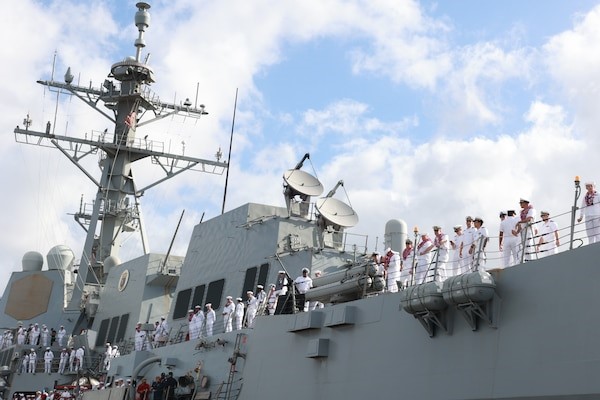
U.S. Navy Sailors assigned to amphibious dock landing ship USS Harpers Ferry (LSD 49) man the rails as the ship pulls into Naval Base San Diego, Oct. 18, 2024. (U.S. Navy photo by MC2 Class Evan Diaz)

By Petty Officer 2nd Class Sang Kim, Oct. 18, 2024 

SAN DIEGO  –  Amphibious dock landing ship USS Harpers Ferry (LSD 49) returned to homeport in San Diego, following a seven-month deployment in the U.S. 7th and 3rd Fleet areas of operations with embarked elements of the 15th Marine Expeditionary Unit (MEU), Oct. 18, 2024. 
 

Carrying over 700 Sailors and embarked Marines, Harpers Ferry participated in multiple, multi-national exercises and operations in the Pacific, displaying interoperability and the U.S.’s commitment to a free and open Indo-Pacific region. 
 

“The accomplishments of USS Harpers Ferry and its Navy and Marine Corps team are quite impressive,” said Cmdr. Gabriel Burgi, the commanding officer of Harpers Ferry. “Together, we steamed tens of thousands of miles from home, away from our friends and families, and completed important missions necessary to protect high seas freedoms. We took part in several bilateral and multinational exercises, and we were great ambassadors of the United States. I couldn’t be more proud of how well the crew and Marines worked together to accomplish many ‘firsts’ for the ARG-MEU team.” 
 

This deployment was an opportunity for the Marine Corps’ newest amphibious ship-to-shore connector, the amphibious combat vehicles (ACV), to gather operational data and lessons learned that will shape future deployments of the new platform in expeditionary environments. 
 

“This deployment was the first ever for the Marine Corps’ first new amphibious vehicle in over 50 years,” said Burgi. “All eyes were on us as we set the precedent for deployed operations of the ACV, and we helped write doctrine for future deployments. We launched and landed the first ACVs in foreign waters and on foreign shores, and the world was watching.” 
 

Harpers Ferry departed San Diego in March to begin a regularly scheduled, Western Pacific deployment. During the deployment, Harpers Ferry and embarked elements of the 15th MEU participated in Exercise Balikatan 24 (BK24), the largest, annual, bilateral exercise conducted between the U.S. and the Philippines. Elements of the embarked 15th MEU conducted a command-and-control exercise (C2X), Humanitarian Civic Assistance (HCA) projects and engagements, and a series of field training events. 
 

ACVs made their operational debut during BK24 in May, splashing from Harpers Ferry in Oyster Bay to conduct a waterborne live-fire gunnery exercise. 
 

“Throughout this deployment the landing force accomplished many firsts for the Marine Corps,” said Maj. Joe Santos, the ACV liaison officer, 15th MEU, and the commander of troops aboard Harpers Ferry. “The 15th MEU deployed with the Amphibious Combat Vehicle for the first time, which marked many more firsts for the Navy and Marine Corps. The Harpers Ferry and landing force was the first to achieve amphibious warfare certifications with the ACV; first to conduct ACV intermediate maintenance underway; first to conduct waterborne gunnery with the ACV; and first to operate within the Indo-Pacific.” 
 

While in the Philippines, Marines and Sailors of the 15th MEU also participated in the Amphibious Coastal Defense Continuum (ACDC), partnering with Philippine Marine Corps’ 3rd Marine Brigade to enhance the Philippine Marine Corps’ coastal defense strategy while supporting the modernization efforts of the Armed Forces of the Philippines. 
 

After BK24 and ACDC, the ship made its way north to Busan, South Korea, for Exercise Ssang Yong 24, a bilateral field training exercise with the Republic of Korea Marine Corps (ROKMC), and U.S. Navy and U.S. Marine Corps (USMC) in vicinity of Pohang. 
 

Ssang Yong was another landmark event for the ACV, marking the first time ACVs conducted a ship-to-shore amphibious assault overseas, partnered with ROKMC amphibious forces. 
 

“Harpers Ferry and their embarked Apache Company and ACV Platoon proved that we could safely and expeditiously launch and recover ACVs,” said Burgi. “The ACVs on deployment was a major milestone for the Navy-Marine Corps team. From onboard maintenance to overseas launch and recovery, almost everything we did with the ACVs was a first for our services. Deploying also gave the ACV platoon confidence in their weapon systems and in their ability to operate far from home without the benefit of onsite maintenance facilities.” 
 

After Ssang Yong, Harpers Ferry transited home to San Diego following a successful seven-month deployment. 
 

“I have seen this ship and her crew go from exiting the shipyards to the completion of a 7th Fleet deployment. This ship and her crew has been tasked over and over, and has exceeded the expectation of fleet commanders every time,” said Burgi.  

“There is no other crew or ship I would rather go to sea with. This crew has delivered miracles selflessly and tirelessly. I couldn’t be more proud of them; being the commanding officer to this crew has been the utmost privilege and highlight of my nearly 30-year career.” 
Santos echoed Burgi’s thoughts on the deployment. 
 

“I am excited for the Marines and Sailors to go home after this deployment knowing that they have accomplished so much,” said Maj. Santos. “They are a part of naval history and will remember this for the rest of their lives. It’s a beautiful day to be on the USS Harpers Ferry!” 


F-35B Test Jet Begins Sea Trials with Japanese Destroyer in Eastern Pacific 

An F-35B Lightning II lands aboard JS Kaga (DDH-184) off the southern coast of California to begin developmental testing. (Darin Russell)

21 October 2024 

From Michael Land 

PACIFIC OCEAN – A U.S. F-35 Lightning II aircraft landed aboard Japan’s Izumo-class multi-functional destroyer JS Kaga (DDH-184) for the first time Oct. 20 off the southern coast of California to begin developmental test aboard the allies’ largest ship. 

A test pilot flew a specially instrumented F-35B short takeoff and vertical landing (STOVL) variant of the 5th generation air system and touched down about 3:15 p.m. 
 
Sea trials will leverage the ship’s recent modifications to conduct fixed-wing aircraft operations. Changes to the Kaga included painting its flight deck with heat-resistant material that tolerates the F-35B’s vectored-thrust engines, installing lights for nighttime operations, and reshaping the flight deck’s bow from a trapezoid to a rectangular shape. 
 
The trials will also pave the way for allies’ increased ability to operate in conjunction with each other. 
 
“This test is essential for strengthening Japan’s defense capabilities and is of utmost importance. We will do our best to achieve good test results together with the ITF,” said Japan Maritime Self-Defense Force Capt. Shusaku Takeuchi, commanding officer, JS Kaga. “This test does not merely enhance the capabilities of the Maritime Self-Defense Force. It also improves the interoperability between Japan and the U.S., strengthening the deterrence and response capabilities of the Japan-U.S. alliance, thereby contributing to peace and stability in the Indo-Pacific region.” 
 
The F-35 is detached from Air Test and Evaluation Squadron Two Three (VX-23), Naval Air Station Patuxent River (NAS Pax River), Maryland. It joins a test team from the F-35 Pax River Integrated Test Force (Pax ITF), who embarked the ship in San Diego. 
 
In addition to F-35 test pilots, the Pax ITF team includes aircraft maintainers, flight test engineers, flight test control engineers, flight deck personnel, logisticians, and others, with support from the U.S. Navy and Marine Corps. 
 
“We are proud to be part of this joint effort to test the compatibility of F-35B aboard JS Kaga,” said Seth Dion, Pax ITF team lead. “Our team has prepared meticulously for this mission, and we are committed to working closely with our allies to achieve our shared goals and strengthen our partnership.” 
 
The sea trials are scheduled to take approximately three weeks. 
 
JS Kaga set sail from its homeport at Kure Naval Base, Japan, in early September. 


TACAMO community announces name for new mission aircraft: E-130J 

Oct 21, 2024 

NAVAL AIR STATION PATUXENT RIVER, Md. — The U.S. Navy’s Airborne Strategic Command, Control and Communications Program Office (PMA-271) and Strategic Communications Wing 1 (SCW-1) today announced the name selected for the Navy’s new Take Charge and Move Out (TACAMO) mission aircraft: E-130J. 

The E-130J – previously called the E-XX while awaiting naming – will relieve the Navy’s E-6B Mercury fleet of the TACAMO mission, which connects the president, secretary of defense and U.S. Strategic Command with naval ballistic missile forces. 

E-130J is the aircraft’s mission design series (MDS). The E stands for special electronic installation; 130 is the design number and reflects the aircraft’s origins as the EC-130; and J is the series, demonstrating that it will be modified from a proven C-130J-30 Super Hercules airframe. The common name – e.g., Mercury – has not been selected. 

At the request of PMA-271, the U.S. Air Force approved the MDS this month. The Air Force approves all military aircraft names. 

PMA-271 is procuring the E-130J through the TACAMO Recapitalization Program. The solicitation, which closed in April 2024, is for a prime contractor to integrate TACAMO mission systems, including the Collins Aerospace Very Low Frequency (VLF) subsystem, into government-furnished C-130J-30 aircraft. Contract award is scheduled for January 2025. 

“I am proud to announce that the U.S. Navy’s new TACAMO aircraft will be the E-130J,” said PMA-271 Program Manager Capt. Adam Scott. “This is an important milestone as we work toward delivering the next generation of TACAMO aircraft to the warfighter.” 

Those warfighters are the SCW-1 squadrons home based out of Tinker Air Force Base, Oklahoma. They include the “Ironmen” of Fleet Air Reconnaissance Squadron (VQ) 3, “Shadows” of VQ-4 and “Roughnecks” of VQ-7. 

“I’m excited as SCW-1 continues to work together with PMA-271 to deliver new capabilities and strengthen America’s nuclear deterrence,” said SCW-1 Commander Capt. Britt Windeler. “The E-130J will assure that our nation’s leadership maintains control of its strategic forces as the E-6B gets closer to end of life, and enable it to focus on the performance of other critical missions until sundown.” 

The E-6B Mercury is a communications relay and strategic airborne command post aircraft. It provides survivable, reliable, and endurable airborne Nuclear Command, Control, and Communications (NC3) for the president, secretary of defense and U.S. Strategic Command. 

PMA-271 is part of Naval Air Systems Command (NAVAIR) and headquartered at Naval Air Station Patuxent River, Maryland. Its mission is to deliver and support survivable, reliable and endurable airborne command, control and communications for the president, secretary of defense and U.S. Strategic Command. 

The mission of SCW-1 is to receive, verify and retransmit Emergency Action Messages (EAMs) to U.S. strategic forces. 


Navy awards Leidos $248M Contract to Provide Autonomous Systems Design and Engineering 

RESTON, Va. (Oct. 17, 2024) – Leidos (NYSE:LDOS), a FORTUNE 500® innovation leader, was recently awarded a follow-on contract by the Naval Information Warfare Center Pacific (NIWC PAC) to support unmanned and automated systems for maritime intelligence, surveillance, and reconnaissance (ISR). This single-award task order has an estimated value of $248 million with a five-year period of performance. 

“This award enables Leidos to accelerate the technology needed to enhance ISR capabilities and harden the foundation for Navy operations,” said Dave Lewis, Leidos senior vice president for sea systems. “We look forward to strengthening our partnership with NIWC PAC and addressing their needs with artificial intelligence and autonomy, integrated sensing, and cyber solutions.” 

Under the contract, Leidos will continue to perform a range of support services, including research and analysis for the collection and processing of ISR capabilities to develop multi-sensor, unmanned underwater vehicles and other unattended and unmanned systems  platforms. Additionally, the company will provide technology assessment and development, software and hardware design, rapid prototyping, integration, lab- and sea-based testing, and recovery and repair activities. 

This contract was awarded under the Department of Defense Information Analysis Center’s (DoDIAC) multiple-award contract vehicle. DoDIAC, sponsored by the Defense Technical Information Center (DTIC), provides technical data management and research support for DOD and federal government users. These contract task orders are awarded by the U.S. Air Force’s 774th Enterprise Sourcing Squadron to develop and create new knowledge for the enhancement of the DTIC repository and its users. 

Established in 1946, the IAC program serves the DOD science and technology and acquisition communities to drive innovation and technological developments by enhancing collaboration through integrated scientific and technical information development and dissemination. 


Navy Announces Site for New Navy Museum

Secretary of the Navy Carlos Del Toro addresses the crowd at the site selection ceremony on Oct. 18. Also pictured are Nina Albert, deputy mayor of the District of Columbia for planning and economic development, and Rear Admiral Samuel J. Cox (retired), director of the Naval History and Heritage Command. Seapower | Brett Davis

WASHINGTON — Secretary of the Navy Carlos Del Toro highlighted a site selection ceremony for the future of the National Museum of the United States Navy on Oct. 18.

“This is a moment of immense pride and anticipation for the Navy, for our nation, and for all who cherish maritime heritage,” Del Toro said, standing near two dilapidated buildings that will be part of the new museum campus.

The site is adjacent to the Navy Yard in Washington and a short walk from the current Navy museum, housed in an aging facility largely off-limits to the general public. The new museum is intended to be a state-of-the-art look at the U.S. Navy, will be open to the public and is near a vibrant neighborhood that also boasts the stadiums for the Washington Nationals baseball team and the DC United, DC Power FC and Washington Spirit soccer teams. It’s expected to attract up to two million visitors annually, well over the 100,000 annual attendance of the current museum, most of whom are already in the Navy.

Del Toro said he is well aware of the draw of Nationals Stadium, and said “I want half of them over here before the game and after the game.”

Rep. Eleanor Holmes Norton, the district’s congressional representative, highlighted the city’s historic ties to the Navy. She said 30,000 city residents are veterans and “deserve the full equality of statehood,” as district residents don’t have voting rights in Congress.

A Long Road Ahead

While service officials now know where the museum will be located, they haven’t yet raised the money, don’t know what it will look like and don’t yet know what artifacts will be in it. All of those efforts are underway by the organizations that will create it: the Navy Museum Development Foundation that will raise the money ($475 million or more) and construct the building and the Naval History and Heritage Command that will select what goes in it. Once the museum is built, the foundation will give it to the Navy, which will staff and operate it.

Rear Admiral Samuel J. Cox (retired), director of the Naval History and Heritage Command, gently poked fun at the museums of the Marine Corps and Army, which he described as being “out in the wilds of Virginia” while the new Navy museum will be next to an all-hours neighborhood.

The new museum, still years away — a groundbreaking is tentatively planned for next October and the first phase likely won’t open until 2030 — has already been a long time coming. Nina Albert, D.C.’s deputy mayor for planning and economic development, was one of the speakers at the event and noted she had served on a Navy museum site selection committee 17 years ago.

“The vision will be worth the work and it will be worth the wait,” she said.

Part of the delay was a prolonged and what Cox called “tortuous” process to acquire the land from the city in a swap that saw the Navy Yard give up some of its land on the other side of the base near the river to acquire the plot that will house the new museum.

The museum will ultimately be 240,000 square feet and filled with meaningful artifacts, such as the bell from the USS Jacob Jones, sunk in 1917 off the coast of Cornwell, England, by a German U-boat and rediscovered in 2022. It was the first U.S. Navy destroyer sunk by enemy action. The bell, recovered by the British Ministry of Defence and transferred to the U.S. Navy earlier this year, is being prepared for display, said Vice Chief of Naval Operations Admiral James J. Kilby.

The museum is carrying high hopes for Navy officials. Former Secretary of the Navy Kenneth J. Braithwaite II said “it will not be a musty old hall with a bunch of old artifacts … it will be the spark that will draw people to the service of our country in the uniform of the United States Navy. This will be a new crown jewel in this city.”


Update on Growler Mishap Near Mt. Rainier 

ARABIAN SEA (May 26, 2021) An E/A-18G Growler attached to the “Zappers” of Electronic Attack Squadron (VAQ) 130 launches from the flight deck of the aircraft carrier USS Dwight D. Eisenhower (CVN 69) during flight operations in the Arabian Sea, May 26, 2021. (U.S. Navy photo by MC3 Cameron Pinske)

17 October 2024 

From CNAF Public Affairs 

The following are news releases from Commander, Naval Air Forces Pacific pertaining to the Growler Mishap near Mt. Rainier in Washington state on Oct. 15, 2024. 

YAKIMA COUNTY, Wash. – The U.S. Navy, along with local law enforcement and partner agencies, continue search and rescue efforts on the mountain where a U.S. Navy EA-18G Growler crashed on Oct. 15. 
  
The wreckage rests at approximately 6,000 feet altitude in a remote, steep and heavily-wooded area east of Mount Rainier. 
  
Soldiers from 1st Special Forces Group (Airborne) based at Joint Base Lewis-McChord are assisting in the search. 1st Special Forces Group (Airborne) brings specialized mountaineering, high-angle rescue, medical, and technical communication skills necessary to navigate the difficult terrain associated with the Cascade Mountain Range that is inaccessible by other means. 
  
The status of the crew cannot be confirmed without a site assessment of the debris area. 
  
“Our priority is to locate our two aviators as quickly and as safely as possible,” said Capt. David Ganci, commander, Electronic Attack Wing, U.S. Pacific Fleet. “Adhering to Dept. of Defense procedure, we cannot identify or confirm the names of aircrew involved in a mishap until 24-hours after their next of kin have been notified of their status. Please remain patient and limit speculation about the incident. That is one of the best ways we can respect the privacy of the loved ones who are impacted by this tragic event.” 
  
There are no known hazards to the public. 
  
“We appreciate the community support as experienced personnel respond around the crash site,” said Capt. Nathan Gammache, commanding officer of NAS Whidbey Island. “We are confident that we have the capability we need at this time, and will request any additional capabilities, if needed, via official channels in coordination with the on-site incident commander.” 
  
The cause of the crash is under investigation. 
  
The U.S. Navy will continue to provide updates. More information is available on NAS Whidbey Island’s website and official social media accounts. 
 
OCT 16, 2024 

4 p.m. PDT │ Update 2                                                                                
  
YAKIMA COUNTY, Wash. – Just after 12:30 p.m. PDT, aerial search crews located the wreckage of the EA-18G Growler that crashed on Oct. 15. The crash site rests on a mountainside east of Mount Rainier. 
  
The status of the two crew members is unknown while the search effort continues. 
  
An Emergency Operations Center has been established on NAS Whidbey Island to coordinate response efforts, and the U.S. Navy is making preparations to deploy personnel to secure the remote area that is not accessible by motorized vehicles. 
  
“I am thankful for the tremendous teamwork displayed by the NAS Whidbey Island squadrons — VAQ, VP, VQ, TOCRON 10 and SAR — as Team Whidbey continues to respond to our tragic mishap,” said Capt. David Ganci, commander, Electronic Attack Wing, U.S. Pacific Fleet.  “I am also grateful to local law enforcement, responders, and tribal communities whose partnership has been essential in planning our critical next steps for access to the site.”   
  
The cause of the crash is under investigation. 
More information will be released as it becomes available. 
  
  
OCT 16, 2024  
11:10 a.m. PDT │ Update 1 
  
NAVAL AIR STATION WHIDBEY ISLAND, Wash. – The U.S. Navy, in coordination with Yakima County tribal and local authorities, continue to search for the EA-18G Growler aircraft that crashed yesterday afternoon. 
  
Aerial operations continued through the night, launching from NAS Whidbey Island and searching in the area 30 miles west of Yakima, Wash. Responders are facing mountainous terrain, cloudy weather, and low visibility as the search is ongoing. 
  
As of 11 a.m. on Oct. 16, neither the crew nor wreckage has been located. 
  
Additional units supporting search and rescue include: U.S. Navy Fleet Air Reconnaissance Squadron One (VQ-1), Patrol Squadron (VP-46), NAS Whidbey Island Search and Rescue, and U.S. Army 4-6 Air Cavalry Squadron out of Joint Base Lewis-McChord.  
  
The cause of the crash is under investigation. 
  
More information will be released as it becomes available. 


OCT 15, 2024 
  
NAVAL AIR STATION WHIDBEY ISLAND, Wash. – At 3:23 p.m. PDT, a U.S. Navy EA-18G Growler aircraft from Electronic Attack Squadron (VAQ) 130 crashed east of Mount Rainier during a routine training flight. 
  
Multiple search and rescue assets, including a U.S. Navy MH-60S helicopter, launched from NAS Whidbey Island to locate the crew and examine the crash site. 
  
As of 7 p.m. on Oct. 15, the status of the two crew members remains unknown. 
  
The cause of the crash is under investigation. 
  
More information will be released as it becomes available. 
  
The “Zappers” of VAQ-130 are based at NAS Whidbey Island, and recently completed a combat deployment on USS Dwight D. Eisenhower as the only E/A-18G Growler squadron with Carrier Air Wing (CVW) 3. 

The EA-18G Growler is a variant in the F/A-18 family of aircraft that combines the proven F/A-18F Super Hornet platform with a sophisticated electronic warfare suite. All EA-18G squadrons are stationed at NAS Whidbey Island, with the exception of one squadron (VAQ-141) attached to CVW-5, Forward Deployed Naval Force, based at Marine Corps Air Station Iwakuni, Japan. 
  
The U.S. Navy fact file on the EA-18G Growler can be found at the following link: 
https://www.navy.mil/Resources/Fact-Files/Display-FactFiles/Article/2166036/ea-18g-growler-airborne-electronic-attack-aircraft


USS George Washington Transits to Japan

Sailors man the rails aboard Nimitz-class aircraft carrier USS George Washington (CVN 73) as the ship departs Naval Air Station North Island, Oct. 1, 2024. (U.S. Navy photo by MC3 August Clawson) 

By USS George Washington Public Affairs. Oct. 17, 2024 

SAN DIEGO  –  The Nimitz-class aircraft carrier USS George Washington (CVN 73) departed the San Diego area for routine operations Oct. 8, beginning its transit to Yokosuka, Japan. 
 
George Washington assumed the role of the U.S. Navy’s only forward-deployed carrier, replacing USS Ronald Reagan (CVN 76), which operated out of Yokosuka for nearly nine years before departing Japan in May. 
 
“USS George Washington departed San Diego to begin the final phase of its redeployment to Japan, where it will once again serve as the Navy’s forward-deployed aircraft carrier,” said Rear Adm. Greg Newkirk, commander of Carrier Strike Group 5. “It will take up station alongside the always-ready forces postured in the area of responsibility. George Washington, with all its capabilities, represents America’s commitment to stability in the region where it will sail and fly with our partner navies as we strive to move from interoperability to true interchangeability.” 
 
George Washington completed its midlife refueling and complex overhaul (RCOH) at Newport News Shipbuilding in May 2023, conducted pre-deployment certifications and inspections over the course of 10 months, and departed Norfolk, Virginia, in April for its Southern Seas deployment around South America, arriving in San Diego in July. 
 
The forward-deployed Carrier Air Wing (CVW) 5, which recently completed training at Naval Air Station Fallon in Nevada, will embark George Washington to transit the Pacific Ocean and return to Marine Corps Air Station Iwakuni in Japan. 
 
“I am incredibly proud of this team and everything they have accomplished this year,” said Capt. Timothy Waits, commanding officer of George Washington. “This crew, alongside Carrier Air Wing 5, is trained, tested, and ready to return to 7th Fleet as the Navy’s premier forward-deployed aircraft carrier.” 
 
This marks the second time that George Washington has served as the Forward-Deployed Naval Forces-Japan aircraft carrier. In 2008, it became the first nuclear-powered aircraft carrier to be forward-deployed to Japan before being relieved by Ronald Reagan in 2015. 
 
After operating in the U.S. 3rd Fleet and 7th Fleet areas of operations, George Washington will arrive in Yokosuka in late fall. 


CNO Sets 80% Surge Readiness Goal by 2027 

Oct. 16, 2024 | By Matthew Olay , DOD News 

Chief of Naval Operations Adm. Lisa Franchetti today said that her goal of having 80% of the Navy’s ships and aircraft ready to surge on short notice by 2027 may seem ambitious, but that it will be worth all the progress that can be made in pursuit of that total percentage.   

Franchetti, who recently delivered remarks on her just-released 2024 Navy navigation plan at a local Washington think tank, was asked afterward whether her relatively short-term 80% surge readiness goal was “aspirational, achievable both.”  

“These are stretch goals, but I am confident we’re going to work hard to get after them,” Franchetti said of her plans to increase surge readiness.  

“And if we don’t make exactly 80% ,” she continued, “we’re going to be further along the road than we would be if I hadn’t set such an ambitious goal.”   

Franchetti’s surge readiness goal falls under a portion of the Navigation Plan for America’s Warfighting Navy 2024 that targets seven areas the CNO sees as vital to fleet readiness.   

Titled “Project 33” in reference to Franchetti being the Navy’s 33rd CNO, the seven core fleet readiness targets the plan seeks to address by 2027 are: 

  • Ready the force by eliminating ship, submarine and aircraft maintenance delays. 

  • Scale robotic and autonomous systems to integrate more platforms at speed. 

  • Create the command centers our fleets need to win on a distributed battlefield. 

  • Recruit and retain the force we need to get more players on the field. 

  • Deliver a quality of service commensurate with the sacrifices of our sailors. 

  • Train for combat as we plan to fight, in the real world and virtually. 

  • Restore the critical infrastructure that sustains and projects the fight from shore.  

To illustrate her line of thinking as it relates to how she plans to reach the 80% surge readiness target by 2027, Franchetti gave the example of how the Navy was able to improve the readiness percentages for the F/A-18 Super Hornet in recent years.  

“In 2018, Secretary Mattis challenged our aviation community to get F/A-18 readiness up from 50% readiness availability to 80%,” Franchetti said.   

“And now, six years on,” she continued, “we’ve been able to sustain 80% readiness for the F/A-18s because of the processes we’ve put in place.”   

Franchetti credited “data-driven, daily drumbeats of accountability” to make sure the Navy understood what the actual readiness levels of accountability for the F/A-18 were — as well as what the barriers were to achieving those proper levels — that led to the Navy successfully being able to sustain 80% readiness for the aircraft through 2024.  

The Navy has since been able to scale those methods of upping readiness levels to the submarine force and surface force, Franchetti said.  

“I am committed, and the team is committed to going after that stretch goal,” Franchetti said of the 80% surge readiness by 2027 target.   

“We have all those processes in place now, and I’m really looking forward to that.”     

Franchetti’s navigation plan focuses on 2027 as the year for the Navy to achieve maximized fleet readiness because that’s also the year China’s Xi Jinping has told his military to be ready for armed conflict.  

“As the CNO who will be at the helm into 2027, I am compelled to do more — and do more, faster — to ensure that our Navy is more ready,” Franchetti said.  

“I have a clock in my office that tells me there are 807 days left until 1 January 2027,” she added.  “There is no time to waste, and your Navy is ready to get after it.” 


Multi-Domain Test Event Lets XQ-58A Demonstrate Tactical Data Link Integration 

From U.S. Marine Corps Communications Directorate 

EGLIN AIR FORCE BASE, FLA. — The Marine Corps’ XQ-58A Valkyrie completed its latest test flight and first multi-service integration effort during Emerald Flag 2024 at Eglin Air Force Base, Florida, this October.  

Emerald Flag 2024 is a multiservice and multi-domain test event that incorporates new and developing technology while focusing on the efficiency of joint warfare. The effort includes integrating advanced long-range kill chains – enabling programs through a range of realistic combat training environments on air, space, and cyber space platforms.  

The XQ-58A effectively demonstrated its capabilities as a forward deployed sensing platform – providing critical threat targeting data to Marine Corps fifth-generation aircraft to rapidly close advanced kill chains. Using a common tactical data link, the XQ-58A contributed broad airborne and surface sensor awareness information to multiple ground and airborne joint network participants.   

“This XQ-58A test marked another milestone in the Marine Corps’ unmanned tactical aircraft program. The flight focused on the use of tactical data links to enable digital communication between the XQ-58A and an airborne four-ship of F-35Bs from Marine Fighter Attack Squadron 214 and other joint aircraft. The success of this flight test during Emerald Flag pushed the manned-unmanned teaming concept a step further for the entire Joint Force,” said Col. Derek Brannon, Branch Head for the Cunningham Group, Deputy Commandant for Aviation. 

This joint collaboration was supported by the U.S. Air Force’s 96th Test Wing; the U.S. Air Force’s 96th Cyberspace Test Group; the U.S. Air Force’s 53rd Test and Evaluation Group; the Office of Undersecretary of Defense for Research and Engineering; Marine Corps Warfighting Laboratory; Headquarters Marine Corps Aviation; Naval Air Systems Command’s Advanced Development Team; Naval Air Warfare Center Aircraft Division AIRWorks; and 2nd Marine Aircraft Wing. This broad team facilitated ongoing research, development, test, and evaluation throughout the Marine Corps’ Penetrating Affordable Autonomous Collaborative Killer – Portfolio (PAACK-P) program.  

The Deputy Commandant for Aviation’s Cunningham Group, an internal working group responsible for planning and implementing Project Eagle, and MCWL collaborated to see this project through to completion. 

“This test flight marked the capstone event for the PAACK-P Rapid Defense Experimentation Reserve project and proved the tactical utility of uncrewed offboard sensing platforms,” said Lt. Col. Bradley Buick, future capabilities officer for Cunningham Group.  

Through this successful joint integration, the XQ-58A continues to provide the Marine Corps with a testable platform for integrating new technologies and concepts in support of the Marine Air-Ground Task Force Unmanned Expeditionary Tactical Aircraft program. 


Enabling Off-the-Shelf Autonomous Naval Warfare 

Enabling Off-the-Shelf Autonomous Naval Warfare (1)

How an autonomous fleet of small, uncrewed platforms can extend maritime reach 

From Northrop Grumman 

The nature of naval warfare is often unpredictable. As near-peer adversaries work to rapidly increase their total number of vessels, uncrewed systems will play an important role in enabling the U.S. Navy to continue to project power and ensure sailors are able to execute missions. 

Northrop Grumman is a proven technology leader with large uncrewed autonomous systems (UAS). The company has now developed two mission-focused autonomous capabilities on the smaller UAS, called Helix and Scion, that will rapidly transform existing commercial uncrewed platforms into resilient and survivable combat and surveillance systems. Executing real-world mission scenarios at the Naval Surface Warfare Center Silent Swarm 2024 exercise, these autonomous technologies demonstrated Northrop Grumman’s readiness to fill existing maritime domain awareness gaps and securely find, fix and track elements in maritime operations. 

Northrop Grumman’s platform-agnostic payload, consisting of an electronic warfare transceiver, a mission integration system and swarming software, loaded onto an uncrewed surface vehicle. (Photo Credit: Northrop Grumman) 

The Navy is actively exploring emerging technologies that enable uncrewed aerial vehicles (UAVs) and uncrewed surface vehicles (USVs) to extend the range of its communications and electronic warfare (EW) capabilities. Northrop Grumman’s Scion – a multifunction EW payload – was created and tailored specifically to the needs of surface operations and can connect to commercially available USV platforms using a common interface. Helix combines an array of uncrewed platforms, payloads and software, allowing for autonomous, multi-domain and multi-modal operations. Its ecosystem is further complemented by digital twin solutions, providing operators with a three-dimensional, dynamic view of the battlespace in a virtual environment. 

“We developed an initial proof of concept for Scion’s capabilities for the Navy in 2023,” said Matt O’Driscoll, chief engineer for Scion, Northrop Grumman. “Building on last year’s successful demonstration, we added five uncrewed systems in the air and two on the surface for this year’s Silent Swarm exercise and all of the systems worked collaboratively and autonomously to find target vessels.” 

At Silent Swarm 2024, sophisticated EW and autonomy payloads were deployed on a distributed team of uncrewed autonomous vehicles, providing data to the command and control software and an advanced situational awareness tool, as seen above. (Credit: Northrop Grumman) 

The concept of operations Northrop Grumman demonstrated included a USV equipped with the Scion EW payload, which collaborated with UAVs launched and controlled by Helix to find, fix, track and target vessels. Helix provided the autonomy engine for intelligent collaborative uncrewed systems and gave operators a near-real-time, multi-layered view of the mission landscape. Through this exercise, Scion enriched Helix’s ecosystem of uncrewed mission solutions. 

“At Silent Swarm, we showcased the combination of the Helix software and the Scion payload as an EW system capable of finding and locating radio frequency emissions over the water,” said Tyler Dillstrom, chief engineer for Helix, Northrop Grumman. “Our autonomy software in control of the USVs used those detections to correlate, identify and track targets from the air and on the surface.”    

Future mission success in the maritime domain will depend on the ability to command and control diverse fleets of uncrewed vehicles with a wide range of payloads. Northrop Grumman’s efforts at Silent Swarm demonstrate the company’s commitment to model-based digital engineering and our ability to deploy solutions more quickly and affordably. With digital capabilities, Northrop Grumman can simulate scenarios in a digital environment before fielding a system. This contributes to future program affordability and confidence in first-time quality. It also showcases Northrop Grumman’s legacy of trusted autonomous solutions in all domains. 

There will be many approaches to ensuring the United States and its allies increase in capacity and capability. Intelligent autonomous platforms will prove to be force multipliers in naval warfare, extending the warfighter’s reach and freeing up valuable resources for other critical missions.