U.S. Coast Guard Encounters Joint Chinese Coast Guard, Russian Border Guard Patrol in Bering Sea 

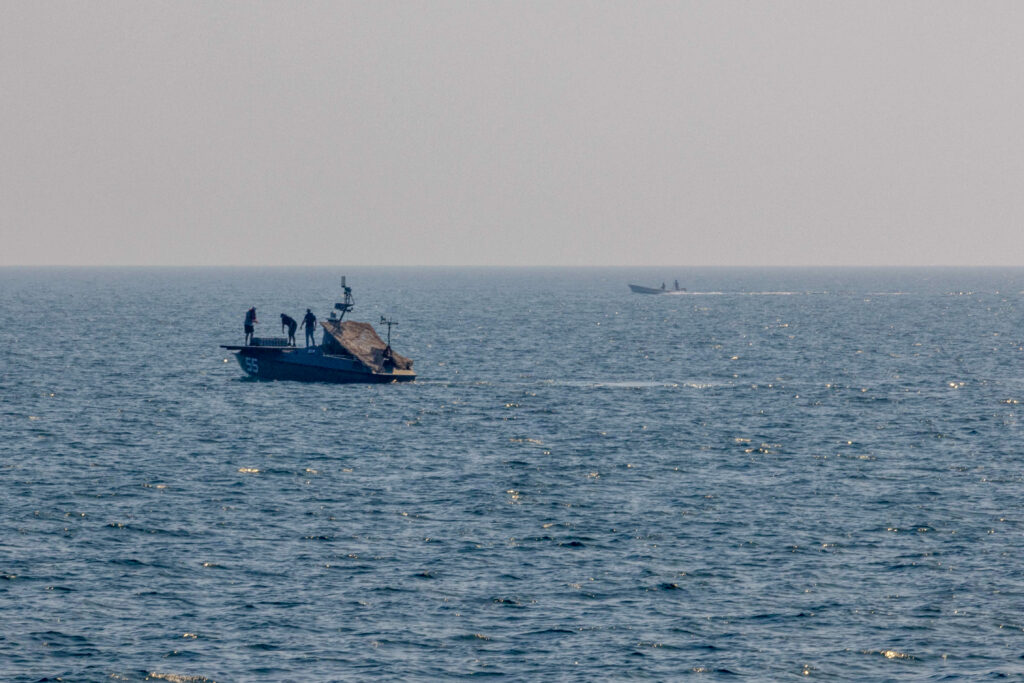
An HC-130J Super Hercules airplane crew from Coast Guard Air Station Kodiak observes two Russian Border Guard ships and two Chinese Coast Guard ships approximately 440 miles southwest of St. Lawrence Island Sept. 28, 2024.  This marked the northernmost location where Chinese Coast Guard vessels have been observed by the U.S. Coast Guard. (U.S. Coast Guard courtesy photo) 

From U.S. Coast Guard 17th District, Oct. 1, 2024 

JUNEAU, Alaska – The U.S. Coast Guard located four vessels from the Russian Border Guard and Chinese Coast Guard conducting a joint patrol in the Bering Sea, Saturday.    

While patrolling the maritime boundary between the United States and Russia on routine patrol in the Bering Sea, a HC-130J Super Hercules airplane crew from Coast Guard Air Station Kodiak observed two Russian Border Guard ships and two Chinese Coast Guard ships approximately 440 miles southwest of St. Lawrence Island. 

The vessels were transiting in formation in a northeast direction, remaining approximately five miles inside the Russian Exclusive Economic Zone. This marked the northernmost location where Chinese Coast Guard vessels have been observed by the U.S. Coast Guard.   

 “This recent activity demonstrates the increased interest in the Arctic by our strategic competitors,” said Rear Adm. Megan Dean, commander of the 17th Coast Guard District. “The demand for Coast Guard services across the region continues to grow, requiring continuous investment in our capabilities to meet our strategic competitors’ presence and fulfill our statutory missions across an expanding operational area.”   

The HC-130 aircrew operated under Operation Frontier Sentinel, an operation designed to meet presence with presence when strategic competitors operate in and around U.S. waters. The Coast Guard’s presence strengthens the international rules-based order and promotes the conduct of operations in a manner that follows international law and norms.   


Navy Exceeded FY24 Recruiting Goals

From the Navy Office of Information, Oct. 1, 2024 

MILLINGTON, Tenn. (October 1, 2024) – The U.S. Navy exceeded its Fiscal Year 2024 recruiting goals, contracting 40,978 new recruits by the end of the fiscal year and marking its most significant recruiting achievement in 20 years. 

Secretary of the Navy Carlos Del Toro visited Millington, Tennessee, today to meet with Navy Recruiting Command leadership, recruiters, and support personnel. During the visit, he expressed his gratitude for their hard work and dedication. 

“I know you work incredibly hard as recruiters, and this can be an exhausting set of orders, but that is why we only select the best Sailors for recruiting duty,” said Secretary Del Toro. “You truly make a difference in assuring the future of our Navy. The Sailors you recruited this year will form the backbone of our Fleet for several decades.” 

For FY24, the Navy not only met its contracting goals without lowering targeted objectives, it also exceeded retention goals. Once again, this fiscal year the Marine Corps exceeded its recruitment goals for both officers and enlisted. 

While the Navy achieved its FY2024 recruiting goals, some recruits are slated to attend boot camp in FY2025, which is when the schoolhouse can accommodate them. 

The Navy’s recruiting success is attributed to several factors including data-driven decision-making, enhanced focus on annual goals, reduced timeframe for processing medical waivers, removing red tape, and expanding opportunities. 

Over the past year, the Navy identified and closed gaps in the recruiting process. For example, the CNO established a culture of “Every Sailor a Recruiter” and advanced our recruiting enterprise by appointing a senior, two-star admiral to lead our recruiting stations and centers. Furthermore, recruiter goals were adjusted from monthly to annual to promote steady-state performance. 

The Navy also stood up a Recruiting Operations Center to monitor recruiting efforts in real time, increase production and remove variance among 26 Talent Acquisition Groups. The new center streamlined processes to expedite newly contracted recruits to boot camp. 

The Navy increased the number of specialties that new Sailors are eligible for, including the new robotics rating, and implemented the Future Sailor Prep Course to provide more opportunities for aspiring Sailors. 

“The Navy is focused on thoughtfully increasing recruiting numbers while maintaining historically high retention rates,” said Secretary Del Toro. “We are doing this by improving the efficiency of our recruiting enterprise and expanding the pool of applicants who can join our team.” 

The Navy’s recruiting success in FY2024 is a testament to the dedication of its recruiters and the appeal of service in the Navy. The Navy offers a wide range of opportunities for young men and women to serve their country, gain valuable skills, and build a rewarding career. 

The U.S. Navy is the largest, most capable, and most technologically advanced naval force in the world. The Navy’s mission is to maintain, train, and equip combat-ready naval forces capable of winning wars, deterring aggression, and maintaining freedom of the seas. 


USCGC Northland Returns Home After 67-day Patrol to Support Operation Nanook 

Coast Guard Cutter Northland (WMEC 904) crew members and an Air Station Cape Cod MH-60 Jayhawk helicopter aircrew conduct a medevac of an injured fisherman, Sept. 18, 2024, while underway in the Atlantic Ocean. The Coast Guard transported the fisherman to a higher level of care. (U.S. Coast Guard photo by Petty Officer 3rd Class Anthony Randisi) 

From U.S. Coast Guard Atlantic Area, Oct. 1, 2024 

PORTSMOUTH, Va. — The crew of the Coast Guard Cutter Northland (WMEC 904) returned to their homeport of Portsmouth, Saturday, following a 67-day deployment in the North Atlantic Ocean and Arctic region.   

Northland’s patrol of the high northern latitudes directly supported the U.S. Coast Guard’s Arctic Strategy and strengthened international relations with allies during Operation Nanook Tuugaalik 2024, a Canadian-led military exercise committed to furthering safety and sustainability of the Arctic region.  

“This deployment has been an incredible experience for the crew of Northland,” said Cmdr. Brian Gismervik, commanding officer of Northland. “Our participation alongside Arctic region partners has emphasized the importance of these operations and showcased the powerful capabilities a combined force can bring to address the evolving challenges and opportunities in the rapidly changing high-latitude environment.”  

While deployed, Northland’s crew conducted training operations with the Royal Canadian Navy, Danish Royal Navy, and U.S. Navy to include live-fire gunnery exercises, towing and formation steaming, medical facility open houses, and cross-deck trainings in maritime law enforcement, engineering, and deck operations.   

Northland’s crew also conducted Northwest Atlantic Fisheries Organization (NAFO) living marine resources (LMR) inspections alongside fisheries officers from the Canadian Department of Fisheries and Oceans as well as U.S. Coast Guard District 1 LMR boardings, combating illegal, unreported and unregulated fishing (IUU-F) firsthand, culminating in over 50 hours and four violations.  

The Northland’s crew sailed more that 8,500 nautical miles while strengthening ties with partner nations through a series of port calls. Northland’s crew visited Halifax, Nova Scotia, Canada, transiting alongside the Canadian Royal Navy HMCS Margaret Brooke (AOPV 431), Royal Danish Navy HDMS Lauge Koch (P572), and U.S. Navy Arleigh Burke-class guided-missile destroyer USS Delbert D. Black (DDG 119) toward high-northern latitudes, where the Northland and Delbert D. Black traveled through the Nuup Kangerlua Fjord, near Nuuk, Greenland. Afterward, the Northland steamed to St. John’s, Newfoundland, Canada, before returning to the United States.  

On Sept. 18, Northland launched a small boat crew in response to a report of a commercial fisherman who suffered broken ribs. Coordinating with the fishing vessel, Coast Guard First District watch standers and a Coast Guard Air Station Cape Cod aircrew, the boat crew embarked the man aboard, transited with him back to the Northland and conducted a medevac aboard an Air Station Cape Cod MH-60 Jayhawk helicopter to a higher level of care facility.   

Northland is the fourth Famous-class medium endurance cutter in the Coast Guard fleet, homeported in Portsmouth, Virginia. The medium endurance cutters execute many missions to include search and rescue, law enforcement, drug and migrant interdiction, homeland security, and defense operations. Northland is under the command of U.S. Coast Guard Atlantic Area. Based in Portsmouth, Virginia, U.S. Coast Guard Atlantic Area oversees all Coast Guard operations east of the Rocky Mountains to the Arabian Gulf.  

For information on how to join the U.S. Coast Guard, visit GoCoastGuard.com to learn about active duty and reserve, officer and enlisted opportunities. Information on how to apply to the U.S. Coast Guard Academy can be found here.   


Cruiser USS Antietam is Decommissioned

The crew departs the ship for the last time during the decommissioning ceremony of Ticonderoga-class guided-missile cruiser USS Antietam (CG 54). 

Story By LaDonna Singleton, Commander, Naval Surface Forces Public Affairs, Sept. 27, 2024 

HONOLULU (September 27, 2024) – Ticonderoga-class guided-missile cruiser USS Antietam (CG 54) was recognized for its more than 37 years of naval service during a decommissioning ceremony at Joint Base Pearl Harbor-Hickam, Hawaii, on September 27. 
 
During the ceremony guest speaker Rear Adm. Christopher Moe (USN, Ret.) spoke about Antietam’s history and accomplishments, wishing this final crew fair winds and following seas as they bid farewell to their ship. 
 
Moe served as Antietam’s commanding officer from 1997 to 1999. “I was there June 6, 1987, when USS Antietam was commissioned in Baltimore, Maryland. The ceremony was a magnificent start to 37 years of service that will end today after thousands of young men and women crossed her quarterdeck, anxious to serve this great nation,” he stated. “This is a remarkable ship and of equal importance is a crew who can only do what they do because they have the love and support of the families at home.” 
 
CG 54’s last Commanding Officer, Cmdr. Victor J. Garza reflected on the service of his crew and those who came before him. “The soul of Antietam is in her Sailors. We bring the heartless steel and iron to life. Today, we lay her to rest. We keep the soul, and until the Navy commissions a fourth USS Antietam, I will be the captain of her soul. We will always be Antietam.” 
 
During his speech, Garza recognized the 23 former Antietam commanding officers who attended the ceremony. He also congratulated the two newly pinned chief petty officers, Chief Fire Controlman Daniel Delgado and Chief Fire Controlman Robin Phillips. Delgado and Phillips were promoted in the ship’s final Chiefs pinning ceremony earlier the same day. Garza also conducted the final ship’s promotion earlier in the day for now Lt. Cmdr. Steve Millet, a former crew member, on the bow. Antietam maintained a crew of 40 officers and 300 enlisted Sailors throughout its service. 
 
CG 54 was named for the site of the 1862 Battle of Antietam, Maryland, between Confederate forces under Gen. Robert E. Lee and Union forces under Maj. Gen. George McClellan, during the American Civil War. 
 
Taking place on September 17, 1862, the Battle of Antietam remains the bloodiest day in American history, with a tally of 22,727 dead, wounded, or missing on both sides. Although the Union Army suffered heavier casualties than the Confederates, the battle was a major turning point in the Union’s favor. 
 
The first USS Antietam was a screw sloop of war and construction began in 1864 at the Philadelphia Navy Yard. Due to the end of the Civil War, the ship was not completed as initially planned. Instead, it remained partially built until 1869, when it was decided to finish it as an equipment storeship. This Antietam served as a storeship and marine barracks at League Island, Pennsylvania, from 1876 to 1888. 
 
The second USS Antietam was an Essex-class aircraft carrier commissioned towards the end of World War II. Launched on August 20, 1944, and commissioned on January 28, 1945, this vessel missed the war but played significant roles in the Korean War, and in Cold War operations. Notably, it was the first aircraft carrier to be fitted with an angled flight deck, enhancing its operational capabilities. 
 
The decommissioning of Antietam supports department-wide business process reform initiatives to free up time, resources, and manpower in support of increased lethality. 
 
The mission of CNSP is to man, train, and equip the Surface Force to provide fleet commanders with credible naval power to control the sea and project power ashore. 


RTX Receives U.S. Navy Contract for ESSM Block 2 Missiles 

Multi-mission weapon system will provide increased flexibility and capability for U.S. and allied navies 

From RTX 

TUCSON, Ariz. (September 30, 2024) — Raytheon, an RTX (NYSE: RTX) business, has received a $525 million contract from the U.S. Navy to produce ESSM Block 2 missiles and spares for the U.S. and allied nations. 

ESSM Block 2 is a short to medium-range, ship-launched, dual-mode, guided missile that has increased maneuverability and improved performance over its Block 1 predecessor.  

“The role of self-ship and local area defense has become increasingly important, and ESSM Block 2 delivers critical capability in this mission,” said Barbara Borgonovi, president of Naval Power at Raytheon. “By partnering with the U.S. Navy and allied navies, we’re ensuring this versatile system is ready to support our fleets around the world.” 

The newest ESSM variant reduces dependence on shipboard illumination and is integrated on a wide variety of combat systems and launchers, delivering improved performance in stressing marine environments, and has significant digital processing margin to keep pace with evolving threats through software improvements. 

Leveraging learning from other active seeker systems – such as AMRAAM and Standard Missile 6 – RTX is using common hardware and factory processes across multiple missile platforms to enable cost savings and increased production capacity. Additionally, the consortium continues to invest in test infrastructure and material to keep capacity ahead of demand and accelerate deliveries. 

ESSM is managed by the NATO SEASPARROW Consortium composed of 12 nations: Australia, Belgium, Canada, Denmark, Germany, Greece, the Netherlands, Norway, Portugal, Spain, Türkiye, and the United States. The consortium is NATO’s largest and most successful cooperative weapons project and represents over 50 years of international military-industrial cooperation. 


NOAA Awards Contract for Next-Generation Hurricane Hunter Aircraft

Artist’s rendering of a NOAA C-130J Hercules hurricane hunter. Credit: NOAA 

By Jonathan Shannon, NOAA, September 27, 2024 

Today, NOAA announced that it has awarded a contract to Lockheed Martin Aeronautics, based in Georgia, for two specialized C-130J Hercules aircraft to become the next generation of NOAA hurricane hunter aircraft. The four-engine aircraft is a proven platform for hurricane reconnaissance. The planes will be modified to serve as flying laboratories in support of NOAA’s hurricane and environmental research. 

“NOAA is continuing to make critical investments to help protect lives and property,” said NOAA Administrator Rick Spinrad, Ph.D. “These new aircraft will be filled with state-of-the-art technology developed by NOAA and our partners, greatly enhancing our ability to gather critical data on hurricanes, atmospheric rivers and our changing climate.” 

Funded in part by the 2023 Disaster Relief Supplemental Appropriations Act, the fully-instrumented aircraft are expected to join NOAA’s fleet in 2030. They will replace the long-serving WP-3D Orions, which have operated since the mid-1970s.  

The contract covers acquisition of two C-130J Hercules aircraft and the NOAA-specific design efforts, with options for additional aircraft. With demand for specialized weather data continuing to grow from the research and emergency response communities, modernizing NOAA’s aircraft fleet is critical to delivering on these future operational and science demands. 

When aircraft data are available, hurricane track and intensity forecasts are improved by more than 15-20% in track accuracy and 10-15% in intensity forecasts. Longer lead-time for tropical cyclone forecasts are imperative as coastal populations and infrastructure continue to grow and evacuation decision times increase. 

“Adding these highly capable C-130J aircraft to our fleet ensures NOAA can continue to provide the public, decision-makers and researchers with accurate, timely and life-saving information about extreme weather events,” said Rear Adm. Chad Cary, director of the NOAA Commissioned Officer Corps and NOAA Marine and Aviation Operations. “NOAA is using our more than 50 years of experience gathering data on hurricanes and other atmospheric phenomena to enhance the capabilities of these specialized new aircraft.”  

The new C-130Js are cargo-type aircraft, which will allow NOAA to accommodate larger science payloads. They will be equipped with a variety of updated instrumentation developed from experience with NOAA’s current WP-3D Orion aircraft and from across the U.S. government.  
Both new aircraft will be customized with the same Multi-Mode Radar as the P-3s, as well as new automated dropsonde launchers, high speed internet connectivity, vertically scanning doppler radar and instrument ports for a variety of research instruments for surface winds, waves and oceanographic sensing. The C-130Js will also be able to launch and control uncrewed aircraft systems that expand the reach of the aircraft into new and under-measured areas of the storm environment.  

These new aircraft will continue the legacy of the P-3s by supporting hurricane forecasting and research, tornado research, atmospheric rivers research and forecasting, satellite calibration and validation, fire weather and atmospheric chemistry and pollution tracking. The aircraft will also carry expanded mission capabilities that include long endurance coastal mapping, gravity measurements and transport capabilities to support worldwide deployments.  

The C-130Js will be based at the NOAA Aircraft Operations Center in Lakeland, Florida, along with NOAA’s other specialized environmental data-gathering aircraft. The fleet is operated, managed and maintained by a combination of NOAA Corps officers and civilian personnel. 


Sonobuoy Testing on Heavy Lift Helicopters Expands Capabilities 

Hand-launched deployments of sonobuoys from a CH-53E Super Stallion showcases the aircraft’s flexibility and various payloads the heavy lift helicopter can take on. (U.S. Navy) 

From Naval Air Systems Command, Sep 27, 2024 

PATUXENT RIVER, Md. — Recent successful testing of hand-launched deployments of sonobuoys from a CH-53E Super Stallion have expanded the capabilities of the aircraft, providing increased flexibility for the U.S. Navy to support Anti-Submarine Warfare (ASW) in the joint environment. Similar testing will soon do the same for the CH-53K King Stallion. 

The successful deployments of sonobuoys from a heavy lift helicopter showcases the aircraft’s flexibility and the changing payloads the aircraft will take on as the CH-53K replaces the CH-53E in the fleet. 

“The H-53 is purpose-built to carry heavy loads, but that’s not the limit of our operational relevance,” said Col. Kate Fleeger, Program Manager, Heavy Lift Helicopters Program Office (PMA-261). “This test is just one example of the untapped capabilities of the H-53. Future payloads and the evolution of the H-53 in the battlespace are limited only by our imagination.” 

PMA-261, Air Test and Evaluation Squadron Two One (HX-21) and Air Anti-Submarine Warfare Systems Program Office (PMA-264) at Naval Air Station Patuxent River, Maryland, conducted the sonobuoy tests, which were overseen by Adam Chesser, H-53 Lead Test Engineer, and performed over the Atlantic Ocean off the coast of Virginia. 

“We evaluated the procedures and separation characteristics to ensure the sonobuoys would not strike the aircraft when launched,” said Chesser. “Clearing the heavy lift aircraft for sonobuoy deployment creates another level of redundancy for the Navy and provides more resources and flexibility to complete the mission.” 

The successful tests were also accomplished with a significant savings in time and money, according to Joe Pham, Assistant Program Manager for Test and Evaluation at PMA-261. 

“By exploring and using an alternative test range option to alleviate scheduling and funding constraints, we were able to execute the test on time and save cost to the program,” he said. 

PMA-261 manages the cradle-to-grave procurement, development, support, fielding, and disposal of the entire family of H-53 heavy lift helicopters. 

PMA-264 plays a critical role in developing, acquiring and sustaining airborne ASW systems and sensor requirements for the Fleet, the Maritime Patrol and Reconnaissance Aircraft program office, the H-60 Helicopter program office, the Persistent Maritime and the Unmanned Aerial Systems program office, and the Navy and Marine Corps Multi-Mission Tactical Unmanned Air Systems program office. 


Navy Unveils ‘Strike Group’ Recruitment Technology

Lieutenant Commander Tiffany Pearson at the Strike Group mixed-reality system, on display at the Navy Memorial in Washington, D.C. Brett Davis

WASHINGTON — The U.S. Navy displayed one of its latest high-tech recruitment tools, the Strike Group, in Washington, D.C. last week at the Navy Memorial.

The modular, mobile system showcases different aspects of Navy life in an aircraft carrier strike group, giving potential Sailors an idea of careers they could pursue on or under the water.

“What we have here is our interchangeable, cutting-edge, multi-unit mobile experience,” said Lieutenant Commander Tiffany Pearson, who was doing community outreach. “It’s called the Strike Group. Obviously it alludes to our carrier strike group in the Navy, and the goal here was to engage our target demographic, 17 to 24 years old, so Generation Z. Generation Z is huge on gaming, as you can see we have different patches at each different station, so game badges are a way to incentivize people to keep going.”

In Washington, the modules were arrayed around the U.S. Navy Memorial Plaza, just down Pennsylvania Avenue from the Capitol.

The Strike Group includes these modules:

  • All Hands, where players test their skills on the deck of a virtual aircraft carrier in a first-person reality game
  • Support, where participants survey an interactive map of the world showing Navy ships conducting humanitarian missions
  • Fly, where players operate a full-motion flight simulator
  • Dive, where participants take on the role of a Navy diver as part of an Underwater Construction Team
  • Achieve, which participants learn about hundreds of potential jobs in the Navy and get an AI-generated image of themselves in their recommended role
  • Seek, which showcases the “silent service” and allows playes to learn about life on a submarine taking part in an Ice Exercise near the North Pole
  • Train, where a Navy Seal trainer guides participants through a series of challenges to test their physical strength, mental fortitude and willpower.

At each station, participants would collect a badge showing their achievement.

“The overall motivation behind that is, unfortunately a lot of people do not have interaction with military members today, either active duty or reservist,” Pearson said. “So, our goal is, with this, to bring it around the country to high schools and colleges, universities, so individuals can get a hands-on experience … to see what it’s like to fly a plane maybe, or to be a diver if that interests them, or even see what humanitarian missions we’ve done. … We even have a trailer that shows them who they could be in the Navy.”

The Navy has previously used similar demonstrations, but the systems were both larger and less flexible. One was the Nimitz, which showcased life on an aircraft carrier, and another was the Burke, highlighting the Navy’s destroyers.

For the latest system, “we call it a strike group because it just doesn’t limit it to one platform … here, it’s a strike group, all-hands efforts,” Pearson said.

The weather for the system’s public debut was not the best, rainy and overcast, but Pearson said a number of potential recruits loved interacting with the technology, so “it has been a bit of a challenge, but it’s been great.”


SIOP microgrid study by NAVFAC EXWC to enhance energy resilience, mission assurance at naval shipyards 

NAVFAC awarded a $3.7 million contract for an electrical microgrid study as part of the Navy’s Shipyard Infrastructure Optimization Program to assess public shipyards in the event of a power grid or utility outage. 

From William Couch, Sept. 27, 2024 

WASHINGTON — Naval Facilities Engineering and Expeditionary Warfare Center (NAVFAC EXWC) awarded Jacobs Engineering CH2M Hill/Clark Nexsen Energy Partners Joint Venture a $3.7 million contract for an electrical microgrid study as part of the Navy’s Shipyard Infrastructure Optimization Program (SIOP) Sept. 13. 
 
The study, expected to be completed in October 2025, will assess all four public shipyards and develop proposed courses of action for ensuring up to 14 days of electrical power in the event of a power grid or utility outage. It will include assessing the technical, economic, and environmental feasibility of implementing a microgrid system to enhance energy efficiency, reliability, and resilience within shipyard facilities. 
 
“This study is foundational to providing energy resilience at our naval shipyards,” said Capt. Luke Greene, SIOP program manager. “Off-grid survivability is critical to maintain the shipyards’ operations under adverse conditions and deliver ships and submarines back to the fleet on time.” 
 
The study is part of SIOP’s holistic recapitalization effort that integrates all infrastructure and industrial plant equipment investments at the Navy’s four public shipyards to meet nuclear fleet maintenance requirements, as well as improve Navy maintenance capabilities by expanding shipyard capacity and optimizing shipyard configuration. 
 
Leveraging the structure and rigor of the Department of Defense’s Major Defense Acquisition Program process — a first for an infrastructure program — SIOP established infrastructure performance criteria to evaluate potential solutions to facilities challenges at the shipyards. These criteria include the ability to operate independently of the electrical grid for up to 14 days. 
 
To date, SIOP has completed 30 facilities projects totaling $867 million, with an additional 40 projects worth a total of $6 billion under contract. This includes four dry docks under construction. SIOP work continues to strengthen the naval shipyards’ resiliency in the face of sea level rise and other adverse conditions. 
 
NAVFAC EXWC, the specialized engineering support and contracting activity for the study, provides research, development, testing and evaluation; in-service engineering; and life-cycle management for shore, oceans, and expeditionary domains to accelerate innovation enabling fleet lethality both at sea and ashore. 
 
“This microgrid study will support infrastructure modernization of our naval shipyards by providing a course of action to increase resilience and provide uninterrupted critical power,” said Andy Vasquez, NAVFAC EXWC program manager. “NAVFAC EXWC is proud to provide the required specialized engineering services to support SIOP.” 
 
For more information about the Shipyard Infrastructure Optimization Program, visit https://www.navfac.navy.mil/PEO-Industrial-Infrastructure/PMO-555-SIOP/. 


BlackSky Wins U.S. Navy Research Contract for Gen-3 Advanced Optical Intersatellite Links 

Project Overmatch initiative advances JADC2 mission and enables real-time imagery support to warfighters during time-sensitive military operations worldwide 

From BlackSky, Sept. 26, 2024 

HERNDON, Va. (September 26, 2024) — BlackSky Technology Inc. (NYSE: BKSY) won a competitive U.S. Navy research contract to explore applications for advanced optical intersatellite link terminals on board the company’s Gen-3 imaging satellites, giving warfighters real-time access to imagery during time-sensitive military operations worldwide. The effort directly supports the Navy’s Project Overmatch and the Department of Defense’s Joint All Domain Command and Control (JADC2) initiatives. 

“BlackSky is making space a viable option for the tactical ISR mission. Extending our Gen-3 satellite capabilities with optical intersatellite link terminals will give Navy customers assured access to real-time earth imaging capabilities across the full range of warfighting scenarios both while underway and ashore,” said Brian E. O’Toole, BlackSky CEO. “End users will receive BlackSky data and insights 10-times faster, with data volumes 5-times greater than current systems.” 

Optical intersatellite links are laser-based communications relays that enable faster and more reliable rates of data transmission compared to radio frequency communications. As part of this study, BlackSky will modify its systems to accommodate an optical intersatellite link terminal that will be uniquely compatible with both the Space Development Agency’s (SDA) Transport Layer and commercial transport layers. BlackSky will also establish novel operating concepts that will inform the acquisition of commercial transport network nodes, how data is moved, and how to seamlessly maintain the core Earth-imaging mission.