U.S. Marine Squadron Conducts First Combat Strikes Using F-35Cs Against Houthi Targets in Yemen
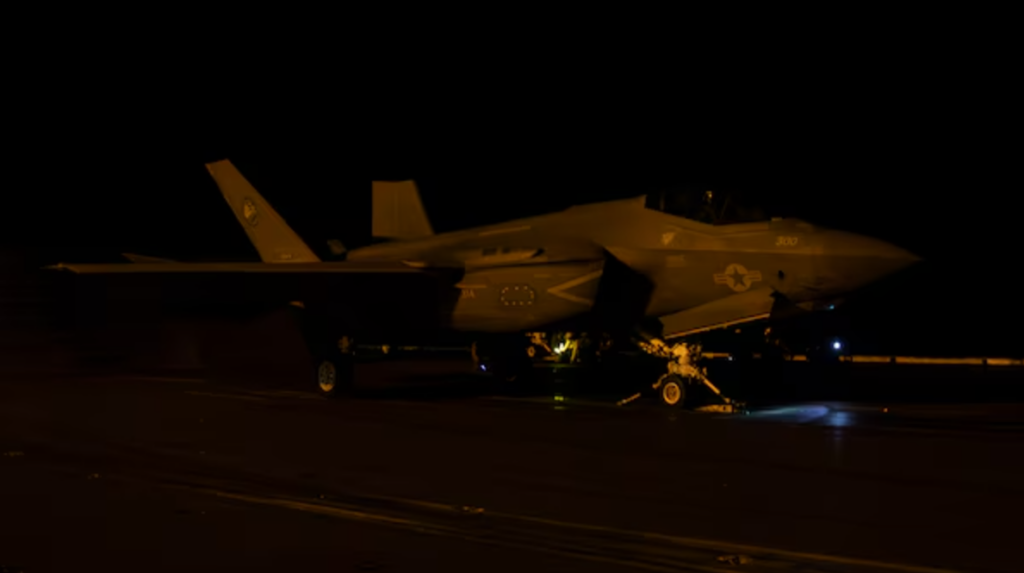
U.S. CENTRAL COMMAND AREA OF RESPONSIBILITY (Nov. 11, 2024) An F-35C Lightning II, attached to Marine Fighter Attack Squadron (VMFA) 314, prepares to launch from the flight deck of the Nimitz-class aircraft carrier USS Abraham Lincoln (CVN 72). (This photo has been altered for security purposes by blurring out names on aircraft) (Official U.S. Navy Photo)
By Carrier Strike Group 3 Public Affairs | November 18, 2024
U.S. CENTRAL COMMAND AREA OF RESPONSIBILITY —U.S. Marine Corps F-35C Lightning II aircraft, assigned to Marine Fighter Attack Squadron (VMFA) 314, conducted the first F-35C combat air strikes for the platform, Nov. 9-10.
VMFA 314, assigned to Carrier Air Wing (CVW) 9 aboard the Nimitz-class aircraft carrier USS Abraham Lincoln (CVN 72), conducted multiple strikes on Houthi weapons storage facilities within Houthi-controlled territories in Yemen. The facilities housed conventional weapons, including anti-ship missiles. The Iranian-backed Houthis used these weapons to target U.S. and international military and civilian vessels navigating international waters in the Red Sea and Gulf of Aden.
“The F-35C demonstrated its warfighting advantage by transiting contested airspace and striking targets in the heart of Houthi territory over multiple days,” said U.S. Marine Lt. Col. Jeffrey “Wiki” Davis, commanding officer of VMFA 314. “My Marines are honored to be first to fight with the F-35C.”
The F-35C is a fifth-generation, long-range stealth fighter jet used by the U.S. Navy, Marine Corps and Air Force, and is a multi-role aircraft able to perform a variety of missions, including air-to-air combat, air-to-ground strikes, reconnaissance and electronic warfare.
“The offensive and defensive capabilities of the F-35C absolutely enhance our air wing’s striking arm,” said U.S. Navy Capt. Gerald “Dutch” Tritz, commander, CVW 9. “The now battle-tested Air Wing of the Future has proven itself a game changer across all carrier air wing missions.”
Other variants of the aircraft include the F-35A and the F-35B. The F-35B first saw combat in 2018 when units assigned to the Essex Amphibious Ready Group conducted airstrikes against the Taliban in Afghanistan and ISIS in Syria. Air Force F-35A’s first combat mission was completed the year after against ISIS targets in Iraq.
The “Black Knights” of VMFA 314, based out of Miramar, Calif., transitioned from the F-18 to the F-35C in 2020, making them the first fleet squadron in both the Navy and Marine Corps to operate the 5th Generation fighter aircraft. VMFA 314 was also the first operational Marine squadron to fly the F-4 Phantom and F-18 Hornet.
VMFA 314, part of 3rd Marine Aircraft Wing, is the only deployed F-35C squadron in the Marine Corps.
Coast Guard Establishes New JROTC Program at Veterans Memorial High School in Corpus Christi
From U.S. Coast Guard Public Affairs Detachment Corpus Christi, Texas
Nov. 15, 2024
CORPUS CHRISTI, Texas – The Coast Guard established a new Junior Reserve Officers’ Training Corps Program at Veterans Memorial High School in Corpus Christi, Nov. 14.
Veterans Memorial High School’s Coast Guard JROTC unit is the 13th in the nation and has over 50 cadets enrolled in the inaugural semester.
“We’re excited to be at Veterans Memorial High School today. They’re off to an excellent start with Commander Gully and Chief O’Leary,” said Cmdr. Clay Cromer, Coast Guard JROTC program manager. “We’re thrilled with the cadets’ leadership, enthusiasm, and the initiative they’re bringing to the table early on.”
Coast Guard JROTC instructors are hired and employed by the school district and certified by the service. Instructors must be Coast Guard retired, selected reserve, or qualified veterans with at least eight years of service. Veterans Memorial High School’s Coast Guard JROTC instructors are Cmdr. Matthew Gully (USCG, Ret.) and Chief Petty Officer Mike O’leary (USCG, Ret.).
The National Defense Authorization Act of 2023 mandated the Coast Guard to establish and maintain JROTC programs in each of the nine Coast Guard districts by Dec. 31, 2025. The Coast Guard is establishing four new JROTC units this fall, bringing the total to 14 JROTC units, with program-wide enrollment of over 1200 cadets. These new units are at the following host schools:
Barnstable High School – Barnstable, MA
Innovation High School – Orlando, FL
Veterans Memorial High School – Corpus Christi, TX
Kalani High School – Honolulu, HI
Coast Guard JROTC is not a recruiting program. Cadets incur no military service obligation by participation in JROTC, but they may be eligible for advanced enlistment opportunities with 2 or more years of participation in the program. The program helps equip cadets with the skills necessary to be more prepared for tomorrow’s challenges, no matter what path they take.
Norfolk Naval Shipyard Delivers USS George H.W. Bush to Fleet on Time After PIA
The Nimitz-class aircraft carrier USS George H.W. Bush (CVN 77), transits to Naval Station Norfolk after on-time completion of an 11-month maintenance period at Norfolk Naval Shipyard and sea trials, Nov. 16, 2024. (U.S. Navy photo by MC2 Samuel Wagner)
By NAVSEA Office of Corporate Communications, Nov. 18, 2024
NORFOLK, Virginia – USS George H.W. Bush (CVN 77) successfully completed sea trials off the coast of Virginia this weekend, marking the successful on-time conclusion of its ten-month Planned Incremental Availability (PIA) at Norfolk Naval Shipyard (NNSY). The nation’s tenth Nimitz-class nuclear-powered aircraft carrier entered its PIA in January 2024.
In returning George H.W. Bush to the fleet on schedule, NNSY applied a series of innovative strategies and engineering solutions to modernize the ship’s safety, communications, and combat systems—scheduling a significant volume of advance work at nearby Naval Station Norfolk (NAVSTA Norfolk) prior to the carrier’s arrival at NNSY.
Key trades workers and shop mechanics worked alongside engineering and material support personnel at NAVSTA Norfolk, augmented by NNSY’s off-yard carrier team. More than 550 personnel supported the project at the peak of the maintenance availability. NNSY also employed experienced zone managers, who conducted the PIA for USS Dwight D. Eisenhower (CVN 69), completed in December 2022, to improve overall learning and performance.
As part of the modernization and maintenance work for George H.W. Bush, crews installed combination ovens in the ship’s galley; modular refrigeration equipment to improve system reliability; and upgrades to the Consolidated Afloat Networks and Enterprise Services system—a program the Navy has implemented across the Fleet to enhance shipboard computing systems and to consolidate multiple legacy networks.
The modernization effort also involved installing the Network Tactical Common Data Link (NTCDL) system, which enables the ship to simultaneously transmit and receive real-time intelligence, surveillance, and reconnaissance data from multiple sources. NTCDL also facilitates the exchange of command and control information over multiple data links, enhancing situational awareness and operational advantage.
NNSY’s success in delivering George H.W. Bush on time demonstrates how the nation’s public shipyards are looking beyond traditional workflows to meet the Chief of Naval Operations’ objective of putting more ready players—combat-ready platforms—on the field.
“The Bush team and crew supported this availability with capability and commitment,” said Capt. Jip Mosman, NNSY Commanding Officer. “Their teamwork and dedication to returning this critical asset to the fleet will serve as the model for future maintenance and modernization programs in America’s shipyards.”
Getting advanced systems and capabilities into the hands of warfighters at speed and scale requires people at every level of the shipbuilding and maintenance enterprise to think, act, and operate differently. NNSY’s culture of collaborative planning among its highly skilled workforce enabled the shipyard to marshal the material and alternative resources necessary to deliver the aircraft carrier’s complex work packages on schedule.
NNSY’s on-time completion of the George H.W. Bush PIA adds to a recent list of successes at the shipyard, including the undocking of USS Toledo (SSN 769) undergoing Engineered Overhaul (EOH) and USS Montpelier (SSN 765) docking for its EOH.
For more information on NNSY and the other U.S. Naval Shipyards—Portsmouth Naval Shipyard, Puget Sound Naval Shipyard and Intermediate Maintenance Facility, and Pearl Harbor Naval Shipyard and Intermediate Maintenance Facility—please visit https://www.navsea.navy.mil/Home/Shipyards/.
Coast Guard Cutter Stratton Returns Home Following 110-day Arctic Deployment
The Coast Guard Cutter Stratton (WMSL 752) transits Glacier Bay, Alaska, Aug. 1, 2024, while patrolling the region. Stratton’s crew returned to its homeport in Alameda, Calif., on Nov. 4, after completing a 110-day patrol in the Arctic Ocean, Chukchi Sea and Bering Sea. (U.S. Coast Guard courtesy photo)
From U.S. Coast Guard Pacific Area, Nov. 15, 2024
ALAMEDA, Calif. — The crew of Coast Guard Cutter Stratton (WMSL 752) returned to its Alameda homeport on Nov. 4, after completing a 110-day patrol in the Arctic Ocean, Chukchi Sea and Bering Sea.
Stratton departed Alameda on July 18 and patrolled the Alaskan Inside Passage to Juneau, Alaska, throughout the Gulf of Alaska, the Bering Sea and into the Arctic Ocean. The crew supported U.S. strategic interests in the high latitudes and ensured the safety and compliance of domestic fishery operators. This was Stratton’s second 110-day Alaska patrol in 2024.
During the patrol, Stratton’s crew tracked and observed two Russian Federation Navy surface action groups transiting through U.S. waters above the Arctic Circle. Stratton patrolled under Operation Frontier Sentinel, an operation designed to meet presence with presence when strategic competitors operate in and around U.S. waters. The Coast Guard’s presence strengthens the international rules-based order and promotes the conduct of operations in a manner consistent with international law and norms.
While patrolling the Arctic, Stratton conducted the first at-sea refueling evolutions for a national security cutter in the high latitudes. The at-sea refueling extended patrol times in the Arctic and enabled persistent Coast Guard presence in the remote region.
Stratton conducted 20 boardings of commercial fishing vessels and foreign trans-shipment vessels enforcing safety and fishing regulations. Alaska’s fisheries are some of the nation’s largest providers of seafood and are a critical component of the U.S. economy. The Coast Guard’s efforts in ensuring safe fishing practices are essential to support this vital industry.
Stratton’s crew also conducted search and rescue (SAR) operations while deployed to the region. Stratton responded to the fishing vessel Galatea, which was adrift in a storm without propulsion due to a severed engine cooling line. Stratton crew deployed to the fishing vessel, repaired the casualty, and safely escorted Galatea to Dutch Harbor.
Stratton also responded to the 738-foot cargo tanker Pan Viva beset by a storm north of Dutch Harbor. After losing propulsion, the vessel was in danger of running aground in seas greater than 30’ and 90-mile-per-hour winds. Stratton provided operational oversight to Pan Viva as Coast Guard MH-60 helicopter air crews evacuated non-essential personnel and commercial tugs aided the vessel.
Throughout the patrol, Stratton conducted 334 deck landings qualifications with Air Station Kodiak’s MH-60 helicopter air crews operating near the Alaskan towns of Utqiagvik and Kotzebue above the Arctic Circle, to Cold Bay and Dutch Harbor in the Bering Sea. Stratton’s coordination of these flight operations provided training opportunities for the crews to enhance their SAR capabilities in the remote areas of Alaska, which tripled the number of shipboard-qualified pilots in the Alaska region.
“I am extremely proud of the resilience and professionalism of Stratton’s crew who’ve spent eight of the last ten months at sea in Alaska, conducting missions to safeguard our nation and people throughout two deployments to the region,” said Capt. Brian Krautler, Stratton’s commanding officer. “We met foreign presence in the Arctic, demonstrating our ability and resolve to protect our most challenging border and we found new ways to extend our presence, devising means to refuel at sea in the high latitudes. We boarded U.S. and foreign vessels to ensure compliance with legal and safety regulations, we enhanced SAR capabilities through rigorous flight training and conducted important search and rescue cases in our most demanding area of operations.”
Stratton also met with the Royal Canadian Navy leadership during a port call in Victoria, Canada, to discuss strategic interests and cooperative efforts in the region. Stratton hosted three Royal Canadian Navy members during the patrol, enhancing U.S. and Canadian interoperability.
Additionally, Stratton conducted community relations engagements in the remote Alaskan communities of Savoonga, Teller and Brevig Mission. During these engagements, crew members met with tribal and city council leadership, volunteered at elementary schools, provided training in water and boating safety, participated in community-wide events including a high-latitude half-marathon, and learned about Inupiat culture, aiding in the service’s understanding of the communities and how to optimize support for remote Alaskan villages.
Commissioned in 2012, Stratton is one of ten commissioned legend-class national security cutters and one of four homeported in Alameda. National security cutters are 418-feet long, 54-feet wide, and have a 4,600 long-ton displacement. They have a top speed of 28 knots, a range of 12,000 nautical miles, and can hold a crew of up to 170. Stratton routinely conducts operations throughout the Pacific, where the cutter’s combination of range, speed, and ability to operate in extreme weather provides the mission flexibility necessary to conduct vital strategic missions.
Stratton’s namesake is Capt. Dorothy Stratton, who led the service’s all-female reserve force during World War II. Dorothy Stratton was the first female commissioned officer in the Coast Guard and commanded more than 10,000 personnel. The ship’s motto is “we can’t afford not to.”
USS Nantucket Commissioned
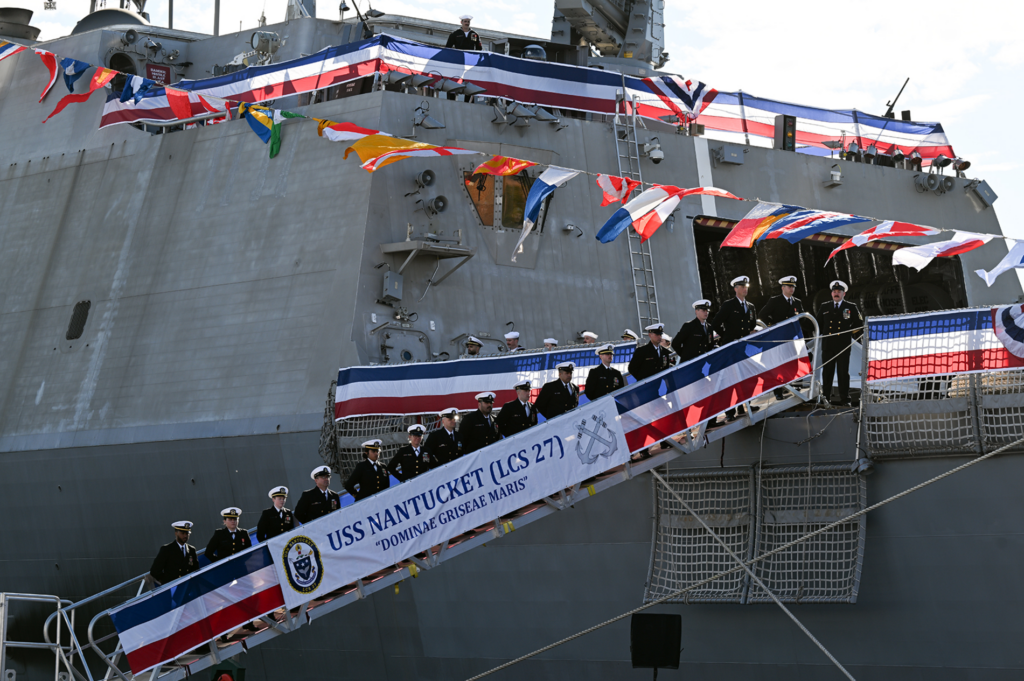
The crew of USS Nantucket (LCS 27) salutes as they bring the ship to life during its commissioning ceremony in Boston. (EJ Hersom)
Nov. 18, 2024
From Lt. Ayifa Brooks
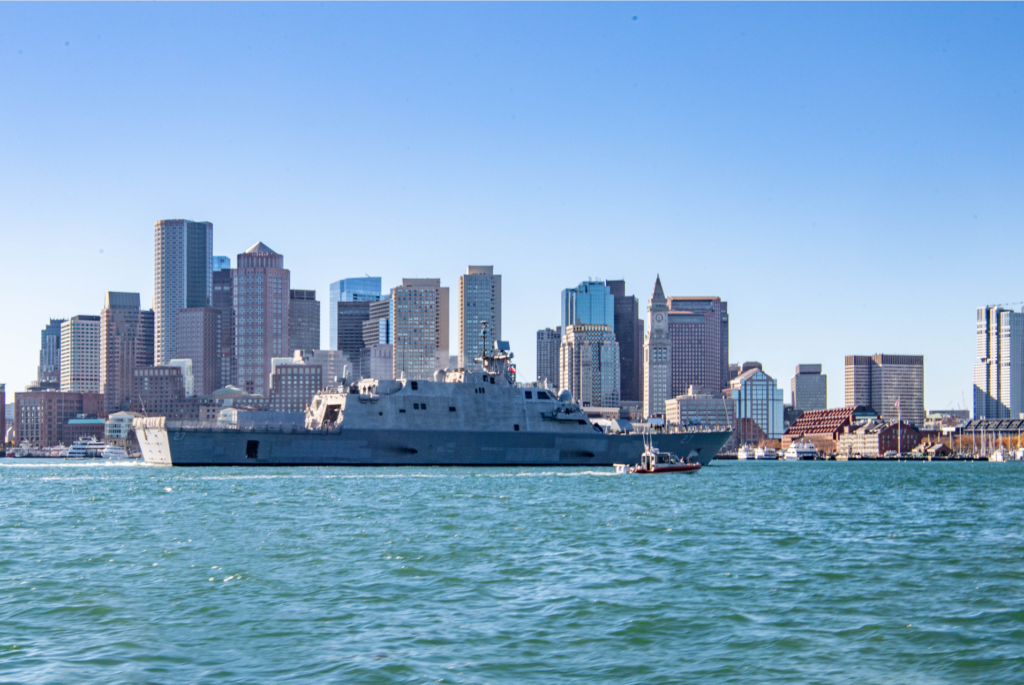
BOSTON — The U.S. Navy commissioned its newest Freedom-variant littoral combat ship, USS Nantucket (LCS 27), Nov. 16, 2024, in Boston. To honor naval history, Nantucket became the newest ship in the fleet while moored stern-to-stern with USS Constitution, the U.S. Navy’s oldest commissioned ship.
“I want to thank all of you for your service and your dedication, I know it’s been a long journey to get to this point. In the past few weeks alone, you’ve traveled over 2,000 nautical miles through four Great Lakes and 15 locks to get here.” said the Honorable Michelle Wu, mayor of Boston, Massachusetts. “While we know the Charlestown Navy Ship Yard isn’t your final stop, it’s a source of great pride for this city and the people of Boston to be granted the privilege of sending you off to your homeport.”
Guest speakers for the event also included the Honorable Maura Healey, Governor of the Commonwealth of Massachusetts, who delivered the commissioning ceremony’s principal address. Remarks were also provided by the Honorable Polly Spencer, ship’s sponsor; the Honorable Bill Keating, U.S. Representative, Massachusetts’ 8th District; the Honorable Meredith Berger, Assistant Secretary of the Navy for Energy, Installations and Environment; Vice Adm. Michael Boyle, Director of Navy Staff; and Mr. Paul Lemmo, Vice President and General Manager, Lockheed Martin Integrated Warfare Systems and Sensors.
“Today we gather to celebrate a remarkable addition to our naval fleet, USS Nantucket. I’m honored to represent Lockheed Martin and we’re proud to partner with the U.S. Navy to build the Freedom-variant littoral combat ships,” said Lemmo. “USS Nantucket is not just a ship, it embodies innovation, resilience, and the spirit of our maritime forces.”
The ship’s sponsor, The Honorable Polly Spencer, wife of the 76th Secretary of the Navy, joined by her two daughters, Sarah Minella and Amy Ambrecht gave the order to “man our ship and bring her to life!”
“I’m so heartened to look out and see young boys and girls here and I hope they leave today inspired to answer the call to service,” said Healy. “The freedom – all the freedoms, all the privileges that we enjoy today as Americans are only possible because of those who have served and those who continue to serve.”
Nantucket is the 14th Freedom-variant littoral combat ship (LCS) commissioned in the United States Navy and the third to be commissioned in naval service to bear this namesake.
USS Nantucket (LCS 27) was built by the Lockheed Martin and Fincantieri Marinette Marine in Marinette, Wisconsin. The ship was authorized on Oct. 10, 2017, and named on Feb. 13, 2018. It was christened Aug. 7, 2021, and completed acceptance trials the following year. The ship was delivered to the U.S. Navy on July 29, 2024.
“My journey began in September 2021 when I received word that I would be the first commanding officer of USS Nantucket and unveiled the crest on the island.” said Cmdr. Kari Yakubisin, Nantucket’s commanding officer. “Our mission on Nantucket is the same as the Constitution was in 1812, while technology has changed over the last 200 years, the mission of the United States Navy remains the same, keep the sea lanes open for commerce, deter piracy and promote peace around the world. I am proud of this crew and the hard work they put in for the last seven months.”
LCS class ships like Nantucket will be equipped with Over the Horizon – Weapons System (OTH-WS) Naval Strike Missile (NSM). The OTH NSM provides the U.S. and its allies with long range anti-surface offensive strike capability as well as increased coastline defense, deterrence, and interoperability. This will include the MK 70 Payload Delivery System (PDS) which uses combat proven MK 41 Vertical Launching System (VLS) technology to provide mid-range precision fires capabilities. The MK 70 enables rapid deployment of offensive capability to non-traditional platforms and locations.
The ceremony featured early successes, milestones, fair wishes, and following seas while showcasing a weeklong series of events celebrating the ship, its crew, community and namesake city.
USS Nantucket will be homeported at Naval Station Mayport, Florida.
LCS is a fast, agile, mission-focused platform designed for operation in near-shore environments yet capable of open-ocean operation. It is designed to defeat asymmetric “anti-access” threats such as mines, quiet diesel submarines and fast surface craft. They are capable of supporting forward presence, maritime security, sea control, and deterrence.
The mission of CNSP is to man, train, and equip the Surface Force to provide fleet commanders with credible naval power to control the sea and project power ashore.
For more news from Naval Surface Forces, visit DVIDS – Commander, Naval Surface Force, U.S. Pacific Fleet, and Commander, Naval Surface Force, U.S. Pacific Fleet.
Navy to Commission Future Littoral Combat Ship Nantucket
From the Navy Office of Information, 15 November 2024
Freedom-variant littoral combat ship USS Nantucket (LCS 27) will be commissioned on November 16, 2024, at 10:00 a.m. EST in Boston, Massachusetts.
The Honorable Maura Healey, Governor of the Commonwealth of Massachusetts will deliver the principal address at the commissioning ceremony. Remarks will also be provided by The Honorable Bill Keating, U.S. Representative, Massachusetts 9th District, The Honorable Meredith Berger, Assistant Secretary of the Navy for Energy, Installations, and Environment, Vice Admiral Michael Boyle, Director of Navy Staff, The Honorable Michelle Wu, Mayor of Boston, Massachusetts, and Mr. Paul Lemmo, Vice President and General Manager, Integrated Warfare Systems and Sensors, Lockheed Martin.
The ship’s sponsor is Polly Spencer, a business owner, grandmother, and wife of Richard Spencer, the 76th Secretary of the Navy. Mrs. Spencer’s connection to Nantucket dates back to 1976, when she was a year-round resident of the island, raising her three children and owning and operating a children’s clothing and toy store. As the wife of Richard Spencer, she traveled to visit sailors, Marines, and their families both at home and abroad. Noting the sacrifices and unwavering dedication she observed, she cites this experience—along with being the sponsor of USS Nantucket—as the highlights of her career.
“The crew, along with our industry partners, have worked tirelessly over the past several years to bring the USS Nantucket (LCS 27) to life, and I am proud of each of them for their contributions and service,” said Secretary Del Toro. “Nantucket already made an impact when she supported a U.S. Coast Guard operation in October in Lake Erie. I take great pride in knowing that Nantucket represents the future of our Fleet and Force — equipped with advanced technology and sailed by our Navy’s best and brightest crews.”
Nantucket is the 14th Freedom-variant littoral combat ship (LCS) commissioned in the United States Navy and the third U.S. Navy ship to bear this name.
The LCS class consists of two variants: the Freedom and the Independence, designed and built by two industry teams. Lockheed Martin leads the Freedom-variant team, building the odd-numbered hulls in Marinette, Wisconsin. Austal USA leads the Independence-variant team in Mobile, Alabama, constructing LCS 6 and the subsequent even-numbered hulls.
Littoral combat ships like Nantucket will be equipped with Over the Horizon – Weapons System (OTH-WS) Naval Strike Missile (NSM). The OTH NSM provides the U.S. and its allies with long range anti-surface offensive strike capability as well as increased coastline defense, deterrence, and interoperability.
Littoral combat ships are fast, optimally manned, mission-tailored surface combatants that operate in both near-shore and open-ocean environments, countering 21st-century coastal threats. LCS ships integrate with joint, combined, manned, and unmanned teams to support forward presence, maritime security, sea control, and deterrence missions around the globe.
The ceremony will be live-streamed at www.dvidshub.net/webcast/34487. The link will become active approximately ten minutes prior to the event, at 09:50 a.m. EST.
Media inquiries may be directed to the Navy Office of Information at (703) 697-5342. For more information on the littoral combat ship program, visit: https://www.navy.mil/Resources/Fact-Files/Display-FactFiles/Article/2171607/littoral-combat-ship-class-lcs/
Naval Research Lab Completes Development of Satellite-Servicing Robotics
Nov. 15, 2024 | By Nicholas Pasquini, U.S. Naval Research Laboratory
United States Naval Research Laboratory Naval Center for Space Technology, in partnership with Defense Advanced Research Projects Agency, has successfully completed development of a spaceflight qualified robotics suite capable of servicing satellites in orbit, Oct. 8.
Under DARPA funding, NRL developed the Robotic Servicing of Geosynchronous Satellites Integrated Robotic Payload. This transformative new space capability was delivered to DARPA’s commercial partner, Northrop Grumman’s SpaceLogistics, for integration with its spacecraft bus, the Mission Robotics Vehicle.
“The recent completion of thermal vacuum testing marks a major milestone toward achieving the program’s goal of demonstrating robotic servicing capabilities on orbit in the near future,” said NRL Director of Research Bruce Danly. “NRL’s contributions to the robotic payload are an essential part of realizing this vision, which promises to transform satellite operations in geostationary orbit, reduce costs for satellite operators, and enable capabilities well beyond what we have today. In fact, the anticipated capabilities are potentially revolutionary for both national security and civil applications.”
As DARPA’s robotic payload developer for the RSGS program, NRL looked to the future to design, build, integrate and test groundbreaking satellite servicing capabilities.
“This collaboration unlocks new servicing opportunities for both commercial and government satellites, enabling usual-close inspections, orbital adjustments, hardware upgrades, and repairs,” said Bernie Kelm, NRL NCST superintendent of the spacecraft engineering division. “We’ve created advanced spaceflight hardware and software that will significantly enhance satellite servicing operations, including all robotic controls.”
Satellites in geosynchronous orbit, positioned approximately 22,000 miles above Earth, are crucial for military, government and commercial communications, Earth-observing science and national security services.
Currently, spacecraft face significant challenges, in part because of the inability to perform in-orbit repairs or upgrades. To compensate for the lack of servicing options, satellites are often loaded with backup systems and excess fuel, leading to increased complexity, weight and cost. Should this project prove successful, satellites can receive in-orbit upgrades based on new technology to extend their service life, Kelm added.
“The military regularly fixes aircraft, tanks, ships and trucks that break. We upgrade aircraft and ships with the latest radars, computers and engines,” said Glen Henshaw, NRL senior scientist for Robotics and Autonomous Systems. “Satellites are the only expensive equipment we buy that can’t be repaired or upgraded once they are in the field, and this costs the taxpayer money. RSGS is intended to change this situation; we intend to demonstrate that we can upgrade and repair these valuable assets using robots.”
Thermal Vacuum (TVAC) Testing Process
The test campaign put the robotic payload through its paces across the range of temperatures it will face while on-orbit and under vacuum conditions similar to space. Engineers tested all aspects of the payload including avionics, cameras and lights, and demonstrated all operations, with each of its two robotic arms including launch lock deployments, calibrations and tool changing. The test also verified SpaceWire communications and robotic compliance and visual servo control modes.
“NRL’s Team RSGS has spent nearly 10 years focused on the goal of completing this first of a kind, robotic servicing payload,” said William Vincent, NRL RSGS program manager. “The completion of IRP TVAC represents a huge milestone and countless hours of work from an incredible group of dedicated personnel. Like sending a child off to college for the first time, shipping the IRP to Dulles is a bittersweet experience.”
NRL worked for over two decades to mature the technology enabling the RSGS program. RSGS is designed to safely and reliably repair and upgrade valuable commercial, civil and national security satellites, some of which cost over a billion dollars. In the near future, robotic satellite “mechanics” may extend the useful life of satellites by upgrading a variety of capabilities including new electronics, propulsion and sensors capabilities. RSGS robots could demonstrate broad servicing as a precursor to building large structures in-orbit which could include the next great observatory, solar power stations or other revolutionary new systems.
“We hope that this will eventually lead to spacecraft that are more modular and easier to maintain,” Henshaw said.
Following its anticipated 2026 launch on the Northrop Grumman’s MRV spacecraft bus, the robotic payload will undergo initial checkout and calibration with full operational servicing missions to follow.
“We will proudly watch RSGS as it provides resilience for the current U.S. space infrastructure and takes the first concrete steps toward a transformed space architecture with revolutionary capabilities,” Vincent said.
About the U.S. Naval Research Laboratory
NRL has a long-standing relationship with academia and industry as a collaborator, contractor, and through technology transfer partnership mechanisms, such as commercial licensing, cooperative research and development agreements and educational partnership agreements.
NRL is a critical link within the Navy’s research, development and acquisition chain and naval research enterprise. Through NRL, the Navy has direct ties with sources of fundamental ideas in industry and the academic community throughout the world and provides an effective coupling point to the research and development chain for Office of Naval Research. NRL is a scientific and engineering command dedicated to research that drives innovative advances for the U.S. Navy and Marine Corps from the seafloor to space and in the information domain. NRL is located in Washington, D.C. with major field sites in Stennis Space Center, Mississippi; Key West, Florida; and Monterey, California, employing approximately 3,000 civilian scientists, engineers and support personnel.
Task Force 61/2: Strengthening Crisis Response and Amphibious Readiness Across Europe, Africa
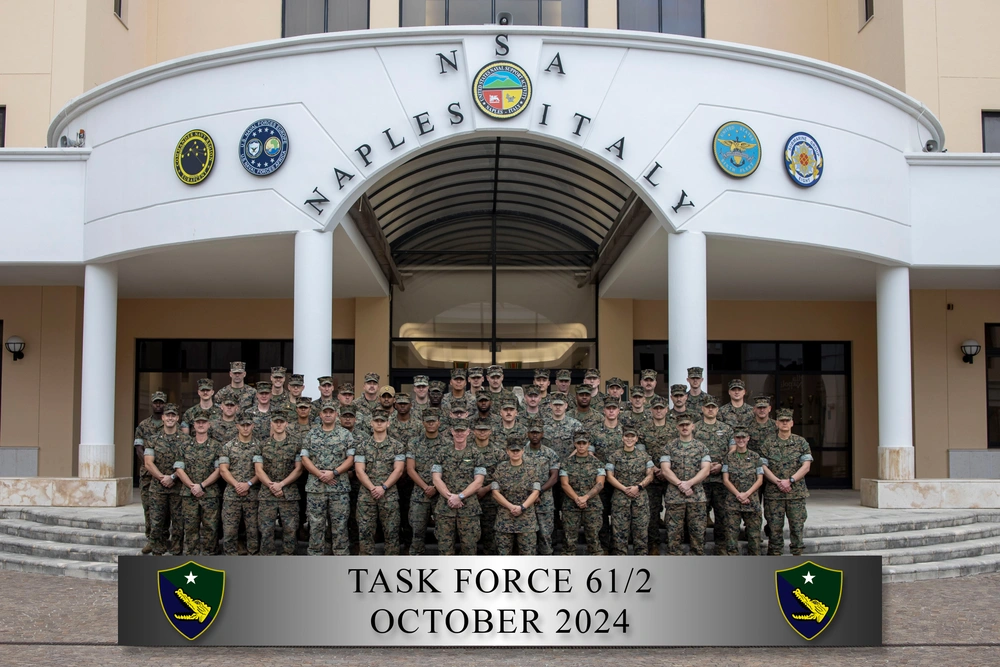
U.S. Marines and Sailors with Task Force 61/2 pose for a group photo at Naval Support Activity, Naples, Italy, Oct. 10, 2024. (U.S. Marine Corps photo by Cpl. Marc Imprevert)
From Task Force 61/2, Nov. 15, 2024
NAPLES, Italy –Task Force 61/2 (TF 61/2) stands at the forefront of the Marine Corps and Navy’s integration efforts in the Mediterranean, enhancing amphibious operations and ensuring that U.S. forces are always ready to respond to any crisis in the region. Based in Naples, Italy, TF 61/2 operates with a scalable presence, supporting Amphibious Ready Group (ARG) and Marine Expeditionary Unit (MEU) deployments in the U.S. European Command (EUCOM) and U.S. Africa Command (AFRICOM) theaters. When the ARG/MEU is not forward deployed in the EUCOM and AFRICOM areas of responsibilities, TF 61/2 maintains a smaller staff in Naples, ready to surge forward to command and control the ARG/MEU or respond to emerging crises in the European and African areas of responsibilities. TF 61/2 is currently staffed by Marines and Sailors from the 2nd Marine Expeditionary Brigade (2d MEB), a subordinate command of II Marine Expeditionary Force (II MEF). Currently, TF 61/2 is commanding and controlling the deployed Wasp Amphibious Ready Group (WSP ARG) composited with the 24th MEU Special Operations Capable (SOC), one of the Marine Corps’ most adaptable and responsive forces. In addition to the ARG/MEU, when forward deployed, TF 61/2 exercises tactical control of Fleet Anti-terrorism Security Team Company, Europe (FASTEUR), as well as reconnaissance and counter-reconnaissance (RXR) forces and other deployed II MEF units as part of Marine Rotational Forces-Europe (MRF-E). The task force maintains an unwavering focus on readiness to respond to crisis, providing swift, flexible options for U.S. Naval Forces Europe and Africa (NAVEUR-NAVAF), U.S. 6th Fleet and U.S. Marine Corps Forces, Europe and Africa (MFEA). TF 61/2 embodies the Marine Corps’ commitment to naval integration, ensuring that the ARG/MEU team is capable and ready to execute amphibious operations, humanitarian assistance, crisis operations, and joint missions with NATO Allies and partners.
The 39th Commandant of the Marine Corps’ Planning Guidance underscores the critical role of II MEF as the Marine Corps’ primary crisis-response force, designed to respond swiftly to emerging contingencies. II MEF is prepared to organize and deploy units through a Marine Air-Ground Task Force (MAGTF) construct, allowing for flexible, mission-tailored force deployment. While II MEF is not directly assigned to any combatant commander, it is structured to be responsive across multiple theaters, including U.S. European Command, Africa Command, Central Command, Southern Command, and Northern Command. This versatility allows II MEF to remain ready for an array of contingencies, acting as a first response for planned and emerging operations while remaining able to augment, reinforce, or even lead joint task force operations. Within this framework, when the 2d MEB, as a subordinate command of II MEF, deploys forward to Naples, Italy, it assumes the role of TF 61/2. As a forward-deployed extension of II MEF, 2d MEB serving as TF 61/2 embodies this readiness, seamlessly commanding and controlling the deployed ARG/MEU to ensure a crisis response capability is continuously available across Europe and Africa whenever needed.
The ARG/MEU is also prominently featured in the Commandant’s Planning Guidance, which underscores its role as the nation’s premier crisis response force, combining flexibility and responsiveness. The ARG/MEU provides the United States with a powerful seabasing capability, uniquely equipped to execute amphibious operations, which ensures it can respond to crises swiftly. TF 61/2, currently commanding and controlling the WSP ARG-24th MEU (SOC), is at the core of this mission, as the ARG/MEU brings forward-deployed, combat-credible forces into the Mediterranean and other high-priority regions. The ARG/MEU’s ability to execute complex operations, from humanitarian aid and crisis response to combat missions, aligns with the Commandant’s vision of a continuously modernizing force that adapts to geographic combatant commander requirements. TF 61/2, therefore, not only supports U.S. 6th Fleet but also enhances the Marine Corps’ ability to provide the crisis response that U.S. national defense strategy demands.
Since 2022, TF 61/2’s presence in Naples has been a critical element of the U.S. strategy to maintain a flexible and scalable forward-deployed amphibious force in the region, adjusting its staff as needed to support ARG/MEU operations and regional crises. Under the command of Brig. Gen. Samuel L. Meyer, who assumed leadership of 2d MEB and TF 61/2 in May 2024, the task force continues its mission of readiness and preparation for crisis response. The addition of Sgt. Maj. Elena M. Rodriguez marks the first time 2d MEB and TF 61/2 have had an appointed sergeant major, providing enhanced leadership across all levels, and ensuring that all Marines and Sailors in the task force are fully prepared to execute their missions.
“Our ability to remain forward deployed and ready to respond to crises, is built on the integration of the Navy and Marine Corps,” said Meyer. “TF 61/2, with the WSP ARG-24th MEU (SOC), is an adaptable force capable of executing a wide range of operations. We’re committed to maintaining the highest standards of readiness, ensuring that we’re prepared for any contingency.”
The initial deployment of TF 61/2 in the early spring of 2022 marked a new era in U.S. 6th Fleet’s approach to amphibious operations and forward presence in the Mediterranean. Since then, the task force has become a crucial element in real-world crisis response and joint training exercises with NATO Allies and partners. Notably, in early 2023, TF 61/2 was pivotal in humanitarian relief efforts following earthquakes in Turkey. U.S. military personnel assigned to TF 61/2 and the 39th Air Base Wing (ABW) were tasked with building a field hospital for citizens affected by the February earthquakes. Upon completion of the field hospital in March 2023, leaders from TF 61/2 and the 39th ABW conducted a final walk-through with Turkish officials before the Turkish Ministry of Health assumed operations of the facility. This mission underscored the U.S. commitment to NATO Allies and highlighted TF 61/2’s readiness to mobilize forces swiftly in support of humanitarian operations.
In July 2023, TF 61/2 provided wildfire support in Greece. An immediate response team from TF 61/2 deployed as a forward element to Greece to coordinate and exercise tactical control of U.S. European Command forces supporting firefighting and relief efforts. The Bataan ARG-26th MEU (SOC), forward deployed during this time, also worked closely with local authorities, assisting in firefighting and evacuation operations that demonstrated the versatility and responsiveness of U.S. amphibious forces.
“TF 61/2’s ability to respond to real-world crises, such as the earthquakes in Turkey, and wildfires in Greece, underscores the importance of maintaining a high level of readiness and rapid response posture,” said Col. Andrew Martinez, deputy commander, TF 61/2. “These operations demonstrate the importance of a forward-deployed TF 61/2 command element and ARG/MEU capable of executing missions that protect U.S. interests and assist our Allies and partners in times of need.” The experiences gained from these real-world operations have further strengthened TF 61/2’s preparedness and ability to command and control the ARG/MEU. The task force’s presence in Naples has ensured a continued close partnership with NATO Allies and partners, further enhancing interoperability and joint amphibious capabilities.
Under the command of Meyer and Rodriguez, TF 61/2 has continued to refine its capabilities and ensure the readiness of the WSP ARG-24th MEU (SOC). The task force’s involvement in Baltic Operations (BALTOPS) in June 2024, a NATO-led exercise in the Baltic Sea, exemplified its commitment to joint operations and amphibious warfare. During BALTOPS 24, key personnel from TF 61/2 operated aboard the Blue Ridge-class command and control ship USS Mount Whitney (LCC 20), successfully commanding and controlling amphibious forces while integrating in close coordination with NATO Allies. This exercise tested TF 61/2’s multi-domain reconnaissance and amphibious capabilities, reinforcing its role as a crucial command and control element in contested environments.
BALTOPS 24 enhanced interoperability and cooperation among NATO Allies, focusing on freedom of navigation and defending the Baltic Sea region. Throughout the exercise, TF 61/2 combined with Expeditionary Strike Group 2 (ESG-2) and became Commander Task Force 162 (CTF 162), with Meyer serving as Commander, Landing Forces (CLF) and Rear Adm. Benjamin Nicholson as Commander, Amphibious Task Force (CATF). During BALTOPS 24, TF 61/2 worked closely with the WSP ARG-24th MEU (SOC), as well as NATO Allies, including Spanish, French, and Dutch naval forces, and played a key role in each of the training phases. The training phases emphasized joint tactical operations and amphibious operations, culminating in a “free-play” scenario to simulate real-world contingencies and build on NATO’s interoperability.
“Our participation in BALTOPS 2024 aboard the Mount Whitney highlighted our ability to operate seamlessly with NATO Allies and lead amphibious operations in contested environments,” said Meyer. “We’ve taken those lessons and applied them to our day-to-day mission, ensuring that we’re ready to respond to any real-world crisis.”
TF 61/2 remains constantly prepared and vigilant, continuously planning for any potential real-world crisis that may arise within the region during its deployment. By maintaining a high state of readiness, TF 61/2 ensures it can swiftly respond to emerging situations, coordinating closely with NAVEUR-NAVAF, U.S. 6th Fleet, and MFEA to assess regional developments and adjust plans as needed. Through regular readiness exercises, crisis response drills, and joint planning sessions with NATO Allies and partners, TF 61/2 continually reinforces its ability to respond to crises at a moment’s notice. This commitment to proactive planning and scalable operational flexibility, positions TF 61/2 as a critical force ready to support stability and security across Europe, the Mediterranean, and Africa.
“Seamless coordination with our Navy counterparts and NATO Allies and partners is essential to maintaining readiness,” said Rodriguez. “The leadership team here at TF 61/2 ensures we stay focused on our mission and maintain the readiness needed to support U.S. 6th Fleet and MFEA. We stand ready to respond to any situation, anywhere in the region.”
This commitment to Marine Corps and Navy integration remains central to TF 61/2’s mission, providing U.S. 6th Fleet with a highly adaptable force that can rapidly respond to emerging crises. Regular participation in NATO exercises, such as BALTOPS, ensures TF 61/2’s ability to project power, enhance interoperability, and execute complex operations in collaboration with Allied and partner forces.
“Our ability to integrate with the Navy ensures that we can execute our mission and provide the rapid-response capability that our nation depends on,” added Martinez. “TF 61/2 and the ARG/MEU remain ready to forward deploy, whether it’s for combat operations, humanitarian aid, or supporting our NATO Allies and partners.”
As 2d MEB nears the end of its current deployment to Naples as TF 61/2, beginning in May 2024, the task force remains fully prepared to respond to real-world crises. Drawing on lessons from past operations, such as the Turkey earthquakes and Greek wildfires, TF 61/2 has played a crucial role in planning and preparing for potential crisis operations, building on its experience to ensure readiness for any emerging contingency. The task force’s command and control capabilities allow it to support NAVEUR-NAVAF, U.S. 6th Fleet, and MFEA, ensuring a vital forward presence that reinforces U.S. commitments to Allies and partners, and enhances stability in the region.
“Our focus is on integrating with the Navy, to ensure that we can respond to any crisis quickly and decisively,” said Meyer. “We have an amazing team here at TF 61/2, and I’m confident in our ability to meet any challenge.”
Since its initial deployment to Naples in 2022, TF 61/2 has cemented its role as an indispensable asset in the European and African theaters. Under the steadfast leadership of Meyer and Rodriguez, the task force has built on its amphibious operations legacy, continually enhancing its readiness, command and control capabilities, and integration with NATO Allies and partners. TF 61/2 scales back its presence in Naples once the ARG/MEU redeploys, but always maintains its readiness to surge forward as needed for crisis response. Whether participating in major exercises, responding to humanitarian needs, or maintaining its forward-deployed posture, TF 61/2 exemplifies the Marine Corps’ commitment to amphibious warfare and crisis response. As the task force looks ahead, it remains focused on its mission to be always ready, always prepared, and always poised to meet any challenge at any time.
Coast Guard Holds Ribbon-Cutting Ceremony for New Air Station Ventura
Coast Guard Fireman Xander Belchere, assigned to Coast Guard Air Station Ventura, cuts a ribbon during the commissioning ceremony for Air Station Ventura at Naval Base Ventura County in Point Mugu, California, Nov. 13, 2024. The ribbon-cutting and commissioning ceremony marked the establishment of the newest Coast Guard air station in 25 years. (U.S. Coast Guard photo by Petty Officer 1st Class Loumania Stewart)
From U.S. Coast Guard District Eleven, Nov. 13, 2024
VENTURA, Calif. — The Coast Guard is proud to announce the opening of its newest air station at Naval Base Ventura County, Point Mugu. The ribbon cutting and commissioning ceremony was held today, marking the establishment of the newest Coast Guard air station in 25 years.
Air Station Ventura features a $70 million state-of-the-art, 48,000 square foot hangar and a 12,000 square foot administration facility, ensuring that Coast Guard personnel have the resources needed to carry out their vital missions. This new facility is expected to house three MH-60 Jayhawk helicopters and approximately 100 personnel, significantly enhancing the Coast Guard’s capabilities in the region.
“The establishment of Air Station Ventura is a critical development for the Coast Guard’s operations within the Eleventh District area of responsibility,” said Rear Adm. Joseph R. Buzzella, commander, Coast Guard District Eleven. “This new station offers ready resources that provide safety and security to the maritime community. This is a monumental day for the air crews and for the community in which they serve.”
Recently, the aircrew of Air Station Ventura conducted three rescues:
Oct. 13, 2024: Air Station Ventura medevac a 63-year-old woman suffering from abdominal pain from the Cruise Ship Grand Princess
Oct. 17, 2024: Air Station Ventura hoists a diver from vessel in 10-foot seas suffering decompression sickness near Anacapa Islands in Channel Islands.
Oct. 31, 2024: Air Station Ventura medevac a man suffering from seizures from Cruise Ship Celebrity Radiance
“The recent rescues by the team at Air Station Ventura is a testament to the skill, dedication and readiness of our aircrews,” said Cmdr. Amanda Sardone, commanding officer, Air Station Ventura. “As plank owners, our crew will continue to leave a lasting mark on the future of this unit and service.”
The air station serves a crucial role in protecting the maritime region from Orange County to San Luis Obispo County including the vital ports of Los Angeles and Long Beach encompassing an area of responsibility more than 350 nautical miles.. Its missions include 24/7 emergency response; search and rescue; drug and migrant interdiction; law enforcement; and marine safety and environmental protection. The permanent presence of the Coast Guard in Ventura County provides enhanced security and quicker response times to emergencies, benefiting both the local community and maritime industries. District 11 now consists of five air stations in its area of responsibility to include: Humboldt Bay, San Francisco, Sacramento, San Diego and Ventura.
Airbus MH-65 Dolphin Helicopter Passes 40 Years of Coast Guard Service
From Airbus Helicopters
Today, Nov. 14, Airbus and the U.S. Coast Guard (USCG) are celebrating the 40th anniversary of the Airbus MH-65 Dolphin helicopter fleet supporting the USCG’s vital life-saving missions.
Key Highlights:
The first MH-65 Dolphin was delivered on November 14, 1984 to the USCG at Airbus’ Grand Prairie, Texas facility, which continues to service and support the maintenance of this fleet today.
In honor of this milestone, a Houston Coast Guard station will fly in an MH-65 to meet the Airbus team responsible for their ongoing support at the Airbus Helicopters’ facility in Grand Prairie, Texas.
Airbus employees in the Dallas area work tirelessly to ensure the Coast Guard can execute their critical missions effectively.
Quick Facts about the Airbus MH-65 Dolphin helicopter:
In Service: Nearly 100 helicopters supporting the U.S. Coast Guard, accumulating more than 1.8 million flight hours; It currently makes up the largest fleet in the USCG.
Locations: Operates across 26 states and various international locations
Missions: The MH-65 has saved more lives and interdicted more drugs than any other helicopter in history.
Global Reach: The MH-65 has operated on every continent
Airbus is the world’s leading helicopter manufacturer, offering the most comprehensive lineup of civilian and military helicopters in the world.