Trump Proposes $1.5 Trillion Defense Budget
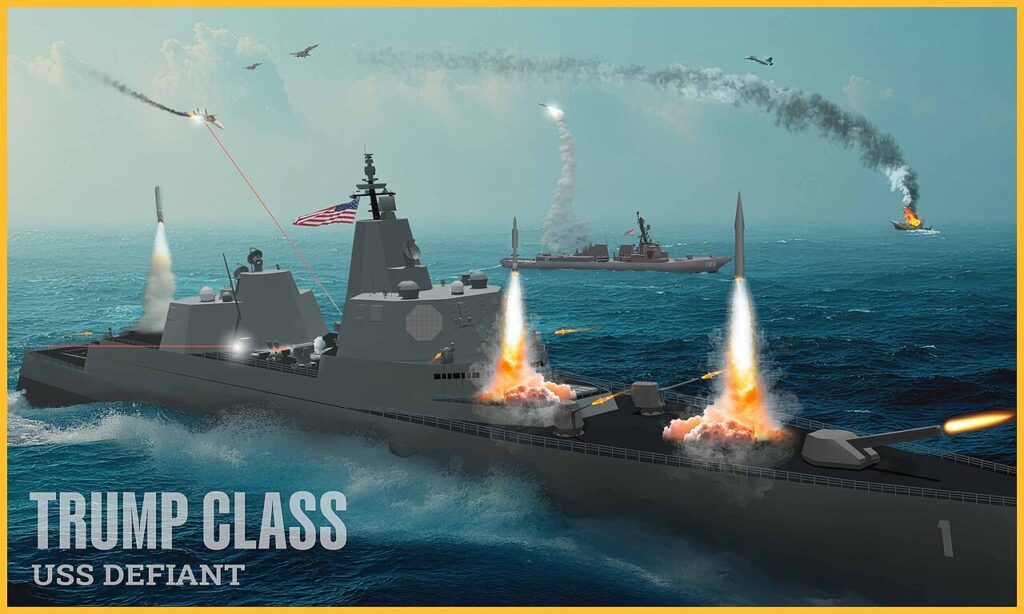
An artist’s conception of the proposed Trump-class USS Defiant battleship. Image credit: White House

President Trump has proposed a $1.5 trillion defense budget for fiscal 2027 that would begin funding of the Trump-class battleship, provide $65.8 billion for shipbuilding, provide a pay raise for the troops and continue funding for the “Golden Dome” missile defense system.

“The Budget builds upon the historic $1 trillion overall defense topline enacted for 2026 and requests $1.5 trillion in total budgetary resources for 2027,” says a budget outline released April 4. “This is a $441 billion or 44-percent increase from the 2026 enacted level in combination with the $151.5 billion in mandatory funding provided through the Working Families Tax Cut Act (WFTC), Public Law 119-21.”

The budget request serves as a road map for Congress to follow, but Congress will ultimately have to approve or disapprove the various spending levels in the president’s budget, many of which will prove controversial, as it also calls for cutting renewable energy, housing and health programs.

Defense Spending

The military shipbuilding budget would include the 18 battle force ships and 16 non-battle force ships and “establishes President Trump’s Golden Fleet, including initial funding for the Trump-class battleship and next generation frigates,” according to the outline.

It would also “maintain or increase” procurement of Columbia- and Virginia-class submarines and would expand procurement of strategic sealift vessels, hospital ships, tankers, submarine tenders and more.

“The repair capacity of public shipyards would be increased, while improved production across the fleet would help address delays and ensure the timely delivery of vessels,” the outline says.

The budget will also call for “unprecedented investments” in unmanned and counter-unmanned systems and “historic investments to aggressively scale its AI [artificial intelligence] ecosystem and ensure broad adoption throughout the armed forces.”

It will also call for realigning funding from “aging, legacy platforms” toward spending on “next-generation, cutting-edge capabilities that are necessary to win 21st Century wars,” reversing “a longstanding negative trend of under-resourced investment that forces DoW [the Department of War] to retain obsolete military capabilities, the sustainment of which further crowds out procurement of new systems.”

To help pay for these new investments, the budget proposes further elimination of spending related to diversity, equity and inclusion, or DEI, efforts, as well as “effectively disestablishing the department’s ‘climate’ portfolio and eliminating climate-specific funding” for electric vehicles and infrastructure, climate change research, climate-related wargames and simulations, and others.

The heads of the House and Senate Armed Services Committee praised the budget on Friday.

“America is facing the most dangerous global environment since World War II. Growing threats from adversaries such as China, Russia, Iran, North Korea, Islamic radicals, and narco-terrorists require decisive action and renewed urgency to reinvest in our defenses. This bold commitment provides the resources needed to rebuild American military capability and confront those challenges head-on,” Sen. Roger Wicker, (R-Mississippi), and Rep. Mike Rogers, (R-Alabama), said in a joint statement.

Some Democrats were less impressed. Rep. Brendan Doyle, ranking member of the House Budget Committee, said, “the President is now demanding a massive increase in defense spending, including a $350 billion slush fund for his reckless war with Iran, while cutting billions from health care, education, housing, and more. This budget represents ‘America Last’.”

Congressional hearings on the budget request are expected to begin soon.


HII Redelivers USS New Jersey from Post-Shakedown Availability 

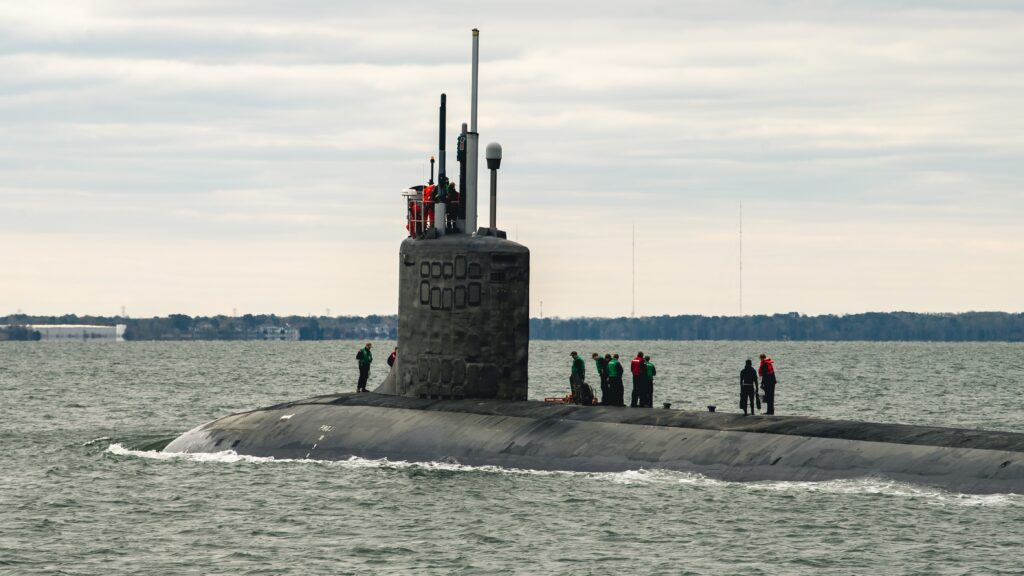
NEWPORT NEWS, Va., April 03, 2026 (GLOBE NEWSWIRE) — HII’s (NYSE: HII) Newport News Shipbuilding division has completed post-shakedown availability (PSA) work on Virginia-class fast attack submarine USS New Jersey (SSN 796). The submarine was redelivered to the U.S. Navy Friday. 

“Maintaining our nation’s undersea maritime supremacy is strengthened by the redelivery of USS New Jersey,” said Jason Ward, NNS vice president of new construction submarine programs. “Our combined NNS-Navy team is focused on the mission and understands the importance of getting this submarine to the fleet.” 

The PSA, a maintenance period that typically follows delivery of new ships, included combat systems and electronics upgrades, as well as general maintenance on the submarine. 


Norfolk Naval Shipyard Undocks USS John Warner 

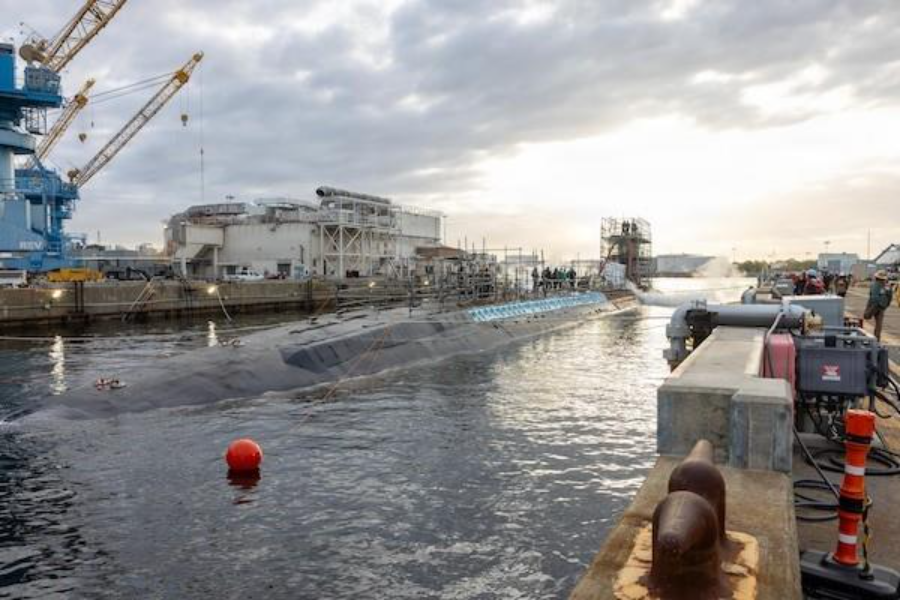
Norfolk Naval Shipyard (NNSY) successfully undocked USS John Warner (SSN 785) last month, meeting a major milestone in the Virginia-class submarine’s Extended Drydocking Selected Restricted Availability (EDSRA). (Photo by  Daniel DeAngelis) 

From Michael D Brayshaw, Norfolk Naval Shipyard, April 2, 2026 

Norfolk Naval Shipyard (NNSY) successfully undocked USS John Warner (SSN 785) last month, meeting a major milestone in the Virginia-class submarine’s Extended Drydocking Selected Restricted Availability (EDSRA). 

During an EDSRA, the submarine is drydocked to undergo hull, propulsion system, and modernization upgrades, allowing the submarine to remain fully operational for its planned service life. Virginia-class submarines are critical vessels in maintaining national security given their operational versatility and nuclear-powered fast attack capability. 

John Warner has been a pivotal availability for the Navy as the first Virginia class Block III drydocking at any of the nation’s four public shipyards. Block III refers to the redesigned submarines procured during the third Virginia-class acquisition contract. 

NNSY’s preparations for John Warner involved extensive teaming and knowledge sharing with Portsmouth Naval Shipyard and Pearl Harbor Naval Shipyard and Intermediate Maintenance Facility, having previously executed Virginia-class CNO availabilities. 

“NNSY’s commitment to learn and reach out for knowledge from the other shipyards for critical work evolutions has been a major key to the success of the project,” said Charles Brock, NNSY Submarine Program Manager. “The Virginia-class shipyard community is a very close-knit group that leans in to help one another. Because this is the first Block III EDSRA for the corporation there were many opportunities where NNSY was able to share lessons learned with the other shipyards to help them as well. Additionally, the team’s drive to work all possible solutions and then execute the best one was critical.” 

In a demonstration of the shipyard’s ability to adapt and overcome first-time challenges, John Warner undocked with the crew able to move back aboard, mast and periscope installation completed, and command and control system testing started, a trifecta feat not accomplished on a submarine availability at NNSY since 2001. 

“The powerful collaboration between our crew and the shipyard delivered the most materially ready submarine I’ve undocked,” said Cmdr. Nicholas Tuuk, John Warner commanding officer. “This achievement allows us to now fully focus on forging a crew of master submariners, ready to execute any mission when we return to the fleet.” 

Undocking with more than 95 percent of the production work complete, remaining availability work will focus on testing and crew readiness to support critical operations and sea trials. 

NNSY established a Submarine Maintenance Operations Center (SMOC) Detachment in 2025 to provide timely depot-maintenance submarine deliveries back to the fleet. The SMOC assists project teams including John Warner’s in resolving issues such as material and resource needs, work package modifications, and technical adjudication. By aligning resources with readiness priorities, the Navy is able to provide more available ships and submarines to defend US interests globally and support critical operations. 

“Clearly identifying the project’s needs and expecting a reciprocal response and commitment has been one of the key elements to the success of John Warner,” said Brock. “It has kept the team and all support aligned to what was needed and when it was needed. Additionally, the team employed a process of setting aggressive goals with specific dates to steer the shipyard in the direction needed to complete these major key events.” 

“It’s a great win for our shipyard and Navy taking such a huge step toward delivering a Virginia-class submarine back to the fleet and ready to meet the mission,” said Rear Adm. Kavon Hakimzadeh, shipyard commander. “I thank everyone for their efforts so far and we now rally around John Warner to urgently complete all remaining work as a committed team to return this critical asset supporting our nation’s warfighting readiness.” 

Commissioned on Aug. 1, 2015, John Warner is the 12th Virginia-class attack submarine and the first ship bearing the name of Senator John Warner who served the Commonwealth of Virginia for three decades until his retirement in 2009. Warner also served as Chairman of the Senate Armed Services Committee from 1999 to 2001, and again from 2003 to 2007. 

As one of the largest, most historic and multifaceted shipyards in the nation, Norfolk Naval Shipyard’s mission is to repair, modernize and inactivate Navy warships and training platforms to maximize readiness and availability for fleet tasking. 


Former Sen. Sam Nunn Visits Ingalls Shipbuilding for Update on His Namesake Destroyer 

From HII 
 

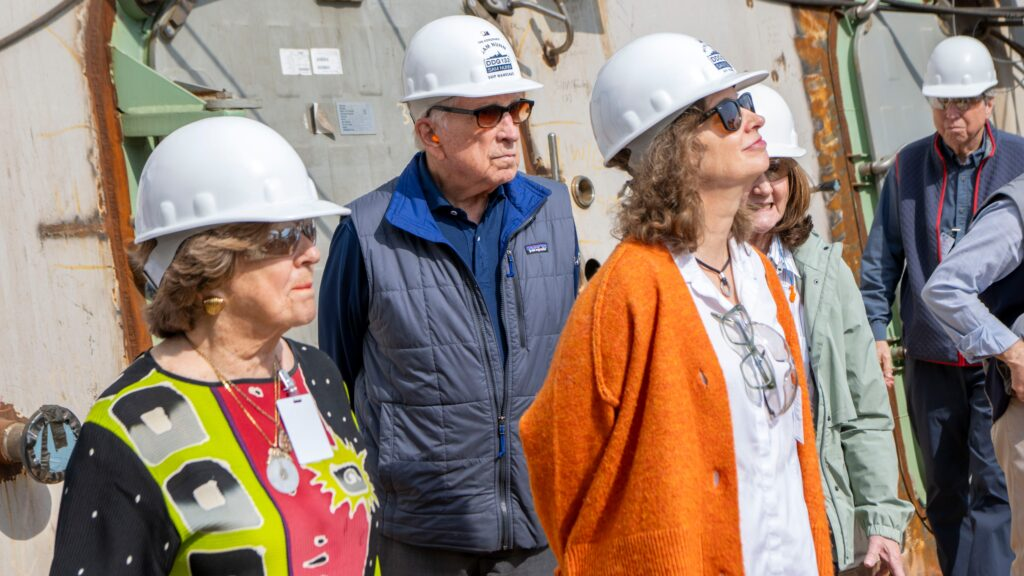
PASCAGOULA, Miss., April 03, 2026 (GLOBE NEWSWIRE) — HII’s (NYSE: HII) Ingalls Shipbuilding division recently welcomed former U.S. Sen. Sam Nunn, his wife, Colleen Nunn, and their daughter and ship sponsor Michelle Nunn, for a visit to the shipyard. The visit included a construction update and tour of the future USS Sam Nunn (DDG 133), a Flight III Arleigh Burke-class destroyer named in honor of the senator, and marked their return to Ingalls following the ship’s keel authentication ceremony. 

“It was an honor to welcome Sen. Nunn and Michelle Nunn to Ingalls to see first-hand the progress taking place on DDG 133 and to highlight the ship’s advancing construction path toward launch,” Ingalls Shipbuilding President Brian Blanchette said. “Our shipbuilders take tremendous pride in building a ship that will carry Sen. Nunn’s name and his legacy of enduring commitment to national defense.” 

During the 24 years of service in the U.S. Senate, Nunn became one of the nation’s most influential voices on defense policy. He spearheaded major initiatives including Department of Defense Reorganization Act and the NunnLugar Cooperative Threat Reduction Program, which led to the deactivation of more than 7,600 nuclear warheads from former Soviet Union republics. The future USS Sam Nunn honors this legacy of strengthening America’s defense and advancing global security. 

Nunn expressed appreciation for the shipbuilders working to bring DDG 133 to life. “It is exciting and deeply humbling to see this powerful destroyer taking shape and to witness the exceptional craftsmanship of the Ingalls team,” Nunn said. “I am grateful for the vital role Ingalls plays in ensuring our nation’s strength and readiness.” 

Future USS Sam Nunn (DDG 133) is the fifth Flight III Arleigh Burke-class destroyer to be built at Ingalls. Flight III destroyers incorporate substantial design and system upgrades including the AN/SPY 6(V)1 Air and Missile Defense Radar and the Aegis Baseline 10 Combat System that significantly enhance the U.S. Navy’s integrated air and missile defense capabilities and ensure readiness against evolving threats well into the 21st century. 

To date, Ingalls Shipbuilding has delivered 36 Arleigh Burke-class destroyers to the U.S. Navy, including the first Flight III, USS Jack H. Lucas (DDG 125) and Ted Stevens (DDG 128). The four Flight III destroyers currently under construction include: Jeremiah Denton (DDG 129), George M. Neal (DDG 131), Sam Nunn (DDG 133), and Thad Cochran (DDG 135). Additionally, Ingalls is in early pre-planning and material procurement phases for John F. Lehman (DDG 137), Telesforo Trinidad (DDG 139), Ernest E. Evans (DDG 141), Charles French (DDG 142), Richard J. Danzig (DDG 143), Intrepid (DDG 145) and Robert Kerrey (DDG 146). 


HII’s Ingalls Shipbuilding Launches Guided Missile Destroyer George M. Neal

From HII, April 1, 2026 
 

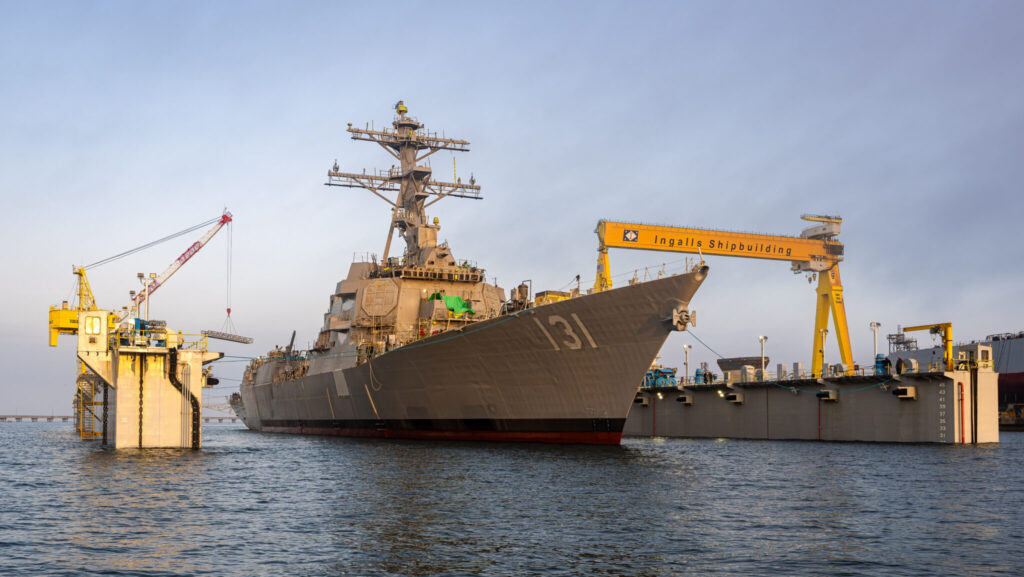
PASCAGOULA, Miss., April 01, 2026 (GLOBE NEWSWIRE) — HII’s (NYSE: HII) Ingalls Shipbuilding division successfully launched future USS George M. Neal (DDG 131) today, marking a major construction milestone for the fourth Flight III Arleigh Burke-class destroyer to be built at the shipyard. 

In the weeks leading up to launch, shipbuilders completed key construction work, secured major components and performed inspections to ensure the ship was ready to enter the water. The ship was then translated from land into the dry dock, where teams conducted final checks before flooding the dock and allowing the destroyer to float for the first time. 

“Launching DDG 131 is a direct reflection of the hard work and dedication of our Ingalls shipbuilders,” said Chris Brown, Ingalls Shipbuilding DDG 51 program manager. “Seeing the ship reach the water for the first time is a proud moment for everyone involved and a real testament to the people who make this work possible for our U.S. Navy.” 

DDG 131 is named for George M. Neal, a Korean War veteran and an aviation machinist’s mate third class who was awarded the Navy Cross for his heroic actions while attempting to rescue a fellow service member under enemy fire. 

As a Flight III Arleigh Burke-class destroyer, DDG 131 represents the next generation of surface combatants for the U.S. Navy, featuring the Flight III AN/SPY-6 (V)1 radar system and the Aegis Baseline 10 combat system, designed to counter threats well into the 21st century. 

Following today’s launch, George M. Neal will move into the next phase of construction, which includes outfitting, systems activation and testing in preparation for sea trials. 

For more information about the Arleigh Burke-class guided missile destroyer program at HII, visit: https://hii.com/what-we-do/capabilities/guided-missile-destroyers/


Army and Navy Continue Tests of Hypersonic Missile

From the Department of War, April 2, 2026 

The U.S. Army’s Portfolio Acquisition Executive Fires, in partnership with the U.S. Navy’s Portfolio Acquisition Executive Strategic Systems Programs, conducted a successful launch of a common hypersonic missile from Cape Canaveral Space Force Station, Florida, on March 26, 2026. 

The Army and Navy partnership to field a common hypersonic missile across land- and sea-based platforms supports the National Defense Strategy by accelerating timelines, reducing costs, and delivering a highly survivable capability to defeat time-sensitive, heavily defended, and high-value targets at speeds exceeding Mach 5.


George H. W. Bush Carrier Strike Group Departs for Deployment 

by Commander, U.S. 2nd Fleet Public Affairs, March 31, 2026 

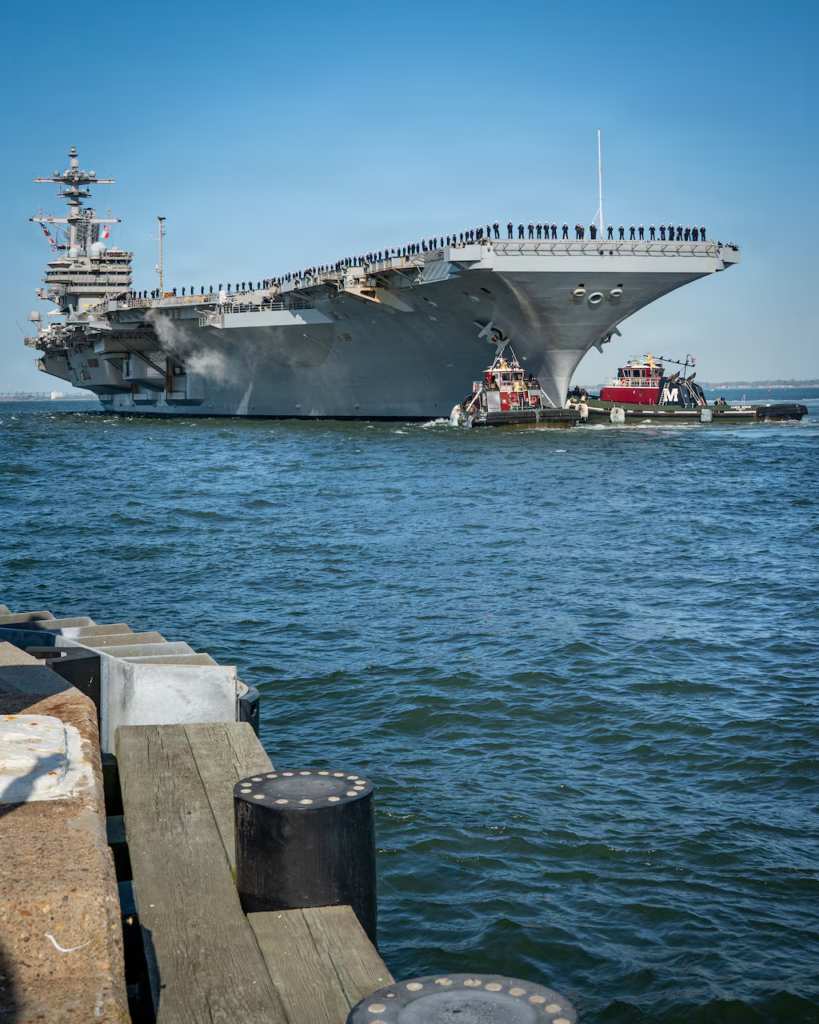
NORFOLK, Va. – The George H. W. Bush Carrier Strike Group (GHWBCSG) departed Norfolk for a regularly scheduled deployment, March 31, 2026. 
 

 “I am proud of every single member of this Strike Group. Our Sailors are ready and able to do the nation’s bidding,” said Rear Adm. Alexis T. Walker, commander, Carrier Strike Group Ten, embarked with the GHWBCSG. 

GHWBCSG deploying ships consists of the flagship USS George H.W. Bush (CVN 77) and three Arleigh Burke-class destroyers: USS Ross (DDG 71), homeported in Norfolk, Va; USS Donald Cook (DDG 75) and USS Mason (DDG 87) homeported in Mayport, Fla. Mason is the GHWBCSG Air and Missile Defense Commander. 

“The crew embodies our ship’s motto ‘Freedom at Work,'” said Capt. Bibeau, commanding officer of George H. W. Bush. “Our Sailors are exceptionally trained, highly motivated, ready to accomplish any assigned mission, and well poised to defeat any threat while deployed.” 

Carrier Air Wing (CVW) 7 embarked on George H. W. Bush consists of nine aircraft squadrons: Strike Fighter Squadron (VFA) 83, “Rampagers,” Strike Fighter Squadron (VFA) 103, “Jolly Rogers,” Strike Fighter Squadron (VFA) 105, “Gunslingers,” Strike Fighter Squadron (VFA) 131, “Wildcats,” Electronic Attack Squadron (VAQ) 140, “Patriots,” Airborne Command and Control Squadron (VAW) 116, “Sun Kings,” Helicopter Sea Combat Squadron (HSC) 5, “Nightdippers,” Helicopter Maritime Strike Squadron (HSM) 46, “Grandmasters,” and Fleet Logistics Multi-Mission Squadron (VRM) 40, “Mighty Bison.” 

GHWBCSG last deployed from August 2022 to April 2023 and spent the entirety of its deployment in the U.S. Naval Forces Europe–U.S. Naval Forces Africa area of operations. While in the Mediterranean, the ship participated in and supported a multitude of multinational exercises to increase NATO capability and deter aggression in the region. 

To access latest news and content on the George H.W. Bush Carrier Strike Group, visit: https://www.dvidshub.net/unit/C2F; https://www.dvidshub.net/unit/CVN77; https://www.c2f.usff.navy.mil/csg10/


Submarine Rescue Diving and Recompression System Completes Certification 

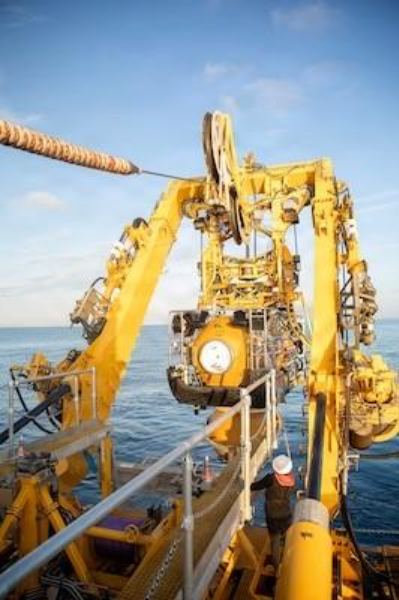
PACIFIC OCEAN (March 4, 2026) The specialized Launch and Recovery System (LARS) returns the pressurized rescue module (PRM-1) Falcon aboard Hornbeck Offshore Services (HOS) ship Mauser following the completion of a controlled manned dive evolution off the coast of San Diego, March 4, 2026. URC is composed of active duty and Reserve Component Sailors and operations and maintenance contractor located in San Diego, Calif., and is home to the U.S. Navy’s manned deep diving submarine rescue submersible. The team provides administrative, maintenance, operations, and logistics oversight for the Submarine Rescue Diving and Recompression System (SRDRS) and Sibitzky Remotely Operated Vehicle (ROV). (U.S. Navy photo by MC1 Tiarra Brown)

From Team Submarine Public Affairs, March 31, 2026 

The U.S. Navy certified the Submarine Rescue Diving and Recompression System (SRDRS) for full operation, March 23, clearing the system for deployment in support of undersea rescue missions around the globe. 

The certification concluded with a final manned dive in the waters near Naval Air Station North Island, Calif., March 6, and marks the culmination of a multi-year collaboration between the Undersea Rescue Command (URC), Submarine Squadron 11, Commander, Submarine Force, U.S. Pacific Fleet, Commander, Submarine Forces, Naval Sea Systems Command, Program Executive Office Attack Submarines, and the Undersea Special Missions Program Office (PMS 390). 

“This successful dive signifies a major milestone for the Navy,” said Rear Adm. Jonathan Rucker, Program Executive Officer, Attack Submarines. “We hold ourselves to extremely high standards in the undersea community. Going through this process shows that the team is ready to meet and exceed those standards. This accomplishment is a direct result of the whole team’s dedication.” 

The SRDRS is a remotely operated system capable of rescuing submarine crews in cases of emergency and can deploy anywhere in the world within 96 hours. With the successful system certification, the URC team is authorized to assist in submarine rescues globally, joining an international force of experts ready to help those in need. 

“Our Submarine Force operates, along with our allies and partners, in challenging undersea environments that span the entire globe. It is critical for us to have an undersea rescue capability that underpins the extensive training our submariners receive and that allows us to respond worldwide in the event of a distressed submarine,” said Rear Adm. Chris Cavanaugh, commander, Submarine Force, U.S. Pacific Fleet. “I commend the team of experts that helped us to achieve this important certification and to maintain our legacy of safe operations beneath the seas.” 

The SRDRS is one of the Navy’s primary undersea rescue capabilities and is designed to support both U.S. and allied rescue operations worldwide. Its main component, the Pressurized Rescue Module (PRM), is a tethered, remotely operated vehicle capable of rescuing up to 16 personnel per sortie. 

“Being onboard the PRM during its certification dive to 2,000 feet was an awe-inspiring experience, demonstrating the effectiveness of this system, and the professionalism and expertise of the entire team,” said Capt. David McGlone, Program Manager for PMS 390. 

“There are a lot of moving parts in any evolution like this, it’s not as simple as ‘dive down and open the hatch.’ The equipment is complex, and the crew operating and maintaining it must be experts at what they do. Being here, observing the team at work, diving in the vehicle, seeing the entire system operate to perform its intended function – I can confidently say I’m impressed.” 

Once activated, the SRDRS was put to the test in two separate dives. In the first demonstration, the system submerged unmanned to a depth of 2,000 feet. Following the unmanned dive, the team underwent a review process before submerging again, this time with a crew, to a mating fixture called Deep Seat. 

URC personnel, comprised of active and reserve component Sailors, and civilian contractors, operate the SRDRS as the U.S. Navy’s only submarine rescue-capable command. 


Vice Adm. Buzzella Assumes Command of U.S. Coast Guard Pacific Area and Defense Force West 

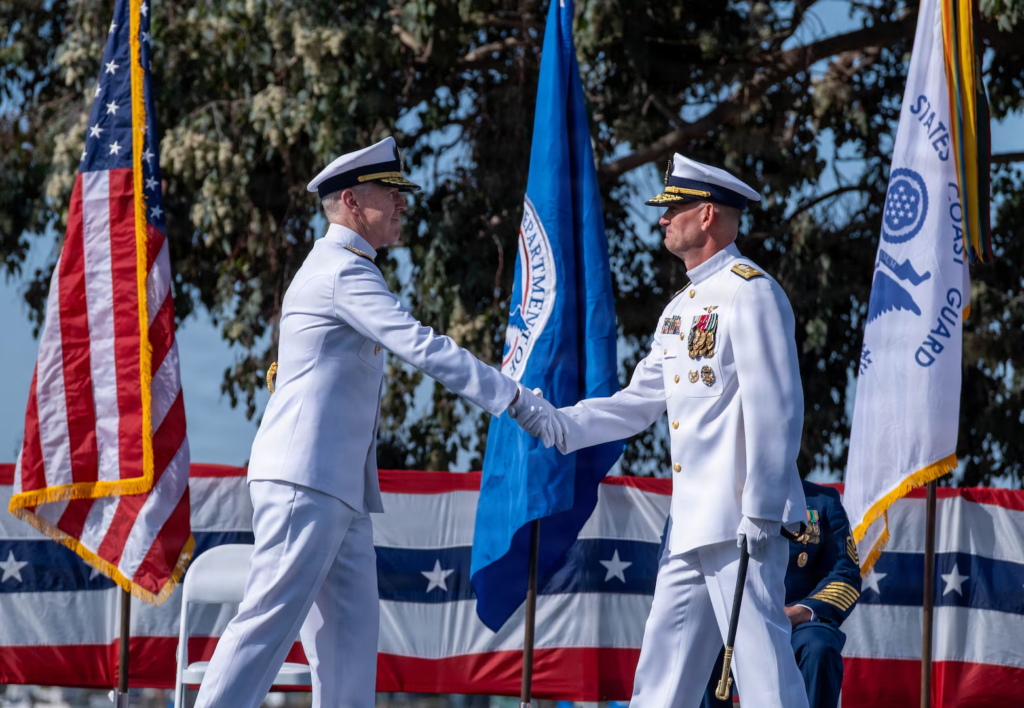
 Adm. Kevin Lunday (left), commandant of the U.S. Coast Guard, shakes hands with Vice Adm. Joe Buzzella during an assumption of command ceremony, March 26, 2026, at Coast Guard Island, Alameda, California. The ceremony formally marked Vice Adm. Joe Buzzella as the commander of Coast Guard Pacific Area and Defense Force West. (U.S. Coast Guard photo by Petty Officer 3rd Class Charlie Valor)

From U.S. Coast Guard Pacific Area, March 31, 2026 

ALAMEDA, Calif. – The U.S. Coast Guard held a formal assumption of command ceremony for Vice Adm. Joe Buzzella as he assumed the duties and responsibilities of U.S. Coast Guard Pacific Area and Defense Force West Commander during an event Thursday, at Coast Guard Island in Alameda.  

Adm. Kevin Lunday, commandant of the U.S. Coast Guard presided over the ceremony. Senior Coast Guard leadership and distinguished guests joined in recognizing Vice Adm. Buzzella’s commitment to leading the Service.  

Vice Adm. Buzzella formally assumed the responsibilities of commander, Coast Guard Pacific Area, overseeing all Coast Guard operations across the Pacific theater—an area encompassing more than 74 million square miles. He reaffirmed the Service’s enduring role as a vital instrument of national power responsible for ensuring maritime safety, security, and stewardship; strengthening partnerships with allies and advancing U.S. interests throughout the Indo-Pacific region.  

“It is an honor to assume command of Coast Guard Pacific Area and Defense Force West,” said Vice Adm. Buzzella. “Across this vast and vital region, Coast Guardsmen stand the watch. Every day, our crews are saving lives, protecting and ensuring we control, secure and defend our nation’s borders. I am humbled by the opportunity to lead this team and remain committed to supporting the readiness, resilience, and mission excellence of the Pacific Area workforce and their families.”   

As Pacific Area commander, Vice Adm. Buzzella will lead Coast Guard operations throughout the Indo-Pacific, the Polar Regions and Western Hemisphere, focusing on enhancing operational readiness, strengthening international partnerships, and advancing strategic priorities in support of national security objectives.  


Duffy Announces $35 Million Investment to Revitalize America’s Small Shipyards

MARAD’s Small Shipyard Grant program received a 200% increase in funding for 2026 

WASHINGTON, D.C. – U.S. Department of Transportation Secretary Sean P. Duffy announced today that the Maritime Administration (MARAD) will invest $35 million into revitalizing America’s small shipyards.  

The investment will go toward: 

  • Upgrading ship repair and construction facilities 

  • Purchasing new equipment, including cranes, plasma cutters, and welding systems 

  • Bolstering maritime training programs to supercharge the maritime workforce 

“This 200% increase in shipyard investments underscores President Trump’s commitment to restoring America’s maritime dominance strategy. Revitalizing this once great industry enhances our national security, reshores good paying jobs, and ensures goods get to where they need to go affordably,” said U.S. Transportation Secretary Sean P. Duffy. 

“Thanks to President Trump and Secretary Duffy, the maritime industry is getting the resources it needs to restore U.S. strength on the seas,” said MARAD Administrator Stephen M. Carmel. “This $35 million investment will empower our domestic maritime industry to modernize facilities, foster competitive operations, and equip the American worker with the skills needed to restore our nation’s maritime dominance.” 

President Donald J. Trump and Secretary Sean P. Duffy are committed to restoring U.S. maritime dominance. As such, the criteria for this grant program includes prioritizing projects that incorporate innovative technology.   

Additional Information: 

Since 2008, MARAD’s Small Shipyard Grant Program has awarded 382 grants for $320.5 million. These funds equip American shipyards with the tools they need to build American ships. 

Eligible shipyards must be in a single geographic location and may not have more than 1,200 production employees. Eligible shipyards must construct, repair, or reconfigure vessels 40 feet in length or greater for commercial or government use, or construct, repair, or reconfigure vessels 100 feet in length or greater for non-commercial vessels. 

The Notice of Funding Opportunity outlines the application criteria. Applicants are encouraged to submit eligible projects as soon as possible but must do so by May 11, 2026.