USS Kingsville Commissioned in Corpus Christi

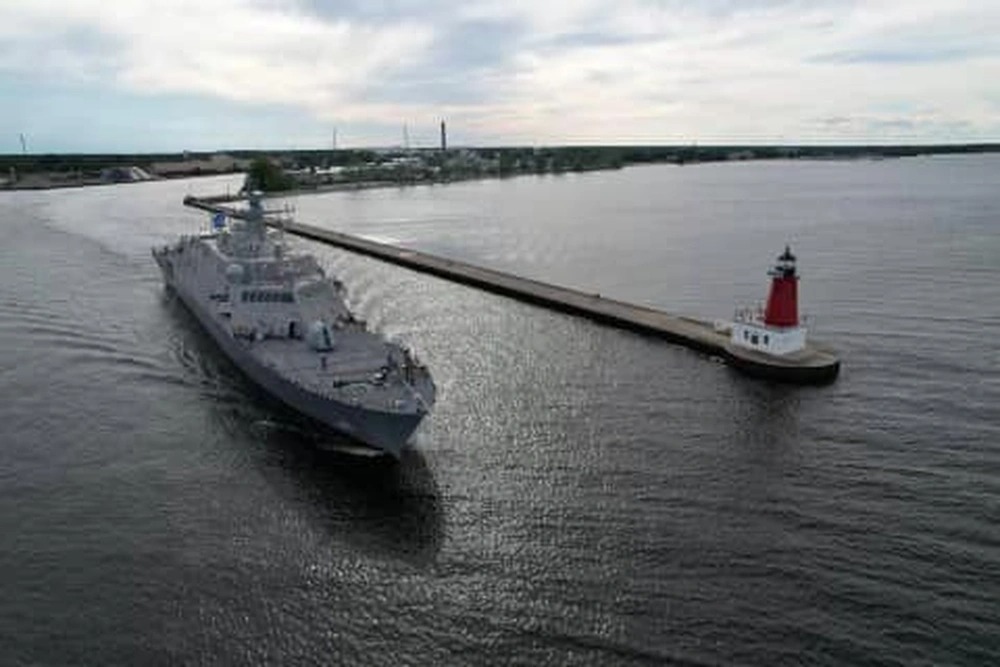
Corpus Christi, Texas (August 24, 2024) The crew of the Navy’s newest littoral combat ship USS Kingsville (LCS 36) brings the ship to life during its commissioning ceremony in Corpus Christi, Texas. (U.S. Navy photo by MC2 Nicholas V. Huynh)

Release from U.S. Pacific Fleet

By Lt. Brinn Hefron of Commander, Naval Surface Force, U.S. Pacific Fleet 

CORPUS CHRISTI, Texas — The U.S. Navy commissioned Independence-variant littoral combat ship USS Kingsville (LCS 36) at the Solomon P. Ortiz Center, August 24. 
 
In the week preceding the ceremony, the crew built ties with their namesake city and visited the King Ranch for a luncheon at the Henrietta Memorial Museum and a tour of the historic ranch. The crew visited with the mayor of Kingsville, the ship’s sponsor, Ms. Katherine Kline, and her parents Dr. Rich and Mrs. Sue Sugden. The U.S. Navy prides itself on a strong tradition of the relationship between a ship and their namesake community or family. These enduring ties at the beginning of Kingsville’s service will strengthen bonds between the ship and the communities of Kingsville and its commissioning location of Corpus Christi. 
 
Leaders and distinguished guests wished the crew of Kingsville fair winds and following seas as they brought the ship to life and began its commissioned service. 
 
Assistant Secretary of the Navy for Financial Management and Comptroller, the Honorable Russell Rumbaugh, delivered the commissioning ceremony’s principal address. The ceremony also featured remarks from Deputy Chief of Naval Operations for Integration and Capabilities and Resources, Vice Adm. Brad Skillman, United States Representatives, the Honorable Vicente Gonzalez, Jr. and the Honorable Michael Cloud, the Mayor of Kingsville, the Honorable Sam Fugate and the Mayor of Corpus Christi, the Honorable Paulette Guajardo. 
 
“A ship commissioning is one of the ways the U.S. Navy keeps itself tied to the nation it serves. It’s why we name ships after cities and states. And what better moment to celebrate our long and intimate relationship than commissioning a ship named after Kingsville,” said Rumbaugh. “This ship will provide maritime security in each of our fleet operations. We in the Department of the Navy are proud of the Littoral Combat Ships.” 
 
During the ceremony, Kingsville’s commanding officer Cmdr. Ludwig Mann III, reported the ship manned and ready, and ship sponsor, gave the traditional order to “Man our ship and bring her to life!” Helping to welcome the ship to the fleet, T-45C aircraft assigned to VT-21 at Naval Air Station Kingsville flew over the ship as the crew ran aboard the ship – bringing her to life. 
 
“This experience is a unique one and should be cherished. You will create a culture that I am sure will last as the Kingsville way for decades to come,” said Skillman. “To the triad, Cmdr. Mann, Cmdr. Kavanaugh, Command Senior Chief Moran, I also know you and the crew are ready to get out there and do the Navy and the nation’s business around the globe. Tough and confident, go get them.” 
 
The night prior to commissioning, the Kingsville Commissioning Committee held an evening reception onboard the USS Lexington Museum where the committee recognized the crew of Kingsville for their service and dedication that ended with a fireworks display. 
 
Kingsville, the 18th Independence-variant LCS, is the first to bear this name and pays homage to the city of Kingsville and the King Ranch. The ship’s sponsor is a member of the sixth generation of the King Ranch family, descendants of steamboat captain Richard King who founded in the King Ranch in Kingsville in 1853. The King Ranch continues to foster a relationship with Naval Air Station Kingsville which was founded in 1942 and is located three miles from the city’s center. 
 
Independence-variant littoral combat ships are fast, optimally manned, mission-tailored surface combatants that operate in near-shore and open-ocean environments, winning against 21st-century coastal threats. LCS integrate with joint combined, manned and unmanned teams to support forward presence, maritime security, sea control, and deterrence missions around the globe. 
 
The mission of CNSP is to man, train, and equip the Surface Force to provide fleet commanders with credible naval power to control the sea and project power ashore. 


Kongsberg to Build Missile Factory in Australia 

From Kongsberg Defence & Aerospace, Aug. 23, 2024 

The government of Australia has announced its decision to invest in the construction of a new factory for Kongsberg Defence & Aerospace (‘KONGSBERG’) strike missiles in Newcastle, Australia. 

The factory will manufacture and service KONGSBERG’s strike missiles to be used by the Australian Defence Force (ADF). Construction of the factory is expected to start later this year, the Australian government said in a press release. 

The Australian government announced it would contribute up to AUS $850 million in partnership with Kongsberg Defence Australia to manufacture and service missiles in Newcastle, including constructing a new factory in the Newcastle Airport precinct in New South Wales, about 120 km north of Sydney. 

“Strong international demand for our strike missiles means we are expanding our footprint in selected countries. The missile factory will be the first to open outside Norway, which is testament to the strong and growing relationship between KONGSBERG, Norway and Australia in cooperating to develop current and future defence capabilities,” said Eirik Lie, president of Kongsberg Defence & Aerospace. 

The government also announced its decision to include Kongsberg Defence Australia as one of its strategic partners in the Guided Weapons and Explosive Ordnance (GWEO) Enterprise. The GWEO Enterprise is backed by a commitment of $16 to $21 billion over the coming decade through the Government’s 2024 Integrated Investment Program. 

“We are honoured to have been selected as a strategic partner in the GWEO Enterprise and look forward to continue to invest in Australia to support the armed forces, while generating jobs and economic benefits in the local area,” said John Fry, managing director at Kongsberg Defence Australia. 

NSM & JSM 
The NSM is an anti-ship missile with superior operational performance and high survivability against all enemy defence systems. The missile was developed by KONGSBERG and first deployed in 2012 by the Norwegian Navy. The air-launched JSM is currently being integrated on the F-35 fighter aircraft. 

The NSM is the main weapon for the Norwegian Navy’s frigates and coastal corvettes, and has been selected by 13 other countries, including Australia. The JSM has so far been selected by Norway, Japan and the US Air Force. 


Coast Guard Offloads Nearly $50 Million in Illegal Narcotics Interdicted in Eastern Pacific Ocean 

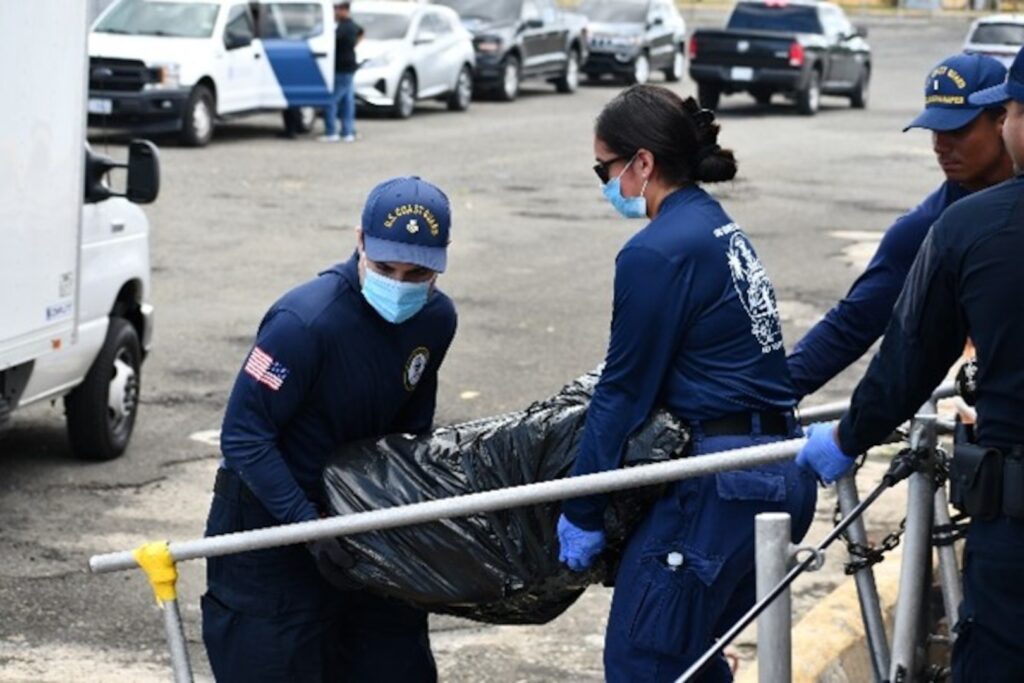
The crew of Coast Guard Cutter Escanaba pose with more than 3,400 pounds of cocaine and 4,410 pounds of marijuana with a combined assessed street value of approximately $50 million in Port Everglades, Florida, Aug. 23, 2024. (U.S. Coast Guard photo by Petty Officer 3rd Class Eric Rodriguez)

From the U.S. Coast Guard 7th District, Aug. 23, 2024 

MIAMI – The crew of Coast Guard Cutter Escanaba (WMEC 907) offloaded more than 3,400 pounds of cocaine and 4,410 pounds of marijuana with a combined assessed street value of approximately $50 million in Port Everglades, Friday, Aug. 23.   

The Escanaba crew embarked a Coast Guard Helicopter Interdiction Tactical Squadron aircrew, and Law Enforcement Detachment 107 from Coast Guard Tactical Law Enforcement Team Pacific. They worked alongside interagency and international partners to interdict illicit narcotics in the international waters off South America in the Eastern Pacific Ocean.   

Coast Guard crews often deploy to the U.S. Southern Command joint operating area, which includes the Caribbean Sea and the Eastern Pacific Ocean, to conduct counter drug missions under Joint Interagency Task Force-South. Deployments for cutters assigned to the Coast Guard Atlantic Area Command include Panama Canal transits to deny transnational criminal organizations access to maritime trafficking routes in the Eastern Pacific Ocean.   

“The Coast Guard’s presence in the Eastern Pacific is vital to our mission of disrupting the flow of illicit narcotics and safeguarding our nation’s security. The crew of the Coast Guard Cutter Escanaba, through their unwavering professionalism and dedication, has once again demonstrated the critical role our people play in these complex operations,” said Vice Adm. Nathan Moore, commander, Coast Guard Atlantic Area. “By maintaining a strong presence in this region, we continue to protect our communities and uphold the highest standards of service. Coast Guard Cutter Escanaba’s success is a direct reflection of our commitment to mission excellence and the core values that guide us.”   

The following assets and crews were involved in the interdictions:   

  • Coast Guard Cutter Escanaba (WMEC 907)   

  • Coast Guard Helicopter Interdiction Tactical Squadron (HITRON) Jacksonville   

  • Law Enforcement Detachment (LEDET) 107 from Coast Guard Tactical Law Enforcement Team – Pacific (PAC TACLET)  

  • Joint Interagency Task Force South (JIATF-South)   

  • Eleventh Coast Guard District   

“The counter narcotics mission continues to be a vital mission of the Coast Guard,” said Cmdr. Jared Silverman, commanding officer of Coast Guard Cutter Escanaba. “The crew of Escanaba, alongside our shipmates from HITRON and TACLET, executed the mission in outstanding fashion and ensured that the spirit of operational excellence lives on.”  

Seven suspected smugglers were transferred to federal custody and face prosecution by the U.S. Department of Justice.   

Detecting and interdicting illicit drug traffickers on the high seas involves significant interagency and international coordination. The Joint Interagency Task Force-South based in Key West, Florida conducts the detection and monitoring of aerial and maritime transit of illegal drugs. Once interdiction becomes imminent, the law enforcement phase of the operation begins, and control of the operation shifts to the U.S. Coast Guard throughout the interdiction and apprehension. Interdictions in the Eastern Pacific Ocean are performed by members of the U.S. Coast Guard under the authority and control of the Coast Guard’s Eleventh District, headquartered in Alameda, California.   

These interdictions relate to Organized Crime Drug Enforcement Task Forces’ Strike Force Initiatives and designated investigations. OCDETF identifies, disrupts, and dismantles the highest-level criminal organizations that threaten the United States using a prosecutor-led, intelligence-driven, multi-agency approach. Additional information about the OCDETF program can be found at https://www.justice.gov/OCDETF.   

The Coast Guard is the United States’ lead federal maritime law enforcement agency with authority to enforce national and international laws on the high seas and waters within U.S. jurisdiction. Coast Guard HITRON aircrews are uniquely qualified to conduct airborne use of force for non-compliant vessels, enhancing the Coast Guard’s ability to react to maritime security threats and to better secure our maritime borders since the program’s inception in 1999. For 25 years, HITRON crews have forward deployed aboard Coast Guard cutters and U.S. Navy or foreign allied warships to conduct drug interdiction operations.  

Coast Guard Cutter Escanaba is a 270-foot Famous-class medium endurance cutter with a crew of 100 homeported in Portsmouth, Virginia.   


USS Hawaii in First Australian Nuclear-Powered Attack Sub Maintenance Availability 

HMAS STIRLING, Western Australia, Australia (Aug. 22, 2024) – Sailors assigned to the Virginia-class fast-attack submarine USS Hawaii (SSN 776) prepare to moor at HMAS Stirling, Western Australia, Australia, as part of a scheduled port visit before conducting a submarine tendered maintenance period (STMP) with the submarine tender USS Emory S. Land (AS 39), Aug. 22. (U.S. Navy photo by MC1 Victoria Mejicanos)

By Lt.Cmdr. Rick Moore Commander, Submarine Force, U.S. Pacific Fleet 

HMAS STIRLING, Western Australia, Australia (Aug. 22, 2024) – In a historic first, Australian personnel will work alongside with their U.S. counterparts to conduct maintenance on USS Hawaii (SSN 776) in Australia as part of a Submarine Tendered Maintenance Period (STMP) at HMAS Stirling in Western Australia. The STMP marks a significant step forward in the Australia, United Kingdom, United States (AUKUS) Pillar 1 program, which is paving the way for Australia to acquire a sovereign, conventionally armed, nuclear-powered submarine capability. 
 
Over the coming weeks, submarine tender USS Emory S. Land (AS 39) will execute several maintenance activities aboard Hawaii. This is the first time Australians have participated in a U.S. submarine maintenance period in Australia. More than 30 Australian personnel who participated in a knowledge exchange period that began in January 2024 aboard Emory S. Land will execute the majority of planned maintenance work with U.S. support and oversight. 
 
The Emory S. Land crew will execute planned and emergent maintenance activities including the removal and reinstallation of an antenna located in Hawaii’s sail, divers visually inspecting the underwater towed array and torpedo tube muzzles, and simulating the removal and installation of a trim pump, to include full rigging and preparations. 
 
“This is an important moment for the Royal Australian Navy,” said Rear Adm. Matthew Buckley, the Australian Submarine Agency’s Head of Submarine Capability. “For the first time, we have Australians who were trained and certified aboard Emory S. Land using their skills on a U.S. SSN in Australian waters.” 
 
AUKUS Pillar 1 is an enhanced trilateral security agreement designed to assist Australia in acquiring sovereign, conventionally armed, nuclear-powered attack submarines. The current port visit is part of a years-long effort to grow the Royal Australian Navy’s ability to maintain SSNs before establishing Submarine Rotational Force – West (SRF-W) as early as 2027. Known as Phase 1, SRF-W will see up to four U.S. SSNs and one U.K. SSN have a rotational presence in Western Australia to grow Australia’s ability to sustain, operate and maintain a sovereign fleet of SSNs. 
 
The second phase of the AUKUS Optimal Pathway begins in the early 2030s, with the United States selling Australia three Virginia-class submarines, with the potential to sell up to two more if needed. Phase Three sees the combination of the next-generation UK submarine design and advanced United States and Australian technology to deliver SSN-AUKUS, the future attack submarine for both Australia and the United Kingdom. Australia plans to deliver the first Australian-built SSN-AUKUS in the early 2040s. 
 
“The groundwork being laid with the STMP will help the Royal Navy when we conduct our future port visits,” said Rear Adm. Chris Shepherd, the UK’s Defence Nuclear Organisation AUKUS Director. “We, like our Australian counterparts, are observing how the U.S. operates so we can help bridge the gap between their system and our Astute-class SSN and, in the near future, SSN-AUKUS.” 
 
“Having Royal Australian Navy Sailors working on our submarine at HMAS Stirling has been something they, and we, have been working toward for months,” said Rear Adm. Lincoln Reifsteck, the U.S. AUKUS Integration and Acquisition Program Manager. “They represent the future of Australia’s sovereign SSN fleet – Australians should be proud of what these professionals have accomplished, and will accomplish, to protect their homeland and help deter aggression in the region.” 
 
“Partnering so closely with the Royal Australian Navy has been a fantastic experience,” said Capt. Brent Spillner, Emory S. Land’s commanding officer. “Their Fleet Support Unit sailors integrated rapidly into our crew and have excelled at every task. It’s truly been a two-way knowledge exchange; we’ve learned as much from them as they have from us, and it’s exciting to see how that’s opened new opportunities to support each other’s forward-deployed ships in the future.” 
 
“It is both personally and professionally rewarding to know that the work we do over the coming weeks will set our Australian partners on the path toward a sovereign SSN capability,” shared Cmdr. Dan Jones, USS Hawaii commanding officer. 
 
The STMP is similar to a planned maintenance period generally conducted in U.S. submarine ports with support from shore-based or tender-based maintenance personnel. Generally lasting up to three weeks, this type of maintenance availability does not require dry-docking the submarine and serves to ensure submarines receive planned and emergent maintenance to remain ready for tasking. 
 
The STMP will support Australia’s nuclear stewardship growth through the planning and execution of simulated radiological training evolutions that will not involve the use of radiological material. These training evolutions will allow Australian radiological controls policy makers to observe how the U.S. Navy safely handles simulated low-level radiological material as a means to increase their knowledge and develop Australian policy and radiation safety practices that are protective of the workforce, the public, and the environment. 


August 22-23 U.S. Central Command Update

From U.S. Central Command 

Aug. 23, 2024

TAMPA, Fla. – In the past 24 hours, U.S. Central Command (USCENTCOM) forces successfully destroyed one Iranian-backed Houthi missile system in a Houthi-controlled area of Yemen. 

It was determined this system presented a clear and imminent threat to U.S. and coalition forces, and merchant vessels in the region. This action was taken to protect freedom of navigation and make international waters safer and more secure for U.S., coalition, and merchant vessels. 

Aug. 22, 2024

TAMPA, Fla. – In the past 24 hours, U.S. Central Command (USCENTCOM) forces successfully destroyed two Iranian-backed Houthi uncrewed aerial vehicles (UAV) over the Red Sea and one UAV in a Houthi-controlled area of Yemen.  

It was determined these UAVs presented a clear and imminent threat to U.S. and coalition forces, and merchant vessels in the region. This action was taken to protect freedom of navigation and make international waters safer and more secure for U.S., coalition, and merchant vessels. 


Amphibious Transport Dock Richard M. McCool, Jr. Sails Away From Ingalls Shipbuilding

From HII 

PASCAGOULA, Miss., Aug. 22, 2024 (GLOBE NEWSWIRE) — San Antonio-class amphibious transport dock ship Richard M. McCool, Jr. (LPD 29) departed from HII’s (NYSE: HII) Ingalls Shipbuilding division on Thursday, en route to its commissioning site in Pensacola, Florida. 

“When any of our ships sail away, it is a poignant reminder of the importance of shipbuilding to the freedom and security of our country,” said Kari Wilkinson, president of Ingalls Shipbuilding. “We are committed to the mission and stand behind those who serve the nation for all Americans.” 

Richard M. McCool,Jr. was delivered to the U.S. Navy in April and is the 13thSan Antonio-class ship delivered by Ingalls. As the final Flight I transition ship before the company moves into production of the LPD Flight II line, Richard M. McCool, Jr. is the first LPD 17-class ship to undergo the installation and activation of the Enterprise Air Surveillance Radar, SPY-6(V)2, rotating variant, S-Band radar. SPY-6(V)2 provides the U.S. Navy with a common hardware variant for aircraft carrier and amphibious ships and commonality with the SPY-6 Family of Radars. In addition to providing hardware and software commonality across the fleet, the radar will also contribute to increased target engagement capability and overall ship self-defense. 

Photos accompanying this release are available at: https://hii.com/news/amphibious-transport-dock-richard-m-mccool-jr-lpd-29-sails-away-from-ingalls-shipbuilding/

Currently, Ingalls has two Flight II LPDs under construction including Harrisburg (LPD 30) and Pittsburgh (LPD 31). In March 2023, Ingalls was awarded a modification to the contract for the procurement of the detail design and construction of Philadelphia (LPD 32), the 16th ship in the San Antonio class and the third LPD Flight II. 

“I am filled with a deep sense of honor and purpose watching LPD 29 sail away,” said Davianne Stokes, Ingalls Shipbuilding’s LPD program manager. “Our shipbuilders have done an outstanding job, and I am grateful to be part of a team that plays such a crucial role in serving our military.” 

LPD 29 is scheduled to be commissioned on Sept. 7, 2024, at Naval Air Station Pensacola in Pensacola, Florida. The naming of LPD 29 honors U.S. Navy Capt. Richard M. McCool, Jr., who was awarded the Medal of Honor in 1945 for the heroism he displayed after his ship was attacked by kamikaze aircraft in the Battle of Okinawa. Despite suffering from shrapnel wounds and painful burns, he led efforts to battle a blazing fire on his ship and rescue injured sailors. 

Amphibious transport docks are used to transport and land Marines, their equipment, and supplies by embarked Landing Craft, Air Cushion (LCAC) or conventional landing craft and amphibious assault vehicles (AAV) augmented by helicopters or vertical take-off and landing aircraft (MV 22). These ships support amphibious assault, special operations, or expeditionary warfare missions and serve as secondary aviation platforms for amphibious operations. 


SECNAV Advances Maritime Statecraft During Visit to UK’s Barrow-in-Furness Shipyard  

From SECNAV Public Affairs, 22 August 2024 

Secretary of the Navy Carlos Del Toro visited BAE Systems Submarines Barrow-in-Furness Shipyard during a trip to the United Kingdom last week.  During the visit he met with UK government, Royal Navy and industry leadership to discuss expanding collaboration and applying best practices to U.S. submarine construction and maintenance. 

During the visit he met with UK government, Royal Navy and industry leadership to discuss expanding collaboration and applying best practices to U.S. submarine construction and maintenance.  Secretary Del Toro was also updated on the SSN-AUKUS program as well as U.S.-UK collaboration on knowledge transfer, technology insertion and senior leadership engagements. 

A tour of facilities showcased submarine production from hull sections of the future Dreadnought-class to the final stages of construction of the Astute-class.  The secretary stopped by the Submarine Skills Academy as well and spoke with apprentices pursuing a variety of skilled trades at the shipyard.     

 “It was an incredible visit to BAE’s Barrow Shipyard, where I saw construction of the Royal Navy’s most advanced submarines by highly skilled technicians and toured their apprentice workshops to develop the next generation of submarine-builders,” said Secretary Del Toro.  “Lessons learned from building these extraordinary ships will pave the way for industry to build the next-generation SSN-AUKUS.” 

The visit also highlighted use of the Shiplift system to raise and lower submarines in and out of the water, both for delivery and for maintenance, instead of using a dry dock.       

Construction of a public university satellite facility at the shipyard demonstrated ways that overseas industry is working to attract, educate and incorporate new talent into its workforce.      

“I was very impressed with the strong partnership displayed between the shipyard, national and local governments to address skilled-workforce challenges in the shipbuilding industrial base that we all face,” said Del Toro.  “As part of my Maritime Statecraft initiative, I will continue to promote public-private training partnerships like this that revitalize American shipbuilding.”         

Launched on Sept. 23, 2023, Maritime Statecraft promotes whole-of-government efforts to restore U.S. and allied comprehensive maritime power.  


Navy’s Carrier Air Wings Will Train as a Joint Fighting Force in Simulators at Sea

From NAWCAD Visual Information, 22 August 2024 

Aviators across USS Abraham Lincoln’s (CVN 72) carrier air wing now train as a joint fighting force using advanced simulators developed and installed by the Naval Air Warfare Center Aircraft Division (NAWCAD). 

The first-of-its-kind training capability, called Simulators at Sea, features connected desktop trainers that enable aviators to practice missions together while deployed—a historically limited capability. 
 
“Simulators at Sea brings American aviators a level of readiness our carrier air wing has never experienced while deployed,” said NAWCAD Commander Rear Adm. John Dougherty IV. “This training is a game changing advantage that keeps our forces the most dominant in the skies.” 
 
Aviators with Lincoln’s Carrier Air Wing (CVW) 9 flying F-35C Lightning II, F/A-18 E/F Super Hornets, EA-18G Growlers, and E-2D Hawkeyes are the first to deploy and rehearse naval missions including wartime scenarios with the Navy’s new Simulators at Sea. Previously, joint mission training on this scale has been significantly limited as practicing wartime scenarios holds risk, flight operations can be expensive, and open-air rehearsal puts Navy tactics on display for adversaries. 
 
“Naval aviators train extensively working up to deployment, but those skills begin to atrophy the day they pull out of port,” said NAWCAD Joint Simulation Environment Director Blaine Summers, whose team delivered the Simulators at Sea capability. “This was a capability gap we had to plug with a fully integrated carrier air wing solution—one we’re ready to scale across the Navy’s fleet of carriers.” 
 
CVW-9 aviators have trained in its new simulators daily since its July 2024 deployment. 
 
Simulators at Sea came together for Abraham Lincoln in less than 12 months following lessons learned from NAWCAD’s 2023 deployment of F-35 simulators onboard USS Carl Vinson (CVN 70). The Simulators at Sea effort was more complex, requiring significant integration efforts that stretched across the Naval Aviation Enterprise’s Naval Air Warfare Center Training Systems Division, NAWCAD’s Webster Outlying Field, and the Naval Aviation Training Systems and Ranges Program, as well as industry partners Boeing, Collins Aerospace, and General Dynamics Information Technology. 
 
The warfare center plans to expand Simulators at Sea to other carriers in the future. 
 
The Naval Air Warfare Center Aircraft Division employs more than 17,000 military, civilian and contract personnel. It operates test ranges, laboratories, and aircraft in support of test, evaluation, research, development and sustainment of everything flown by the Navy and Marine Corps. Based in Patuxent River, Maryland, the command also has major sites in St. Inigoes, Maryland, Lakehurst, New Jersey, and Orlando, Florida. 


August 21 U.S. Central Command Update

From U.S. Central Command, Aug. 21, 2024 

TAMPA, Fla. - In the past 24 hours, U.S. Central Command (USCENTCOM) forces successfully destroyed an Iranian-backed Houthi surface-to-air missile and radar system in a Houthi-controlled area of Yemen. 

It was determined these systems presented a clear and imminent threat to U.S. and coalition forces, and merchant vessels in the region. This action was taken to protect freedom of navigation and make international waters safer and more secure for U.S., coalition, and merchant vessels. 


USS San Diego Departs for Japan 

From Commander, Surface Force, U.S. Pacific Fleet, 20 August 2024 

SAN DIEGO – The San Antonio-class amphibious transport dock ship USS San Diego (LPD 22) left San Diego, Aug. 14, for Sasebo, Japan. 

San Diego will replace USS Green Bay (LPD 20), also a San Antonio-class amphibious transport dock ship, which has been forward deployed to Sasebo for a decade. Green Bay will return to the United States at its new homeport of San Diego. 
 
The forward presence of San Diego supports the United States’ commitment to the defense of Japan, enhances the national security of the United States and improves its ability to protect strategic interests. San Diego will directly support the Defense Strategic Guidance to posture the most capable units forward in the Indo-Pacific Region. 
 
“USS San Diego is prepared for this move. Being forward deployed will be very rewarding for the crew and families. We appreciate all the support and fond memories of the City of San Diego, but it’s time for the city’s namesake USS San Diego to lead the charge. America is counting on us to deter aggression, defend our national security interests, and preserve our way of life,” said Capt. David Walton, San Diego commanding officer. 
 
San Diego was commissioned May 19, 2012, and has been stationed in San Diego for 12 years. The ship’s motto is “Semper Vigilans,” or “Always Vigilant.” Its crest, adapted from the City of San Diego’s coat of arms, recalls the city’s origin as a mission settlement. The mission bell has been replaced with a ship’s bell, acknowledging the city’s long-standing connection to the maritime industry and the U.S. Navy. The palm wreath signifies honor and victory. 
 
Maintaining an FDNF capability with the most advanced ships supports the United States’ commitment to the defense of Japan and the security and stability of the vital Indo-Pacific region.