Airbus U.S. Space & Defense Completes First Aerial Logistics Connector Demo 
From Airbus, Oct. 14, 2024 

Airbus U.S. Space & Defense announced today that it recently completed its first program demonstration in support of the U.S. Marine Corps Aerial Logistics Connector contract at Marine Corps Air Station New River and Marine Corps Base Camp Lejeune. 

The demonstration evaluated the performance characteristics of the UH-72B Lakota platform, validated the aircraft’s ability to carry specialized cargo, showcasing Airbus’ approaches to meeting Marine Corps requirements for an Aerial Logistics Connector system to support expeditionary advanced base operations. 

“Integrating warfighter inputs early on in this phase of the contract helps ensure we’re hitting all the marks and gives us invaluable insights so we deliver the right capabilities to the U.S. Marine Corps,” said Rob Geckle, Jr., Chairman and CEO of Airbus U.S. Space and Defense.    

This event is part of the Aerial Logistics Connector Middle Tier of Acquisition (MTA) Rapid Prototyping Program, which aims to provide the service with aircraft prototypes to demonstrate capabilities to the warfighter through a series of operational demonstrations and experiments. Future demonstrations will provide further information about the aircraft’s capabilities and will focus on modifications necessary for the aircraft to meet Marine Corps requirements to operate autonomously and carry specialized payloads. These demonstrations will continue throughout the rest of 2024 and 2025 and will inform future acquisition decisions for the opportunity to build prototype aircraft. 

In May 2024, Naval Air Systems Command (NAVAIR) awarded Airbus U.S. Space & Defense a Phase I Other Transactional Authority Agreement, through Naval Aviation Systems Consortium, based on its unmanned UH-72 Logistics Connector concept, a variant of the proven UH-72 Lakota platform. 

The Aerial Logistics Connector effort is one of several efforts across the Department of Defense to deliver logistical support in distributed environments during peer or near peer conflicts. 
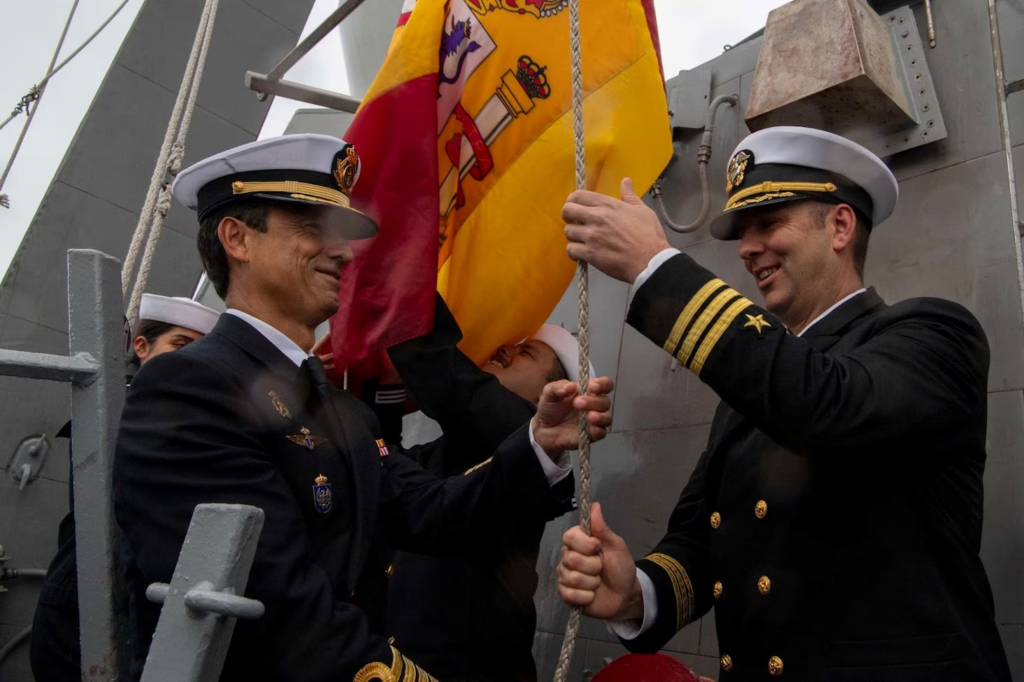


Fifth U.S. Navy DDG Homeport Shifts to Rota, Spain 

NAVAL STATION ROTA, Spain (Oct. 15, 2024) Cmdr. Scott Burrill, the commanding officer of the Arleigh-Burke class guided-missile destroyer USS Oscar Austin (DDG 79), raises a Spanish flag with Spanish Armada Capt. Ernesto Guesos, Commander, 41st Frigate Squadron, during the ship’s homeport shift to Naval Station (NAVSTA) Rota, Spain, from NAVSTA Norfolk, Va., Oct. 15, 2024.

by U.S. Naval Forces Europe and Africa/ U.S. Sixth Fleet Public Affairs 

15 October 2024 

ROTA, Spain – The Arleigh Burke-class guided-missile destroyer USS Oscar Austin (DDG 79) arrived to its new homeport of Naval Station Rota, Oct. 15, as the first of two additional DDGs to join the Forward Deployed Naval Force-Europe (FDNF-E) force. 

The arrival of Oscar Austin expands U.S. Navy capabilities in the U.S. European Command (EUCOM) and U.S. Africa Command (AFRICOM) areas of responsibility. Oscar Austin is now assigned to Destroyer Squadron (DESRON) 60 / Commander, Task Force (CTF) 65 and U.S. 6th Fleet. 

“USS Oscar Austin’s arrival to Naval Station Rota strengthens our commitment to maintaining a forward presence in Europe,” said Vice Adm. J.T. Anderson, Commander, U.S. 6th Fleet. “The addition of this ship to our forces in the region provides our Allies with an added layer of security and assurance, and serves as a powerful symbol of the enduring partnership between the United States and Spain.” 

Modernized with the latest Aegis Ballistic Missile Defense (BMD) upgrade, USS Oscar Austin offers a key capability for the U.S., directly contributing to extended deterrence by providing Allies and partners protection against the threat of ballistic missile attack. The second U.S. Navy destroyer to shift its homeport to Naval Station Rota, scheduled to arrive in 2026, also has the latest Aegis BMD upgrade. 

“Arleigh Burke-class guided-missile destroyers are true multi-mission ships, capable of providing maritime security, conducting anti-air and anti-submarine warfare, and providing humanitarian assistance and disaster relief,” said Capt. Alex Mamikonian, commodore, DESRON 60 and CTF 65. “Bringing USS Oscar Austin to Spain enhances our ability to maintain ready and postured forces to assure, deter and defend in an increasingly complex security environment.” 

Oscar Austin departed Norfolk, Va. Sept. 30 to transit to Spain and assist in providing full coverage and protection for all NATO European populations, territories and forces against the increasing threats posed by the proliferation of ballistic missiles. 

The initial decision to base destroyers out of Spain is part of the U.S. European Phased Adaptive Approach announced by President Obama in 2009. Since its announcement, the U.S. has broadened its Ballistic Missile Defense (BMD) capabilities in theater including increasing FDNF-E from four to six and the finalization of the second Aegis Ashore site in Poland. 

Oscar Austin is the first Flight IIA Arleigh Burke-class guided-missile destroyer and proudly bears the name of Pfc. Oscar P. Austin, United States Marine Corps. Oscar Austin was commissioned on August 19, 2000, in Norfolk, Va. Oscar Austin is ballistic missile defense, anti-submarine, and anti-surface warfare capable. The ship can embark two MH-60R Seahawk helicopters to assist in anti-submarine and other warfare areas. Destroyers can work with Carrier Strike Groups, Surface Action Groups, Expeditionary Strike Groups or independently. 

U.S. 6th Fleet, headquartered in Naples, Italy, conducts the full spectrum of joint and naval operations, often in concert with allied and interagency partners, in order to advance U.S. national interests and security and stability in Europe and Africa. 


Project Link: New T-45 Mixed Reality Trainer Improves Readiness 

Shown is a T-45C prototype mixed reality cockpit view. Note: Dials, displays, and out-of-the-cockpit view are virtual images while the cockpit panels and buttons are seen in the “real world” via a video pass-through camera.

From Naval Air Systems Command, Oct. 11, 2024  

PATUXENT RIVER, Md. — The Naval Aviation Training Systems and Ranges Program Office (PMA-205) and the Naval Air Warfare Center Training Systems Division (NAWCTSD) are bringing the future of training to student aviators with the new T-45C Goshawk mixed-reality simulator, also known as Project Link. 

The Navy is pioneering emerging technologies through the Naval Aviation Training Next (NATN) program, focusing on extended reality (XR) for aviation training. XR encompasses virtual reality (VR), augmented reality, and mixed reality (MR), offering immersive experiences by blending virtual and real worlds. 

Project Link is one of several efforts aligned under the NATN program advancing aviation training by exploring the use of XR trainers; providing individualized training syllabi; and improving performance assessment through updated methods, metrics, and measurements.  

The NATN program is an innovative initiative by the U.S. Navy to use advanced technologies like VR and artificial intelligence to streamline and enhance the training process for new student naval aviators. While AR/VR/MR training solutions do not entirely replace other methods of training, the benefits of these systems can be profound. 

Recent technological advancements made MR a promising solution for flight training, with MR trainers showing potential in supplementing operational flight trainers and offering greater realism and immersion through a blend of virtual and physical cockpit elements.  

“I am excited about the feedback from Chief of Naval Air Training instructors and students on mixed reality technology,” said Capt. Kevin McGee, PMA-205 program manager. “Industry has been improving mixed reality over the past five to seven years and I believe MR is now mature enough to provide significant value in the virtual training environment, replacing some of the larger, more expensive visual projector systems that are employed in our pilot training systems.” 

An initial capability evaluation of the T-45C MR simulator prototypes, conducted by the Naval Undergraduate Flight Training Systems Program (PMA-273), assessed their capability to support future procurement decisions for the undergraduate jet training pipeline. Despite closely resembling the T-45C Goshawk cockpit and using commercial head mounted display systems for visual projection, the prototypes faced some limitations in certain functionalities. The PMA-205/NAWCTSD team addressed the discrepancies and improved the system fidelity, leading to the procurement of four training devices delivered to Meridian, Mississippi, in April. Through the Office of the Under Secretary of Defense for Research and Engineering’s Accelerate the Procurement and Fielding of Innovative Technologies (APFIT) program, the Navy procured an additional 20 systems with eight to arrive in Meridian and 12 to be delivered to Kingsville, Texas, in 2025. 

“These systems reached a level of readiness that allowed for their delivery and immediate integration into training programs. This successful outcome demonstrates the effectiveness of collaborative efforts in refining and advancing military training technologies,” said Cmdr. Lee “Scampi” Sciarini, deputy director, Research and Technology Programs, Naval Air Warfare Center Training Systems Division (NAWCTSD). 

Lt. Cmdr. Joseph Geeseman, PMA-205 Science and Technology Portfolio manager, emphasized the importance of fleet feedback during the development process. 

“These user-evaluation events provide the development teams the opportunity to more narrowly focus their efforts, ensuring that the T-45C MR trainer end product not only meets training requirements, but also exceeds fleet expectations in the look, feel, and ease-of-use of these leading-edge training systems,” Geeseman said. 


RTX’s Raytheon Completes Hydrodynamic Testing for the Barracuda Mine Neutralization System  

Milestone moves program one step closer to operational testing  

From RTX 

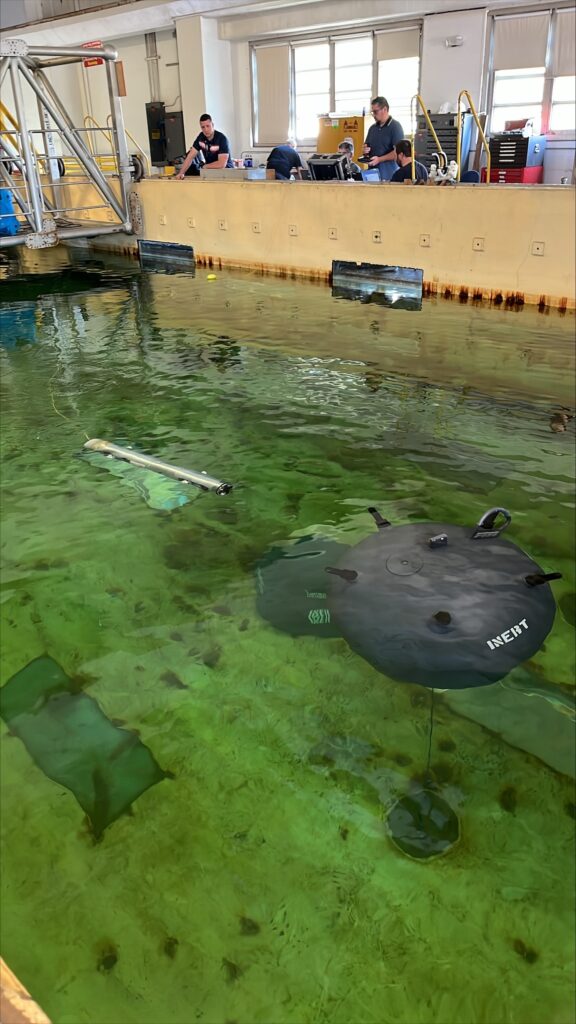
PORTSMOUTH, R.I. (October 7, 2024) — Raytheon, an RTX (NYSE: RTX) business, recently conducted a series of controlled environmental tests for the Barracuda Mine Neutralization System at the Naval Surface Warfare Center Carderock Division. 

Using a production representative test unit, Barracuda operated and collected data in environments of various sea states and water currents, demonstrating the ability to hydrodynamically control itself in conditions simulating the ocean. 

The test demonstrated the ability of the vehicle to detect, track and hold position on a target on its own. It was the first time Raytheon has executed this type of testing with the Barracuda mine neutralizer underwater vehicle and moves the program one step closer towards meeting operational requirements. 

“This event marks a significant milestone in the advancement of underwater security and naval defense,” said Barbara Borgonovi, president of Naval Power at Raytheon.  “Barracuda’s performance reaffirms its position as a game-changing solution for identifying and neutralizing naval mines, a critical challenge in modern naval operations.” 

Barracuda is the U.S. Navy’s program of record for next-generation mine neutralization. It is a semi-autonomous system that uses sonar and camera systems to locate and neutralize undersea mine threats.   

Raytheon was first awarded a contract for Barracuda in 2018. The program completed its critical design review in March 2023, and has now entered its qualification testing phase. In July 2023, Raytheon was awarded a contract to deliver engineering development model units to the U.S. Navy. The program will go into Low-Rate Initial Production in 2027. 


Secretary of the Navy Del Toro Champions Small Business Partnerships at San Francisco Fleet Week

From SECNAV Public Affairs, 10 October 2024 

SAN FRANCISCO, CA – October 10, 2024 – Secretary of the Navy Carlos Del Toro addressed a gathering of small business leaders during San Francisco Fleet Week, emphasizing the vital role they play in supporting the U.S. Navy and Marine Corps today. 

The event, titled “Breaking Barriers: A Department of the Navy & SBA Partnership for Small Business Success,” was held at the San Francisco SBA Business Office and brought together representatives from the San Francisco Chamber of Commerce, regional APEX Accelerators, the National Defense Industrial Association, and other key stakeholders. 

Secretary Del Toro highlighted the Department of the Navy’s commitment to small business partnerships, noting that contracts worth $526 million have been awarded to small businesses located within 50 miles of San Francisco. He cited examples of successful collaborations, such as a $2.89 million contract with Atomic, a Pleasanton-based small business, for the development of advanced tactical atomic clocks, and a $451,000 contract with Arize AI, a Berkeley-based small business, for AI machine learning technology to enhance underwater threat detection. 

“From my vantage point as Secretary of the Navy, a healthy, diverse industrial base made up of companies of all sizes—founded by American entrepreneurs from all walks of life—is absolutely crucial to the success of our Navy and our Marine Corps,” said Secretary Del Toro. 

The Secretary underscored the importance of small businesses in providing critical capabilities and services to support Sailors, Marines, and civilians stationed around the globe. He emphasized the need for innovation and technological advancements in areas such as artificial intelligence, machine learning, cybersecurity, and unmanned systems to maintain the Navy’s maritime dominance. 

“We—along with our international partners and allies—are facing challenges across the globe,” said the Secretary. “Addressing these threats requires a whole-of-nation commitment to ensuring we have a strong Navy and Marine Corps that can defend our interests on a global scale.” 

The Secretary’s remarks were followed by a small business roundtable discussion, where he engaged with entrepreneurs and industry leaders to discuss opportunities for collaboration and address the unique needs of small businesses in the defense sector. He encouraged businesses to connect with the Department of the Navy’s Office of Small Business Programs (OSBP) for guidance and support in navigating the federal procurement process. 

In the evening, Secretary Del Toro attended the “Honor Our Fallen” concert at the Herbst Theater in the San Francisco War Memorial Building. The concert, hosted by The Center for Humanitarian Assistance, featured a performance by the U.S. Marine Corps 1st Marine Division Band and honored the fallen service men and women of the Afghanistan and Iraq conflicts. A private reception followed to thank attending Gold Star families. 

About the U.S. Department of the Navy Office of Small Business Programs: 

The U.S. Department of the Navy Office of Small Business Programs maximizes opportunities for small businesses in Navy contracts, ensuring they are integrated into the Navy’s acquisition process. 


CH-53K Advanced Aviation Training Device Declared Ready for Training 

The CH-53K Advanced Aviation Training Device is a new “first of its kind” trainer for both pilots and aircrew of the CH-53K. The mixed-reality static trainer recently completed a test readiness review and joint final testing and was declared ready for training. (U.S. Navy)

From NAVAL AIR SYSTEMS COMMAND, Oct. 10, 2024 

PATUXENT RIVER, Md. — A Test Readiness Review (TRR) and Joint Final Testing (JFT) were recently completed for the CH-53K Advanced Aviation Training Device (AATD) 1, resulting in the trainer being declared Ready for Training (RFT) on Aug. 16. The new mixed-reality static training device is the first of its kind to support both pilot and aircrew training on the CH-53K King Stallion.   

Veraxx Engineering Corporation developed the AATD prototype for the H-53 Heavy Lift Helicopter Program Office (PMA-261). 

According to Maj. Daniel Meckley, H-53 Training Systems Integrated Product Team Lead, “The purpose of the device is to provide cockpit familiarization and crew resource management training to pilots and aircrew.”  

The AATD provides mixed reality goggles for pilots, which simulates the external environment while also allowing them to see their hands.   

“With the AATD, the pilots don’t need to use the goggles because there is a big screen TV in front of the device to conduct basic training,” explained Meckley.   

The crew chief also wears a set of goggles, but these are virtual reality instead of mixed reality.  

“This means the crew chief cannot see his or her hands,” said Meckley. “All they see is the simulated environment.”  

According to Meckley, even though the crew chief station is physically located behind the cockpit, the training can simulate being anywhere inside or outside the aircraft.  

“This leads to enhanced communication and crew resource management during specific training areas like aircraft startup/shutdown, confined area landings, formation flights, etc.,” he said.  

PMA-261 manages the cradle-to-grave procurement, development, support, fielding and disposal of the entire family of H-53 heavy lift helicopters, including the CH-53K King Stallion, the CH-53E Super Stallion and the MH-53E Sea Dragon.  


USS Annapolis Returns Home to Naval Base Guam Following Indo-Pacific Deployment 

USS Annapolis (SSN 760) arrives at Naval Base Guam. (MC1 Justin Wolpert) 

From Lt. James Caliva, Oct. 10, 2024 

NAVAL BASE GUAM – The Los Angeles-class fast-attack submarine USS Annapolis (SSN 760) returned to its homeport of Naval Base Guam after a successful three-month deployment in the Indo-Pacific region, Oct. 5, 2024. 

 “USS Annapolis exemplifies excellence and stands as the pinnacle of our submarine force, playing a vital role in ensuring a free and open Indo-Pacific,” said Capt. Neil Steinhagen, commander, Submarine Squadron 15. “Their unwavering commitment to advancing theater security and executing operational tasks has produced outstanding results. True to their motto, ‘Born Free, Hope to Die Free,’ the crew of Annapolis consistently meets every challenge head-on, showcasing unparalleled operational readiness and exceptional teamwork. Bravo Zulu, team—welcome home!” 
 
Under the command of Capt. James Tuthill, Annapolis completed missions vital to national security, bolstering operational maritime capabilities in the Pacific. During their deployment, the submarine participated in key bilateral operations with the French Navy and welcomed Rear Adm. Chris Cavanaugh, commander, Submarine Group Seven, during a port visit to Yokosuka, Japan. 
 
“My crew answered the call, exemplifying remarkable dedication to our mission across the Pacific,” said Tuthill. “I couldn’t be prouder of them, or the tenacity and professionalism they displayed every day at sea. Their resilience, determination, and refusal to quit when things got hard define my extraordinary team. It’s a true honor to lead such an inspiring group. They rose to every occasion.” 
 
Commissioned on April 11, 1992, Annapolis is the fourth ship in the history of the U.S. Navy to be named for Annapolis, Maryland, home of the United States Naval Academy. 
 
Assigned to Commander, Submarine Squadron 15 at Polaris Point, Naval Base Guam, Annapolis is one of four Los Angeles-class fast-attack submarines forward-deployed in the Pacific. Renowned for their unmatched speed, endurance, stealth, and mobility, Los Angeles-class submarines form the backbone of the Navy’s submarine force, ensuring readiness and agility in safeguarding maritime interests around the world. 


USS Boxer, 15th MEU Arrive in Philippines to Deliver Emergency Relief Supplies

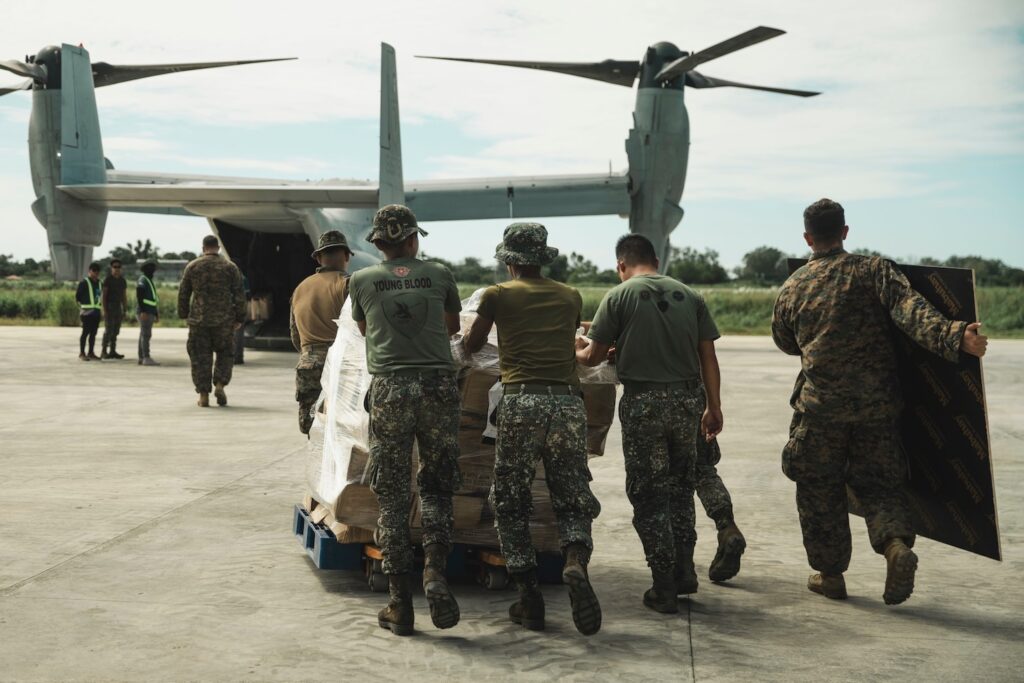
U.S. Marines assigned to the 15th Marine Expeditionary Unit and Philippine Marines assigned to 4th Marine Brigade load USAID supplies into an MV-22B Osprey during foreign disaster relief operations at the Laoag International Airport in Laoag City, llocos Norte, Philippines, Oct. 8, 2024. (U.S. Marine Corps photo by Cpl. Luis Agostini) 

By Capt. Brian Tuthill, 15th Marine Expeditionary Unit Public Affairs 

Oct. 9, 2024 

LUZON, PHILIPPINES  –  Amphibious assault ship USS Boxer (LHD 4), and embarked elements of the 15th Marine Expeditionary Unit (MEU), arrived in the Philippines Oct. 8 to support the U.S. Agency for International Development’s (USAID) efforts in foreign disaster response operations following Typhoon Krathon (locally known as Julian), which made landfall on the Province of Cagayan, Philippines, Sept. 30. 
 
Their support is at the request of the Philippine government and directed by U.S. Secretary of Defense Lloyd Austin and U.S. Indo-Pacific Command. 
 
“The primary focus of our mission is helping the people of the Philippines recover as quickly and safely as possible,” said U.S. Marine Corps Col. Sean Dynan, commanding officer, 15th MEU. “Alongside the Armed Forces of the Philippines and USAID, our forces will help coordinate and transport relief supplies to those who were most affected in the Batanes Islands. Humanitarian assistance in an expeditionary environment is what we train to do, and it is one of the reasons we are forward deployed as an amphibious force.” 
 
The Boxer Amphibious Ready Group and 15th MEU (ARG-MEU) will send personnel and equipment from the ship to transport foreign disaster response (FDR) supplies to remote locations within the Philippines in collaboration with USAID. 
 
“Our condolences go out to all those affected by this devastating typhoon,” said U.S. Navy Capt. Tate Robinson, commodore, Amphibious Squadron (COMPHIBRON) 5. “The unique construct of the Navy and Marine Corps team in an ARG-MEU provides us the ability to respond to crises through rapid maneuverability and embarked assets, allowing us to be on station and ready to support however we are needed. I am proud of the way our amphibious force team has come together to work alongside our Philippine allies in a timely, efficient, and professional manner to provide aid and alleviate suffering for those affected by Typhoon Krathon.” 
 
The USAID supplies being delivered on the ground will include items such as tarps, shelter kits and food packets. 
 
Boxer and 15th MEU will join personnel from I Marine Expeditionary Force’s Marine Rotational Force – Southeast Asia, who are already located in the country, to help facilitate the efficient distribution of materials. Additionally, U.S. Marine Corps KC-130J Hercules aircraft from Marine Aerial Refueler Transport Squadron 152, 1st Marine Aircraft Wing, arrived in Manila from Okinawa, Japan, last week to support the ongoing relief efforts. 
 
The ARG-MEU team is capable of conducting operations from combat missions to humanitarian aid and disaster relief. They exemplify these capabilities with air-borne and sea-based connectors to move people and supplies where and when needed. As such, prior to the deployment, Boxer and 15th MEU conducted training and certification for humanitarian assistance missions. 
 
The U.S. military regularly trains with the Philippines on FDR operations. Recurring exercises, such as Balikatan and Kamandag, provide crisis response training that enhances operational readiness and develops joint interoperability during an actual disaster and the relief efforts that follow. 
 
Boxer and embarked elements of the 15th MEU are conducting routine operations in the U.S. 7th Fleet area of operations. U.S. 7th Fleet is the U.S. Navy’s largest forward-deployed numbered fleet, and routinely interacts and operates with allies and partners in preserving a free and open Indo-Pacific region. 


Forging Industry Can Meet Defense Demand, Group Says

A Rock Island Arsenal-Joint Manufacturing and Technology Center artisan transfers a metal component during the forging process as part of a demonstration at the U.S. Army Tank-automotive and Armaments Command Casting & Forging Summit in 2022. The event gathered experts and officials across the government, military, industry and academia to discuss how to best modernize and sustain manufacturing operations critical to national security. U.S. ARMY U.S. Army | Hayley Smith, Rock Island Arsenal-Joint Manufacturing and Technology Center

The forging industry has a message for the Department of Defense and the country’s defense contractors: it has tremendous capacity and is ready to work.

That message is being spread by a new education campaign from the Forging Industry Association. The group’s CEO, Jim Warren, told reporters on Oct. 9 there is a perception within the DoD that the forging industry lacks capacity, but that’s not the case.

“We have no problem with capacity on anything,” he said. If there is a problem in the future, it will be with an expected surge in construction of commercial aircraft, but until then, “we can do it all,” including making forged and cast components for ships and submarines.

The real issue, he said, is with an uncertain demand signal that makes it hard to predict when forged and cast products will be needed. The Forging Industry Association’s message to the DoD and the prime contractors is, “can we please run more like a commercial industry?” Warren said.

The FIA is promoting a new survey from the auditing firm Wipfli, which concluded that 63% of forging companies do work within the defense industry and members, on average, are using 51% of their available capacity.

Companies that do primarily defense work have an even lower capacity use, at 41%. The FIA concluded these companies have ample capacity to do additional defense work if it was available. The study also showed that 76% of forgers have invested in robotics, so they are working to boost their efficiency.

“Washington is making historic investments in our technological edge to compete in this new era of great power competition. But the North American forging industry is at risk of being neglected — by a combination of inattention from government authorities, a stubborn myth that it lacks sufficient capacity to meet demand, and trade policies that hobble us and aid our adversaries,” Warren said in a statement.

Helpful Steps

The FIA wants the government to take several steps, including streamlining the process for adding forging companies to approved vendor lists; adding more varied types of materials; extending contract periods to allow companies to make better use of their capacity; and make additional investments in new technology, infrastructure and workforce development programs.

The Defense Production Act Title III and the Industrial Base Analysis and Sustainment programs could help fund new technology to help improve the quality of hot forged parts, FIA said.

There are also trade issues. As is the case with other industries, the FIA says government-subsidized Chinese companies are unfairly competing in the market.

“What’s needed are higher tariffs on Chinese forgings — more than the current 25% tariffs currently in place — to help bring back some of that lost business,” Warren said in a statement. “More aggressive efforts are also called for to prevent China, India, and others from dumping into the market forgings such as gears and connecting rods that are far below fair market. That means considering outright bans on certain countries from importing forgings.”


MSCPAC Bids Farewell to USNS Pecos 

From Sarah Cannon, Oct. 9, 2024 

USNS Pecos (T-AO 197) will transit to the East Coast to be deactivated and removed from service. 

SAN DIEGO — Military Sealift Command Pacific (MSCPAC) bids fair winds and following seas to the Military Sealift Command (MSC) fleet replenishment oiler USNS Pecos (T-AO 197) as it made its last departure from the San Diego Bay today. The ship will transit to the East Coast, where it will be deactivated and removed from service. 
 
Christened in 1989, Pecos served as part of the MSC fleet for 35 years. During its career, Pecos served in the Persian Gulf during both Operation Desert Storm and Operation Enduring Freedom. 
 
In 2006 Pecos deployed with the MSC Hospital Ship USNS Mercy (T-AH 19) for five-months, delivering aid and humanitarian assistance to the Pacific Islands and Southeast Asia, following the humanitarian assistance missions in the wake of the tsunami in Indonesia. Missions like this evolved into what is now known as the Pacific Partnership missions. These missions continue to provide medical and humanitarian assistance, while building international friendships throughout Southeast Asia. 
 
In 2011, following the deadly earthquake and tsunami in Japan, Pecos rendezvoused with United States Seventh Fleet flagship USS Blue Ridge (LCC-19) near Kyushu, Japan as part of Operation Tomodachi. Blue Ridge transferred 96 pallets of humanitarian assistance and disaster relief material to Pecos for delivery to the Essex Amphibious Group and Carrier Strike Group 5. The pallets consisted of water containers and water purification tablets, first-aid products, tarpaulins, blankets, and other supplies. During her support effort to Operation Tomodachi, Pecos completed nine underway replenishments and delivered more than 2.3 million U.S. gallons of fuel to other supporting ships. 
 
On November 28, 2018, the United States Navy sent Pecos and guided missile destroyer USS Stockdale (DDG 106) through the Taiwan Strait as a demonstration of the “U.S. commitment to a free and open Indo-Pacific. 
Most recently, Pecos provided logistics support to the multi-national maritime exercise, Rim of the Pacific 2024, delivering nearly 4 million gallons of diesel fuel and 2.2 million gallons of jet fuel through 36 underway replenishment events. 
 
“This ship and its crew have answered all bells, time and time again. ” said Capt. Micah Murphy, commander, Military Sealift Command Pacific (MSCPAC). “The ship’s longstanding success, highlighted by this year’s RIMPAC, is really a testament to the professional mariners abilities, dedication to duty, and relentless pursuit of quality customer service to the fleet. It is fitting that one of the longest tenured Masters in MSC, Captain Keith Walzak, was at the helm during the last phase of this ship’s prolific career, capping off a storied career for them both. While it is sad to see a ship’s service end, it is special to be here to say fair winds and following seas to a ship as rich in MSC history as Pecos. Her spirit will live on in the new John Lewis class of oilers that her crew embarks and brings to life.” 
 
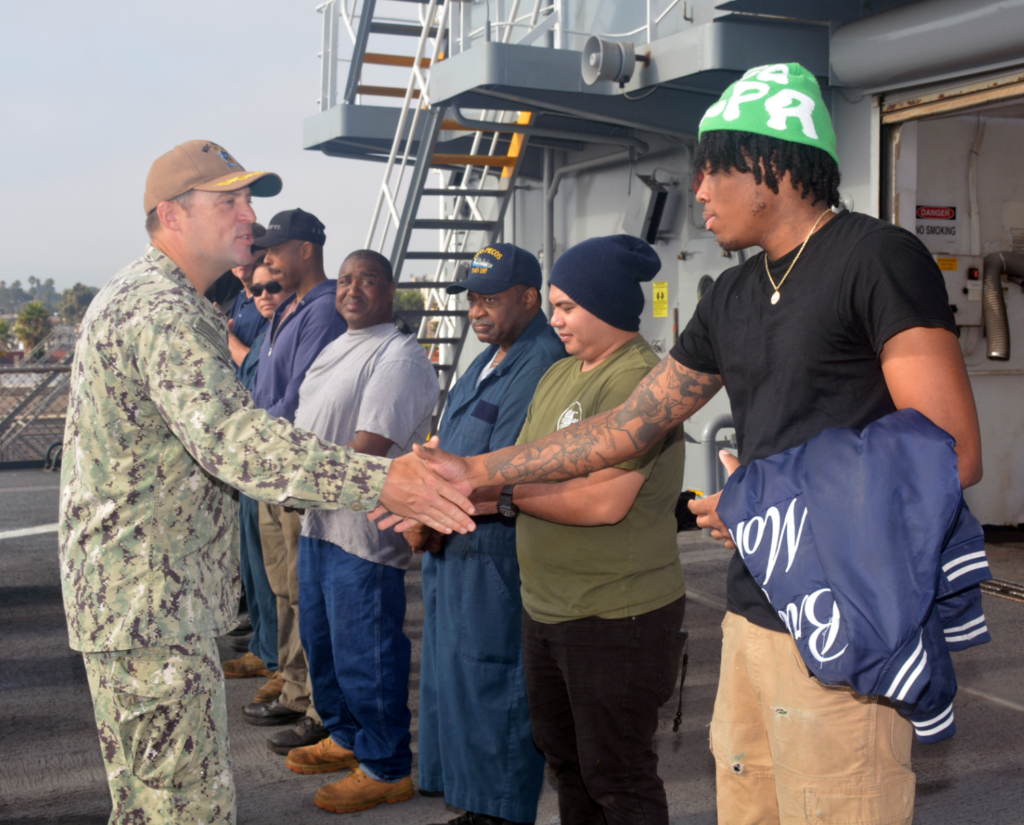
Ahead of Pecos’ departure, Murphy and the MSCPAC team boarded the ship and took a moment to recognize members of the crew, for their outstanding support to the MSC mission, specifically to RIMPAC 2024, and to honor the retirement of Capt. Keith Walzak, Pecos’ civil service master, as he brings to end a 45-year career with MSC. 
 
“I have served on a lot of ships during my career, but Pecos will be the one I really remember,” Walzak said as he addressed the crew. “I might remember this ship, because it is my last, and will be foremost on my mind, but I think I will also remember it, because of the hard work and dedication of all of you. We have a real team here, and that is why we were able to work through a lot of the challenges we’ve had, and to do the great work we’ve done this summer. I am proud of each and every one of you, and I am proud to have served with you.” 
 
Walzak graduated from the United States Merchant Marine Academy in 1980 and was recruited directly into MSC. Over the course of his career, Walzak served 40 ship assignments, 30 as ship’s master. He is the Plank owner of USNS Butte (T-AE 27), USNS Mount Baker (T-AE 34), and USNS Cesar Chavez (T-AKE 14), the latter as the first master, something he considers a career highlight. 
 
“Looking over my whole career, I would have to say that one of the most memorable moments would have to be in 2012, standing on the dais with my wife, as USNS Cesar Chavez, the last-AKE built, was being christened and launched into San Diego Bay, as the first Master on the last T-AKE,” said Walzak. 
 
On behalf of the Secretary of the Navy, Murphy presented Walzak with the Civilian Meritorious Civilian Service Award for his, support to RIMPAC 2024. 
 
“In 45 years of service I have gotten two certificates from the Secretary of the Navy,” joked Walzak. “The first was my discharge from the Navy Ready Reserve, and this one, that I received today. I appreciate the recognition, and I’m proud to have had the opportunity to serve with MSC and to have had the long career that I’ve had. I’ve seen a lot, done a lot, and now I am ready to do whatever my wife wants me to do. She’s spent 41 years waiting for this day. We will travel about, visit family, and get in some relaxation time.” 
 
Pecos is one of the 15 ships of the Henry J. Kaiser class fleet replenishment oilers which are operated by Military Sealift Command. As the class ages out of the MSC fleet, it is being replaced by the new John Lewis class which includes USNS John Lewis (T-AO 205), USNS Harvey Milk (T-AO 206) and USNS Earl Warren (T-AO 207), all currently operating under MSC.