HII Delivers Advanced REMUS 620 UUVs to NOAA Less than 24 Months after Unveiling
From HII
MCLEAN, Va., Sept. 09, 2024 (GLOBE NEWSWIRE) — HII’s (NYSE: HII) Mission Technologies division has successfully built and delivered two REMUS 620 uncrewed underwater vehicles (UUVs) to the National Oceanic and Atmospheric Administration (NOAA) for enhanced high-resolution ocean floor mapping.
Unveiled only 22 months ago in November 2022, the REMUS 620 is the first medium-class UUV designed to deliver a comprehensive range of above- and below-water capabilities over long distances.
“The rapid delivery of the REMUS 620 underscores HII’s exceptional agility and efficiency in producing and deploying uncrewed systems that meet the needs of our customers,” said Duane Fotheringham, president of Mission Technologies’ Unmanned Systems business group. “The swift production and delivery timeline to NOAA demonstrate our commitment to supporting our customers’ mission requirements with rapid development and deployment of new capabilities and technology.”
The REMUS 620 vehicles incorporate cutting-edge modular design and engineering. Like all the REMUS UUVs built by HII, the NOAA REMUS 620 vehicles have been modified with customized enhancements for NOAA’s advanced underwater mapping and habitat restoration missions. Upgrades include a synthetic aperture sonar module, additional energy module, and auxiliary equipment.
NOAA plans to use the REMUS 620 vehicles for high-resolution mapping in the Gulf of Mexico, with a focus on restoring Mesophotic and Deep Benthic Communities — or dim and sunlight-free seafloor habitats — injured by the 2010 Deepwater Horizon oil spill. The timely delivery of these UUVs will allow NOAA to accelerate its critical environmental restoration and exploration missions, building on its existing use of other REMUS models for habitat characterization, marine archaeology, and various oceanographic studies.
“The market interest in the REMUS 620 has been tremendous,” Fotheringham said. “The rapid delivery to NOAA, alongside our growing backlog of REMUS 300 orders, reinforces the market’s confidence in the continued capabilities and versatility of the REMUS series.”
More than 600 REMUS UUVs have been sold globally and are in operation in more than 30 countries, including 14 NATO members. Over 90% of the vehicles delivered in the past 23 years are still operational today, demonstrating the platform’s durability and the ability to integrate new technologies as they are developed.
SECNAV Del Toro Attends USNS Lansing Keel Laying at Austal Shipyard
Artist rendering of the future USNS Lansing (EPF 16). (Austal USA)
From SECNAV Public Affairs, 6 September 2024
MOBILE, Ala. (Sept. 6, 2024) – Secretary of the Navy Carlos Del Toro attended the keel laying ceremony for USNS Lansing (EPF 16) alongside ship sponsor Michigan Gov. Gretchen Whitmer in Mobile, Alabama, Sept. 6, 2024.
The Expeditionary Fast Transport (EPF) shipbuilding program provides high speed, shallow draft transportation capability to support the intra-theater maneuver of personnel, supplies and equipment for the U.S. Navy, Marine Corps, and Army.
“Our EPFs are force multipliers for our combat logistics fleet,” said Secretary Del Toro. “They allow for quicker responses to crises, strengthen our ability to conduct humanitarian and disaster relief operations, and provide logistical support for special forces missions.”
Lansing will be manned by dedicated crews, comprised of both civilian mariners from the Military Sealift Command and embarked military personnel, whose expertise and teamwork will ensure the ship operates at peak efficiency, delivering critical resources and services exactly when and where they’re needed.
The keel laying represents the success and importance of our Maritime Statecraft initiative, which encompasses a national, whole-of-government effort to restore the comprehensive maritime power of our nation.
“Michigan has a world-class skilled workforce and is a leader in developing the techno-industrial workforce we need to build and assemble the ships, munitions, parts, and pieces our Navy, Marine Corps, and indeed our nation need to promote peace around the world,” said Del Toro. “Austal, building this ship, represents another key line of effort under our new, national approach to Maritime Statecraft—a foreign shipbuilder establishing a U.S. subsidiary, investing in America, and partnering with us to build American ships.”
USNS Lansing is the first ship named in honor of Michigan’s capital city, Lansing. A previous USS Lansing (DE 388) was named for Aviation Machinist Mate First Class William Henry Lansing and decommissioned in 1965.
Bridging the gap between low-speed sealift and high-speed airlift, EPFs transport personnel, equipment and supplies over operational distances with access to littoral offload points including austere, minor and degraded ports in support of the Global War on Terrorism/Theater Security Cooperation Program, Intra-theater Operational/Littoral Maneuver and Sustainment and Seabasing. EPFs enable the rapid projection, agile maneuver and sustainment of modular, tailored forces in response to a wide range of military and civilian contingencies such as Non-Combatant Evacuation Operations, Humanitarian Assistance and Disaster Relief.
Secretary Del Toro made the announcement alongside Governor Gretchen Whitmer and Mayor Andy Schor of Lansing, Michigan, July 22, in addition to announcing the Michigan Maritime Manufacturing (M-3) initiative.
Austal USA, located in Mobile, Alabama, was realized in 1999 for the purpose of reaching the ever increasing commercial and defense aluminum vessel market in the United States. Our shipbuilding facility occupies 164 acres on the eastern shore of the Mobile River and is strategically positioned at the mouth of the Gulf of Mexico.
US Marine Corps Orders L3Harris Multi-Channel Radios Under 10-Year IDIQ
From L3Harris, Aug 28, 2024
ROCHESTER, N.Y., Aug. 28, 2024 — L3Harris Technologies (NYSE:LHX) has received a new order from the U.S. Marine Corps for multi-channel handheld and vehicular radio systems worth more than $120 million, bringing program orders to date above $600 million.
The recent order is under a 10-year, $750 million indefinite delivery, indefinite quantity contract for L3Harris Falcon IV® handheld radios. These software-defined devices allow for immediate upgrades to the latest in NSA-certified, high-assurance standards and access to a broad resilient waveform portfolio to maintain spectrum superiority against emerging threats.
“Our continued investment toward high-assurance technology centers around providing U.S. Marines and other customers the ability to operate seamlessly on the move without enemy interference or detection,” said Chris Aebli, President, Tactical Communications, L3Harris. “These highly advanced systems allow our fighting forces to coordinate with a growing coalition that have selected L3Harris as their resilient communication systems provider.”
L3Harris delivers communication systems enabling Combined Joint All-Domain Command-and-Control concepts with more than 60 years of experience supporting joint force and coalition partner initiatives, including the U.S. Army’s Handheld, Manpack and Small Form Factor, the U.S. Special Operations Command’s Next Generation Tactical Communications and the UK Ministry of Defence’s Multi Mode Radio programs.
QinetiQ US Awarded Contract to Support Delivery of Hardware on CVN 81
STRAIT OF GIBRALTAR (Jan. 5, 2023) The world’s largest aircraft carrier USS Gerald R. Ford (CVN 78) transits the Strait of Gibraltar, Jan. 5, 2024. CVN 81 will be the fourth ship of the class. (U.S. Navy photo by MC2 Jacob Mattingly)
From QinetiQ, Sept. 5, 2024
MCLEAN, Va., — QinetiQ US announces that it has received a contract from General Atomics Electromagnetic Systems (GA-EMS) in San Diego, California to deliver control hardware and software for the Electromagnetic Aircraft Launch System (EMALS) and the Advanced Arresting Gear (AAG) to be installed on the U.S. Navy’s next Ford-class aircraft carrier, the future Doris Miller (CVN 81).
This contract reflects a multi-year production task to update, procure, assemble, and test launch control and arresting control hardware. For more than a decade, QinetiQ has supported GA-EMS and the U.S. Navy by providing the hardware and software for the EMALS Launch Control Subsystem, as well as control hardware and software for the AAG system. These systems were developed for and installed on the USS Gerald R. Ford (CVN 78) and future Ford-class carriers John F. Kennedy (CVN 79) and Enterprise (CVN 80).
“QinetiQ US is honored to continue our partnership with General Atomics Electromagnetic Systems, delivering critical technology for the fourth ship in the Ford-class, CVN 81. Our ongoing commitment to excellence ensures that the Navy is equipped with the best systems to accomplish its mission with increased reliability, improved operational efficiencies, and significantly decreased lifecycle costs,” said Christopher Forrest, Executive Vice President of Advanced Robotics and Mission Solutions at QinetiQ US.
Development and production of the hardware and software will be done in QinetiQ’s Franklin, Massachusetts facility.
Austal USA Launches 15th EPF, USNS Point Loma
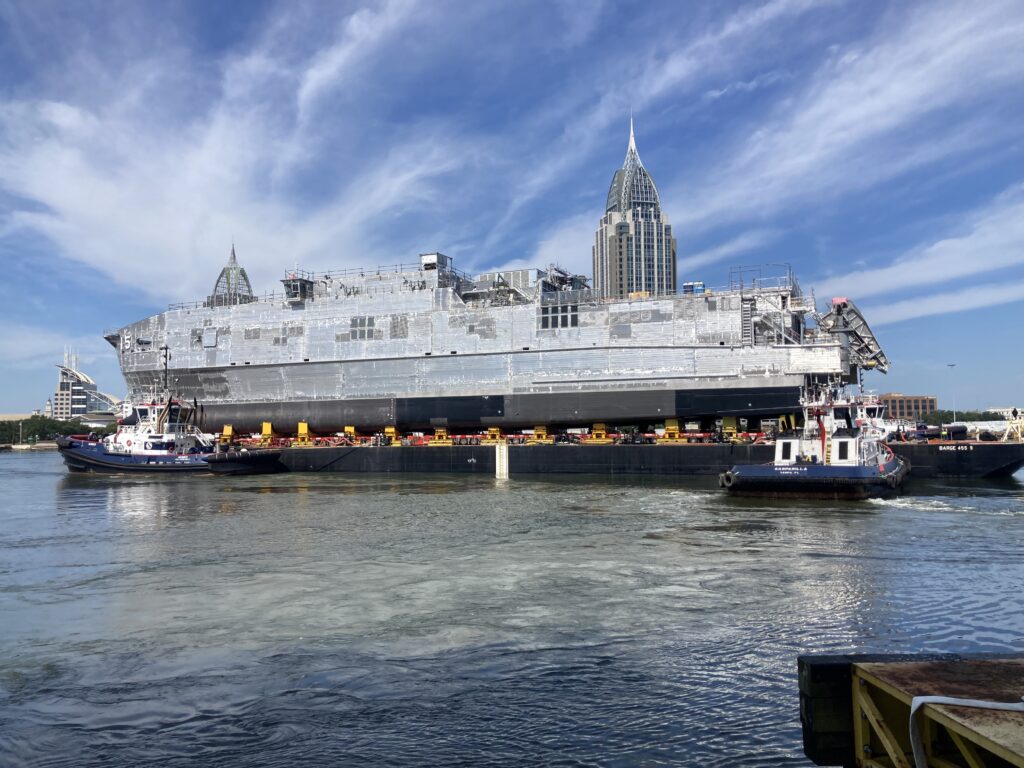
MOBILE, Ala. – Austal USA launched USNS Point Loma (EPF 15) at the company’s state-of-the-art ship building facility in Mobile, Ala. today. The U.S. Navy’s 15th Expeditionary Fast Transport (EPF), christened in the beginning of August, is now docked pier side for final outfitting and system activation in preparation for sea trials later this year.
During the launch process, self-propelled modular transporters (SPMT) lifted the ship almost three feet and moved it approximately 400 feet onto a deck barge moored adjacent to the final assembly bay. The barge moved the ship downriver to Austal USA’s West Campus repair yard where the ship was placed in a floating dry dock. The EPF was submerged in the dry dock enabling it to float for the first time, and it was returned back upriver to Austal USA’s new construction facility.
“The continued success of this launch process is a testament to the value of teamwork and applying lessons-learned to everything we do,” stated Austal USA Vice President of New Construction Programs, Dave Growden. “Our test and activation, crane and rigging, and safety teams work methodically alongside our Navy partners and key vendors such as Berard Transportation and E.N. Bisso & Son tug services. These partnerships allow us to continually examine our process, identify opportunities for improvement, and more effectively achieve these major ship milestones.”
Production efforts on EPF 15 will shift to final outfitting and system activation to support USNS Point Loma getting underway for sea trials.
Navy Honors Capt. Thomas G. Kelley at Keel Plate Signing
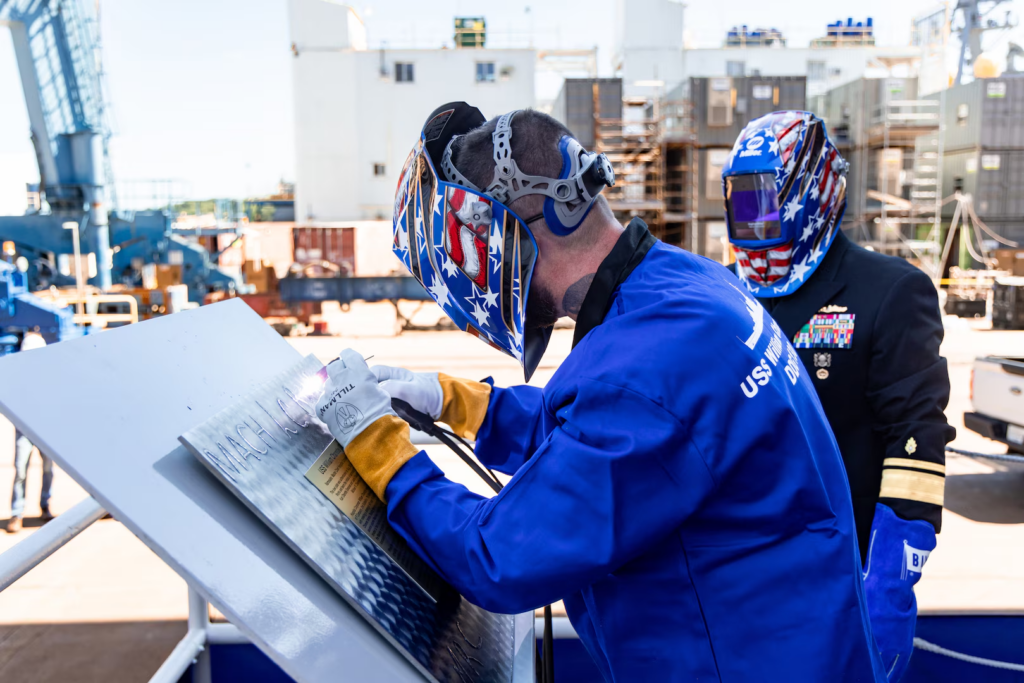
The U.S. Navy celebrated the keel plate signing ceremony for the future USS Thomas G. Kelley (DDG 140) at General Dynamics Bath Iron Works (BIW) on Aug. 30. During the ceremony, Marc Cote, a senior welder from General Dynamics BIW, welded the ship’s namesake, Capt. Kelley’s signature onto the keel plate which will be used in the future during the keel laying ceremony. Capt. Kelley, a Medal of Honor recipient for his heroism during the Vietnam War. (U.S. Navy photo)
By Team Ships Public Affairs, Aug.30, 2024
The U.S. Navy celebrated the keel plate signing for one of the Navy’s future Arleigh Burke-class Flight III destroyers at an event hosted at General Dynamics Bath Iron Works (BIW) on Aug. 30.
The ceremony was held in honor of Capt. Thomas G. Kelley, a Medal of Honor recipient for his heroism during the Vietnam War and the namesake of the future USS Thomas G. Kelley (DDG 140).
During the ceremony, Marc Cote, a senior welder from General Dynamics BIW, welded Capt. Kelley’s signature onto the keel plate which will be used in the future during the keel laying ceremony.
“What an honor! I am truly grateful and humbled that Secretary Del Toro chose me to be the namesake of DDG 140. To have the ship built in my backyard makes it more special and is a testament to the work skills of New England men and women. I am so proud of the capability this destroyer will eventually bring to the fleet”
Flight III destroyers feature the AN/SPY-6(V)1 Air and Missile Defense Radar and incorporate upgrades to the electrical power and cooling capacity plus additional associated changes to provide greatly enhanced warfighting capability to the fleet.
PEO Ships, one of the Department of Defense’s largest acquisition organizations, is responsible for executing the development and procurement of all destroyers, amphibious ships and craft, auxiliary ships, special mission ships, sealift ships and support ships.
Keel Laid for Future USS William Charette
During a keel laying ceremony for the future USS William Charente on Aug. 29, a welder from General Dynamic Bath Iron Works etches the initials of the keel honorees into the keel plate. The initials are of the ship namesake’s children, Margaret Ann Charette Henderson, Kati Charette Donovan, Laura Charette Bennett, Michael R. Charette, and the late William A. Charette. The namesake’s daughters are the ship’s co-sponsors. (U.S. Navy photo)
By Team Ships Strategic Operations, Aug. 29, 2024
Bath, Maine – The keel for the future USS William Charette (DDG 130), an Arleigh Burke-class guided-missile destroyer, was laid during a ceremony on Aug. 29 at General Dynamic Bath Iron Works (BIW).
The ship is named in honor of Master Chief Hospital Corpsman William R. Charette, a veteran who was awarded the Medal of Honor for his heroic acts during the Korean War, while assigned to Company F, 2nd Battalion, 7th Marines,1st Marine Division in Panmunjom Corridor (DMZ), Korea.
Rear Adm. Darin K. Via, Surgeon General of the Navy and Chief, Bureau of Medicine and Surgery (BUMED), presided over the ceremony on behalf of the Secretary of the Navy Carlos Del Toro.
“All of us in Navy Medicine are immensely proud to have a warship named after one of our own. We understand that it is one of the greatest honors you can receive in the Navy. The future USS William Charette will not only be a symbol of American strength but also a testament to the courage and dedication of Navy corpsmen,” said Rear Adm. Darin Via. “To have a ship named after a Navy corpsman is to hold to the maxim of ‘Corpsman Up!’ and embodies the ethos of courage, fidelity, and service before self.”
A keel laying ceremony represents the joining together of the ship’s modular components at the land level. During the ceremony, the keel is authenticated when the welder etches the initials of the keel honorees into the keel plate. The authentication was confirmed by Via, on behalf of the namesake’s children, Margaret Ann Charette Henderson, Kati Charette Donovan, Laura Charette Bennett, Michael R. Charette, and the late William A. Charette. The namesake’s daughters are the ship’s co-sponsors. BUMED Force Master Chief PatrickPaul (PaP) Mangaran, director of the Hospital Corps and leader of the Navy Medicine’s enlisted force, also read a statement on behalf of the Charette family.
“The future USS William Charette will be a welcomed addition to the fleet and another player on the field to provide the Navy with the most advanced warfighting capability” said Capt. Seth Miller, DDG 51 Class program manager, Program Executive Office (PEO) Ships. “This ship honors the legacy of the late William Charette and his heroism during the Korean War. We are honored to have his daughters as sponsors and for the entire family to celebrate this significant milestone.”
A DDG 51 Flight III destroyer features the AN/SPY-6(V)1 Air and Missile Defense Radar and incorporates upgrades to the electrical power and cooling capacity plus additional associated changes to provide greatly enhanced warfighting capability to the fleet. The future destroyers Harvey C. Barnum Jr. (DDG 124), Louis H. Wilson Jr. (DDG 126), Patrick Gallagher (DDG 127), Quentin Walsh (DDG 132), John E. Kilmer (DDG 134), and Richard G. Lugar (DDG 136) are also under construction at BIW.
PEO Ships, one of the Department of Defense’s largest acquisition organizations, is responsible for executing the development and procurement of all destroyers, amphibious ships and craft, auxiliary ships, special mission ships, sealift ships and support ships.
Sept 3 U.S. Central Command Update
From U.S. Central Command, Sept. 3, 2024
TAMPA, Fla – In the past 24 hours, U.S. Central Command (USCENTCOM) forces successfully destroyed an Iranian-backed Houthi missile system in a Houthi-controlled area of Yemen.
It was determined this system presented an imminent threat to U.S. and coalition forces, and merchant vessels in the region. This action was taken to protect freedom of navigation and make international waters safer and more secure for U.S., coalition, and merchant vessels.
Senior Navy Leader Visits Indo-Pacific for AUKUS, Strengthens Interoperability from Under Secretary of the Navy Public Affairs
PERTH, Australia (Sept. 2, 2024) – USS Emory S. Land (AS 39) Sailors brief the Acting Under Secretary of the Navy Tom Mancinelli (front right) aboard the ship about their job, Sept. 2, during the Submarine Tendered Maintenance Period (STMP) in Perth, Australia. Mancinelli traveled to Australia to observe the AUKUS STMP and affirm and advance the strong alliance between Australia and the U.S. for an enduring resilient, free and open Indo-Pacific. (U.S. Navy photo by Capt. Courtney Hillson)
From SECNAV Public Affairs, Sept. 4, 2024
PERTH, Australia – Acting Under Secretary of the Navy Tom Mancinelli traveled to Perth, Australia, Sept. 1-3, to meet with partner navies, government officials, and military leaders to discuss their shared commitment to maintaining a free and open Indo-Pacific.
Mancinelli observed the Submarine Tendered Maintenance Period (STMP) and engaged with Royal Australian and U.S. Navy Sailors supporting this Australia, United Kingdom, United States (AUKUS) milestone.
“AUKUS is a partnership to defend a free and open Indo-Pacific and defend our shared interests,” the acting Under Secretary said. “The United States is committed to its success as we take on the challenges of the 21st century together.”
Throughout the trip, he discussed the trilateral AUKUS partnership and held several engagements to communicate the Department of the Navy’s commitment to advancing interoperability, innovation, and maritime security.
The acting Under Secretary of the Navy met with senior defense leaders, Royal Australian Navy (RAN) leaders, and government leaders during his travel to Western Australia, to include Australian Prime Minister Anthony Albanese, Deputy Prime Minister and the Minister of Defence Richard Marles, Minister for Defence Industry and Capability Development Pat Conroy, Premier of Western Australia Roger Cook, Western Australia Minister for Defence Paul Papalia, Minister for Resources and Northern Australia Madeleine King, British High Commissioner Vicki Treadell, RAN Chief of Navy Vice Adm. Mark Hammond, and Director General Australian Submarine Agency Vice Adm. Jonathan Mead.
Leaders exchanged views on the importance of maritime security and spoke about AUKUS Optimal Pathway accomplishments, the significance of maintaining strong navies, as well as their shared commitment to ensure a stable, peaceful, and prosperous Indo-Pacific region, complementing the existing regional security architecture.
“There is no substitute for presence. We are supporting this generational opportunity that will increase our maritime capabilities and interoperability, while also helping Australia develop and operate its own sovereign, conventionally armed, nuclear-powered submarines,” Mancinelli emphasized.
“The Submarine Tendered Maintenance Period, a hallmark of AUKUS Pillar I for 2024, is a proud step forward in our shared journey,” said Mancinelli. “It represents one of the tangible ways in which our navies are sharing our talents and resources.”
At HMAS Stirling, the future home to Submarine Rotational Force – West, which is helping to shape Australia’s future fleet of conventionally armed, nuclear-powered submarines, he visited commands and thanked personnel.
The acting Under Secretary toured the USS Hawaii (SSN 776) alongside Albanese and Marles. On board he spoke with Australian and U.S. Navy Sailors working together and conducting maintenance on the submarine.
Separately, Mancinelli met with Fleet Support Unit Sailors and visited the submarine tender ship USS Emory S. Land (AS 39) to talk with Sailors and meet defense and RAN leaders.
USS Emory S. Land Sailors are supporting maintenance activities aboard the Hawaii. This is the first time Australians have participated in a U.S. submarine maintenance period in Australia. Additionally, more than 30 Australian personnel who participated in a knowledge exchange period that began in January 2024 aboard Emory S. Land are executing the majority of planned maintenance work with U.S. support and oversight.
“I am excited to see progress firsthand, and I look forward to seeing an even closer partnership with the Australian Navy and British Navy in the future as we work together to preserve a free and open Indo-Pacific.”
Mancinelli then toured the Henderson Shipyard and Hoffman Engineering, an Australian firm that supplies parts for Australia’s Collins class submarines.
“We’re making historic investments in our own defense industrial base capabilities and standing shoulder to shoulder with two countries that share our values and our commitment to peace and security,” he noted.
Lastly, he visited a Perth-based think tank and engaged in dialogue with defense and national security experts about AUKUS. He also discussed the strategic importance of the enduring Alliance between Australia and the U.S. and the ways in which our navies are working together to uphold the rules-based order.
The U.S. and Australian navies share a mutual interest in maintaining freedom of navigation and open sea lanes for trade and commerce. They conduct frequent cooperative deployments, and regularly operate together during flagship theater exercises such as Pacific Partnership, Rim of the Pacific (RIMPAC), and the Australian-led Kakadu.
This trip marked Mancinelli’s first international trip as the acting Under Secretary of the Navy and his first visit to Perth, Australia.
Austal USA Starts Construction of Coast Guard Offshore Patrol Cutter
Representatives of Austal USA and U.S. Coast Guard gathered to celebrate the start of construction on the future USCGC Pickering. (Photo from Austal USA)
From Austal USA, Aug. 29, 2024
MOBILE, Ala. – Austal USA celebrated the start of construction on the first U.S. Coast Guard Heritage-class Offshore Patrol Cutter (OPC) to be built at the company’s Mobile, Ala. ship manufacturing facility today. Pickering (WSMM 919) is the first OPC being built under a contract that includes up to 11 cutters and has a potential value of $3.3 billion.
Austal USA was honored to have Coast Guard Rear Admiral Michael Campbell as a key speaker at today’s event. The OPC program will recapitalize the Coast Guard’s aging medium endurance cutters and provide a capability bridge between the service’s national security cutters, which operate in the open ocean, and the fast response cutters which operate closer to shore.
“Austal USA is excited to begin construction on the first of these high priority cutters for the U.S. Coast Guard,” commented Dave Growden, vice president of new construction programs. “This contract exemplifies the flexibility of our workforce and importance of our steel panel line to Austal USA’s future success. Our multi-talented shipbuilders are well prepared to demonstrate their capability to produce the same high-quality steel ship as they have been producing for our aluminum programs.”
The 360-foot OPC will support the national security strategy for maintaining the nation’s economic, social, environmental and military security mission areas. The OPC will typically conduct its primary missions beyond 12 nautical miles from shore and will be employed anywhere the national interests require the Coast Guard’s unique blend of authorities and capabilities.
OPCs meet the service’s long-term need for cutters capable of deploying independently or as part of task groups to conduct law enforcement, search and rescue, homeland security and defense missions.
OPC will provide the majority of the Coast Guard’s offshore presence conducting a variety of missions including law enforcement, drug and migrant interdiction, and search and rescue. With a range of 10,200 nautical miles at 14 knots and a 60-day endurance period, each OPC will be capable of deploying independently or as part of task groups, serving as a mobile command and control platform for surge operations such as hurricane response, mass migration incidents and other events. The cutters will also support Arctic objectives by helping regulate and protect emerging commerce and energy exploration in Alaska.
Through continual capital investments, over $500 million to date, Austal USA has expanded its capability and capacity to enable concurrent production of aluminum and steel ships. The company recently broke ground on a new assembly building which will provide 192,000 square feet of new covered manufacturing space. The building will consist of three bays, two of which will be sized specifically to erect the OPC.