HII, Path Robotics Team to Integrate Physical AI Into Manned, Unmanned Shipbuilding

COLUMBUS, Ohio — HII and Path Robotics signed a memorandum of understanding today to explore the integration of Path’s physical AI for welding into shipbuilding operations that could accelerate throughput, strengthen the maritime industrial base, and augment the shipbuilding workforce. The MOU signing ceremony took place at Path Robotics’ headquarters and was attended by Eric Chewning, HII’s executive vice president of maritime systems and corporate strategy, and Andy Lonsberry, Path Robotics CEO and co-founder.

“We are excited to partner with Path Robotics to incorporate their state-of-the-art physical AI models to further augment our workforce and speed up U.S. Navy manned and unmanned shipbuilding production,” said Chewning. “Our shipbuilding throughput was up 14% in 2025 and we are looking for an additional 15% increase in 2026.  By working with new partners like Path Robotics, we can further accelerate shipbuilding production.  I look forward to jointly developing an autonomous AI-based welding solution that can help us meet Navy standards and be scaled in our shipyard facilities. Navigating this transformational partnership has the potential to increase our throughput efficiency without sacrificing quality.”

HII and Path Robotics will work to identify and potentially pursue future opportunities in three areas that include autonomous shipbuilding capability development, train a workforce to extend automation and establish an intellectual property framework for physical AI-based autonomous welding systems. In addition, the companies will pursue research and development around integrating Path’s physical AI models with other innovative shipbuilding technologies used in the construction of HII ships, to include HII’s ROMULUS line of unmanned surface vehicles. Together these technologies would augment the welding workforce, automate structural production, and accelerate throughput to advance national security objectives.

“Partnering with the nation’s largest military shipbuilder during such a critical time for national defense and manufacturing underscores the importance of what we’re building at Path,” said Lonsberry. “Welding is one of the hardest processes to automate in any industry, and shipbuilding is no exception. Path’s physical AI is purpose-built for that challenge – seeing, understanding, and adapting to real world conditions in real time. We’re honored to work alongside HII to help modernize defense manufacturing and strengthen the naval industrial base for decades to come.”    

Prior to the MOU signing ceremony, attendees from HII, local dignitaries and Path stakeholders walked the Path Robotics factory floor and observed robotic welding demonstrations in the company’s new intelligence center. The demonstrations showcased how Path Robotics systems may be applicable to naval fabrication work, ranging from heavy foundations to large, complex ship structural assemblies. The technology showed how an autonomous welding system can adapt to unpredictable shipyard conditions, such as fit variations, complex joint types and different materials     .

Path’s physical AI model for welding, Obsidian, and proprietary sensing and vision system transforms a traditional industrial robot arm from a rigid, repeat-only machine into a real-time perception and decision-making system that can see, understand, and adapt to the variations of a shipbuilding environment.

Currently, HII shipbuilders perform specialized, high-tolerance welding and direct weld support activities on large, complex ship structures without an AI-based autonomous welding capability. HII divisions use automated robot welders that require human collaboration — they are traditional panel line units, cobot welders that work alongside shipbuilders, or mechanized welders that follow pre-programmed paths. AI-driven autonomous welding technology presents a promising potential opportunity to expand distributed shipbuilding capacity and augment HII’s skilled workforce to accelerate delivery and meet the U.S. Navy’s growing demand.
American Defense Companies Strike High-Tech Gulf of America Security Partnership  

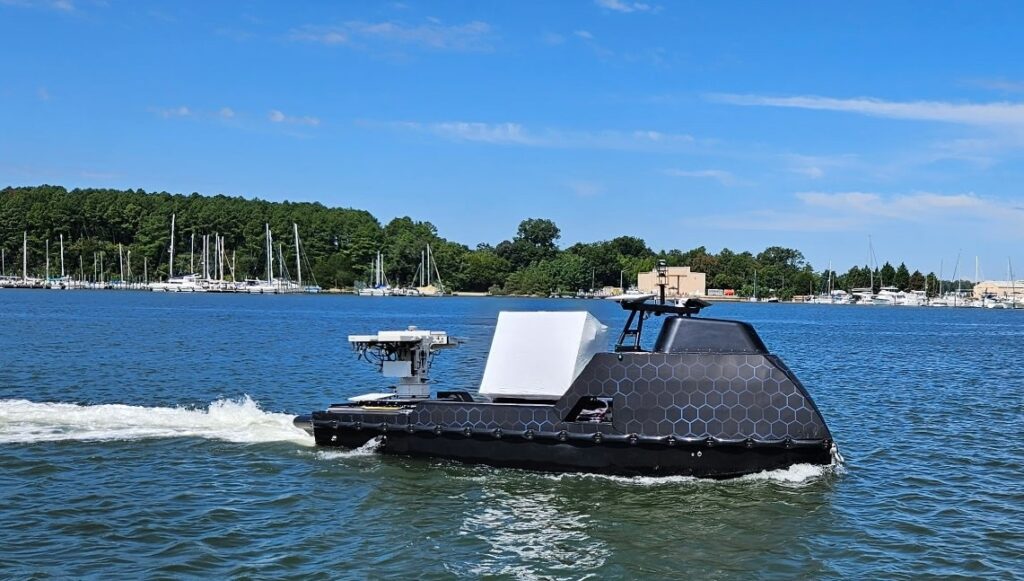
Wraith USV (Photo from Janus)

From Janus Marine & Defense LLC

  • Partnership between Janus Marine & Defense and Raven Defense can build ‘wall of steel’ around US oil and gas and shipping operations 

  • Companies will fuse latest electronic warfare and autonomous vessel and air technology 

  • Deploying new technology can free up US Navy ships, slashing costs, without compromising lethality or vigilance 

Two leading American defense firms are striking a strategic agreement to build a high-tech ‘wall of steel’ to support the US Navy, commercial shipping and offshore operations in the Caribbean and Gulf of America. 

The partnership sees South Carolina-headquartered marine autonomy specialist Janus Marine & Defense join forces with New Mexico-based US Department of War RF Systems contractor Raven Defense Corporation. 

Janus CEO Jack Dougherty, a former U.S. Navy Iraq War veteran, said the aim of the partnership is to take pressure off the US Navy while protecting US oil and gas and shipping operations in the Gulf. 

“The Gulf of America is seeing a massive increase in naval and commercial shipping and offshore activity,” he said. “This demands the latest technology to protect assets and people. The Janus–Raven partnership will provide a wall of steel around operations. Key is to use technology to take the pressure off the US security forces in a contested, high-risk maritime environment. We can slash costs, without compromising lethality and vigilance, by deploying Janus experience with autonomous surface and subsurface vessels combined with Raven’s satellite communications, air drones, ISR, and electronic warfare expertise.” 

 Jack said the ‘wall of steel’ will protect offshore energy infrastructure, ports, and critical maritime corridors, reducing reliance on, and risk to, manned vessels. He said Janus’ expertise draws on over a decade of contracting experience leading and operating Unmanned Surface Vessels in defense and security operations, starting with the autonomous mine-hunting unit in 2014 in U.S. 5th Fleet. 

Chris Patscheck, CEO of Raven Defense, which draws on decades of defense and electronic warfare experience, said the partnership is built on the latest maritime security needs — persistent, intelligent, and unmanned. 

“We’re proud to step up for America’s interests in the Gulf with our friends at Janus,” he said. “Our solution integrates persistent intelligence, surveillance and reconnaissance (ISR), autonomous patrol, rapid interception, and remote operations center (ROC) support. It is purpose-built for the unique threat environment facing offshore energy operators. By leveraging unmanned water and air drones, advanced signal detection methods, and cybersecurity, our partnership offers continuous and pervasive coverage. We are setting a new standard for how energy infrastructure and shipping is protected.” 


Coast Guard Offloads Over $133.5 Million in Illicit Drugs Interdicted in Eastern Pacific Ocean

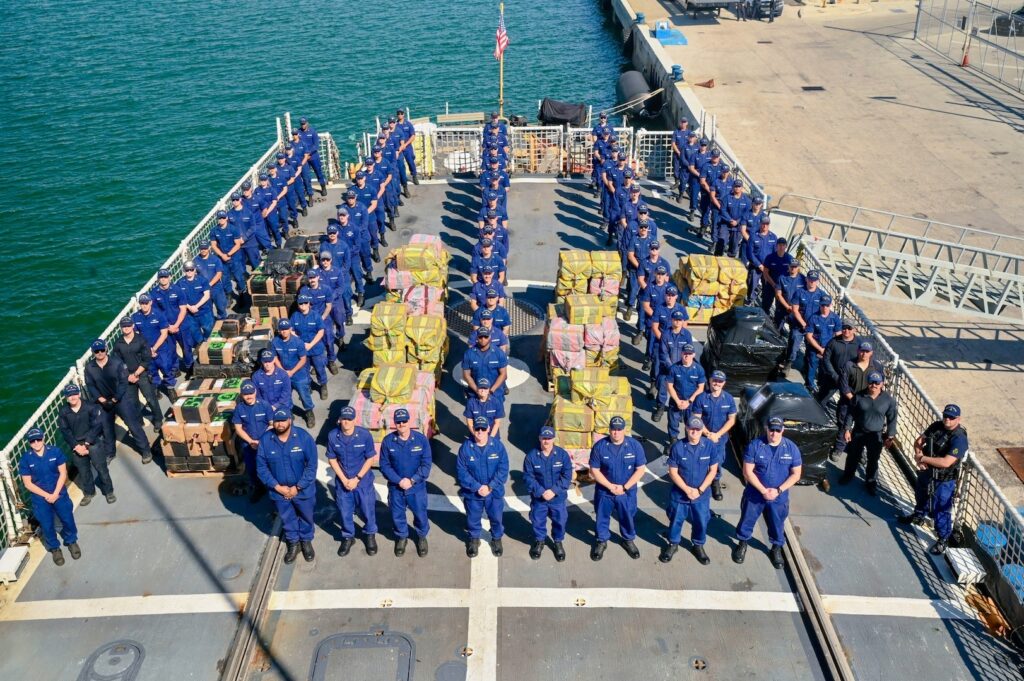
The crew of USCGC Seneca (WMEC 906) stand for a photo during a drug offload at Port Everglades in Fort Lauderdale, Florida, Feb. 30, 2025. The crew offloaded more than 17,750 pounds of illicit narcotics worth more than $133 million as a result of four interdictions in the international waters of the Eastern Pacific Ocean. (U.S. Coast Guard photo by Petty Officer 2nd Class Eric Rodriguez) 

From Coast Guard Southeast District

MIAMI – U.S. Coast Guard Cutter Seneca’s crew offloaded approximately 17,750 pounds of cocaine worth more than $133.5 million in Port Everglades, Feb 13.   

The seized contraband was the result of four interdictions in international waters of the Eastern Pacific Ocean.  

On Jan. 25, Seneca’s crew detected a go-fast vessel, and the embarked Helicopter Interdiction Tactical Squadron air crew employed airborne use of force tactics. Seneca’s boarding team interdicted and boarded the vessel, seizing 4,410 pounds of cocaine.   

  On Jan. 31, Seneca’s crew detected three go-fast vessels, and the embarked HITRON air crew employed airborne use of force tactics. Senaca’s boarding team interdicted and boarded all three vessels, seizing 13,340 pounds of cocaine.  

“I am extremely proud of the crew’s incredible performance and adaptability during this deployment,” said Capt. Lee Jones, commanding officer, Coast Guard Cutter Seneca. “This deployment demonstrates our enhanced posture and continued success in the fight against narco-terrorism and transnational criminal organizations. The Coast Guard, in conjunction with our inter-agency and international partners, continues to patrol areas commonly associated with drug trafficking in the Eastern Pacific, denying smugglers access to maritime routes by which they move illicit drugs to our U.S. land and sea borders.”  

The following assets and crews were involved in the interdiction operations:   

  • Coast Guard Helicopter Interdiction Tactical Squadron  

80% of interdictions of U.S.-bound drugs occur at sea. This underscores the importance of maritime interdiction in combatting the flow of illegal narcotics and protecting American communities from this deadly threat. U.S. Southern Command’s Joint Interagency Task Force-South based in Key West conducts the detection and monitoring of aerial and maritime transit of illegal drugs. Once interdiction becomes imminent, the law enforcement phase of the operation begins, and control of the operation shifts to the U.S. Coast Guard throughout the interdiction and apprehension. Interdictions in the Eastern Pacific Ocean are performed by members of the U.S. Coast Guard under the authority and control of the Coast Guard’s Southwest District, headquartered in Alameda, California.    

To protect the Homeland from ongoing trafficking of illicit narcotics from South America to the United States, the Coast Guard is accelerating our counter-drug operations in the Eastern Pacific Ocean in support of Operation Pacific Viper.  

The Coast Guard continues increased operations to interdict, seize and disrupt transshipments of cocaine and other bulk illicit drugs by sea. These drugs fuel and enable cartels and transnational criminal organizations to produce and traffic illegal fentanyl, threatening the United States.  

These interdictions deny criminal organizations illicit revenue. They provide critical testimonial and drug evidence as well as key intelligence for their total elimination. These interdictions relate to Homeland Security Taskforce Tampa, investigations in support of Operation Take Back America, which identifies, disrupts, and dismantles the highest-level criminal organizations that threaten the United States using a prosecutor-led, intelligence-driven, multi-agency approach.  

Coast Guard Cutter Seneca is a 270-foot medium-endurance cutter homeported in Portsmouth, Virginia, under U.S. Coast Guard Atlantic Area Command. 


Coast Guard Commissions USCGC Frederick Mann in Kodiak, Alaska 

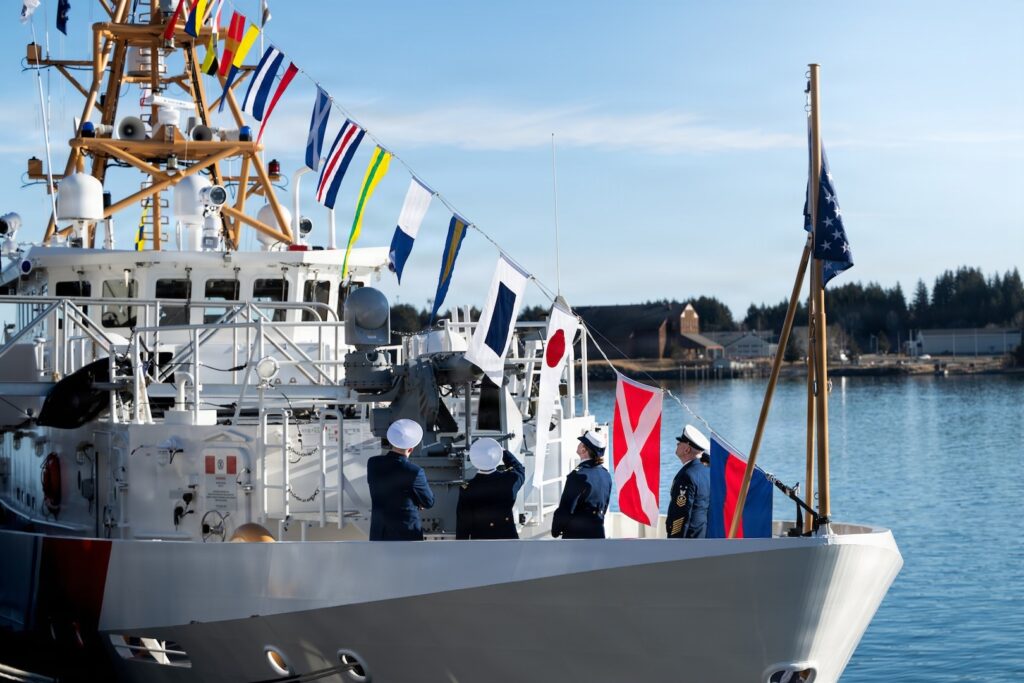
The Coast Guard Cutter Frederick Mann (WPC 1160) displays signal flags after the cutter’s commissioning ceremony at Coast Guard Base Kodiak, Alaska, Feb. 13, 2026. The commissioning solidified the Mann as the sixth fast response cutter to be homeported in Alaska, and it was presided over by Rear Adm. Bob Little, commander of the Coast Guard’s Arctic District. (U.S. Coast Guard photo by Petty Officer 3rd Class Cameron Snell) 

From Coast Guard Arctic District Public Affairs

KODIAK, Alaska — The Coast Guard commissioned its newest and sixth Arctic District Fast Response Cutter (FRC), Coast Guard Cutter Frederick Mann (WPC 1160), for official entry into its service fleet during a ceremony held in Kodiak, Friday, Feb. 13.  

The ceremony was presided over by Rear Adm. Bob Little, commander of the Arctic District. Members of the Mann family were also in attendance, including the cutter’s sponsor, Mrs. Eugenia “Jeannie” Mann Hyder, niece of Frederick Mann.   

“Commissioning the Frederick Mann increases U.S. strength and ensures control of our maritime borders and approaches,” said Little. “This crew will honor their motto – courage through fire—as they serve in the U.S. Arctic and Alaska.” 

The Mann is the Coast Guard’s 60th FRC and the third to be homeported at Coast Guard Base Kodiak. The crew of the Mann will primarily serve in and ar​​ound the Aleutian Islands, Bering Sea, Gulf of Alaska, and North Pacific Ocean. The cutter is designed for missions such as search and rescue; fishery patrols; drug and migrant interdiction; national defense; and ports, waterways, and coastal security.  

Chief Warrant Officer Frederick Mann was born in Atlee, Virginia, Oct. 14, 1918, and enlisted in the Coast Guard in 1939.   

During World War II, Mann’s ship, the USS George F. Elliott, participated in the initial landings of Guadalcanal on Aug. 7, 1942. The following day, Japanese bombers attacked the landing fleet and a bomber aircraft crashed into his ship, spilling fuel across the decks and setting the ship on fire.  

Mann carried a fire hose into the burning ammunition compartment and pumped water into the space. Despite a lack of oxygen, suffocating smoke, and super-heated bulkheads, Mann re-entered the compartment to ensure the hose was dousing the fire and filling the compartment properly. His immediate actions prevented the space from detonating and causing more casualties aboard the Elliot.  

As a direct result, the vessel continued to burn overnight without the ammunition detonating, and everyone was able to safely evacuate the vessel. For his heroic actions, Mann was awarded the Gold Life Saving Metal, and also received the Silver Star medal and the Presidential Unit Citation.   

Afterward, Mann returned stateside and served a total of 31 years at a variety of units including captain-of-the-port (COPT) stations and lifeboat stations on the Great Lakes, East Coast, and Gulf Coast. He also served aboard the cutters Bibb and General Greene, buoy tenders Myrtle, Oak, White Pine, and finally Narcissus, which he commanded.  

Mann met his wife, the former Winnie Knox, who served as a SPAR at COTP Miami at the same time as he did. Fred and Winnie retired to Bayview, Texas, near his last duty station at Port Isabel. They were married for 54 years.  

Coast Guard veteran and war hero Chief Warrant Officer Frederick Dean Mann passed away at the age of 98 on Jan. 9, 2017. 

The Coast Guard has ordered a series of new FRCs to replace the 1980s-era Island-class 110-foot patrol boats. Supported by historic investments made​​ possible through President Trump’s One Big Beautiful Bill Act, the legislation provides nearly $25 billion – the largest single funding commitment in Coast Guard history – including $1 billion dollars for additional FRCs. This commissioning follows the commissioning of USCGC Storis (WAGB 21) in August, which is the Coast Guard’s first polar ice breaker acquisition in over 25 years. The Arctic District is scheduled to acquire two new Offshore Patrol Cutters in the near future.  

The FRCs feature advanced command, control, communications, computers, intelligence, surveillance and reconnaissance equipment, and over-the-horizon cutter boat deployment, enhancing the Coast Guard’s operations to control, secure, and defend the U.S. border and maritime approaches. These new assets and capabilities continue the Coast Guard’s modernization through Force Design 2028, an initiative introduced by Secretary of Homeland Security Kristi Noem to transform the Coast Guard into a more agile, capable and responsive fighting force.  

The commissioning ceremony is a traditional milestone in the life of a cutter that marks its entry into active service and represents the cutter’s readiness to conduct Coast Guard operations.  


Australia, Philippines, and U.S. Conduct a Multilateral Maritime Cooperative Activity

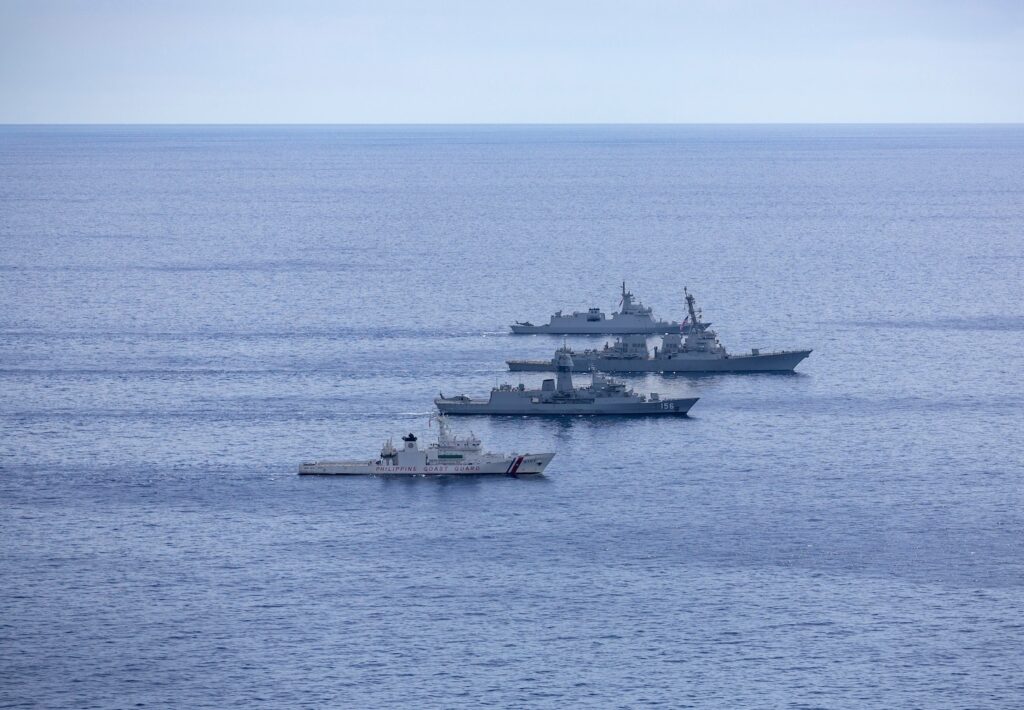
From front, Philippine Coast Guard Teresa Magbanua-class patrol vessel BRP Teresa Magbanua (MRRV 9701), Royal Australian Navy Anzac-class frigate HMAS Toowoomba (FFH 156), U.S. Navy Arleigh Burke-class guided-missile destroyer USS Dewey (DDG 105) and Philippine Navy Jose Miguel Malvar-class guided-missile frigate BRP Diego Silang (FFG 07) sail in formation during the Maritime Cooperative Activity (MCA) in the Philippines’ Exclusive Economic Zone, Feb. 16, 2026. (U.S. Navy photo by MC2 Class Oscar Diaz) 

By U.S. 7th Fleet Public Affairs

SOUTH CHINA SEA  –  The combined armed forces of Australia, the Philippines, and the United States, demonstrated a collective commitment to strengthen regional and international cooperation in support of a free and open Indo-Pacific while conducting a multilateral Maritime Cooperative Activity (MCA) within the Philippines’ Exclusive Economic Zone, Feb. 15-16, 2026. 

As the first multilateral MCA of 2026, this event built on previous MCAs and our continuous operations together, which strengthen the interoperability of our armed and defense forces and their doctrines, tactics, techniques, and procedures. This MCA focused on conducting visual information drills and replenishment-at-sea. 

MCAs are conducted in a manner consistent with international law and with due regard to the safety, navigational rights, and freedoms of all nations. 

Participating units included Royal Australian Navy Anzac-class frigate HMAS Toowoomba (FFH 156), Royal Australian Air Force P-8A Poseidon maritime patrol and reconnaissance aircraft, Philippine Navy Jose Miguel Malvar-class guided missile frigate BRP Diego Silang (FFG 7), AW109 helicopter, Philippine Air Force’s FA-50 fighter jets, A-29 Super Tucano, C-208B, a Sokol Search and Rescue helicopter, Philippine Coast Guard Teresa Magbanua-class patrol vessel BRP Teresa Magbanua (MRRV 9701), U.S. Navy Arleigh Burke-class guided-missile destroyer USS Dewey (DDG 105), and a P-8A Poseidon assigned to Patrol Squadron (VP) 4. 

The U.S., along with our allies and partners, upholds the right to freedom of navigation and overflight and other lawful uses of the sea and international airspace, and respect for all nations’ maritime rights under international law. 

U.S. 7th Fleet is the U.S. Navy’s largest forward-deployed numbered fleet and routinely interacts and operates with allies and partners in preserving a free and open Indo-Pacific region. 


Office of Special Projects: Protecting the Navy’s Nuclear Superiority from Spies

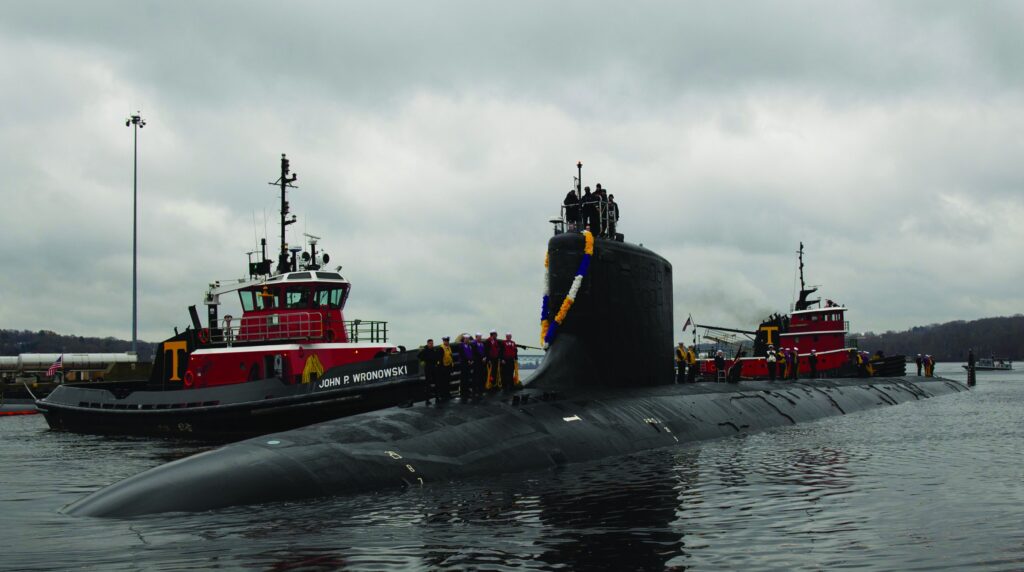
Tugboats guide USS Minnesota (SSN783) to the pier as the Virginia-class nuclear-powered fast-attack submarine returns to Naval Submarine Base New London in Gorton, Connecticut, following a regularly scheduled deployment in November 2021.

From U.S. Fleet Forces Command

WASHINGTON – When it comes to protecting the Department of the Navy’s secrets, no one is better equipped than the NCIS Office of Special Projects (OSP), the Navy’s elite counterespionage unit. 
 
Comprised of Special Agents, intelligence professionals, technical and financial experts, and the NCIS Special Surveillance Team, OSP can respond globally to threats targeting Navy and Marine Corps information, personnel, and installations. 
 
Leveraging cutting-edge investigative techniques and strong intelligence cooperation—underpinned by the Navy’s growing prosecutorial strength in national security matters—OSP rapidly converts information into action, minimizing losses and mitigating risks to the Navy’s superiority. These advanced capabilities, combined with NCIS’s unique counterintelligence and law enforcement authority, make OSP the Department of War’s preeminent weapon against adversarial intelligence services and insider threats. 
 
OSP’s strong partnerships with federal law enforcement agencies, including the FBI, also serve as an investigative force multiplier for cases involving civilian subjects outside the Uniform Code of Military Justice. 
 
One such case—the investigation of Jonathan and Dianna Toebbe—illustrates the power of this collaboration. 

In 2021, Jonathan Toebbe, aided by his wife, Dianna, attempted to sell highly sensitive information on the U.S. Navy’s nuclear propulsion program. As a civilian nuclear engineer for the Naval Nuclear Propulsion Program, Jonathan had access to restricted data detailing military-sensitive design elements, operating parameters, and performance characteristics of reactors for nuclear-powered warships. 
 
NCIS and the FBI launched a counterintelligence investigation after Jonathan sent a package containing restricted data and instructions for establishing a covert relationship—along with an offer to provide more information in exchange for cryptocurrency—to an individual whom he believed represented a foreign government. He later attempted to contact the perceived foreign representative using encrypted email. In reality, he was communicating with an undercover agent. 
 
Over several months, Jonathan exchanged messages with the undercover agent and agreed to provide additional restricted data in return for thousands of dollars in cryptocurrency. 
 
Between June and August 2021, he completed two “dead drops,” delivering encrypted SD cards and receiving $100,000 in cryptocurrency. A review of the cards confirmed they contained restricted data related to Navy submarine reactors. Both Jonathan and Dianna were arrested on Oct. 9, 2021, while attempting to deliver a third SD card. 
 

On Nov. 9, 2022, Jonathan was sentenced to more than 19 years in prison. Dianna received a sentence of more than 21 years. 

“The Office of Special Projects continues to innovate to rapidly and aggressively meet adversarial threats to the Department of the Navy,” said OSP Special Agent in Charge James Allen. “Through the development and enhancement of organic capabilities, and by strategically leveraging unique partnerships, OSP remains committed to preserving warfighting superiority and enhancing the lethality of the Department of War.” 

OSP specializes in conducting national security and counterintelligence investigations on behalf of the Department of the Navy. Working alongside federal partners as force multipliers, OSP identifies and disrupts threats to critical DON personnel, programs, and technologies. 


GA-ASI Achieves New Milestone with Semi-Autonomous CCA Flight 

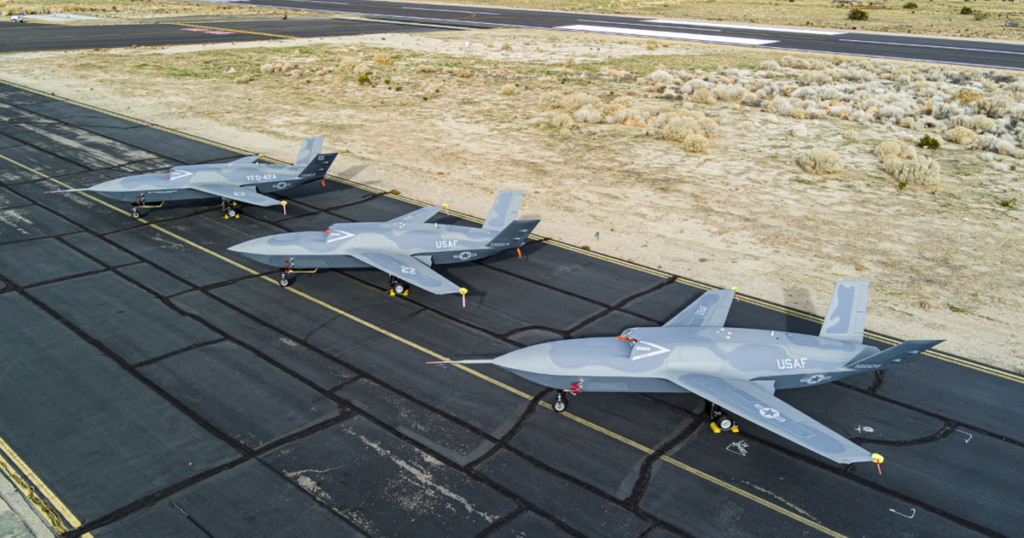
YFQ-42A Uncrewed Fighter Jet Executes Mission Autonomy Test 

From General Atomics Aeronautical Systems Inc. 

SAN DIEGO – 12 February 2026 – General Atomics Aeronautical Systems, Inc. (GA-ASI) passed a new milestone this month, successfully integrating 3rd-party mission autonomy into the YFQ-42A Collaborative Combat Aircraft to conduct its first semi-autonomous airborne mission. 

For this test, GA-ASI used mission autonomy software supplied by Collins Aerospace, an RTX business, to fly the new YFQ-42A CCA, designed and developed by GA-ASI for the U.S. Air Force. The Sidekick Collaborative Mission Autonomy software was seamlessly integrated with the YFQ-42A’s flight control system, utilizing the Autonomy Government Reference Architecture (A-GRA). The integration enabled robust and reliable data exchange between the autonomy software and the aircraft’s mission systems, ensuring precise execution of mission autonomy commands. 

During the recent testing, autonomy mode was activated via the Ground Station Console (GSC). Once enabled, a human autonomy operator on the ground transmitted various commands directly to the YFQ-42A, which executed the instructions with high accuracy for more than four hours. This test highlights the effectiveness of Sidekick’s advanced mission autonomy capabilities and the flexibility of the A-GRA standard in supporting complex operational requirements. 

“We are excited to collaborate with Collins to deliver enhanced autonomous mission solutions,” said David R. Alexander, president of GA-ASI. “The integration of Sidekick with our YFQ-42A demonstrates our commitment to innovation and operational excellence in unmanned aircraft technology.” 

This achievement underscores GA-ASI’s dedication to advancing autonomous systems for defense applications. The combination of Sidekick autonomy software and YFQ-42A mission systems, connected through A-GRA, sets new benchmarks for combat autonomy, mission flexibility, operator control, and system reliability. 

“The autonomy capabilities showcased in this flight highlight our dedicated investment to advance collaborative mission autonomy,” said Ryan Bunge, vice president and general manager for Strategic Defense Solutions, Collins Aerospace, an RTX business. “The rapid integration of Sidekick onto this General Atomics platform and its immediate ability to support a broad spectrum of combat-relevant behaviors underscores the strength and flexibility of our open systems approach.” 

This first mission autonomy flight continues a robust YFQ-42A development schedule for GA-ASI that began in August 2025 with initial flights of YFQ-42A Tail One. In less than six months, GA-ASI has built and flown multiple YFQ-42A aircraft, including push-button autonomous takeoffs and landings. 

GA-ASI has been building and flying uncrewed jets for nearly two decades, beginning with the company-funded, weaponized MQ-20 Avenger® in 2008. Ongoing company investment in Avenger continues to yield results, as the aircraft routinely serves as a CCA surrogate for advanced autonomy development and testing in both government programs and company-funded research and development. 

As a family-owned, privately held defense company for more than 30 years, GA-ASI is known as one of the original disruptors in the U.S defense industry, pioneering and inventing many of the technologies now considered ubiquitous in uncrewed aircraft operations around the world. The company re-invests more than 35 percent of annual revenue into internal research and design projects, building ahead of need and designing capabilities ahead of requirements. 

In 2025, for example, an internally funded Avenger demo featured both GA-ASI’s TacACE autonomy software and Shield AI’s Hivemind software on the same flight, with the MQ-20 seamlessly switching between AI pilots while still airborne. Later in the year, GA-ASI teamed with Lockheed Martin and L3 Harris for another Avenger flight demo, connecting the MQ-20 with an F-22 Raptor for an advanced manned-unmanned teaming mission that allowed the human fighter pilot to command the Avenger as an autonomous CCA surrogate via tablet control from the cockpit. 

In 2024, GA-ASI first flew its XQ-67A Off-Board Sensing Station (OBSS) jet, developed in collaboration with Air Force Research Laboratory (AFRL). This early CCA prototype validated the “genus/species” concept pioneered with AFRL as part of the Low-Cost Attritable Aircraft Platform Sharing (LCAAPS) program, focused on building several aircraft variants from a common core chassis. 

GA-ASI’s Gambit Series envisions multiple missionized variants from this common core concept, with XQ-67A already showcasing airborne sensing and YFQ-42A illustrating air-to-air combat. Using this novel manufacturing approach to drive overall customer value, GA-ASI can quickly pivot to diverse missions with less time and cost investment than building a clean-sheet aircraft. 


HII Places Second Nikon SLM Solutions NXG 600E Order

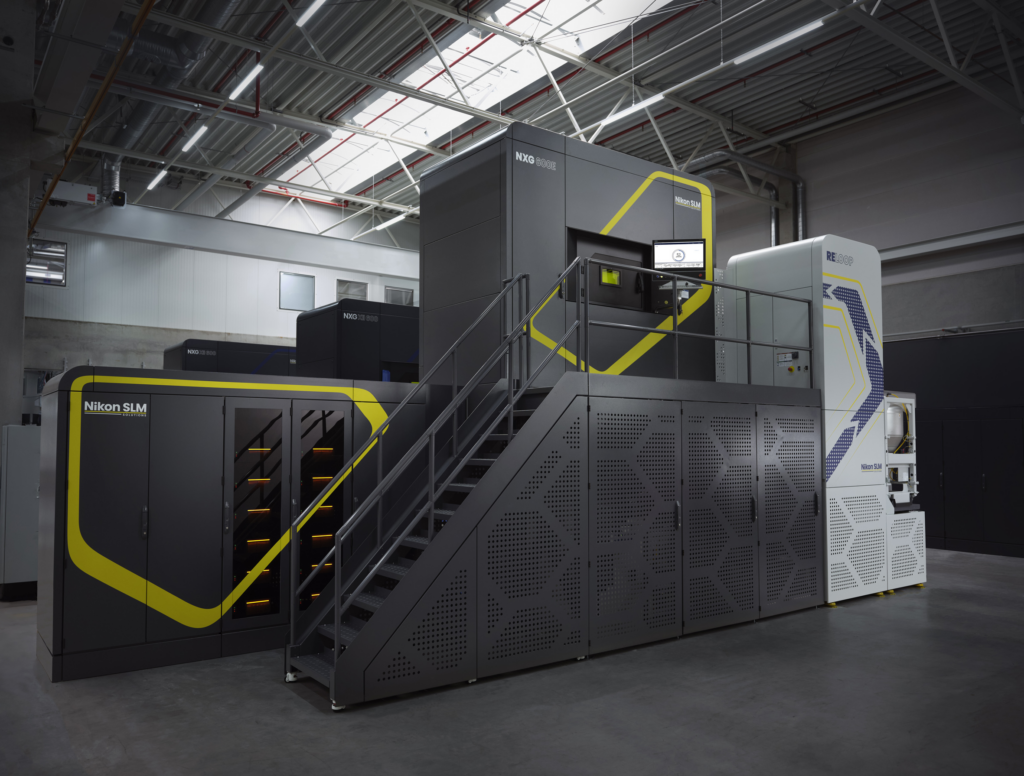
Long Beach, CA, USA – Nikon SLM Solutions, a unit of Nikon Advanced Manufacturing and global leader in laser powder bed fusion (L-PBF) metal additive manufacturing, today announced that HII’s (NYSE: HII) Newport News Shipbuilding (NNS) division has placed a second NXG 600E order, further strengthening its advanced manufacturing capabilities in support of U.S. Navy shipbuilding and the Maritime Industrial Base (MIB). 

The order builds on a previously announced NXG 600E acquisition and reflects HII’s continued investment in large-format metal additive manufacturing to enable production of large, complex components and replacement of legacy castings for critical naval applications. 

Through close collaboration with HII, Nikon SLM Solutions will lead parameter development and process maturation for L-PBF production of NiAlBr components, expanding material capability for additive manufacturing within U.S. Navy supply chains and supporting long-term maritime readiness. 

“This second NXG 600E order reflects HII’s leadership and long-term commitment to advancing the maritime industrial base through additive manufacturing,” said Hamid Zarringhalam, CEO of Nikon Advanced Manufacturing and Chairman of the Board, Nikon SLM Solutions. “Expanding critical materials capabilities such as Nickel Aluminum Bronze is a foundational part of Nikon Advanced Manufacturing’s holistic approach, combining scalable platforms, material and process development, and  

U.S.-based production and support. Together with HII, we are enabling additive manufacturing to move from isolated applications to a repeatable, industrial capability that supports U.S. Navy shipbuilding at scale.” 


Keel Laid for Future USNS Ruth Bader Ginsburg 

From Team Ships, Feb. 13, 2026 

SAN DIEGO - The keel for the future USNS Ruth Bader Ginsburg (T-AO 212) was authenticated at the General Dynamics NASSCO shipyard on Feb. 13. The event marked a major construction milestone for the John Lewis-class replenishment oiler. 

The ship’s namesake, Ruth Bader Ginsburg, was an advocate for justice who served on the U.S. Supreme Court for 27 years. 

Keel laying authentication ceremonies are a centuries-old tradition marking a significant construction milestone where a ship transitions from design to reality. The keel was authenticated when the ship’s sponsor, Jane Ginsburg, daughter of the late Justice, welded her initials onto a steel plate. This plate will be permanently affixed to the ship’s hull, remaining with the vessel throughout its entire service life as a symbol of its beginning. 

“This keel laying marks the first of many significant milestones for this ship and we are excited to bring this vessel to the Fleet,” said John Lighthammer, program manager, Auxiliary and Special Mission Shipbuilding Program Office. 

John Lewis-class replenishment oilers are a critical component of the Navy’s Combat Logistics Force and are a cornerstone of the Navy’s fuel delivery capability. These 746-foot vessels are engineered to provide robust support, with the capacity to carry up to 162,000 barrels of diesel ship fuel, jet fuel, and other cargo. 

Operated by the Military Sealift Command, these ships enable the Navy’s warships to remain at sea for extended periods, providing the fuel, supplies, and provisions necessary to sustain global missions. 

 As a Department of War’s acquisition organization, PEO Ships is responsible for executing the development and procurement of all destroyers, amphibious ships and craft, and auxiliary ships, including special mission ships, sealift ships and support ships. 


UTIC Highlights Investments, Collaboration, and Workforce Development 

From The Undersea Technology Innovation Consortium, Feb. 12, 2026 

MIDDLETOWN, R.I. – The Undersea Technology Innovation Consortium (UTIC) had a significant year of growth in 2025, expanding its membership and accelerating innovation in undersea and maritime technologies. 

In 2025, UTIC marked the 100th prototype project award, representing $1.5 billion in total prototype project funding to UTIC members to advance critical innovation for the U.S. Navy across the undersea tech domain. The consortium also continued its commitment to workforce development, surpassing $100,000 in awarded STEM scholarships to help build the next generation of maritime and undersea tech talent. 

UTIC’s membership, representing 300 organizations across over 40 states, highlights increasing national engagement from industry and academic partners. In addition, UTIC convened more than 200 undersea tech industry leaders through two Industry Days, an AUKUS Forum, and a Defense Investment Forum, creating opportunities for collaboration, knowledge-sharing, and partnership. 

In 2025, UTIC entered into a Cooperative Research and Development Agreement (CRADA) with Naval Undersea Warfare Center (NUWC) Division Newport, strengthening collaboration to advance innovative technologies that support the U.S. Navy’s most critical missions.  

These milestones underscore UTIC’s growing role as a national leader for collaboration, innovation, and investment in undersea and maritime technologies. 

“UTIC is committed to propelling undersea tech advancement.  The ongoing success of our partnership with the Navy, combined with our strong commitment to workforce development and collaboration, fosters innovation across the undersea and maritime domains,” said Molly Donohue Magee, UTIC CEO. 

The 2025 Annual Report is available here