USCGC Munro Returns from Eastern Pacific Patrol; $500M Worth of Narcotics Seized

From U.S. Coast Guard Pacific Area, 5 June 2024 

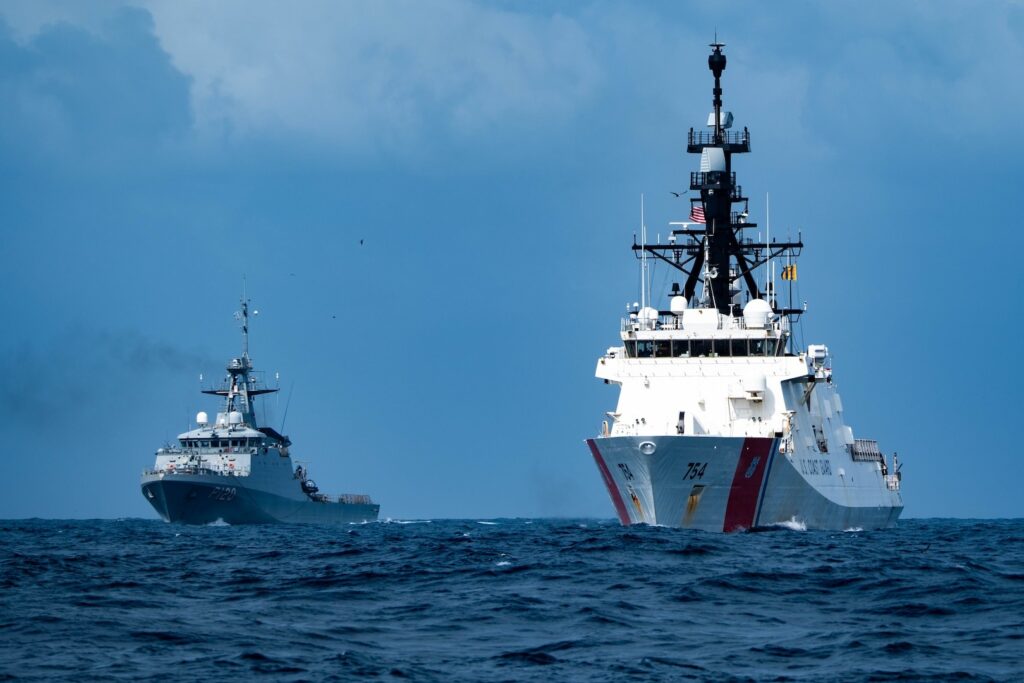
ALAMEDA, Calif. – The crew aboard U.S. Coast Guard Cutter Munro (WMSL 755) returned to their home port in Alameda on Monday, following a four-month patrol off the coasts of Central and South America in the Eastern Pacific Ocean. 
 
During their multi-mission deployment, Munro’s crew conducted counter-narcotic and illegal, unreported, and unregulated (IUU) fishing patrols. 
 
The 150-member crew deployed to the Eastern Pacific Ocean, where they interdicted seven “panga” style vessels, three low-profile vessels, and one fishing vessel suspected of trafficking narcotics. 
 
The interdictions resulted in the seizure of nearly 35,000 pounds of cocaine, more than 3,000 pounds of marijuana, and more than 140 pounds of the ketamine-based hallucinogenic party drug “tuci.” Combined, the seized narcotics are worth an estimated $500 million in wholesale value and $2 billion in street value. Munro conducted a bulk offload of the illicit narcotics in San Diego, where the narcotics were turned over to federal agents from the Drug Enforcement Administration for destruction. 
 
Munro’s crew conducted 200 flight evolutions with an embarked helicopter and aircrew from the Jacksonville, Florida-based Coast Guard Helicopter Interdiction Tactical Squadron (HITRON). The HITRON helicopter crew was a force multiplier capable of providing airborne use of force in maritime drug interdiction efforts. Munro utilized the helicopter crew for warning shots toward eight non-compliant suspect vessels and disabling fire used on four non-compliant suspect vessels, stopping the vessels by shooting out their engines and allowing surface assets to gain positive control. 
 
Following the counter-narcotics patrol, Munro transited further south to conduct IUU fisheries interdictions in international waters off the coast of Peru and Ecuador under Operation Southern Shield. Under the authority of the South Pacific Regional Fisheries Management Organization (SPRFMO) conservation management measures, Munro conducted 16 high-seas boardings and inspections of a multi-national distant water fishing fleet of more than 300 fishing and transshipment vessels, resulting in nine violations reported to SPRFMO member countries. 
 
While conducting Operation Southern Shield, Munro hosted ship observers from the Peruvian Coast Guard, the National Aeronaval Service of Panama, and the Ecuadorian Navy, emphasizing the multi-national effort to combat IUU fishing. Working alongside the Ecuadorian Navy shiprider, Munro conducted four inspections aboard Ecuadorian-flagged fishing vessels on the high seas, carrying out the first enactment of the recently signed United States-Ecuador Bilateral Agreement. 
 
Additionally, Munro’s crew responded to a search and rescue case 25 miles off the coast of Peru, saving the life of a 37-year-old patient who had been critically injured. 
 
“Our crew is dedicated and working hard to show the commitment of the U.S. Coast Guard in combating both narcotics and Illegal, Unreported, and Unregulated fishing on the high seas,” said Capt. Rula Deisher, Munro’s former commanding officer. 
 
Near the end of the patrol, Munro hosted a change of command ceremony in San Diego Thursday. During the ceremony, Capt. James O’Mara IV relieved Deisher as Munro’s commanding officer. 
 
“I am thankful to family and friends who supported Munro throughout the four-month deployment,” said O’Mara, who assumed command of Munro on May 30. “You won’t find a crew more excited than this one, ready to be home and reconnect with families. Munro showcased all the capabilities and versatility of this platform while making tangible impacts to several national security objectives. The crew has everything to be proud of, and I am honored to join this team.” 
 
Munro is one of four national security cutters homeported on Coast Guard Base Alameda. National security cutters feature advanced command, control, communications, computers, cyber, intelligence, surveillance and reconnaissance equipment; aviation support facilities; stern cutter boat launch; and long-endurance station keeping. The 418-foot cutters have an endurance of 60 to 90 days and can serve as operational-level headquarters for complex law enforcement, defense, and national security missions involving the Coast Guard and multiple partner agencies. 


CNO Franchetti Meets with Top Officials from Bahrain

Chief of Naval Operations Spokesperson Cmdr. Desiree Frame provided the following readout: 

Chief of Naval Operations Adm. Lisa Franchetti met with the Kingdom of Bahrain’s Crown Prince and Prime Minister, His Royal Highness Salman bin Hamad Al Khalifa, June 4. 

Franchetti thanked the Crown Prince for the inviolable U.S. – Bahrain defense relationship and expressed her gratitude for the continuous hospitality Bahrain shows in hosting the U.S. Navy. 

The CNO also highlighted Bahrain’s leadership in the security and stability of the region and expressed her gratitude to the Crown Prince for being one of the United States’ longest and closest partners in the Middle East, a major non-NATO Ally, and their participation in Operation Prosperity Guardian.  

During their discussion, Franchetti applauded the Comprehensive Security Integration and Prosperity Agreement (C-SIPA) signed last year to formalize U.S – Bahrain cooperation to deter conflict in the region, enhance regional stability, and de-escalate tensions. Franchetti added that C-SIPA is as a significant upgrade in our strategic bi-lateral relationship with Bahrain. Right now, C-SIPA is a bilateral agreement between the United States and Bahrain, however both leaders said they welcome other friendly countries to join because the more integrated and coordinated we are, the more secure, stable, and prosperous the region will be. 

This is the first time Franchetti has met the Crown Prince. 


Vigor begins low-rate initial production work on U.S. Army landing craft 

VANCOUVER, Washington (June 4, 2024) – Vigor, a Titan Company, has begun low rate initial production (LRIP) on the Maneuver Support Vehicle (Light) (MSV(L)) vessel at its facility in Vancouver, Washington. The new generation U.S. Army landing craft replaces the Vietnam-era Landing Craft Mechanized 8 (LCM-8). Vigor completed and launched the prototype vessel, SSG Elroy F. Wells, in 2022 and now commences work on the next phase of the new $1 billion contract. More than 180 skilled workers are expected to support the project over the next five years. 

“Beginning this work represents a milestone for the Army, for Vigor and for our employees,” said Jayson Robinson, Vigor’s Vice President of Fabrication. “It is a credit to the great work of our team over the last several years and the partnership with the Army to have the opportunity to take what we have learned from the prototype and build the next generation of landing craft. Our employees are incredibly proud to support our national defense and our customer’s critical mission.”  

Vigor was originally awarded the contract in 2017 and secured the Vancouver, WA facility to complete the prototype, multiple vessels under low rate production, and several more over ten years. The vessel is designed to support Army Mariners and their payload in even the most difficult environments due to its state-of-the-art maneuverability and stability.  

After undergoing sea trials throughout 2023, Vigor and the Army completed the DD 250 handoff of the prototype vessel in February and began planning for production of future vessels. The next phase of fabrication began this week and will continue for the next five years 

“This project will not only improve the Army’s capabilities, it provides more than 180 family wage jobs here in Vancouver,” Robinson said. “We are honored to have been selected for this work and committed to providing a quality, reliable vessel to our customer.”  


BAE Systems electronic warfare pods to protect U.S. Navy P-8A Poseidon aircraft 

NASHUA, N.H. — June 5, 2024 — BAE Systems received a $95 million contract from the U.S. Navy for advanced countermeasure pods to protect the P-8A Poseidon Multi-Mission Maritime Aircraft from missiles and other threats. The electronic warfare (EW) pod detects and counters inbound threats, protecting the Poseidon and its crews, and expanding the aircraft’s operating range in contested environments. 

“We’re working closely with the U.S. Navy to deliver innovative solutions to protect this critical, high-value aircraft,” said Don Davidson, director of Advanced Compact Electronic Warfare Solutions at BAE Systems. “We quickly prototyped a very capable system using proven technology to defend against air-to-air and surface-to-air guided threats.” 

BAE Systems’ survivability pod provides early threat detection and effective countermeasures to protect U.S. and international high-value airborne assets. The system’s flexible, open architecture design allows rapid and affordable modernization, is compatible with future threat-detection and decoy countermeasure capabilities, and can host third-party EW techniques. 

The engineering and manufacturing development (EMD) contract follows a rapid-response contract from the U.S. Navy to demonstrate the system in 2021. The BAE Systems team designed, built, and tested a demonstration pod, exhibiting strong military-industry collaboration and rapid prototyping. The EMD contract follows successful airworthiness and effectiveness testing. 

The P-8A self-protection pod is part of BAE Systems’ Intrepid ShieldTM layered approach to aircraft and ground platform survivability that uses the full electromagnetic spectrum to detect, exploit, and counter advanced threats. The pod can be rapidly adapted for other high-value airborne assets, enabling them to operate in contested environments. 

Work on the P-8A pod and its components is conducted at BAE Systems’ state-of-the-art facilities in Nashua, New Hampshire and Austin, Texas. 


June 4 Red Sea Update 

From U.S. Central Command, June 4, 2024 
 

TAMPA, Fla. – In the past 24 hours, Iranian-backed Houthis launched two anti-ship ballistic missiles (ASBM) from Houthi-controlled areas of Yemen into the Red Sea. There were no injuries or damage reported by U.S., coalition, or commercial ships.   

This continued malign and reckless behavior by the Iranian backed Houthis threatens regional stability and endangers the lives of mariners across the Red Sea and Gulf of Aden.  


USCGC Seneca Returns Home After Two-Month Patrol in Windward Passage, Florida Straits

U.S. Coast Guard Atlantic Area, May 31, 2024 

PORTSMOUTH, Va. — The crew of U.S. Coast Guard Cutter Seneca (WMEC 906) returned to their home port in Portsmouth, May 21, 2024, following a 58-day migrant interdiction patrol in the Windward Passage and Florida Straits. 

Seneca’s crew deployed in support of Homeland Security Task Force – Southeast (HSTF-SE) and Operation Vigilant Sentry (OVS) while at sea in the Coast Guard Seventh District’s area of operations. 

Patrolling off the coast of Haiti and southern Florida Straits, Seneca’s presence helped deter migrants from taking to the sea in unsafe vessels to ensure the safety of life at sea and protect the maritime borders of the United States. 

While at sea, Seneca worked with a Coast Guard Air Station Miami HC-144 Ocean Sentry airplane crew and responded to an international search and rescue case involving an overboard passenger who fell from a cruise ship. 

During the deployment, Seneca’s crew had the opportunity to attend the inaugural Fleet Week 2024 in Miami, Florida in early May. Crew members conducted nearly 1,000 public tours over a six-day period, showcasing the U.S. Coast Guard, cutter Seneca, and the service’s missions. Seneca hosted numerous VIPs aboard to include Secretary of the Navy Carlos Del Toro, local and state politicians. 

“It’s been an honor leading Seneca and her crew, serving alongside the best and brightest women and men in the service,” said Capt. James F. McCormack, commanding officer of Seneca. “Seneca and her crew provided stability in the maritime environment of the South Florida Straits and represented the Coast Guard with distinction amongst the other U.S. maritime services at Fleet Week Miami. Seneca lived up to our motto, “Tradition of Honor, A Legacy of Action.”” 

While deployed, Seneca’s crew transited over 9,000 nautical miles. 

Established in 2003, HSTF-SE is the Department of Homeland Security-led interagency task force charged with directing operational and tactical planning, command and control, and functions as a standing organization to deter, mitigate, and respond to maritime mass migration in the Caribbean Sea and Florida Straits.  

OVS is the 2004 DHS plan that provides the structure for deploying joint air and surface assets and personnel to respond to irregular maritime migration in the Caribbean corridor of the United States. Its primary objectives are to protect life at sea while deterring and dissuading mass maritime migration alongside our federal, state, and local partners.   

Seneca is a 270-foot, Famous-class medium endurance cutter. The cutter’s primary missions are counter drug operations, migrant interdiction, enforcement of laws and treaties, and search and rescue in support of U.S. Coast Guard operations throughout the Western Hemisphere. 

For information on how to join the U.S. Coast Guard, visit www.GoCoastGuard.com to learn more about active duty and reserve, officer and enlisted opportunities. Information on how to apply to the U.S. Coast Guard Academy can be found here.  


Future Challenges, Opportunities Discussed at Naval Aviation 3-Star Summit

From Naval Air Systems Command, June 3, 2024 

LEXINGTON PARK, Md. — The stars were out for over 200 attendees May 29 at the Naval Aviation 3-Star Summit in Lexington Park, Maryland. The evening’s theme was “Advancing Naval Aviation Readiness for the High-End Fight.” 

The event marked the first-time leaders of the Naval Aviation Enterprise, including NAVAIR Commander, Vice Adm. Carl “Chebs” Chebi; Commander, Naval Air Forces Pacific and “Air Boss” Vice Adm. Daniel “Undra” Cheever; Director, Air Warfare Division (N98) Rear Adm. Michael “Buzz” Donnelly; and Marine Corps Deputy Commandant for Aviation Lt. Gen. Bradford “Gilla” Gering gathered for the event, hosted by The Patuxent Partnership, Association of Naval Aviation and Marine Corps Aviation Association. 

The panel spent 90 minutes addressing a wide range of questions on topics including recruiting and retention, overcoming budget challenges, joint capability development, accelerating capability delivery, unmanned aviation, increased automation (artificial intelligence and machine learning), and Live Virtual Constructive Training.   

Vice Adm. Chebi opened the discussion with an audience question about improvements to the requirements process to help the naval aviation community be a little more flexible. 

“I think that is a very specific area we need to look at formally,” replied Adm. Donnelly, director of the Air Warfare Division (N98) at the Pentagon. “There is a recognized shortfall in the speed we need to move with innovation…to take advantage of what industry can do. The current process cannot keep up with the way we are doing things right now.” 

Chebi said while it is a “long, laborious process, there’s a lot we can effectively apply within the construct of ‘big R’ requirements to get capability out there now. There are so many authorities and flexibilities we can leverage to increase warfighting capability and the availability of our platforms.” 

Air Boss Vice Adm. Cheever then addressed retention and recruiting in naval aviation. 

“There are gaps out there. [In the enlisted specialties] we don’t have a lot of young apprentices,” he said. “So they’re not training to become journeymen and supervisors, and the development is a little slower than we’d like right now. In the officer ranks, we’re mitigating department head shortages, as well as junior officer shortages, by assigning temporary duty in key billets. The flexibility and standard of excellence in naval aviation ensures even those who didn’t train with the team, can seamlessly join the team. I’m pulling pros from the bullpen that are really trained and really good.” 

From the Marine perspective, Lt. Gen. Gering said, “in aggregate, we’re making our recruiting mission. If you look at our retention goals, we’re making those as well.” 

Chebi also asked the panel to discuss budget challenges for Naval and Marine Corps aviation. 

“Balancing crisis response with modernization is one of the Commandant’s five priorities,” Gering said. “Crisis response is a must pay bill; we must look for trade space in modernization with a fixed top line.” 

Chebi was then asked about new collaboration with the other services in future launch weapons solutions. 

Donnelly noted an increased level of cooperation in that arena. 

“Coming back into the Pentagon from my previous requirements job… I’m pleased at how close we are cooperating with the Air Force, particularly in weapons. We’ve got a partnership in [long-range and penetrating weapons] as well as air-to-air. With our partnered use of the F-35 Lightning II, the fit, form, and function vis-a-vis weapons carriage and delivery match both our needs.” 

Donnelly also emphasized partnership with industry. 

“I think our industry partners recognize how much the DoD and the services are investing. That partnership has been very helpful, and it’s also included Congress who has given us some legislative authorities for multi-year procurements.” 

An audience member asked the panel the status of a replacement for the Navy and Marine T-45 Goshawk training aircraft. 

“It’s not just the airframe replacement of the T-45. It’s a holistic, undergraduate training system,” said Donnelly. “CNATRA is changing its syllabus based on the way people are learning today, adding virtual reality and simulation.” We recognize with the precision landing mode we expect in future fighters… landing on a carrier may not be the most difficult portion of the mission. We can reduce some of the workload we’re putting into carrier landings, freeing up time to focus on more complex tasks such as information processing and decision making. [It] gives us a holistic new way to look at what we will implement and probably some wider options to consider as a T-45 replacement.” 

A question on automation prompted Chebi to advocate for more development of AI and ML. 

“The smartest folks in the room are not sitting up here. So please provide us your inputs on ways to do this better. My ask of all of you is to show us what the possibilities are from automation, from AI, from ML, so that we can apply them to our programs.” 

“I think where automation can really help us is aviation safety,” Gering said. “And I think the other thing we are struggling with is the tyranny of time-distance logistics in the big fight. I think we could use a lot of help there. We need predictive maintenance. It’s all about logistics, fuel and weapons in the high-end fight. 

The group later discussed a brief they received via video teleconference with leadership from the deployed Dwight D. Eisenhower Carrier Strike Group. 

“My takeaway is, it’s really impressive to see the capability employed today in the Red Sea. We provided that capability by working together toward an outcome that matters – delivering the capability the fleet needs, when they need it, so they can deter, fight, win and return home safely,” Chebi said. 

“The operations conducted in the Red Sea validate decades of planning, development, and investment that we’ve gotten out of the fleet,” Donnelly said. “It validates our ability to react very quickly to recognize the gaps and get solutions back immediately to the fleet to give them the advantage we require.” 

Billed as a follow-up to the TPP-hosted Defense Summit in March, the 3-Star Summit served to enhance dialog with industry members and educate the public on the importance of naval aviation to national defense. 


US Navy Launches Careers in Defense Industry

General Dynamics Electric Boat

By Team Submarine Public Affairs, June 4, 2024 

WASHINGTON – The U.S. Navy Submarine Industrial Base (SIB) program along with local shipbuilding companies and suppliers, elected officials, and community leaders gathered to celebrate the future of the defense workforce during the inaugural National Signing Day event in Boston on May 30. 

The National Signing Day concluded a series of five Talent Pipeline Program (TPP) events across key maritime hubs, honoring the latest group of talent joining the Defense Industrial Base (DIB).  

The five regional TPPs in Philadelphia, Virginia, Pittsburgh, New York, and New England highlighted the SIB program’s efforts over several years to develop robust talent pipelines within these regions. Across these signing days, more than 2,700 individuals were recognized for starting their careers with small and medium-sized suppliers that support the maritime industry. 

“Serving as a part of the National Signing Day event has been a huge honor,” said Meganne Atkins, executive director, AUKUS Integration and Acquisition Office, and guest speaker.  “Witnessing the accelerated growth of this program, from my first event at a high school gymnasium in Pittsburgh to this grand stage now at the New England Aquarium in Boston has been a humbling, edifying, and inspirational experience,” said Atkins. 

During the event, each region’s senior representative, or flag sponsor, introduced an employer to represent that specific pipeline. The National Signing Day showcased the scope and scale of the TPP. 

The Signing Day events kicked off in Virginia on May 7, where the region’s TPP celebrated its second year by recognizing 1,200 new hires. The event underscored the critical role these skilled tradespeople, including welders, pipefitters, and electricians, play in our national security. 

“It doesn’t matter your position or title; you contribute to our national security. You are helping the United States of America exercise power projection and diplomacy,” emphasized Team Submarine’s Command Master Chief Jeff Hiscocks during the ceremony. 

Mike Ross, an Assembly Operator at TE Connectivity and a U.S. Army veteran, the event’s new hire guest speaker, expressed his gratitude for the professional development opportunities at TE and the privilege of continuing to serve the military beyond uniformed service. 

“Every day I am driven by a sense of purpose knowing that the parts we develop contribute to the defense of our country and its allies,” said Ross. 

On May 14, the Pittsburgh pipeline recognized over 700 skilled tradespeople who joined or reached their one-year anniversary with employers supporting the Defense Industrial Base. In just its second year, the Pittsburgh pipeline has already doubled its impact, expanding from 30 to 72 participating companies and now reaching across Pennsylvania, Ohio, New Jersey, and Maryland. The event highlighted the growing collaboration across the region. 

The inaugural Signing Day for the New York TPP was held on May 21. It celebrated partnerships with 36 employers and recognized 74 individuals who have found careers in defense manufacturing. This milestone reflects the program’s commitment to fostering new opportunities and supporting the region’s industry. 

Philadelphia’s third Signing Day event on May 23 celebrated the program’s success in helping more than 650 individuals find careers within defense manufacturing. 

The Navy’s Executive Director for Strategic Submarines, Mr. Matt Sermon, highlighted the importance of these roles, stating, “The Pennsylvania Talent Pipeline is a critical workforce program that helps protect our Nation. The skills and hard work you bring are the cornerstones in building the next generation of submarines that will patrol our oceans and protect our shores.” 

Concluding the series of events, the New England TPP hosted its first Signing Day and celebrated its partnerships with 31 employers and recognized 394 individuals on May 30. Following the New England event, key members from the other four TPPs joined the New England leaders and employees for the National Signing Day event.  

“I’m glad we have such a fantastic turnout for the first-ever New England Talent Pipeline Project Signing Day,” said the pipeline’s Flag sponsor Ms. Atkins said Meganne Atkins, executive director, AUKUS Integration and Acquisition Office. “To everyone who’s walking across this stage today, I say this: embrace this moment. This is your time to shine, to show the world what you’re made of! You’re doing incredibly important work that directly impacts our national security. And together, we will continue to build a future that is safe, secure, and full of endless possibilities.” 

Adm. Daryl Caudle, commander, U.S. Fleet Forces Command, highlighted the occasion in a video message to the group. 

“It brings me great pleasure to participate in the conclusion of one chapter of your lives and the beginning of what will be the next phase of an incredible part of your professional journey,” Caudle said. “You are now an elite member of the foundation that supports our world-class Navy. Celebrate today’s occasion because it is certainly an achievement worth enjoying.” 

As the U.S. Navy prepares to build one Columbia-class and two Virginia-class submarines per year by 2028, which will require hiring more than 140,000 skilled workers over the next decade, initiatives like the SIB’s Talent Pipeline Programs are more critical than ever. 

Prior to these events, Rear Adm. Scott Pappano, Program Executive Officer for Strategic Submarines, noted the program’s importance. 

“These signing days highlight the many meaningful career paths to be found in submarine manufacturing and the good-paying jobs being created in communities across the country,” emphasized Pappano. “These events represent merely the beginning as we work to grow and sustain the Submarine Industrial Base long-term.” 

The May signing days celebrated individual achievements and underscored the collaborative efforts of over 290 defense industry and 140 academic partners dedicated to supporting the Nation’s defense. As the program continues to expand, adding new events and regions, the TPP stands as a testament to the power of collaboration and the enduring spirit of the skilled tradespeople who are the backbone of the U.S. Navy’s submarine fleet strengthening national security and our communities one skilled tradesperson at a time. 

In a world of evolving global security threats, the U.S. Navy’s investment in workforce development through the SIB Program is crucial. These initiatives not only bolster the submarine force but also affirm the Navy’s commitment to maintaining American maritime supremacy. 


WASP ARG-24TH MEU (SOC) Begin Deployment

From U.S. Fleet Forces Command, 01 June 2024 

ATLANTIC OCEAN – Sailors and Marines assigned to the Wasp (WSP) Amphibious Ready Group (ARG)-24th Marine Expeditionary Unit (MEU) Special Operations Capable (SOC) began deployment operations in the Atlantic, June 1. 
 
The deployment is a scheduled rotation of forces that fosters maritime security and increased theater cooperation. The ARG provides a forward naval expeditionary presence with vast, specialized crisis response capabilities to support geographic combatant commander, numbered fleet commander, and joint special operations task force commander. 
 
“The Wasp ARG is ready,” said Capt. Nakia Cooper, commodore of Amphibious Squadron 4. “I’m confident in the skill and unwavering commitment of our team. Through robust training and real-world events, we have demonstrated professionalism and proficiency at every level. We are ready to support combatant commanders around the globe in any capacity deemed necessary.” 
 
WSP ARG certified to deploy following a composite training unit exercise, which concluded May 12. The ARG consists of three Hampton Roads-based ships: amphibious assault ship USS Wasp (LHD 1), amphibious transport dock ship USS New York (LPD 21), and dock landing ship USS Oak Hill (LSD 51), totaling more than 4,500 Sailors and Marines across the force. 
 
“The Marines and Sailors of the 24th MEU (SOC) demonstrated their tactical acumen throughout our pre-deployment training program, and we are ready to execute in any clime or place,” said Col. Todd Mahar, commanding officer, 24th MEU (SOC). “We are excited to deploy with our Wasp ARG teammates and take our naval warfighting capabilities forward to support national security objectives.” 
 
Coupled with the WSP ARG, the 24th MEU (SOC) serves as a premier stand-in force with a full complement of all-domain capabilities to operate persistently within the littorals or weapons engagement zones of an adversary. The 24th MEU (SOC) serves as one of the Nation’s primary crisis response forces capable of conducting amphibious operations, crisis response, and limited contingency operations, including enabling the introduction of follow-on forces and designated special operations, in support of theater requirements of the geographic combatant commander. 
 
U.S. 2nd Fleet, reestablished in 2018 in response to the changing global security environment, develops and employs maritime forces ready to fight across multiple domains in the Atlantic and Arctic in order to ensure access, deter aggression and defend U.S., allied, and partner interests. 
 
To learn more about WASP ARG and 24th MEU “Team of Teams,” visit their DVIDS feature page at https://www.dvidshub.net/feature/wasparg24thmeu. 
 
You can find Amphibious Squadron 4, Wasp Amphibious Ready Group on Facebook and DVIDS. 
 
You can find the 24th Marine Expeditionary Unit on Facebook, Twitter (@the24MEU), Instagram (@24MEU), and DVIDS. 
 
You can find USS Wasp on Facebook and Instagram (@usswas


June 2 Red Sea Update 

From U.S. Central Command 

June 3, 2024 

TAMPA, Fla – In the past 24 hours, U.S. Central Command (USCENTCOM) forces conducted a self-defense engagement over the southern Red Sea, destroying one Iranian-backed Houthi uncrewed aerial system (UAS). 

It was determined the UAS presented an imminent threat to U.S., coalition forces, and merchant vessels in the region. These actions are taken to protect freedom of navigation and make international waters safer and more secure. 

June 1 Red Sea Update 

June 1, 2024 

TAMPA, Fla. – Between 9 a.m. and 7:30 p.m. (Sanaa time) June 1, U.S. Central Command (USCENTCOM) forces destroyed one Iranian-backed Houthi uncrewed aerial system (UAS) in the southern Red Sea. USCENTCOM forces also observed two other UAS crash into the Red Sea. No injuries or damage was reported by U.S., coalition, or commercial ships. 

Additionally, between 7 and 11:30 p.m., USCENTCOM forces successfully engaged two Houthi anti-ship ballistic missiles (ASBM) in the southern Red Sea. The ASBM were fired in the direction of USS Gravely and were destroyed in self-defense, with no damage or injuries reported by U.S., coalition, or commercial ships. 

It was determined these UAS and ASBM presented an imminent threat to U.S., coalition forces, and merchant vessels in the region. USCENTCOM’s actions are taken to protect freedom of navigation and make international waters safer and more secure for U.S., coalition, and merchant vessels. 

May 31 U.S. Central Command Update 

May 31, 2024 

TAMPA, Fla. – At approximately 1:30 a.m. (Sanaa time) on May 31, Iranian-backed Houthis launched one uncrewed aerial system (UAS) from Houthi-controlled areas of Yemen into the Red Sea. The UAS crashed into the Red Sea with no injuries or damage reported by U.S., coalition, or commercial ships. 

Separately, between 2:53 a.m. and 10:59 p.m. (Sanaa time), U.S. Central Command (USCENTCOM) forces successfully destroyed one UAS over the Gulf of Aden and three UAS over the Red Sea that were launched from Iranian-backed Houthi-controlled areas in Yemen.  

At approximately 9:31 p.m. (Sanaa time), Iranian-backed Houthis launched two anti-ship ballistic missiles (ASBM) from Houthi-controlled areas of Yemen into the Gulf of Aden. There were no injuries or damage reported by U.S., coalition, or commercial ships. 

It was determined these systems presented an imminent threat to U.S., coalition forces, and merchant vessels in the region. This action was taken to protect freedom of navigation and make international waters safer and more secure for U.S., coalition, and merchant vessels.