Shield AI’s V-BAT Tapped for $198M Coast Guard Contract
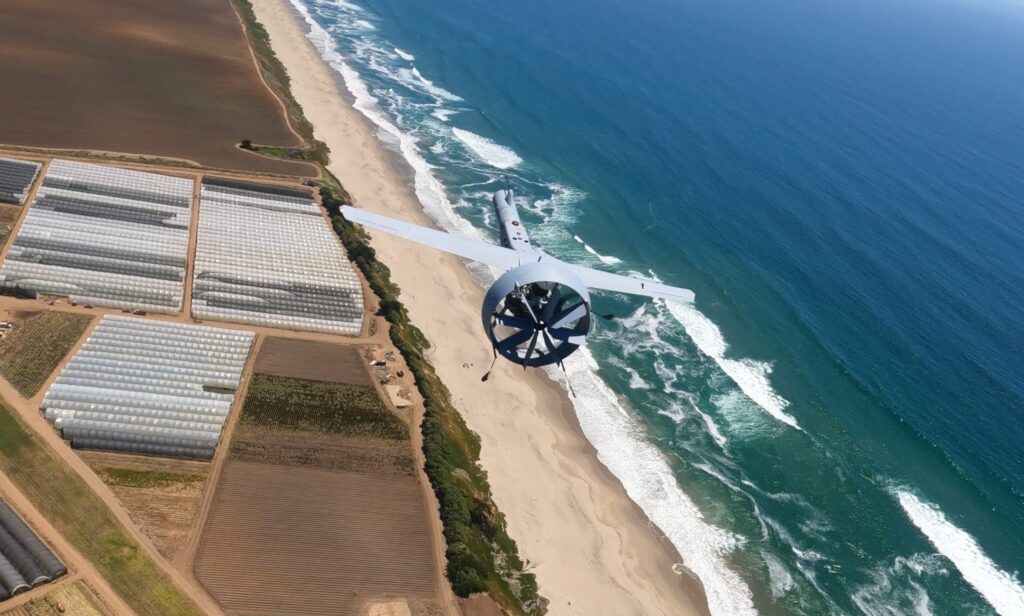
WASHINGTON (July 1, 2024) – Shield AI, the defense technology company building the world’s best AI pilot, announced today that the U.S. Coast Guard has awarded the company a $198,106,876 indefinite-delivery, indefinite-quantity firm fixed-price contract to provide Contractor Owned Contractor Operated (COCO) Intelligence, Surveillance, and Reconnaissance (ISR) services. This service will be implemented using the V-BAT unmanned aircraft system (UAS).
“We’re excited to support the U.S. Coast Guard with their ISR operations. All maritime vessels will become drone carriers as maritime forces move to deploy distributed, affordable, intelligent drones. V-BAT’s selection by the U.S. Coast Guard is indicative of a broader market movement where increasingly customers are recognizing they can accomplish the vast majority of their mission sets with affordable drones rather than exquisite, expensive crewed or uncrewed aircraft,” said Brandon Tseng, Shield AI’s President, Co-founder, and former Navy SEAL.
The V-BAT series aircraft is the only operationally deployed single-engine ducted fan vertical takeoff and land (VTOL) UAS that can launch and recover from a hover and fly on wing in horizontal flight. With more than five years of persistent operational experience at sea, U.S. and international customers view the V-BAT as a flexible platform capable of performing Group 2 to Group 5 UAS missions and beyond.
USS Mason Returns to Mayport From Combat Deployment
USS Mason Returns to Mayport from Combat Deloyment
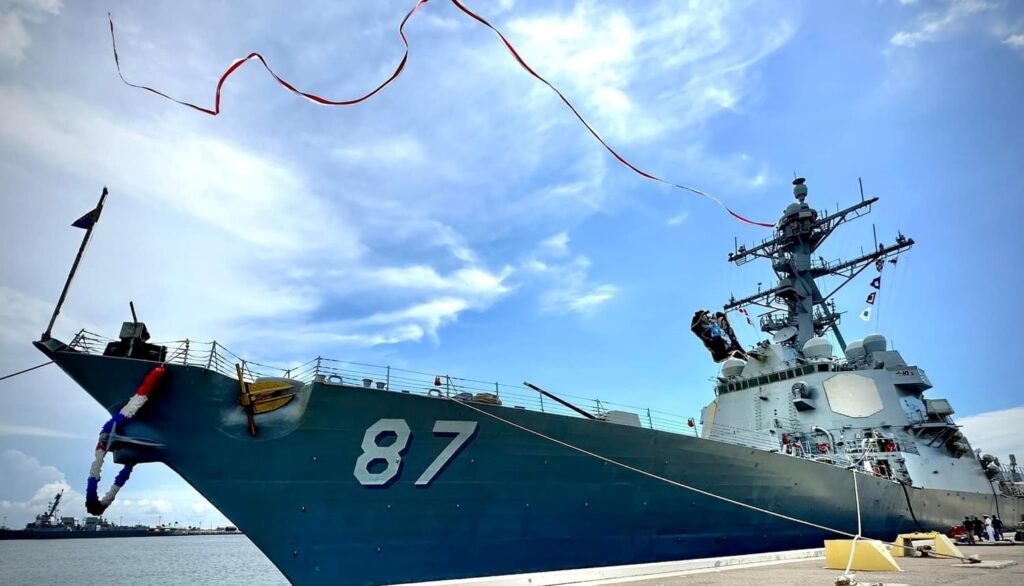
NAVAL STATION MAYPORT, Fla. — Arleigh Burke-class guided-missile destroyer USS Mason (DDG 87) returned to Naval Station Mayport, July 2, 2024, after being deployed for more than eight months in the U.S. Naval Forces Central Command area of operations.
Mason was deployed for 263 days in the Red Sea, Gulf of Aden, and Mediterranean Sea, supporting freedom of navigation and the free flow of commerce.
While deployed, Mason faced unprecedented attacks from the Houthi terrorist group based out of Yemen.
“I am extremely proud of this battle tested and battle proven crew who achieved unparalleled accomplishments while deployed,” said Cmdr. Justin B. Smith, Mason’s commanding officer. “No matter the threat or challenge, they demonstrated an innate ability to sustain a high level of readiness for eight months by thinking on their feet and quickly reacting. As result of their abilities, they protected Mason’s crew and exceeded all mission tasking throughout deployment.”
While deployed, Mason intercepted multiple unmanned aerial vessels and anti-ship ballistic missiles targeting merchant vessels and coalition warships. In support of the freedom of navigation and worldwide commerce, Mason escorted and saved 26 merchant vessels as they transited through the Bab Al-Mandeb Strait.
On Nov. 26, 2023, Mason responded to a distress call in the Gulf of Aden where five suspected pirates overtook M/V Central Park. Once Mason arrived, the suspected pirates fled, and Mason’s Visit, Board, Search, and Seizure team took custody of the suspected pirates and freed the crew stuck in the ship’s citadel.
Continuing the global support of the free flow of commerce, the crew displayed proficient interoperability between coalition partners through Liaison Naval Officers, helicopter cross deck operations, ship maneuvering exercises, and coordinated engagements.
Mason was deployed as part of the Dwight D. Eisenhower (IKE) Carrier Strike Group (CSG). IKECSG operated in the U.S. 5th and 6th Fleet areas of operations to deepen strategic relationships with allies and partners, and to support maritime security and stability.
The strike group is commanded by CSG-2 and comprised of flagship Dwight D. Eisenhower, Carrier Air Wing (CVW) 3 with its nine squadrons, USS Philippine Sea (CG 58), and Destroyer Squadron (DESRON) 22 with its guided missile destroyers.
July 1 CENTCOM Update
From U.S. Central Command
July 1, 2024
TAMPA, Fla. – In the past 24 hours, U.S. Central Command forces successfully destroyed one Iranian-backed Houthi radar site in a Houthi controlled area of Yemen.
It was determined the radar site presented an imminent threat to U.S., coalition forces, and merchant vessels in the region. This action was taken to protect freedom of navigation and make international waters safer and more secure.
RIMPAC 2024 Kicks Off in Hawaii
Caption: Vice Adm. John Wade, Commander, U.S. 3rd Fleet and Exercise Rim of the Pacific (RIMPAC) 2024 Combined Task Force (CTF) Commander, center, and task force leadership take questions during the opening press conference for RIMPAC 2024 held at Joint Base Pearl Harbor-Hickam, Hawaii, June 27. (U.S. Navy Photo by MC2 Courtney Strahan)
28 June 2024
From Lt.Cmdr. Robert Reinheimer
HONOLULU, Hawaii - The opening ceremony and press conference kicked off the 29th edition of the biennial Rim of the Pacific (RIMPAC) exercise, the world’s largest international maritime exercise, today.
Approximately 29 nations, 40 surface ships, three submarines, 14 national land forces, over 150 aircraft and more than 25,000 personnel will train and operate in and around the Hawaiian Islands during the exercise, which runs until Aug. 1. RIMPAC provides a unique training opportunity while fostering and sustaining cooperative relationships among participants critical to ensuring the safety of sea lanes and security on the world’s oceans.
“The Rim of the Pacific exercise has grown over the years to be the world’s largest and premier joint combined maritime training opportunity,” said Vice Adm. John Wade, commander, U.S. 3rd Fleet and RIMPAC 2024 Combined Task Force (CTF) commander. “The exercise’s purpose is to build relationships, to enhance interoperability and proficiency and, ultimately, contribute to the peace and stability in the vitally-important Indo-Pacific region.”
The theme of RIMPAC 2024 is “Partners: Integrated and Prepared.”
For the first time in RIMPAC history, a member of the Chilean Navy, Commodore Alberto Guerrero, will serve as deputy commander of the CTF. Japan Maritime Self-Defense Force Rear Adm. Kazushi Yokota will serve as the vice commander. Other key leaders of the multinational force will include Commodore Kristjan Monaghan of the Royal Canadian Navy, who will command the maritime component, and Air Commodore Louise DesJardins of the Royal Australian Air Force, who will command the air component.
This year’s RIMPAC will host its largest humanitarian aid and disaster relief exercise with eight countries, five ships, five landing craft, five aircraft, multiple land forces, and over 2,500 total participants including the statewide Hawaii Healthcare Emergency Management exercise.
During RIMPAC, participating forces integrate and exercise a wide range of capabilities, from disaster relief to maritime security operations, and from sea control to complex warfighting. The relevant, realistic preparation and training syllabus includes amphibious operations, gunnery, missile, anti-submarine, and air defense exercises, as well as military medicine, humanitarian assistance, disaster relief, counter-piracy, mine clearance operations, explosive ordnance disposal, and diving and salvage operations.
With inclusivity at its core, RIMPAC fosters multinational cooperation and trust, leverages interoperability, and achieves respective national objectives to strengthen integrated, prepared, coalition partners.
For more RIMPAC 2024 information and updates, visit https://www.cpf.navy.mil/rimpac/. Any additional questions or queries should be sent to [email protected].
Naval Sea Systems Command Celebrates 50 Years
By Naval Sea Systems Command Office of Corporate Communications
July 1, 2024
WASHINGTON – Naval Sea Systems Command (NAVSEA), responsible for the acquisition, construction, maintenance, and inactivation of ships, submarines, and combat systems for the U.S. Navy, celebrated its 50th anniversary July 1.
As the largest of the Navy’s six system commands, NAVSEA’s origins date back to 1794, when Commodore John Barry was charged with oversight of the construction of six 44-gun frigates and the responsibility to ensure that all business “harmonized and conformed” with the public’s interest. To build and maintain the fleet, the newly formed Navy Department established shipyards across the eastern seaboard, including the Washington Navy Yard, where NAVSEA headquarters sits today.
Since then, various organizations were established to oversee design, construction and repair of ships and ordnance. Ultimately, in 1974 with the merger of the Naval Ship Systems Command (NAVSHIPS) and the Naval Ordnance Systems Command (NAVORD), NAVSEA was formed with then-Vice Adm. Robert C. Gooding as the first NAVSEA commander.
The impetus for merging NAVSHIPS with NAVORD came after the U.S. Navy became a key part of America’s nuclear deterrence following the first ballistic missile launch from a submerged submarine. Using the skipjack-class as the base design, naval engineers lengthened the hull to accommodate the Polaris missile system, demonstrating a need for a holistic approach to ship and ordnance design.
Vice Adm. Jim Downey, commander, Naval Sea Systems Command, attributes NAVSEA’s success – past and present – to a team of talented personnel who are committed to ensuring the U.S. Navy has the reliable combat capability needed to meet its mission sets.
“Today our team spans 42 locations worldwide, working together to continue the critical work of those who served before us to generate readiness and warfighting capability for our Sailors and Marines,” said Downey. “Working together our team has delivered incredible technological advances – from Nimitz to Ford and Spruance to Arleigh Burke – enabling our Navy to meet its mission to defend freedom, preserve economic prosperity, and keep the seas open and free.”
Through the span of 50 years, NAVSEA has maintained its commitment to the public and the fleet, continually translating warfighting requirements into combat capability to enable our nation and its partners to project presence in peace, power in war, and assured access at all times. With the delivery of over 20 new ship classes of battle force ships over the past five decades, NAVSEA has been the powerful “Force Behind the Fleet.”
Today NAVSEA has a workforce of nearly 90,000 civilian and military personnel spanning multiple directorates, field activities, and program executive offices. A diverse command, NAVSEA hosts careers in acquisition and contracts, administration and program management, business and finance, engineering, IT and cybersecurity, science, mathematics, trades, and more.
USS Constitution to go Underway in Honor of Independence Day
BOSTON (August 12, 2022) USS Constitution fires a 21-gun salute from its saluting batteries off the coast of Castle Island, Mass. (U.S. Navy photo by Airman Austin Jean)
From the Department of the Navy, 28 June 2024
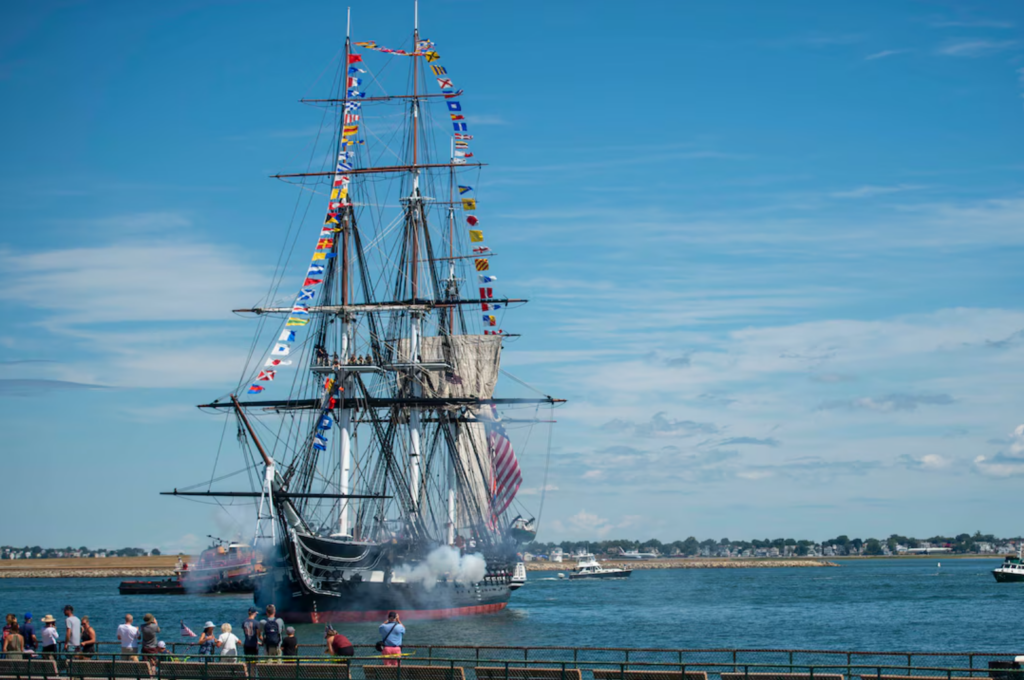
BOSTON – USS Constitution is scheduled to go underway from Charlestown Navy Yard, Massachusetts, on Thursday, July 4, at 10 a.m.
USS Constitution will be closed in the morning and reopen to the public for tours following the underway from 3 p.m. to 6 p.m.
The underway will celebrate the United States’ 248th birthday and will include a 21-gun salute viewable from Fort Independence on Castle Island at approximately 11:30 a.m.
USS Constitution will fire an additional 17-gun salute as she passes the U.S. Coast Guard Sector Boston, the former site of Edmund Hartt’s Shipyard, where USS Constitution was built and launched on Oct. 21, 1797.
USS Constitution’s cruise will be viewable from the Boston Harborwalk, Castle Island, and Charlestown Navy Yard.
USS Constitution is open Tuesday to Sunday from 10 a.m. to 6 p.m. for public visitation.
USS Constitution is the world’s oldest commissioned warship afloat and America’s Ship of State.
She played a crucial role in the Barbary Wars and the War of 1812, actively defending sea lanes from 1797 to 1855.
The active-duty Sailors stationed aboard USS Constitution provide free tours and offer public visitation as they support the ship’s mission of promoting the Navy’s history and maritime heritage and raising awareness of the importance of a sustained naval presence.
USS Constitution was undefeated in 33 at sea engagements with opponents. The ship earned the nickname of Old Ironsides during the War of 1812 when British cannonballs were seen bouncing off the ship’s wooden hull.
June 30 U.S. Central Command Update
From U.S. Central Command
June 30, 2024
TAMPA, Fla. – In the past 24 hours, U.S. Central Command (USCENTCOM) forces conducted a self-defense engagement, destroying three Iranian-backed Houthi uncrewed surface vessels (USVs) in the Red Sea.
It was determined the USVs presented an imminent threat to U.S. and coalition forces, and merchant vessels in the region. These actions were taken to protect freedom of navigation and make international waters safer and more secure.
This continued malign and reckless behavior by the Iranian-backed Houthis threatens regional stability and endangers the lives of mariners across the Red Sea and Gulf of Aden.
Expeditionary Fast Transport to Support SOUTHCOM’s Continuing Promise Goodwill Deployment
SANTA MARTA, Colombia (Aug. 20, 2023) Expeditionary fast transport ship USNS Burlington (T-EFP 10) arrives in Santa Marta, Colombia, Aug. 20, 2023. Continuing Promise 2023 marks the 13th mission to the region since 2007 and the first involving USNS Burlington. The mission will also foster goodwill, strengthen existing partnerships with partner nations, and encourage the establishment of new partnerships among countries, non-government organizations, and international organizations. (U.S. Navy photo by Lt. j.g. Nicko West)
By Richard R. Burgess, Senior Editor
ARLINGTON, Va. — A Spearhead-class expeditionary fast transport, USNS Burlington (T-EPF 10), is scheduled to deploy next week on a voyage to five countries in the Caribbean and Central and South America to provide humanitarian and civic assistance to the population and to promote regional good will under the U.S. Southern Command’s annual Continuing Promise mission.
Making its second such deployment, the Burlington will deploy with more than 100 Sailors, Soldiers, State Department personnel, and crew members to provide medical, veterinary, and construction services, subject-matter exchanges, and cultural exchanges. The ship is crewed by 26 Civil Mariners of the U.S. Military Sealift Command.
The Burlington, making the 14th annual deployment of Continuing Promise since 2007, will visit Jamaica, Costa Rica, Honduras, Columbia, and Panama during the two-month deployment. The countries visited differ from year to year.
“We really try to spread the opportunity around the Caribbean and even — based on resources — to some of the other countries in South America,” said Rear Admiral Jim Aiken, commander, U.S. 4th Fleet and commander, Naval Forces, U.S. Southern Command, speaking to reporters during a June 28 phone conference. “We have a spreadsheet and spend a significant amount of time evaluating [and] assessing where we should go. So, we’re going to a lot of different countries than we did previously. The only one is actually a repeat country from last year is Panama.
“So, going forward, we’ll keep looking for different opportunities and different engagements,” Aiken said. “This is based on a couple of things. First of all, there has to be a working relationship where there’s a need and a desire. The second thing is that we look at it and we really want to try to be strategic where there’s ‘no kidding’ need.
Aiken listed the mission sets of the deployment as medical and veterinary assistance; humanitarian and disaster relief discussions; civil construction, bio-medical assistance, and the State Department’s Women, Peace, and Security Program discussions.
He said the USNS Comfort is available for the Continuing Promise deployment “every two or three years,” with the ship planned for next year.
While the Burlington, smaller than the Comfort, brings the assistance teams to port, the teams actually conduct their medical assistance in hospitals ashore side-by-side with local teams.
Aiken mentioned that the “Navy staff has decided to convert a number of EPFs into hospital-like assets that actually could support surgeries and care actually on board.”
“Both numerically and qualitatively, Continuing Promise has been one of the most impactful humanitarian missions in the U.S. Navy’s history,” said Lieutenant Commander. Cmdr. Zachary Smith, the mission commander the operation. “The mission is a symbol of our long-standing commitment to the nations and people of Latin America and the Caribbean.
“We’ve delivered on our promises,” Smith said. “Working hand-in-hand with our partners we delivered over the course of the history of the mission more than 600,000 medical treatments, over 7,000 surgeries, and countless constructions projects, … and community relations events. Previous iterations of the mission have been extremely successful, and we anticipate making just as much of an impact this year.”
According to a Navy release, ”30 U.S. Navy medical professionals, including general practitioners, nurses, pharmacists, radiologists, dentists, optometrists, and biomedical technicians from Navy Medicine Readiness and Training Command (NMRTC Portsmouth, NMRTC Jacksonville, NMRTC Great Lakes, NMRTC Pensacola, NMRTC Camp Lejeune) and Naval Medicine Readiness and Logistics Command bring their expertise to this year’s iteration of Continuing Promise.
“The Continuing Promise team includes a U.S. Army veterinary team from the 248th Medical Detachment (Veterinary Service Support), which will collaborate with host nation colleagues to provide direct public health education and animal care at local veterinary organizations in-country,” the release said. “U.S. Navy Seabees from Navy Mobile Construction Battalion 1 will assist in host nation led community engineering projects. U.S. Navy experts will host seminars and training exercises with host nation civilian officials and military professionals covering disaster preparedness and response. These exchanges aim to support host nation facilities, improve readiness, and empower local and national officials with the knowledge and experience to act with confidence during emergencies.”
“This is a very special mission for me because I’ve seen it many times firsthand in my nearly three years in this assignment, Aiken said. “This is our shared neighborhood. We have friends and we have partners, and we enjoy the side-by-side that we have with each and every one of them. We learn from them, and they learn from us.”
The admiral recalled a previous Continuing Promise deployment to Columbia and being approached by a citizen who had been assisted during a Continuing Promise four years prior by the medical team on board the hospital ship USNS Comfort. The person was given surgery on his palate. He approached, saying that the surgery “changed my life so much, and instead of me being ridiculed by my schoolmates I am now able to live a normal life. … I just wanted to come back and say, Thank you.’”
“That’s the reason why I still get excited about this and every time we do this,” Aiken said.
Coast Guard Commissions First Pacific Northwest-Based Fast Response Cutter
Coast Guard Cutter David Duren (WPC 1156) transits near the Cape Disappointment Lighthouse as it enters the Columbia River near Astoria, Ore., for the first time on May 20, 2024. (U.S. Coast Guard photo by Petty Officer 2nd Class Steven Strohmaier)
From U.S. Coast Guard 13th District, June 28, 2024
ASTORIA, Ore. — The Coast Guard commissioned its 56th Fast Response Cutter and first one to be stationed in the Pacific Northwest during a ceremony held in Astoria, Ore., Thursday.
Coast Guard Cutter David Duren (WPC-1156) is the first of three planned Fast Response Cutter’s (FRC) to be homeported in Astoria.
The ceremony was presided by Vice Adm. Andrew Tiongson, Pacific Area Commander. Members from the Duren family were also on hand, including the cutter’s sponsor, Dawn Duren.
The namesake for the cutter, Master Chief Petty Officer David Duren, enlisted in the Coast Guard in 1965 and retired in 1993. During his career, Duren became a heavy weather coxswain and graduated from the Coast Guard’s National Motor Lifeboat School in 1969, qualifying as Coast Guard surfman No. 100.
During his tenure, Duren received two Coast Guard Medals for exceptional heroism and the Douglas Munro Inspirational Leadership Award. He deployed on search and rescue cases more than any other officer-in-charge at the time and during one year, he participated in 250 cases. Personnel under his command received a total of 24 medals and awards.
The crew of the David Duren will primarily serve in the Pacific Ocean, Puget Sound, Strait of Juan de Fuca, and the Columbia River. The Sentinel-class FRC is designed for multiple missions, including search and rescue; fishery patrols; ports, waterways, and coastal security; drug and migrant interdiction; and national defense.
The Coast Guard has ordered a total of 65 FRCs to replace the 1980s-era Island-class 110-foot patrol boats. The FRCs feature advanced command, control, communications, computers, intelligence, surveillance and reconnaissance equipment; over-the-horizon cutter boat deployment to reach vessels of interest; and improved habitability and seakeeping.
The commissioning ceremony is one of the most important traditional milestones in the life of a cutter, as it represents the readiness of the cutter to conduct Coast Guard operations and marks her entry into active service.
June 27 U.S. Central Command Update
From U.S. Central Command
June 27, 2024
TAMPA, Fla. – In the past 24 hours, U.S. Central Command (CENTCOM) forces successfully destroyed one uncrewed aerial system (UAS) launched by Iranian-backed Houthis into the Red Sea. It was determined this UAS presented an imminent threat to U.S., coalition forces, and merchant vessels in the region.
This action was taken to protect freedom of navigation and make international waters safer and more secure.
This continued malign and reckless behavior by the Iranian-backed Houthis threatens regional stability and endangers the lives of mariners across the Red Sea and Gulf of Aden.