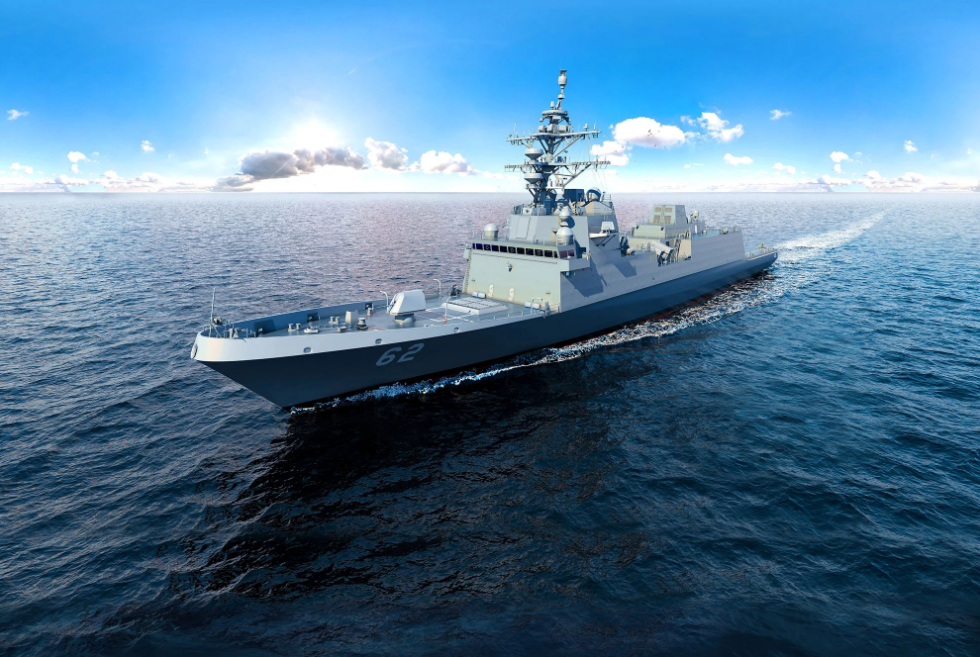
ARLINGTON, Va. — The U.S. Navy has ordered the next two Constellation-class guided-missile frigates (FFGs) from Fincantieri’s Marinette Marine, the Defense Department said.
The Naval Sea Systems Command awarded Marinette Marine Corp., of Marinette, Wisconsin, a $1.04 billion fixed-price incentive (firm-target) modification to previously awarded contract “to exercise options for detail design and construction of two Constellation-class guided-missile frigates, FFG 66 and FFG 67,” the May 23 contract announcement said.
The order brings to six the number of Constellation-class FFGs on order. This order is funded by the fiscal 2024 defense budget. The contract allows options for four more frigates. The Navy has a stated requirement for 20 frigates.
The Navy has selected a name for FFG 66, the future USS Hamilton, as announced May 23 by Secretary of the Navy Carlos Del Toro, in honor of Alexander Hamilton, a hero of the American Revolution and the nation’s first secretary of the Treasury.
More Than 1 Million Pounds of Aid Moved Into Gaza Via DOD’s Temporary Pier
MEDITERRANEAN SEA (May 17, 2024) A truck with humanitarian aid drives down the ramp from the the Bob Hope-class large, medium speed roll-on, roll-off ship MV Roy P. Benavidez (T-AKR 306) onto the roll-on/roll-off discharge facility (RRDF) platform, May 17, 2024. (U.S. Navy photo by MC1Kelby Sanders)
May 23, 2024 | By Joseph Clark, DOD News
U.S. forces have facilitated the transfer of more than 1 million pounds of humanitarian assistance into Gaza via the Defense Department’s Joint Logistics, Over-the-Shore pier, a senior military official said today.
Navy Vice Adm. Brad Cooper, deputy commander of U.S. Central Command, said 820 metric tons, or 1.2 million pounds, of aid have been transferred to a beach transfer point on Gaza’s shore since the temporary pier became operational on May 17.
Of that, 506 metric tons, or two-thirds of total aid transferred via the maritime corridor to the beach transfer point, has been distributed by the United Nations further into Gaza, Cooper said, citing figures current as of last night.
The effort, led by the U.S. Agency for International Development, is being carried out as part of the United States’ broader efforts alongside international partners to surge assistance to Palestinians in need.
“U.S. Central Command forces continue to support USAID’s provision of humanitarian assistance into Gaza from the sea as part of our government policy to flood the zone with humanitarian assistance,” Cooper said.
Construction of the pier began late last month after President Joe Biden called on the military to conduct the emergency operation during his State of the Union address.
Soldiers from the Army’s 7th Transportation Brigade at Joint Base Langley-Eustis, Virginia, and sailors from Naval Beach Group 1 at Naval Amphibious Base Coronado, California, were tapped to deploy the JLOTS capability.
Delivering the capability involved a complex choreography of logistics support and landing crafts that carry the equipment used to construct the approximately 1,800-foot causeway comprising modular, floating sections linked together.
The units also constructed a roll-on, roll-off discharge facility that is 72 feet wide by 270 feet long. The discharge facility will remain about far off Gaza’s shore and enable cargo ships to offload aid shipments at sea prior to being transported to shore.
About 1,000 soldiers and sailors are involved in the operation.
The U.S. is also working closely with the Cyprus, the government of Israel, the U.N. and international donors including the United Arab Emirates, United Kingdom and European Union as part of the multi-step process to move aid into Gaza from the sea.
International donors first ship aid into Cyprus where it is screened and packaged before being loaded onto ships to be transported to the temporary pier.
From the pier, the aid is offloaded into a marshaling area before being distributed further into Gaza by humanitarian organizations.
Officials emphasized that no U.S. boots are on the ground in Gaza as part of the operation, and that safety of U.S. forces is the top priority.
The distribution of aid into Gaza once offloaded from the pier is being done solely by humanitarian aid workers.
“This is a complex humanitarian aid mission that requires continuous coordination between many partners,” said Dan Dieckhaus, the director of USAID’s response operations. “The support and contributions of the U.N., the government of Cyprus and other international partners, including the U.K., European Union, United Arab Emirates, France, Romania and others is vital, as is the cooperation of Israel.”
In addition to operating the pier, the U.S. has stood up a coordination cell to ensure operations are carried out as safely and efficiently as possible.
“Our commitment to the safety of humanitarian workers requires a meticulous approach to distribution, route planning and convoy monitoring with various stakeholders, especially the U.N., to reduce risk,” Cooper said. “We’re doing this collaboratively with the Israeli Defense Forces and the United Nations who are embedded in our combined coordination cell.”
Cooper emphasized that despite measures to mitigate risk, the environment remains “very complex and dynamic.”
Still, he said the U.S. aims to continue increasing the flow of aid.
“We have thousands of tons of aid in the pipeline,” he said, adding “we do encourage international donors to continue their contributions so that we can sustain and increase the volume of lifesaving aid getting to the people of Gaza every day.”
Brazil, United States partner to combat illegal fishing
The U.S. Coast Guard Cutter James (WMSL 754) moors in Rio de Janeiro, Brazil, May 20, 2024. The James arrived in Rio de Janeiro for a scheduled port visit during Operation Southern Cross 2024. (U.S. Coast Guard photo by Petty Officer 3rd Class Logan Kaczmarek)
From U.S. Coast Guard Atlantic Area, May 23, 2024
RIO DE JANEIRO — U.S. Coast Guard Cutter James (WMSL 754) arrived in the port of Rio de Janeiro, Brazil for a scheduled visit, Monday.
This visit marks James’ third stop as the cutter continues its multi-mission deployment in the South Atlantic Ocean, exhibiting the U.S. Coast Guard’s partnership with Brazil and strengthening the interoperability of the two nations’ maritime forces to counter illicit maritime activity and promote maritime sovereignty throughout the region.
“Working with the Brazilian navy has been a successful demonstration of how our countries can work together,” said U.S. Coast Guard Capt. Donald Terkanian, James’ commanding officer. “James has had the opportunity to enhance relations between the U.S. and Brazil while also addressing the threats posed by illegal, unreported, and unregulated fishing, port security, and in facilitating safe and lawful maritime commerce and travel.”
James embarked Brazilian navy Lt. Cmdr. Fernando Schild in April of 2024. Brazil and the United States’ naval services both use unmanned aerial systems to provide increased maritime domain awareness across a variety of mission sets. The embarked Brazilian officer is part of Brazil’s first ship-based unmanned aerial systems squadron, and the embarkation of this officer aboard James highlights the robust partnership between the two nations and their shared commitment to upholding the rules-based international order at sea.
In recent years, the United States and Brazil have partnered to share and exchange maritime tactics, techniques, and procedures. Since 2009, the U.S. Coast Guard has provided 34 mobile training team deployments and three resident training courses to Brazil in the areas of crisis management, mobile command systems, port security, maritime law enforcement, search and rescue, and disaster response. Both countries are dedicated to the responsible management of marine resources, demonstrating their shared commitment through the continued integration of their naval forces.
James, staffed by 150 men and women and is one of the largest and most technologically advanced ships in the Coast Guard’s fleet. The crew is dedicated to missions including combatting drug trafficking and monitoring for illegal, unreported, and unregulated fishing activities in the Atlantic. Their work not only supports U.S. interests but also contributes to regional stability and security.
James is the fifth Legend-class national security cutter in the Coast Guard fleet and is currently homeported in Charleston, South Carolina. The national security cutters can execute the most challenging national security missions, including support to U.S. combatant commanders.
James is under the command of U.S. Coast Guard Atlantic Area. Based in Portsmouth, Virginia, U.S. Coast Guard Atlantic Area oversees all Coast Guard operations east of the Rocky Mountains to the Arabian Gulf. In addition to surge operations, they also allocate ships to work with partner commands and deploy to the Caribbean and Eastern Pacific to combat transnational organized crime and illicit maritime activity.
CNO Celebrates Maritime Service at Fleet Week New York
NEW YORK (May 23, 2024) – Chief of Naval Operations Adm. Lisa Franchetti departs the Wasp-class amphibious assault ship USS Bataan (LHD 5) during Fleet Week New York, May 23, 2024. Franchetti traveled to New York City to celebrate maritime service during Fleet Week New York, and discuss her priorities for America’s Warfighting Navy. (U.S. Navy photo by Chief Mass Communication Specialist Michael B. Zingaro)
From CNO Public Affairs
NEW YORK (May 23, 2024) – Chief of Naval Operations Adm. Lisa Franchetti traveled to New York to meet with future Sailors and their families and engage with Sailors, Marines and Coast Guardsmen during Fleet Week New York, May 23.
Fleet Week New York, now in its 36th year, is a time-honored sea service celebration that gives citizens of New York City and the surrounding Tri-State Region the opportunity to witness today’s maritime capabilities first-hand. It also provides service members the opportunity to experience New York City and tell their stories to the American people.
CNO started the visit speaking with media at the Rockefeller Center, where she highlighted the importance of the Navy and emphasized the value of service to our Nation. She also had the opportunity to meet with the Navy Band and Fleet Week attendees in the Today Show Plaza.
“It’s an honor to lead our amazing team. We’ve got about 600,000 Active and Reserve Sailors and civilians deployed around the world,” said Franchetti. “We preserve the peace, we’re ready to respond in crisis and, if necessary, win decisively in war. We have a Carrier Strike Group in the Western Pacific, we have another one going around South America, and of course we have the USS Eisenhower Carrier Strike Group leading Operation Prosperity Guardian in the Red Sea to protect the free flow of commerce. Your Navy is out there every day protecting our way of life and I couldn’t be more proud.”
Following her visit to Times Square, CNO visited the Wasp-class amphibious assault ship USS Bataan (LHD 5) to meet with future Sailors currently in the delayed entry program, local Naval Reserve Officers Training Corps (NROTC) scholarship recipients and prospective United States Naval Academy Midshipmen, and their families.
CNO took the opportunity to thank families for their support and fielded questions about what to expect in the Navy. CNO also highlighted her priorities for America’s Warfighting Navy: Warfighting, Warfighters, and the Foundation that supports them.
“I’m proud to welcome you to the Navy team – the opportunities you will have in the Navy are endless, and I want to thank you for making the choice to serve something greater than yourself,” Franchetti told the future Sailors. She then told the parents, “Thank you for the support you’ve provided your kids along the way. It is your love, steadfast support, and encouragement for them to be their best that got them here, and the Navy is committed to making them the strongest version of themselves. Welcome to our Navy family.”
While in New York, Franchetti was honored with the Intrepid Freedom Award at the Intrepid Museum’s Salute to Freedom gala held aboard the decommissioned USS Intrepid (CV-11).
“I am truly honored to accept this award. This award is testament to the hard work and success of the Sailors I’ve led and the missions we’ve supported throughout my 38-year career,” said Franchetti. “With an average of 110 ships and 70,000 Sailors and Marines deployed at sea on any given day, the Navy-Marine Corps team is delivering power for peace, deterring potential adversaries, and standing ready to fight and win our Nation’s wars. I could not be more proud of our Navy team, and am grateful to accept this award on their behalf.”
This was CNO’s first trip to New York since her confirmation.
Sikorsky Flight-Tests Scalable ‘Rotor Blown Wing’ UAS for DARPA Project
The VTOL tail sitter features proprotors for flight efficiency
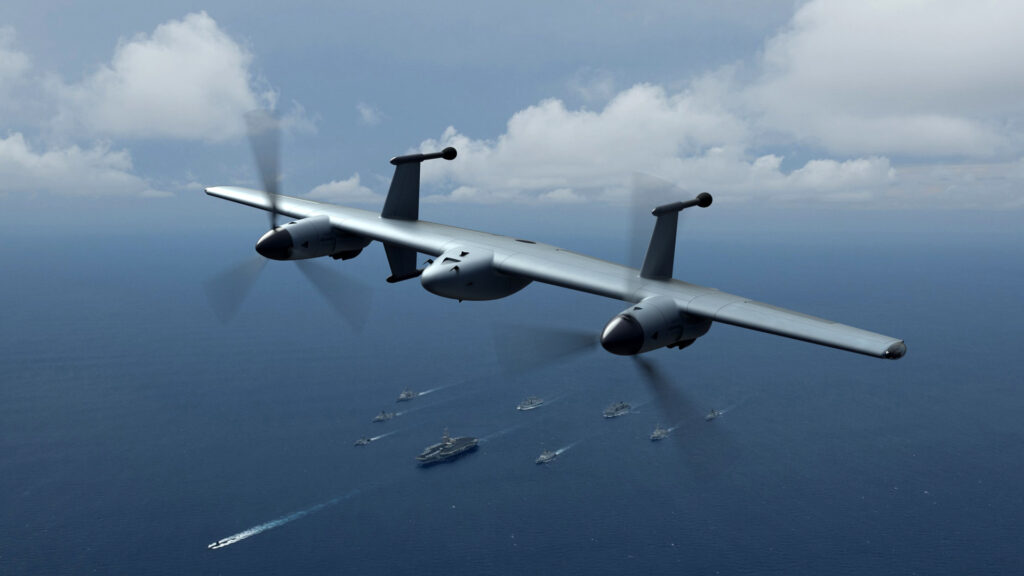
STRATFORD, Conn., May 22, 2024– Sikorsky, a Lockheed Martin company (NYSE: LMT), is conducting flight tests to mature the control laws and aerodynamics of a novel vertical takeoff and landing uncrewed aerial system (VTOL / UAS). The flight tests are intended to prove the efficiency and scalability of a twin proprotor ‘rotor blown wing’ configuration that sits on its tail to take-off and land like a helicopter, and transitions easily to horizontal forward flight for long-endurance missions, such as intelligence, surveillance, reconnaissance and targeting.
The ongoing flight tests support the ANCILLARY initiative by the Defense Advanced Research Projects Agency (DARPA), which seeks to develop a Class 3 UAS VTOL X-Plane that can operate in most weather conditions from ship decks and unprepared surfaces without infrastructure. Sikorsky is one of several competitors down-selected to advance their UAS conceptual designs into the next development phase.
The term ‘rotor blown wing’ refers to the constant airflow from the proprotor wash across the wing. Sikorsky chose the design to reduce drag on the wing in hover mode and when transitioning to forward flight, and to increase cruise efficiencies and endurance.
The design is just one of the many ways Sikorsky is advancing 21st Century Security® technologies and innovations, said Igor Cherepinsky, director of rapid prototyping group Sikorsky Innovations.
“Flight tests are underway to verify our tail-sitting rotor blown wing UAS can launch and land vertically with high stability, and cruise efficiently on wing,” said Cherepinsky. “Key enablers to flight maneuverability, and future vehicle scalability, are our MATRIX autonomy flight control system, and an articulated rotor system similar to those in traditional helicopters.”
For the flight tests now underway, Sikorsky is flying a proof-of-concept vehicle powered by a battery. If selected to produce an air vehicle for a future ANCILLARY phase, Sikorsky plans to build a 300-pound hybrid-electric version to include a 60-pound ISR payload.
Sikorsky Innovations was formed in 2010 to overcome technological challenges to rotary wing speed, autonomy, and intelligence. Learn more about the engineering team’s achievements in speed and intelligence, and its current focus on electrification and VTOL UAS to support 21st Century Security® missions.
Navy Admiral Selects Three Littoral Combat Ships for 2025 Basing with 5th Fleet
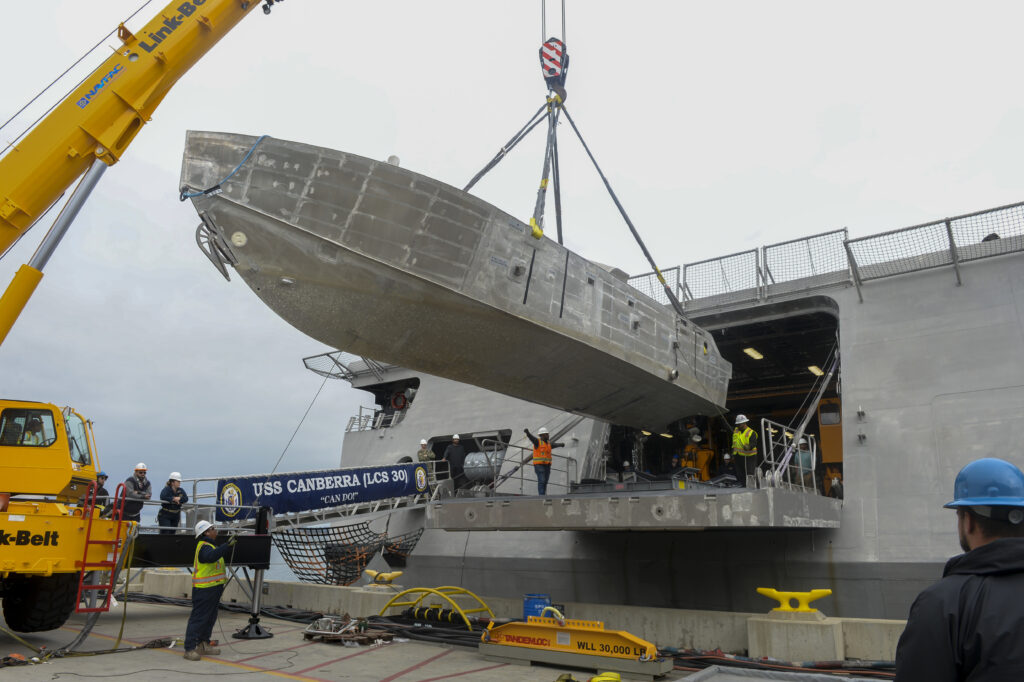
An unmanned surface vehicle is craned aboard the Independence-variant littoral combat ship USS Canberra (LCS 30), as a part of the first embarkation of the Mine Countermeasures (MCM) mission package, April 23. The MCM mission package is an integrated suite of unmanned maritime systems and sensors which locates, identifies, and destroys mines in the littorals while increasing the ship’s standoff distance from the threat area. Littoral Combat Ships are fast, optimally-manned, mission-tailored surface combatants that operate in near-shore and open-ocean environments, winning against 21st-century coastal threats. (U.S. Navy photo by Mass Communication Specialist 1st Class Vance Hand)
By Richard R. Burgess, Senior Editor
ARLINGTON, Va. — The admiral in charge of U. S. Navy surface forces has named the three Independence-class littoral combat ships (LCS) slated to be forward-deployed to the U.S. 5th Fleet to replace the Avenger-class mine-countermeasures ships (MCMs).
“MCMs are reaching their end-of-service-lives, and we have to replace them, as great as they are,” said Vice Admiral Brendan McLane, commander, U.S. Naval Surface Forces, speaking May 23 at the International Mine Warfare Technology Symposium in San Diego. “Secretary of the Navy [Carlos] Del Toro has approved the strategic laydown which confirmed the deployment of LCS 2 variants — including [USS] Tulsa [LCS 16], Santa Barbara [LCS 32], and Canberra [LCS 30] — to deploy to Bahrain in 2025, and four more to Sasebo [Japan] in 2027.
“The platforms will have the MCM mission package and will replace our legacy MCMs,” McLane said. “But even with these mission packages, we’ll have to incorporate them into a team to be able to combat enemy mining operations. Joining the LCS will be a theater expeditionary MCM team {than] will deploy a combination of unmanned systems, divers, and sensors teamed together to defeat enemy mining. We’re already doing some of that teamwork.”
Two LCS have been deployed to the 5th Fleet area of responsibility so far: Freedom-class LCS USS Sioux City (LCS 11) in 2022 and USS Indianapolis (LCS 17) in 2023, the latter still deployed there.
“The Sioux City teamed with CTF-52’s MCM expeditionary capability and embarked Helicopter Sea Combat 22 detachment to augment MCM capabilities in 5th Fleet,” McLane said. “Sioux City paved the way for future LCS operations within 5th Fleet and showed what a valuable contributor and teammate the LCS platform can be. The full LCS with mission packages will bring even more capability to the 5th Fleet team.”
McLane said he is “tremendously excited for the long-term viability of LCS as our enduring mine warfare platform due to their modularity and the ability to quickly design, develop, and deploy new subsystems within the MCM mission package will give the Navy persistent competitive advantage as mine warfare continues to evolve.”
Marine Corps set to receive new Light Assault Weapon System
The M72 Fire from Enclosure (FFE) system with A8 and A10 munition. (Courtesy photo from Nammo)
From Marine Corps Systems Command, May 20, 2024
MARINE CORPS BASE QUANTICO, Va. — Marine Corps Systems Command is pleased to
announce the acquisition of the M72 Light Assault Weapon Fire from Enclosure Munition.
The M72 LAW Fire from Enclosure (FFE) is a compact, lightweight, single-shot weapon system. It incorporates an improved launcher featuring an enhanced in-line trigger mechanism and improved sling design. The M72 FFE comprises two configurations: the M72A8 anti-armor and the M72A10 multi-purpose, anti-structure munition. The M72A8 contains a high-
explosive charge warhead that improves armor penetration, while the M72A10 provides Marines with increased capability for eliminating structures.
The M72 FFE is designed to deliver versatility and reliability, enabling Marines to counter threats effectively in close-range
combat. Its performance is optimized for urban environments, vehicles, and complex terrain, ensuring operational effectiveness in these challenging scenarios.
The M27A FFE variants will replace the current LAW weapon system capability. The new system allows Marines to fire multiple shots daily from inside a room and has less flash and back blast than an M9 pistol. The reduced visibility increases the lethality and safety of Marines.
“This new capability removes the Marine from exposure to enemy engagement by introducing the FFE capability, said Mr. Scott Adams, Product Manager, Ammo. “The FFE and the reduced thermal signature provides the Marine with an added layer of protection.”
The MCSC team worked closely with their Army counterparts to procure this new capability. All shoulder-fired rocket ammunition is procured through the U.S. Army Joint Munitions Command, the Single Manager for Conventional Ammunition. This enables the services to combine orders to realize cost savings by leveraging economic order quantity prices.
The M72 FFE rocket underscores the Marine Corps’ ongoing efforts to lighten the warfighter’s load and increase lethality. PdM Ammo expects to begin fielding the M72A FFE in calendar year 2024.
SECNAV Del Toro Names Future Guided Missile Frigate USS Hamilton (FFG 66)
From SECNAV Public Affairs, May 23, 2024
Secretary of the Navy Carlos Del Toro announced that a future Constellation-class Guided Missile Frigate (FFG 66) will be named USS Hamilton. Secretary Del Toro made the announcement, May 23, while joining New York Mayor Eric Adams at Gracie Mansion for the New York City Mayor’s Fleet Week Welcome Breakfast.
The future USS Hamilton honors Secretary of the Treasury and Founder of the U. S. Coast Guard Alexander Hamilton and the crews of previous Navy vessels to bear the name.
“Secretary Hamilton was a fierce advocate for our Nation to establish a Navy. He understood that we, as a maritime nation, needed to establish ourselves from the outset as a maritime power, both commercial and naval,” said Secretary Del Toro. “USS Hamilton, once constructed, will sail around the world, representing the freedom and ideals its namesake spent his life advocating for.”
During the Revolutionary War, Hamilton served for four years as an aide-de-camp for General George Washington and later, in 1781, commanded a light infantry battalion at the battle of Yorktown. He subsequently contributed significantly to the adoption of the United States Constitution by serving as a delegate to the Constitutional Convention, drafting a large portion of the Federalist Papers, and providing pivotal support for New York’s adoption of the proposed document.
As President Washington’s first Secretary of the Treasury, Hamilton was the architect of policies that greatly strengthened the country’s credit and economy. He consistently advocated for a strong Navy, and encouraged the development of dock yards, naval arsenals, and shore facilities. To counter the large number of smugglers who were undercutting the new nation’s finances by evading import taxes, Secretary Hamilton in 1790 spurred the establishment of the U.S. Revenue Cutter Service—forerunner of today’s United States Coast Guard. Ships previously named in honor of Alexander Hamilton have served in the U.S. Navy, U.S. Coast Guard, and Revenue Cutter Service.
USS Hamilton, the fifth of the new Constellation-class frigates, was appropriated in 2024. The other ships in the class are USS Constellation (FFG 62), USS Congress (FFG 63), USS Chesapeake (FFG 64), and USS Lafayette (FFG 65), which Secretary Del Toro named last year in France.
The Constellation-class guided-missile frigate represents the Navy’s next generation small surface combatant. This ship class will be an agile, multi-mission warship, capable of operations in both blue-water and littoral environments, providing increased combat-credible forward presence that provides a military advantage at sea.
The Constellation-class will have multi-mission capability to conduct air warfare, anti-submarine warfare, surface warfare, electronic warfare, and information operations.
May 22 U.S. Central Command Update
From U.S. Central Command, May 22, 2024
TAMPA, Fla. – At approximately 3:16 p.m. (Sanaa time) on May 22, U.S. Central Command (USCENTCOM) forces successfully engaged four uncrewed aerial systems (UAS) in an Iranian-backed Houthi controlled area of Yemen.
It was determined these systems presented an imminent threat to U.S., coalition forces, and merchant vessels in the region. These actions are taken to protect freedom of navigation and make international waters safer and more secure for U.S., coalition, and merchant vessels.
HASC TACAIR Mark-Up Would Assign Newest Super Hornets to Navy Reserve
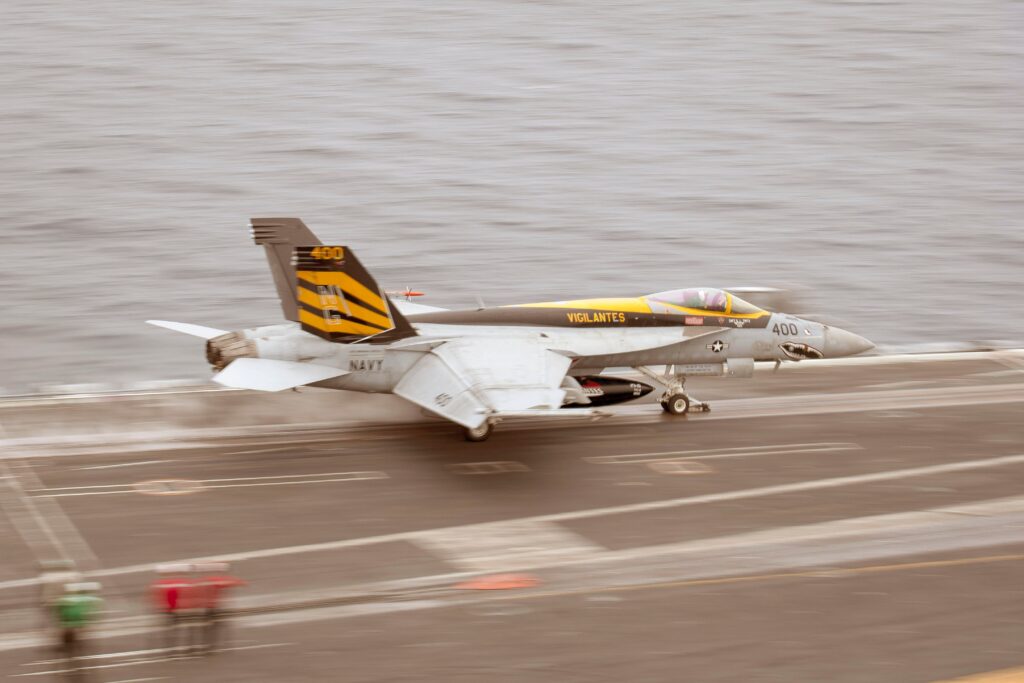
PACIFIC OCEAN (May 19, 2024) An F/A-18E Super Hornet, assigned to Strike Fighter Squadron (VFA) 151, takes off from the flight deck of the Nimitz-class aircraft carrier USS Abraham Lincoln (CVN 72). (U.S. Navy photo by MC1 Kevin J. Steinberg)
By Richard R. Burgess, Senior Editor
ARLINGTON, Va. — The mark-up of the House Armed Services Committee’s TACAIR and Land Forces subcommittee for the 2025 National Defense Authorization Act would assign the newest F/A-18E/F Super Hornet strike fighters to the Navy Reserve.
The mark-up would “require the Secretary of the Navy to assign only to the Navy Reserve all F/A-18E/F Super Hornet aircraft procured using funds appropriated for the Navy for fiscal year 2022 or fiscal year 2023,” the text of the mark-up said.
“The Secretary of the Navy shall ensure that all covered [F/A-18] aircraft are (1) provided only to the Navy Reserve; and (2) used only to recapitalize and maintain, within the Navy Reserve (A) a deployable tactical strike-fighter capability; and (B) a threat representative adversary support capability that may be used in support of training activities of the Department of Defense,” the document said.
The Super Hornets would be Block III versions. The only Navy Reserve squadron currently equipped with Super Hornets — Fighter Composite Squadron 12 — operates older versions of the F/A-18E.
The subcommittee’s mark-up also approved multiyear procurement authority beginning in 2025 for Marine Corps’ CH-53K King Stallion heavy lift helicopters and the T408 engines that power them.