Airbus Offers Unmanned UH-72 Helicopter for Marine Corps Aerial Logistics
Photo Credit: Airbus
ARLINGTON, Va. — Naval Air Systems Command awarded Airbus U.S. Space & Defense a Phase I Other Transactional Authority Agreement, through Naval Aviation Systems Consortium, in support of the United States Marine Corps Aerial Logistics Connector.
The award is part of a Middle Tier of Acquisition (MTA) Rapid Prototyping Program which aims to provide the Marine Corps with prototypes to demonstrate the aircrafts capabilities to the warfighter through a series of operationally experiments. The Airbus U.S. UH-72 Unmanned Logistics Connector, a variant of the proven Lakota platform, is intended to provide logistical support during expeditionary operations within contested environments.
“Our unmanned UH-72 logistics connector leverages nearly two decades of U.S. military capability and offers Marines a versatile, affordable and enduring solution to address logistics missions around the globe,” said Rob Geckle, chairman and CEO of Airbus U.S. Space & Defense. “We look forward to supporting the Marine Corps with this latest modernization of the Lakota platform.”
Leidos and Elroy Air to Demonstrate Autonomous Aerial Resupply Drone for U.S. Marine Corps
RESTON, Va. (May 14, 2024) – Leidos (NYSE:LDOS), a FORTUNE 500 innovation company, and Elroy Air, an autonomous aircraft systems and software development company, have been approved to demonstrate an autonomous Medium Aerial Resupply Vehicle – Expeditionary Logistics (MARV-EL) prototype for the Navy and Marine Small Tactical Unmanned Aircraft Systems program office (PMA-263). The flight test activities are scheduled for July 2024. The development and testing are part of a contract awarded last year to develop and demonstrate an uncrewed aircraft system that can autonomously resupply forward-deployed ground forces for the U.S. Marine Corps.
“Leidos is pleased to team with Elroy Air to bring this critical capability to the warfighter,” said Tim Freeman, Leidos senior vice president and Airborne Systems business area manager. “Approval to proceed to test is a major milestone and is the result of months of hard work by the team. We look forward to demonstrating how the Leidos and Elroy Air MARV-EL solution will help deliver a logistics advantage to the Marines and other branches of the military.”
Leidos and Elroy Air are slated to demonstrate Elroy Air’s Chaparral system at the U.S. Army Yuma Proving Ground in Yuma, Arizona. The Chaparral is a “lift-plus-cruise” hybrid-electric vertical take-off and landing (hVTOL) cargo aircraft. The Chaparral system leverages the benefits of wing-borne flight driven by electric propulsion and turbo-generation for efficient autonomous operations and longer-range missions. It is designed with an advanced carbon composite airframe and modular automated payload capabilities to help reduce the personnel required versus legacy aircraft and enable zero-touch logistics.
“We’re excited to work with Leidos to provide these critical capabilities to U.S. and allied forces,” said Elroy Air CEO and co-founder Dave Merrill. “We’ve been designing Chaparral from the beginning to move cargo and resupply troops in the battlespace without putting crews in harm’s way. We look forward to demonstrating these capabilities and working toward serving the U.S. Marine Corps’ goals for expeditionary logistics.”
MARV-EL is a PMA-263 effort designed to provide commanders with a responsive capability to sustain Marine Corps Forces conducting expeditionary advanced base and other distributed operations. MARV-EL, using autonomous operations, should be the “middle-weight” unmanned logistics asset, providing combat sustainment to Marines when ground or manned aviation assets are unavailable due to threat, terrain, weather, or competing priorities.
High School Seniors Sign for Careers at HII’s Newport News Shipbuilding
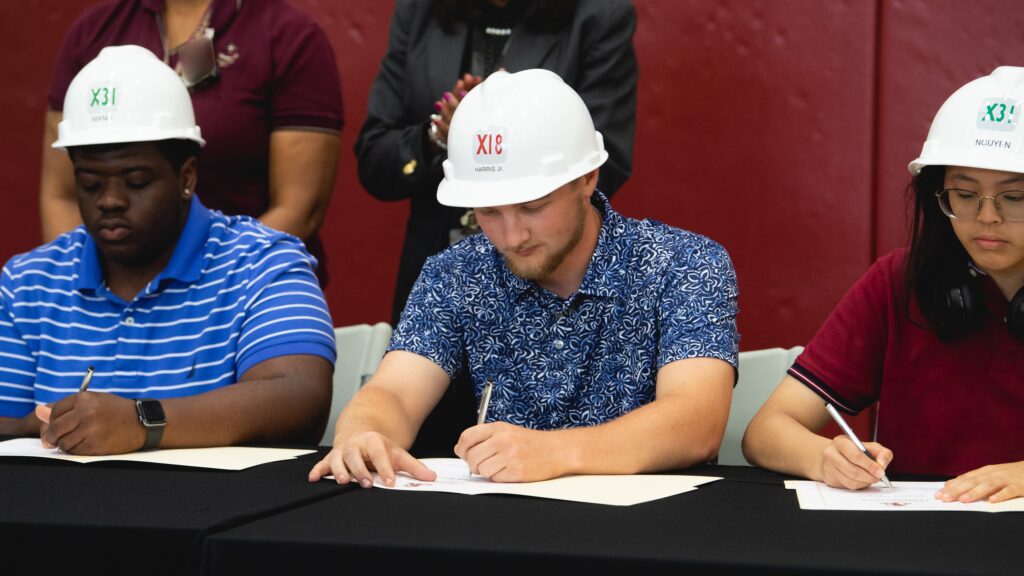
NEWPORT NEWS, Va., May 10, 2024 (GLOBE NEWSWIRE) — HII’s (NYSE: HII) Newport News Shipbuilding division is welcoming more than three dozen graduating high school seniors to careers in shipbuilding. The shipyard held a signing day at The Newport News Shipbuilding Apprentice School Wednesday and participated in the New Horizons Regional Education Centers (NHREC) Good Life Solution Program’s Career Selection Day on Thursday.
A total of 38 students accepted employment offers from NNS: 15 who will begin full-time trade positions within the shipyard and 23 who will attend The Apprentice School. Funded by HII to train and develop the next generation of shipbuilders, The Apprentice School offers four- to eight-year, tuition-free apprenticeships in 19 trades and eight optional advanced programs, to include accredited undergraduate degrees in engineering.
Wednesday’s event, in partnership with the Department of Labor in celebration of National Youth Apprenticeship Week (YAW), recognized students who have completed one of several workforce development programs at The Apprentice School: the Pre-Apprenticeship Program, Youth Builders, Good Life Solutions, and Apprentice Accelerated (APX).
The Thursday event recognized additional students in The Good Life Solution Program, which is a collection of partnerships between NHREC and local employers looking to improve the way they recruit, hire, train and retain entry-level new hires out of high school. The program has a one-year retention rate of 80%.
“It is an exciting time to embark on a career in shipbuilding,” said Xavier Beale, NNS vice president of human resources. “These students will not only build the highest-quality aircraft carriers and submarines for the U.S. Navy, they are also building a meaningful career. We are thrilled to have them join our ranks in a calling to serve our nation as only shipbuilders can.”
NNS plans to hire approximately 3,000 skilled trade positions this year to meet the shipbuilding needs of the U.S. Navy. The shipyard anticipates hiring nearly 19,000 trades people within the next decade.
To learn more about the Good Life Solution Program, visit nhrec.org/gls.
For more information about careers at Newport News Shipbuilding visit, hii.com/careers.
U.S., Japan, Korea Coast Guards Sign Trilateral Agreement to Increase Maritime Cooperation
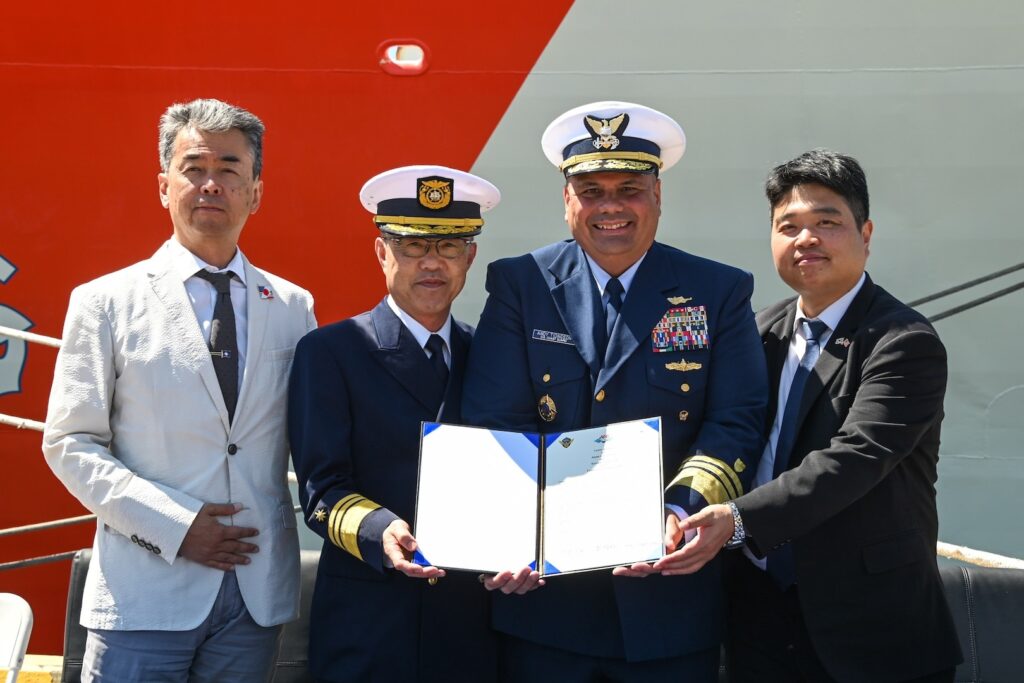
Mr. Kishimori Hajime, deputy Consul General of Japan (left), Japan coast guard Vice Adm. Watanabe Yasunori, Japan coast guard vice commandant for operations, U.S. Coast Guard Vice Adm. Andrew Tiongson, commander, U.S. Coast Guard Pacific Area, and Hyunchul Kang, deputy Consul General of the Republic of Korea, pose with a signed trilateral agreement at Coast Guard Island, Alameda, Calif., May 9, 2024. (U.S. Coast Guard photo by Master Chief Petty Officer Charly Tautfest)
U.S. Coast Guard Pacific Area, May 12, 2024
ALAMEDA, Calif – U.S. Coast Guard, Japan Coast Guard and Korea Coast Guard representatives displayed continued commitment to enhance maritime expertise and promote regional cooperation by signing a trilateral letter of intent, Thursday.
This agreement aligns trilateral cooperation between Japan, the Republic of Korea and the United States to include capacity-building efforts to Association of Southeast Asian Nations and Pacific Island countries. The letter of intent advances a joint statement between the three nations’ leaders, which was held at Camp David in August 2023.
U.S. Coast Guard Vice Adm. Andrew Tiongson, Commander, U.S. Coast Guard Pacific Area, met Japan Coast Guard Vice Adm. Watanabe Yasunori, Japan Coast Guard Vice Commandant for Operations, to finalize a trilateral letter of intent, which was previously signed by Korea Coast Guard Oh Sang Kwon, Deputy Commissioner of the Korea Coast Guard. Oh signed the letter of intent in April with the understanding that the agreement would be finalized upon Watanabe’s May visit to U.S. Coast Guard Pacific Area command.
Mr. Hyunchul Kang, Deputy Consul General of the Republic of Korea, attended the trilateral signing on behalf of the Korea coast guard, and Mr. Kishimori Hajime, Deputy Consul General of Japan, presented brief remarks as well.
“This trilateral agreement between U.S., Japan and Korea Coast Guards is the lynchpin that will drive our coast guards to work together to advance maritime safety, security, and prosperity in the Indo-Pacific,” said Tiongson. “It will enhance our multilateral operations with each other, as well as other trusted partners in the region.”
The agreement specifically recognizes the important of efforts to conserve maritime resources, combat illegal, unreported and unregulated fishing and search and rescue response efforts.
May 13 Red Sea Update
From U.S. Central Command
May 13, 2024
TAMPA, Fla. – At approximately 3:41 p.m. (Sanaa time) on May 13, U.S. Central Command (USCENTCOM) forces successfully destroyed one uncrewed aerial system (UAS) in an Iranian-backed Houthi controlled area of Yemen.
Later, between approximately 5:51 p.m. and 6:02 p.m. (Sanaa time), USS Mason (DDG 87) successfully engaged and destroyed one inbound anti-ship ballistic missile launched by Iranian-backed Houthis from Yemen over the Red Sea. Additionally, USCENTCOM forces destroyed one UAS launched by Iranian-backed Houthis from Yemen over the Red Sea. There were no injuries or damages reported by U.S., coalition, or merchant vessels.
It was determined these weapons presented an imminent threat to U.S., coalition forces, and merchant vessels in the region. These actions are taken to protect freedom of navigation and make international waters safer and more secure for U.S., coalition, and merchant vessels.
VideoRay Awarded $92.6M Navy Maritime Expeditionary Standoff Response Contract
POTTSTOWN, Pennsylvania — VideoRay LLC announced May 14 it has been awarded a $92.6 million, five-year contract for the continuous production, sustainment and development of the MK20 Defender remotely operated vehicle platform for the U.S. Navy’s Maritime Expeditionary Standoff Response (MESR).
This contract provides access to VideoRay’s Mission Specialist family of underwater robotics systems to support the Navy’s Explosive Ordnance Disposal Underwater Response Vehicle program and the MESR program of record. Administered by Naval Information Warfare Command, Pacific, the contract provides for the delivery and support of the Navy’s next-generation ROVs that will be used to conduct critical undersea missions to support our warfighters.
The MK20 Defender ROV, based on VideoRay’s Mission Specialist Defender, is a highly robust, man-portable, expeditionary ROV that offers modularity and an open architecture design that allows for the easy integration of third-party sensors, software applications, and versatile, field-swappable payload options to meet the Navy’s expanding needs for expeditionary mine countermeasure operations. Core technology onboard this platform has been developed by industry partners and includes: EOD Workspace control software and autonomy platform by Greensea IQ, Multibeam sonar and USBL positioning system by BluePrint Subsea, Doppler Velocity Log (DVL) for navigation by Nortek, and a two-function manipulator by Eddify, which combine to significantly expand vehicle capabilities while maintaining the size, weight and power specifications needed to meet the Navy’s challenging requirements.
Designed and built in Pottstown, Pennsylvania, and serviced from its Pottstown and San Diego offices, the Mission Specialist Defender has quickly become the cornerstone of VideoRay’s Mission Specialist family of products, boasting a rapidly growing number of domestic and international defense and commercial customers worldwide.
“This production contract with the U.S. Navy marks an exciting new chapter for VideoRay, acknowledging the dedication and hard work of our team to achieve this significant milestone,” said Chris Gibson, CEO of VideoRay. “We are grateful for the opportunity to collaborate with the Navy and to receive valuable feedback, which has been instrumental in continuously enhancing our next-generation Expeditionary EOD and MCM systems to meet the fleet’s requirements. We look forward to continuing our partnership with the U.S. Navy, along with our partners to advance our technology and capabilities to meet the needs of our defense and commercial customers alike worldwide.”
CNO Welcomes USS Carney from Historic Middle East Deployment
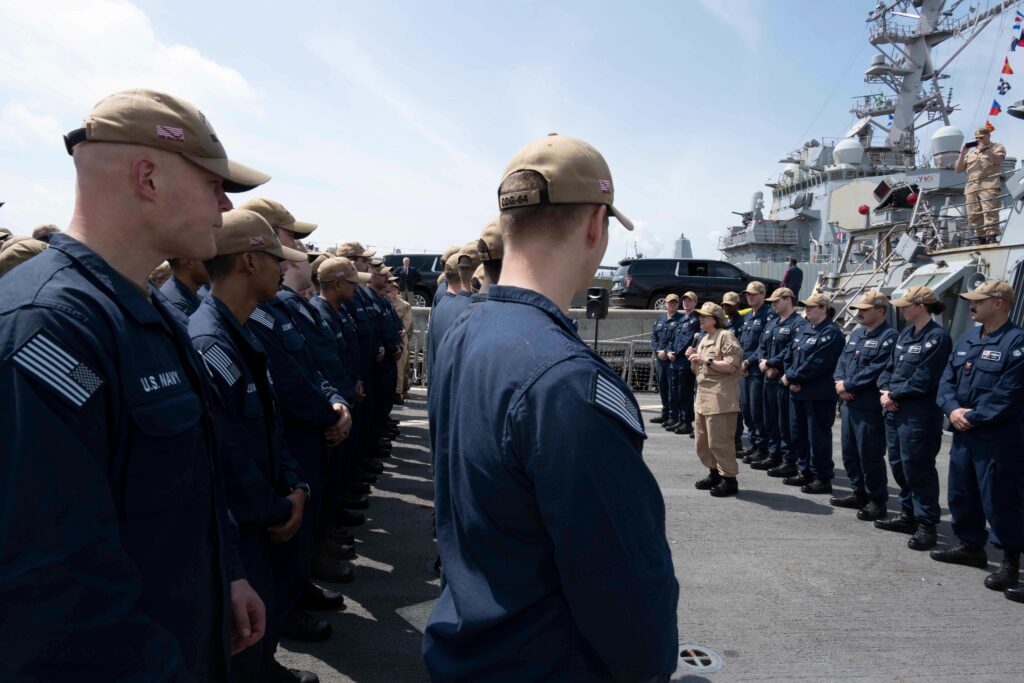
NORFOLK, Va. (May 10, 2024) – Chief of Naval Operations Adm. Lisa Franchetti welcomes the Arleigh Burke-class destroyer USS Carney (DDG 64) to Norfolk, Virginia, May 10. (U.S. Navy photo by MC1 Class William Spears)
NORFOLK, Va. (May 10, 2024) – Chief of Naval Operations Adm. Lisa Franchetti welcomed the crew of Arleigh Burke-class guided-missile destroyer USS Carney (DDG 64) to the United States from a historic deployment to the Middle East, May 10.
Carney conducted a brief stop in Norfolk for logistics before returning home to Naval Station Mayport later this month.
“I could not be more proud of what the Carney team has done since September. Called to action on the very first day that you entered the U.S. 5th Fleet, you conducted 51 engagements in 6 months,” said Franchetti. “You saved lives, ensured the free flow of commerce, and stood up for the rules-based international order and all the values that we hold dear. It has been eye-watering to watch, you are truly America’s Warfighting Navy in action.”
Carney was conducting routine operations in U.S. 6th Fleet when Hamas attacked Israel on Oct. 7. Carney entered the U.S. 5th Fleet area of operations on Oct. 18, ready to conduct operations in support of maritime stability and security in defense of U.S., Allies, and partner interests.
Throughout the ship’s seven-month deployment, Carney successfully destroyed Houthi-launched weapons, including land attack cruise missiles, anti-ship ballistic missiles, and unmanned systems. Additionally, Carney conducted two defensive strikes against Houthi targets in Yemen, destroying 20 targets, and successfully destroyed one Iranian-launched medium-range ballistic missile.
During her visit to the ship, CNO recognized 14 Sailors for their outstanding achievements while on deployment.
“As Surface Warriors, we train to this. We train to this level of readiness and boldness, with a clear commitment to the warfighting excellence that you all exhibited on the world stage for everyone to see. You did exactly what you were trained to do,” said Franchetti. “It is absolutely wonderful to be onboard today and have the opportunity to welcome you back and give you a great big Bravo Zulu – for a job incredibly well done.”
Carney departed Naval Station Mayport, September 27, 2023, on a scheduled independent deployment to the U.S. 5th and 6th Fleet areas of operation. While deployed, Carney predominately operated with the Dwight D. Eisenhower Carrier Strike Group, and initially operated with the Gerald R. Ford Carrier Strike Group upon arrival to the U.S. 6th Fleet.
May 11-12 CENTCOM Update
From U.S. Central Command
May 11, 2024
TAMPA, Fla. – At approximately 8:45 p.m. (Sanaa time) on May 10, Iranian-backed Houthis launched an uncrewed aerial system (UAS) over the Gulf of Aden from Houthi controlled areas in Yemen. A coalition aircraft successfully engaged the UAS. There were no injuries or damages reported by U.S., coalition, or merchant vessels.
Later, between approximately 4:30 a.m. and 4:45 a.m. (Sanaa time) on May 11, U.S. Central Command (USCENTCOM) forces successfully destroyed three UAS launched by Iranian-backed Houthis over the Red Sea from Houthi controlled areas in Yemen. There were no injuries or damages reported by U.S., coalition, or merchant vessels.
It was determined that these UAS presented an imminent threat to both coalition forces and merchant vessels in the region. These actions are taken to protect freedom of navigation and make international waters safer and more secure for U.S., coalition, and merchant vessels.
May 12, 2024
TAMPA, Fla. – At approximately 3:30 a.m.(Sanaa time) on May 12, U.S. Central Command (USCENTCOM) forces successfully destroyed one uncrewed aerial system (UAS) launched by Iranian-backed Houthis over the Gulf of Aden from Houthi controlled areas in Yemen. There were no injuries or damages reported by U.S., coalition, or merchant vessels.
It was determined the UAS presented an imminent threat to both coalition forces and merchant vessels in the region. These actions are taken to protect freedom of navigation and make international waters safer and more secure for U.S., coalition, and merchant vessels.
U.S. Coast Guard Awards Bollinger Shipyards Two Fast Response Cutters
From Bollinger Shipyards, May 13, 2024
LOCKPORT, La., — (May 13, 2024) – The U.S. Coast Guard has exercised a contract option to award Bollinger Shipyards (“Bollinger”) two additional Sentinel-Class Fast Response Cutters (FRC). This announcement brings the total number of FRCs awarded to Bollinger up to 67 vessels since the program’s inception. To date, the U.S. Coast Guard has commissioned 55 FRCs into operational service.
“We’re incredibly proud of our long history supporting the U.S. Coast Guard that now stretches four decades,” said Bollinger Shipyards President and CEO Ben Bordelon. “Our unique experience building for the Coast Guard is unparalleled and has shown time and time again that we can successfully deliver the highest quality and most capable vessels. We look forward to continuing our partnership with the Coast Guard.”
Both FRCs will be built at Bollinger’s Lockport, La facility that supports over 650 direct jobs in Lafourche Parish out of the nearly 4,000 shipbuilders supporting Bollinger’s 13 facilities across Louisiana and Mississippi.
Bordelon continued, “This program isn’t just an economic benefit for our region, but a national security priority that continues to enjoy the support of a bipartisan, bicameral coalition in the United States Congress. That being said, these additional vessels allow for the continued prosperity and economic wellbeing for over 650 families in South Louisiana. The hardworking men and woman of Bollinger Shipyards take tremendous pride in every single vessel we build and deliver for the U.S. government knowing we’re helping to keep our homeland safe.”
The FRC program has had a total economic impact of over $2 billion since inception in material spending and directly supports more than 650 jobs in Southeast Louisiana. The program has indirectly created 1,690 new jobs from operations and capital investment and has an annual economic impact on GDP of $202 million, according to the most recent data from the U.S. Maritime Administration (MARAD) on the economic importance of the U.S. Shipbuilding and Repair Industry. Bollinger sources over 271,000 different items for the FRC consisting of 282 million components and parts from 965 suppliers in 37 states.
The FRC is one of many U.S. Government shipbuilding programs that Bollinger is proud to support. In addition to the construction of the FRC, Bollinger is contracted to build the Polar Security Cutter (PSC) for the U.S. Coast Guard, the Towing, Salvage and Rescue Ship (T-ATS), the Auxiliary Personnel Lighter (APL), the newest oceanographic survey ship (T-AGS 67) and the Mine Countermeasures Unmanned Surface Vessels (MCM USV) for the U.S. Navy. Bollinger is also building three Regional Class Research Vessels (RCRV) for the National Science Foundation through Oregon State University. Bollinger also supports the nuclear-powered ballistic missile submarine program by building various platforms for General Dynamics-Electric Boat.
ABOUT THE FAST RESPONSE CUTTER PLATFORM
The FRC is an operational “game changer,” according to senior Coast Guard officials. FRCs are consistently being deployed in support of the full range of missions within the United States Coast Guard and other branches of our armed services. This is due to its exceptional performance, expanded operational reach and capabilities, and ability to transform and adapt to the mission. FRCs have conducted operations as far as the Marshall Islands—a 4,400 nautical mile trip from their homeport. Measuring in at 154-feet, FRCs have a flank speed of 28 knots, state of the art C4ISR suite (Command, Control, Communications, Computers, Intelligence, Surveillance, and Reconnaissance), and stern launch and recovery ramp for a 26-foot, over-the-horizon interceptor cutter boat.
Coast Guard Offloads More Than $185 Million in Illegal Narcotics During Fleet Week Miami
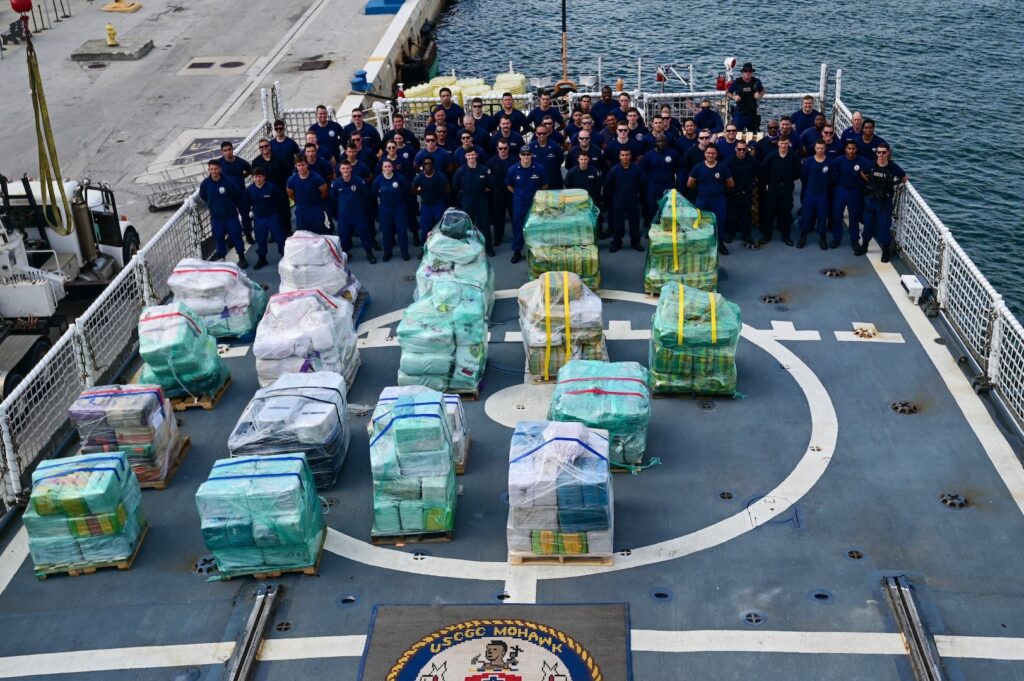
U.S. Coast Guard Cutter Mohawk (WMEC-913) crewmembers pose with approximately 18,000 pounds of illegal narcotics at Port Everglades in Fort Lauderdale, Florida, May 10, 2024. (U.S. Coast Guard photo by Petty Officer 2nd Class Ryan Estrada)
From U.S. Coast Guard 7th District, May 10, 2024
MIAMI – The crew of U.S. Coast Guard Cutter Mohawk (WMEC 913) offloaded more than 13,803 pounds of cocaine and 3,736 pounds of marijuana with a combined estimated street value of approximately $185 million in Port Everglades, Friday.
Coast Guard crews, working alongside interagency and international partners, interdicted the illegal drugs in the international waters of the Caribbean Sea and Atlantic Ocean during six separate cases.
“Our offload today represents the combined efforts of U.S. and allied military units from a Caribbean coalition of partners working together to deny drug trafficking organizations access to maritime smuggling routes,” said Cmdr. David Ratner, commanding officer of USCGC Mohawk. “I am especially proud of the hard work of the Mohawk crew, and grateful for the opportunity to operate with interagency and NATO partners in support of our National Security.”
The following assets and crews were involved in the interdictions:
USCG Cutter Mohawk (WMEC 913)
USCG Tactical Law Enforcement Team South (TACLET-South)
USS Leyte Gulf (CG 55)
U.S. Navy Helicopter Maritime Strike Squadron 50 (HSM 50)
Royal Netherlands Navy ship HNLMS Groningen (P 843)
Royal British Navy ship HMS Trent (P 244)
Joint Interagency Task Force South (JIATF-South)
Joint Task Force – East (JTF-E)
U.S. Customs and Border Protection Air and Marine Operations (CBP-AMO)
Along with the illicit narcotics, 10 suspected smugglers were apprehended and will face prosecution in federal courts by the U.S. Department of Justice.
The offload included contraband seized by Coast Guard law enforcement detachments deployed aboard HMS Trent, HNLMS Groningen, and USS Leyte Gulf, whose crew interdicted a self-propelled semi-submersible vessel in March. You can read more about that case here.
The fight against transnational criminal organizations requires a unity of effort in all phases, from detection and monitoring to interdiction and apprehension, through to criminal prosecutions by international partners and U.S. Attorneys’ Offices in districts across the nation.
The Joint Interagency Task Force South in Key West, Florida, conducts the detection and monitoring of aerial and maritime transit of illegal drugs. The law enforcement phase of counter-smuggling operations in the Caribbean is conducted under the authority of the Coast Guard 7th District, headquartered in Miami. The interdictions, including the actual boardings, are led and conducted by members of the U.S. Coast Guard.
U.S. Customs and Border Protection Air and Marine Operations deployed a National Air Security Operations MQ-9 Unmanned Aircraft System to Puerto Rico in coordination with JTF-E and JIATF-S reinforcement of the Eastern Caribbean Campaign, resulting in tremendous success. JTF-E’s Eastern Caribbean Campaign is a divergence from conventional strategies with a multi-dimensional view on security threats predominating in the region. The deployment highlighted threats emanating from the Eastern Caribbean contributing to the seizure of 25 metric tons of narcotics.
These interdictions relate to Organized Crime Drug Enforcement Task Forces (OCDETF) designated investigations. OCDETF identifies, disrupts, and dismantles the highest-level criminal organizations that threaten the United States using a prosecutor-led, intelligence-driven, multi-agency approach. Additional information about the OCDETF program can be found at https://www.justice.gov/OCDETF.
USCGC Mohawk is a 270-foot, medium endurance cutter homeported in Key West, Florida with a crew of 100. The cutter’s primary missions are counter drug operations, migrant interdiction operations, enforcement of federal fishery laws, and search and rescue in support of Coast Guard operations throughout the Western Hemisphere. Sister ship USCGC Seneca (WMEC 906) homeported in Portsmouth, Virginia, is participating in the inaugural Fleet Week Miami and is hosting free public tours. Visit the Fleet Week Miami website for more information: Fleet Week Miami.
Visit www.GoCoastGuard.com to learn more about active duty and reserve, officer and enlisted opportunities in the U.S. Coast Guard. Information on how to apply to the U.S. Coast Guard Academy can be found here.