AUKUS Trilateral Statement 

ROCKINGHAM, Australia (March 10, 2024) The Los Angeles-class fast-attack submarine USS Annapolis (SSN 760) moors alongside Diamantina Pier at Fleet Base West in Rockingham, Western Australia, March 10, 2024. (USN photo by MC Kaitlyn E. Eads)

March 21, 2024   

From The Honourable Richard Marles MP, Deputy Prime Minister and Minister for Defence, Australia; the Right Honourable Grant Shapps, Secretary of State for Defence, United Kingdom; and Lloyd J. Austin III, Secretary of Defense, United States. 

“One year ago, on 13 March 2023 in San Diego, the Leaders of Australia, the United Kingdom, and the United States announced the Optimal Pathway. The Optimal Pathway outlines an ambitious plan to deliver a conventionally armed, nuclear-powered submarine capability (SSNs) for the Royal Australian Navy (RAN) – a plan that will strengthen our three countries’ combined military capabilities, boost our collective industrial capacity, set the highest non-proliferation standard and enhance our ability to promote stability and security in the Indo-Pacific and beyond.  

AUKUS is built on the bedrock of decades of close defense, capability and technology cooperation between our three nations and is a natural progression of our partnership. Today, AUKUS partners welcomed the announcement of the selection of ASC Pty Ltd and BAE Systems to build Australia’s SSN-AUKUS submarines, and the selection of ASC as Australia’s nuclear-powered submarine sustainment partner.  

The formation of these strategic partnerships with industry is a significant milestone in the AUKUS endeavour. It is a demonstration of our trilateral industry supporting the Optimal Pathway becoming a reality and will underpin Australia’s role as a capable security partner and responsible steward of a conventionally armed, nuclear-powered submarine capability for decades to come.  

The enduring trilateral partnership between the governments of Australia, the United Kingdom and the United States supports these commercial relationships and further enables the close industrial collaboration across our three countries in support of AUKUS.  

ASC and BAE Systems will build the SSN-AUKUS submarines for the Royal Australian Navy. BAE Systems has been at the heart of the UK’s submarine enterprise for generations. SSN-AUKUS is being trilaterally developed, based on the United Kingdom’s next-generation design and incorporating technology from all three nations, including cutting edge United States submarine technologies. Also to be built by the UK and operated by the Royal Navy, SSN-AUKUS will be equipped for intelligence, surveillance, undersea warfare and strike missions, and will provide maximum interoperability among AUKUS partners. 

ASC has been at the centre of Australia’s sovereign submarine program for decades as Australia’s sovereign submarine sustainment partner, and the builder of Australia’s Collins-class submarines. ASC will build its sustainment capability for SSNs, including through partnering opportunities with UK and US industry. Sustainment capability is critical to the Optimal Pathway, accelerating Australia’s ability to operate and sustain its own Virginia class submarines as soon as possible and contribute to regional security, together with AUKUS partners. 

The Optimal Pathway was always designed to create a stronger, more resilient trilateral submarine industrial base, supporting submarine production and maintenance in all three countries. The announcements today are a testament to that – the build of SSN-AUKUS will increase opportunities for industrial base collaboration, strengthen our collective industrial base capacity, and generate economic growth in defense and national security sectors in all three countries. Similarly, the announcement of Australia’s sovereign sustainment partner is a key milestone to build Australia’s capacity to operate and sustain nuclear-powered submarines. ASC will, in time, develop robust industry partnerships with UK and US businesses to gain the technical skills, know-how and capacity to sustain nuclear-powered submarines. 

All AUKUS partners are investing significantly to ensure success of the Optimal Pathway and are working at pace to transform and integrate our trilateral industrial bases to support SSN cooperation.  

  • Australia has agreed an AUD$1.5 billion investment for early priority works at HMAS Stirling, to put in place the enablers for the safe and secure rotational presence of United Kingdom and United States SSNs through Submarine Rotational Force-West from 2027. Australia has also commenced enabling works at the future nuclear-powered submarine construction yard at Osborne Naval Shipyard in Adelaide. All up, Australia has committed at least AUD $18 billion in infrastructure upgrades across South Australia and Western Australia over the next 10 years to enable critical milestones for the Optimal Pathway. 
  • The United States has announced the intended investment of USD $11.4 billion in its submarine industrial base across the five-year defense budget period starting in 2025 to increase the production rate of Virginia class submarines as quickly and effectively as possible, to meet its own fleet requirements and support U.S. commitments under AUKUS. 
  • The United Kingdom also announced last year that it would inject GBP £3 billion into its Defence Nuclear Enterprise, including the construction of submarine industrial infrastructure that will help to deliver the SSN-AUKUS program. Subsequently, Rolls-Royce has announced that it will double the size of its Derby site to support the delivery of the UK and Australian programs, which will include building all of Australia’s nuclear reactors. 

Australia, the United Kingdom, and the United States remain fully committed to this shared endeavor. These steps to grow Australia’s submarine construction and maintenance capability are critical to the AUKUS partnership, expanding trilateral industrial capacity and building the collective resilience of AUKUS partners to produce and sustain conventionally armed nuclear-powered submarines for decades to come.” 


U.S. Navy Achieves Significant Engine Testing Milestones for LUSV Program 

By Program Executive Office Unmanned and Small Combatants, March 22, 2024 

WASHINGTON — The U.S. Navy’s Large Unmanned Surface Vessel (LUSV) program reached pivotal milestones earlier this year after several industry teams successfully completed extended reliability demonstrations of four different engine configurations, officials announced today. 

The four 720-hour tests demonstrated the capability and durability of different engine plants to operate for extended periods without human intervention – a critical enabler for advancing unmanned maritime operations and the Navy’s manned-unmanned Hybrid Fleet concept. 

Mandated by a congressional requirement in the 2021 National Defense Authorization Act, the engine testing milestones must be completed before the LUSV can proceed into a formal development phase. An engine system only qualifies for use in the program after successful demonstration events. 

Demonstrations of each engine configuration took place over 720 continuous hours. No human intervention or preventative/corrective maintenance on the equipment was permitted during this time. Successfully completing the demonstration meant that an engine system could not exhibit any failures or issues that would require maintenance of any kind during operations on an unmanned ship for 30 days. 

Four teams have successfully completed their separate 720-hour testing milestones. The successful teams include: 

· Bollinger and Carter Machinery on behalf of Caterpillar in Chesapeake, Virginia was the first team to achieve this milestone in December of 2023. They demonstrated sufficient mechanical reliability of the 1550 kw Caterpillar 3512C model engine. 

· Fincantieri Marinette Marine (FMM) and Carter Machinery on behalf of Caterpillar in Chesapeake, VA demonstrated mechanical durability of the Caterpillar 2300 kW rated 3516 main propulsion diesel, lube oil and fuel system. 

· Gibbs & Cox and Southwest Research Institute in San Antonio, Texas on behalf of Cummins also validated the reliability of the QSK95 diesel engine paired with an ABB AMG 0560M04 LAE generator. 

· Huntington Ingalls Incorporated (HII), in partnership with the U.S. Coast Guard, conducted a successful 720-hour demonstration on behalf of MTU of the MTU 20V 4000 M93L, a Main Propulsion Diesel Engine configuration. 

Each of these respective engine configurations are all now eligible for use on the LUSV program. 

“These successful test events mark a significant milestone for our team and brings us one step closer to delivering the Large Unmanned Surface Vessel to the Navy,” said Capt. Scot Searles, program manager of the Unmanned Maritime Systems (PMS 406) program office. “The completion of these rigorous engine tests is a testament to the hard work and collective expertise of both our Navy team and our industry partners. We are pleased with the results and look forward to continuing our work with industry to forge the future Hybrid Fleet.” 

LUSVs will supplement the Fleet’s missile magazine capacity as part of the Navy’s Distributed Maritime Operations (DMO) concept. Currently, the LUSV is envisioned as a vessel greater than 200 ft. in length with a full load displacement of approximately 1,500 tons. LUSVs are intended to be low cost, high endurance, modular USVs that can employ a variety of payloads. 

The Navy in 2020 awarded six LUSV conceptual design contracts to industry teams to refine program requirements and to provide informed feedback on the Navy’s LUSV requirements. As part of these contracts, each of these teams have been pursuing propulsion plant efforts, culminating in these engine test demonstrations. 

PEO Unmanned and Small Combatants leads the Navy’s efforts to develop, deliver and sustain capable and affordable unmanned maritime systems to meet Fleet requirements. 


USCGC Legare Returns Home Following Living Marine Resources Patrol, Engagements With French Navy 

Crews from the Coast Guard Cutter Legare (WMEC 912) and the French naval ship Premier-Maître L’Her (F792) take a group photo aboard Legare, off the coast of Long Island, New York, on March 16, 2024. Legare worked with Premier-Maître L’Her for a series of engagements and exercises designed to demonstrate interoperability with a critical NATO partner. U.S. Coast Guard

PORTSMOUTH, Va. — The U.S. Coast Guard Cutter Legare (WMEC 912) returned home to Portsmouth, Thursday, after a seven-week patrol in the Coast Guard’s First District area of operations.   

In support of Operation Atlantic Venture, Legare steamed more than 6,300 nautical miles, patrolling the coast of New England, New York, and near the Gulf of Maine, to conduct maritime safety missions, while bolstering the safety and sustainability of the marine ecosystem through enforcement of living marine resources regulations.   

Legare’s crew completed 41 commercial fishing vessel boardings and two recreational vessel boardings, resulting in seven violations of safety or regulatory standards.    

During the patrol, the Legare crew completed joint training evolutions with U.S. Coast Guard Cutter Maurice Jester (WPC 1152), Coast Guard Air Station Cape Cod, and the French naval ship Premier-Maître L’Her (F792). Legare worked with Premier-Maître L’Her for a series of engagements and exercises designed to demonstrate interoperability with a critical NATO partner.   

“The officers and crew of Legare performed up to the high standards of the United States Coast Guard for this deployment,” said Cmdr. Jeremy Greenwood, Legare’s commanding officer. “The success in this deployment was measured not just in the sheer number of boardings we conducted, but also by our ability to maintain defense readiness, serve the American public, as well as protect the environment we live in.”  

Legare also collaborated with the Coast Guard Recruiting Office Providence, Rhode Island, to host a recruiting event at the Massachusetts Maritime Academy. Legare gave tours to more than 300 cadets, 150 Junior Reserve Officer Training Course cadets, and 50 civilian visitors.  

The Legare is a 270-foot, Famous-class medium-endurance cutter. The cutter’s primary missions are counter drug operations, migrant interdiction, enforcement of federal fishery laws, and search and rescue in support of U.S. Coast Guard operations throughout the Western Hemisphere.   

For information on how to join the U.S. Coast Guard, visit GoCoastGuard.com to learn about active duty, reserve, officer, and enlisted opportunities. Information on how to apply to the U.S. Coast Guard Academy can be found here.  


March 21 Daily Red Sea Update 

USCENTCOM 

March 21, 2024

TAMPA, Fla. – On March 21, between 8:50 a.m. and 11:40 a.m. (Sanaa time), a coalition aircraft successfully engaged and destroyed one unmanned surface vessel (USV) launched by Iranian-backed Houthi terrorists from a Houthi-controlled area of Yemen.  

Additionally, coalition forces successfully engaged and destroyed two anti-ship ballistic missiles (ASBMs) launched by Iranian-backed Houthi terrorists from Houthi-controlled areas of Yemen toward the Red Sea. There were no injuries or damage reported to U.S. or coalition vessels. 

It was determined these weapons presented an imminent threat to coalition and merchant vessels in the region. These actions are taken to protect freedom of navigation and make international waters safer and more secure for coalition and merchant vessels. 


MV Roy P. Benavidez Departs in Support of JLOTS Mission

From Military Sealift Command Public Affairs 

NEWPORT NEWS, Va. (March 21, 2024)—The Bob Hope-class MV Roy P. Benavidez (T-AKR 306), a large, medium speed roaying heavy equipment and material needed to construct a temporary pier to support the flow of multinational humanitarian aid into Gaza. 

The ship will anchor in the area to receive fuel prior to proceeding to the Mediterranean Sea. 

MV Roy P. Benavidez, part of the U.S. Department of Transportation, U.S. Maritime Administration’s (MARAD) Ready Reserve Fleet, is transporting components for a floating modular pier system which will be delivered to the U.S. Army’s 7th Transportation Brigade who will construct the temporary pier in the Mediterranean. 

This capability is known as Joint Logistics-Over-the-Shore, or JLOTS. 

“JLOTS is a critical capability that allows ship-to-shore cargo distribution in the absence of a usable pier,” said Army Lt. Gen. John P. Sullivan, deputy commander, U.S. Transportation Command (USTRANSCOM). “It can be used to augment an established port or to create a pier where one is needed, and allows us to support areas where large populations are isolated from food, water, and other forms of humanitarian aid.” 

JLOTS operations are part of USTRANSCOM’s strategic sealift mission. 

Operated by Military Sealift Command for the current JLOTS mission, MV Roy P. Benavidez is crewed by contracted merchant mariners and is dry cargo surge sealift carrier capable of transporting up to 380,000 square feet of containerized cargo and rolling stock between developed ports. 

“MARAD’s ability to activate the Ready Reserve Force vessel MV Roy P. Benavidez is a hallmark of our strategic sealift capability,” said Maritime Administrator Ann C. Phillips. “Missions like this — supporting the Armed Forces, highlight the cornerstone capabilities MARAD delivers in support of interagency operations.”  


Keel Laid for Future USNS Muscogee Creek Nation

By Team Ships Public Affairs, March 21, 2024

HOUMA, La. – A keel laying ceremony for the future USNS Muscogee Creek Nation (T-ATS 10), the fifth ship of the Navy’s Navajo class of Towing, Salvage, and Rescue vessels was held at Bollinger Houma Shipyards, Mar. 20. 

Sponsors Geri Wisner, Attorney General of the Muscogee (Creek) Nation; Nicole Foster, wife of Rear Admiral Calvin Foster; and Muscogee (Creek) Nation Principal Chief David Hill attended to authenticate the keel. Members of the Muscogee (Creek) Nation were also in attendance. 

The keel laying ceremony formally marks the start of a ship’s life and the joining of the ship’s modular components. The keel serves as the symbolic backbone of the ship. 

During the ceremony, the keel authenticators watched a welder etch their initials into the keel plate and declared it to be “truly and fairly laid.” 

“We are honored to have representatives of the Muscogee (Creek) Nation here to celebrate this milestone with us,” said Program Executive Office, Ships Auxiliary and Special Mission Ships Program Manager, John Lighthammer. “The ship is critical to the operations of our fleet. Today’s ceremony is a reminder of the pride and determination of the Muscogee people it is named to honor.” 

The Navajo class of ships will provide ocean-going tug, salvage, and rescue capabilities to support Fleet operations. The 10 ships are intended to provide continuity of capability following on after the Powhatan and Safeguard classes of vessels, which are nearing the end of their expected service lives. 

Navajo-class ships will be capable of towing U.S. Navy ships and will have 6,000 square feet of deck space for embarked systems. The platform will be 263 feet long, have a beam of 59 feet, and will be able to carry a load of nearly 2,000 tons. 

In addition to the future USNS Muscogee Creek Nation (T-ATS 10), Bollinger Houma Shipyards is in the process of constructing the future USNS Navajo (T-ATS 6), USNS Cherokee Nation (T-ATS 7), USNS Saginaw Ojibwe Anishinabek (T-ATS 8) and USNS Lenni Lenape (T-ATS 9). 

As one of the Defense Department’s largest acquisition organizations, PEO Ships is responsible for executing the development and procurement of all destroyers, amphibious ships and craft, auxiliary ships, special mission ships, sealift ships and support ships. 


Bataan ARG, 26th MEU(Soc) Return From 8-month Deployment

By Chief Mass Communication Specialist Eva-Marie Ramsaran, Amphibious Squadron 8 Public Affairs 

21 March 2024 

NORFOLK, Virginia — More than 4,000 Sailors and Marines assigned to the Bataan Amphibious Ready Group (ARG) and embarked 26th Marine Expeditionary Unit (Special Operations Capable) (MEU(SOC)) returned to Hampton Roads following an eight and a half-month deployment to the U.S. 2nd, 5th and 6th Fleet areas of operations, March 21. 

Two of the ARG ships, the Wasp-class amphibious assault ship USS Bataan (LHD 5) and Harpers Ferry-class dock landing ship USS Carter Hall (LSD 50), returned to Naval Station Norfolk and Joint Expeditionary Base Little Creek in Virginia. 

“It is great to be home,” said Amphibious Squadron (CPR) 8 Commodore, Capt. Martin Robertson. “I’m proud of the Sailors and Marines of the Bataan Amphibious Ready Group who return home today knowing that for eight and a half months, they were the nation’s rapid response force.” 

The San Antonio-class amphibious transport dock ship USS Mesa Verde (LPD 19) is expected to return to Naval Station Norfolk, Virginia, in the coming days. Most of the Marines assigned to the 26th MEU(SOC) departed the ARG ships and returned to Camp Lejeune, North Carolina earlier this week. 

While in the U.S. 5th and 6th Fleet areas of operations, the Bataan ARG and 26th MEU(SOC) team supported a wide range of interoperability opportunities and exercises across the North Atlantic, Eastern Mediterranean, Baltic region, Red Sea and Arabian Gulf, increasing combat readiness and crisis response capabilities while strengthening relationships with both Allies and partners. 

“These young men and women were called into action from the start to help stop the spread of wildfires in Southern Europe, to deter Iran from seizing U.S.-flagged merchant vessels in the Middle East, and they reacted swiftly at the onset of the crisis in the Bab-El Mandeb to ensure merchant shipping access to the Red Sea,” Robertson said. “Your sons and daughters stood ready to assist American citizens in countries impacted by the Israel-Hamas conflict, and their efforts directly prevented the conflict from expanding to other nations in the region. Simultaneously, we operated close to Russia in the high north and Baltic regions, reinforcing America’s commitment to the NATO alliance, emphasizing the importance of regional peace and security. Thank you to our families and friends. Your love and support made all our successes possible.” 

In July 2023, following the wildfires in Greece, the Bataan ARG disaggregated, with Mesa Verde remaining in the U.S. 6th Fleet area of operations supporting Allies and partners through various bilateral exercises and operations across the theater. Mesa Verde and the embarked Marines visited Greece, Ireland, Latvia, Norway, Spain and the United Kingdom. Additionally, Secretary of the Navy Carlos Del Toro visited Mesa Verde while the ship was in Dublin, Ireland, for the U.S. Naval Academy versus University of Notre Dame football game, Aug. 26, 2023. 

Bataan and Carter Hall transited the Suez Canal and operated in the U.S. 5th Fleet area of operations for more than four months, ensuring the free flow of navigation and regional stability. Following the outbreak of conflict between Israel and Hamas, both ships participated in Operation Prosperity Guardian in the Red Sea to deter further escalation and protect open sea lanes. 

“It’s been a challenging deployment, but we have accomplished a lot, and I am extremely proud of the hard work and resilience of every member of the Bataan team,” said Capt. Paul Burkhart, Bataan’s commanding officer. “Throughout the past eight months, we have really shown what it means to be ‘Bataan tough.’ We were able to showcase our amphibious capabilities throughout three Navy fleets, deter aggression through our presence and were able to create and share countless memories that will last a lifetime.” 

Notable visitors to the Bataan and Carter Hall included commanders and staff of U.S. Naval Forces Europe-Africa, U.S. 6th Fleet, U.S 5th Fleet, U.S. Central Command, Task Force 61/2, Task Force 51/5, French, Italian and Turkish navies, along with distinguished guests from the Kingdom of Bahrain, Cyprus, Egypt, Jordan, Kuwait, Oman, Kingdom of Saudi Arabia, United Arab Emirates and U.K. 

The ARG/MEU presence overseas supported strategic interests and contributed to regional security and stability and reassured U.S. commitment to multiple regions. The blue-green team provided operational flexibility to combatant commanders by providing a versatile contingency response force using sea, air, land and logistical assets. The versatility inherent to the amphibious force allowed for flexible and mission-tailored forces, while representing our nation’s strength, capability and resolve to partners and Allies and deterring potential adversaries. 

“History has proven the necessity of having forward-deployed Marines, embarked aboard amphibious ships. Over the past eight months, the Marines and Sailors of the 26th MEU(SOC) have showcased the value, utility and unique all-domain operational capabilities you only find in a marine expeditionary unit,” said Col. Dennis Sampson, commanding officer of the 26th MEU(SOC). “When coupled together, the ARG and the MEU(SOC) form a flexible naval expeditionary force capable of reassuring our Allies and partners of our commitment to maritime security and capable of dominating within the littorals against any adversary in any clime or place.” 

The Bataan ARG is comprised of the Bataan, Mesa Verde, and Carter Hall. Embarked commands include CPR 8, Fleet Surgical Team 8, Tactical Air Control Squadron 21, Helicopter Sea Combat Squadron 26, Assault Craft Unit 4, Beach Master Unit 2 and the 26th MEU(SOC). 

The 26th MEU(SOC) consists of the Command Element; Aviation Combat Element, Marine Medium Tiltrotor Squadron 162 (Reinforced); Ground Combat Element, Battalion Landing Team 1/6; and Logistics Combat Element, Combat Logistics Battalion 22. 


March 20 Red Sea Update

USCENTCOM, March 20, 2024 

TAMPA, Fla. – Between 10:10 a.m. and 7:40 p.m. (Sanaa time) on March 20, a coalition aircraft successfully engaged and destroyed one unmanned aerial vehicle, and U.S. Central Command successfully engaged and destroyed one unmanned surface vessel, both launched by Iranian-backed Houthi terrorists from Houthi-controlled areas of Yemen. There were no injuries or damage reported to U.S. or coalition ships. 

It was determined these weapons presented an imminent threat to merchant vessels and U.S. Navy ships in the region. These actions are taken to protect freedom of navigation and make international waters safer and more secure for U.S. Navy and merchant vessels. 


Coast Guard Commandant Delivers Annual State of the Coast Guard Address

Headquarters, U.S. Coast Guard, March 21, 2024 

WASHINGTON — Commandant of the U.S. Coast Guard, Admiral Linda L. Fagan, delivered the annual State of the Coast Guard Address at the Cannon House Office Building in Washington, DC Wednesday.  

Fagan expressed pride in recent Coast Guard operations and the increasing global impact the service has in protecting our economic prosperity and national security, alongside the Department of Homeland Security, federal, interagency and international partners.  

“Last year, the United States Coast Guard saved nearly five thousand lives and ensured the safety of thousands more through our operations to prevent maritime accidents before they happen,” said Fagan. “This is the Coast Guard people see every day protecting our economic prosperity and national security. This is the Coast Guard that is respected and admired around the world.”  

She also highlighted the rapidly evolving threats the service is facing which impact the workforce, mission readiness, and recruiting. As the Coast Guard faces significant personnel, shoreside infrastructure and asset maintenance shortfalls, she called for consistent and reliable funding to meet readiness requirements.  

“The quality of our facilities and ships not only impact mission readiness; it is an important factor potential recruits think about when they consider Coast Guard service,” said Fagan. “And recruiting is critical to operational readiness.”  

Focusing on the importance of the Coast Guard’s core values of Honor, Respect and Devotion to Duty, Adm. Fagan highlighted new policies and training the service has implemented to prevent and stop harmful behavior, as well as a long-term initiative to strengthen service culture.   

“Strengthening our culture demands consistent work and long-term commitment, and our values must always be reflected in our daily actions and traditions,” said Fagan. “This effort is as critical to our workforce and mission readiness as building new ships or infrastructure. A culture intolerant of harmful behaviors is the standard the American people expect.  It is the standard I set for the service.”  

View the full remarks and the recorded address at USCG Commandant’s Home Page and on U.S. Coast Guard – YouTube.   


Navy to Send Beach Group, Sealift Ships to Support Gaza Relief

A Joint Logistics Over-the-Shore Trident floating pier and causeway is shown under assembly. (US Army photo by Sgt. Ashunteia Smith) 

By Richard R. Burgess, Senior Editor 

ARLINGTON, Va. — The U.S. Navy is sending an expedition of beach cargo handling forces to assist in the establishment of a floating causeway and pier to handle delivery of relief supplies to Gaza. 

Speaking on background, a Navy official told reporters on March 20 that Beach Group One, augmented by other logistics forces, would be deployed to the eastern Mediterranean Sea to deliver and assemble lighterage of the Joint Logistics Over-the-Shore (JLOTS) system to convey supplies to the Trident pier and causeway Joint Logistics Over-the-Shore (JLOTS) pier that will be assembled by the Army’s Transportation Corps. 

Beach Group One, based in San Diego, is a command that provides beachmasters and LCAC air cushion landing craft to amphibious warfare ships, as well as a JLOTS. 

The JLOTS equipment — positioned in Jacksonville, Florida — will be transported to the Mediterranean on three sealift ships — 2nd USNS LT John P. Bobo, USNS1st LT Baldomero Lopez, and Maritime Administration’s Ready Reserve Force ship Roy P. Benevidez — with the latter transporting Army equipment. The ships will deploy nonstop straight to operations area and remain on station off Gaza to provide berthing and support for the Sailors and Soldiers involved in the relief operation. The Beach Group One personnel will be flown to the Mediterranean to join their equipment.  

The official said the Navy would be sending 260 personnel to the operation, including augmentees from Beach Group Two and Navy Cargo Handling Battalion One. The personnel would include boatswain’s mates, Seabees, hospital corpsmen, quartermasters, and operations specialists, as well as other ratings.  

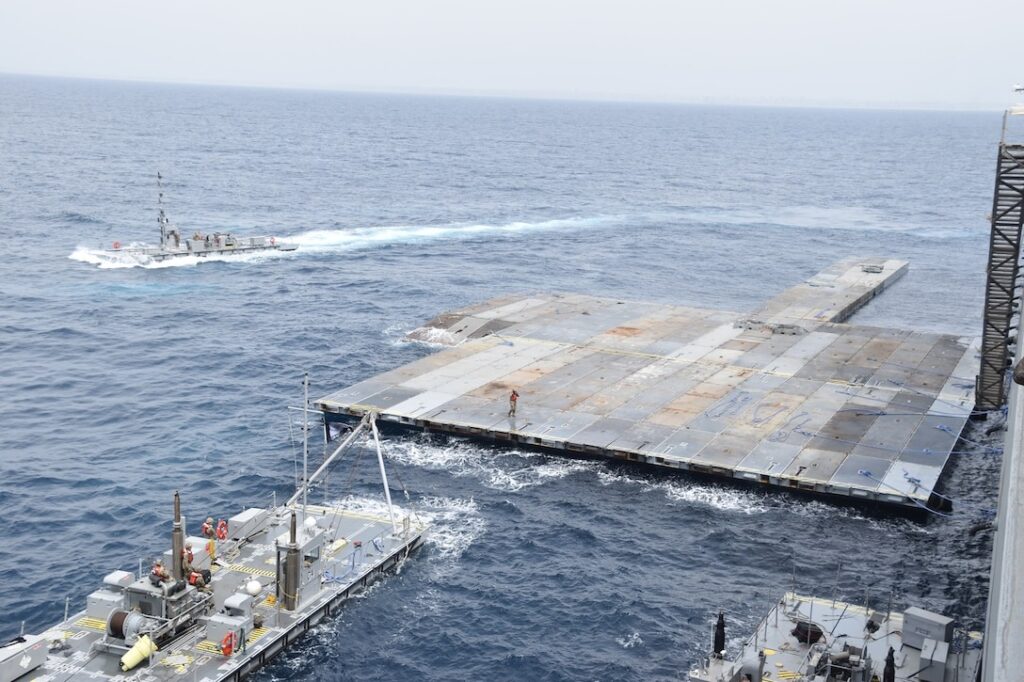
The beach group will assemble a Roll-On/Roll Off Discharge Facility (RRDF), a 72-foot-by-270-foot floating platform built from nine sections that join together. The official said the RRDF takes four-to-five days to assemble. The RRDF, positioned three miles from the beach, will be moored alongside ships to accept their cargo containers, offloaded onto the RRDF by cranes. The containers are then loaded onto lighterage that are moved by tugboats to the Army Trident pier, which is attached to a causeway that leads to the shore. The containers are then trucked ashore by the tractor-trailers. 

The sealift ships and the JLOTS will be supported by medium landing craft, repair craft, and small boats.  

The JLOTS was last used in Exercise Talisman Saber in July 2023. The official said that the JLOTS is assembled regularly for training and proficiency, usually once or twice per year. 

The official confirmed that no U.S. military personnel will be operating ashore in Gaza. Contract personnel will be used to drive the tractor-trailers onto the pier to receive the cargo. 

The duration of the operation is yet to be determined. The official said the beach group would be meeting whatever was required by its operational commander. He said the command-and-control structure in the theater was still being worked out.