Navy Orders 17 Block III Super Hornets Plus Data Package
PHILIPPINE SEA (Dec. 4, 2023) An F/A-18E Super Hornet from the “Stingers” of Strike Fighter Squadron (VFA) 113 prepares to launch from the flight deck of the Nimitz-class aircraft carrier USS Carl Vinson (CVN 70). (USN photo by MC3 Joshua Sapien)
By Richard R. Burgess, Senior Editor
ARLINGTON, Va. — The Navy has ordered 17 more Block III F/A-18E/F Super Hornet strike fighters for the fleet, with the contract action also providing for the initial phase of delivery of the aircraft’s data package.
In a March 19 Defense Department contract announcement, the Naval Air Systems awarded to Boeing a not-to-exceed $1.14 firm-fixed-price, undefinitized contract modification to procure “10 F/A-18F Lot 46 aircraft, as well as two F/A-18F and five F/A-18E Lot 47 aircraft.”
The contract also shows progress in resolution with Boeing over the rights to the aircraft’s data package, important to the sustainment of the Super Hornet fleet.
“This modification also provides for Phase One of the F/A-18E/F and EA-18G technical data package including the operation, maintenance, installation and training data in support of F/A-18 and EA-18G sustainment efforts for the Navy,” the release said.
“The technical data package was a crucial part of this negotiation; it is necessary for naval aviation’s operational readiness and post-production sustainment,” said Rear Adm. John Lemmon, program executive officer for Tactical Aircraft Programs, in a March 19 Navy release. “The Super Hornet remains a predominant aircraft in the carrier air wing and will continue to provide significant combat capability into the 2040s. The Navy received appropriated funds from Congress to purchase these Super Hornets to help mitigate the strike fighter shortfall. The award is an Undefinitized Contract Action with the intent to definitize within the next few months.”
Delivery of the new Super Hornets is scheduled from late 2026 through to begin in the winter of 2026, with final delivery no later than April 2027.
The Block III version of the Super Hornet completed its first carrier deployment last month with the return of the USS Carl Vinson from the Western Pacific Ocean. Strike Fighter Squadron 113 took the Block IIIs on the deployment.
Poland Joins Combined Maritime Forces in Middle East as 42nd Member
By Combined Maritime Forces Public Affairs | March 20, 2024
MANAMA, Bahrain —Combined Maritime Forces welcomed the Republic of Poland as the 42nd member of the world’s largest maritime security partnership, March 17.
“We’re thrilled to welcome Poland as a member of CMF,” said Vice Adm. George Wikoff, CMF commander. “We greatly benefit from Poland’s participation in this coalition of nations committed to regional maritime security. I look forward to being ‘Ready Together’ with our new partners as CMF continues to set the global standard for maritime cooperation.”
CMF is comprised of a headquarters staff and five combined task forces focusing on defeating terrorism, preventing piracy, encouraging regional cooperation, and promoting a safe maritime environment. The naval partnership upholds the international rules-based order by supporting security and stability across 3.2 million square miles of water encompassing some of the world’s most important shipping lanes.
With 42 nations, CMF is the largest naval partnership in the world. Other task forces include CTF 150, focused on maritime security in the Gulf of Oman, Arabian Sea and eastern Gulf of Aden; CTF 151, which leads regional anti-piracy efforts; CTF 152, dedicated to maritime security in the Arabian Gulf; CTF 153, responsible for maritime security in the Red Sea, Bab al-Mandeb, and western Gulf of Aden; and CTF 154, established in May to enhance maritime security training throughout the region.
GA-ASI Tests Sonobuoy Dispensing System with MQ-9B Seaguardian UAV
SAN DIEGO – 20 March 2024 – On Feb. 27, 2024, General Atomics Aeronautical Systems, Inc. (GA-ASI), in cooperation with the Naval Air Systems Command (NAVAIR), conducted a series of tests on GA-ASI’s Sonobuoy Dispensing System (SDS) using the MQ-9B SeaGuardian Unmanned Aircraft System (UAS) on the U.S. Navy’s W-291 test range in southern California.
GA-ASI’s SeaGuardian flew the full test flight event configured with the SDS pod and SeaVue multi-role radar from Raytheon, an RTX business. During the test, the SDS pod dropped eight AN/SSQ-53 and two AN/SSQ-62 sonobuoys. Upon dispensing, the sonobuoys were successfully monitored by the SeaGuardian’s onboard Sonobuoy Monitoring and Control System (SMCS).
“This was a very successful demonstration of our SDS capability,” said GA-ASI President David R. Alexander. “The demonstration helped us prove out the SDS, which is an important component for our Anti-Submarine Warfare capability.”
The SeaGuardian was flown under a NAVAIR Interim Flight Clearance. The SDS pod is fitted with an advanced pneumatic ejection system developed, designed, and manufactured by AEREA in Italy. AEREA also supplies the internal structure assembly.
MQ-9B SeaGuardian is a medium-altitude, long-endurance RPA system. Its multi-domain capabilities allow it to flex from mission to mission. SeaGuardian has been used by the U.S. in several recent demonstrations, including Northern Edge, Integrated Battle Problem and Group Sail. The aircraft is currently being operated by the Japan Coast Guard (JCG) and the Japan Maritime Self-Defense Force (JMSDF).
Aircraft Carrier Suppliers Alarmed at Navy’s Planned Delay of CVN 82
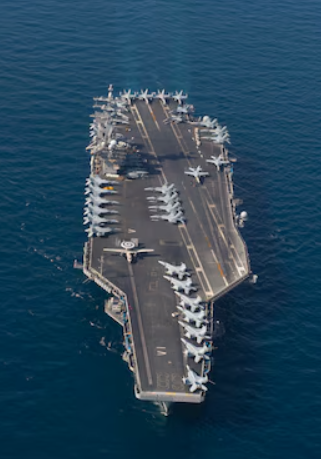
STRAIT OF GIBRALTAR (Jan. 5, 2024) The world’s largest aircraft carrier USS Gerald R. Ford (CVN 78) transits the Strait of Gibraltar, Jan. 5, 2024. (USN photo by MC2 Jacob Mattingly)
By Richard R. Burgess, Senior Editor
ARLINGTON, Va. — The coalition of suppliers of components, parts, and services for the construction of the U.S. Navy’s aircraft carriers (CVNs) is alarmed at the proposed two-year delay of authorization for CVN 82 — the fifth Gerald R. Ford-class CVN — and the potential disruption to the supplier base for the ships.
Lisa Dante Papini, chair of the Aircraft Carrier Industrial Base Coalition (ACIBC), which represents more than 2,000 businesses, said she is “extremely concerned” about the proposed delay for CVN 82 from 2028 to 2030, noting that 40% of the suppliers said in a survey that they would be negatively affected by the delay.
Papini said the delay likely would involve worker layoffs, production lines going cold, and suppliers de-prioritizing military requirements and seeking more work in other sectors. She noted that re-starting cold production lines and hiring or re-hiring workers is a lengthy and expensive process. The skills needed — such as welding — are in high demand in other industries as well, complicating the attraction of new workers.
“That’s why we’re concerned about going cold,” she said.
She also explained the need for advance funding for supplying aircraft carrier construction three years in advance of construction start.
“We’re so far to the left of those delivery dates,” she said. That’s why we ask for advance funding.”
Papini, like her counterparts in the Amphibious Warfare Industrial Base Coalition and the Submarine Industrial Base Coalition, emphasizes that stability and predictability of shipbuilding helps the supplier base “level-load their work;” recruit, train, and retain their workers; reduce costs, and deliver products on time.
The ACIBC met with senators and congressmen on March 20 on Capitol Hill to explain its concerns and priorities.
USCGC David Duren is the First of Three FRCs to be Homeported in Astoria, Oregon
LOCKPORT, Louisiana — Bollinger Shipyards recently delivered the USCGC David Duren to the U.S. Coast Guard in Key West, Florida. This is the 182nd vessel Bollinger has delivered to the U.S. Coast Guard over a 35-year period and the 56th Fast Response Cutter (FRC) delivered under the current program.
“We’re incredibly proud to deliver the USCGC David Duren, the first of three Fast Response Cutters to be homeported in Astoria, Oregon,” said Bollinger President & CEO Ben Bordelon. “We’re confident that pound for pound, the quality and capabilities of the FRC platform are unmatched and that this vessel will outperform its mission requirements and expectations in the challenging conditions where it will operate in the Pacific Northwest. Our unique experience building for the Coast Guard is unparalleled and has shown time and time again that we successfully deliver the highest quality vessels on a reliable, aggressive production schedule. We look forward to continuing our historic partnership with the U.S. Coast Guard.”
The USCGC David Duren will be the first of three FRCs to be homeported in Sector Columbia River, which is known as “The Protectors of the Pacific Northwest.” The sector is responsible for coastal safety, security, and environmental protection, as well as protecting and securing vital infrastructure, rescuing mariners in peril at sea, enforcing federal law, maintaining navigable waterways, and responding to all hazards impacting the maritime transportation system along the Oregon coast.
As the U.S. Congress continues to debate Fiscal Year 2024 government funding, the future of the Fast Response Cutter Program remains uncertain. While the House Homeland Security Appropriations Bill included funding for four new FRCs, the Senate bill did not include funding for any new vessels. The prospect for a year-long Continuing Resolution (CR) at last year’s funding level introduces a critical level of uncertainty, as funding levels continue to lag behind the meteoric rise in raw material and input costs.
The Coast Guard’s Fiscal Year 2025 Budget to Congress includes procuring two more FRCs to provide increased Coast Guard presence and engagement with allied and partner countries in the Indo-Pacific region. Last year, Adm. Linda Fagan, the Commandant of the U.S. Coast Guard, said, “The Indo-Pacific is clearly a consequential region for America’s future. The United States Indo-Pacific Strategy identifies an expanded role for the U.S. Coast Guard as a top Administration priority as we seek to ensure a region that is free and open. The U.S. Coast Guard will continue its long history of operational presence in the region with additional cutter patrols and deployable specialized forces.”
Each FRC is named for an enlisted Coast Guard hero who distinguished themselves in the line of duty. Boatswain’s Mate Master Chief David N. Duren was one of the most iconic figures in the history of Coast Guard surfmen. Considered perhaps the finest boat driver in the history of the modern Coast Guard, he is remembered by his shipmates and mentees not only for his expertise in seamanship, but also for his leadership and character. Between 1979 and 1983, Duren deployed on search and rescue cases more frequently than any other officer-in-charge and, in one year, executed over 250 cases. During this tour, Duren received two Coast Guard Medals for exceptional heroism, and the Douglas A. Munro Inspirational Leadership Award. Perhaps more remarkable was the fact that the personnel under his watch at Depoe Bay earned a total of 24 medals and awards.
ABOUT THE FAST RESPONSE CUTTER PLATFORM
The FRC is an operational “game changer,” according to senior Coast Guard officials. FRCs are consistently being deployed in support of the full range of missions within the United States Coast Guard and other branches of our Armed Services due to its exceptional performance, expanded operational reach and capabilities, and ability to transform and adapt to the mission. FRCs have conducted operations as far as the Marshall Islands — a 4,400 nautical mile trip from their homeport. Measuring in at 154 feet, FRCs have a flank speed of 28 knots, state of the art C4ISR suite (Command, Control, Communications, Computers, Intelligence, Surveillance, and Reconnaissance), and stern launch and recovery ramp for a 26-foot, over-the-horizon interceptor cutter boat.
Kratos Receives $57.6 Million Navy Contract for 70 BQM-177A Aerial Targets
Kratos BQM-177A shipboard Launch
March 18, 2024
SAN DIEGO, March 18, 2024 (GLOBE NEWSWIRE) – Kratos Defense & Security Solutions, Inc. (NASDAQ: KTOS), a Technology Company in the Defense, National Security and Global Markets and industry-leading provider of high-performance, jet-powered unmanned aerial systems, announced today that its Unmanned Systems Division has received a $57,673,542 modification to a previously awarded firm-fixed-price contract.
This modification exercises options to procure full rate production Lot Five of the BQM-177A Surface Launched Aerial Targets to provide for the production and delivery of 70 BQM-177A Surface Launched Aerial Targets and 70 Rocket-Assisted Takeoff attachment kits, as well as associated technical and administrative data in support of weapons system test, and evaluation and fleet training for the Navy.
Steve Fendley, President of Kratos Unmanned Systems Division, said,“It’s exciting to be a major part of this critically important capability for the U.S. Navy with our BQM-177A Sub-Sonic Aerial Target (SSAT) aircraft system (target). The 177A continues to push the envelope delivering leading edge realistic threat-representative capabilities to support today’s peer-level threat environment. We look forward to the increased production rate and continuing to evolve the system with our customer as the threats evolve.”
Greg Crewse, Program Manager for the Navy’s Aerial Targets program office (PMA-208), said, “In partnership with the Navy Aerial Targets program office, Kratos Defense and the BQM-177A Air Vehicle are true assets to the Navy and, together, we have the opportunity to engage in critical training exercises that will prepare our personnel to face a multitude of scenarios in a challenging, cost-effective test environment prior to engaging real-world threats, should the need arise. As recent real-world events have proven, these target presentations are growing ever more critical to prepare our warfighters to go into harm’s way – and prevail.”
Secretary of the Navy Carlos Del Toro Hosts Maritime Industry Roundtable
WASHINGTON – Secretary of the Navy Carlos Del Toro hosted maritime industry executives from major ship repair companies in the Pentagon, March 18.
The Secretary invited industry leaders to participate in a roundtable discussion focused on surface ship repair and modernization initiatives under the aegis of his efforts on Maritime Statecraft.
Navy and Marine Corps leaders have expressed that repair process improvements are critical to meeting the needs of worldwide combatant commanders.
“The maritime industry is a strategic sector critical to our economic and national security,” said Secretary Del Toro. “As a collective force, our combined structure plays a vital role maintaining the open sea lines of communication that sustain the U.S. and world economy.”
The roundtable featured open and transparent dialogue between government and industry representatives covering issues including maintenance delay days, contract award timelines, repair yard efficiencies, performance to plan initiatives, maritime training programs, and the impacts of a fiscally constrained environment.
Discussions further revolved around recent successes in surface ship maintenance and modernization, and collaboration on ideas for continued improvement.
For example, 41% of Chief of Naval Operations maintenance availabilities were completed on time in Fiscal Year 2023, up from 37% in FY22. The number of maintenance delay days decreased over the same period – 2,136 in FY23, down from 2,483 in FY22.
In addition to the Secretary, nearly one dozen government representatives attended the roundtable, including leaders across the Navy, Marine Corps, Coast Guard, and MARAD.
“I launched the Government Shipbuilders Council in November 2023 with these types of discussions in mind – bringing in stakeholders from across the whole of government and fostering a robust dialogue with our partners in industry. This is what Maritime Statecraft is all about,” said the Secretary. “We’re all going to walk out of this room better informed and better able to make the strategic decisions required of each of us.”
March 18 Red Sea Update
USCENTCOM, March 18, 2024
TAMPA, Fla. – On March 18, between 1:00 p.m. and 7:40 p.m. (Sanaa time) United States Central Command (CENTCOM) forces successfully engaged and destroyed seven anti-ship missiles, three unmanned aerial vehicles (UAV), and three weapons storage containers in Houthi-controlled areas of Yemen in self-defense. It was determined these weapons presented an imminent threat to merchant vessels and U.S. Navy ships in the region.
These actions are taken to protect freedom of navigation and make international waters safer and more secure for U.S. Navy and merchant vessels.
USMC Conducts First F-35 Landing in Sweden During Exercise Nordic Response
A U.S. Marine Corps pilot lands an F-35B Lightning II jet with Marine Fighter Attack Squadron (VMFA) 542, 2nd Marine Aircraft Wing (MAW), at Lulea, Sweden, March 13, 2024. (U.S. Marine Corps photo by Lance Cpl. Orlanys Diaz Figueroa)
Captain Jacob Sugg USMC, Exercise Nordic Response Media Information Center
15 Mar 2024
LULEA, Sweden–Four U.S. Marine Corps F-35B Lightning II Joint Strike Fighters with Marine Fighter Attack Squadron 542, 2nd Marine Aircraft Wing, and a KC-130J Super Hercules with Marine Aerial Refueler Transport Squadron 252, 2nd MAW, conducted distributed aviation operations during Exercise Nordic Response 24 at Kallax Air Base in Lulea, Sweden, March 13, 2024.
Exercise Nordic Response, formerly known as Cold Response, is a NATO training event conducted every two years to promote military competency in arctic environments and to foster interoperability between the Marine Corps and allied nations.
The event marked the first time a U.S. F-35 Lightning II jet aircraft landed in Sweden, the first time any F-35 operated at Kallax Air Base, and one of the first training events conducted by Sweden as a NATO member.
“We’re thrilled to welcome the first American F-35 landing here at Kallax air force base, and it’s an F-35B from the U.S. Marine Corps,” said Swedish Brig. Gen. Tommy Petersson, deputy commander of the Swedish Air Force. “For the U.S. Marine Corps of course, it’s a part of the agile combat employment portion in the framework of the exercise we’re conducting together right now, Nordic Response 24.”
The preplanned event provided an opportunity for U.S. Marine Corps aviation platforms to use a Swedish air base and host-nation support to conduct aviation-delivered ground refueling from a U.S. KC-130J Super Hercules to U.S. F-35B JSF aircraft.
“Of course, this is of vital interest for Sweden as a new ally in NATO to further develop our ability for host-nation support, for instance for American assets,” said Petersson.
Distributed aviation operations is a method of generating aviation combat power through the coordinated employment of aviation squadrons, command-and-control agencies, aviation logistics, and aviation ground-support units disaggregated across the battlefield that challenges adversary targeting efforts. The 2nd MAW concept of DAO distributes command and control of aviation forces across echelons of command, pushing authorities to the lowest levels, while keeping forces moving between airfields and air sites. It also integrates and builds interdependencies between the 2nd MAW and its allies and partners.
“This is an opportunity to work with our Swedish partners to exercise distributed aviation operations,” said U.S. Maj. Gen. Scott Benedict, commanding general of 2nd MAW. “We were able to launch our aircraft into a NATO training strike package, recover them back here in Sweden, refuel them via expeditionary means out of a KC-130, and get them back in the air for another sortie. This is our means to be able to operate in an environment where we are protected because of our mobility.”
Both VMFA-542 and VMGR-252 deployed from their home base of Marine Corps Air Station Cherry Point, North Carolina. VMFA-542 is the first East Coast operational F-35 squadron for the U.S. Marine Corps. Exercise Nordic Response 24 was VMFA-542’s first overseas exercise as an F-35B Lightning II jet squadron and since achieving initial operational capability on Feb. 5, 2024.
During the exercise, VMFA-542 employed its fifth-generation assets in a near-peer adversary training exercise while advancing and sustaining the squadron in core mission-essential tasks of anti-air warfare, active air defense, suppression-of-enemy air defense, and strike capabilities while progressing the squadron toward full operational capability. The squadron integrated with NATO allies across Northern Europe and with United Kingdom and Norwegian F-35 aircraft, showcasing the breadth and diversity of the Joint Strike Fighter program.
Throughout the exercise, VMGR-252 employed its KC-130J Super Hercules aircraft to support Marine Air-Ground Task Force objectives such as providing transportation of cargo, combat-assault transport, aerial refueling, and aviation-delivered ground refueling to both U.S. and allied aircraft. They conducted aviation operations from expeditionary shore-based sites and cold-weather conditions to achieve training objectives and increase aircrew and loadmaster proficiencies.
Exercise Nordic Response 24 was a two-week exercise that brought together NATO allies and partners for a comprehensive demonstration of military prowess across land, maritime, and aviation domains. Against the backdrop of challenging arctic and mountainous conditions, participating military forces engaged in realistic force-on-force scenarios, showcasing their capabilities in both offensive and defensive operations.
“Our allies and partners have been living in this region for a long time, and they’ve developed similar capabilities themselves,” said Benedict. “As we partner with allies, it enables us to exercise what to do better and to learn from their experience operating here. We’re always better working together; opportunities to enable our concepts and operations alongside partners, while learning, gets the best of both worlds.”
Exercise Nordic Response 24 is a continuation of the record-breaking NATO exercise Steadfast Defender.
B-roll, imagery, and news stories of II MEF Marines participating in Exercise Nordic Response 24 can be found hyperlinked on the Exercise Nordic Response DVIDS page.
Rite-Solutions Awarded $60 Million NUWC Division Newport IT Services Contract
MIDDLETOWN, R.I. (March 18, 2024) — Rite-Solutions was recently awarded a $60.7 million, five-year contract to support NUWC’s Activity Chief Information Officer (ACIO)/Information Technology (IT) division, which is responsible for strategic planning, operations, maintenance, and compliance of the center’s IT systems and infrastructure.
The company will provide IT services in several areas including software engineering, system administration, cybersecurity, client support services/help desk, Navy Marine Corps Intranet (NMCI) support, IT governance and application portfolio management support, and more.
“Cybersecurity touches every one of these areas,” notes Rocky Reeves, Rite-Solutions Sr Vice President and Director of IT Services. Over one-half of the personnel supporting this contract must meet the Navy’s strict Cybersecurity Workforce requirements. “This was a major reason Rite-Solutions won the contract. Many of our employees have degrees in cybersecurity or computer science as well as security and operating system certifications.”
“We are honored that NUWC chose to renew the contract with us,” says Rite-Solutions co-founder Joe Marino. “While we are rapidly expanding into new technologies that give the Navy an Information Advantage, IT services and security remain a critical component of what we offer.”
The company is the prime contractor on the project and will work with subcontractors including SAIC, McLaughlin Research Corporation, Mikel, and others.
Rite-Solutions will support NUWC headquarters in Newport, R.I. as well as NUWC locations in Connecticut, Virginia, Florida, and the Bahamas.