Steadicopter and flyAlchemy Partner to Support U.S. Operational Deployment of Rotary UAV Systems
Agreement includes provision of Black Eagle 50E systems for ISR and specialized missions supporting U.S. government and DoW operational needs
From Steadicopter Ltd.
March 9, 2026 – Steadicopter Ltd., a developer and manufacturer of rotary unmanned aerial systems, announced the signing of a services agreement with U.S.-based flyAlchemy to support operational deployment and evaluation of its rotary UAV platforms in the United States.
Under the agreement, Steadicopter will provide Black Eagle 50E rotary UAV systems for demonstration, customer evaluation programs, and mission development activities supporting ISR and specialized operational missions. The partnership will include flight demonstrations, regulatory alignment and preparation for future operational deployment for U.S. government and commercial customers.
“Signing this agreement strengthens our operational footprint in the U.S. market and enables us to align our rotary UAV capabilities with real mission requirements,” said Noam Lidor, CEO of Steadicopter. “The Black Eagle 50E platform provides a flexible and modular ISR solution for a wide range of operational scenarios, and this collaboration creates a strong foundation for expanding our presence in the United States.”
Initial activities will focus on demonstration flights, regulatory alignment, and payload integration, supporting ISR missions, disaster management, infrastructure monitoring, and specialized mission profiles. The partnership will also support certification pathways and training programs at flyAlchemy’s U.S. flight test locations.
The partnership strengthens Steadicopter’s expansion into the U.S. market, combining the company’s advanced rotary UAV platforms with flyAlchemy’s operational experience supporting government missions, remote sensing operations, and advanced aerial data services.
The companies intend to collaborate closely to align Steadicopter’s U.S. market expansion with flyAlchemy’ operational expertise and advanced payload capabilities, with the goal of establishing a long-term strategic presence for advanced rotary UAV capabilities in the United States.
About the Black Eagle 50E
The Black Eagle 50E (BE50E) is Steadicopter’s flagship rotary unmanned aerial system, delivering a cost-effective, high-quality real-time ISR capability across land and maritime domains. Its modular open architecture supports multiple payloads including EO/IR sensors, SAR, maritime patrol radar, SIGINT systems, AIS receivers, communications relay systems, and cargo delivery configurations.
With a minimal logistical footprint and long-endurance hovering capability, the platform enables persistent surveillance and flexible mission configurations supporting military, homeland security, and civilian operational environments.
Coast Guard Cutter Munro crew returns home after 119-day, multi-mission patrol; more than 20,000 pounds of cocaine seized
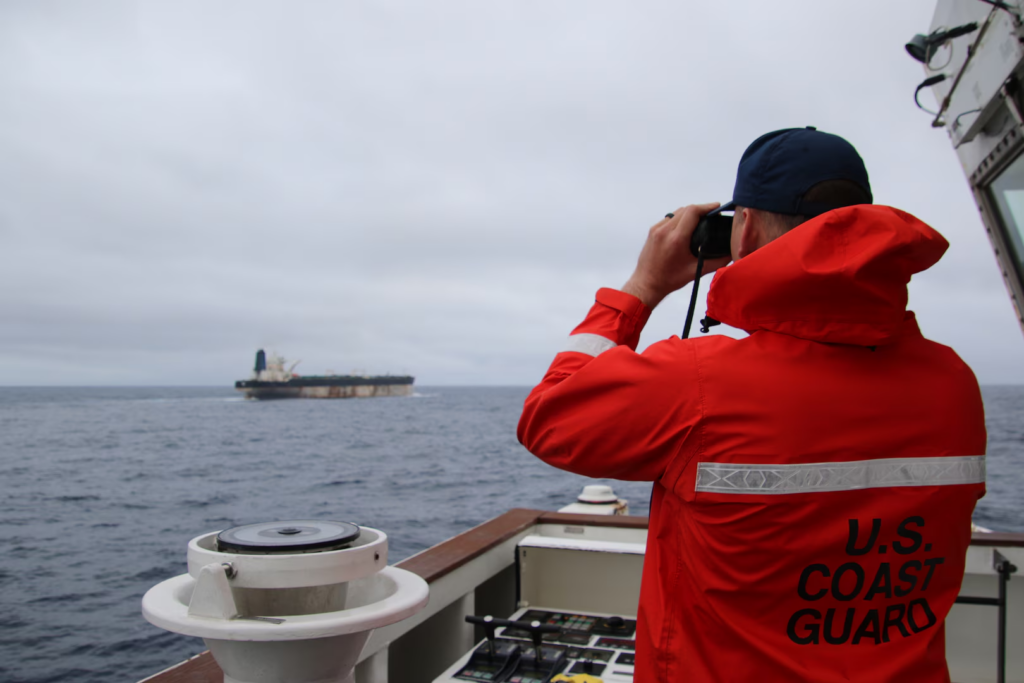
A Coast Guard Cutter Munro (WMSL 755) crew member observes the oil tanker Bella 1 in the North Atlantic Ocean, Jan. 6, 2026. Munro’s crew monitored the vessel until it was seized by Coast Guard deployable specialized forces, with support from the Department of War, after Bella 1 violated U.S. sanctions and resisted initial boarding attempts off coastal Venezuela in late December. (U.S. Coast Guard photo)
From U.S. Coast Guard Pacific Area, March 6, 2026
ALAMEDA, Calif. – The crew of U.S. Coast Guard Cutter Munro (WMSL 755) returned to their home port in Alameda, on Sunday, following a historic 119-day multi-mission deployment spanning more than 26,000 miles from the Eastern Pacific Ocean to the Northern Atlantic.
Munro departed Alameda on November 3, 2025, to conduct training workups and participate in the Department of War’s exercise Resolute Hunter offshore of San Diego, before sailing into the Eastern Pacific to execute a counternarcotics patrol in support of the U.S. Coast Guard’s Operation Pacific Viper. Munro was diverted to the Atlantic Ocean in support of the Department of War’s Operation Southern Spear.
While supporting U.S. Southern Command’s Joint Interagency Task Force South and Coast Guard Southwest District, Munro detected and identified a heavily laden go-fast vessel transiting along a known smuggling route in the Eastern Pacific. With the help of its two cutter pursuit boats, Scan Eagle short-range unmanned aerial system, and an embarked MH-65 aircraft from the Helicopter Interdiction Tactical Squadron (HITRON), Munro successfully found, tracked and interdicted the vessel using warning shots and disabling fire from the HITRON aircraft. Munro subsequently detained six suspected narco-terrorists and seized 22,052 pounds of cocaine valued at over $250 million – the single largest maritime drug seizure in 18 years, and the largest ever in HITRON’s history. This interdiction continued the Coast Guard’s historic counter-drug operations through Operation Pacific Viper, including the seizure of over 200,000 pounds of cocaine along maritime smuggling routes from South and Central America since early August.
After transiting through the Panama Canal, Munro took station in the Caribbean Sea, ready to conduct new tasking in support of Operation Southern Spear. Munro located and identified the dark fleet Motor Tanker Bella 1, a U.S. sanctioned vessel determined to be without nationality and subject to U.S. jurisdiction. Munro’s crew continuously pursued the non-compliant vessel across the North Atlantic Ocean for 18-days and over 4,900-miles. The pursuit culminated with the boarding of Bella 1, where Munro worked in tandem with Department of War assets to seize control of the 333-meter crude oil carrier for further transfer to the U.S. Department of Justice and U.S. Department of Homeland Security for disposition.
“The service, our nation and our families can be extremely proud of Munro,” said Capt. Jim O’Mara, Munro’s commanding officer. “This crew rose to every new challenge thrown at them with professionalism and persistence, and they achieved historic results. This was a one-of-a-kind deployment for us, but it is also just one part of a much broader campaign and U.S. national strategy.”
“We could not have done this without support from partners, allies, and our families,” said O’Mara. “Our families had to adapt to each new twist, just like all military families do across the Armed Forces. It is tough on them. But when they hold strong at home that keeps us motivated and focused on our mission. Now, we reunite with our loved ones, proud of what we accomplished and already preparing for the next mission.”
Commissioned in 2017, Munro is one of four U.S. Coast Guard Legend-class National Security Cutters homeported in Alameda, California. The cutter is named in honor of Signalman First Class Douglas A. Munro – the only Coast Guardsman awarded the Medal of Honor – for his heroic actions on September 27th, 1942, when he gallantly sacrificed himself in the defense, rescue, and evacuation of 500 stranded U.S. Marines from Point Cruz, Guadalcanal, in the Solomon Islands.
FN Awarded $9.9 Million Contract from U.S. Army and Navy for Machine Guns
MCLEAN, Va., March 5, 2026 —FN America, LLC, is pleased to announce that it has been awarded a $9.9 million contract to supply the U.S. Army and U.S. Navy with FN® M240B machine guns, continuing the supply of FN America’s longest-standing military weapons platform.
“This contract continues FN’s legacy of providing the most effective and advanced weapon systems for the warfighter,” said Jim Williams, Vice President, Military Programs for FN America, LLC. “The U.S. Army contract for the M240 machine gun was the first military contract FN was awarded and the first to be produced from our production facility in South Carolina. We’re incredibly honored to continue supporting the U.S. military with high-quality and reliable weapon systems for our servicemen and women.”
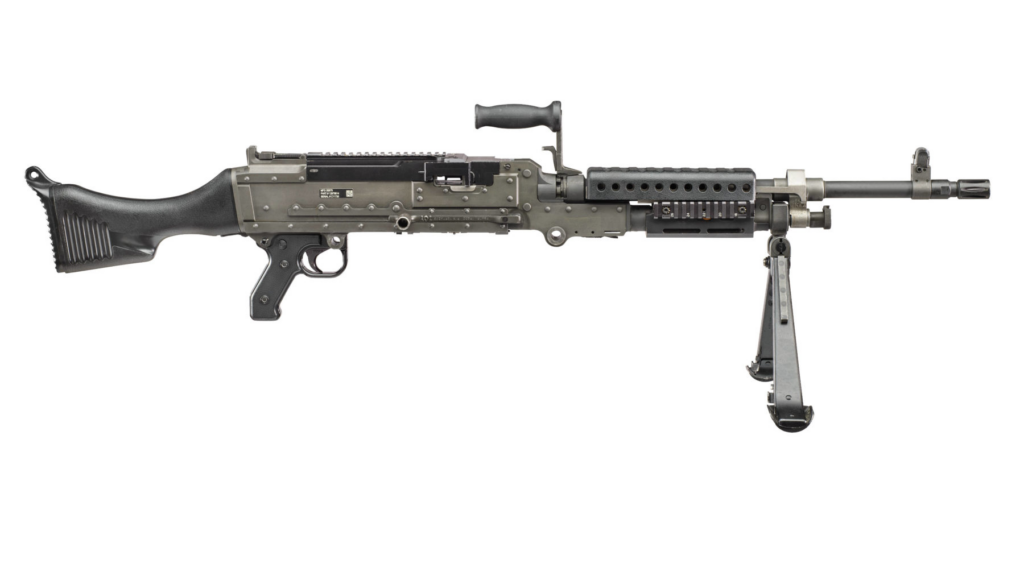
The FN® M240B, built on the M240 platform that was adopted and has been in use by the U.S. military since the late 1970s, is the “go-to/can-do” medium machine gun for all branches of the U.S. military. It offers unmatched reliability, extended range and an exceptional service life. This weapon’s high volume of fire makes it the principal suppressive firearm for the infantry platoon and company.
Chambered in 7.62x51mm NATO, the M240B’s cold hammer-forged MIL-SPEC barrel has a hard-chromed bore for longer life, improved accuracy and maximum range of 3,725 meters. The receiver is machined steel and is equipped with a top-mounted MIL-STD-1913 optical rail. The crossbolt safety and curved trigger help enhance operator control.
“Since beginning our first production in 1981, FN has produced millions of firearms for the U.S. military at our Columbia, SC, manufacturing facility,” said Daryl Atkins, Director, Industrialized Weapons for FN America, LLC. “FN is extremely proud of the high-quality, reliable firearms we build for our military servicemen and women, and we look forward to continuing the tradition with this contract.”
Throughout its history, FN has been one of the largest suppliers of small arms to the U.S. military and continues to develop innovative, future technology. In addition to the M240 platform, the company currently holds contracts for the FN® M249, MK 46, MK 48, MK 17 and MK 20 SSR for USSOCOM and various other contracts.
General Dynamics NASSCO Christens the Sixth and Final Ship in the ESB Program for the U.S. Navy
From General Dynamics NASSCO, March 7, 2026
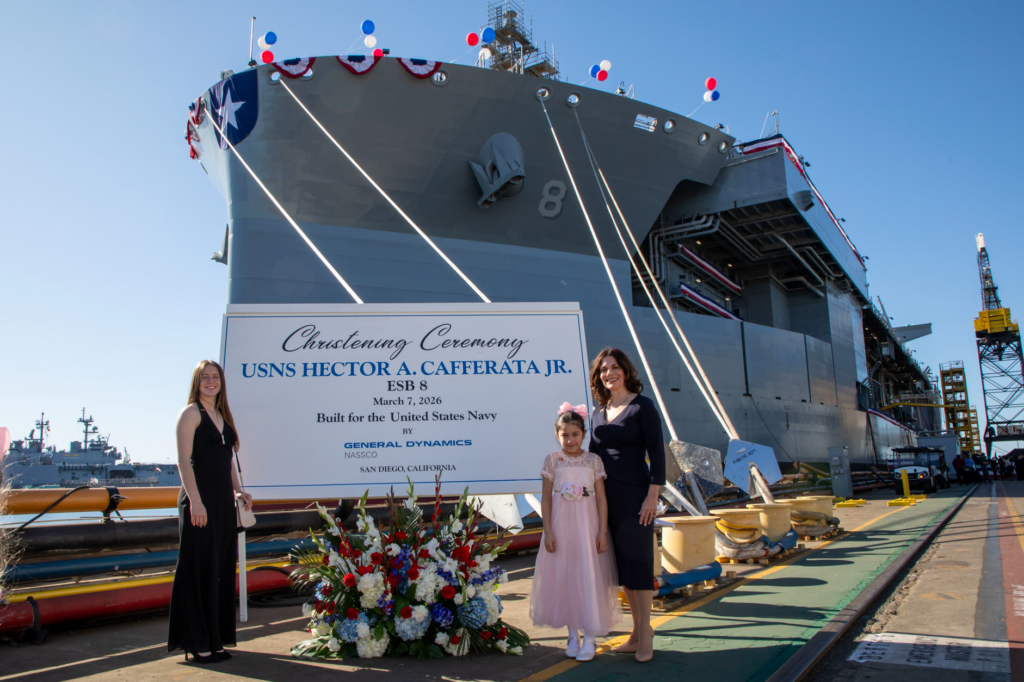
SAN DIEGO – Today, General Dynamics NASSCO christened the USNS Hector A. Cafferata Jr. (ESB 8), the sixth and final ship for the U.S. Navy’s Expeditionary Sea Base (ESB) program. Sergeant Major Carlos A. Ruiz served as the principal speaker at the ceremony, which also included remarks from NASSCO, U.S. Navy, and U.S. Marine Corps representatives. Following remarks, ship co-sponsors Heather Cafferata, daughter of the ship’s namesake, and Jessica Cafferata, granddaughter of the ship’s namesake, christened the ship with the traditional champagne bottle break alongside the hull.
“Ships are not just steel and machinery—they carry legacies, and they connect past generations to future ones,” said David Carver, president of General Dynamics NASSCO. “The remarkable story of valor and sacrifice of Hector Cafferata Jr. will soon sail across the globe, carried by a ship that embodies his courage and dedication.”
The ship is named for Private First Class Hector A. Cafferata Jr., who was awarded the Medal of Honor for his brave actions at the Battle of Chosin Reservoir during the Korean War. He single-handedly held off a regimental-strength enemy force and safeguarded wounded Marines by throwing a live grenade away from his position. The Medal of Honor was presented to him by President Harry Truman in a White House ceremony in 1952.
The ESB ship class is a highly flexible platform designed to support multiple maritime-based missions. ESB ships are mobile sea-based assets and are a part of the critical access infrastructure that supports the deployment of forces, equipment, supplies, and warfighting capability. These 784-foot ships are configured with a 52,000 square-foot flight deck to support MH-53, MH-60, MV-22 tilt-rotor, and H1 aircraft operations.
The first five ships in the ESB program – USS Lewis B. Puller (ESB 3), USS Hershel “Woody” Williams (ESB 4), USS Miguel Keith (ESB 5), USS John L. Canley (ESB 6), and USNS Robert E. Simanek (ESB 7) – have been delivered to the U.S. Navy.
USS Cincinnati Returns to Homeport in San Diego
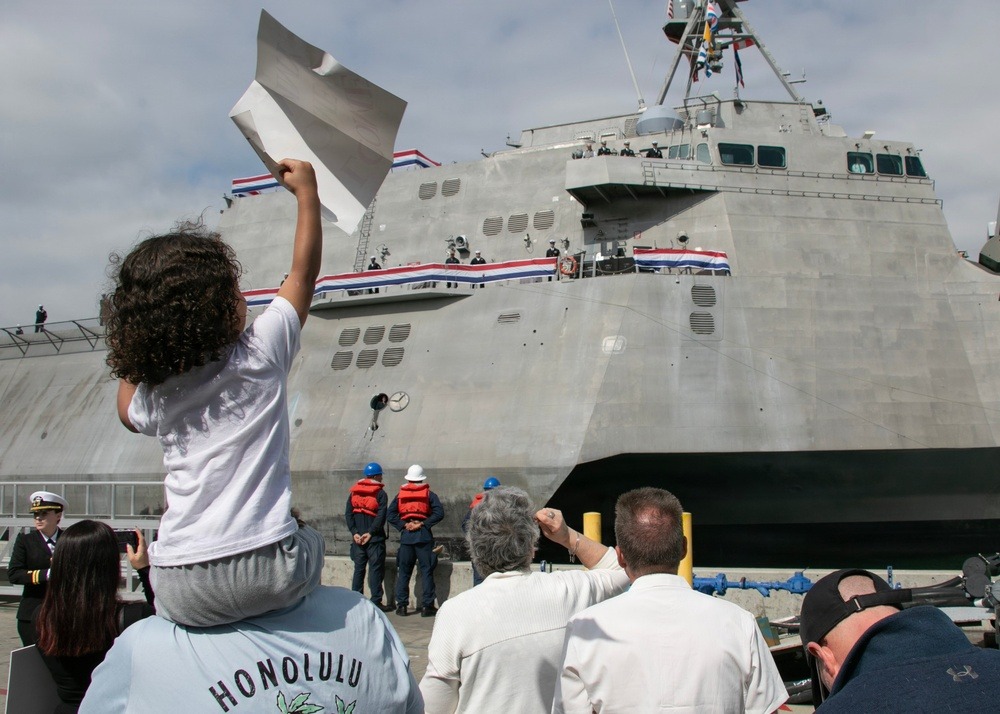
Families and friends welcome the Independence-variant littoral combat ship USS Cincinnati (LCS 20) as it returns to its homeport of Naval Base San Diego, March 4, 2026. The Cincinnati returned to its homeport of San Diego after eight months of sustained operations in the U.S. 3rd and 7th Fleet areas of operations. (U.S. Navy photo by MC1 Class Josh Coté)
SAN DIEGO – Independence-variant littoral combat ship USS Cincinnati (LCS 20) arrived at its San Diego homeport following eight months of sustained operations at sea, March 4.
Cincinnati conducted several multilateral exercises and port visits in the U.S. 3rd and 7th Fleet areas of operations throughout the Indo-Pacific, including Brunei, Cambodia, Indonesia, Malaysia, the Philippines, the Republic of the Marshall Islands, Singapore, enhancing regional maritime cooperation and interoperability. Cincinnati participated in Cooperation Afloat Readiness and Training (CARAT) exercises with members of the Association of South East Asian Nations (ASEAN) throughout the Pacific.
“I am immensely proud of the crew for their exceptional performance during our sustained operations abroad,” said Cmdr. Andrew Recame, commanding officer of Cincinnati. “This was a significant milestone, not only for the ship and its crew, but for the entire LCS program. For eight months, Team Cincy operated boldly in the U.S. 7th Fleet area of operations, demonstrating the versatility and capability of the U.S. Navy wherever we went. The dedication and professionalism of our Sailors has been truly outstanding, and they have represented the best of America’s spirit on the high seas and foreign shores.”
In July 2025, during a port visit to the Republic of Marshall Islands, Cincinnati hosted “Stand and Defend,” a special event to honor Marshallese U.S. military veterans for their service, sacrifice, and dedication; co-hosted an Independence Day Celebration at Delap Dock; and conducted ship tours for dignitaries including the ambassador to the Marshall Islands.
In September 2025, Cincinnati transited to the Southern Hemisphere enroute to Timor-Leste. Upon crossing the equator, the crew took part in a “Crossing the Line” ceremony, a time-honored maritime tradition where “Pollywogs,” those who have never crossed the equator, are transformed into “Shellbacks.” Upon arrival in Dili, Timor-Leste, Cincinnati participated in CARAT Timor-Leste 2025, a comprehensive bilateral exercise designed to enhance maritime partnership and interoperability. The exercise encompassed a series of key diplomatic and military-to-military engagements, from the official opening and closing ceremonies to a formal U.S. Navy reception that strengthened strategic maritime ties.
In October 2025, Cincinnati participated in multinational exercise Sama Sama 2025 alongside ships and aircraft from Canada, France, Japan, and the Philippines. “Sama Sama,” a Tagalog word that translates to “together,” consisted of a series of maritime exercises while circumnavigating the Philippine province of Palawan. Cincinnati’s crew, as part of a combined, international force, planned and conducted six days of underway communications exercises, live-fire exercises, tactical maneuvering drills, flight operations, and small boat operations.
Cincinnati participated in CARAT Brunei 2025, reinforcing commitment to regional security and maritime partnerships. The exercise included subject matter expert exchanges in a variety of fields including legal, communications, cyber security, damage control, and medical. Cincinnati Sailors also participated in community relations events where they volunteered at Yayasan Kanser Kanak, a children’s cancer foundation; the Sejahtera Community Animal Shelter; and the Brunei Darussalam Paraplegic and Physically Disabled Association: Wheelchair Repair Facility/Disabled Training Center. CARAT Brunei concluded with the sea phase, where Cincinnati and a Royal Brunei Armed Forces offshore patrol vessel, a P-8A Poseidon from Commander, Task Force 72, and a U.S. Coast Guard visit, board, search, and seizure (VBSS) team conducted live-fire gunnery exercises, air defense exercises, and VBSS operations.
In December 2025, Cincinnati participated in CARAT Malaysia 2025, marking another significant milestone in the long-standing defense partnership. During three days at sea, Cincinnati, alongside Royal Malaysian Navy Lekiu-class guided-missile frigate KD Lekiu (FFG 30), sailed in formation and conducted exercises such as communications drills, simulated air defense exercises, and deck landing qualifications within the Strait of Malacca.
Cincinnati also co-hosted ASEAN-U.S. Maritime Exercise (AUMX) 2025 with the Indonesian Navy in Batam, Indonesia. The exercise brought together eight partner navies, including warships from Brunei, Indonesia, Malaysia, Myanmar, the Philippines, Singapore, and Vietnam, and culminated with two days of communication exercises, tactical maneuvering drills, air defense exercises, search and rescue, and medical evacuation drills.
In January, Cincinnati was the first U.S. Navy warship to moor pierside at Ream Naval Base, Cambodia. This was only the second visit of a U.S. warship to the Kingdom of Cambodia in the last nine years, following Independence-variant littoral combat ship USS Savannah’s (LCS 28) visit in 2024. While in port, the crew welcomed Commander, U.S. Indo-Pacific Command Adm. Samuel Paparo, along with over 100 senior military and government officials for a hosted reception and ship tours.
“It is a privilege to welcome home and recognize the safe return of the USS Cincinnati after a long and challenging deployment,” said Capt. James Hoey, commodore, Littoral Combat Ship Squadron 1. “This warship demonstrated a strong and steady presence in strategically vital waterways and operated seamlessly alongside our allies and partners across the Indo-Pacific region. Over the course of this deployment, this crew found common purpose in one another and in the mission: standing the watch, trusting each other, and serving something greater than themselves. I know the families, friends and shipmates here today are just as proud of their Sailors as I am.
Cincinnati’s operations exemplify the Navy’s commitment to integrated deterrence, regional maritime security, and enduring alliances and partnerships throughout the Indo-Pacific.
Littoral combat ships are fast, optimally manned, mission-tailored surface combatants that operate in near-shore and open-ocean environments, winning against 21st-century threats. LCS integrate with joint, combined, manned and unmanned teams to support forward-presence, maritime security, sea control, and deterrence missions around the globe.
For more news from Commander, Littoral Combat Ship Squadron 1, visit https://www.surfpac.navy.mil/comlcsron1/ or follow on Facebook at www.facebook.com/COMLCSRONONE/ or on Instagram at https://www.instagram.com/littoralcombatshipsquadron1/.
While Improving Quality of Life, Navy Remains Ready to Fight
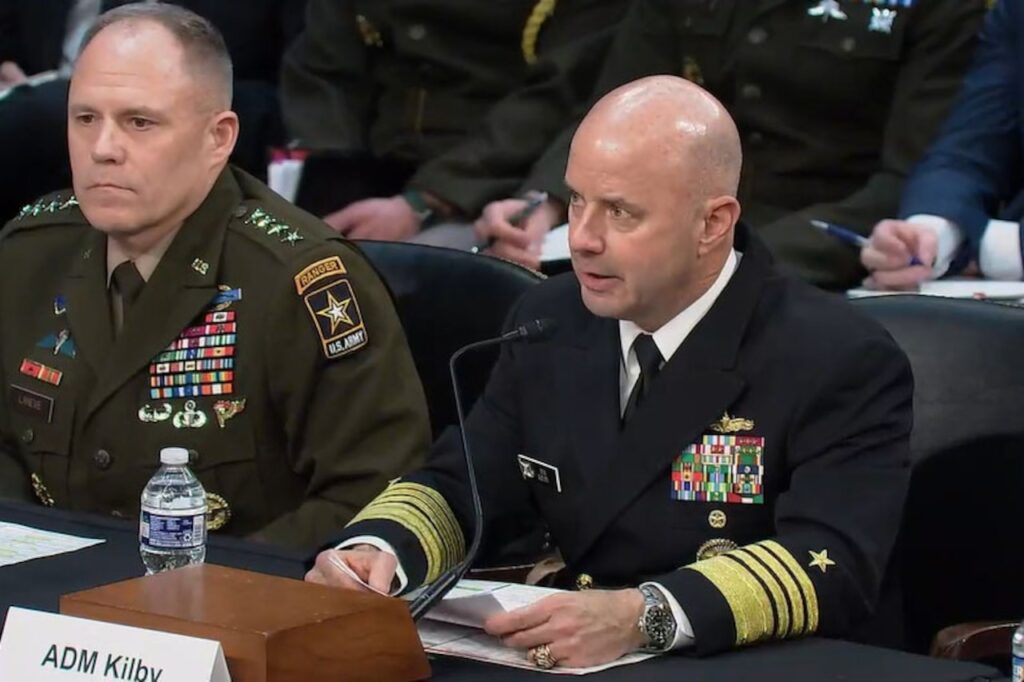
Navy Adm. James W. Kilby, vice chief of naval operations, testifies at a Senate Armed Services Committee hearing on joint force readiness in Washington, March 4, 2026. Credit:DOW screenshot
March 5, 2026 | By David Vergun, DoW News
The Navy is participating in exercises and operations worldwide, said Navy Adm. James W. Kilby, vice chief of naval operations, who, along with other service leaders, testified yesterday at a Senate Armed Services Committee hearing in Washington on joint force readiness.
Last year in the Middle East, the Navy executed strikes against adversaries during Operations Rough Rider and Midnight Hammer, while defending regional allies and partners.
This year, the Navy participated in Operation Absolute Resolve in the Atlantic, while sailors operate every day to deter China and build partnerships in the Pacific, Kilby said.
Currently, the Navy is supporting Operation Epic Fury. On March 3, a Navy fast attack submarine sank an Iranian combatant ship with the Mark 48 torpedo.
The Navy’s primary weapon system is its sailors, the admiral said, noting that the service exceeded its recruiting goals last year and is successfully working to increase retention.
To further support sailors, the Navy is focused on improving quality of life through a new initiative that provides permanent shore-based housing so that no sailor is required to live aboard a ship while on shore duty, he said. Efforts also include expanding child care, improving fitness facilities and expanding meal selections with healthy options.
Always looking for ways to improve, the service is increasing platform readiness by reducing maintenance delays, investing in shipyard infrastructure optimization and developing the civilian workforce. Advanced technologies such as conditions-based maintenance and advanced additive manufacturing are being used to optimize systems.
“The Navy continues to drive toward our goal of 80% combat surge-ready ships, aircraft and submarines with urgency and accountability,” Kilby said, adding that he’s concerned with the material condition of amphibious ships and is working to improve that.
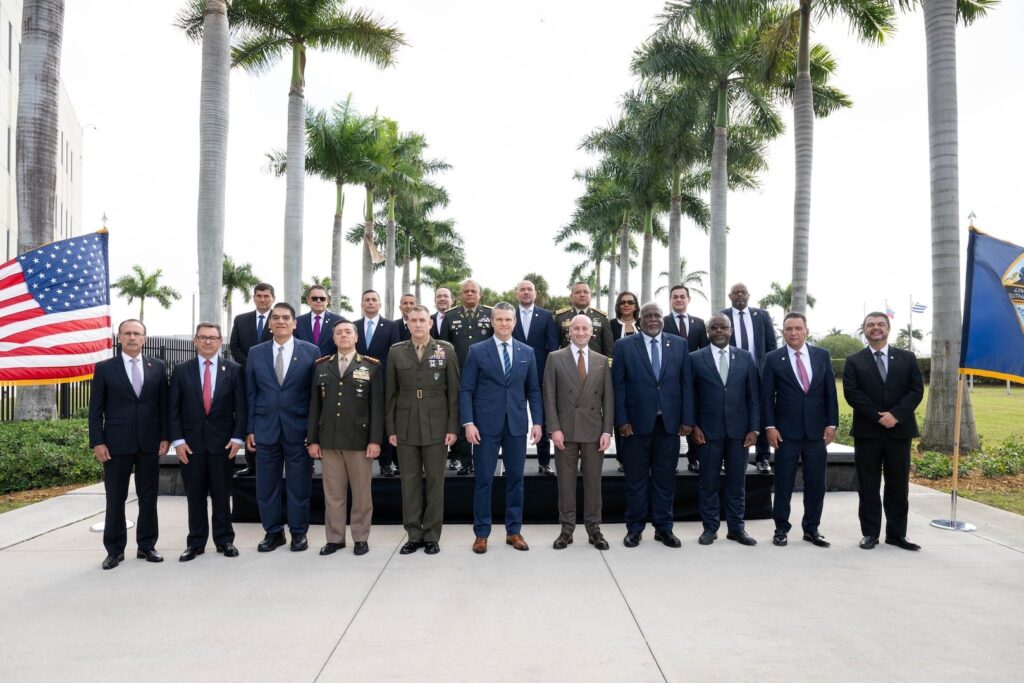
Secretary of War Pete Hegseth underscored the importance of strong, regional border security today during the inaugural Americas Counter Cartel Conference at U.S. Southern Command headquarters in Doral, Florida.
The operational conference brought together regional defense and security leaders from the Caribbean, Central America and South America to achieve shared security objectives. Hegseth, along with representatives from 17 countries from throughout the Western Hemisphere, signed a joint security declaration, reaffirming their commitment to peace, sovereignty and stability in the region.
“This conference is about you; this conference is about us. This conference is not called the ‘America’s Counter Cartel Conference’; it’s the ‘Americas Counter Cartel Conference,'” Hegseth told the group at the beginning of his remarks.
The secretary drew comparisons between the current administration’s prioritization of homeland security and that of the Monroe Doctrine in 1823, in which President James Monroe declared that the Western Hemisphere was off-limits to any new attempts at colonization by European nations, and that any interference by those powers would be viewed as a hostile act against the United States.
“Today, some 200 years later, we still marvel at the wisdom of President Monroe’s declaration. We, like you, want borders and sovereign territories that are secure; we want unfettered access to key terrain and trade so that our nations can industrialize; and we want to prevent external powers from threatening our peace and independence in our shared neighborhood,” Hegseth said, adding that the Western Hemisphere needs to be a region of strong, sovereign nations.
He described past U.S. foreign policy as a flawed form of “benign neglect,” in that it prioritized other overseas theaters and the borders of other countries before prioritizing its own.
As an example, Hegseth said that the human smuggling industry grew by as much as 2,000% over a five-year span, soaring from being a $500 million enterprise in 2018 to one that brought in $13 billion in 2022.
He also noted that the Western Hemisphere contains one-eighth of the world’s population but one-third of the violent crime.
In contrast, Hegseth said that under President Donald J. Trump and the recently released National Defense Strategy, all of those trends are reversing.
“The president’s historic National Defense Strategy ensures that the Department of War will prioritize resources around the threats and objectives that are core to homeland defense … and prosperity of the American people,” he said.
To illustrate this, Hegseth pointed to the drastic reduction in illegal crossings at the U.S. southern border, as well as the successful deterrence of narco-terrorists in the Caribbean region, which has been ongoing since September 2025.
He also highlighted that the flow of fentanyl into the U.S. is down 56%.
Hegseth then appealed to the other represented countries in the room.
“America is prepared to take on these threats and go on the offense alone, if necessary. However, it is our preference — and it is the goal of this conference — that in the interests of this [hemisphere], we all do it together; with you, with our neighbors and with our allies who are eager and willing and capable to do this,” Hegseth told the group.
He emphasized the importance of maintaining shared Western values, stating that the nations of the Western Hemisphere have always been united by heritage, history and geography.
The secretary also called for the strengthening of partnerships through increased burden sharing among all partner countries south of the equator.
“This is what we did in World War II. We called it the ‘quarter sphere defense,’ and we will do this again if we’re serious about our national security [and] if we prioritize geography,” Hegseth explained.
“This means that for every country in this hemisphere, border security must be your top priority,” he added.
Hegseth wrapped his remarks up by circling back to the Monroe Doctrine.
“With Donald Trump in the Oval Office, and with all of you here, we can still realize that long-ago dream of James Monroe, [and] in our time, we will make the Americas great again,” he said.
Ecuadorian and U.S. Military Forces Launch Operations Against Narco-terrorists
From U.S. Southern Command, March 3, 2026
On March 3, Ecuadorian and U.S. military forces launched operations against Designated Terrorist Organizations in Ecuador. The operations are a powerful example of the commitment of partners in Latin America and the Caribbean to combat the scourge of narco-terrorism.
Together, we are taking decisive action to confront narco-terrorists who have long inflicted terror, violence, and corruption on citizens throughout the hemisphere.
“We commend the men and women of the Ecuadorian armed forces for their unwavering commitment to this fight, demonstrating courage and resolve through continued actions against narco-terrorists in their country,” said Marine Gen. Francis L. Donovan, commander of U.S. Southern Command.
Hegseth Says There’s No Shortage of American Will, Resources in Operation Epic Fury
March 5, 2026 | By Matthew Olay, DoW News
Secretary of War Pete Hegseth today said there is no shortage of American will, nor is there a shortage of materiel, when it comes to U.S. kinetic engagement against the Iranian terrorist regime during Operation Epic Fury.
While providing an update on the conflict for the second time in as many days, and joined by the commander of U.S. Central Command, Navy Adm. Brad Cooper, Hegseth said the Iranian regime would be foolish to think that the U.S. isn’t completely committed to accomplishing the mission in Iran.
“Iran is hoping that we cannot sustain this, which is a really bad miscalculation for the [Islamic Revolutionary Guard Corps] in Iran,” Hegseth said during a press briefing at Centcom headquarters in Tampa, Florida.
He added that there is no shortage of American will to execute the mission, and that there is no shortage of U.S. munitions to facilitate that execution.
“Our stockpiles of defensive and offensive weapons allow us to sustain this campaign as long as we need to. … Again, our munition status only increases as our advantage increases. [And] our capabilities? We have only just begun to fight and fight decisively,” Hegseth said.
Contrary to the notion that there is a shortage of U.S. material, the secretary said that even more offensive firepower is headed to the region.
“The amount of combat power that’s still flowing — that’s still coming — that we’ll be able to project over Iran is in multiples of what it currently is right now, when you add up our capabilities and those of the Israeli defense forces,” Hegseth said.
“Our munitions are full up, and our will is ironclad, which means our timeline is ours and ours alone to control as long as it takes, to ensure the United States of America achieves these objectives,” he added.
Cooper thanked Hegseth for authorizing Centcom to use overwhelming kinetic force against the Iranian regime.
“If I could channel my inner Navy officer, we are at ‘full speed ahead’ in executing orders given by leadership in Washington,” Cooper told the media.
The admiral concurred with Hegseth’s assessment that U.S. combat power is growing in the region while Iran’s continually declines, citing the last 72 hours as an example.
During that time, America’s bomber force has struck close to 200 targets deep inside Iran, including around the capital city of Tehran.
Cooper also said that, in just the one hour prior to the start of today’s press conference, U.S. B-2 Spirit stealth bombers dropped dozens of 2,000-pound penetrator bombs that targeted deeply buried Iranian ballistic missile launchers.
“Notably, we have also struck Iran’s equivalent of [U.S.] Space Command, which degrades [Iran’s] ability to threaten Americans,” he said.
As to the decline in Iran’s combat capability, Cooper said that Iran’s ballistic missile attacks have decreased by 90% since the first day of the conflict, and that Iranian drone attacks have decreased by 83% in the same timeframe.
At sea, Cooper said the count of sunken Iranian navy ships has surpassed 30.
“And in just the last few hours, we hit an Iranian drone carrier ship, roughly the size of a World War II aircraft carrier. And as we speak, it’s on fire,” he added.
Under orders from President Donald J. Trump, Centcom forces are working to destroy Iran’s missile industrial base.
“We’re not just hitting what they have, we’re destroying their ability to rebuild. And so, as we transition to the next phase of this operation, we will systemically dismantle Iran’s missile production capability for the future, and that’s absolutely in progress,” Cooper said.
He added that Centcom and Israel’s combined joint forces have “relentlessly destroyed” Iran’s air defenses during the conflict, and that those forces will continue hunting for more systems to attack.
“Our air defenders are at the top of their game, [and] I couldn’t be prouder, shoulder to shoulder with our partners in the region — in many cases — providing the most integrated air defense network in Middle East history,” Cooper said.
Following their formal remarks, Hegseth addressed reports that a U.S. F-15 Eagle fighter jet had been shot down, calling the reports false.
“As you can imagine, Iran is doing everything it can to peddle in lies, deception and inflation of numbers, in reality, mostly to propagandize to their own people,” he said, adding that Iran had floated another false report that 500 Americans have been killed in the conflict.
The secretary also addressed concerns about the operation expanding beyond Iran’s borders to other nations throughout the Middle East, saying that nothing could be further from the truth, and that Iran’s targeting of countries throughout the region is actually encouraging those countries to side with the U.S. and Israel in the conflict.
“It’s actually firming up the unity of resistance in order to focus exactly where we need to,” Hegseth said. “So, this idea that [the conflict] is expanding — no, it’s actually simplifying, in a number of ways — exactly what we need to achieve and how we’ll achieve it.”
Keel Laid for Future USS Philadelphia
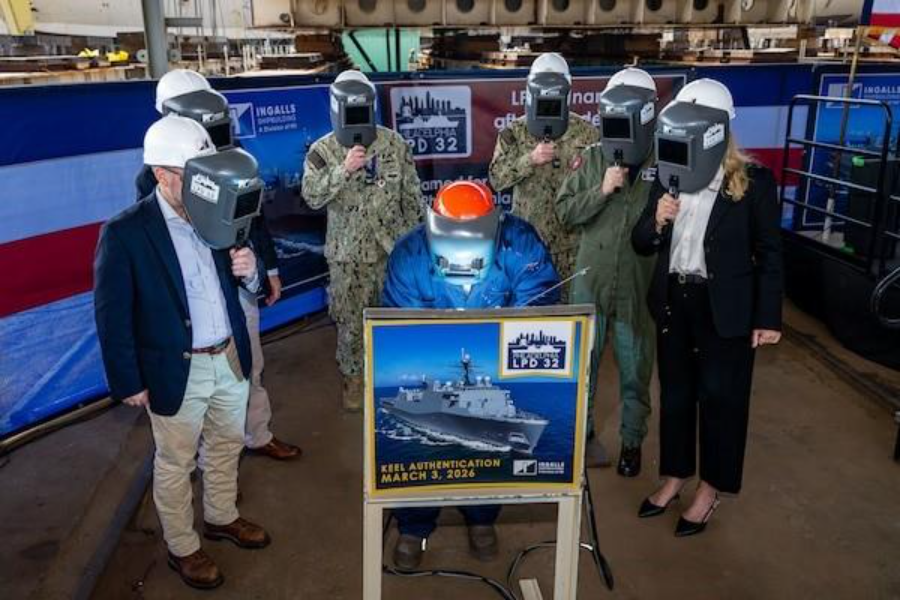
Mrs. Maureen Paparo, sponsor for LPD 32, Philadelphia, and other platform guests watch as Cory Dillon, Ingalls Structural Welder, welds the sponsor’s initials onto the keel plate at Ingalls Shipbuilding in Pascagoula, MS, March 3, 2026. (Photo/Luis Solis) In Photo From Left: Brian Blanchette, President of Ingalls Shipbuilding and Executive Vice President at HII Chris Kastner, President and CEO, HII, Captain Randy Slaff, Commanding Officer, Supervisor of Shipbuilding, Conversion and Repair, Gulf Coast, Cory Dillon, Ingalls Structural Welder, Captain Matt Tardy, Unites States Navy, Amphibious Warfare Program Manager, Program Executive Office, Ships, Admiral Samuel Paparo, Unites States Navy, Commander, United States Indo Pacific Command, and husband to our ship sponsor, and Mrs. Maureen Paparo, Sponsor and Keel Authenticator of LPD 32. (Photo by Luis Solis)
From Team Ships Public Affairs, March 4, 2026
PASCAGOULA, Miss. - The keel for the future USS Philadelphia (LPD 32), a San Antonio class-amphibious transport dock ship, was authenticated at HII’s Ingalls Shipbuilding division, March 3.
The ship is named in honor of the historic city of Philadelphia and its maritime legacy. The city is the birthplace of the U.S Navy and Marine Corps and was home to the Philadelphia Naval Shipyard from 1801-1995, which constructed numerous Navy vessels.
Keel laying authentication ceremonies are a centuries-old tradition marking a significant construction milestone where a ship transitions from design to reality. The keel was authenticated when the initials of the ship’s sponsor, Ms. Maureen Paparo, were welded onto a steel plate. Paparo is a Philadelphia native and the spouse of Adm. Samuel Paparo, the 27th Commander of U.S. Indo-Pacific Command. This plate will be permanently affixed to the ship’s hull, remaining with the vessel throughout its entire service life as a symbol of its beginning.
“The future USS Philadelphia honors one of America’s foundational cities and its continuous support of the Navy and the maritime domain,” said Capt. Matthew Tardy, program manager, Amphibious Warfare Program Office. “This keel laying marks the ceremonial beginning of construction and we look forward to delivering this ship to the fleet.”
San Antonio-class amphibious transport dock ships (LPD) are warships that embark, transport, and land elements of a landing force for a variety of expeditionary warfare missions, humanitarian assistance, and disaster relief. They provide the Navy and Marine Corps with modern, sea-based platforms that are networked, survivable, and built to operate with 21st-century transformational platforms such as air-cushioned landing craft (LCAC), modern helicopters, and vertical take-off landing craft (MV-22).
Today’s ceremony underscores the Navy’s commitment to building America’s Golden Fleet. For 250 years, American naval power has projected strength globally. That mission continues – and intensifies. We operate forward 24/7, 365 days a year. This operational tempo demands continuous capability delivery, and the Golden Fleet is our answer.
As a Department of War acquisition organization, PEO Ships is responsible for executing the development and procurement of all destroyers, amphibious ships and craft, and auxiliary ships, including special mission ships, sealift ships and support ships.