Navy Narrows Fiscal 2025 Aircraft Procurement to Five Types
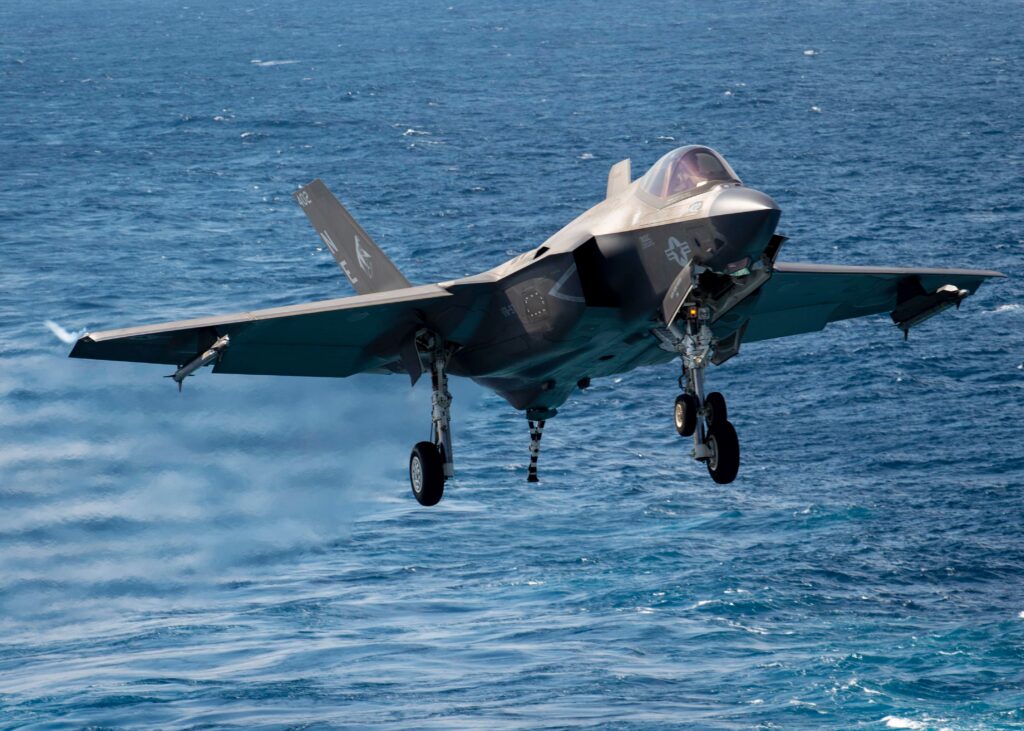
PHILIPPINE SEA (Jan. 29, 2024) An F-35C Lightning II from the “Warhawks” of Strike Fighter Squadron (VFA) 97 prepares to recover on the flight deck of Nimitz-class aircraft carrier USS Carl Vinson (CVN 70). (U.S. Navy photo by Mass Communication Specialist 2nd Class Isaiah B. Goessl)
By Richard R. Burgess, Senior Editor
ARLINGTON, Va. — The Department of the Navy is proposing to procure 75 aircraft with $16.2 billion in the fiscal 2025 budget, but those 75 are divided among only five types.
The 2025 budget proposed funding 13 F-35B Lightning II strike fighters for the Marine Corps; 13 F-35C carrier-based variants for the Navy and Marine Corps; 19 CH-53K King Stallion heavy-lift helicopters for the Marine Corps, 27 T-54 multi-engine training aircraft for the Navy, and three MQ-25A Stingray unmanned aerial refueling aircraft for the Navy.
The budget is noteworthy in that the 2025 procurement funding of such types as the F/A-18E/F Super Hornet strike fighters, EA-18G Growler electronic attack aircraft, E-2D Advanced Hawkeye radar warning aircraft, MH-60R/S helicopters, MV-22B and CMV-22B Osprey transport aircraft, AH-1Z Viper and UH-1Y Venom helicopters, P-8A Poseidon maritime patrol aircraft, MQ-4C Triton and MQ-9A Reaper unmanned surveillance aircraft, and TH-73A Thrasher training helicopters — barring adjustment by the Congress — has been completed, although in some cases deliveries are ongoing. In some cases, the production lines will remain open for some time, building aircraft for foreign customers and which could resume production for the Navy and Marine Corps if needed.
The only new types on the five-year horizon are a replacement for the T-45 Goshawk training jet and a replacement for the E-6B Mercury strategic communications aircraft, planned to be a version of the C-130J Super Hercules.
Procurement of the KC-130J Super Hercules tanker/transport for the Marine Corps is being gapped for four years, with one planned for fiscal 2029. The fact that C-130Js are in production for other services and nations means that this gap does not have major implications for the Lockheed Martin production line.
The 2025 Future Years Defense Plan lists planned Department of the Navy procurement for 2026 through 2029 as 58, 67, 77, and 90 aircraft, respectively.
Noteworthy is — as of this writing — that the fiscal 2024 defense budget still is mired in the Congress.
Austin Nominated for Deputy Commandant for CD&I
ARLINGTON, Va.—Secretary of Defense Lloyd J. Austin III announced March 14 that the president has made the following nomination:
Marine Corps Maj. Gen. Eric E. Austin for appointment to the grade of lieutenant general, with assignment as deputy commandant for Combat Development and Integration, Headquarters, U.S. Marine Corps; and commanding general, Marine Corps Combat Development Command. Austin is currently serving as the commanding general, 1st Marine Aircraft Wing, Camp Foster, Okinawa, Japan.
ArmorWorks Enterprises Announces Acquisition of Fox Valley Metal-Tech
CHANDLER, AZ, March 14, 2024 – ArmorWorks Enterprises, LLC (“ArmorWorks”), a portfolio company of Littlejohn Capital, LLC, announced today the acquisition of Fox Valley Metal-Tech, Incorporated (“Fox Valley”), a provider of complex, precision metal fabrications for use on naval ships, submarines, combat vessels, and other critical defense applications.
Founded in 1989 and based in Green Bay, WI, Fox Valley specializes in complex metal fabrications primarily for the U.S. Department of Defense (“DoD”), as well as commercial industries. The company manufactures custom electrical enclosures and consoles, components and fabrications for military trailers, radar systems as well as watertight doors and hatches. Fox Valley actively supports leading defense industry companies, and its precision components and fabrications are incorporated on the latest naval platforms such as the Ford-class aircraft carrier and Columbia-class submarine, amongst others. The company has a state-of-the-art 185,000 square foot facility that enables it to meet the highest of quality standards. For more information, visit www.fvmt.com.
Kevin Dahlin, Chief Executive Officer of ArmorWorks, commented, “Fox Valley’s components meet the Navy’s stringent requirements, and combine unique fabrication, machining, precision welding, and painting/finishing capabilities to provide customers with a vertically-integrated manufacturing solution in compliance with the highest U.S. military standards. Fox Valley’s fabrications are trusted on high priority naval programs amid a historical fleet expansion, and we look forward to supplementing our existing business with the addition of Fox Valley’s superior products.”
Angus Littlejohn III, President of Littlejohn Capital, said, “Fox Valley’s focus on mission-critical Naval systems instantly propels ArmorWorks into a broader segment of the DoD. The acquisition also adds impressive manufacturing capabilities in the Midwest expanding the geographic reach of ArmorWorks. Fox Valley is a trusted partner to the defense industry, and we are proud to add this company as an integral part of ArmorWorks as they continue to protect the military personnel who defend our country.”
Steve Corbeille, Co-Founder and Chief Executive Officer of Fox Valley, added, “Fox Valley has built its business and reputation over the past 25 years by developing products whose standards are designed to withstand the harshest conditions. Fox Valley will continue to thrive and better serve its customers as part of a larger organization within ArmorWorks.”
KAL Capital served as exclusive financial advisor to Fox Valley.
Navy to Christen Submarine Idaho
MARCH 15, 2024
The Navy will christen its newest Virginia-class attack submarine, the future USS Idaho (SSN 799), during a 10 a.m. EDT ceremony March 16, at General Dynamics Electric Boat, in Groton, Connecticut.
The Honorable Nickolas H. Guertin, Assistant Secretary of the Navy (ASN) for Research, Development, and Acquisition (RDA), will deliver the ceremony’s principal address. Senior representatives from the Navy, the shipbuilders, Congress, and the state of Idaho are also expected to speak.
In a twist on the time-honored Navy tradition of breaking a bottle of sparkling wine across the bow, the Submarine’s Sponsor, Ms. Teresa Stackley, will christen the boat with water she has collected from several lakes in Idaho. Stackley is the daughter of a Navy Sailor and is the spouse of the Honorable Sean Stackley, a former Naval officer who served as ASN (RDA) from 2008 to 2017.
The submarine, which began construction in 2017, will be the 26th Virginia-class fast attack submarine and the fifth U.S. Navy ship to be christened with the name Idaho. The last ship named Idaho was battleship BB 42, commissioned in 1919.
Though landlocked, the state of Idaho prides itself in its rich Naval history and continuing contributions to the fleet. The Navy’s Acoustic Research Detachment on Lake Pend Oreille, Idaho’s largest and deepest body of water, is a state-of-the-art facility that supports research, development, testing, and evaluation of submarine acoustic stealth technology and propulsor design. Lake Pend Oreille is a critical body of water to the U.S. Submarine Force.
Virginia-class submarines are built to operate in the world’s littoral and deep waters while conducting anti-submarine warfare; anti-surface ship warfare; strike warfare; special operations forces support; intelligence, surveillance and reconnaissance; irregular warfare; and mine warfare missions. This next-generation attack submarine provides the Navy with the capabilities required to maintain the nation’s undersea superiority well into the 21st century.
March 14 Red Sea Update
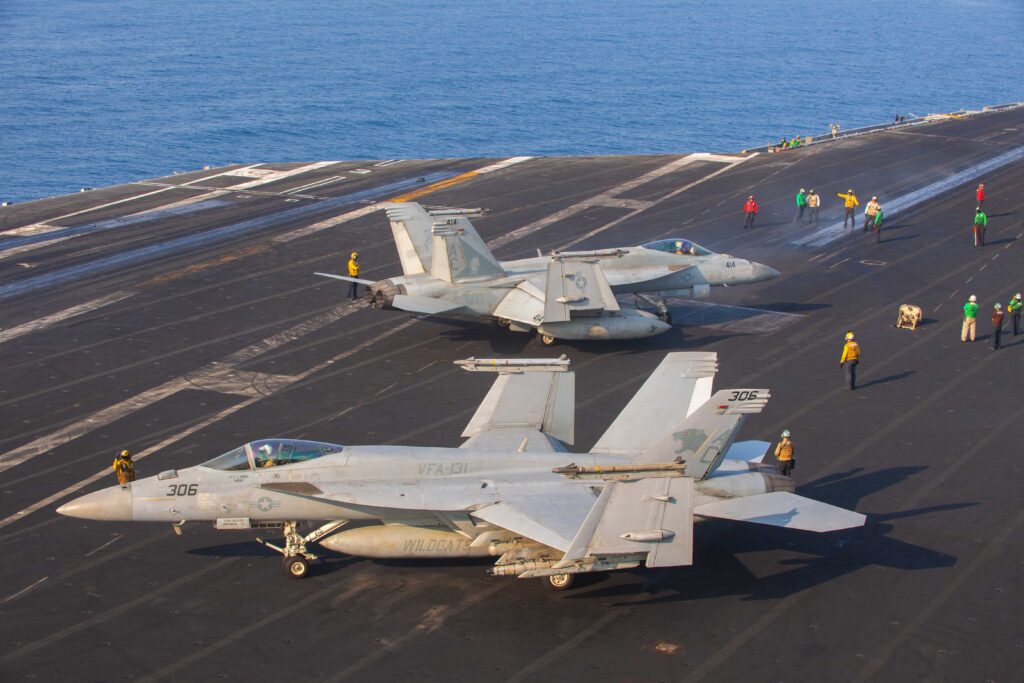
RED SEA (March 05, 2024) An F/A-18E Super Hornet attached to Strike Fighter Squadron (VFA) 131 and an F/A-18E Super Hornet attached to VFA-105 prepare for launch aboard the Nimitz-class aircraft carrier USS Dwight D. Eisenhower (CVN 69) in the Red Sea, March 5, 2024. The Dwight D. Eisenhower Carrier Strike Group is deployed to the U.S. 5th Fleet area of operations to support maritime security and stability in the Middle East region. (Official U.S. Navy photo)
USCENTCOM, March 14, 2024
TAMPA, Fla. – Between 6:50 a.m. on March 14 and 12:40 a.m. on March 15 (Sanaa time), Iranian-backed Houthi terrorists fired two anti-ship ballistic missiles (ASBMs) from Houthi-controlled areas of Yemen toward the Gulf of Aden and two additional ASBMs towards the Red Sea. There were no injuries or damage reported to U.S. or coalition ships.
Additionally, United States Central Command successfully engaged and destroyed nine anti-ship missiles and two unmanned aerial vehicles in Houthi-controlled areas of Yemen. It was determined these weapons presented an imminent threat to merchant vessels and U.S. Navy ships in the region. These actions are taken to protect freedom of navigation and make international waters safer and more secure for U.S. Navy and merchant vessels.
BATARG and 26th MEU(SOC) Returns Home From 8-month Deployment
Marines and Sailors assigned to the 26th Marine Expeditionary Unit (Special Operations Capable) will return home in several waves beginning Mar. 16, 2024 after successfully completing an extended eight-month deployment embarked aboard the amphibious warships of the Bataan Amphibious Ready Group (BATARG) in U.S. Naval Forces Europe and Africa/6th Fleet and U.S. Naval Forces Central Command/5th Fleet areas of operations.
The BATARG is comprised of the Wasp-class amphibious assault ship USS Bataan (LHD 5), the San Antonio-class amphibious transport dock ship USS Mesa Verde (LPD 19), and the Harpers Ferry class dock landing ship USS Carter Hall (LSD 50).
Upon leaving the east coast of North Carolina for deployment in July 2023, the Secretary of Defense directed the BATARG and 26th MEU(SOC) to support operations in the U.S. Central Command (USCENTCOM) in response to attempts by Iran to threaten the free flow of commerce in the Arabian Gulf and Strait of Hormuz. The 26th MEU(SOC) took deliberate actions to task-organize an element aboard the USS Mesa Verde with the appropriate staff depth and operational capabilities to execute operations and activities in support of U.S. European Command (USEUCOM) theater security objectives, while the majority of the 26th MEU(SOC) Marine Air-Ground Task Force, embarked aboard USS Bataan and USS Carter Hall, was postured in USCENTCOM to deter Iranian malign activity and increase maritime security in the waters surrounding the Strait of Hormuz.
The 26th Marine Expeditionary Unit’s deployment marked the first time the U.S. Marine Corps and II Marine Expeditionary Force were able to certify and employ a special operations capable Marine Expeditionary Unit in over two decades. This historical milestone demonstrated the Marine Corps’ commitment to joint naval integration and partnering with forward-deployed special operations forces in support of crisis response and Fleet campaigning priorities, reinforced throughout the 26th MEU(SOC)’s voyage with the BATARG.
Throughout the deployment, the 26th MEU(SOC) executed distributed operations spanning across the Tri-Geographic Combatant Command to include USEUCOM, USAFRICOM, and USCENTCOM, contributing to increased maritime security and regional stability, while also participating in activities with Allies and partners to enhance mil-to-mil relationships, showcase interoperability, and sustain high operational readiness.
In the High North, the Marines and Sailors of the 26th MEU(SOC), embarked aboard USS Mesa Verde participated in bilateral exercises with elements of the Norwegian Brigade North and Italian partners to exchange tactics, techniques, and procedures in the coastal regions and littorals.
While operating in the Baltics, the 26th MEU(SOC) participated in Exercise Northern Coasts, a German, multi-national naval exercises series in the Baltic region, aimed at delivering realistic, live training for a broad range of amphibious operations. The 26th MEU(SOC)’s participation in Exercise Northern Coasts marked the first time U.S. Marine Corps forces participated in this large-scale NATO-exercise.
Concurrently, in USCENTCOM, the Marines and Sailors of the 26th MEU(SOC), embarked aboard USS Bataan and USS Carter Hall participated in a series of bilateral exercises with the Kuwaiti Marine Corps, Bahrain Royal Marines, and the Bahrain Royal Air Force. Additionally, the BATARG and 26th MEU(SOC) supported Operation Inherent Resolve and Operation Prosperity Guardian. Moreover, the 26th MEU(SOC) showcased an ability to integrate and partner with other forward-deployed Special Operations Forces within the littorals as a part of the MEU/SOF-I3 continuum and efforts to increase maritime security and stability while deterring any potential malign actors.
When the terrorist attacks against Israel on 7 Oct. dynamically changed the security environment across the region, the 26th MEU(SOC) rapidly transitioned from participating in a readiness and sustainment training exercise in Kuwait to posturing to rapidly respond to emergent operational requirements and to safeguard U.S. national interests within the Red Sea.
The Marines and Sailors of the 26th MEU(SOC), embarked aboard the three ships of the aggregated BATARG in the Mediterranean Sea, remained postured in the Eastern Mediterranean Sea from Dec. 28 to Mar. 1 as the immediate response force with the operational capabilities needed to provide leaders across the Geographic Combatant Command with options in USEUCOM and USCENTCOM. The 26th MEU(SOC) also conducted several enhanced interoperability training sustainment exercises with NATO Allies and partners in the Mediterranean Sea.
Through rapid planning, coordination, and execution, the BATARG and 26th MEU(SOC) team successfully completed multinational training events with Naval Striking and Support Forces NATO (STRIKFORNATO), the United Kingdom, Türkiye, and NATO Maritime Group Two at the end of February prior to transiting towards the United States.
“History has proven the necessity of having forward-deployed Marines, embarked aboard amphibious ships. Over the past eight months, the Marines and Sailors of the 26th MEU(SOC) have showcased the value, utility, and unique all-domain operational capabilities you only find in a Marine Expeditionary Unit,” said Col. Dennis Sampson, Commanding Officer of the 26th MEU(SOC). “When coupled together, the ARG and the MEU(SOC) form a flexible naval expeditionary force capable of reassuring our Allies and partners of our commitment to maritime security and capable of dominating within the littorals against any adversary in any clime or place.”
From the High North of Norway, to the Baltics, to the Mediterranean, Horn of Africa, to the Middle East, the BATARG and the 26th MEU(SOC) successfully completed over 15 bilateral activities with over 30 NATO Allied and partner countries in Plymouth, United Kingdom; Narvik and Setermoen, Norway; Riga, Latvia; Dublin, Ireland; Cartagena, Spain; Athens, Chania, Volos, and Lidochorro, Greece; Dubai and Abu Dhabi, United Arab Emirates; Manama, Bahrain; Saudi Arabia; Yemen; Kuwait; Lanarca, Cyprus. In addition to bilateral exercises, the BATARG and 26th MEU(SOC) engaged with multiple representatives from embassies, ministries of defense, and local government, military, and civilian officials to strengthen relationships with NATO Allies and partners through in-person key leader engagements and subject matter expert exchanges, including ship tours, ceremonies and receptions, and community service projects during each port visit.
“Throughout our time in the U.S. 5th and U.S. 6th Fleet regions, the Sailors and Marines of the BATARG and 26th MEU(SOC) showcased the unique capabilities that we bring as a response force to our Allies and partners,” said Capt. Martin Robertson, Amphibious Squadron 8 Commodore. “Our presence in the Eastern Mediterranean was exactly what our Nation needed: an integrated Navy and Marine Corps force ready to respond when called upon.”
The 26th MEU(SOC) serves as one of the United States’ premier crisis response forces capable of conducting amphibious operations, crisis response, and limited contingency operations, to include enabling the introduction of follow-on forces and designated special operations, in support of theater requirements of the Geographic Combatant Commander. The 26th MEU(SOC) serves as a premier stand-in force with the unique all-domain operational capabilities necessary to compete and win within the littorals and within the weapons engagement zones of an adversary in any clime or place.
“I am very proud of the steadfast professionalism of every Marine and Sailor assigned to the 26th MEU(SOC) and the BATARG. They have made a difference and highlighted the relevance of the ARG and MEU to our national security interests across the Tri-COCOM region,” Sampson said. “More so, I am truly grateful for the steadfast support from our 26th MEU(SOC) families and friends. I know they are proud of their Marine or Sailor and I know they are ready for our homecoming in a couple of weeks.”
The BATARG and 26th MEU(SOC) presence in the U.S. 6th Fleet and U.S. 5th Fleet areas of operation supported strategic objectives and contributed to regional security and stability, reassuring the United States commitment to Allies and partners in the High North, Baltics, Mediterranean, and Middle East. Coupled with the BATARG, the 26th MEU(SOC) showcased the value, utility, and operational flexibility a forward-deployed ARG-MEU provides Geographic Combatant Commanders.
From responding to contingencies to enhancing bilateral relations with key Allies and partners, the constant theme of the 26th MEU(SOC) was being ‘Ready, Relevant, and Capable’ of aggregating other joint, coalition, or special operations forces and deploying with limited notice in support of crises, expeditionary operations on land or from the sea, or other emergent operational requirements.
BAE Systems awarded U.S. Navy contract to continue supporting Mobile Deployable C5ISR programs
MCLEAN, Va. – March 14, 2024 – The U.S. Navy has awarded BAE Systems a contract worth approximately $86 million to continue supporting its Mobile Deployable Command, Control, Communications, Computers, Combat Systems, Intelligence, Surveillance, and Reconnaissance (MDC5ISR) programs.
The five-year contract from the U.S Naval Air Systems Command’s Naval Air Warfare Center Aircraft Division Webster Outlying Field Special Communications Mission Solutions Division will involve the company providing engineering and technical services for new and legacy MDC5ISR systems and platforms.
“As a leading systems integrator, our team brings an unmatched level of expertise to the program,” said Lisa Hand, Vice President and General Manager, BAE Systems Integrated Defense Solutions. “We have provided quick reaction, integrated C5ISR solutions on this program for more than 35 years and we are proud to continue our support to warfighters deployed around the globe.”
This follow-on contract includes support for a variety of MDC5ISR products including small craft, transportable systems, en-route communication systems, and intra-platform systems for the U.S. Navy, Special Operations Forces, Homeland Security, and for other Department of Defense (DoD) and non-DoD agencies.
The company will perform work in Lexington Park, Maryland; St. Inigoes, Maryland; and Little Creek, Virginia.
USCGC Frederick Hatch Supports Partners in Micronesia, Republic of Palau Under Operation Rematau
U.S. Coast Guard Forces Micronesia/Sector Guam, March 14, 2024
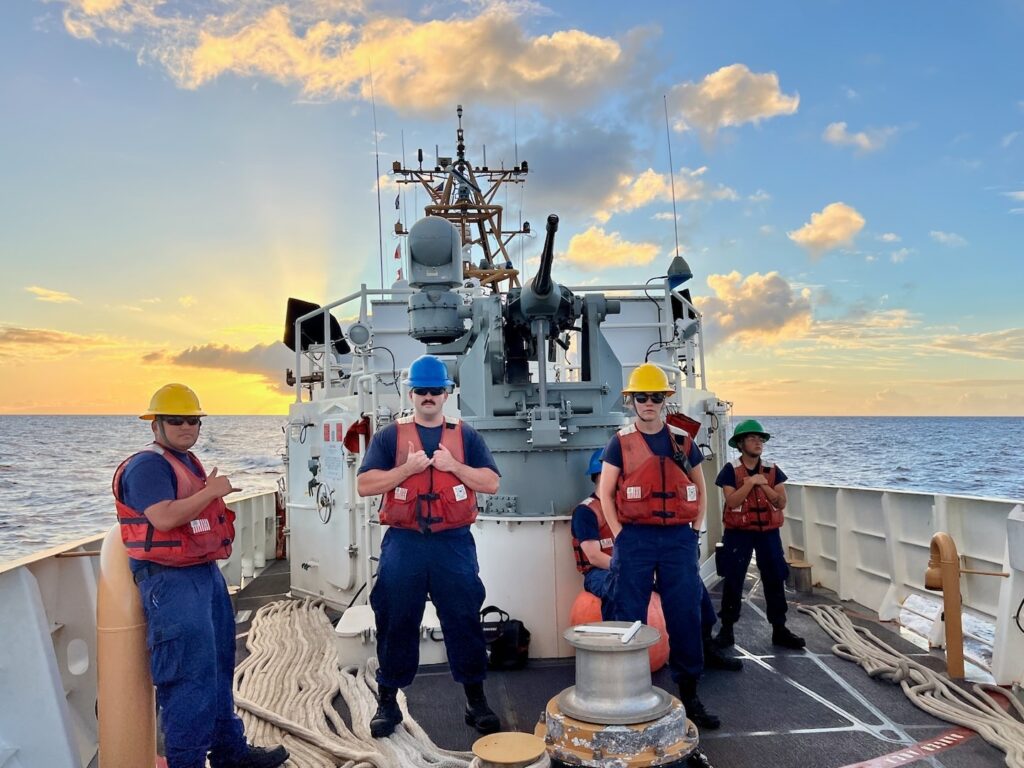
SANTA RITA, Guam — The crew of the USCGC Frederick Hatch (WPC 1143) completed a significant operational patrol under Operation Rematau from Feb. 15 to March 4, 2024, reinforcing the U.S. Coast Guard’s commitment to maritime safety, security, and environmental stewardship in the Pacific region.
“Frederick Hatch marked an important milestone in the U.S. Coast Guard’s relationship with our friends in Palau by pioneering the use of the recently signed enhanced bilateral agreement, and we look forward to deepening our ties with Palau’s Marine Law division going forward. The cutter’s first-ever visit to Tinian and participation in Yap Day were both very enjoyable ways to learn about the cultures of our neighboring islands while reflecting our commitment to communities across the Pacific,” said Lt. Patrick Dreiss, commanding officer of USCGC Frederick Hatch.
The Frederick Hatch crew proudly represented the U.S. Coast Guard at the annual Pika Fest Celebration on Tinian, Commonwealth of Northern Mariana Islands, and Yap Day in Colonia, Yap State, the Federated States of Micronesia (FSM).
Supporting local needs, they transported 1,500 lbs. of non-perishable food, 1,200 lbs. of water, and essential supplies, including fishing gear and tools, to Ulithi Atoll, FSM, during a state-declared emergency drought. The crew renewed the meaningful connection with the local community, engaging in direct support and sharing in the generosity and warmth of the island’s residents.
“The opportunity to contribute to the enduring partnership between the Ulithi community and the U.S. Coast Guard, rooted in World War II and grown throughout decades of collaboration, was a special experience for myself and the crew. Thank you to the local non-profit organizations we worked alongside, as the experience of supporting and visiting the people of Ulithi is one of the highlights of my career,” said Dreiss.
Further showcasing the spirit of cooperation and support, the Hatch’s crew organized a donation drive prior to sailing, collecting 40 bags of school supplies and clothing from the U.S. Coast Guard community in Guam and collaborated with the Ayuda Foundation and the Ulithi-based One People One Reef research foundation to facilitate these critical donations to the island.
“Today exemplifies the spirit of teamwork and camaraderie that we hold dear here in Ulithi. It warms our hearts to hear that your short visit to our island was enjoyable, and we’re delighted that you appreciated the coconuts, bananas, and flowers. Knowing that the bananas are adorning your ship’s canopy, and the flowers are being proudly worn by your crew fills us with immense joy,” said Ulithi Mayor John Rulmal.
Yap Day, observed annually on March 1, is a significant cultural and legal holiday in Yap State, one of the four states of the FSM. Established in 1968 and renamed in 1979, it celebrates Yapese culture, highlighting traditional skills and competitions, such as tattooing, fresh produce contests, and traditional games. The U.S. Coast Guard regularly attends, and the 2024 celebration was particularly special as Petty Officer 2nd Class Eugene Halishlius, a native of Yap currently stationed in Guam, returned home aboard Frederick Hatch for the first time in years to participate, further symbolizing the deep connections between the U.S. Coast Guard and the Pacific communities served.
“Returning to Yap, I’m reminded of the values instilled in me: respect, humility, and the identity of being an islander. Coming from a family of navigators, we believe in the power of knowing your waypoints, a principle that guides us to success. Inspired by my brother Ken Raigeluw, who is also serving and driven by our service’s unique opportunities and missions, this journey not only contributes to our collective mission but also my personal growth and family legacy,” said Halishlius.
The Frederick Hatch crew responded to a request from the government of Yap State for a U.S. Coast Guard presence near Ngulu Atoll to deter illegal sea cucumber poaching, demonstrating a commitment to protecting the region’s marine resources and aiding partners. This patrol also marked the first-ever boarding under the Palau enhanced bilateral agreement, signed in August 2023, authorizing U.S. Coast Guard boarding officers to conduct boardings in Palau’s exclusive economic zone (EEZ) on the country’s behalf without a Palauan officer present. While the crew found everything compliant with international and Palauan requirements, the action set a precedent for further regional maritime law enforcement cooperation. It reinforces the trust and confidence of partners in the U.S. Coast Guard’s role to ensure compliance with fishing regulations within partner EEZs.
The patrol also emphasized the need for continued vigilance in the Western Pacific. Not for the first time, the Frederick Hatch crew identified areas of concern for illegal fishing activities and non-compliance with maritime regulations wherein fishing vessels were observed not transmitting on AIS or VMS near the Palau EEZ border with the high seas.
“These efforts not only affirm our dedication to preserving the region’s marine biodiversity but also reinforce the strong and enduring partnerships we have, particularly in support of our Compact of Free Association partners addressing shared security challenges and advancing mutual interests in the Blue Pacific,” said Capt. Nick Simmons, commander of U.S. Coast Guard Forces Micronesia/Sector Guam. “Our partnership with local non-profits and the community in Guam exemplifies a holistic approach to strengthening the fabric of trust and mutual respect we’ve built over decades with Pacific Island communities and beyond as we face future challenges and opportunities together.”
About Operation Rematau Operation Rematau is how U.S. Coast Guard Forces Micronesia/Sector Guam supports the overarching Coast Guard endeavor Operation Blue Pacific to promote security, safety, sovereignty, and economic prosperity in Oceania. Rematau means people of the deep sea. It reinforces the U.S. commitment to working together to advance Pacific regionalism based on the Blue Pacific narrative. This action supports U.S. national security objectives, bolstering regional maritime good governance and security.
About USCGC Frederick Hatch The Frederick Hatch is the 43rd 154-foot Sentinel-class fast response cutter named for a surfman and lighthouse keeper who was a two-time Gold Life Saving Medal recipient. Designed for many missions, including search and rescue, national defense, and maritime law enforcement, the Frederick Hatch crew plays a significant role in safeguarding national interests and preserving good maritime governance.
March 13 Red Sea Update
USCENTCOM, March 13, 2024
TAMPA, Fla. – Between 2:00 a.m. and 4:50 p.m. (Sanaa time) on March 13, Iranian-backed Houthi terrorists fired one anti-ship ballistic missile from Houthi-controlled areas of Yemen into the Gulf of Aden. The missile did not impact any vessels and there were no injuries or damage reported.
United States Central Command then successfully engaged and destroyed four unmanned aerial systems (UAVs) and one surface-to-air missile in Houthi-controlled areas of Yemen.
It was determined these weapons presented an imminent threat to merchant vessels and U.S. Navy ships in the region. These actions are taken to protect freedom of navigation and make international waters safer and more secure for U.S. Navy and merchant vessels.
The Correspondent and the Colonel: Pearl Harbor and 9/11 Link Defender and Daughter
Charles Compton at Coastal Air Patrol Base 1 in Atlantic City, New Jersey. Compton family
Charles Compton was like many a Chicago teenager who learned to fly in the late 1930s and impressed a lovely girl or two along the way on airborne dates. One beauty would become his wife.
“It was a lot of fun years. But then it all changed,” Compton said in 2011 when he was promoted to the rank of colonel by the Civil Air Patrol to honor his life of service.
Dec. 7, 1941
“I was out practicing touch and goes, and I landed. Somebody came out and said, “all aircraft are grounded,” he said. No one knew what was coming next.
Sept. 11, 2001
ABC News White House Correspondent Ann Compton started a routine day with a chore made easier by a run of the mill story. She was the pool reporter responsible for doing all the fact gathering for other broadcast news media outlets as President George Bush listened as Florida grade schoolers read for him. As a parent It was a lot of fun to witness. But then it all changed.
Compton watched the President’s face as White House Chief of Staff Andy Card whispered in his ear, “A second plane hit the second tower. America is under attack.”
“The Pearl Harbor moment was immediate,” Compton said. “As we were taking off, the Pentagon was hit.”
For the next 10 hours, the network TV reporter was one of the few on Air Force One as the presidential aircraft and its fighter escorts headed for cross-country protection, soaring above a nation of planes quickly descending and landing as fast as they could, wherever they could. All aircraft were grounded, and no one knew what was coming next.
August 1943
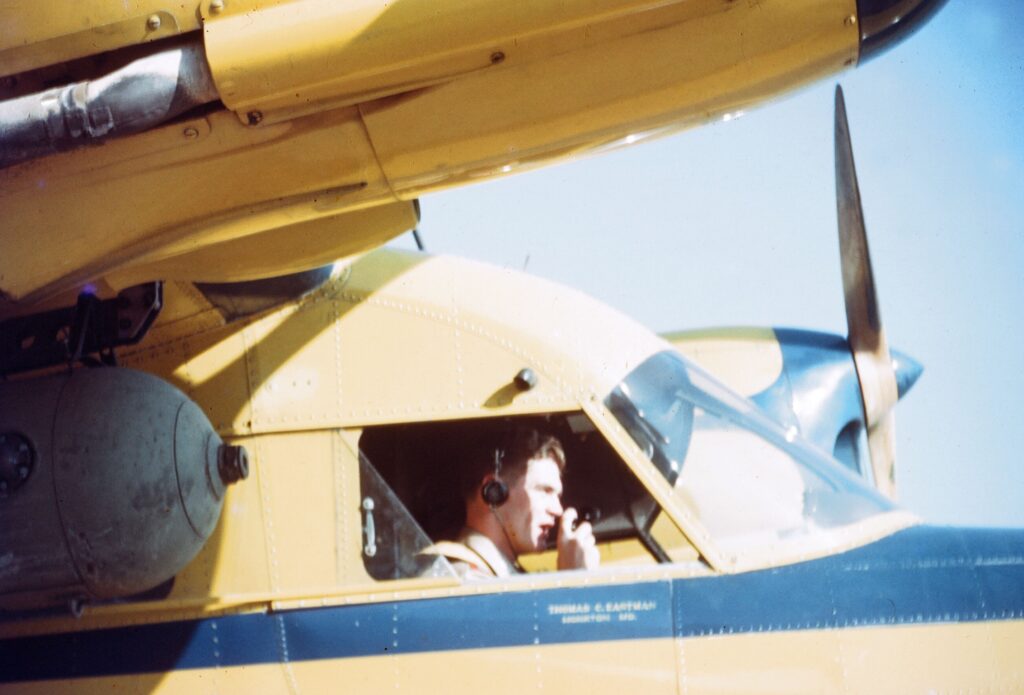
A little plane flew through the mist of a New Jersey morning off New York Harbor and pulled into a tight circle to sweep low, glancing for U-boats ravaging shipping just outside major harbors and along the coast. Charlie Compton was in his own plane, wearing a makeshift Army Air Corps uniform of the Civil Air Patrol. The CAP was organized formally six days before Pearl Harbor. America wasn’t ready to defend itself on the home shores due to limited military planes and pilots.
Right after Pearl Harbor, Compton tried to get into the fight and fly with the Army and Navy but was denied by both for having only one kidney. He eventually found his way to the first coastal patrol base of the Civil Air Patrol in Atlantic City, New Jersey.
The Axis Powers were more than ready. An east coast oceanfront of sunbathers and ship traffic quickly became a kill zone of merchant convoys being attacked within sight of shore. The bodies of merchantman washed ashore as ships carrying vital supplies and war materiel to Europe were sometimes sunk amid the explosions and towering flames of torpedoed tankers.
The Germans called it “the happy time.” But the little yellow planes kept coming.
One of them would be Compton and a fellow pilot hunting for submarines one day, escorting a convoy the next. Through the Army and then Navy, the escorts began to make a difference.
The goal wasn’t necessarily to sink subs but to drive them away, like a border collie does predators of the sheep. And in short order, the sheep were no longer going to the slaughter and the hunter became the harried.
The network of coastal patrol bases stretched from Maine to Mexico.
For some time now the CAP planes had been armed with an assortment of bombs, singly and in pairs.
“In mid-May 1942, senior Army and Navy leaders authorized the arming of CAP coastal patrol aircraft,” according to Frank Blazich Jr., the military history curator at the National Museum of American History. “Depending on capacity, aircraft typically carried one to three 100-pound AN-M30 general purpose demolition bombs; larger aircraft carried either the AN-M57 250-pound demolition bomb, or one 325-pound Mk 17 depth bomb.”
The nascent Battle of the Atlantic wasn’t meant to be won by attrition as much as by harrassing the German subs into diving to avoid being attacked from the air. Every dive to avoid being spotted or attacked meant less time to charge their batteries on the surface.
“We were all out there pretty gung-ho and looking for a fight,” Compton said, but that made the Army weaponers cautious as to when the CAP planes would be armed. “We could tell what kind of day it was going to be if we saw the Army ordnance trailers out there arming the aircraft,” he said.
No bomb loading meant the focus was to be on escort and observation, reporting back to female CAP radio operators.
“And then we would generally fly three-hour missions, by escorting the tankers and the colliers and the cargo ships, up and down the coast … and then hand off to other sections,” he said.
But often there was no one to hand off the overwatch duties to, because the imperiled convoys were making a beeline to Europe. They were on their own, escorted by a handful of navy ships from the U.S., Canada and Great Britain.
“We did fly low enough to give them a wave. And when we saw them off and dipped our wing, and saw them heading east into harm’s way while we were able to go back to our safe haven. We thought a lot about those brave souls, some that didn’t make it,” Compton reflected during his promotion ceremony.
Even today, his daughter Ann speaks passionately about her father’s feelings of the time.
“That’s a long trek for a merchant ship,” she says, recalling how this part of his service laid heavy on his heart then, and on hers today. “The pain he felt that they were sailing into harm’s way and he could no longer protect them — he took that very hard.”
Blazich wrote that “on July 19, 1942, German Admiral Karl Doenitz, commander of all German U-boats, withdrew his last submarines operating off the East Coast after increasing losses and reduced success against merchant traffic.”
The former national historian of the Civil Air Patrol, Blazich said “the CAP coastal patrol operation ceased on August 31, 1943, in accordance with an Army agreement to transfer all anti-submarine operations to the Navy.” His definitive and painstakingly researched book, “An Honorable Place in American Air Power” (2020 Air University Press, Maxwell AFB Florida) tells the full tale, as does this fact sheet:
The CAP reported the following to the U.S. military regarding the 18 months of coastal patrol operations:
• 57 attacks on enemy submarines
• 82 bombs dropped against submarines
• 173 radio reports of submarine positions
• 17 floating mines reported
• 36 dead bodies reported
• 91 vessels in distress reported
• 363 survivors in distress reported
• 836 irregularities noted
• 1,036 special investigations at sea or along the coast
The cost of freedom was paid for with the blood and sweat of brave civilian volunteers whose limitations for military service were transcended to remarkable service to the country.
Colonel Charles Compton lived on to have a family that included two boys and the reporter girl who would be an eyewitness to the next time the improbable happened, America caught unaware and under siege. His daughter Ann reports his final years, including his 104th in 2020, were marked by birthday tributes by the cadets he cared so much about, and cared for him in turn. His legacy and theirs lives on in the Evanston, Illinois, squadron that bears his name.
A larger family exists today in the 60,000 adult and cadet volunteers of the Civil Air Patrol, whose core missions of emergency services, aerospace education and youth program continue to serve America in “defending the skies of the homeland,” including security exercises with intercepting Air Force and Air Guard jets, drug interdiction maneuvers with homeland security aircraft, along with humanitarian disaster relief and search and rescue missions saving dozens of lives each year with the world’s largest fleet of single-engine airplanes.
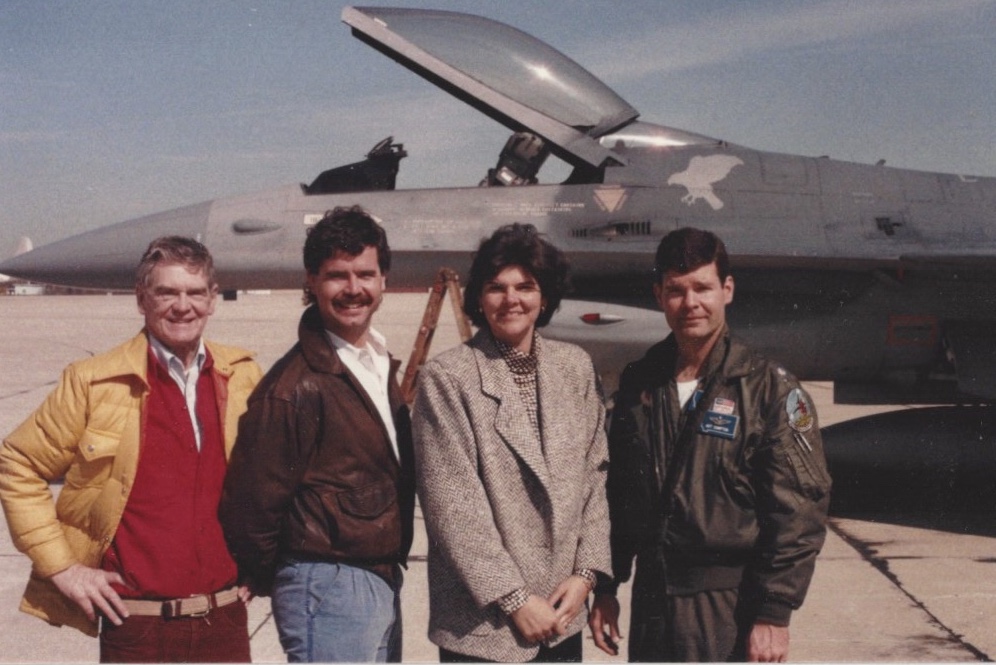
Colonel Compton (far left) with sons and daughter Ann Compton at Naval Air Station Glenview, Illinois. Compton family
Sept. 12, 2001
As yet another small plane of the Civil Air Patrol took off from New Jersey, the situation was that all planes were grounded and no one knew what would happen next.
Like so many before, it rose over the New York and New Jersey shores, yet this time it did not swoop low over the coastline or sweep past the harbor and out to the shipping lanes.
Instead of turning back to the harbor of New York City it headed up above Manhattan, the sole civilian plane in the skies of all America, swooping low to begin its circling run through the mist and around smoke rising over the wreckage of the twin towers of the World Trade Center.
New Yorkers below were still in a state of shock. Their only sense of security that remained came from the swift arrival of Navy fighters from the aircraft carriers George Washington and John F. Kennedy the day before. Those F/A-18 Hornets joined Air Force and Air National Guard interceptors in an ongoing aerial combat aircraft patrol. An obvious deterrent to terrorism, but more importantly a visual representation of protection from above.
The little red, white and blue aircraft circling the towers was doing a familiar role in a new way. Beneath its red tail marked USAF AUX and bearing the crest of the Civil Air Patrol, Lt. Col. Jacques Heinrich and his mission crew digitally photo-mapped the wreckage, to show the paths to save and the ways to recover.
The vital images from that CAP colonel were authorized by, and delivered to, President Bush at the White House as Ann Compton continued her journalistic vigil, an echo of the living example father set, protecting the sea lanes and the sea services with no pay or fanfare six decades before.
Jim McClure is a life member of the Navy League of the United States and a frequent contributor to Seapower.This story originally appeared in the February-March issue of Seapower magazine.