SCHIEBEL WINS CAMCOPTER S-300 CONTRACT FOR SOUTH KOREAN NAVY
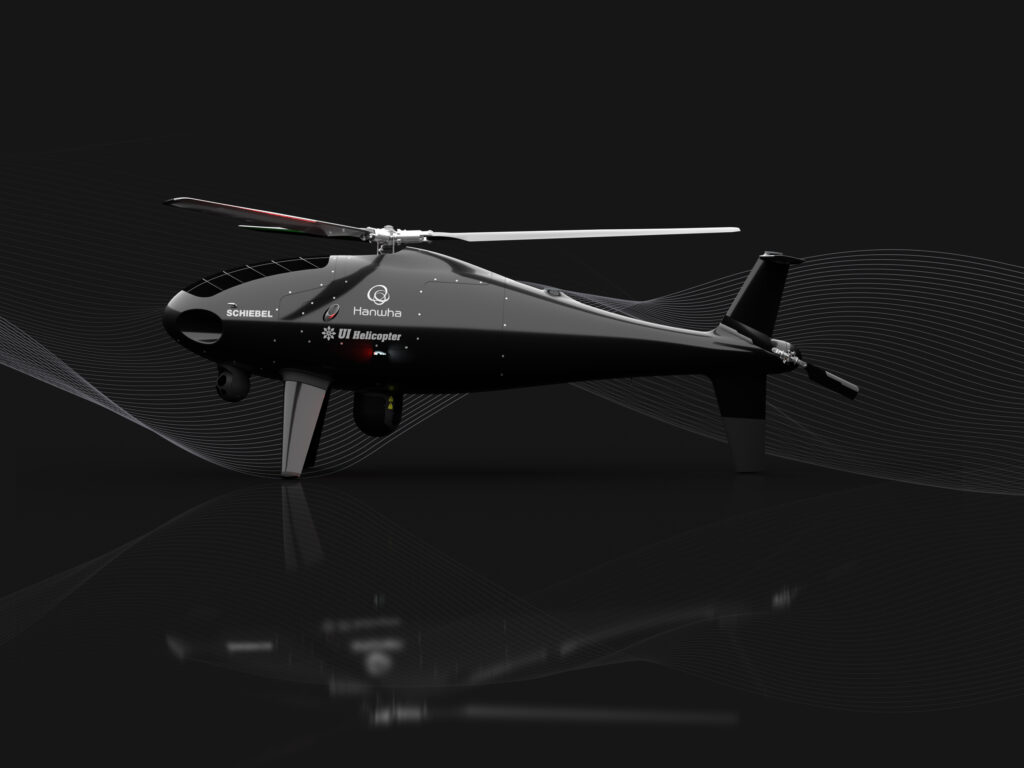
Vienna, 20 February 2024 – Schiebel, together with Korean based defence solutions companies Hanwha Systems and UI Helicopter, has been awarded a contract by the Defence Acquisition Programme Administration (DAPA) for the development and delivery of the Vertical Take-off and Landing (VTOL) CAMCOPTER S-300 Unmanned Air System (UAS), to be operated by the South Korean MOD.
The contract was signed with Hanwha Systems for the supply of the S-300 for Intelligence, Surveillance, Target Acquisition and Reconnaissance (ISTAR) missions for the South Korean Navy and Marine Corps.
The South Korean Navy has been a Schiebel customer for over 10 years, regularly carrying out maritime ISR operations with its CAMCOPTER S-100 UAS fleet. The changing geo-political situation and North Korean threat call for an expansion of their UAS fleet, adding larger and heavier UAS with greater capability.
“We are extremely excited that the South Korean Navy and Marine Corps is building on its extensive experience and success with the S-100 by awarding Hanwha the contract for Schiebel’s new long-endurance, heavy-lift-capable UAS. The S-300 marks a major milestone in the company’s history,” said Hans Georg Schiebel, Chairman of the Schiebel Group.
The STANAG-compliant and fully certifiable S-300 has an endurance of up to 24 hours and operates at an altitude of up to 21,000 feet, offering a persistent loiter capability for ISTAR operations. The heavy-lift UAS carries payloads of up to 250 kg, making it an ideal cargo delivery solution over long distances in complex and high altitude terrain. The versatility and flexibility of the S-300 also allows for the release of payloads such as dropping multiple sonar-buoys for Anti-Submarine Warfare (ASW) operations.
To ensure maximum mission versatility and cost effectiveness, the heavy-lift-capable S-300 can be controlled by the same proven Ground Control Station used by the CAMCOPTER S-100. Schiebel’s ‘system of systems’ approach ensures the interoperability of its unmanned fleet for many years to come building on its experience derived from over 20 years of building a robust and proven VTOL core system.
Schiebel recently announced the expansion of its Abu Dhabi facility extensively increasing its global footprint for the CAMCOPTER S-300. However, the new platform’s open architecture will also ensure it will be able to meet countries’ sovereignty and offset requirements.
New Dry Dock Project at Pearl Harbor Naval Shipyard Reaches Early Milestone
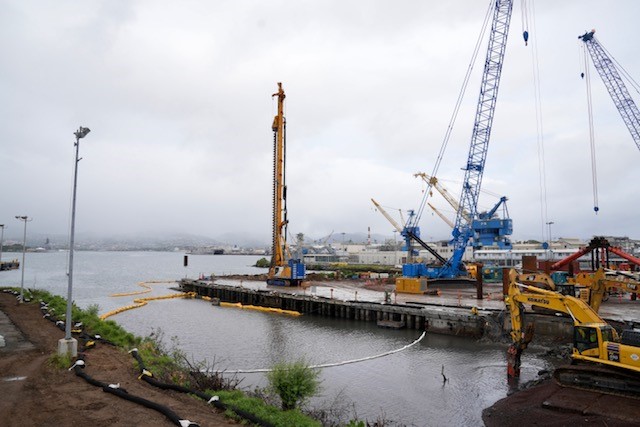
Caption: PEARL HARBOR, Hawaii – Contractors work on the construction of Dry Dock 5 at Joint Base Pearl Harbor-Hickam Dec. 18, 2023. Dragados/Hawaiian Dredging/Orion JV (DHO JV), under contract with Naval Facilities Engineering Systems Command, is conducting major in-water construction for a new dry dock at Pearl Harbor Naval Shipyard and Intermediate Maintenance Facility (PHNSY & IMF). The $3.4-billion graving dock project, the first new dry dock in Pearl Harbor since 1943, will support PHNSY & IMF’s ability to continue maintaining and modernizing the U.S. Navy’s nuclear-powered submarines into the future. U.S. Navy photo by Joel Onemu
From Pearl Harbor Naval Shipyard Public Affairs, Feb. 16, 2024
PEARL HARBOR, Hawaii – Dragados/Hawaiian Dredging/Orion JV (DHO JV), under contract with Naval Facilities Engineering Systems Command (NAVFAC), has begun major in-water construction for a new dry dock at Pearl Harbor Naval Shipyard and Intermediate Maintenance Facility (PHNSY & IMF).
Dry Dock 5 construction commenced after a traditional Hawaiian blessing ceremony on Aug. 19, 2023, and the project has reached the milestone of starting the installation of foundational piles that will essentially anchor the new graving dock.
The Navy will commemorate this significant, early-phase construction milestone at the Dry Dock 5 Anchoring Ceremony scheduled for Feb. 24, 2024, at 10 a.m. at PHNSY.
U.S. Senator Mazie Hirono, Adm. Samuel Paparo, Commander, U.S. Pacific Fleet, and Gerry Majkut, president of Hawaiian Dredging Construction Company, Inc., are scheduled to speak at the ceremony.
“This milestone is a testament to the hard work various organizations have put into the project and a reminder of the steadfast commitment to our community here in Hawai’i,” said Capt. Richard Jones, PHNSY & IMF commander.
The $3.4-billion graving dock project will support PHNSY’s ability to continue maintaining and modernizing the U.S. Navy’s nuclear-powered submarines into the future. It will include the necessary support facilities and the new dry dock will have a 150-year service life. Dry Dock 5 will replace Dry Dock 3, one of four existing dry docks at PHNSY & IMF. Dry Dock 3 is the smallest dry dock and is incapable of docking the current Virginia-class of Navy submarines. The last dry dock to be constructed in Pearl Harbor was in 1943.
To oversee the project, Naval Facilities Engineering Systems Command (NAVFAC) commissioned its newest command, Officer in Charge of Construction, Pearl Harbor Naval Shipyard (OICC PHNSY) in March 2023. OICC PHNSY provides robust quality assurance, contract administration, and command-level accountability for construction of DD5 and the broader once-in-a-generation recapitalization of PHNSY under the Navy’s Shipyard Infrastructure Optimization Program (SIOP).
“Setting the conditions for full-scale construction on a project of this magnitude took a robust team of professionals in both government and industry,” said OICC PHNSY Commanding Officer Capt. Stephen Padhi. “Logistics, permits, monitoring, site preparation, work planning and controls had to set the stage for production for the next four years. As major activities are underway, we look forward to confidently meeting our targets for schedule, quality, safety, cost, and ethics.”
Leading the construction is contractor DHO JV. “We’re extremely excited to work on a project of this scale with the U.S. Navy,” said Gerry Majkut, president of Hawaiian Dredging Construction Company, Inc. “Not many companies get the chance to be part of a major project like this, so having the opportunity to build this dry dock is extremely rewarding.”
Over the course of construction, which is scheduled to finish in 2027, DHO JV expects to draw from many local and small businesses in Hawaii to support the project, in close coordination with local unions. Overall, the project is expected to provide approximately 2,500 jobs locally.
Navy to Commission Future Expeditionary Sea Base USS John L. Canley
FEB. 16, 2024
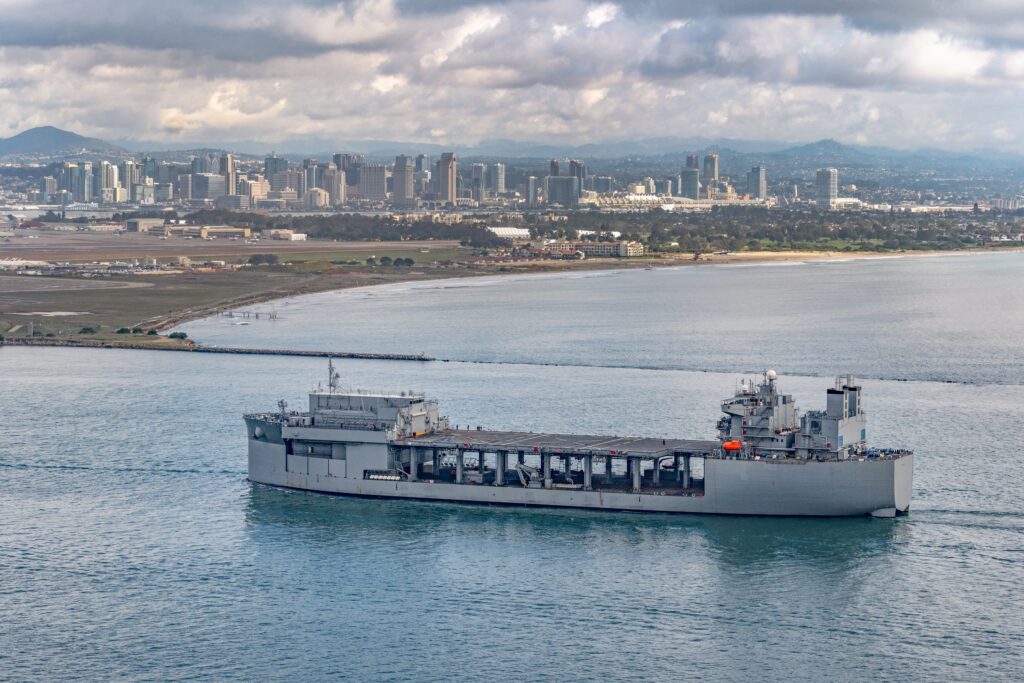
The Navy will commission the future USS John L. Canley (ESB 6) as the newest Expeditionary Sea Base ship (ESB) during a 10:00 a.m. PST ceremony on Saturday, Feb. 17, in Coronado, California.
The commissioning ceremony’s principal address will be delivered by the Honorable Carlos Del Toro, Secretary of the Navy. Remarks will also be provided by General Joseph P. Dunford, Jr., 19th Chairman of the Joint Chiefs of Staff and 36th Commandant of the Marine Corps; Sergeant Major Carlos Ruiz, Sergeant Major of the Marine Corps; and Mr. David Carver, President of General Dynamics NASSCO. The ship’s sponsor is Patricia Sargent, Sgt. Maj. Canley’s daughter.
Built by General Dynamics NASSCO, currently there are six delivered ships across two variants: Expeditionary Transfer Dock (ESD) and Expeditionary Sea Base. The future USS John L. Canley (ESB 6) is a highly flexible platform used across various military operations. When commissioned, the ship will be employed as a mobile sea-based asset. It will be a part of the critical access infrastructure supporting the deployment of forces, equipment, supplies, and warfighting capability.
The first of its name, the ship honors United States Marine Corps Sgt. Maj. John L. Canley, Ret., who was awarded the Medal of Honor 50 years after his actions during the Battle of Hue City. Canley served as Company Gunnery Sergeant, Company A, First Battalion, First Marines, First Marine Division in the Republic of Vietnam from Jan. 31 to Feb. 6, 1968. Sgt. Maj. Canley passed away in Bend, Oregon May 11, 2022.
ESB 6 joins the USS Lewis B. Puller (ESB 3), USS Hershel “Woody” Williams (ESB 4), USS Miguel Keith (ESB 5) which support a variety of maritime-based missions, including Special Operations Forces (SOF) and Airborne Mine Counter Measures (AMCM). ESBs have a four-spot flight deck, mission deck, and hangar, designed around four core capabilities: aviation facilities, berthing, equipment staging support, and command and control assets. Follow-on ships Robert E. Simanek (ESB 7) and Hector A. Cafferata Jr. (ESB 8) are under construction. The commissioning of ESBs provides combatant commanders greater operational flexibility to employ this platform in accordance with the laws of armed conflict.
The ceremony will be live streamed at https://www.dvidshub.net/webcast/33415. The link becomes active approximately ten minutes prior to the event at 09:50 a.m. PST.
Three-Star Command Lands in Norway for Exercise Nordic Response 24
By II MEF Communication Strategy and Operations, Feb. 15. 2024
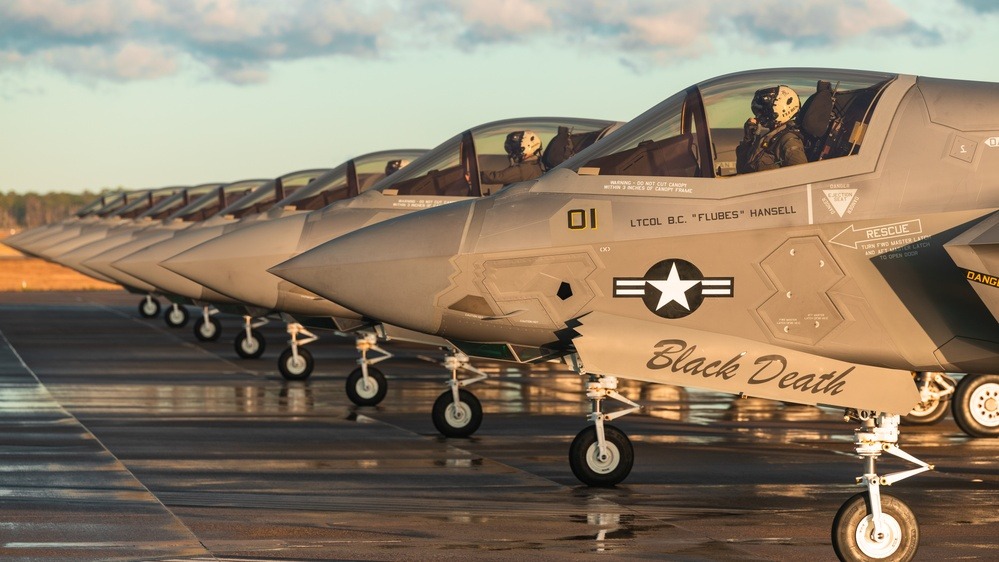
On February 12th, the vanguard of the U.S. Marine Corps, II Marine Expeditionary Force (MEF) command element arrived at Bardufoss Air Station, Norway, to participate in NATO’s exercise Nordic Response 24. As the Land Component Command headquarters for the exercise, II MEF’s command element will synchronize operations between the U.S. Marine Air-Ground Task Force, Norwegian Army units and a combined Swedish and Finnish Brigade under a NATO Joint Task Force.
We’re looking forward to exercising with our Norwegian hosts, NATO allies and partners,” remarked II MEF commanding general Lt. Gen. David A. Ottignon. “There’s no place like the Nordic countries to sharpen our warfighting skills.”
Nordic Response 24 is part of the much larger NATO exercise Steadfast Defender 2024, which is expected to involve approximately 90,000 troops across Europe. According to U.S. Army Gen. Christopher Cavoli, NATO’s Supreme Allied Commander and U.S. Europe Command commander, the exercise “will demonstrate our unity, our strength, and our determination to protect each other.”
II MEF’s strategic deployment more than 6,500 kilometers from its home base in the United States demonstrates the reach and mobility of American forces available to defend NATO’s northern flank, if called upon.
“Nothing is easy when you’re operating in several feet of snow, at negative 40 degrees Fahrenheit, surrounded by 5,000-foot mountain peaks,” Ottignon said. “But being a Marine isn’t about doing what’s easy. It’s about being the best and being prepared for the challenges of the future. This exercise in this environment is designed to do just that by building on the grit, skills, and determination within every Marine so they can operate in any clime and place.”
Around 2,500 U.S. Marines will join the exercise alongside NATO allies and Sweden. The goal is to strengthen coordination across air, ground, maritime and other domains into a unified fighting force ready to respond to any threat.
From January to March 2024, the U.S. Marines and their Norwegian counterparts will work hand-in-hand with NATO allies to hone tactics and procedures for winter warfare. Beyond tactical objectives, the exercise signals the steadfast solidarity allies share in defending collective security.
“Norway is special to us. Our countries have been working together for more than a century. II MEF has trained side-by-side, strengthening bonds and operating as one cohesive team in Norway during the last decade of Cold Response exercises,” added Ottignon. “The Arctic is a fluid strategic place. It’s important for our allies to know that we’re here today and we’ll be here when needed to respond swiftly to any threat.”
B-roll, imagery, and news stories of II MEF Marines preparing for exercise Nordic Response 24 ca be found hyperlinked.
CENTCOM Intercepts Iranian Weapons Shipment Intended for Houthis
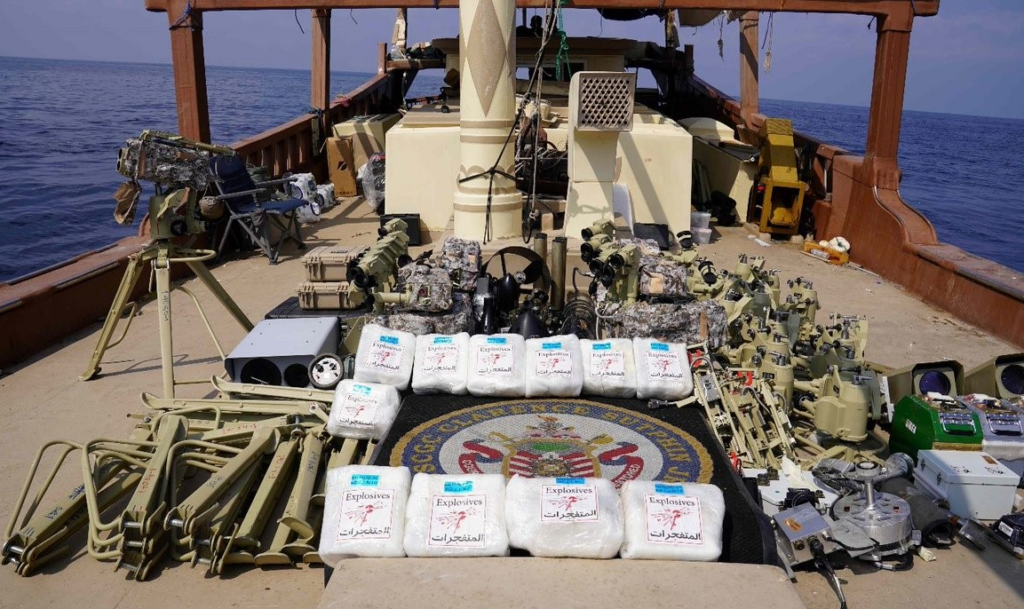
Military-grade weapons and other lethal supplies are stacked on the deck of a vessel seized by the U.S. Coast Guard Sentinel-class fast-response cutter USCGC Clarence Sutphin Jr. (WPC 1147) in the Arabian Sea, Jan. 28. Clarence Sutphin Jr. operates in the U.S. 5th Fleet area of operations to help ensure maritime security and stability in the Middle East region. (Photo by U.S Coast Guard)
By U.S. Central Command Public Affairs | February 15, 2024
TAMPA, Fla. — A U.S. Coast Guard cutter, forward deployed to the U.S. Central Command (CENTCOM) area of responsibility, seized advanced conventional weapons and other lethal aid originating in Iran and bound to Houthi-controlled areas of Yemen from a vessel in the Arabian Sea on Jan. 28.
The U.S. Coast Guard Sentinel-class fast-response cutter USCGC Clarence Sutphin Jr. (WPC 1147), assigned to U.S. Naval Forces Central Command, located the vessel and boarded it in the Arabian Sea. The boarding team discovered over 200 packages that contained medium-range ballistic missile components, explosives, unmanned underwater/surface vehicle (UUV/USV) components, military-grade communication and network equipment, anti-tank guided missile launcher assemblies, and other military components.
The direct or indirect supply, sale or transfer of such aid violates U.N. Security Council Resolution 2216 (as extended and renewed by resolutions 2675 and 2707).
“This is yet another example of Iran’s malign activity in the region, ” said Gen. Michael Erik Kurilla, CENTCOM commander. “Their continued supply of advanced conventional weapons to the Houthis is in direct violation of international law and continues to undermine the safety of international shipping and the free flow of commerce.”
CENTCOM is committed to working with our allies and partners to counter the flow of Iranian lethal aid in the region by all lawful means including U.S. and U.N. sanctions and through interdictions.
WEST 2024: Naval Special Warfare a Force Multiplier for Fleet, Prioritizing Reintegration with Joint Force
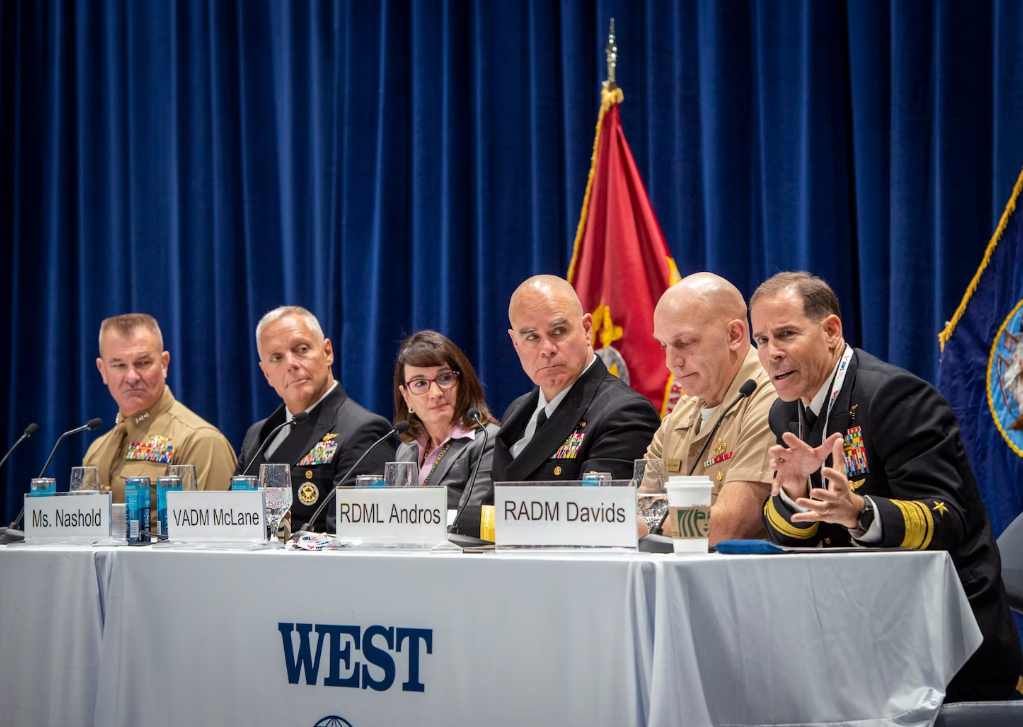
Rear Adm. Keith Davids, commander, Naval Special Warfare Command (NSWC), answers questions during the WEST 2024 convention held at the San Diego Convention Center. U.S. Navy | Mass Communication Specialist 2nd Class Kyle Fiori
SAN DIEGO – Rear Adm. Keith Davids, commander, Naval Special Warfare Command (NSWC), attended and participated in AFCEA-USNI WEST (WEST) 2024 conference, Feb. 13-15.
WEST, the premier naval conference and exposition on the West Coast, brings military and industry leaders together to discuss new technologies and capabilities. The theme of the 34th iteration of the event was, “Are Acquisition and Readiness on Pace to Meet Global Security Demands?”
Davids participated in a panel discussion alongside six leaders from sea service warfare communities to discuss acquisition and readiness and address the question, “What Changes are Community Leaders Making to Meet Global Security Demands?”
“Over the past two decades, the focus of Naval Special Warfare (NSW) has been primarily on counterterrorism,” said Davids. “Now, we are prioritizing integration with the Fleet and Joint Force. We can operate forward in contested areas that enhances warfighting lethality in unique ways. ”
Davids emphasized that conventional response methods have grown ineffective in addressing contemporary conflicts and diverse threats across the globe. To counter the instability and distinct challenges to U.S. warfare capabilities, Davids called on industry to support NSW’s value proposition.
“We’re interested in leveraging our maritime access and placement to deliver asymmetric effects for the Fleet. Therefore, we need industry’s help to enhance our stealth, precision, scale, and decision advantage,” said Davids. “We are eager to collaborate with many of you on new ideas and concepts.”
Joining Davids on the panel was Rear Adm. Brad Andros, commander, Navy Expeditionary Command, Lt. Gen. Karsten Heckl, commanding general, Marine Corps Combat Development Command, Vice Adm. Brendan McLane, commander, Naval Surface Forces, Vice Adm. Daniel Cheever, commander, Naval Air Forces and Elizabeth Nashold, deputy commander, Naval Information Forces. Retired Vice Adm. Peter H. Daly, former CEO and Publisher, U.S. Naval Institute, moderated the discussion.
AFCEA, which stands for the Armed Forces Communications & Electronics Association, and the U.S. Naval Institute (USNI), sponsor WEST each year. The conference is organized into a main program and three engagement theaters – Marine, General, and Information Warfare.
Along with exhibits, keynote speakers and panel discussions, WEST also gives attendees a chance to hear from the Secretary of the Navy, the Chief of Naval Operations, the Commandants of the Marine Corps and Coast Guard, the Sea Service Chiefs, and various industry leaders.
WEST 2024 also featured a Department of the Navy (DON) Information Technology (IT) conference, an Innovation Showcase, and awards announcements recognizing individual and group winners in categories such as Emerging Leaders, a USNI essay contest, and women’s appreciation.
Naval Special Warfare is the nation’s elite maritime special operations force, uniquely positioned to extend the Fleet’s reach and gain and maintain access for the Joint Force in competition and conflict.
AeroVironment’s Puma 3 AE Now Offers Extended Endurance of up to 3 Hours
A new optional battery extends the range of AeroVironment’s Puma 3 AE UAS. AeroVironment
ARLINGTON, Virginia – AeroVironment’s PS2500 battery is now approved for use in the Puma 3 AE unmanned aircraft system (UAS). The optional PS2500 battery allows operators to achieve extended endurance of up to three hours of flight time. The increased endurance provides operators with greater mission flexibility and time on station across land and maritime operations.
“The new PS2500 battery offers both new and current Puma customers the opportunity to dramatically expand the duration of their operations, enabling more ground covered in a single flight,” said Brad Truesdell, AeroVironment’s vice president and general manager of small UAS (SUAS). “Adding longer endurance capabilities to Puma’s existing flexible launch options and modularity makes it a truly unparalleled asset for various types of operations.”
Puma customers can now choose between the standard smart battery with two and a half hours of endurance, or the PS2500 battery with three hours of endurance. The high-energy-density lithium-ion PS2500 battery pack features an improved capacity of 24.5Ah (amp-hours) while retaining the size and form factor needed to be seamlessly integrated into Puma 3 AE’s existing battery bay and is also interoperable with Puma LE as a Line Replaceable Unit (LRU).
U.S. 7th Fleet Holds Change of Command, Welcomes New Commander
By U.S. 7th Fleet Public Affairs, Feb. 15, 2024
YOKOSUKA, Japan – U.S. 7th Fleet held a change of command ceremony Feb. 15 at the Fleet Activities Yokosuka Theater.
Vice Adm. Fred W. Kacher relieved Vice Adm. Karl O. Thomas as the 54th commander of the world’s largest forward-deployed naval force, U.S. 7th Fleet.
“To the men and women of 7th Fleet, it has been my sincere honor to lead this forward deployed team as you demonstrated daily how professional navies operate to secure the maritime commons and uphold the rules based international order,” said Thomas. “To my counterparts in our ally and partner nations throughout the region, your professionalism and friendship has been the greatest reward as we operated as one seamless team. I remain inspired by your commitment to maintaining a free and open Indo-Pacific.”
Prior to commanding 7th Fleet, Thomas served as the assistant deputy chief of naval operations, plans, and strategy, a role Kacher also held. Thomas began his career as an E-2C Hawkeye aviator, and he commanded a carrier airborne early warning squadron, two aircraft carriers and the forward-deployed Carrier Strike Group in Japan. His follow-on assignment will be the deputy chief of naval operations for information warfare.
During the ceremony, Thomas emphasized the critical importance of his close relationships with fleet commander counterparts throughout the Indo-Pacific. Throughout his tenure, Thomas led numerous advanced dual-carrier operations, multilateral events, critical freedom of navigation operations, and Taiwan Straits transits, among other high-visibility exercises and operations with allies and partners from across the Indo-Pacific.
Vice Adm. Blake Converse, deputy commander, U.S. Pacific Fleet, spoke highly of Thomas’s visionary leadership and the importance of the rules-based international order in the Indo-Pacific.
“Our national command authority continues to recognize that this is the most important and consequential theater that we operate our forces in,” said Converse. “As such, we have grave responsibilities to deter aggression, to protect the international rules-based order, and to ensure freedom of navigation.”
Kacher began his career as a surface warfare officer aboard cruisers and destroyers. He was the first commanding officer of the Arleigh Buke class guided-missile destroyer USS Stockdale (DDG 106), and went on to serve as the commodore of Destroyer Squadron Seven, commander of Expeditionary Strike Group Seven; executive officer to the Supreme Allied Commander, Europe, and Commander, U.S. European Command; and chief of staff to Commander, Naval Surface Force, U.S. Pacific Fleet. He most recently served as the acting Superintendent of the U.S. Naval Academy.
“I could not be more humbled to lead the U.S. 7th Fleet,” said Kacher. “I am honored to re-join our forward deployed men and women as we operate combat credible naval forces in one of the most complex maritime regions in the world, and I look forward to engaging with our allied and partner navies in our shared commitment to a free and open Indo-Pacific.”
U.S. 7th Fleet is the U.S. Navy’s largest forward-deployed numbered fleet and routinely interacts and operates with allies and partners in preserving a free and open Indo-Pacific region.
For more news from Commander, U.S. 7th Fleet, visit https://www.c7f.navy.mil/.
CNO Concludes Trip to West Coast for Industry and Sailor Engagements
14 February 2024
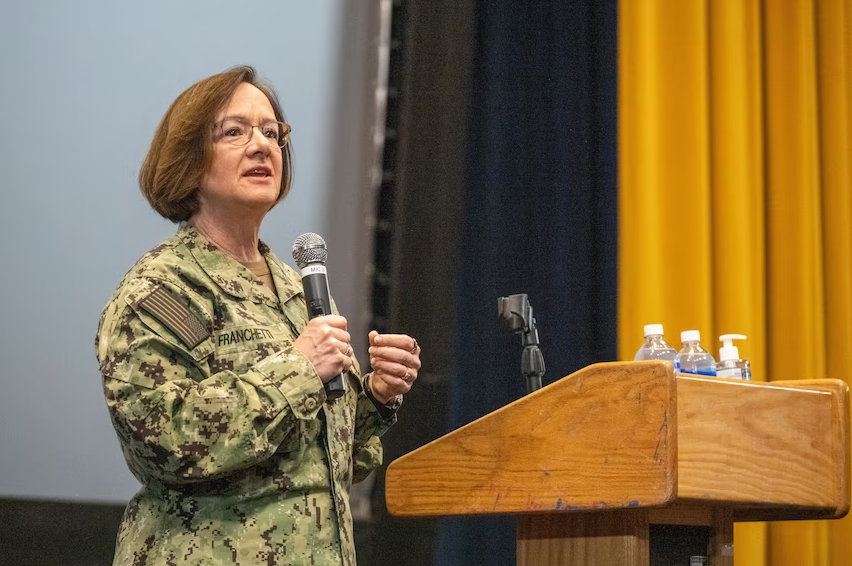
SAN DIEGO – Chief of Naval Operations Adm. Lisa Franchetti traveled to San Diego to speak at WEST 2024, meet with industry leaders, and engage with Sailors, Feb. 12-14.
Franchetti’s visit to San Diego was anchored with WEST 2024, the premier naval conference and exposition on the West Coast, which brings military and industry leaders together – connecting platform builders and designers of technologies with the military and government officials that utilize them, where she delivered a keynote address and took questions from the audience.
During her remarks, the CNO emphasized her priorities for America’s Warfighting Navy and discussed how leaders at all levels need to think differently about how the Navy operates in uncertain, complex and rapidly changing environments. She expressed her pride in the Navy team, noting that no other Navy is capable of deploying and sustaining forces at such a global scale – from seabed to space, cyberspace and in the information environment. Looking to the future, she shared that the Navy is acting with purpose and urgency to leverage technological breakthroughs that are redefining conflict. She then highlighted her focus on expanding the reach, depth, and lethality of the Fleet through manned-unmanned teaming.
“We’re building on the many successes with unmanned systems that you’ve read about in 4th Fleet, 5th Fleet, and 7th Fleet. These are real-world laboratories of learning.” said Franchetti. “I think unmanned and autonomous systems have an enormous potential to multiply our combat power by complementing our existing fleet of ships, submarines and aircraft.”
After the keynote address, Franchetti walked the exhibit floor room to see displays, watch demonstrations, and meet with industry leaders to discuss how the Navy can work with the defense industrial base to field the Navy of today and the future. Franchetti then visited General Dynamics NASSCO, the only full-service shipyard on the West Coast, where she was briefed on current and future programs, and heard how NASSCO is leveraging commercial design and finding innovative ways to construct ships in order to drive down cost and mitigate construction delays.
While at the shipyard, CNO toured the fleet replenishment oiler USNS Earl Warren (T-AO 207). The 746-foot Warren is one of the new John Lewis-class and has the ability to carry 162,000 barrels of diesel ship fuel and aviation fuel and dry stores cargo, which will bring increased capacity to sustain warfighters at sea.
Next, Franchetti visited the amphibious transport dock USS Anchorage (LPD 23). Anchorage entered the shipyard in July 2023, following a 7-month Western Pacific deployment, where the crew received the 2023 Maritime Excellence Award. Anchorage is currently undergoing a lifecycle maintenance availability to prepare the ship for future deployments through system upgrades and refurbishments.
Aboard Anchorage, Franchetti met with Sailors and recognized them for their achievements, received updates on the ship’s first Drydocking Selected Restricted Availability, and was able to speak to the crew and NASSCO shipyard workers on the ship’s Main Circuit.
“I can see by walking around and meeting some of your great teammates that you’re getting after my priorities every day, and you’re making sure our Navy puts more players on the field just like this exceptional warship,” Franchetti said. “I couldn’t be more proud of what the team has done in just six or so months, you’ve made incredible progress. From the installation of the new SPS-73 radar, to the repairs on the bulkhead and ballast tanks and everything in between, I am really impressed with what’s been accomplished here.”
CNO rounded out her visit with an all-hands call at Naval Base San Diego for more than 750 Sailors. During the all-hands call she highlighted her priorities, emphasized the need for a ready, combat-credible maritime force, and stressed the importance of the warfighter to the Navy’s mission.
“It’s about warfighting – delivering decisive combat power, and that’s about warfighters,” said Franchetti. “That’s all of you right here in this room. Because we can have the best platforms in the world, but they don’t go anywhere and they don’t do anything without the people that operate them and make us the most powerful Navy in the world.”
Franchetti concluded her trip to San Diego by visiting multiple unaccompanied housing barracks at Naval Base San Diego and Naval Air Station North Island, in order to see firsthand the living conditions on base. She assured leadership and Sailors that she remains committed to providing the Navy’s Sailors and civilians with a quality of service that meets or exceeds established standards.
“My priorities are warfighting, warfighters and the foundation that supports them. We can’t do what we need to do every day, without our Sailors, active and reserve, without our Department of Navy civilians, and of course, without the families who support everything we do. So I am focused on quality of service, which is a combination of the quality of work and the quality of life,” said Franchetti.
This was CNO’s second trip to the West Coast since her confirmation.
USNS Mercy Returns to San Diego, Concluding Pacific Partnership 24-1
By Ensign Lacy Burkett
Feb. 13, 2024
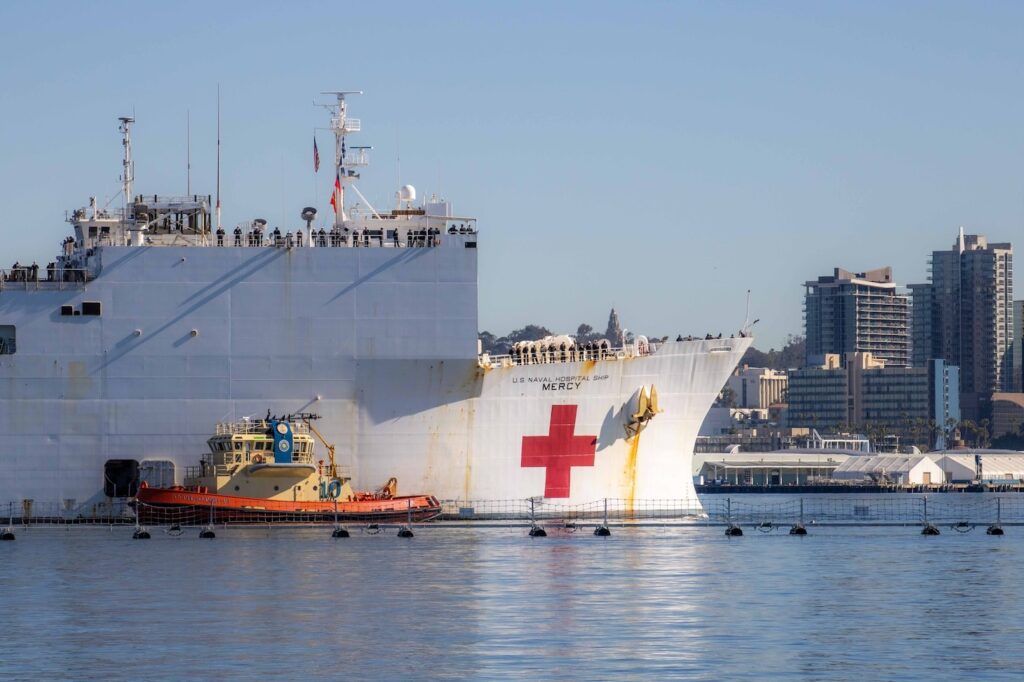
SAN DIEGO – Pacific Partnership 24-1 personnel assigned to the hospital ship USNS Mercy (T-AH 19) returned home today as the ship pulled in to Naval Air Station North Island, concluding the four-month humanitarian and disaster relief mission.
More than 800 service members and civilian mariners returned to San Diego after participating in Pacific Partnership 24-1, the largest multinational humanitarian mission that takes place in the Indo-Pacific. Pacific Partnership, now in its 19th iteration, is an annual mission that focuses on strengthening capacity of host nations to respond to crisis and fostering enduring bonds of friendship and multinational cooperation through four lines of effort: medical, engineering, host nation outreach and humanitarian assistance and disaster relief (HADR). This year’s mission’s five stops included the Republic of the Marshall Islands, Solomon Islands, the Republic of Palau and two states in the Federated States of Micronesia, Pohnpei and Chuuk.
“Our annual commitment to the Pacific Partnership mission demonstrates our dedication to strengthening alliances and partnerships for an enduring free and open Indo-Pacific,” said Rear Adm. Mark A. Melson, Commander, Task Force 73 and executive agent for this year’s mission. “I am tremendously proud of our team of Joint service members, allies and partners who supported the 2024 mission. There is more work to do. We will continue to work shoulder-to-shoulder every year i alongside partner nations in Southeast Asia and the Pacific Islands, to ensure we’re ready together in times of crisis.”
Born out of the devastation of the 2004 Boxing Day Tsunami, Pacific Partnership is an enduring annual mission in the Indo-Pacific region. This year’s mission was joined by partner nations from Japan, United Kingdom, New Zealand, Germany and Australia.
“Pacific Partnership is a multinational effort which means that we work with partner nations who share our values, who share our commitment to these developing nations who host us, and who share our common goal of a free and open Indo-Pacific,” said Capt. Brian Quin, mission commander for Pacific Partnership 24-1. “We go because there’s a need. We go because we partner with like-minded nations and like-minded people, and we go because we are asked. ”
Pacific Partnership medical personnel alongside the host nation medical teams and partner nations performed over 410 surgeries both aboard USNS Mercy and at the local host nation hospitals. Additionally, the dental team saw 3,665 patients and the optometry team saw 7,025 patients. In addition to medical services, the team also provided continuing medical education.
“I think a big focus of this has been education,” said Cmdr. Matt Russell, medical planner for Pacific Partnership 24-1. “In addition to the continuing medical education lectures that our staff are giving, as well as our surgical colleagues, we have set up classes for basic life support, first aid for first responders, how to respond to trauma, and really all of these courses have been very well received and well attended.”
Seabees from Amphibious Construction Battalion One (ACB 1) also provided their construction expertise to repair schools, hospitals, roads and increase host nation capacity. In Palau, Seabees constructed a community chicken coop which will allow for the local population to decrease their dependency on imported food.
Host nation outreach events (HNOE) involved sports days and band concerts by the Pacific Partnership Band comprised of a detachment from the U.S. Pacific Fleet Band augmented by two Royal Australian Navy musicians for the entire mission and three Japan Self Defense Force band members during the Palau mission stop. During the five stops, the Pacific Partnership team participated in 41 HNOE events and 53 band concerts with a total attendance of 23,500.
Humanitarian relief and disaster response (HADR) efforts include working with host nations to increase capabilities for preparing for and responding to disasters and emergencies. During the four-month mission, U.S. Army Civil Engineers held boating safety classes, 21 subject matter expert courses and 4 search and rescue exercises.
For more information about Pacific Partnership and USNS Mercy, visit www.facebook.com/pacificpartnership, www.facebook.com/USNSMERCY, or https://www.msc.usff.navy.mil/ships/mercy