Britain’s Largest Warship HMS Prince Of Wales Makes Virginia Temporary Homeport During East Coast Deployment
The Royal British Navy’s Queen Elizabeth-class aircraft carrier HMS Prince of Wales (R09) conducts an underway replenishment with the U.S. Navy’s USNS Supply (T-AOE-6), Sept. 19, 2023. Prince of Wales is participating in a Western Atlantic deployment off the East Coast. (U.S. Navy photo by Lt. j.g. Thomas McGowan)
Release from U.S. Fleet Forces Command, Sept. 29, 2023
*****
NORFOLK, Va. — The United Kingdom’s largest aircraft carrier, HMS Prince of Wales (R09), will make Naval Station Norfolk its temporary homeport this fall beginning Sept. 30 as it pushes the boundaries of Naval Aviation with F-35 Lightning advancement and drone launches off the East Coast over the next few months.
HMS Prince of Wales left for deployment in early September with a goal to further develop how the Royal Navy utilizes Carrier Strike Groups. After a visit to Mayport, Florida, the warship will be pushing the limits of their carrier, operating drones, strike fighters, tilt-rotors and helicopters from both the U.S. Navy and the U.S. Marine Corps.
Over the next few months the warship will specifically be pushing the boundaries of carrier landings for the U.K.’s fifth-generation jets, the F-35 Lightning stealth fighter.
Allowing the jets to land on the carrier faster and while carrying heavier loads (i.e. more fuel and weapons) will allow HMS Prince of Wales to launch more strike missions, faster.
The carrier will also practice launching and landing the F-35 in heavy sea states to demonstrate their ability to operate in harsh environments.
These sea states are why the HMS Prince of Wales is operating off the East Coast, to capitalize on the heavy seas that come with hurricane season in the United States.
Part of HMS Prince of Wales’ deployment will include multiple port calls to Naval Station Norfolk this fall, where they will be hosted by Carrier Strike Group-10 and the Nimitiz-class aircraft carrier USS George H.W. Bush (CVN 77).
Sailors aboard HMS Prince of Wales will be able to tour Naval Station Norfolk and visit surrounding areas in the coming months.
USS Louisiana Proves Readiness of Unmatched Strategic Weapons System
An unarmed Trident II D5LE missile launches from the Ohio-class ballistic missile submarine USS Louisiana (SSBN 743), marking a successful Demonstration and Shakedown Operation-32 (DASO-32) off the coast of San Diego, California, Wednesday. The primary objective of a DASO is to evaluate and demonstrate the readiness of the SSBN’s Strategic Weapon System (SWS) and crew before operational deployment following the submarine’s engineered refueling overhaul. DASO-32 is the last DASO conducted by an Ohio-class SSBN coming out of engineering refueling overhaul (ERO), marking the completion of all post-ERO DASOs for the Ohio-class SSBNs. The Trident II D5LE strategic weapon system is the system that will provide the initial SWS capability for the Columbia-class SSBN. (U.S. Navy Photo by Mass Communication Specialist 3rd Class Kevin Tang)
Release from Strategic Systems Programs Office, Sept. 28, 2023
*****
SAN DIEGO — The U.S. Navy’s Strategic Systems Programs conducted a scheduled, missile test flight of an unarmed life-extended Trident II (D5LE) missile from USS Louisiana (SSBN-743), an Ohio-class ballistic missile submarine, on the Western Test Range off the coast of San Diego, California, at approximately 2:10 p.m. Sept. 27, 2023.
This test marks 191 successful missile launches of the Trident II (D5 & D5LE) strategic weapon system (SWS) missile since it began operations in 1989. Trident II missile remains unmatched in its reliability.
“I am immensely proud of the government-industry team,” said VADM Johnny Wolfe, Jr., Director of Strategic Systems Programs. “The completion of DASO-32 marks an historic milestone in the life of the Trident II D5 weapons system, and provides the SSP team with a tangible reminder of the great responsibility before us—sustain this unmatched weapons system while developing the next generation strategic weapons system to ensure our nation’s sea-based strategic deterrence capability through 2084.”
This was part of a Demonstration and Shakedown Operation, designated DASO-32. DASO-32 is the last DASO conducted by an Ohio-class SSBN coming out of Engineering Refuel Overhaul (ERO). The primary objective of a DASO is to evaluate and demonstrate the readiness of the SSBN’s strategic weapon system and crew before operational deployment following the submarine’s midlife refueling overhaul or as part of new construction.
The Trident II (D5) SWS is a highly accurate and reliable weapon system that has been actively deployed on Ohio-class SSBNs since its introduction to operational deployment on USS Tennessee (SSBN 734) in 1990. It is the deployed system for the remaining service life of U.S Ohio-class and United Kingdom Vanguard-class SSBNs, and is the initial loadout for the U.S. Columbia-class and U.K. Dreadnought-class SSBNs.
Test launches are conducted on a recurring basis to evaluate and ensure the continued reliability and accuracy of the strategic weapon system. Each test provides valuable information about our strategic weapon systems, thus contributing to assurance in our capabilities.
The Navy’s last DASO was in October 2021 off the coast of Cape Canaveral, Florida, from USS WYOMING (SSBN-742). The Navy’s most recent flight test—a Follow-on Commander’s Evaluation Test—was a series of two missile launches from USS West Virginia (SSBN-736) in June 2023 also off the coast of Cape Canaveral, Florida.
Flight test missiles are not armed. Safety of the public and the crew conducting the mission is paramount. Today’s launch was conducted from sea, the missile flew over the sea, and landed in the sea. At no time did the missile fly over land.
The missile test was not conducted in response to any ongoing world events or as a demonstration of power. Test launches, including DASOs, are scheduled years in advance.
Strategic Systems Programs is the Navy command that provides cradle-to-grave lifecycle support for the Navy’s strategic weapon systems. This includes training, systems, equipment, facilities and personnel responsible for ensuring the safety, security, and effectiveness of the nation’s Submarine
Launched Ballistic Missile (SLBM) Trident II (D5LE) strategic weapon system. In addition to maintaining the current Trident II (D5LE) strategic weapons system, Strategic Systems Programs is looking towards the future. Nuclear modernization is crucial to the continued success of the U.S.’s sea based strategic deterrent. Strategic Systems Programs is developing the next generation strategic weapon system, and modernizing shore-based infrastructure and capabilities to sustain the Ohio-class to end of life and support Columbia-class fleet introduction.
SLBMs are the sea-based leg of the nation’s strategic nuclear deterrent Triad that also includes the U.S. Air Force’s intercontinental ballistic missiles (ICBM) and nuclear-capable bombers. Each part of the Triad provides unique capabilities and advantages.
The sea-based leg makes up the majority – approximately 70 percent – of the U.S.’s deployed strategic nuclear deterrent Triad. The SLBM is the most survivable leg of the triad, provides a persistent presence, and allows for flexible concepts of operations.
A credible, effective nuclear deterrent is essential to our national security and the security of U.S. allies. Deterrence remains a cornerstone of national security policy in the 21st century.
U.S. Coast Guard Cutter Confidence Returns Home Following 62-day Counternarcotics Patrol in the Caribbean Sea
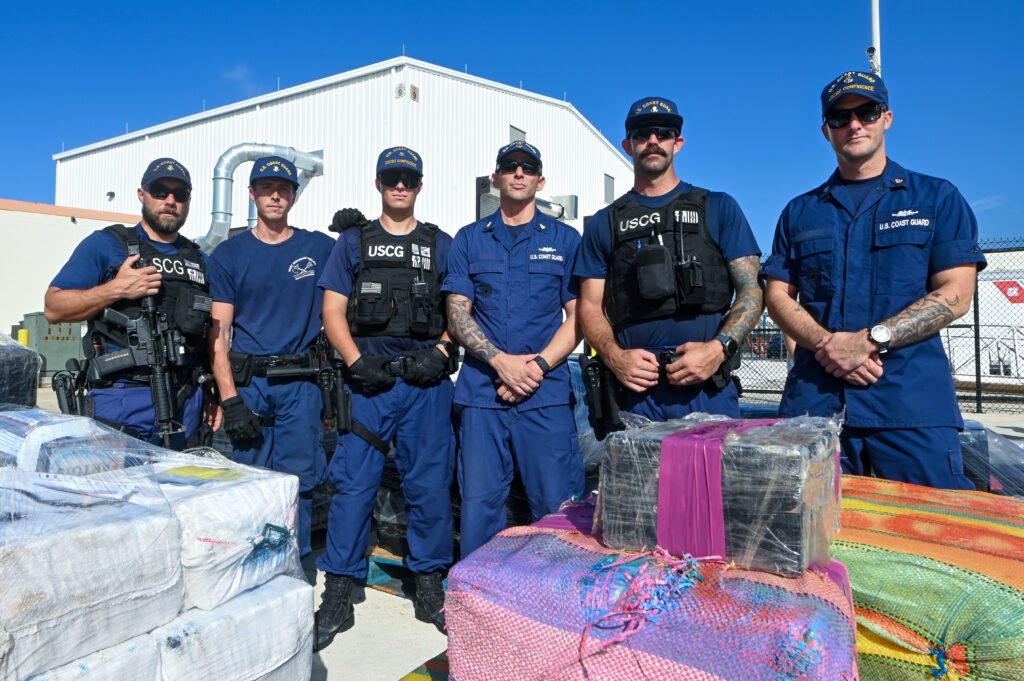
Bales of illegal narcotics, worth an estimated $160 million, are offloaded onto pallets by the U.S. Coast Guard Cutter Confidence (WMEC 619) crew, Sept. 19, 2023, at Coast Guard Base Miami Beach, Florida. Coast Guard and partner agency crews interdicted the illegal narcotics during nine separate cases in the international waters of the Caribbean Sea. (U.S. Coast Guard photo by Petty Officer 3rd Class Santiago Gomez)
Release from U.S. Coast Guard Atlantic Area, Sept. 28, 2023
*****
CAPE CANAVERAL, Fla. — The crew of the U.S. Coast Guard Cutter Confidence (WMEC 619) returned to their homeport in Cape Canaveral, Sept. 20, following a 62-day deployment to the Caribbean Sea.
From their homeport in eastern Florida, Confidence’s crew sailed to the central Caribbean Sea and conducted a counternarcotics patrol with an embarked helicopter and aircrew from the Helicopter Interdiction Tactical Squadron while in support of Joint Interagency Task Force – South. While underway, Confidence worked with air and sea assets from partner agencies, allied militaries, and other Coast Guard units.
Confidence’s crew conducted four separate drug cases within a span of four days and prosecuted an additional case while returning to homeport. In total, these five interdictions resulted in the apprehension of 15 suspected narco-traffickers and prevented the flow of over 6,000 pounds of illicit substances, valued at over $85 million, from reaching the United States.
In addition to enforcing U.S. law at sea and supporting the Coast Guard’s counterdrug mission, the crew of the Confidence also interdicted an unlawful migrant venture in the Mona Passage that originated from the Dominican Republic. While protecting the sovereign maritime borders of the U.S., the interdiction by Confidence resulted in the successful rescue of 42 migrants aboard the makeshift vessel, which was taking on water.
“I am extremely proud of the Confidence crew for their teamwork, devotion to duty and commitment to keeping the streets of the U.S. and our partner allies safe,” said Cmdr. Thomas Martin, commanding officer of Coast Guard Cutter Confidence. “Members of all ranks showcased exceptional professionalism and perseverance over the course of this patrol, enabling our success. I also appreciate the contributions of our DoD, DHS and international partners, making this patrol a success.”
The seized drugs were later transferred in Miami to partner law enforcement agencies during Confidence’s transit home.
Confidence’s crew steamed over 9,000 miles while conducting training, law enforcement missions, search and rescue, and helicopter operations throughout the Caribbean Sea deployment.
Confidence is a 210-foot, Reliance-class medium-endurance cutter with a crew complement of 70. The cutter’s primary missions are counter-drug operations, migrant interdiction, enforcement of federal fishery laws, and search and rescue in support of U.S. Coast Guard operations throughout the Western Hemisphere.
For information on how to join the U.S. Coast Guard, visit GoCoastGuard.com to learn about active duty, reserve, officer, and enlisted opportunities. Information on how to apply to the U.S. Coast Guard Academy can be found here.
Navy Orders modernized cockpit, architecture improvements for E-2D aircraft
An E-2D Advanced Hawkeye, attached to the “Bear Aces” of Airborne Command and Control Squadron (VAW) 124, launches from the flight deck of the world’s largest aircraft carrier USS Gerald R. Ford (CVN 78) in the Eastern Mediterranean Sea, Sept. 2 2023, during its scheduled deployment in the U.S. Naval Forces Europe area of operations.
Release from Naval Air Systems Command, Sep 28, 2023
*****
NAVAL AIR SYSTEMS COMMAND, Patuxent River, Md. — The U.S. Navy awarded an $845.5 million contract to Northrop Grumman Systems Corporation for the E-2D Delta System Software Configuration 6 (DSSC 6) on Sept. 12.
“Essentially, with the changes and upgrades with DSSC 6, this will be an E-2D ‘Block II’ which will reduce pilot workload, improve situational awareness, and bring vital readiness and reliability upgrades paired with architecture and cybersecurity improvements,” said Arrobio.
DSSC 6 replaces the current integrated navigation and controls and display systems and tactical mission computer and display systems on E-2D Advanced Hawkeye aircraft with a modern Hawkeye cockpit technology refresh and theater combat identification that allows for rapid integration of new capabilities, including non-proprietary applications from industry partners.
Fielding of DSSC 6 in the fleet is scheduled to begin in 2029.
PMA-231’s mission is to develop, acquire and sustain unmatched carrier-based airborne command, control, and logistics aircraft with the E-2C Hawkeye, E-2D Advanced Hawkeye and C-2A Greyhound.
Navy to Commission Future Littoral Combat Ship Augusta
Release from the U.S. Department of Defense, Sept. 29, 2023
*****
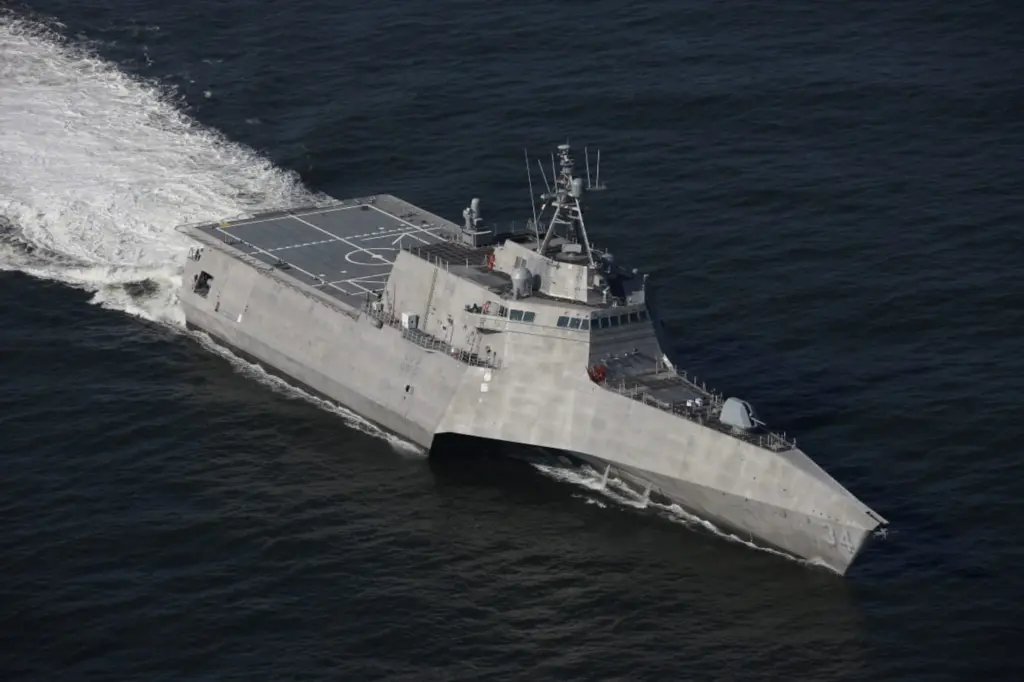
The Navy will commission the future USS Augusta (LCS 34) as the newest Independence-variant littoral combat ship (LCS) during a 10:00 a.m. EST ceremony on Saturday, Sept. 30, in Eastport, Maine.
The Honorable Jared Golden, U.S. Representative, Maine’s 2nd District, will address the ceremony via recorded remarks. Remarks will also be provided by Vice Admiral John Fuller, Naval Inspector General; Rear Adm. James Downey, Special Assistant to the Assistant Secretary of the Navy for Research, Development, and Acquisition; the Honorable Mark O’Brien, Mayor of Augusta, Maine; the Honorable Chris Gardner, Director of the Eastport Port Authority and Washington County Maine Commissioner; and Mr. Larry Ryder, Vice President of Business Development, and External Affairs, Austal USA. The ship’s sponsor is the Honorable Leigh Saufley, President and Dean of University of Maine School of Law and former Chief Justice of the Maine Supreme Judicial Court.
LCS 34 is the 17th Independent-variant LCS, the 33rd in the class. She is the second naval warship named for the city of Augusta, Maine. LCS 34 continues the legacy of USS Augusta (SSN 710), a Los Angeles-class submarine that was in active service for 24 years and decommissioned on February 11, 2009.
The selection of Augusta as the ship’s namesake, the easternmost state capital in the U.S., recognizes the value of Maine’s maritime history and landscape. The state’s rugged Atlantic coast is home to fishermen, lobstermen, and a thriving maritime industry that is testament to Maine’s enduring contributions to the nation.
The LCS class consists of two variants, the Freedom and the Independence, designed and built by two industry teams. Lockheed Martin leads the Freedom-variant team, the odd-numbered hulls, in Marinette, Wisconsin. Austal USA leads the Independence-variant team in Mobile, Alabama, for LCS 6 and the subsequent even-numbered hulls.
Littoral combat ships are fast, optimally-manned, mission-tailored surface combatants that operate in near-shore and open-ocean environments, winning against 21st-century coastal threats. LCS integrate with joint, combined, manned and unmanned teams to support forward-presence, maritime security, sea control and deterrence missions around the globe.
The ceremony will be live streamed at https://www.dvidshub.net/webcast/32605. The link becomes active approximately ten minutes prior to the event at 09:50 a.m. EST.
No U.S. Injuries Following IRGC Navy Lazing Incident at Sea
GULF OF OMAN (Aug. 14, 2023) Aviation Boatswain’s Mate (Handling) 3rd Class Ezequiel Rodriguez signals to a U.S. Marine Corps AH-1Z Viper helicopter from Marine Medium Tiltrotor Squadron 162, 26th Marine Expeditonary Unit (MEU), during flight operations aboard the amphibious dock landing ship USS Carter Hall (LSD 50) in the Gulf of Oman, Aug. 14, 2023. Components of the Bataan Amphibious Ready Group and 26th Marine Expeditionary Unit are deployed to the U.S. 5th Fleet area of operations to help ensure maritime security and stability in the Middle East Region. (U.S. Navy photo by Mass Communication Specialist 2nd Class Moises Sandoval)
MANAMA, Bahrain – Statement from U.S. Naval Forces Central Command Spokesman Cmdr. Rick Chernitzer:
“Iran’s Islamic Revolutionary Guard Corps Navy (IRGCN) interacted in an unsafe and unprofessional manner with a U.S. AH-1Z Viper attack helicopter, assigned to the 26th Marine Expeditionary Unit (Special Operations Capable), as the aircraft was conducting routine operations in the international airspace of the Arabian Gulf, Sept. 27. The interaction took place at approximately 7:30 p.m. local time. The aircraft is attached to Marine Medium Tiltrotor Squadron (VMM) 162 (Reinforced), deployed aboard the Wasp-class amphibious assault ship USS Bataan (LHD 5), on a scheduled deployment to the Middle East Region.
“IRGCN vessels shone a laser multiple times at the aircraft while in flight. Fortunately, no injuries were reported and the aircraft was not damaged.
“These are not the actions of a professional maritime force. This unsafe, unprofessional, and irresponsible behavior by the Iranian Revolutionary Guard Corps Navy risks U.S. and partner nation lives and needs to cease immediately.
“U.S. naval forces remain vigilant and will continue to fly, sail and operate anywhere international law allows while promoting regional maritime security.”
Secretary of the Navy Carlos Del Toro today announced the creation of the Navy’s Disruptive Capabilities Office (DCO), during remarks at the Naval Research Laboratory (NRL) Centennial Exhibition at the Pentagon, Sept. 28.
This new organization, said Secretary Del Toro, “will push the bounds of rapidly delivering warfighting capability though the innovative application of existing and new systems, and harnessing today’s exponential growth in technology.”
Secretary of Defense Lloyd J. Austin III announced today that the president has made the following nomination:
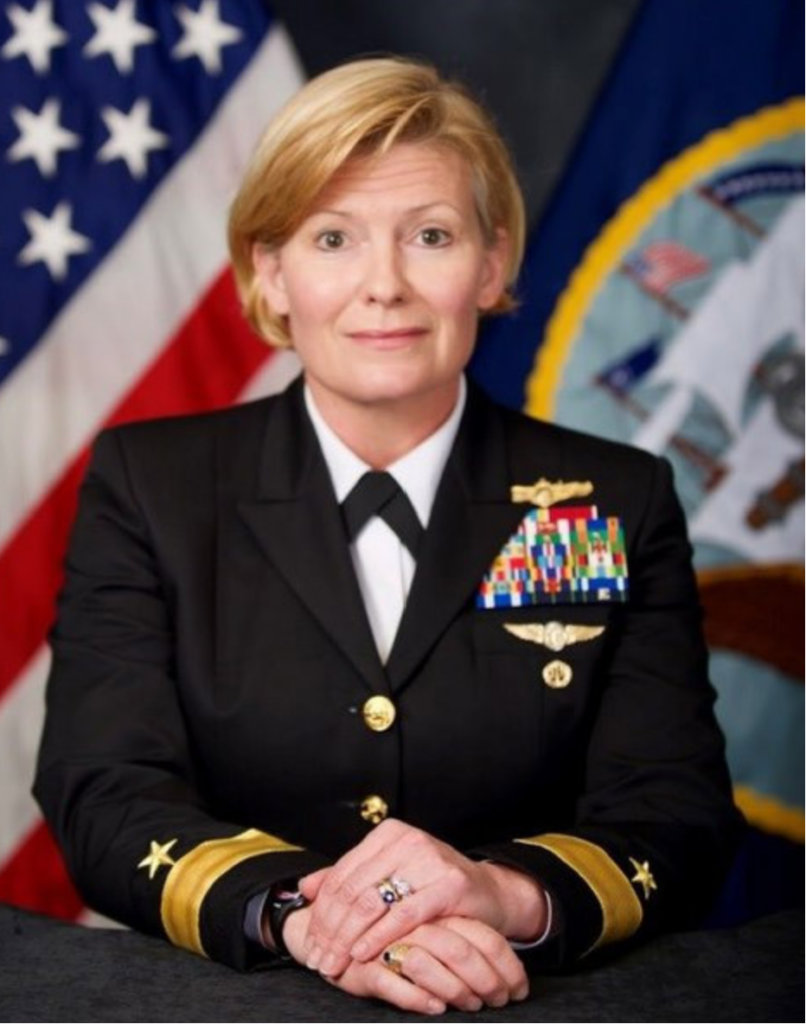
Navy Rear Adm. (lower half) Heidi K. Berg for appointment to the grade of rear admiral. Berg is currently serving as assistant deputy chief of naval operations for Operations, Plans, and Strategy, N3/N5B, Office of the Chief of Naval Operations, Washington, D.C.
Below is the official biography for Berg:
Rear Adm. Berg is a native of LaCrosse, Wisconsin. She is a graduate of the U. S. Naval Academy. She studied Russian at the Defense Language Institute, and Arabic at the Kalimat Institute in Cairo, Egypt. Berg holds a Master’s degree in Modern Middle Eastern Studies and Arabic from Oxford University, UK.
Operational tours include Navy Security Group Activity in Rota, Spain, where Berg flew over 1000 hours as a communications intercept evaluator onboard EP-3E aircraft in support of Operations Provide Promise/Sharp Guard. She deployed onboard the USS Kidd (DDG 993), Cruiser Destroyer Group 12 onboard the USS Saratoga (CV 60), and the USS Key West (SSN 722). She served on the Sixth Fleet aboard the USS LaSalle (AGF 3) in Gaeta, Italy, where she participated in initial talks with the post-Soviet Russian Navy. She supported global crisis response at Naval Security Group Menwith Hill in Harrogate, UK. In 2012, Berg deployed to Afghanistan as director of the International Security Assistance Force (ISAF) Red Team at ISAF HQ in Kabul. As director, she led alternative analysis and provided strategic assessments to the ISAF Commander.
She commanded the Navy Information Operations Command in Bahrain, where she was responsible for providing airborne and surface Signal Intelligence support to Iraqi Freedom, Enduring Freedom, and Persian Gulf maritime operations. She also commanded the Navy Element of the Defense Intelligence Agency, and the Joint Military Intelligence Training Center.
Staff assignments include serving as the Airborne SIGINT Requirements Officer (N2N6) on the Chief of Naval Operations (OPNAV) Staff; Information Operations Strategy and Policy (N3IO) at OPNAV; deputy for Plans and Policy at Fleet Cyber Command/U.S. TENTH Fleet; deputy National Intelligence Officer for Military Issues at the National Intelligence Council; Military Advisor to the deputy director of National Intelligence, where she supported daily intelligence briefings to the President and National Security Council; Information Warfare and Foreign Area Officer Director (PERS-47) at Navy Personnel Command, Strategic Advisor (OOZ) to the Chief of Naval Operations; and Acting Director, Navy Digital Warfare Office.
As a flag officer, Berg served as the director of Intelligence (J-2) at U.S. Africa Command, and as the director of Strategy, Plans and Policy (J-5) at U.S. Cyber Command.
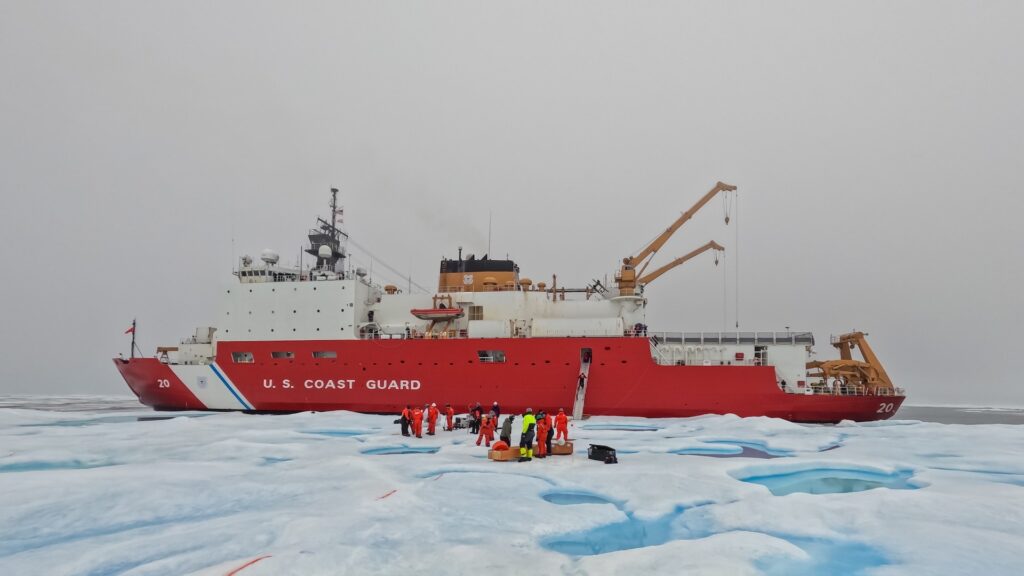
U.S. Coast Guard Cutter Healy completes mission with U.S. National Science Foundation in East Siberian Sea
EAST SIBEREAN SEA – U.S. Coast Guard Cutter Healy (WAGB 20) crew and embarked researchers completed the 2023 U.S. National Science Foundation (NSF) mission, Saturday, servicing the Nansen and Amundsen Basins Observational System (NABOS).
The month-long mission’s objective was to recover, service, and replace an array of nine long-term subsurface moorings that encircled the Siberian shelf from the Eurasian Basin to the East Siberian Sea.
These moorings provide insight into how warm water from the Atlantic Ocean enters the Arctic, impacting the deep basin interior, upper ocean, and sea ice as it circulates in the region and beyond.
In addition, Healy is specially equipped to execute Conductivity, Temperature, and Depth (CTD) casts, sampling the water column in areas normally inaccessible due to pack ice. During this month-long mission, the cutter conducted 41 such casts.
Since its beginning in 2002, the primary goal of the NSF-funded NABOS project has been to gain a better understanding of the circulation and transformation of Atlantic waters in the Arctic Ocean. Missions from 2021 to 2025 aim to quantify the role of freshwater as a regulator of heat transfer from Atlantic waters to the sea ice, according to project leader Igor Polyakov at the University of Alaska, Fairbanks.
With these observations, NABOS looks to inform the scientific community and public on the potential impacts to Arctic sea-ice coverage and marine ecosystems, and the expanding effect on the mid-latitudes. The success of NABOS since its earliest days has always been reliant on international partnerships, researchers of diverse backgrounds, and assets such as Healy achieving the results for which the project is known.
Healy is the Coast Guard’s only research icebreaker, as well as the nation’s sole surface presence routinely operating in the Arctic Ocean. The platform is ideally specialized for projects like NABOS; providing access to the most remote reaches of the Arctic Ocean; areas barricaded by pack ice and insurmountable by most research vessels.
Commissioned in 1999, the Healy is one of two active polar icebreakers and is the largest and most technologically advanced icebreaker in the Coast Guard. The Healy’s crew compliment of 84 supports the ship’s primary mission of scientific support.
PASCAGOULA, Miss., Sept. 28, 2023 (GLOBE NEWSWIRE) — HII’s (NYSE: HII) Ingalls Shipbuilding division, in partnership with Jackson County’s Passion, Purpose, Paycheck (P3) program and the Department of Defense’s (DOD) Project MFG, hosted an inaugural welding competition Sept. 22 at Ingalls Shipbuilding. Students from local career and technical training programs were invited to demonstrate their proficiency in a timed competition.
Project MFG holds nationwide events that bring together partnerships of employers, educators and communities to inspire the next generation of highly skilled trade professionals.
“Hosting events like Project MFG is an excellent opportunity to collaborate with our educational partners in raising awareness about careers at Ingalls,” Ingalls Shipbuilding Community Relations Manager Lisa Bradley said. “Connecting young students from the local community and showcasing their talents is an important part of our mission and one of the ways we promote the opportunities available right here in Pascagoula.”
The collaborative effort drew 24 students from across four area schools and technical training programs to compete in the welding competition.
Competitors were tested on welding skills required in today’s advanced manufacturing field, especially ones that are in high demand at Ingalls. Participants raced against a two-hour clock and were cheered on by school leaders and representatives from Ingalls Shipbuilding. After showcasing their skills, the top three welders were announced.
First place – Jonathan Hardy, Moss Point High School
Second place – Nicholas Tapper, Moss Point High School
Third place – Ethan Williams, Pascagoula High School
“I want to congratulate all of the students who participated in the Ingalls Project MFG welding competition and took the opportunity to learn more about the important careers available at Ingalls,” P3 Career Coach Supervisor David Fava said. “Connecting students to Project MFG and Ingalls is a win-win scenario for all: Students get to show off their skills to a potential employer; Ingalls is able to show their customer that they have a strong workforce pipeline in place, and DOD gets to celebrate and verify craft skills development in our area.”
Following the competition, each of the participating students received a contingent offer from Ingalls pending successfully graduating from high school or their current technical training program. The students were also provided with over $200 worth of safety equipment including steel toed shoes, a hard hat, coveralls and a welding shield.
Project MFG is a program of the Global Learning Accelerator Inc., a 501(c)3 nonprofit, funded in part by the Department of Defense, and operated and managed by RD Solutions LLC. The mission of the Global Learning Accelerator is to develop exciting and innovative learning opportunities that inspire students and participants to explore and pursue their passions for lifelong success.