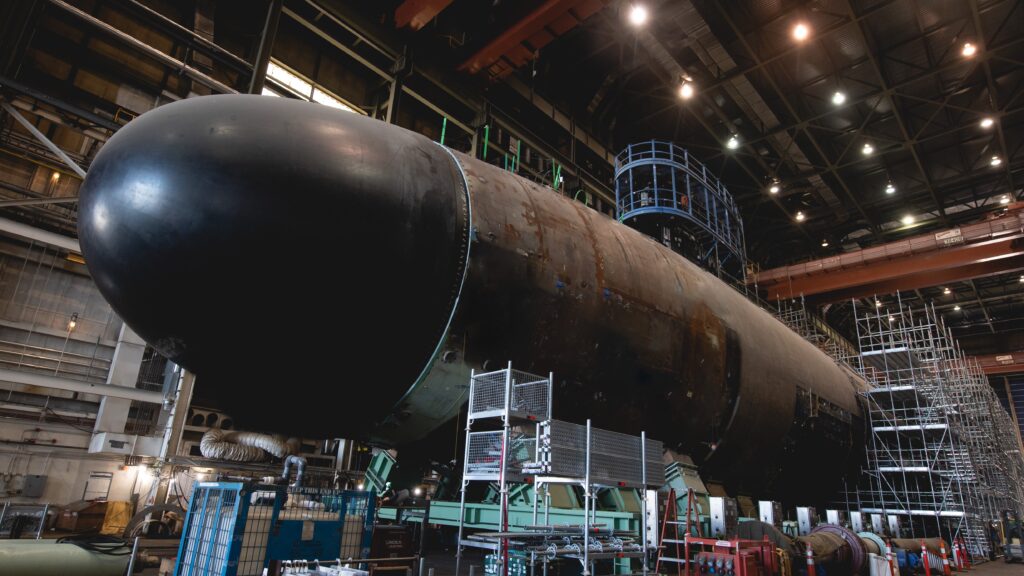
NEWPORT NEWS, Va., Sept. 27, 2023 (GLOBE NEWSWIRE) — HII shared today (NYSE: HII) that its Newport News Shipbuilding (NNS) division has reached a significant milestone in the construction of Virginia-class submarine Arkansas (SSN 800).
Arkansas (SSN 800) is now “pressure hull complete,” meaning that all of the hull sections were joined to form a single, watertight unit.
“It’s exciting to reach pressure hull complete, because it’s a visible sign that construction has progressed to the point where Arkansas really starts to take its final shape,” said Jason Ward, NNS vice president of Virginia-class submarine construction. “We absolutely understand the important mission ahead for Arkansas and are working with urgency to get this powerful national security asset to the Navy as soon as possible.”
NNS is one of only two shipyards capable of designing and building nuclear-powered submarines. The advanced capabilities of Virginia-class submarines increase firepower, maneuverability and stealth.
This milestone comes following the christening of Massachusetts (SSN 798) and keel authentication of Oklahoma (SSN 802) at NNS so far in 2023.
Arkansas is the Navy’s 27th Virginia-class fast attack submarine. The ship’s sponsors are the six women of the historic group known as the Little Rock Nine, the first African American students to attend all-white Central High School in Little Rock, Arkansas, during desegregation. NNS honored all nine members, including the three men, during the November 2022 keel authentication ceremony.
Producing state-of-the-art AI-driven technologies for autonomous systems
September 2023, Global- Advanced Navigation, the world’s most determined innovator in artificial intelligence (AI) for robotic and navigation technologies, has unveiled a new high-tech robotics facility for autonomous systems based at UTS Tech Lab in Botany, New South Wales (NSW), Australia.
The facility will scale up the manufacturing of Advanced Navigation’s world-first AI navigation systems for GPS-denied environments, including its digital fiber-optic gyroscope (DFOG) technology, Boreas.
Advanced Navigation is one of only four companies in the world with the capability to manufacture strategic grade fiber-optic gyroscopes. This technology empowers reliable navigation for marine vessels, space missions, aerospace, defense, autonomous vehicles and flying taxis. The company deploys its unique AI-based physics algorithms to solve complex challenges earth-bound and beyond.
Strengthening Australia’s sovereign capabilities
Xavier Orr, Advanced Navigation CEO and co-founder, said, “There is a critical need to improve Australia’s economic complexity and sovereign capabilities. A key step is to build our industrial capacity in high-tech, as well as drive knowledge exchange and propel collaborative initiatives between government agencies, academic institutions and industry leaders.”
State-of-art robotics manufacturing for autonomous systems
There is a seismic shift across the landscape of sovereign manufacturing, driven by advanced technologies like AI, automation and precision engineering. In the context of autonomous systems, the importance of precision and reliability is non-negotiable.
Adopting a vertical integration framework, the facility houses equipment and processes for automated manufacturing utilizing machine learning. This guarantees the delivery of reliable, durable and high-quality navigation systems.
Collaborating with UTS academics and community
In addition to the manufacturing capability, the facility will be home to extensive research collaborations between Advanced Navigation and the University of Technology Sydney (UTS). This will expedite the commercialization of several socially impactful technologies, including:
Light Detection, Altimetry and Velocimetry (LiDAV) system– LiDAV delivers precise three-dimensional velocity and altitude information relative to the lunar surface, enabling complex autonomous landing procedures and confident exploration on the moon. The technology is set to board US-based space systems company Intuitive Machines’ Nova-C lander as part of NASA’s ongoing Commercial Lunar Payload Services (CLPS) program.
Cloud Ground Control– A revolutionary cloud-based solution that allows pilots and mission planners to remotely command and control a swarm of uncrewed vehicles across air, land and sea through a web browser. By enabling real-time video feed, and telemetry, and easy access and management of captured data, Cloud Ground Control provides full remote visibility and situational awareness in search and rescue, emergency response and disaster relief operations.
Guiding visually impaired passengers– As part of the NSW Small Business Innovation and Research (SBIR) program, Advanced Navigation has developed an indoor positioning technology to support members of the visually impaired community navigate safely inside underground train stations.
Professor Andrew Parfitt, Vice-Chancellor and President of UTS, said,“UTS is pleased to be working with Advanced Navigation to tap into critical growth areas, including AI, robotics and space technologies.
The collaboration between UTS’s global research leaders in autonomous systems technology and Advanced Navigation’s exceptional team of scientists and engineers, utilizing UTS Tech Lab’s cutting-edge facilities, highlights our commitment to developing sovereign capabilities for defense and space.
We look forward to deepening and expanding our collective capabilities with Advanced Navigation to accelerate the production of high-impact innovations.”
Bolstering societal demand for STEM roles
The facility appeals to the Federal Government’s ongoing commitment towards building a science, technology, engineering and mathematics (STEM) workforce. It is set to drive employment in robotics, manufacturing, photonics, mechatronics and mechanical engineering and other fields.
Chris Shaw, Advanced Navigation CEO and co-founder, said, “Our new facility will help drive rapid growth in Australia’s STEM industry. Determined to be the catalyst of the autonomy revolution, we are commercializing technologies that are key to addressing some of humanity’s biggest challenges. We are honored to partner with UTS, who has a reputation for supporting multidisciplinary research and opening access to next-generation technologies.”
Advanced Navigation was founded on a culture of research and discovery. Powered by a deep curiosity to apply ground-breaking technologies to uncover and explore new frontiers, the company is ultimately extending human capabilities to build a more resilient and sustainable future with safer outcomes, on and off planet.
USCGC Cutter Forward returns home following 78-day deployment in the high northern latitudes
PORTSMOUTH, Va. – The crew of the U.S. Coast Guard Cutter Forward (WMEC 911) returned to their homeport in Portsmouth, Tuesday, following a 78-day deployment in the North Atlantic Ocean.
Throughout the deployment, Forward supported the U.S. Coast Guard’s Arctic Strategy and partnered with allied nations and agencies during Operation Nanook 2023, an annual Canadian-led military exercise to strengthen maritime objectives in the high northern latitudes.
Alongside Canadian and French forces navigating the waters of the North Atlantic Ocean, Forward’s crew performed training evolutions including towing and formation steaming, replenishment at sea, visual communications tactical signaling, and cross-deck exercises. In addition, an attached team from Coast Guard Tactical Law Enforcement Team Pacific conducted a boarding exercise with French Navy vessel BSAM Garonne to demonstrate at-sea capabilities and assist in enhancing partner training curriculums.
During the deployment, Forward also completed two living marine resources enforcement patrols. The first was carried out in support of the First Coast Guard District’s living marine resources mission. The second, conducted alongside international partners, was focused on commercial fishing vessels inspections as part of the Northwest Atlantic Fisheries Organization. The NAFO fisheries patrol ensured compliance with international fishing norms while safeguarding natural resources and preserving fish stocks, all reinforcing U.S. dedication to combatting illegal, unregulated, and unreported fishing.
Forward collaborated with embarked U.S. Navy personnel from the Unmanned Undersea Vehicle Flotilla-1 team to launch their Razorback UUV. The undersea vehicle, equipped with mapping and sonar capabilities, deployed deeper than any U.S. Navy submersible and traveled to a depth of nearly 2,000 feet (600 meters).
Members from the U.S. Navy’s Afloat Training Group Atlantic were also embarked aboard Forward to help build their service’s Arctic Vision Initiative, which will serve to inform U.S. Navy training entities of seamanship, navigation, engineering, and medical considerations necessary for operating naval vessels in the polar regions.
Forward sailed more than 10,500 nautical miles while the crew liaised with international partners through a series of port calls. Forward visited Halifax, Nova Scotia, Canada, during their Natal Day celebration to observe the province’s birthday. Crew members then traveled to Nuuk, Greenland, and completed a short visit to St. John’s, Newfoundland, Canada, before transiting back to the United States.
Forward ended the deployment by hosting several Indo-Pacific heads of state who were participating in the 2023 U.S.-Pacific Island Country Summit in Baltimore, Maryland. Approximately 40 international guests joined Forward for a tour and reception ahead of the transfer of U.S. Coast Guard Cutter Harriet Lane (WMEC 903) to a Pacific Ocean homeport.
“We had the opportunity to advance objectives of the Arctic Strategy and support the IUU Fishing Strategic Outlook,” said Cmdr. Staci Rutsch, commanding officer of Forward. “Acting as true ambassadors, we represented the nation in diplomatic engagements with NATO partners, reinforcing U.S. interests and solidifying the USCG as being the partner of choice. This crew’s ability to shift to perform highly in our non-standard missions leaves me impressed and motivated every day.”
For information on how to join the U.S. Coast Guard, visit www.GoCoastGuard.com to learn more about active duty and reserve officer and enlisted opportunities. Information on how to apply to the U.S. Coast Guard Academy can be found here.
First Flight III Destroyer Jack H. Lucas Sails Away From HII’s Ingalls Shipbuilding
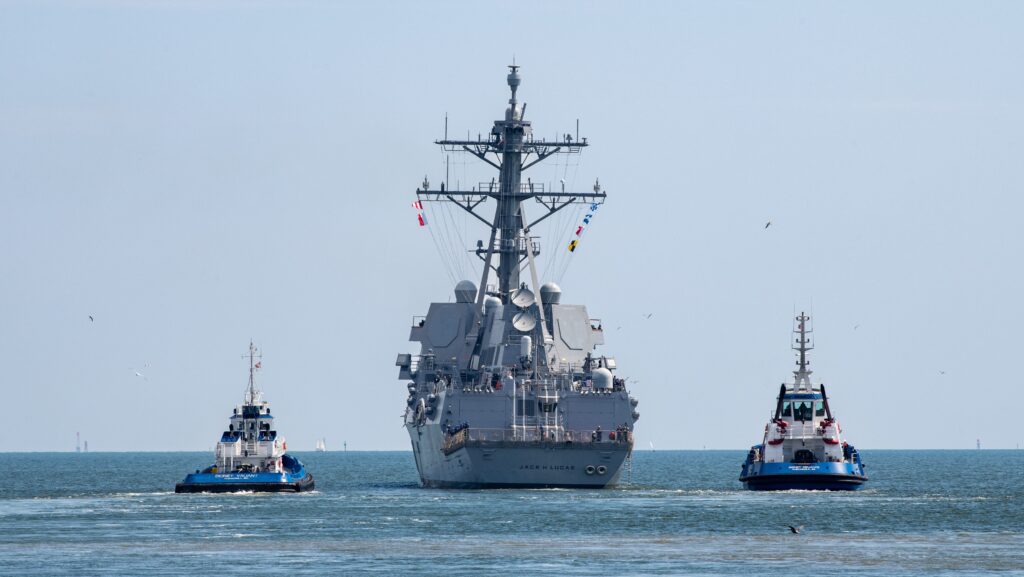
PASCAGOULA, Miss., Sept. 26, 2023 (GLOBE NEWSWIRE) — The first Flight III Arleigh Burke-class guided-missile destroyer Jack H. Lucas (DDG 125) departed HII’s (NYSE: HII) Ingalls Shipbuilding division Tuesday. DDG 125 will be commissioned Oct. 7, 2023 at a ceremony in Tampa, Florida, before sailing to its homeport in San Diego.
“Watching Jack H. Lucas sail away is a proud moment for our entire DDG shipbuilding team,” Ingalls Shipbuilding DDG Program Manager Ben Barnett said. “Our shipbuilders will follow this first Flight III destroyer with honor as it joins the fleet as one of the most highly capable destroyers we have delivered.”
Ingalls has delivered 35 Arleigh Burke-class destroyers to the U.S. Navy including the Jack H.Lucas (DDG 125), in June of this year. Additionally, Ingalls has four other Flight III destroyers currently under construction including Ted Stevens (DDG 128), Jeremiah Denton (DDG 129), George M. Neal (DDG 131) and Sam Nunn (DDG 133).
Flight III Arleigh Burke-class destroyers incorporate a number of design modifications that collectively provide significantly enhanced capability. DDG 125 includes the AN/SPY-6(V)1 Air and Missile Defense Radar (AMDR) and the Aegis Baseline 10 Combat System that are designed to keep pace with the threats well into the 21st century.
Arleigh Burke-class destroyers are highly capable, multi-mission ships and can conduct a variety of operations, from peacetime presence and crisis management to sea control and power projection. Guided missile destroyers are the backbone of the U.S. surface fleet and are capable of fighting multiple air, surface and subsurface threats simultaneously.
SECNAV Del Toro Calls for a New, Bold Maritime Statecraft in Era of Intense Strategic Competition
Secretary of the Navy Carlos Del Toro today called for a “new maritime statecraft” to prevail in an era of intense strategic competition, during remarks at the John F. Kennedy School of Government at Harvard University, Sept. 26.
During his speech, Secretary Del Toro stated that maritime statecraft, in a broad sense, encompasses not only naval diplomacy, but a national, whole-of-government effort to build comprehensive U.S. and allied maritime power, both commercial and naval.
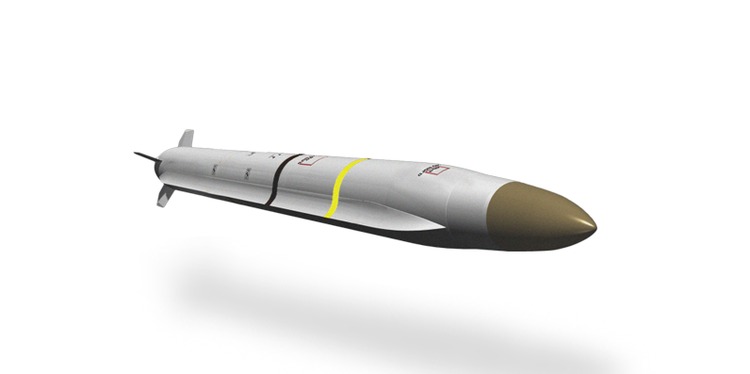
LOS ANGELES – Sept. 25, 2023 – Northrop Grumman Corporation (NYSE: NOC) announced today the U.S. Air Force has awarded the company an approximately $705 million contract to deliver the Stand-in Attack Weapon (SiAW), an air-to-ground weapon that accelerates the pivot to a new generation of air power.
Northrop Grumman’s SiAW leverages the company’s weapons systems design, development and production expertise to deliver on the Air Force’s digital engineering priorities and accelerate capability for the warfighter.
During the next 36 months, Northrop Grumman will further develop the weapon, conduct platform integration and complete the flight test program for rapid prototyping in preparation for rapid fielding. Work will be performed at the company’s Northridge, California facility and its factory of the future for missile integration at Allegany Ballistics Laboratory in West Virginia.
Expert:
Susan Bruce, vice president, advanced weapons, Northrop Grumman: “Northrop Grumman’s SiAW delivers on the Air Force’s desire for its first digital weapons acquisition and development program. With our expert digital engineering capabilities, this next-generation missile represents an adaptable, affordable way for the Department of Defense to buy and modernize weapons.”
Details on SiAW and Phase 2 Development:
SiAW is an air-to-ground weapon that will provide strike capability to defeat rapidly relocatable targets as part of an enemy’s anti-access/area denial environment. To adapt to ever-changing threats, the missile design features open architecture interfaces that will allow for rapid subsystem upgrades to field enhanced capabilities to the warfighter.
Phase 2 development is a continuation of the Air Force requirement for this first-of-its-kind Middle Tier Acquisition large weapon program focused on digital engineering, Weapon Open System Architecture and agility. The Air Force is targeting an initial operational capability by 2026. Phase 2 consists of two primary increments:
Phase 2.1 concludes with a guided vehicle flight test.
Phase 2.2 concludes with three additional flight tests and the delivery of SiAW leave-behind prototype missiles and test assets.
The development of SiAW is part of Northrop Grumman’s broad offerings in advanced weapons, including armaments, components, missiles, electronics and interceptors to defeat and deter threats.
DoD Releases Report on Defense Spending by State in Fiscal Year 2022
Today, the Department of Defense Office of Local Defense Community Cooperation released its Fiscal Year 2022 Defense Spending by State report to help states and communities better understand how Defense procurement, personnel spending and grants impact their economies. Fiscal Year 2022 is the first year to incorporate DoD grant awards, which were reported to USAspending.gov.
The report’s graphs, maps, and tables present a range of findings, such as total spending figures, categories of contracted goods and services, major defense vendors, numbers, and types of defense personnel, and, for the first time, grants awarded by DoD. This snapshot provides public and private leaders with a starting place to assess how defense investments across installations, communities, and the private sector can be optimized by supporting regional innovation, industrial capability and capacity, supply chain resilience, and cultivating a skilled workforce.
“Our industrial base is one of our greatest competitive advantages, and this report enables our state, local, and industry partners to visualize the full scope of our investments as we focus on fostering a resilient and robust defense ecosystem,” said Dr. Radha Plumb, Deputy Under Secretary of Defense for Acquisition and Sustainment. “As we work to deliver the technologies and services our warfighters need at speed and scale, the report highlights how the Department is expanding our relationships with industries not traditionally associated with defense and serves as a tool for state and local partners to identify new partnership opportunities.”
Defense spending fell in Fiscal Year 2022 as the federal government ramped down its response to the COVID-19 pandemic. DoD contract obligations and payroll spending in the 50 states and the District of Columbia decreased by $10.1 billion over the prior year. This is the result of a 2.3 percent decrease in DoD contract obligations and a 0.06 percent decrease in payroll spending.
DoD contract obligations, payroll spending, and grant awards in the 50 states and the District of Columbia totaled $558.7 billion, which is 2.2 percent of the country’s gross domestic product. If the total spending were divided across every U.S. resident, it would amount to $1,679 per U.S. citizen. Of those funds, $389.5 billion (70 percent) were spent on contracts for products and services, $159.4 billion (28 percent) paid the salaries of DoD personnel, and $9.7 billion (2 percent) were awarded as grants.
Virginia, Texas, and California topped the list of recipients for overall defense spending. However, Virginia, Hawaii, and Connecticut ranked highest when considering defense spending relative to their respective state GDPs.
The top ten states for total Defense spending in Fiscal Year 2022 were:
Rank
State
Defense Spending (billions)
1
Virginia
$62.7
2
Texas
$58.0
3
California
$56.2
4
Florida
$30.2
5
New York
$28.1
6
Maryland
$26.4
7
Connecticut
$22.3
8
Pennsylvania
$17.9
9
Massachusetts
$15.2
10
Arizona
$15.0
Texas, Connecticut, and North Carolina had the largest overall increases in DoD spending from Fiscal Year 2021 to 2022. This was driven by a large contract to Lockheed Martin in Texas, increases in contracts to General Dynamics and Raytheon in Connecticut, and a large contract with GlaxoSmithKline in North Carolina. Two large contracts – Pfizer, Inc. in New York ($16.7 billion) and Moderna, Inc. in Massachusetts ($1.8 billion) – also remain through COVID-19 vaccine and treatment purchases by DoD, in coordination with the U.S. Department of Health and Human Services. Arizona replaced Washington in the top ten states with an increase of $0.3 billion in Fiscal Year 2022.
The top ten recipients of Defense contracts in Fiscal Year 2022 were:
Rank
Company
Defense Spending (billions)
1
Lockheed Martin
$44.5
2
Raytheon Technologies
$25.4
3
General Dynamics
$21.5
4
Pfizer, Inc.
$16.7
5
Boeing
$14.2
6
Northrop Grumman
$12.8
7
Humana
$7.7
8
L3Harris Technologies
$6.2
9
Huntington Ingalls
$6.1
10
BAE Systems
$4.9
Nine of the ten companies were on this list in Fiscal Year 2021. BAE Systems replaced Moderna, Inc., which was an anomaly in 2021 due to the federal government’s response to the COVID-19 pandemic.
According to Patrick O’Brien, the OLDCC Director, “We know state and local leaders are eager to support the resiliency of military installations and the modernization of the defense industrial base. The contract, grant, and personnel data in this report presents governors, local officials, and other leaders with topline information to help them target their efforts.”
This analysis primarily entailed an examination of DoD funded prime- and sub-award contract data, grant awards, and defense personnel and payroll figures drawn from an array of sources, including DoD’s Defense Manpower Data Center and USAspending.gov, which is managed by the U.S. Department of the Treasury. Fiscal Year 2022 is the first year to incorporate DoD grant awards, which were reported to USAspending.gov. This spending includes support for the National Guard as well as Research and Development activities.
The Fiscal Year 2022 report, as well as previous years’ reports, can be found on the OLDCC website at: https://oldcc.gov/dsbs-fy2022
A supplemental analysis report of DoD contract, personnel, and grant spending in American Samoa, the Commonwealth of the Northern Mariana Islands, the Commonwealth of Puerto Rico, Guam, and the Virgin Islands of the United States is forthcoming.
New Pax River facility expands engineering capabilities of Booz Allen Hamilton
Release from Booz Allen Hamilton
*****
August 29, 2023
MCLEAN, Va. – Booz Allen Hamilton has opened a new Pax River Mission Systems Integration Facility (MSIF) in California, Maryland, expanding upon the firm’s specialized engineering ecosystem of resources to tackle growing client challenges across the Department of Defense (DOD). The new 20,000-square-foot, multiconfigurable facility provides a first-of-its-kind space in the region to rapidly design, develop, prototype, integrate, test, and evaluate innovative solutions that address the warfighter’s evolving and dynamic needs.
Strategically located minutes away from the Naval Air Station, Patuxent River, and 60 miles south of Washington, DC, the MSIF will act as a hub for next-generation technology and is an extension of Booz Allen’s Lexington Park office, established in 1979, and home to more than 400 employees serving a broad spectrum of clients.
“Our new facility is an answer and solution to the Department of Defense’s call to create and field technical capabilities at speed and scale, rapidly accelerating readiness and the deployment of new technology into the field,” said Booz Allen Global Defense Sector President Judi Dotson. “Our goal is to enable our clients to be at the forefront of meeting mission demands, with the capability and capacity to support quick-turn integration needs across all services—and the MSIF will do just that.”
With this expansion, Booz Allen is further delivering on its goal of expanding engineering capabilities and delivering best-in-class technologies, expanding on current limitations, boosting existing capabilities, and empowering government, industry, and local partnerships, providing support to the Naval Air Systems Command and the Naval Air Warfare Center Aircraft Division in Southern Maryland and the Naval Surface Warfare Center in Dahlgren, Virginia, as well as Navy and DOD engineering clients across the firm.
“The MSIF is an integral expansion of Southern Maryland’s ongoing contribution to the defense of our nation,” said Rep. Steny H. Hoyer (D-MD-05). “This investment from Booz Allen will help enable St. Mary’s County to be a leader in developing new technologies and furthering current capabilities for the Navy and the Department of Defense as a whole. I am proud to welcome this facility to our community.”
The space features a high bay garage, hardware and software integration labs, an anechoic chamber, and a specialized testing lab to support design, testing and evaluation, warehousing space, and more. The facility will provide integrated engineering capabilities that are innovative, open, and secure, removing costly barriers and enabling the U.S. government full flexibility to design, develop, upgrade, and sustain weapons systems organically.
Booz Allen is proud of its long-standing community support efforts in the region, serving causes including Christmas in April, Special Olympics, Three Oaks Homeless Shelter, and St. Mary’s Hospice, as well as environmental initiatives such as Adopt a Road and International Coastal Clean-Up.
“Our investment in the MSIF builds upon more than 40 years in Southern Maryland with a continued commitment to regional growth and positive community impact while enabling a continuation of services to design and deploy critical solutions to meet our clients’ complex mission needs,” said Dottie Simeona, senior vice president, leading Booz Allen’s Naval Air and Naval Sea Warfare Center businesses. “We are thrilled to officially open our latest facility, which will be a critical component of our expanding engineering ecosystem and will provide a space for Booz Allen’s robust bench of on-hand mission experts to rapidly engineer, integrate, and test solutions with the synergy of emerging technology and prototyping.”
Fairbanks Morse Defense Teams with Massa Products Corporation and Industrias Ferri S.A. to Expand Product, Service Capabilities
Through its exclusive North American maritime defense agreement with Massa, a longstanding leader in cutting-edge design and manufacturing of sonar and ultrasonic products, Fairbanks Morse Defense expands its service capabilities with sonar transducer systems, cables, and connectors.
“Massa Products Corporation is excited to collaborate with FMD,” said Dawn F. Massa Stancavish, President/CEO & CINO, Massa Products Corporation. “We feel that competency is our bond at a time when our Navy needs to count on the industry to deliver high-quality reliable products and services in real-time.”
Industrias Ferri S.A. has supported maritime industry clients as a leading manufacturer of deck equipment and auxiliary machinery for over five decades. This sales and service agreement will expand the breadth of product and service offerings of Fairbanks Morse Defense by bolstering the company’s ability to provide U.S. Navy, Military Sealift Command, and U.S. Coast Guard customers with OEM equipment, parts, overhauls, and other services for accommodation ladders, gangways, and other deck machinery.
“Ferri is dedicated to providing high-quality manufacturing and support to the maritime industry. We have developed our technical expertise for over 50 years, and we look forward to bringing this knowledge and skill to our new collaboration with Fairbanks Morse Defense,” said Patricio Fernández, CEO, Industrias Ferri S.A.
In addition to providing support for turnkey service solutions for Fairbanks Morse Defense customers, Massa and Ferri will have access to FMD’s global network of highly trained field service technicians and the defense contractor’s strategically located service centers.
“Massa and Ferri are highly respected leaders in their fields, and our collaborations with them increase our ability to respond quickly to our customer’s needs with the right parts, services, and maintenance so they are always mission ready,” said Jay McFadyen, Chief Commercial Officer and President of FMD Services.
Fairbanks Morse Defense currently powers more than 80% of the Navy’s ships with medium-speed applications. The defense contractor has rapidly expanded its array of best-in-class marine technologies, OEM parts, and turnkey services for marine defense customers through expansion and the acquisitions of companies such as Ward Leonard, Hunt Valve, Maxim Watermakers, Federal Equipment Company, Research Tool & Die, and Welin Lambie. Additional exclusive product and service capability agreements can be found on the Fairbanks Morse Defense website.
HENSOLDT Provides US Coast Guard with Naval Radars
Follow-on contract to equip Legend-class National Security Cutters
ULM, Germany – 25 September 2023 – Sensor solutions provider HENSOLDT is equipping the US Coast Guard’s Legend-class National Security Cutter (NSC) with its proven TRS-3D multi-mode naval radar. The US Coast Guard awarded HENSOLDT a follow-on contract worth approximately $10 million to deliver a further radar in its latest ‘Baseline D’ version to be installed at the Coast Guard training center (TRACEN), Petaluma, California. Up to now, HENSOLDT has delivered 12 radars to the US Coast Guard’s NSC program.
“With more than 50 radars in service with Coast Guards and Navies worldwide, our TRS-3D naval radar has proven itself”, HENSOLDT CEO Thomas Müller says. “We are making sure that our customers capitalize on continuous technology enhancements.”
The TRS-3D Baseline D, with the US designation AN/SPS-75, utilizes gallium nitride (GaN) and solid-state emitter technology to deliver traditional TRS-3D robust performance while improving reliability and options for future development. HENSOLDT’s TRS-3D radars have been aboard every NSC since the program’s inception. TRS-3D is a three-dimensional, multi-mode naval radar for air and surface surveillance, target acquisition, self-defense, gunfire support and aircraft control. It automatically detects and tracks all types of air and sea targets, alleviating crew workload requirements.
HENSOLDT has decades of experience in radar and actively drives the further development of key technologies in this field. In addition to naval and ground-based air defence radars, the company’s portfolio also includes fighter radars as well as ground surveillance and space radars.