Tripoli Expeditionary Strike Group operates in 7th Fleet
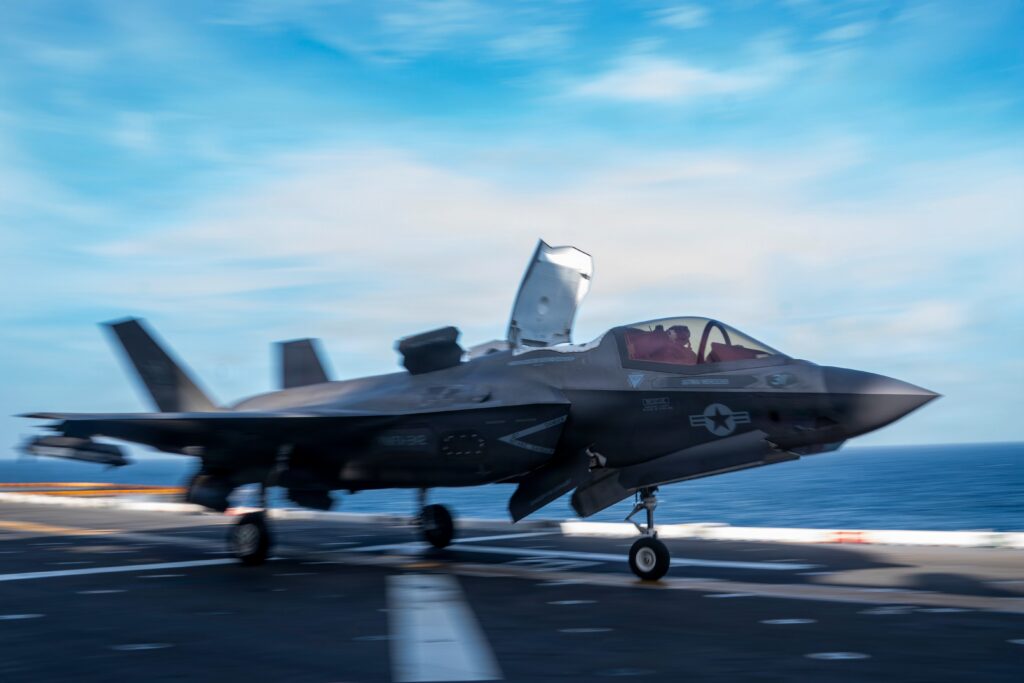
An F-35B Lighting II, attached to Marine Fighter Attack Squadron 242 takes off from the flight deck of America-class amphibious assault ship USS Tripoli (LHA 7) during flight operations in the South China Sea, Dec. 11, 2025. (U.S. Navy photo by Mass Communication Specialist Seaman Angel Conde)
U.S. 7th FLEET AREA OF OPERATIONS — The Tripoli Expeditionary Strike Group, composed of the 31st Marine Expeditionary Unit (MEU), America-class amphibious assault ship USS Tripoli (LHA 7), Ticonderoga-class guided-missile cruiser USS Robert Smalls (CG 62) and Arleigh Burke-class guided-missile destroyer USS Rafael Peralta (DDG 115), is conducting routine operations in the U.S. 7th Fleet area of operations, Dec. 11.
This marks Tripoli’s initial forward-deployed assignment as the flagship for the Tripoli Expeditionary Strike Group. The group’s presence promotes regional stability and maritime security in U.S. 7th Fleet.
“The Tripoli Expeditionary Strike Group is maintaining peace and security in the Indo-Pacific while assuring access to the seas for all nations,” said Rear Adm. Tom Shultz, commander of the Tripoli Expeditionary Strike Group. “As the only permanently forward-deployed expeditionary strike group, our Navy and Marine Corps team’s ability to operate in the air, on land, and sea, combined with anti-air warfare, anti-submarine warfare and anti-surface warfare capabilities allows us to support any contingency in the region.”
The 31st MEU brings the ability to conduct a variety of joint, maritime and amphibious multi-domain operations and activities. They are permanently positioned to provide a flexible and combat-capable force to contribute to deterrence, security, crisis response and multi-domain military operations in the Indo-Pacific.
“The 31st MEU is flexible and responsive. We’re forward deployed and have longstanding, habitual relationships with Amphibious Squadron 11, the Japan Ground Self-Defense Force’s Amphibious Rapid Deployment Brigade and Special Operations Command Pacific,” said Col. Chris Niedziocha, commanding officer of the 31st MEU. “Those relationships, coupled with the unit’s high operational tempo ensure the MEU is always ready to respond to crises and campaign with our allies or fight tonight.”
Embarked aboard Tripoli is a detachment of F-35B Lightning II aircraft from Marine Fighter Attack Squadron (VMFA) 242, which provides the Tripoli Expeditionary Strike Group more stealth and flexibility than any other aircraft. The Tripoli Expeditionary Strike Group is capable of conducting expeditionary warfare operations with Navy and Marine Corps capabilities to support theater contingencies that range from crisis response to full combat operations. U.S. 7th Fleet, the U.S. Navy’s largest forward-deployed numbered fleet, routinely interacts and operates with allies and partners in preserving a free and open Indo-Pacific region.
Lunday Sworn In as 28th Commandant of the U.S. Coast Guard
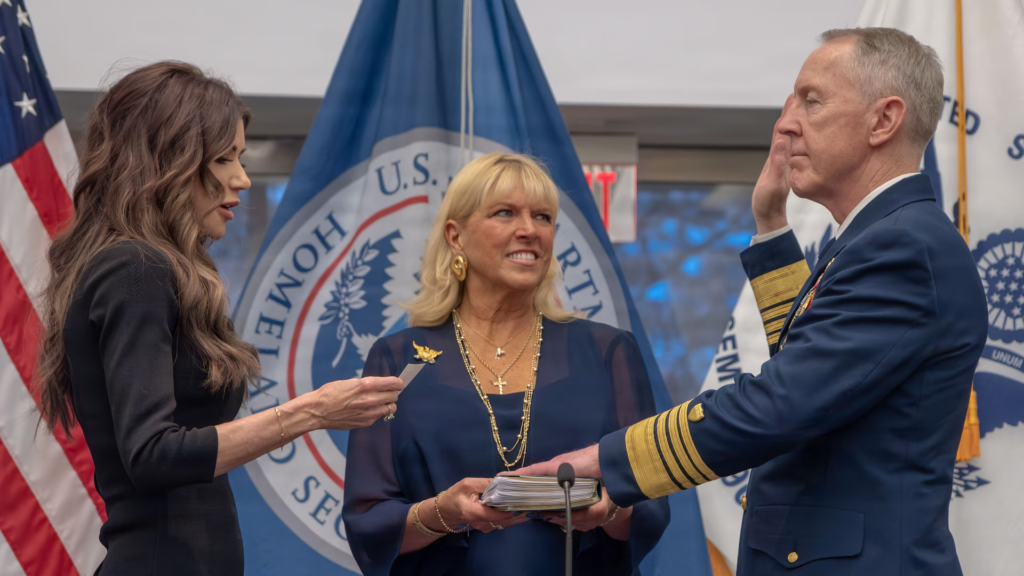
U.S. Coast Guard Adm. Kevin E. Lunday is sworn in as the 28th Coast Guard Commandant by U.S. Department of Homeland Security Secretary Kristi Noem at Coast Guard Headquarters in Washington, D.C. on Jan. 15, 2026. Lunday served as Acting Commandant since Jan. 20, 2025. Before serving as Commandant, Lunday served as the 34th Vice Commandant of the Coast Guard. (U.S. Coast Guard photo by Petty Officer 2nd Class Gabriel Wisdom)
From U.S. Coast Guard Headquarters, Jan. 15, 2026
WASHINGTON – The United States Coast Guard held a formal swearing-in and assumption of command ceremony Jan. 15 for Adm. Kevin Lunday as the 28th Commandant of the U.S. Coast Guard during an event at Coast Guard Headquarters.
Secretary Kristi Noem joined senior Coast Guard leadership, members of the Joint Force and distinguished guests in recognizing the transition of command and Adm. Lunday’s commitment to leading the Service.
“President Trump’s plan was simple when he became President of the United States. He wanted to revitalize the Coast Guard, equip it with the best technology, ships, and aircraft available, and then recruit the men and women that were necessary to run it all. It’s a tall order, and it takes a special kind of leader to lead this team and make that a reality,” said Secretary Noem. ”With almost 40 years in the Coast Guard, and with command experience that has ranged from the Indo-Pacific to the Persian Gulf to cyberspace, Kevin Lunday was the man for the job. Congratulations, Admiral Lunday!”
Upon taking the oath of office, Adm. Lunday formally assumed the responsibilities of Commandant and reaffirmed the Coast Guard’s enduring role as a vital instrument of national power responsible for controlling, securing, and defending the U.S. border and maritime approaches; facilitating the safe and secure flow of commerce that is vital to economic prosperity, strategic mobility, and America’s maritime dominance; and responding to crises and contingencies that may come without warning.
“I am honored to assume command of the United States Coast Guard,” said Adm. Kevin Lunday. “Every day, Coast Guard men and women carry out missions that protect our homeland, secure our maritime borders, save lives and protect national security. I am humbled to serve alongside them while ensuring they have what they need to succeed – today and in the future.”
As Commandant, Adm. Lunday will lead the Service’s continued transformation through Force Design 2028, while strengthening operational readiness and supporting the Coast Guard workforce and their families.
The Coast Guard remains Always Ready, delivering mission excellence across the maritime domain in service to the American people.
Navy’s New Mobile Ship Target Arrives in Port Hueneme
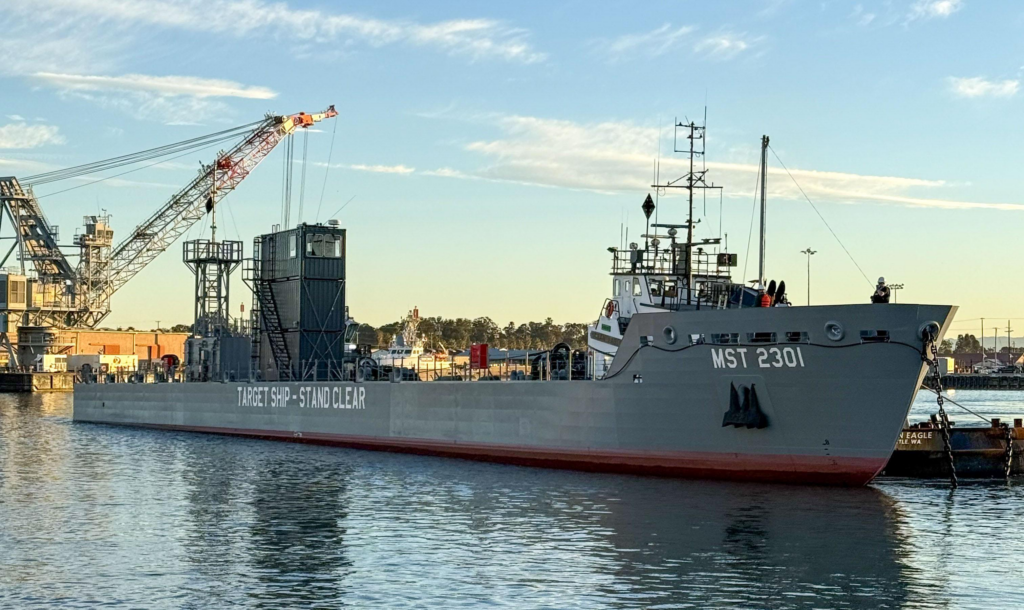
The Navy’s Mobile Ship Target MST 2301, known as MST-2, arrives at Port Hueneme to begin outfitting and preparation for future weapons testing operations. The remotely operated vessel is designed to provide a realistic, reusable surface target for live-fire and sensor testing. (Courtesy photo)
From Naval Air warfare Center Weapons Division, Jan. 14, 2026
PORT HUENEME, Calif. — The Navy’s newest test ship, the Mobile Ship Target, arrived in Port Hueneme Jan. 14, where Naval Air Warfare Center Weapons Division teams will prepare it for operations supporting advanced weapons testing.
Gunderson Marine built and launched the 260-foot Mobile Ship Target, known as MST-2 and designated MST 2301, in Portland, Oregon, in July 2025 for builder’s sea trials before delivering it to the Navy.
At Port Hueneme, NAWCWD teams will outfit MST 2301 for operational use. To enable remote operation, the Threat Target Systems Department’s seaborne engineering team will install a government-developed remote-control system. This capability will allow the vessel to operate safely during live-fire events.
“Once complete, the MST will give us a safe, repeatable way to run some of the toughest weapons tests the fleet depends on,” said Kevin Gross, director, Threat Target Systems Department.
Unlike smaller or single-use targets, MST-2 was designed for long-term use. Missions will include sensor and tracking evaluations as well as live-fire events with weapons launched from ships or aircraft. Its size, speed and reconfigurable design make it a flexible platform for testing future naval capabilities.
MST-2 will replace the Advanced Target Launch System, also known as MST-1 (MST 9301), which is being removed from government ownership after decades of supporting fleet and maritime testing operations.
“This is about giving Sailors and Marines confidence,” said Rear Adm. Keith Hash, commander, Naval Air Warfare Center Weapons Division. “When they go into harm’s way, they need to trust their systems completely. The MST lets us prove that trust under the most realistic conditions possible.”
NAWCWD expects MST 2301 to complete outfitting and begin supporting weapons testing in early 2026.
CHINA LAKE, Calif., Jan. 15, 2026 – For the first time, Lockheed Martin (NYSE: LMT) conducted a successful 90-degree launch of a Joint-Air-to-Ground Missile (JAGM) from the JAGM Quad Launcher (JQL) during a demonstration in China Lake, California.
THE BIG PICTURE
In the demonstration, JAGM proved its ability to neutralize UAS threat systems.
It also demonstrated the versatility of the JQL launcher, which was mounted to a Richard Childress Racing 6×6 Mothership vehicle.
WHY IT MATTERS
Validating JAGM & JQL full vertical-launch capability: This demonstration validated JAGM’s full verticallaunch capability across multiple platforms, including surfacecombatant vessels, which provides a 360degree defensive envelope for maritime vessels and other platforms. With JAGM’s advanced dual-mode seeker (SAL/MMW), this integration effort presents JAGM as the ideal munition solution for the U.S. Navy and its allies’ mission-critical needs.
Showcasing counter-UAS technology: The successful engagement of a UAS threat with JAGM underscores the missile’s ability to detect, track and neutralize hostile threats including drones, unmanned surface vehicles (USVs) and other air threats. This is an increasingly vital capability that modern naval forces need to address emerging threats.
Multidomain mission integration: The integration of JAGM with the JQL highlights Lockheed Martin’s ability to provide flexible, missiontailored deployment across air, sea and land environments. Operators can select from a range of engagement envelopes to meet specific user mission objectives.
EXPERT PERSPECTIVES
“The successful JQL verticallaunch demonstration confirms that JAGM can be rapidly deployed from a multimissile launcher across a variety of scenarios, while delivering the networkcentric integration our global users demand,” said Casey Walsh, program management director, Lockheed Martin Multi-Domain Missile Systems. “This milestone validates our vision of a unified missile architecture that seamlessly operates across air, land and sea domains, enhancing survivability and flexibility for future combat operations.”
“Lockheed Martin continues to push the boundaries of what is possible in vertical launch system development, driving innovation and advancement in the field,” said Edward Dobeck, director, Lockheed Martin Launching Systems. “This proven combat-ready capability meets multidomain deployment objectives today, and provides the same reliability expected of all our launching systems.”
Coast Guard Awards $200M Contract to Rebuild Station South Padre Island, Texas
An architectural rendering depicts the future U.S. Coast Guard Station South Padre Island, Texas. The $200 million recapitalization project includes new operational, support, and waterfront facilities, and is scheduled for completion in 2028. (U.S. Coast Guard courtesy illustration)
From U.S. Coast Guard Heartland District, Jan. 14, 2026
WASHINGTON — The U.S. Coast Guard has awarded a $200 million design-build contract to The Haskell Company for the comprehensive recapitalization and expansion of Coast Guard Station South Padre Island in South Padre Island, Texas. This award marks the largest single task order in the history of the Coast Guard’s military construction program.
The contract, funded through the One Big Beautiful Bill Act, will deliver the design and construction of more than 120,000 square feet of essential facilities and supporting infrastructure, directly enhancing mission readiness and execution for Coast Guard and Customs and Border Protection personnel on the southwest U.S. border in Texas. Preliminary design and environmental work will begin immediately, with project completion anticipated in summer 2028.
Located six miles north of the United States-Mexico border, Station South Padre Island is at the forefront of securing the U.S. southern border. The recapitalization project will support the Coast Guard’s operations to secure the U.S. border and maritime approaches, facilitate commerce vital to economic prosperity and strategic mobility, and respond to contingencies along the Gulf Coast and surrounding waterways.
The scope of work includes:
Environmental assessment, site survey investigations, and design services for various facilities
Construction of new station facilities
Construction of Unaccompanied Personnel Housing (UPH), additional berthing, and mission support facilities
Rebuilding of waterfront infrastructure
Construction of a Joint Operations Center and Customs and Border Protection support space
Forward operations space for Deployable Specialized Forces
Delivery of a new harbor operations center and other mission support facilities
Comprehensive site development, utilities, and outfitting
The project represents the largest award value for a shore infrastructure construction project in Coast Guard history and will be delivered on the shortest timeline to date. The planning phase was compressed from the standard 18 months to 45 days, while the contracting process was reduced from 15 months to four months.
On April 20, 2025, a fire severely damaged the boat house at Station South Padre Island, forcing crews to relocate operations. The next day, station personnel responded to reports of illegal fishing and interdicted a vessel in the U.S. Exclusive Economic Zone, where they discovered 130 pounds of red snapper and 75 pounds of shark on board.
“The courageous team of Station South Padre Island showed resilience and determination,” said Admiral Kevin Lunday, acting Commandant of the Coast Guard. “The day after fire severely damaged facilities at Station South Padre Island, this crew was back on patrol, successfully interdicting illicit activity in one of our most complex operating environments. This project will provide Station South Padre Island with modern facilities and empower them to continue operations to control, secure, and defend our southern border.”
Secret Service’s New Trainer Courtesy of Presidential Helicopters Program Office
VH-3D helicopter, bureau number 159351, officially welcomed to the United States Secret Service James J. Rowley Training Center in South Laurel, Md. on January 12. (L to R) Col. Ryan Shadle, Commanding Officer, Marine Helicopter Squadron One, Mr. Miltom Wilson, United States Secret Service Assistant Director, Office of Training, and Col. Erica Mantz, Program Manager, Presidential Helicopters Program Office. Photo courtesy of United States Secret Service.
From Naval Air Systems Command, Jan. 16, 2026
LAUREL, Md. — In June 2025, the Presidential Helicopters Program Office (PMA-274) delivered and installed a retired and refurbished VH-3D helicopter, bureau number 159351 (BUNO 351), to the United States Secret Service (USSS). The agency received the aircraft at the James J. Rowley Training Center (JJRTC) in South Laurel, Maryland, fulfilling its need for a new training aircraft to continue effectively training its agents.
A team of industry and contract support assisted in the seamless transfer of the aircraft and ensured it was treated with top-shelf inspection, maintenance, demilitarization, and white-glove care. The aircraft was delivered to the USSS in quintessential showroom appearance with all tactical features needed for up-to-date training for President and Vice President of the United States (POTUS/VPOTUS) safety and protection.
The aircraft will be used by the USSS to conduct threat reaction and other tactical procedural training, improving agents’ skills to optimize their important protective mission.
BUNO 351’s journey began years before this delivery, in 2022, when the USSS and United States Marine Corps (USMC) started discussions about upgrading the organization’s training asset. Earlier in 2025, initial demilitarization efforts on BUNO 351 were performed by the PMA-274 maintenance department at the Presidential Helicopter Support Facility. The aircraft spent weeks in refurbishment along with having ground training features installed as requested by the USSS. Upon completion the aircraft was shipped to the JJRTC, where it replaced an unserviceable training aircraft.
The USSS explained that the unserviceable training asset was no longer equipped to safely provide needed space and layout for new members who were in training for protective details within the Secret Service. The old training aircraft, now removed from the JJRTC, was a retired U.S. Navy asset. It was painted to resemble Marine One, which is the call sign, or name, of the helicopter when POTUS is aboard.
Trainees can now work both inside and outside of the mock Marine One safely and more accurately for the Presidential and Vice Presidential protection missions they will provide. BUNO 351 also provides the added value of the proper seating configuration in alignment with the VH-92A Patriot helicopter, the latest model flown by Marine Helicopter Squadron One (HMX-1) in support of the presidential lift mission.
“Our teams have collaborated diligently to make this transfer possible,” said Col. Erica Mantz, PMA-274 program manager. “This effort to deliver BUNO 351 has greatly strengthened our partnership with the U.S. Secret Service and contract support team.”
The old U.S. Navy training helicopter was manufactured in October 1963 and has been used by countless special agents and Uniformed Division officers to practice protective movements. It has since been transported to Arizona for shredding and recycling.
“Not only is VH-3D BUNO 351 a significant improvement for our training requirements, our visitors to JJRTC have the opportunity to view a Marine One on tours of the training facility,” said Deputy Special Agent In Charge Troy Sarria. “The new helicopter draws even more attention as an officially retired and demilitarized VH-3D – once flying Presidents and Vice Presidents.”
PMA-274 not only transported the aircraft with industry partners, the program logistics and sustainment teams worked to ensure a comprehensive demilitarization and transfer process was complete end-to-end. An important step is to properly account for all government inventory with a seamless, clear transfer of possession to the USSS.
“We are grateful for the helicopter’s capability and awed by the quality of the final product,” added Sarria.
During the January dedication ceremony officially inducting the retired VH-3D as the USSS training asset, Mantz shared with attendees, “This aircraft served nearly 50 years, supporting nine U.S. Presidents throughout its distinguished history. Now 351 will continue to serve our great nation in a different, but equally important capacity.”
The retired 159351 VH-3D sits just feet away from half a mock Air Force One, dubbed Air Force One Half, aboard JJRTC. This placement is essential. The configuration of these two training assets mimics real-life events and leads to more effective and realistic training.
BUNO 351 served HMX-1 shy of 50 years before reaching its end of service life. The aircraft entered into service in July 1975 and was decommission in October 2024. This venerable aircraft carried nine presidents: Gerald Ford, Jimmy Carter, Ronald Regan, George H. W. Bush, Bill Clinton, George W. Bush, Barack Obama, Donald Trump, and Joe Biden.
PMA-274 provides safe, ready, high-performing, and affordable aircraft, capabilities, and support to HMX-1.
Cutter Alert Returns Home After Interdicting $18.4M in Narcotics During 45-day Patrol
Members of the Servicio Nacional de Fronteras and U.S. Coast Guard Cutter Alert conduct a training exercise near Panama City, Panamá, Dec. 19, 2025. The Coast Guard’s long-standing cooperation with Panamanian security institutions is a small part of broader ongoing cooperative security efforts between the U.S. and partners in Central America. (U.S. Army photo by Spc. Trey Woodard)
Coast Guard Cutter Alert returns home after interdicting more than $18.4M in narcotics during 45-day patrol
Cape Canaveral, Fla. — The crew of the Coast Guard Cutter Alert (WMEC 630) returned to their home port in Cape Canaveral, Thursday, following a 45-day counter-drug patrol in the Windward Passage, Caribbean Sea and Eastern Pacific Ocean.
While underway in the Coast Guard Southeast District area of responsibility, Alert’s crew interdicted a go-fast style vessel trafficking illegal narcotics in the Windward Passage. The crew seized 2,250 pounds of cocaine valued at $18.4 million, seven pounds of marijuana valued at $7,000 and an illegal firearm. The four suspected smugglers on board, narcotics and firearm were transferred to the Bahamas government for prosecution.
“I am immensely proud of my crew’s unwavering dedication,” said Cmdr. Mario Gil, commanding officer of Alert. “Time spent away from family and missed holidays represents a significant sacrifice, which makes their commitment to combating narco-terrorism and protecting our nation’s borders from illicit drugs all the more commendable, as demonstrated by the extraordinary success of this patrol.”
In the region, Alert’s crew also patrolled in support of Operation Vigilant Sentry while underway in the Coast Guard Southeast District area of responsibility. Crew member presence in the vicinity of Haiti served to deter unsafe and illegal migration.
While transiting the Panama Canal, the crew had the distinct honor of hosting Ambassador Kevin Marino Cabrera, U.S. Ambassador to Panama, aboard the cutter for a tour of the ship, discussions about current operations and a Miami-inspired lunch prepared by Alert’s culinary specialists.
The crew also supported U.S. – Panama relations by hosting eight members from Panama’s National Aeronaval Service (SENAN) and Joint Maritime Force – Panama for joint training and a professional exchange of counter-narcotics best practices. Crew members conducted multiple joint pursuit-style, simulated interdictions with vessels and forces from SENAN. This training provided continued support of the Salas-Becker Complementary Agreement of 2002, which created a framework for U.S.–Panama bilateral cooperation to counter illicit drug trafficking by sea and air.
During a port-of-call visit to Golfito, Costa Rica, Alert’s crew welcomed representatives from the Costa Rican Coast Guard aboard for a tour of the ship and an embarked MH-65 Dolphin helicopter from the Coast Guard Helicopter Interdiction Tactical Squadron, based in Jacksonville. The visit fostered joint nation inoperability and strengthened international counter-drug efforts in the region.
While at sea in the Coast Guard Southwest District area of responsibility, the crew conducted boardings to verify and enforce international law at sea in the Eastern Pacific Ocean.
In addition, Alert crew members earned the title of shellback after crossing the equator, a title few sailors earn during a career.
US Navy and Marines Select L3Harris T7 Robots to Enhance Ordnance Disposal Capabilities
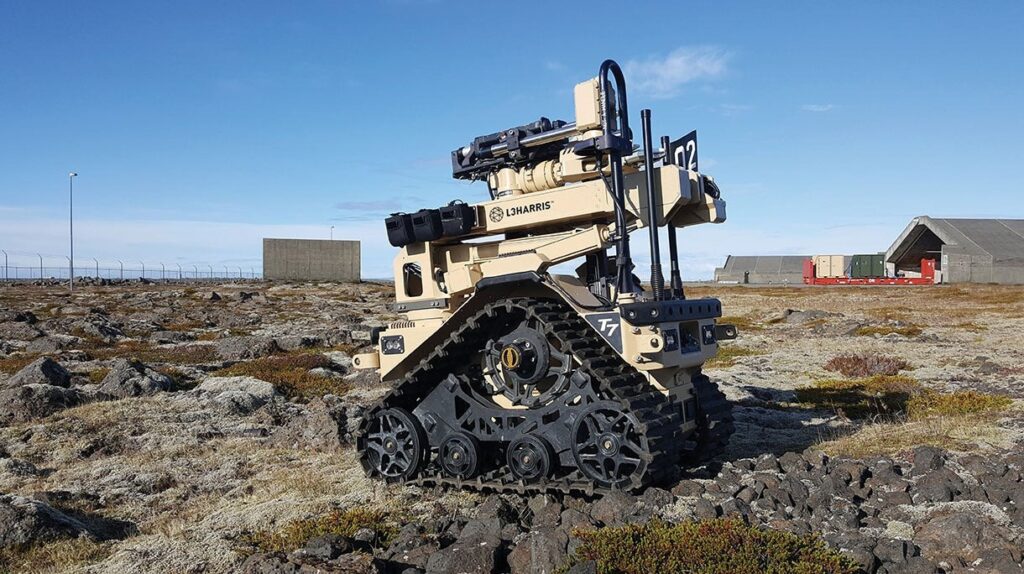
The L3Harris large T7 robotic systems will provide U.S. Navy and U.S. Marines with enhanced dexterity and performance to safely execute explosive ordnance disposal missions. (L3Harris)
MELBOURNE, Fla., Jan. 14, 2026 — L3Harris Technologies (NYSE: LHX) has received an award to support the U.S. Navy and the U.S. Marines with 34 large T7™ robots that will deliver enhanced capabilities for explosive ordnance disposal (EOD) missions.
L3Harris T7 robots help keep troops out of harm’s way by neutralizing explosive threats from a safe distance. The company designed the robotic systems for high-risk missions, providing mobility, manipulation and intuitive control.
“Recognized by both the Navy and Marines for outstanding dexterity and performance, L3Harris T7 robotic systems will provide them a significant advantage for their most challenging EOD missions,” said Dave Kornick, President, Intelligence and Cyber, Space and Mission Systems, L3Harris. “We’re honored to continue working with the Department of War and our key partners in the U.K. and Australia, who also use the most advanced robotic technology available.”
Deliveries under this multi-year contract are scheduled to begin this year. L3Harris will also provide robotic system and comprehensive operator training.
This award follows a U.S. Air Force order for more than 100 robots in 2021. The Australian Defence Force and U.K. Ministry of Defence also use large T7 and medium-sized T4 robots to support their EOD missions.
Coast Guard Releases Force Design 2028 Initial Update, Highlights Return on Investment
WASHINGTON — The United States Coast Guard today released the Force Design 2028 Initial Update, detailing the reforms implemented since January 2025 and the significant, measurable impacts these changes have delivered for the American people. The update underscores how Force Design 2028 has strengthened the Service’s operational effectiveness, improved workforce readiness, accelerated capability delivery, and generated unprecedented value for the Nation.
As a result of these reforms, the Coast Guard is better positioned today than at any point earlier this year to control, secure, and defend the U.S. southern border and maritime approaches; facilitate the uninterrupted flow of commerce; and rapidly respond to national and global contingencies.
“The United States Coast Guard serves as a vital instrument of national power, advancing security both at home and abroad, safeguarding the American economy, and providing rapid response to emergent contingencies. When I became the Secretary of Homeland Security, we took steps to change the Coast Guard in support of President Trump’s America First Agenda,” said Kristi Noem, Secretary of Homeland Security. “Through the implementation of Force Design 2028, the extraordinary return on investment—the value the Coast Guard provides to our Nation—is poised to grow even further. The men and women of the Coast Guard exemplify the very best of our Nation. We are immensely proud of their achievements through Force Design 2028. Together we will continue to put America First.”
“As we deliver the first update on Force Design 2028, the Coast Guard is already a stronger, more agile, capable, and responsive fighting force,” said Adm. Kevin Lunday, Acting Commandant of the U.S. Coast Guard. “The Service is better positioned than it was in January 2025 to effectively control, secure, and defend the U.S. borders and maritime approaches, facilitate the uninterrupted flow of commerce, and rapidly respond to contingencies. Force Design 2028 is already improving operational outcomes while establishing the foundation for even greater achievements in the future.”
Unmatched Return on America’s Investment Through disciplined and aggressive stewardship of its $12.1 billion annual budget, the Coast Guard delivers an unmatched return on investment for the Nation. Conservative analysis shows the Service generates more than $74 billion in social and economic value through cost avoidance—representing a 6-to-1 return on taxpayer investment.
Historic Counter-Drug and Law Enforcement Results Since January 2025, the Coast Guard has seized more than 466,000 pounds of cocaine—equivalent to over 176 million lethal doses, enough to kill more than 52 percent of the U.S. population. In Fiscal Year 2025 alone, the Service interdicted more than 510,000 pounds of cocaine, the highest total in Coast Guard history and an increase of more than 200 percent over FY24.
Beyond interdictions, Coast Guard counter-drug and law enforcement missions generate substantial social value. Conservative estimates indicate these operations saved the Nation over $10 billion in avoided costs, including more than $2.27 billion in healthcare costs associated with cocaine interdiction alone.
Facilitating Commerce and Responding to Contingencies The Coast Guard’s continued governance and protection of the Marine Transportation System enabled the safe movement of 1.8 billion tons of cargo in FY25—an increase of more than 13 percent from FY24—returning more than $28 billion in value to the American people.
The Service also reaffirmed its enduring commitment to saving lives at sea. In FY25, Coast Guard crews saved nearly 5,000 lives and preserved/assisted more than $974 million in property while responding to mariners in distress across the Nation’s waterways.
Building a Larger, Healthier, and More Ready Workforce Force Design 2028 continues to advance efforts to build a healthier, more resilient, and mission-ready workforce, including progress toward expanding the force by 15,000 military members to meet evolving operational demands and support new assets.
In FY25, the Coast Guard exceeded 110 percent of its active-duty enlisted recruiting goal, enlisting more than 5,200 members—the highest total since 1991. The Service also achieved 104 percent of its Reserve Enlisted recruiting goal and 100 percent of its active-duty Officer mission.
Enhanced Agility in Response to National Priorities Increased agility resulting from Force Design 2028 initiatives enabled the Coast Guard to rapidly address emerging threats and national priorities:
Operation Border Trident, launched in March 2025, targeted transnational terrorist and criminal organizations and illegal alien activity in the California Coastal Region, increasing interdictions by 44 percent compared to FY24.
Operation River Wall, initiated in October 2025, secured approximately 260 miles of the Rio Grande River, resulting in the interdiction of 47 illegal aliens and the deterrence of 237 more.
Operation Pacific Viper, launched in August 2025, doubled the Coast Guard’s most capable assets in the Eastern Pacific. In just over four months, crews seized more than 170,000 pounds of illegal narcotics—averaging approximately 1,600 pounds of cocaine interdicted per day.
Structural Reform and Rapid Capability Delivery These outcomes were made possible by sweeping reforms enacted under Force Design 2028. The Coast Guard established new leadership roles—including Chief of Staff, Deputy Commandant for Systems, Deputy Commandant for Personnel, and Program Executive Offices—while eliminating 14 Admiral positions (32 percent) to streamline decision-making and maximize efficiency.
The Service also created the Rapid Response Prototype Team (RAPTOR) to deliver technology solutions at speed. RAPTOR transitioned a capability from concept to operational use in just three weeks, supporting Operation Border Trident with a contractor-owned, contractor-operated long-range unmanned aerial system employing artificial intelligence.
Additionally, the Coast Guard empowered commanders by revising administrative policies related to non-judicial punishment and delegating surface and airborne use-of-force authorities, increasing operational effectiveness at the tactical level.
Accelerated Investment and the Road Ahead Capability delivery is being further accelerated through Force Design 2028 and resources provided by the One Big Beautiful Bill Act (OB3). More than $3 billion in OB3 funds have already been obligated, with 75 percent of total funding expected to be obligated by the end of FY26. In the coming months, the Coast Guard will implement major structural changes and investments, including:
Establishing a Deployable Specialized Forces Command to enhance integration with the Department of War and optimize force employment. Expanding training capacity to support a growing force of more than 15,000 additional military members.
Enhancing Maritime Domain Dominance through Coastal Sentinel, improving sensor integration and operational responsiveness. Rapidly identifying, testing, and acquiring commercially available boats, cutters, and aircraft to empower Coast Guard personnel across all mission areas.
Executing a comprehensive Force Posture and Operational Concepts Campaign to transform how the Service organizes, trains, equips, and employs forces—streamlining strategic decision-making, decentralizing execution, and leveraging next-generation technologies to ensure enduring U.S. maritime dominance.
The Force Design 2028 Initial Update affirms the Coast Guard’s commitment to reform, readiness, and results—delivering security, prosperity, and unmatched value for the American people today and into the future.
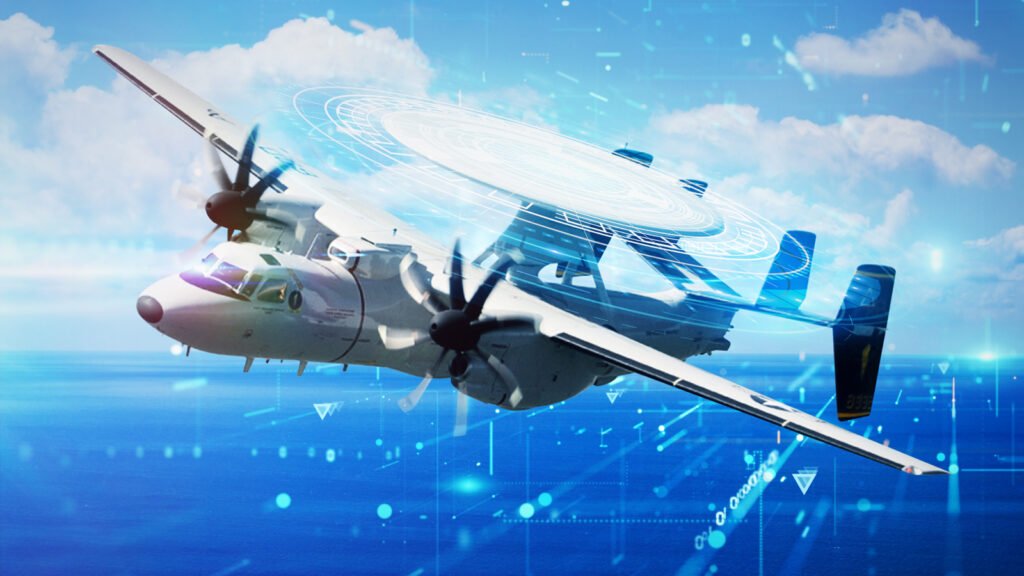
BAE Systems Awarded $62 Million Contract to Stand up Hawkeye IFF Service Depot
New depot capability speeds up repairs and increases combat readiness for U.S. Navy
GREENLAWN, N.Y. — January 15, 2026 – The U.S. Navy has awarded BAE Systems a $62 million contract to begin a new capability in the current depot line at the Fleet Readiness Center Southwest in San Diego, California for the E-2D Advanced Hawkeye aircraft interrogator system. The effort will provide testing, troubleshooting, diagnostic, and repair capabilities for the AN/APX-122A Identification Friend or Foe (IFF) interrogator system.
“This onsite maintenance center will enable the Navy to enhance mission readiness and platform availability, while reducing lifecycle costs and turnaround time,” said Damon Brady, director of Tactical Systems at BAE Systems. “It will establish a new operational capability to get critical command and control technologies to U.S. joint forces and allies faster.”
The interrogator system provides enhanced identification and enables faster decision making to distinguish between allied forces and potential threats in contested scenarios, giving operators the situational awareness they need to complete their missions. The E-2D carries out a variety of tactical missions that include command and control, border security, search and rescue, and missile defense.
BAE Systems will develop a depot test station within its facilities to perform diagnostics and repairs on critical modules within the E-2D IFF system and provide sustainment support once delivered to the U.S. Navy at the Fleet Readiness Center Southwest.
With more than 80 years of IFF experience, BAE Systems has delivered over 16,000 transponders, 1,500 interrogators, and 6,000 combined interrogator transponder systems for use on new and existing platforms, including unmanned aerial vehicles, ships, and rotary- and fixed-wing aircraft. IFF products are available for all service branches and support the U.S. and coalition forces in air defense, weapon systems, air traffic control, and range instrumentation.
The Hawkeye interrogator system is manufactured at BAE Systems’ facilities in Greenlawn, New York and Manassas, Virginia.