Flight control technology upgrade maximizes processing power for added mission capabilities and safety enhancements
ENDICOTT, N.Y. — Sept. 6, 2023 — BAE Systems’ next-generation vehicle management computer was successfully flight tested on the F-35 Lighting II aircraft. The test demonstrated a technology upgrade for all three F-35 variants that will increase computer performance and addresses obsolescence issues. Testing occurred at Naval Air Station Patuxent and Edwards Air Force Base.
BAE Systems’ Vehicle Management Computer (VMC) enables advanced control modes and improves mission efficiency and safety. Its distributed architecture allows the aircraft to operate reliably with enhanced mission effectiveness in demanding environments. The upgraded VMC will not only help to mitigate obsolescence but will also improve safety, maintainability, and availability of the aircraft for the U.S. military and its allies.
“The VMC provides the high integrity processing required to implement the advanced control algorithms that enable this platform’s critical missions,” said Corin Beck, director of Military Aircraft Systems for Controls and Avionics Solutions at BAE Systems. “This upgrade leveraged BAE Systems’ technology roadmap to ensure the F-35 will advance its mission management and flight control capabilities today and into the future.”
This technology upgrade incorporates a quad-core advanced processor for both a high-performance and efficient solution. The new level of computing power allows for additional aircraft capabilities while reducing pilot workload. It also adds advanced mission capabilities to the VMC such as the Joint Precision Approach and Landing System (JPALS) and Auto Ground Collision Avoidance System (AGCAS).
BAE Systems has more than 40 years of experience developing and integrating flight control technology for military and commercial platforms. Work on the VMC occurs at the company’s state-of-the-art engineering and manufacturing facility in Endicott, New York.
BAE Systems is a major global partner to Lockheed Martin on the F-35 program. The company provides the VMC, electronic warfare system, active inceptor control system, and aft fuselage for each F-35 at manufacturing facilities in the U.S., U.K., and Australia. The company also delivers sustainability, technical support, and training services to keep the F-35s mission-ready.
Secretary of Defense Lloyd J. Austin III announced today that the president has made the following nominations:
Navy Rear Adm. Blake L. Converse for appointment to the grade of vice admiral, with assignment as deputy commander, U.S. Pacific Fleet, Pearl Harbor, Hawaii. Converse is currently serving as deputy commander, U.S. Pacific Fleet, Pearl Harbor, Hawaii.
Navy Rear Adm. Jeffrey T. Jablon for appointment to the grade of vice admiral, with assignment as deputy chief of naval operations for installations and logistics, N4, Office of the Chief of Naval Operations, Washington, D.C. Jablon is currently serving as a special assistant to director, Navy Staff, Office of the Chief of Naval Operations, Washington, D.C.
Navy Rear Adm. (lower half) Michael A. Brookes for appointment to the grade of rear admiral. Brookes is currently serving as director, National Maritime Intelligence Integration Office; and commander, Office of Naval Intelligence, Washington, D.C.
Navy Capt. Bryan E. Braswell for appointment to the grade of rear admiral (lower half). Braswell is currently serving as commander, Naval Information Warfighting Development Center, Norfolk, Virginia.
DEPOT TACKLES SUPPLY CHAIN ISSUES WITH ADVANCED MANUFACTURING
Release from U.S. Marine Corps Logistics Command
*****
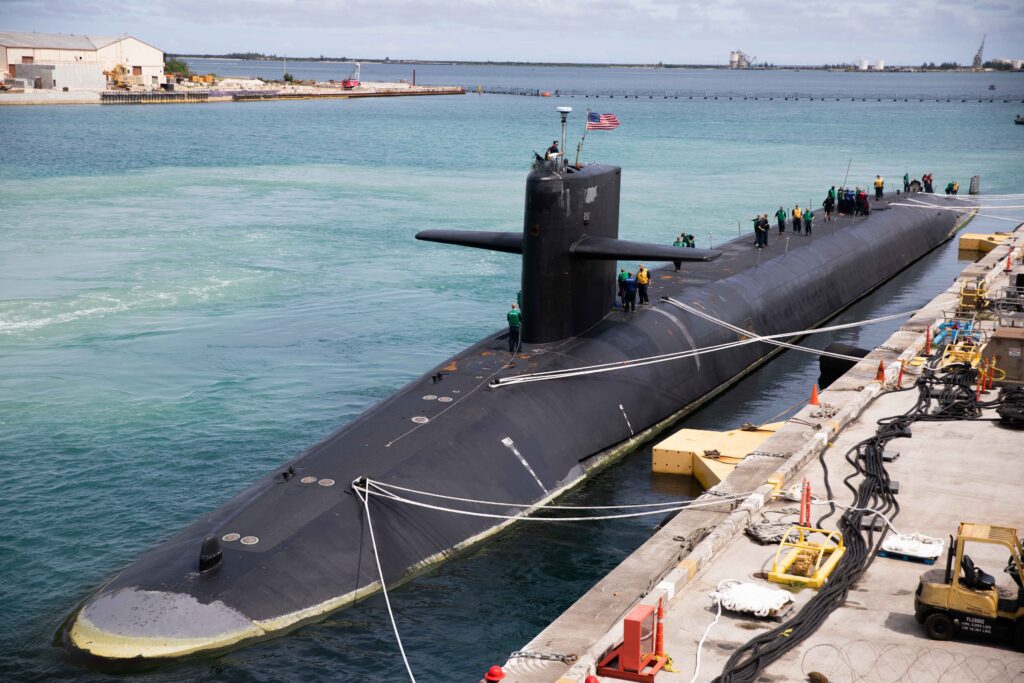
MARINE CORPS LOGISTICS BASE ALBANY, GA – The Marine Corps Advanced Manufacturing Center of Excellence (AM COE) recently helped the Navy solve a supply chain issue for the USS Kentucky.
The Kentucky, an Ohio-class ballistic submarine (SSBN), needed a specifically designed cover for a ventilation system, and a long lead supply chain and the complex geometry of the part meant that a creative solution was needed.
In December, Naval Sea Systems Command’s Trident Refit Facility Bangor (TRFB), which is responsible for repairing, incrementally overhauling and modernizing the Pacific Fleet SSBNs during refits, contacted the Marine Depot Maintenance Command (MDMC). The AM COE, part of the Marine Corps Maintenace Command, leverages AM technology to increase depot production and bolster supply operations and expeditionary capabilities for the Fleet Marine Force.
When TRFB reached out to the MDMC’s Advanced Manufacturing team for a solution, they answered the call. The Marine Corps AM COE reengineered the provided drawings to meet 3D printer specifications and MDMC’s Production Plant in Barstow, California, 3D printed the aluminum using an EOS 400-1 Machine.
This is the first additively manufactured metallic component produced to solve a supply chain issue on Ohio-Class submarines.
“We appreciate the tremendous work of the Marine Corps Advanced Manufacturing Center,” said CAPT Mike Eberlein, commanding officer, TRFB. “Having access to AM greatly increases our efficiency and this is just one of many examples of multiple commands working together to solve problems for the benefit of our warfighters.”
The Marine Corps AM COE continually explores ways to expand partnerships and welcomes inquiries from organizations across the U.S. Marine Corps, Department of Defense, industry and academia.
USS Lake Champlain Decommissions After 35 Years of Distinguished Service
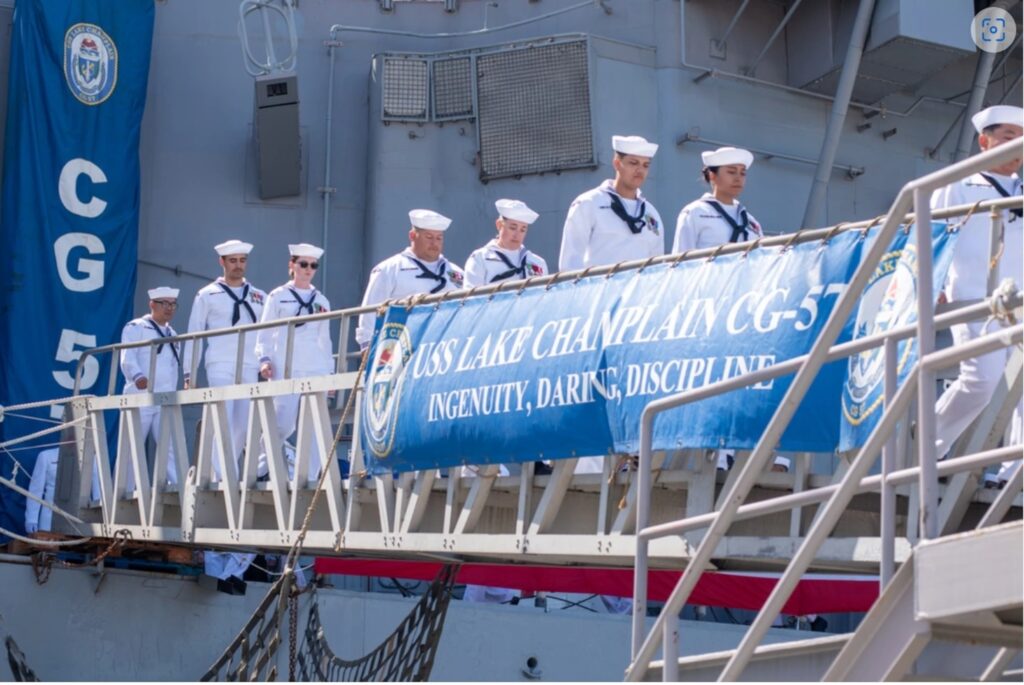
Ticonderoga-class guided-missile cruiser USS Lake Champlain (CG 57), the 11th ship of its class, was recognized for more than 35 years of naval service during a decommissioning ceremony at Naval Base San Diego, Sept. 1.
During the ceremony guest speaker Vice Adm. Thomas H. Copeman III (Ret.) wished the current crew fair winds and following seas as they bid farewell to their ship. Copeman was a former Lake Champlain executive officer and the 17th Commander, Naval Surface Forces.
“Behind me is a machine of wonderous complexity and capability. It is truly a marvel of modern technology dedicated to decisive combat operations at sea,” said Copeman. “The fact that she is sitting here, still mission capable is a tribute to the surface Navy and all the people tasked to support the surface fleet. It is those Sailors who have literally given the primes of their lives to the United States Navy keeping this machine in fighting shape that we are really here to pay tribute to.”
The former commander concluded, “Without all these dedicated Sailors, officers and enlisted, the ship behind us would have been nothing but a monument to technology. For 35 years it was the home for thousands of Sailors.”
Lake Champlain’s Commanding Officer, Capt. Steven M. Foley reflected on the service of his crew and those who came before.
“It truly has been my honor and privilege to have served as Lake Champlain’s 19th and final commanding officer,” said Foley. “I served before on this fine warship as a chief and senior chief and was also selected as an officer. CHAMP built a reputation on the waterfront for bringing out the best in her Sailors, just like she did in me. To all the CHAMP Warriors – past and present – Fighting 57 will be eternally grateful and proud of your hard work, dedication, and commitment to excellence! As we bid farewell, we thank all those that stood the watch and give special thanks to the family and friends for their continued love and support over three and half decades. CHAMP may be gone, but the memories we shared and the legacy we made will live forever in our hearts.”
Selected for the limited duty officer program while both were assigned to Lake Champlain, Foley credits Copeman’s guidance throughout his career for the opportunity to serve as the ship’s final commanding officer.
Lake Champlain maintained a crew of 40 officers, 31 chiefs and 300 enlisted Sailors, and never changed homeports from San Diego. The ship was built in Pascagoula, Mississippi, by Ingalls Shipyard Company and commissioned Aug. 12, 1988, in Manhattan, New York City, New York. Through the course of its distinguished service, Lake Champlain supported Operations Enduring Freedom and Southern Watch, Global War on Terrorism, Maritime Security Operations (MSO) in the North Arabian Gulf (NAG), and counter piracy operations and was awarded 11 Battle Effectiveness (Battle “E”) Awards, three Navy Unit Commendations, and two Meritorious Unit Commendations.
Lake Champlain’s rich deployment history spans three and a half decades. With its first deployment beginning in 1989, the ship completed 17 major deployments. In 1990 the ship responded to an SOS from the Chinese cargo ship M/V Huazhu which was in distress and taking on water. Upon arrival, Lake Champlain and four other ships joined other merchant vessels in the search but could find no sign of the stricken ship or its crew. In heavy seas and with the weather worsening through the day, they searched for the crew. Eventually, USNS Navasota (T-A0 1061) spotted logs and survivors clinging to debris. In ten-to-twelve-foot seas and darkening, overcast skies, the helicopter flight crews and rescue swimmers battled the elements and the added danger of Huazhu’s adrift cargo to pull survivors out of the frigid waters in the Northern Philippine seas. One of Lake Champlain’s petty officers spotted a survivor among a drift of logs that were being buffeted by the heavy seas. Disregarding his own personal safety, he jumped into the rough waters and pulled the man out. He was later awarded the Navy and Marine Corps Medal for his heroic actions. In worsening weather conditions and his body trapped in a particularly large drift of debris, only the Huazhu’ s captain was not recovered.
In all, 14 survivors were rescued and five bodies were recovered. Taken onboard Lake Champlain for transport to Subic Bay, Philippines, the ship’s two-person medical department treated the men. Two were severely injured and received immediate and intensive care that would later be credited with saving their lives. The rescued crewmen waved as they went ashore and the ship’s crew lining the rails waved back. One of the seriously injured was miraculously able to walk off the ship with some assistance and thanked the captain on the pier. Overcome with emotion, he hugged him before allowing himself to be led off to the ambulance. Lake Champlain departed Subic Bay 31 minutes after arriving.
The following year, CG 57 again stopped briefly in Subic Bay, Philippines to support Operation Fiery Vigil evacuations after the eruption of Mt. Pinatubo. The ship evacuated 844 personnel in three runs, covering 2,500 miles in five days.
In 1993 Lake Champlain seized over 7-tons of cocaine, after intercepting Mexican vessel Oso IV, during counter-drug Operation Tidal Wave in the eastern Pacific.
Lake Champlain lived up to the legacy of its predecessors.
CG 57 was the third U.S. Navy warship named to commemorate the victories during the War of 1812 in the waters of Lake Champlain and the lakeside town of Plattsburg, New York.
On Sept. 11, 1814, Brigadier General Alexander Macomb and his troops defended Plattsburg while Master Commandant Thomas MacDonough and his ships defended Lake Champlain from the converging British forces. The defense of Plattsburg and Lake Champlain solidified the American advantage and withheld British territorial gains.
The first ship of the fleet to bear the name Lake Champlain (AC 7) was a cargo ship during World War II making three round trips to Europe, carrying various supplies such as coal, ammunitions, provisions, and soldiers. AC 7 was decommissioned on March 20, 1919.
The second ship of the fleet to bear the name was an Essex-class aircraft carrier, USS Lake Champlain (CV 39) commissioned on June 3, 1945, and was the last U.S. Naval aircraft carrier with an axial flight deck. Too late to see action in World War II, the ship was assigned to “Magic Carpet” duty repatriating US military personnel. Decommissioned briefly in the late 1940s, the ship again served in the combat zone off Korea providing air support, later served off the coast of Lebanon in 1957, and was active during the 1962 quarantine of Cuba. The ship was also part of both the Mercury and Gemini Programs prior to decommissioning on May 2, 1966.
The decommissioning of CG 57 supports department-wide business process reform initiatives to free up time, resources, and manpower in support of increased lethality.
US Air Force, RTX complete first flight test of AIM-120C-8
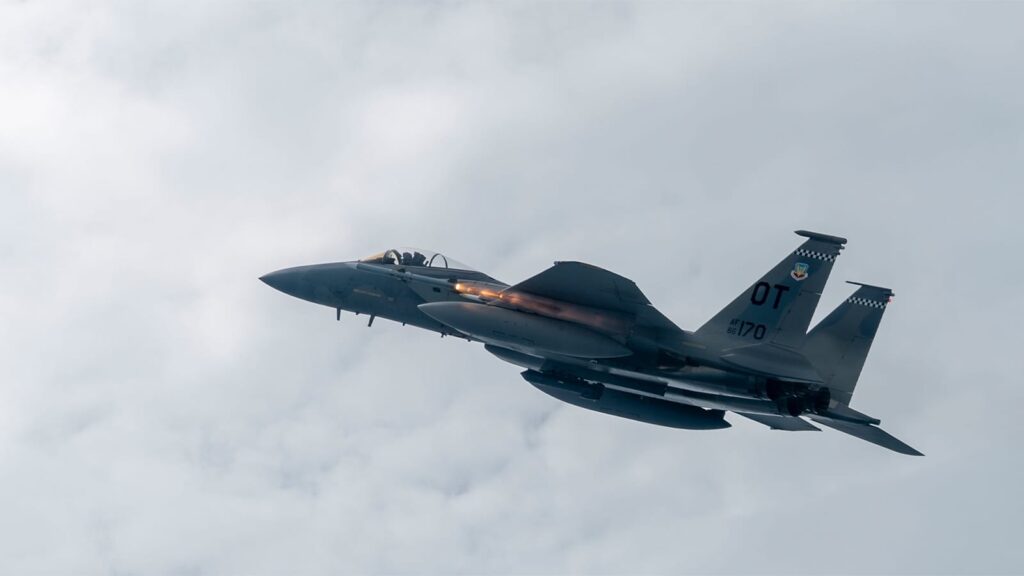
TUCSON, Ariz., Sept. 1, 2023 /PRNewswire/ — The U.S. Air Force and Raytheon, an RTX (NYSE: RTX) business, successfully completed the first flight test of the AIM-120C-8 – the latest international variant of AMRAAM® developed under the Form, Fit, Function (F3R) refresh. The AIM-120C-8 was fired from an F-15C Eagle and downed the aerial target, meeting all primary objectives for the flight test.
“AMRAAM is a combat-proven missile trusted by more than 40 international partners for both air-to-air and surface-to-air missions,” said Paul Ferraro, president of Air Power at Raytheon, an RTX business. “With the advancements from F3R, which updates both the missile’s hardware and allows for future Agile software upgrades, we are maximizing the capabilities of this munition for allies around the world.”
Under the F3R program, engineers used model-based systems engineering initiatives and other digital technologies to upgrade multiple circuit cards and advanced processors in the guidance section of the missile and to re-host legacy software in the AIM-120D-3 and AIM-120C-8 AMRAAMs.
This AIM-120C-8 flight test follows the completion of flight testing of the AIM-120D-3. Flight testing on the AIM-120D-3 was completed in just 11 months after the initial flight test and concluded with showcasing the success of the missile in a highly contested environment.
Recently, the U.S. Air Force awarded Raytheon a $1.15 billion AMRAAM contract to produce AIM-120D-3 and C-8 missiles for 19 countries.
U.S., Philippine Navies conduct bilateral sail to enhance interoperability
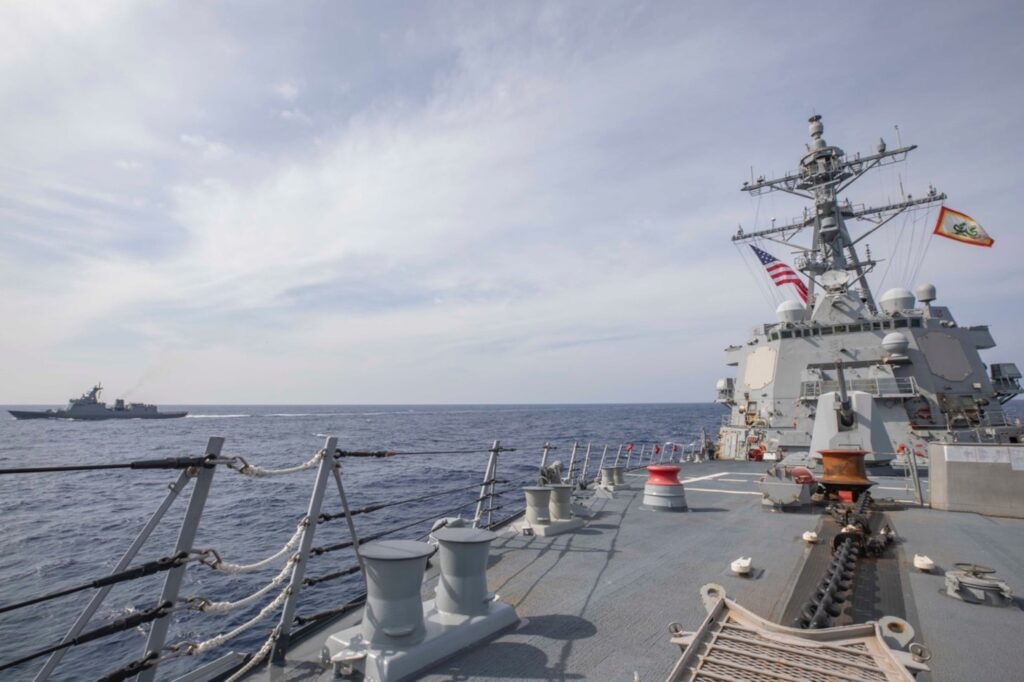
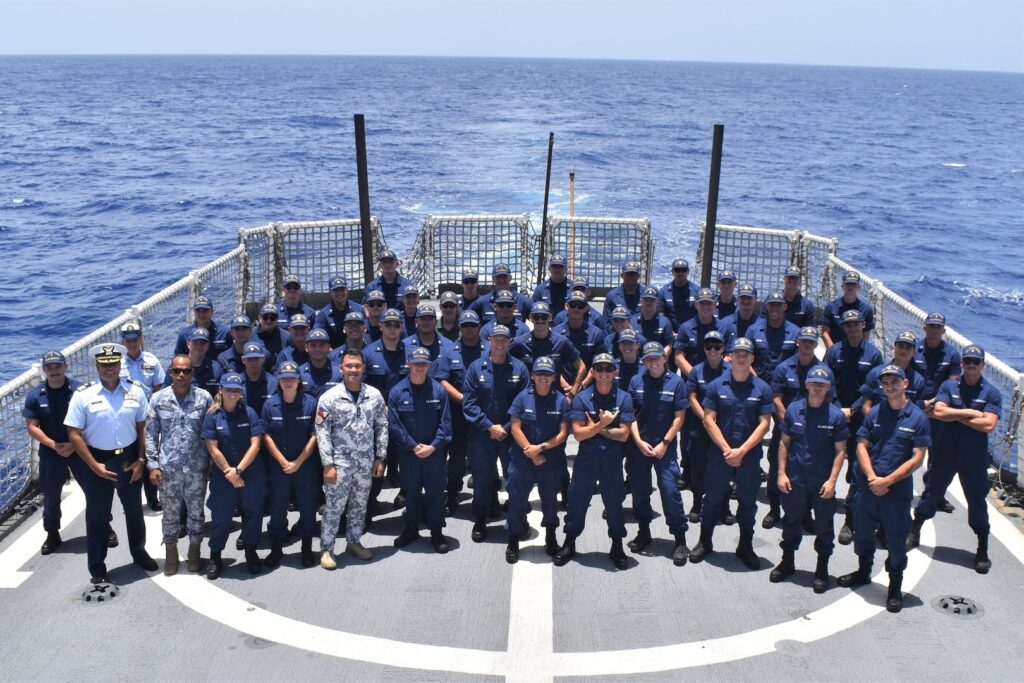
SOUTH CHINA SEA – U.S. Navy Arleigh Burke-class guided missile-destroyer USS Ralph Johnson (DDG 114) and Philippine Navy guided-missile frigate BRP Jose Rizal (FF-150) conducted a bilateral sail in the South China Sea Sept. 4, to enhance the interoperability between the two navies.
During the sail, the ships completed division tactics (DIVTACS), which is at-sea training designed for ship handlers to practice maneuvering within close proximity to other vessels and improve the confidence of the bridge teams to manage more challenging sailing conditions.
“This was a great opportunity to continue improving our ability to operate alongside our allies from the Philippines,” said USS Ralph Johnson Officer Of The Deck (OOD) Lt.j.g. Vince Smetona, from San Clemente, California. “The relationship between our navies has been incredibly strong for a long time, and evolutions like this allow us to keep strengthening those bonds at a ship-level.”
U.S. 7th Fleet routinely sails with allies and partners to build interoperability and address shared maritime security challenges.
“U.S. 7th Fleet will continue to find opportunities to sail alongside our allies and partners and reinforce the importance of professional maritime operations at sea anywhere international law allows. Our U.S.-Philippines alliance remains vital to Indo-Pacific security and stability in the region,” said Vice Adm. Karl Thomas, Commander, U.S. 7th Fleet.
U.S. 7th Fleet is the U.S. Navy’s largest forward-deployed numbered fleet, and routinely interacts and operates with allies and partners in preserving a free and open Indo-Pacific region.
By Naval Sea Systems Command Office of Corporate Communications
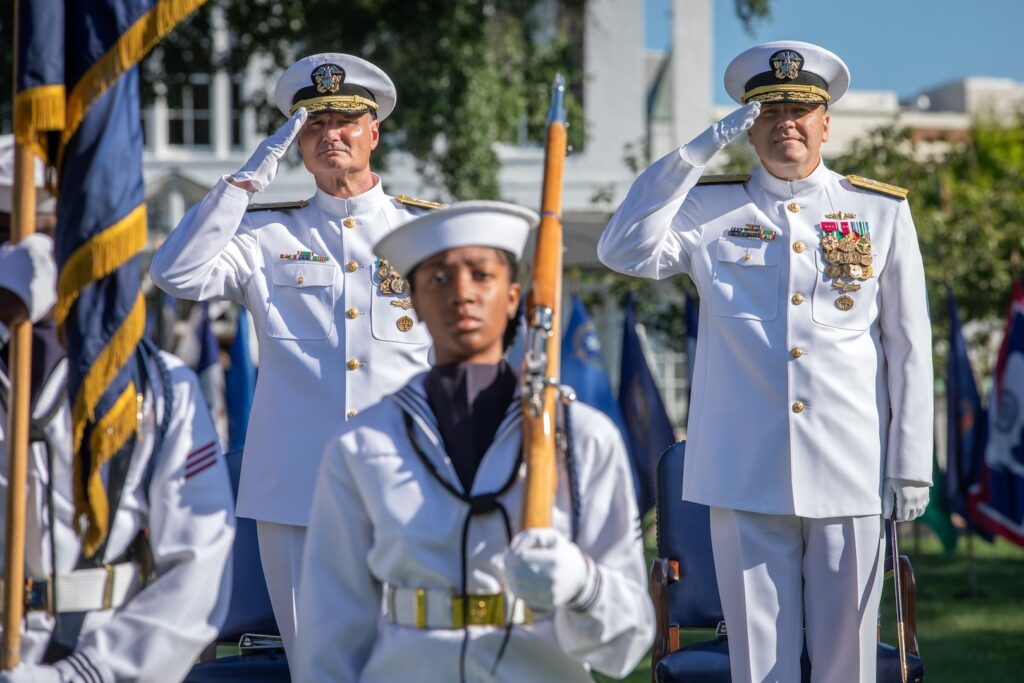
WASHINGTON NAVY YARD – Vice Adm. William J. Galinis relinquished his assignment as Commander, Naval Sea Systems Command (NAVSEA) after successfully concluding his three-year tenure in a retirement and assumption of command ceremony held at the Washington Navy Yard, Sept. 1.
During the ceremony, Secretary of the Navy Carlos Del Toro spoke about Galinis’ accomplishments throughout his 40 years of service to the Navy and the critical role NAVSEA plays in our nation’s defense.
“NAVSEA oversaw the successful completion of thousands of maintenance availabilities, all while taking critical steps to reduce maintenance delays across both private and our public shipyards,” said Secretary Del Toro. ”With each new ship delivered and every maintenance availability completed, Vice Admiral Galinis and his team ensured our fleet remained ready, lethal, and capable of responding to the demands of our Fleet and Combatant Commanders around the world. For the past three years, he has led the men and women of NAVSEA with the utmost integrity, developing a strong, mission-focused team while never wavering in his commitment to take care of his people.”
The Vice Chief of Naval Operations (VCNO) Adm. Lisa Franchetti served as the presiding officer over the ceremony.
“When you think about it, Naval Sea Systems Command is the engine that powers our entire fleet,” said Franchetti. “Our Navy would not be in the position of advantage we are today – with well over 100 ships and submarines deployed around the world – without Bill’s leadership these past three years.”
Vice Adm. Galinis, who became NAVSEA’s 45th commander in June 2020, thanked the command and its partners throughout the fleet and industry during his farewell address.
During his tour of duty, Galinis led the NAVSEA enterprise, a global workforce of more than 86,000 civilian and military personnel, with a fiscal responsibility for nearly one quarter of the Navy’s entire budget. He ensured NAVSEA continued to deliver warfighting readiness through the COVID-19 pandemic, enabling the fleet to continue normal operations.
“I am extremely proud of the NAVSEA team and work this team does for our Navy and country every day,” said Vice Adm. Galinis. “Across the spectrum from early stages of ship, submarine and combat system design to the construction, maintenance and modernization of these platforms and combat systems, it really is a true team effort. It has been a tremendous honor to work with and lead this incredibly talented and hardworking team.”
During Galinis’ tenure, he oversaw the delivery of 22 battle force ships and 260 boats and craft to the U.S. Navy fleet, the completion of 168 CNO availabilities, and 1,600 continuous maintenance availabilities. He engaged his leadership team in sustained efforts focused on the four public shipyards, and surface ship availabilities in private shipyards, driving performance improvements and leadership expectations.
As the Head Contracting Authority, he oversaw the execution of over 160,000 contract actions valued at more than $180 billion. With awards for programs including the Columbia-class ballistic missile submarine, Arleigh Burke-class guided missile destroyers, and Constellation-class multi-mission guided missile frigates, Galinis helped promote a long-term demand signal across shipbuilders and the vendor base while laying the foundation for a more capable and interoperable Navy fleet.
Through his leadership, the NAVSEA enterprise improved its overall warfighting readiness and provided an inherently flexible naval force and systems capable of deploying across combatant commands to meet emerging missions, deter potential adversaries, reassure allies and partners, enhance security and guarantee the free flow of global commerce. Anderson thanked Galinis for his leadership and commitment to the nation.
Rear Adm. Tom Anderson assumes the role of acting NAVSEA commander having most recently served as Program Executive Officer, Ships where he was responsible for Navy shipbuilding of surface combatants, amphibious ships, logistics support ships, support craft, and related foreign military sales.
Anderson, a surface warfare officer who transferred to the engineering duty community in 1996, has served in a variety of industrial, fleet, program office, and headquarters assignments in ship design and construction, maintenance, budgeting, and requirements. Anderson’s previous flag assignments include commander of NAVSEA’s Surface Warfare Centers; and commander Navy Regional Maintenance Center and NAVSEA director of Surface Ship Maintenance, Modernization and Sustainment.
Rear Adm. James Downey has been nominated as the next commander of NAVSEA, and has been temporarily assigned as a special assistant to the Assistant Secretary of the Navy for Research, Development and Acquisition while awaiting confirmation.
NAVSEA is the largest of the Navy’s six system commands, responsible for the building, buying, maintaining, and inactivation of ships, submarines and systems for the U.S. Navy.
U.S. Coast Guard Cutter Resolute returns home following 67-day Caribbean patrol
ST. PETERSBURG, Fla. — The crew of U.S. Coast Guard Cutter Resolute (WMEC 620) returned to their home port in St. Petersburg, Thursday, following a 67-day patrol in the Windward Passage of the Caribbean Sea.
Resolute deployed in support of Homeland Security Task Force – Southeast (HSTF-SE) and Operation Vigilant Sentry (OVS) to patrol the Coast Guard’s Seventh District area of operations. While underway, Resolute’s crew conducted maritime safety and security missions while working to detect, deter, and intercept unsafe and illegal migrant ventures bound for the United States.
During the patrol, Resolute’s crew interdicted an overloaded and unseaworthy vessel with 94 Haitian migrants 30 miles off the north coast of Haiti. Boarding teams embarked all 94 migrants onto Resolute where crew members provided shelter and care for three days, before repatriation.
“I could not be prouder of this crew and what they were able to accomplish during this patrol,” said Cmdr. Michael Ross, commanding officer of Resolute. “They answered the call and responded to each case with dignity, compassion, and professionalism.”
Resolute also conducted joint training with an MH-60 Jayhawk helicopter crew from the Coast Guard’s forward-deployed aviation detachment in the Bahamas, while underway in the Caribbean. Resolute performed in-flight refueling, vertical replenishment, and basket hoist training to enhance mission readiness.
During time off from operations, Resolute crew members volunteered at Fundación Casa Niños Felices, an orphanage in the Dominican Republic. Resolute’s crew volunteered their liberty to spend time with over 30 orphans, furthering their humanitarian outreach efforts.
HSTF-SE serves as the Department of Homeland Security lead for operational and tactical planning, command and control, and as a standing organization to deter, mitigate, and respond to maritime mass migration in the Caribbean Sea and the Florida Straits. HSTF-SE continues enhanced enforcement efforts in support of OVS, the 2004 DHS plan to respond to irregular maritime migration in the Caribbean Sea and the Straits of Florida.
Resolute is a 210-foot, Reliance-class medium endurance cutter. The cutter’s primary missions are counter-drug operations, migrant interdiction, and search and rescue in support of U.S. Coast Guard operations throughout the Western Hemisphere.
For information on how to join the U.S. Coast Guard, visit GoCoastGuard.com to learn about active duty, reserve, officer, and enlisted opportunities. Information on how to apply to the U.S. Coast Guard Academy can be found here.
Coast Guard transfers custody of 3 suspected smugglers, offloads $19 million in seized cocaine in San Juan, Puerto Rico
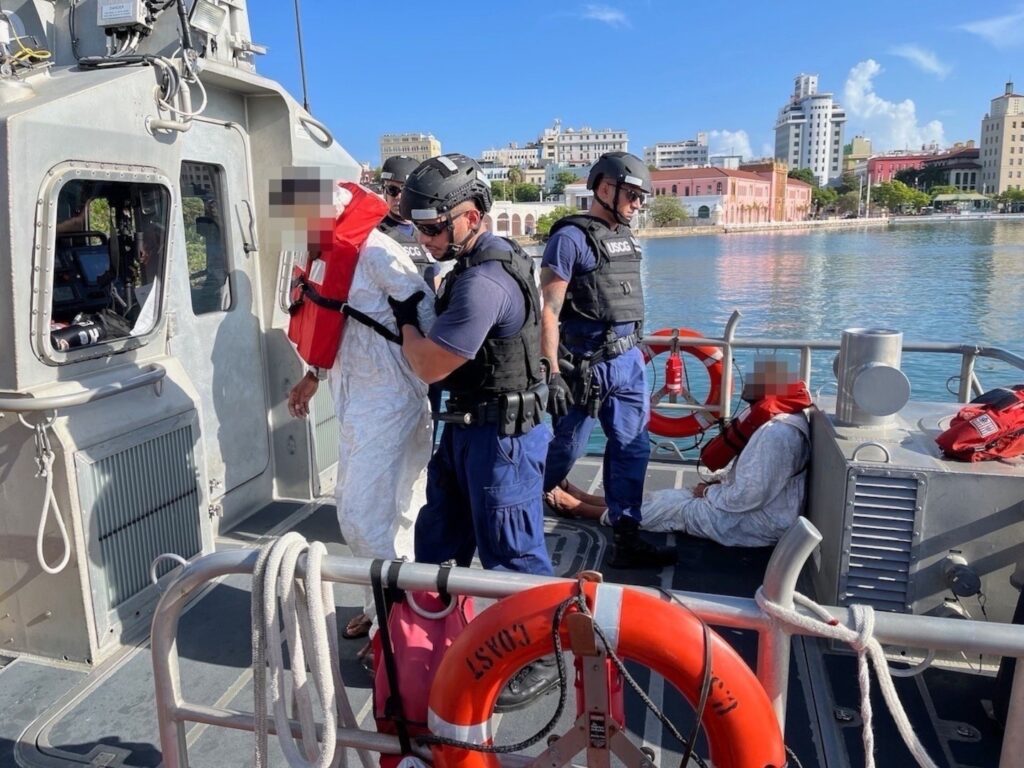
SAN JUAN, Puerto Rico — The crew of Coast Guard Cutter Donald Horsley (WPC – 1117) offloaded approximately 1,709 pounds of seized cocaine and transferred custody of three suspected male smugglers to federal law enforcement authorities in San Juan, Puerto Rico, Thursday.
The suspected smugglers are Venezuelan nationals who now face criminal prosecution by the U.S. Department of Justice in the U.S. Federal District Court in Puerto Rico. The seized contraband is estimated to have a wholesale value of $19 million.
Coast Guard Cutter Donald Horsley interdicted a suspect non-compliant 46-foot go-fast vessel Saturday night, after the aircrew of a maritime patrol aircraft detected the vessel while patrolling Caribbean Sea waters southeast of Puerto Rico. Following a high-speed pursuit and the interdiction of the suspect vessel, the cutter crew apprehended the suspected smugglers and successfully recovered 31 bales of contraband which had been jettisoned from the go-fast vessel during the pursuit.
“The strong collaboration and coordination between our Coast Guard units and our partner law enforcement agencies operating in the Caribbean are instrumental to achieving continued successful outcomes like in this case,” said Capt. José E. Díaz, Coast Guard Sector San Juan commander. “Our shared resolve and collective efforts are critical to further strengthening the security and stability of the region, while safeguarding our citizens in Puerto Rico and the U.S. Virgin Islands from this threat.”
The Transnational Organized Crime Division of the U.S. Attorney’s Office for the District of Puerto Rico is leading the prosecution for this case, while Special Agents supporting the Caribbean Corridor Strike Force are leading the investigation.
The interdiction is the result of multi-agency efforts involving the Organized Crime Drug Enforcement Task Force (OCDETF), the Caribbean Border Interagency Group and the Caribbean Corridor Strike Force. OCDETF identifies, disrupts, and dismantles the highest-level criminal organizations that threaten the United States using a prosecutor-led, intelligence-driven, multi-agency approach. Additional information about the OCDETF Program can be found at https://www.justice.gov/OCDETF. For breaking news, follow us on Twitter. For additional information, find us on Facebook and Instagram.
Cutter Donald Horsley is a 154-foot fast response cutter that is homeported in San Juan, Puerto Rico.
Middle East Naval Coalition Expands with Jordan as 12th Member
By U.S. Naval Forces Central Command Public Affairs | September 01, 2023
MANAMA, Bahrain —
U.S. Naval Forces Central Command (NAVCENT) welcomes the Hashemite Kingdom of Jordan as the latest member of the International Maritime Security Construct, a multinational maritime coalition established in 2019 to deter attacks on commercial shipping in the Middle East.
Jordan becomes the twelfth member of IMSC and its operational arm, Coalition Task Force Sentinel, which also welcomed the Seychelles last October. The NAVCENT-led IMSC is headquartered in Bahrain.
“Jordan as a proud nation understands the importance of free flow of global commerce and freedom of navigation and is committed to continuing its important role in underpinning global maritime security in cooperation with our allies and partners,” said Commander of the Royal Jordanian Naval Force, Col. Hisham Khaleel Al-Jarrah, in a statement announcing the move. “From this standpoint and in order to effectively confront the multifarious challenges this region faces in the complex maritime environment of the 21st century, we are excited to join the IMSC team.”
He said Jordan has a proud naval tradition and that the RJNF, “is looking forward to adding our skills and professionalism to one of the most essential and effective multinational organization in the Middle East.”
“Joining IMSC is the latest of many multilateral engagements by Royal Jordanian Navy,” he said, “and it is a continuation of our commitment to the collective responsibility of Maritime Security in the Middle East. Together as a team with our partners in IMSC, we can ensure the inherent right of freedom of navigation to merchant masters and enhance our maritime domain awareness.”
“We’re very excited to have Jordan as part of IMSC,” said Vice Adm. Brad Cooper, commander of NAVCENT, U.S. 5th Fleet and Combined Maritime Forces. “Regional security and stability is an imperative and Jordan has long played a key role in that endeavor. Their representation on the IMSC makes our team that much stronger.”
“I’m both thrilled and honored to welcome the Kingdom of Jordan to IMSC,” said United Kingdom Royal Navy Commodore Peter Laughton, commander of IMSC. “Jordan brings to the construct a long history of championing the international rules-based order, and will join a vibrant and dynamic multinational coalition, committed to freedom of navigation and the free flow of trade in the Middle East. With Jordan’s addition, IMSC will continue delivering its vital mission along with our other important regional and European partners.”
IMSC was formed in July 2019 in response to increased threats to merchant mariners transiting international waters in the Middle East. CTF Sentinel was established four months later to deter state-sponsored malign activity and reassure the merchant shipping industry in the Bab al-Mandeb and Strait of Hormuz.
In addition to Jordan, IMSC’s member-nations include Albania, Bahrain, Estonia, Latvia, Lithuania, Romania, Saudi Arabia, Seychelles, the United Arab Emirates, the United Kingdom and the United States.
Jordan is also a member of Combined Maritime Forces, another major naval partnership based in the Middle East, and also led by Cooper.