Austal USA Christens Final EPF: Future USNS Lansing
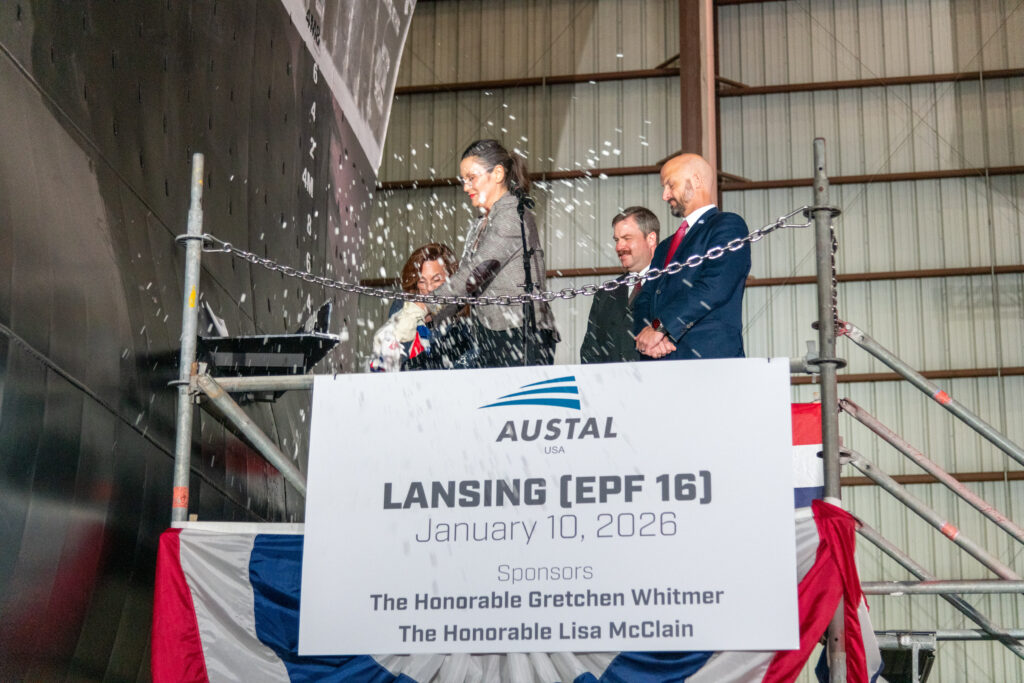
Credit: Austal USA 

Release From Austal USA

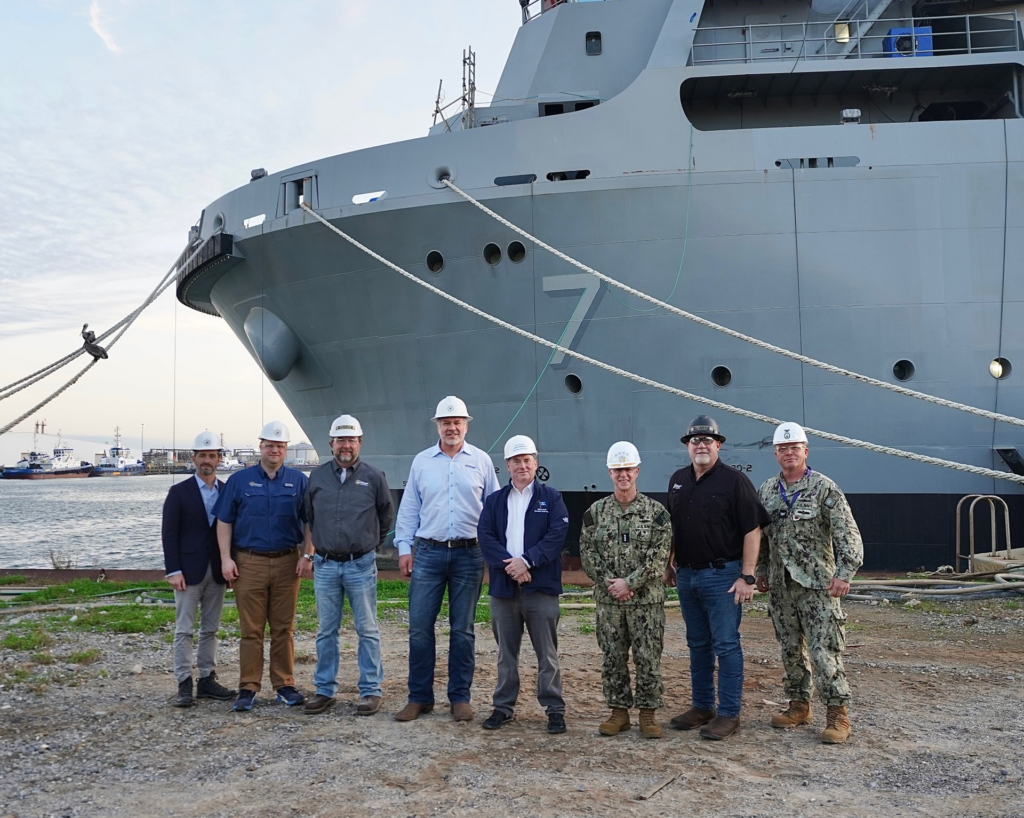
MOBILE, Ala. – The final U.S. Navy Expeditionary Fast Transport Ship – future USNS Lansing (EPF 16) – was christened at a ceremony today at Austal USA’s Mobile, Ala. ship manufacturing facility.  The christening marks a major milestone in the Spearhead-class EPF program, which has delivered vital high-speed, shallow-draft transport capability to the U.S. Navy and Military Sealift Command. Since the inception of the EPF program, Austal USA has built and delivered a fleet of fast transport vessels that provide agile intra-theater personnel and cargo movement, rapid response support, and enhanced operational flexibility around the globe. 

This christening event was unique in that two sponsors christened the ship; The Honorable Gretchen Whitmer, Governor of Michigan, and The Honorable Lisa McClain, U.S. Representative serving Michigan’s 9th District broke bottles of champagne simultaneously on the bow of the ship after which they jointly exclaimed, “For the United States of America, I christen thee Lansing. May God bless this ship and all who sail in her!”.  

“I was especially honored to witness this tradition that means so much to our Navy and our Nation with the christening of the last ship of this great fleet. The Flight II Expeditionary Fast Transport ships represent a significant increase in naval auxiliary capability, designed to support a wide range of missions including medical operations, logistics, and troop transport.” commented Austal USA President Michelle Kruger.  “These ships are built by an exceptional team of dedicated men and women who consistently strive to be the best in the industry, delivering the most capable and cost-effective vessels to our superior Navy.” 

The Honorable Gretchen Whitmer has been Michigan’s Governor since 2019.  As a lifelong Michigander, earning both her bachelor’s degree and law degree from Michigan State University, Whitmer is a lawyer, an educator, former prosecutor, State Representative and Senator.  Since taking her oath of office, she has signed executive directives to clean up Michigan’s drinking water, secure equal pay for equal work, and expand opportunities for small and disadvantaged businesses. 

Born and raised in Stockbridge, Michigan, The Honorable Lisa McClain is serving her second term as U.S. Representative for Michigan’s 9th District.  She currently serves as a member of the House Committee on Financial Services and the Committee on Education and Workforce and Chairwoman of the House Republican Conference for the 119th Congress.   

Speakers at today’s event included: Principal speaker, The Honorable Hung Cao, Under Secretary, U.S. Navy; Rear Admiral Benjamin Nicholson, Commander, Military Sealift Command, U.S. Navy; Vice Admiral Seiko Okano, Principal Military Deputy to the Assistant Secretary of the Navy for Research, Development and Acquisition; Michelle Kruger, Austal USA President; and Scott Bonk, Director, Future Combatants & Mission Systems, General Dynamics Mission Systems. 

The future USNS Lansing is the first Navy ship named after the capital of Michigan.  There have been 32 naval ships named after some aspect of Michigan. This includes the first iron-hulled ship in the Navy, named after the state and commissioned in 1844.  

EPF Flight II provides a Role 2E (enhanced) medical capability which includes, among other capabilities, basic secondary health care built around primary surgery; intensive care unit; ward beds; and limited x-ray, laboratory and dental support. The EPF’s catamaran design provides inherent stability to allow surgeons to perform underway medical procedures in the ship’s operating suite. Enhanced capabilities to support V-22 flight operations and launch and recover 11-meter Rigid Hull Inflatable Boats complement the ship’s medical facilities. These Flight II upgrades along with EPF’s speed, maneuverability and shallow water access are key enablers for mission support of future Distributed Maritime Operations and Expeditionary Advanced Base Operations around the world. Flight II retains the capability of the Flight I to support other missions including core logistics. EPF is one of four shipbuilding programs under serial production at Austal USA. 

The EPF program has been a cornerstone of Austal USA’s contribution to U.S. maritime logistics and expeditionary operations, providing fast, flexible support for a wide range of fleet missions. With the christening of the final EPF vessel, Austal USA continues its legacy of supporting the U.S. Navy with innovative ship design and construction excellence. 
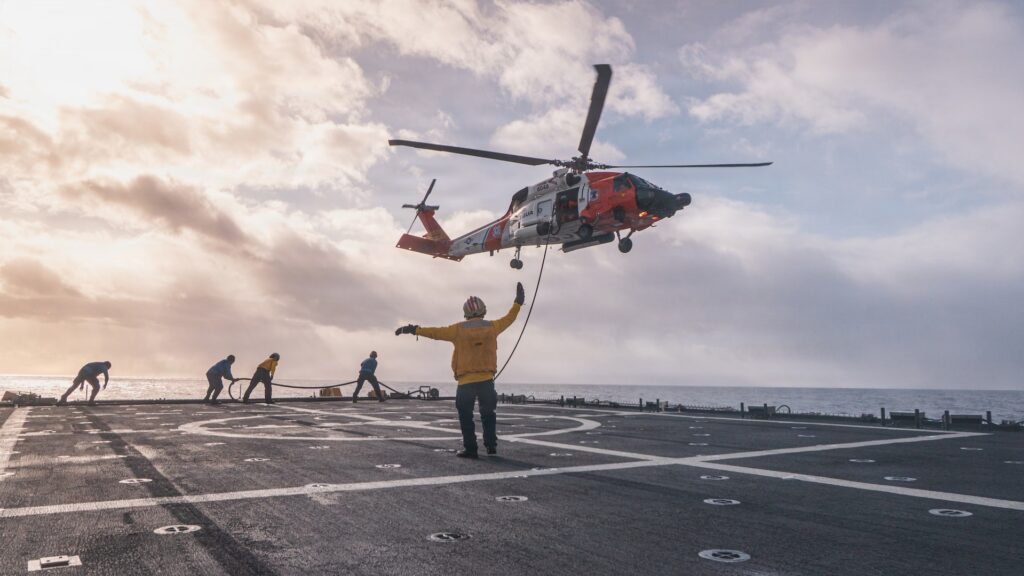


Coast Guard Cutter Kimball Returns to Honolulu After 120-Day Arctic Patrol

 A Landing Signals Officer aboard USCGC Kimball (WMSL 756) directs a Cold Bay-based MH-60 helicopter during helicopter in-flight refueling operations in the Bering Sea, Oct. 31, 2025. The hook-up crew stood by to attach the fuel hose, a capability that allows the aircraft to remain airborne during refueling to support a sustained operational tempo and mission readiness. (U.S. Coast Guard photo by Petty Officer 2nd Class Peter Holtzhausen) 

Release From U.S. Coast Guard Oceania District

HONOLULU — The crew of the Coast Guard Cutter Kimball (WMSL 756) returned to Honolulu, Jan. 1, after a 120-day, 16,500-nautical-mile deployment to the Bering Sea and Gulf of Alaska reinforcing maritime safety, security, and national sovereignty in the region. 

As the Arctic region continues to become more accessible and consequential, the demand for U.S. Coast Guard statutory mission services, leadership, and presence continues to grow. Kimball’s crew exemplified these efforts. 

Throughout the deployment, Kimball’s crew conducted law enforcement operations, provided critical emergency response, and participated in joint exercises with the Department of War, showcasing the versatility and capability of the national security cutter platform. 

Kimball’s law enforcement teams conducted 13 inspections of fishing vessels and conducted joint boardings with the National Oceanic and Atmospheric Administration Office of Law Enforcement. Three citations were issued for violations that included two cases of illegally retained catches. 

The crew also conducted extensive training with MH-60 helicopters from Air Station Kodiak to enhance proficiency between cutters and air crews. In addition, Kimball tested the new Vertical Takeoff and Landing Battery (V-BAT) unmanned aerial system while patrolling the Bering Sea, conducting several operations to evaluate and enhance the cutter’s surveillance capabilities. 

Following the aftermath of Typhoon Halong, Kimball’s crew provided critical support to the area by positioning as a ready fueling platform for responding air assets. The crew also served as the on-scene coordinator and rendered assistance to a disabled and adrift bulk carrier that lost propulsion near a heavily trafficked pass through the Aleutian Islands. 

Kimball participated in two joint operations with United States Alaskan Command under Operation TUNDRA MERLIN. These activities involved Kimball and multiple U.S. Air Force aircraft in simulated joint maritime strikes, providing valuable insight into the national security cutter’s capabilities and demonstrates integration of Department of Homeland Security and Department of War assets in support of homeland defense. 

“I am immensely proud of this crew for standing the watch over one of the harshest maritime operational areas in the world,” said Capt. Craig Allen, Kimball’s commanding officer. “This crew demonstrated remarkable skill, tenacity, and teamwork across a wide spectrum of Coast Guard missions. Their professionalism made a direct positive impact to the safety and security of the Alaskan community.” 

While on patrol, Kimball’s crew crossed the Arctic Circle, earning the designation as “Blue Nose Polar Bears.” The crew also engaged with the Dutch Harbor, Alaksa, community by volunteering for a beach clean-up and hosting a holiday-themed tour of the cutter for nearly 250 local residents. 

Commissioned in 2019, Kimball is one of two 418-foot, Legend-class national security cutters homeported in Honolulu. The cutter’s primary missions are counter-drug operations and defense readiness. The namesake of U.S. Coast Guard Cutter Kimball is Sumner Increase Kimball, the organizer of the United States Life-Saving Service and its general superintendent from 1878–1915. 


CH-53K Program Enters Multi-Year Procurement Contract with GE 

A U.S. Marine Corps CH-53K King Stallion helicopter assigned to Marine Heavy Helicopter Squadron (HMH) 461, Marine Aircraft Group 29 lifts a joint light tactical vehicle during a helicopter support team exercise at Marine Corps Base Camp Lejeune, North Carolina, Sep. 4, 2025. The helicopter support team operations enhanced the ability to coordinate safe rigging, loading, and lifting of vehicles by helicopter for precise and secure air transport. (U.S. Marine Corps photo by Sgt. Jorge Borjas) 

Release From Naval Air Systems Command

NAS PATUXENT RIVER, Md. — A five-year, multi-year procurement (MYP) contract was signed on January 8 between the Department of War (DOW) and GE Aerospace for both new production and spare T-408 engines, along with associated sustainment services for the CH-53K King Stallion helicopter. The $1.4 billion contract covers five years, Lots 9-13, providing more than $174 million in savings over the Future Years Defense Program (FYDP). 

The CH-53K program is critical to the Marine Corps’ strategic plan. It is replacing the CH-53E as the only marinized heavy-lift rotary-wing aircraft in the U.S. defense inventory. 

“This multi-year procurement is a key indicator of the strong commitment to the CH-53K program, and the integral part that GE plays,” said Col. Kate Fleeger, program manager, H-53 Heavy Lift Helicopters Program Office (PMA-261). “The contract allows GE to manage supply chain health through a stable, predictable demand signal, ultimately achieving better pricing, passing those savings on to the government.” 

Multi-year procurement is one of several contracting mechanisms that Congress permits the DOW to use in limited circumstances. MYP is used in lieu of an annual contract and provides the opportunity for significant savings. MYP contracts require congressional approval for each use, with the program meeting specific criteria to qualify for MYP. 

“By committing to long-term contracts, we are simultaneously reducing cost and helping to strengthen our defense industrial base,” said Fleeger. “Ultimately, this multi-year procurement will significantly reduce risk to the CH-53K transition plan.” 

Long-term, MYP contracts provide stability to industrial partners while incentivizing investment. That investment provides personnel and equipment needed for uninterrupted production for the years negotiated. It also allows the program office to improve production while reducing the administrative burdens of annual contracts. 

There are currently 23 CH-53K aircraft in operation with the U.S. Marine Corps. The CH-53K King Stallion program is on track for its first Marine Expeditionary Unit (MEU) deployment in FY27. 

PMA-261 manages the cradle to grave procurement, development, support, fielding and disposal of the entire family of H-53 heavy lift helicopters. 


VMM-264 Reactivates Following Five-Year Hiatus

11 Dec 2025 | Capt. Jacob Ballard2nd Marine Aircraft Wing 

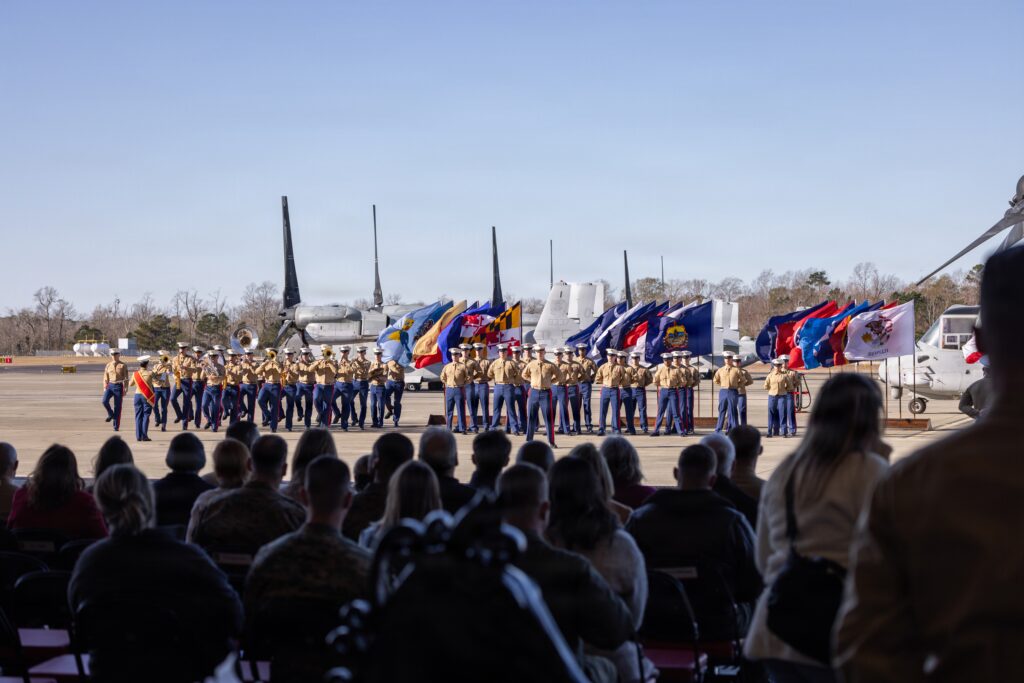
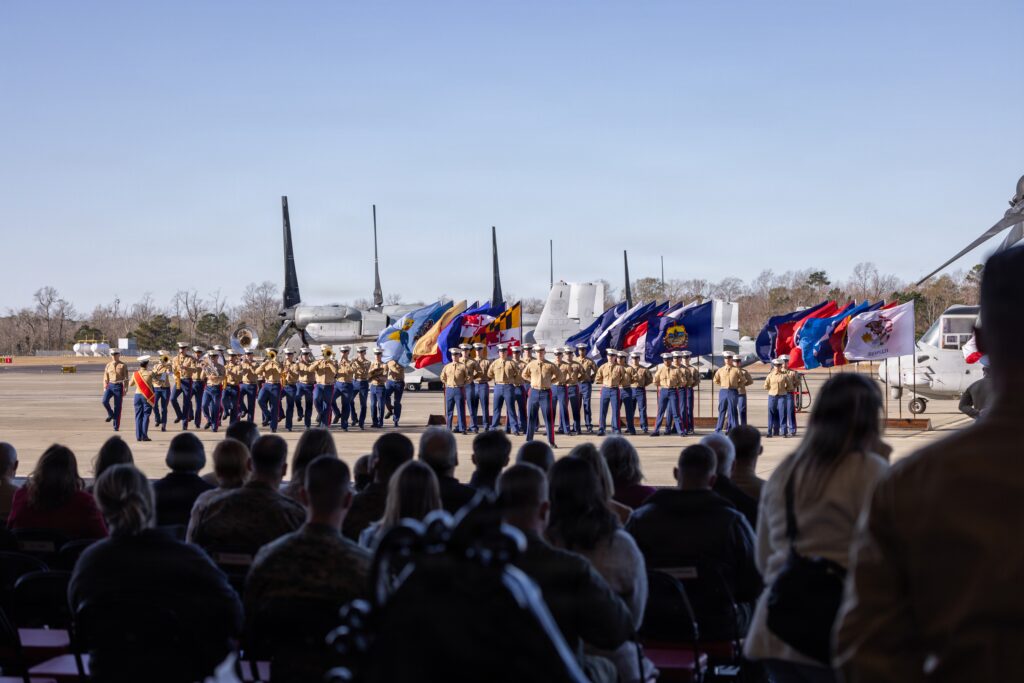
MARINE CORPS AIR STATION CHERRY POINT, N.C. — Marine Medium Tiltrotor Squadron (VMM) 264, 2nd Marine Aircraft Wing (MAW), was reactivated during a ceremony at Marine Corps Air Station New River, North Carolina, on Thursday. 

VMM-264, known as “The Black Knights,” was deactivated on June 24, 2020, under Force Design initiatives. Throughout the squadron’s deactivation, the Marine Corps conducted an analysis of force management to ensure no operational commitments were unmet. This analysis identified the need for an additional VMM squadron on the east coast to provide sustained operational support to II Marine Expeditionary Force (MEF). This change within 2nd MAW reflects incremental adjustments to Force Design to meet the operational demands of the service. 

During the reactivation ceremony, Col. Daniel Kaiser, commanding officer of Marine Aircraft Group 26 (MAG), spoke about the squadron’s history and its role in the MV-22’s early operational employment.  

“VMM-264 carries a distinguished legacy, having been established in 1959 and providing decades of critical support to Marine Air-Ground Task Force (MAGTF) operations around the globe. Upon transitioning to the MV-22 Osprey in 2009, the squadron played a pivotal role in developing and advancing the MV-22 as the Marine Corps’ premier assault support platform.” 

Kaiser went on to express excitement about the squadron’s return. “MAG-26 is proud to welcome this storied unit back into the fold and looks forward to the significant contributions the ‘Black Knights’ will bring in support of the ‘Carolina MAGTF.’” 

The squadron will resume operating the MV-22 Osprey tiltrotor aircraft. The MV-22 Osprey is a multi-role tiltrotor aircraft developed by Bell Helicopter and Boeing, designed to support Marine Corps operations with enhanced versatility and speed. First introduced in the late 1990s, the MV-22 combines the vertical takeoff capability of a helicopter with the speed and range of a fixed-wing airplane. It is equipped to perform a wide array of missions, including troop transport, logistics support, and casualty evacuation. Due to its speed and range, the Osprey significantly reduces transit time in operational environments, making it a crucial asset for rapid deployment and maneuverability in the field.  

In addition to the reactivation, the ceremony also served as an assumption of command, during which Lt. Col. Paul Lancaster formally assumed responsibility, authority, and accountability for VMM-264 as the commanding officer. 

Lancaster expressed his pride in leading the reactivation. “I’m proud to lead the reactivation of a legacy assault support unit. This reactivation brings the necessary balance and capacity to the MV-22 community and supports the continued evolution of Marine Corps aviation.” He also recognized the efforts of those who made the reactivation possible: “Today’s ceremony honors the Marines and Sailors who worked tirelessly to build a world-class squadron, dedicated to operational excellence. It also honors the thousands of Marines and Sailors who wore the Black Knight patch previously.” 

VMM-264 is a subordinate unit of 2nd MAW, the aviation combat element of II MEF. 


HII Expands European Unmanned Operations with New Facility in Portchester, UK

Release From HII

PORTCHESTER, United Kingdom, Jan. 12, 2026 (GLOBE NEWSWIRE) — HII (NYSE: HII), the world’s leading manufacturer of autonomous surface and underwater unmanned vehicles, has doubled the size of its unmanned facility in Portchester, U.K. 

The enlarged facility significantly enhances and strengthens the company’s presence in the United Kingdom and increases capacity and support for the U.K. Royal Navy and European partners that operate the REMUS line of unmanned underwater vehicles (UUVs). 

In addition to supporting regional unmanned customers, the Portchester facility will serve as a European hub for HII’s Mission Technologies division, enabling collaborative customer support for U.S. combatant commands and allied missions. The site will provide operational, technical, and logistics support to deploy, sustain, and integrate electronic warfare and C5ISR systems, fleet modernization efforts, artificial intelligence capabilities, and live, virtual, and constructive training. 

The facility also prepares the region for the deployment and sustainment of HII’s ROMULUS family of unmanned surface vessels (USVs), a modular AI-enabled line powered by HII’s Odyssey Autonomous Control System and scheduled for availability in 2026. 

HII’s unmanned platforms are known for modular design, long endurance and reliable field performance. They support defense, commercial and research missions that include mine countermeasures, hydrographic survey, intelligence collection and environmental monitoring. 

The expanded Portchester facility will operate as a strengthened regional hub for HII’s unmanned systems. Staffed by U.K. employees, it will drive new jobs and support supplier engagement, maintenance, training and long-term sustainment for operators across the U.K. and Europe. The site will also work in close coordination with HII’s global engineering, production, training and mission support teams to keep programs aligned and effective. 

Duane Fotheringham, president of Mission Technologies’ Unmanned Systems business group, said, “This new HII Portchester facility reinforces HII’s long term presence in the United Kingdom and provides a strong foundation for future cooperation. It ensures that U.K. and European operators, suppliers, and partners of ROMULUS USVs and REMUS UUVs receive regional access to world class support, training and sustainment.” 

REMUS UUV Family of Systems 

REMUS unmanned underwater vehicles are the world’s leading UUV. They use an open-architecture design that supports the rapid integration of new payloads, mission-specific configurations, and future upgrades that ensure operators keep pace with evolving challenges and requirements while managing costs. REMUS systems are in service with more than 30 countries, including 14 NATO members, and are known for dependable operation, advanced sensor performance, and a strong record in mine hunting, reconnaissance and underwater survey missions. 

In September, Babcock International Group and HII signed a memorandum of understanding to integrate HII’s REMUS vehicles with Babcock’s submarine Weapon Handling and Launch Systems. The goal is autonomous launch and recovery of UUVs through submarine torpedo tubes, strengthening undersea advantage for allied navies. The partnership builds on the U.S. Navy’s first successful forward-deployed torpedo-tube launch and recovery of a UUV using a REMUS. Babcock’s Weapon Handling and Launch Systems are in service with submarine fleets in the U.K., Canada, Australia, Spain and South Korea. 

The Royal Navy has a long partnership with REMUS. Since 2001, the Ministry of Defence has acquired REMUS 100, REMUS 300 and REMUS 600 vehicles for mine countermeasure operations. In 2024, HII announced the sale of three REMUS 100s and five REMUS 300s to the Royal Navy. This order reflects confidence in the upgrade potential and build quality of HII systems and builds on more than two decades of cooperation. The first two REMUS 100s delivered in 2001 remain in active service today. 

The REMUS Mine Hunting Capability (MHC) provides high resolution seabed imaging and precise navigation, giving naval teams a fast and reliable tool to counter underwater threats. 

The REMUS line includes several variants, each designed for specific mission sets and operating depths. The numbering reflects operational depth and generation. 

  • REMUS 130: Compact and optimized for shallow-water operations and rapid deployment. 

  • REMUS 300: Offers increased range and payload capacity in a lightweight form. Serves as the baseline for the U.S. Navy’s Lionfish program. 

  • REMUS 620: Features modular upgrades, modernized electronics, battery life up to 110 hours, and a range of 275 nautical miles. Recently supported submarine launch and recovery operations for the U.S. Navy Submarine Force. 

  • REMUS 6000: Operates at depths up to 6,000 meters and is used for deep-sea recovery and complex scientific work. 

All REMUS models share a common architecture, allowing operators to scale capability while maintaining system familiarity. More than 90% of REMUS units delivered over the past 23 years remain in service. This highlights the platform’s durability and lifecycle value, two critical factors in defense acquisition. 

REMUS Track Record 

  • Defense: Used by 14 NATO navies for mine warfare, ISR, and seabed mapping. 

  • Search and Recovery: Played key roles in the search for Air France Flight 447, post-tsunami response in Japan, and the discovery of USS Indianapolis (CA 35). 

  • Science and Environment: Supports environmental monitoring, marine archaeology, and oceanographic research. The National Oceanic and Atmospheric Administration is deploying REMUS 620 systems to map seafloor habitats affected by the Deepwater Horizon spill. 

HII ROMULUS USV Family of Systems 

HII’s ROMULUS family is a modular, AI-enabled line of USVs powered by the Odyssey Autonomous Control System. The flagship, ROMULUS 190, is currently under construction with sea trials planned for 2026. 

ROMULUS is built on a commercial-standard hull for rapid, repeatable production. It delivers speeds over 25 knots and a range of 2,500 nautical miles. Large versions of the ROMULUS are capable of carrying four 40-foot ISO containers. ROMULUS is purpose built for global mission deployment and extended autonomous operations. 

Powered by the Odyssey ACS, ROMULUS delivers open-ocean autonomy, multi-agent swarming, and modular adaptability. It supports missions that include ISR, counter-unmanned air systems, mine countermeasures, strike, and launch and recovery of UUVs and UAVs. 


Northrop Grumman to Rapidly Develop Marine Corps CCA with Kratos’ Valkyrie UAS 

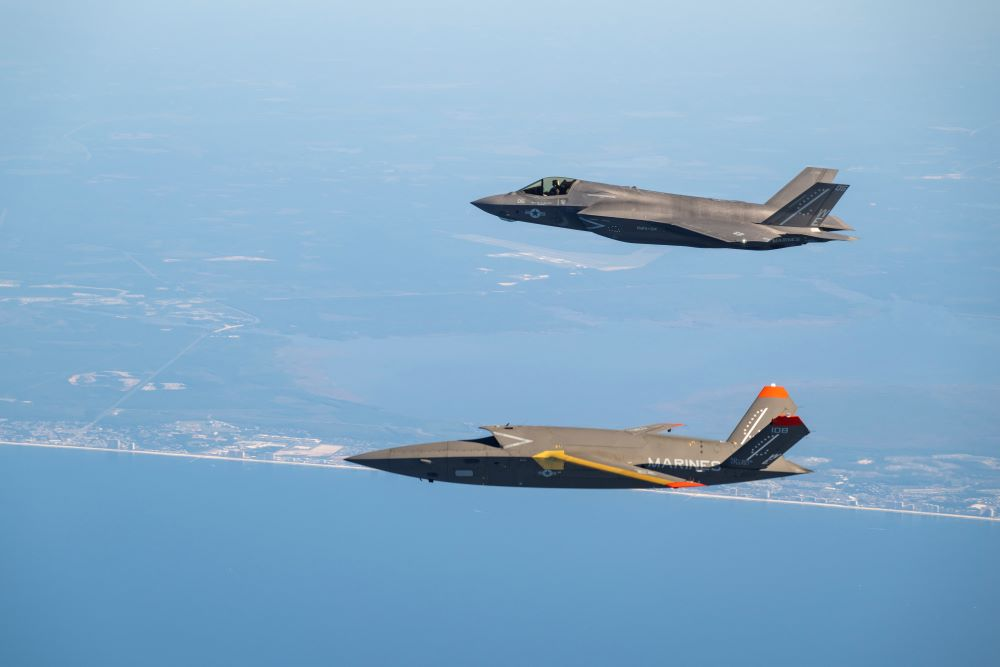
This agile solution integrates Northrop Grumman’s proven mission systems with Kratos’ mature Valkyrie. (Photo Credit: U.S. Marine Corps)

From Northrop Grumman, Jan. 8, 2026 

BALTIMORE – Jan. 8, 2026 – Northrop Grumman (NYSE: NOC) was competitively awarded the U.S. Marine Corps’ Marine Air-Ground Task Force Uncrewed Expeditionary Tactical Aircraft (MUX TACAIR) Collaborative Combat Aircraft (CCA). This award combines Northrop Grumman’s uncrewed capabilities and autonomous leadership with Kratos’ Valkyrie uncrewed aerial system to work alongside crewed fighters to provide air dominance in high-threat environments. 

Northrop Grumman will develop and rapidly deliver platforms that include: 

  • Advanced Mission Kit: Northrop Grumman’s cost-effective mission kit is inclusive of sensors and software-defined technologies designed specifically for uncrewed aircraft. The mission kit’s flexible technology can perform various kinetic and non-kinetic effects, making the platform a combat-ready asset. 

  • Open Architecture Autonomy Software: Northrop Grumman’s open architecture autonomy software package – known as Prism – will manage the aircraft’s operations autonomously. 

  • Valkyrie Uncrewed Aerial System from Kratos Defense and Security Solutions: Fully equipped for a variety of missions that will include conventional takeoff and landing capabilities, enhanced runway flexibility with a modular airframe and payload bays for customizable effects. 

Experts: 

Krys Moen, vice president, advanced mission capabilities, Northrop Grumman: “Northrop Grumman remains at the forefront of advanced sensing capabilities, delivering innovative solutions that meet the needs of the warfighter with unmatched speed and reliability. This enhanced capability set ensures optimal performance for both crewed and uncrewed platforms.” 

Steve Fendley, president Kratos Unmanned Systems Division: “The integration of the Kratos Valkyrie aircraft system configured with the world’s best multifunction mission systems from Northrop Grumman results in a high-capability CCA at a price point that enables the uncrewed systems to be deployed in mass with crewed aircraft.” 

Details: 

Northrop Grumman has packaged its sensors and other mission capabilities into a smaller envelope, resulting in a more cost-effective solution that is compatible with an uncrewed platform. Combining existing product lines and proven capabilities, Northrop Grumman, Kratos, and commercial partners developed a missionized CCA that includes survivability, connectivity, lethality and supportability elements. With more than 20 successful flight demonstrations in operationally relevant environments, Northrop Grumman and Kratos are offering the U.S. Marine Corps a low risk, expedited path to MUX TACAIR mission capability and persistent joint crewed and uncrewed expeditionary operations. 


Transportation Secretary Sean P. Duffy Taps New Leadership for U.S. Merchant Marine Academy

Rear Admiral (select) Tony Ceraolo & Dr. Johnathan Gajdos will lead the charge in restoring the Academy’s prominence and military readiness 

From the U.S. Department of Transportation, Jan. 8, 2026 

WASHINGTON, D.C.– U.S. Transportation Secretary Sean P. Duffy today announced Rear Admiral (select) Tony Ceraolo as Superintendent and Dr. Johnathan Gajdos as Provost at the U.S. Merchant Marine Academy. Both men bring decades of experience in public administration, military leadership and education. 

 Under the leadership of President Trump and Secretary Duffy, Rear Adm. (sel) Tony Ceraolo and Dr. Gajdos are focused on restoring the Academy to an institution worthy of the sacrifices made by these young patriots and strengthening its academic programs so midshipmen are fully prepared to serve, lead, and defend our great nation. 

 President Trump’s Executive Order on Restoring America’s Maritime Dominance directed a revitalization of the Academy earlier this year. Secretary Duffy swiftly signed a partnership with the U.S. Army Corps of Engineers to modernize campus facilities, upgrade simulators and navigation labs, and completely overhaul the IT system. The Secretary also spearheaded the restoration of the Christ on the Water painting. These initiatives aim to ensure the Academy is attracting the best and brightest to serve as our nation’s merchant mariners. 

“Rear Admiral Tony Ceraolo and Dr. Johnathan Gajdos are precisely the leaders the U.S. Merchant Marine Academy needs at this critical moment—especially after the last administration neglected the Academy and its midshipmen,” said U.S. Transportation Secretary Sean P. Duffy. “These men bring the experience, discipline, and vision required to reverse years of decline at the Academy, restore America’s maritime power, and prepare the next generation of American patriots for service to our country.” 

 “I am honored and excited to serve as the 15th Superintendent of the U.S. Merchant Marine Academy at a pivotal moment for both the Academy and our nation. With unprecedented focus, support, and momentum behind the maritime sector, this is an exciting time to lead” said Rear Adm. (sel)Tony Ceraolo, Superintendent at U.S. Merchant Marine Academy. “I look forward to working alongside our exceptional faculty and staff to educate, mentor and graduate leaders of exemplary character—men and women fully prepared to advance our nation’s national security, economic success, and marine transportation needs.” 

“When I had the opportunity for a campus visit during the selection process for this position, I was immediately impressed by the dedicated faculty, the motivated midshipmen, and the skilled staff, fully embracing the Academy’s critical mission,” said Dr. Johnathan Gajdos, Provost at U.S. Merchant Marine Academy. “As I assume the role of USMMA’s Provost, I am excited to support the work of our faculty as they educate America’s future merchant mariners and maritime leaders.” 

About Rear Adm. (sel) Tony Ceraolo: 

 Before joining the Academy as Chief of Staff in 2023, Rear Adm. (sel) Ceraolo spent 34 years in the U.S. Coast Guard. Prior to his retirement, he served as the Executive Assistant to the Coast Guard Deputy Commandant for Operations. Earlier in his career, he served as a Senior Counselor to the Secretary of Homeland Security where he spearheaded and coauthored DHS’s first-ever Strategic Approach for Arctic Homeland Security, as well as Director for Maritime Security and Director for Arctic Region Policy on the National Security Council Staff at the White House.  

 His command experience includes service as Commanding Officer of two Coast Guard cutters, as well as a deployment as Commander of U.S. Coast Guard Patrol Forces Southwest Asia – the Coast Guard’s largest command outside the continental United States; and, as Sector Commander and Captain of the Port for San Francisco and Northern California.  

Captain Ceraolo graduated with honors from the U.S. Coast Guard Academy. He earned a Master of Public Administration from Harvard University’s Kennedy School of Government, and a Master of Arts with Distinction in National Security and Strategic Studies from the U.S. Naval War College in Newport, Rhode Island. He is also a graduate of the Joint Forces Staff College, a designated permanent cutterman, and an Eagle Scout.   

About Dr. Johnathan Gajdos: 

Prior to joining the U.S. Merchant Marine Academy, Dr. Gajdos spent more than 15 years in administrative and teaching roles at the Defense Language Institute Foreign Language Center (DLIFLC), the primary language education and training institution for the U.S. military. Most recently, he served as Associate Provost for Undergraduate Education, where he oversaw six schools providing full-time, intensive foreign language training in nine languages.  

His prior assignments at DLIFLC include serving as dean of the Persian Farsi School, academic advisor at the Institute’s Washington, D.C. office, and teaching team leader and instructor in the German program (earning the DLIFLC Civilian Instructor of the Year award from the Kiwanis Club of Monterey in 2013). Dr. Gajdos has also taught at Monterey Peninsula College, the University of Iowa, and Technische Universität Dortmund, Germany.   

 Dr. Gajdos earned a Ph.D. and M.A. in Germanic linguistics from the University of Iowa; a Bachelor’s in German from Georgetown University; and a Graduate Certificate in Public Administration from the University of North Dakota. A graduate of the Army Training and Doctrine Command Intermediate Leader Development Program, he has completed Army Management Staff College courses as well as Wharton Online’s Leadership and Management Certificate program. He is a two-time recipient of the Army Civilian Service Commendation Medal and in 2025 was awarded the Army Meritorious Civilian Service Medal.  

The U.S. Merchant Marine Academy, located in Kings Point, New York, educates and graduates licensed merchant mariners and leaders of exemplary character who will serve America’s marine transportation and defense needs in peace and war. The U.S. Merchant Marine Academy is administered by the Department of Transportation. 


US Navy Selects Northrop Grumman for Second Stage Solid Rocket Motor Program 

The second stage solid rocket motor completes a static fire test on November 21, 2025 in Elkton, Maryland. (Photo Credit: Northrop Grumman)

From Northrop Gruman, Jan. 7, 2026 

ELKTON, Md. – Jan. 7, 2026 – Northrop Grumman Corporation (NYSE: NOC) was awarded a $94.3 million contract by the U.S. Navy to develop and qualify a new 21-inch diameter second-stage solid rocket motor (SSRM) for the Navy’s extended-range missile programs to deter and defeat fast-moving air, surface and hypersonic threats. 

  • The SSRM is a low-risk, rapidly developed design that enables the Navy to quickly and cost-effectively field an extended-range hypersonic defense capability. 

  • The high-performance 21” diameter rocket motor is engineered to significantly extend range and speed across various missions, including air warfare, surface warfare, land strike, and ballistic missile defense. 

  • The Navy has expressed interest for potential deployment of Northrop Grumman’s extended range propulsion technology across various platforms. 

  • Continued design and low-rate initial production of 60 units for testing and delivery will take place at Northrop Grumman’s Propulsion Innovation Center in Elkton, Md. 

Expert: 

Gordon LoPresti, senior director, propulsion systems and control, Northrop Grumman: “Being chosen by the U.S. Navy is an honor and a testament to our rapid development capabilities, production capacity and leadership in advanced propulsion solutions. The successful development and demonstration of our SSRM in just 10 months showcases our unique, affordable, and versatile extended-range capabilities that will equip the U.S. Navy to excel in its defense and deterrence missions. We are eager and prepared to rapidly qualify and produce these motors in quantities to meet the needs of the US.” 

Details: 

As the nation’s preeminent propulsion provider, Northrop Grumman continues to invest in facilities, capacity, and technologies, to ensure the ability to produce advanced weapons and solid rocket motors affordably at scale. To meet the growing customer demand, Northrop Grumman has invested more than $1 billion since 2018 to enhance capacity and capabilities for weapons and missile components, including solid rocket motors. With decades of proven success and over one million solid rocket motors delivered, Northrop Grumman is a trusted provider of SRMs and advanced propulsion systems essential for defense, payload delivery and space exploration. 

Northrop Grumman is delivering advanced propulsion and solid rocket motors at scale today and is investing in further expanding capacity to meet growing customer demand and support a resilient defense industrial base. Propulsion work takes place across six strategic sites in West Virginia, Utah and Maryland, totaling 10 million square feet of manufacturing space. We’re tripling capacity for small tactical SRMs at our West Virginia production facility, doubling production capacity for large SRMs in Utah, and increasing by 25% manufacturing capacity in Maryland to accommodate future high-demand programs, including air-breathing hypersonic propulsion solutions. 


SECNAV, CNO, MCPON, Senior Navy Leaders Visit Bollinger Mississippi Shipbuilding 

From Bollinger Shipyards  

PASCAGOULA, Miss. — (January 9, 2026) – Bollinger Shipyards yesterday hosted The Honorable John C. Phelan, Secretary of The Navy (SECNAV) at its Bollinger Mississippi Shipbuilding facility in Pascagoula for his first official visit in the role. Joining Secretary Phelan was Adm. Daryl Caudle, Chief of Naval Operations (CNO), John J. Perryman, Master Chief Petty Officer of The Navy (MCPON) and Jason L. Potter, Assistant Secretary of The Navy for Research, Development, and Acquisition (ASN RDA). Their collective presence underscored the Navy’s commitment to advancing workforce development, platform innovation, and procurement reform across the shipbuilding sector. 

The visiting leaders toured the yard, engaging with Bollinger’s workforce and leadership to discuss current transformation initiatives. Bollinger highlighted the success of its innovative workforce development initiatives, such as its Shipbuilder Bootcamp, its significant 61% increase in the Mississippi workforce, as well as ongoing projects at Bollinger Mississippi Shipbuilding and beyond. The delegation’s interactions with employees and management reinforced the importance of industry-government collaboration in meeting the evolving needs of the US Navy and its partners. Bollinger’s unique experience as a leader in both commercial and government shipbuilding has made the company a leading advocate for procurement reforms that bring government acquisition closer to the streamlined commercial model, accelerating delivery and putting vessels in the water faster to meet the Administration’s priorities. 

“We’re honored to welcome Secretary Phelan and his leadership team to Pascagoula,” said Ben Bordelon, President and CEO of Bollinger Shipyards. “Secretary Phelan’s visit emphasizes what we all recognize. The Navy under President Trump has set ambitious goals that demand speed, scale, and sustained execution in order to restore America’s maritime dominance. The fastest path to results is to empower the industrial base to do what it does best. That means setting clear requirements, providing stable demand, and streamlining the processes that slow awards and production, so shipbuilders and our supplier partners can lead on delivery. When industry is trusted and empowered to execute, the Navy gets more capability, more predictably, and our warfighters and sailors get these critical assets sooner. We greatly appreciate the continued trust and partnership of the Trump Administration and Secretary Phelan as we work to grow and modernize the fleet in support the brave men and women of the US Navy.” 

Through these high-level discussions, Bollinger and its Navy partners reaffirmed their shared vision for modernizing and streamlining acquisition processes. These efforts aim to accelerate production timelines, improve cost-effectiveness, and deliver enhanced naval capabilities more efficiently, strengthening America’s shipbuilding leadership. 


U.S. Navy to Christen Future USNS Lansing 

From the U.S. Department of War, Jan. 9, 2026 

The U.S. Navy will christen the future USNS Lansing (EPF 16) during a ceremony at Austal USA in Mobile, Alabama, Jan. 10 at 10:30 a.m. (CDT). 

The principal address will be delivered by The Honorable Hung Cao, Under Secretary of the Navy. Additional speakers will include Vice Adm. Seiko Okano, principal military deputy to the Assistant Secretary of the Navy for Research, Development, and Acquisition; Rear Adm. Benjamin Nicholson, commander, Military Sealift Command; Ms. Michelle Kruger, president of Austal USA; and Mr. Scott Bonk, director of Future Combatants and Mission Systems, General Dynamics Mission Systems. 

“As we christen the future USNS Lansing, we celebrate another symbol of the unbreakable linkage that ties the workmanship of our shipyard workers to those of our American mariners who will man these ships. This also marks the pivotal transition from construction to the rigorous test and trials phase to ensure these platforms are ready to answer the call,” said Under Secretary of the Navy Hung Cao. 

In a time-honored tradition, the ship’s sponsors, the Honorable Gretchen Whitmer, Governor of Michigan, and the Honorable Lisa McClain, U.S. Representative, Michigan’s 9th District, will christen the ship by breaking a bottle of sparkling wine across the bow. 

“The future USNS Lansing is one step closer to joining the U.S. fleet and Military Sealift Command to answer the call to action, any ocean, any time,” said Cao. 

The ship is named in honor of Michigan’s capital city Lansing. USNS Lansing is the first ship to be named after the city, a manufacturing hub that has produced supplies for our nation’s military since the Civil War. 

The christening of the future USNS Lansing symbolizes the Navy’s 250-year commitment to innovation and maritime dominance. From seabed to space, the Navy delivers power for peace – always ready to fight and win. This milestone marks the Navy’s enduring legacy and commitment to shaping the future of maritime power. 

EPF 16, as the final “Flight II” ship of the Spearhead class, will be able to deploy as an expeditionary fast transport, as a Role 2 medical-capable platform, or as a combination of both. The ship is currently designated to be crewed by 31 civilian mariners and is capable of embarking up to 155 embarked forces, or an Expeditionary Medical Unit as required.