Vigor Successfully Completes USS Chosin (CG 65) Modernization at Harbor Island
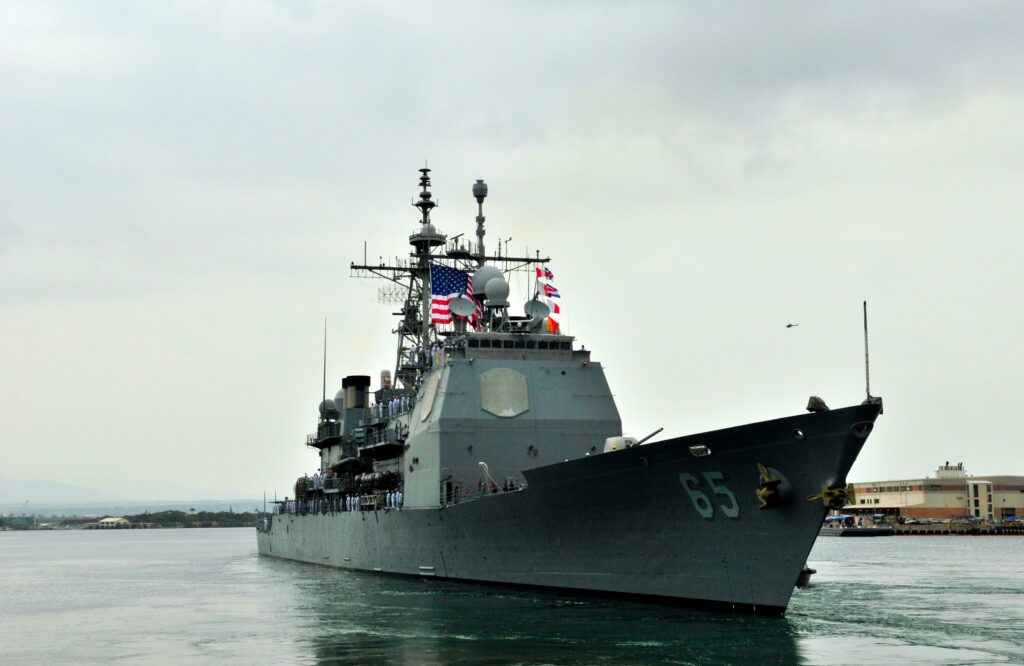
PEARL HARBOR (March 25, 2016) Sailors man the rails aboard USS Chosin (CG-65) as they prepare to depart Pearl Harbor one last time. Chosin will be homeport shifting to San Diego to undergo Cruiser Modernization. (U.S. Navy Photo by Ensign Krystyna Nowakowski/Released)
Release from Vigor Shipyards via email
*************
Three-year, highly complex maintenance project was largest in Vigor’s history
Seattle, WA (February 28, 2023) – Vigor, a Titan company, successfully completed a three-year modernization project on USS Chosin (CG 65) at its Harbor Island shipyard today, sending the U.S. Navy ship back to its homeport of Naval Station Everett. The project, which encompassed more than 1.7 million hours of work for Vigor employees, in addition to work by dozens of subcontractors and the U.S. Navy, was one of the largest, longest and most complex in Vigor’s history.
“Vigor’s completion of USS Chosin in Seattle represents an incredible success for our skilled workers and the hundreds of people who worked on this project over the last three years,” said Adam Beck, Executive Vice President of Ship Repair for Vigor. “Vigor employees and our many partners successfully managed this very complex project through the COVID-19 pandemic, ultimately returning the ship to the U.S. Navy to continue its service to our nation. We are honored to support the U.S. Navy, and are grateful to all who made this success possible.”
Vigor employees devoted approximately 1.7 million hours to USS Chosin over the last three years, modernizing weapons, communications and information systems, as well as upgrading many other areas of the ship. They worked in close partnership with the team from the Northwest Regional Maintenance Center (NWRMC) at Naval Station Everett, where USS Chosin is homeported.
Work on USS Chosin commenced alongside USS Cape St. George (CG 71), which is also scheduled to be completed this year. Both maintenance projects were awarded to Vigor together in 2019.
“This project was not only important to the Navy and our national defense, it also supported more than 600 family-wage jobs at the Harbor Island shipyard,” Beck said. “This steady work has allowed Vigor to grow the capacity of our skilled workforce in support of Navy readiness and supported industrial jobs and the local economy.”
As USS Chosin leaves Harbor Island, two other U.S. Navy ships remain at the facility, including USS Cape St. George and USS John Paul Jones (DDG 53). Vigor’s support for the Navy also extends beyond Seattle, with USS Tulsa (LCS 16) currently undergoing maintenance at Swan Island in Portland, OR and USS Michael Murphy (DDG 112) nearing the end of its availability in Hawaii.
Innovation Lab is Bringing HII Technology to the Next Generation of Shipbuilders
NEWPORT NEWS, Va., Feb. 28, 2023 (GLOBE NEWSWIRE) — HII’s (NYSE: HII) Newport News Shipbuilding division is harnessing the power of technology as it recruits the next generation of shipbuilders.
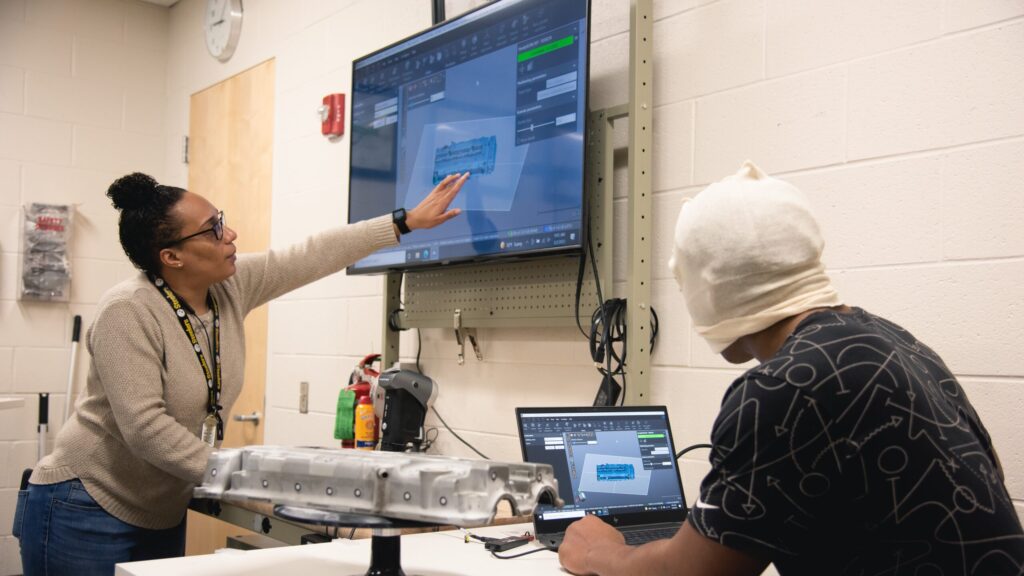
The Ray Bagley Innovation Lab is part of The Newport News Shipbuilding Apprentice School. The mobile laboratory includes stations that cover the various skill sets associated with all 19 trades offered by the school.
In use since 2021, the lab is part of the orientation process for new apprentices and affords students from K-12 schools the opportunity to explore shipbuilding trades and possible career opportunities.
“The Ray Bagley Innovation Lab allows students to experience the various trades used to build ships in a safe, controlled environment,” said Dr. Latitia McCane, director of education at The Newport News Shipbuilding Apprentice School. “The unique experience also helps breakdown preconceived ideas about construction trades. We don’t just build ships here, we build careers.”
The lab is intentionally mobile, allowing the workstations to move into the gymnasium, thus converting the gym into an actual work area. Portions of the equipment also leave campus for community events, such as supporting high school career days in the region.
On Feb. 17, the Innovation Lab was dedicated in honor of Ray Bagley, retired vice president of trades operations at NNS. Bagley retired in 2018 after serving the company for more than 43 years. He started his career as an apprentice painter and went on to work at all levels of production and construction leadership at NNS.
HII, Verizon and BayPort Credit Union all have provided financial support for the Ray Bagley Innovation Lab.
Funded by HII to train and develop the next generation of shipbuilders, The Newport News Shipbuilding Apprentice School offers four- to eight-year, tuition-free apprenticeships in 19 trades and eight optional advanced programs.
Accredited by the Council for Occupational Education, The Newport News Shipbuilding Apprentice School is certified to offer associate’s degrees of applied science in maritime technology in 26 educational programs. Through partnerships with Virginia Peninsula Community College, Tidewater Community College and Old Dominion University, the Newport News Shipbuilding Apprentice School’s academic program provides the opportunity to earn associate degrees in business administration, engineering and engineering technology and bachelor’s degrees in mechanical or electrical engineering.
Coast Guard Cutter Juniper returns to homeport after completing a 43-day Operation Blue Pacific patrol
HONOLULU – The Coast Guard Cutter Juniper (WLB 201) returns to homeport in Honolulu after a mission in the Pacific to deter illegal fishing and support partner nation’s sovereignty as part of Operation Blue Pacific.
The crew of the Juniper departed Honolulu mid-January and covered approximately 8,200 nautical miles in the effort to assist Pacific Island partners in protecting maritime governance and a rules-based international order to ensure a free and open Indo-Pacific.
“Combining efforts to deter illegal, unregulated, and unreported fishing throughout Oceania is more important than ever,” said Lt. Cmdr. Timothy Bonner, the Juniper’s commanding officer. “It was an honor for the Juniper crew to have the opportunity to work with our Fijian partners in assisting them in patrolling their exclusive economic zone.”
The Juniper embarked four Fijian shipriders representing Fiji’s Police Force, Ministry of Fisheries, Revenue and Customs, and the Republic of Fiji Navy who spent multiple days underway with the crew.
With support from members of the Juniper, USCG TACLET Pacific, and a Mandarin linguist from the U.S. Marine Corps, the Fijian Shipriders were able to utilize cutter resources to patrol Fijian waters and conduct a fishery boarding in the effort to deter IUU fishing within their EEZ.
While in Suva, Fiji, the Juniper crew hosted U.S. Ambassador Marie Damour and conducted tours for multiple agencies including Fiji’s Ministry of Fisheries, Revenue and Customs, and Maritime Safety Authority. Multiple Juniper crewmembers visited the William Cross College with representatives from the U.S. Navy, U.S. Embassy, and Republic of Fiji Navy to speak with senior-grade students and hold group discussions about the topic of overcoming gender bias. An interagency rugby match with the Republic of Fiji Navy took place that very same day at the historic Albert’s Park in Suva.
After departing Fiji, the Juniper crew transited to American Samoa where they serviced multiple aids to navigation (ATON) in Pago Pago Harbor and on Ta’u Island.
“It is our pleasure to support American Samoa’s maritime transportation system by utilizing our crew’s multi-mission capabilities,” said Lt. j.g. Pryor Miller, the Juniper’s operations officer. “Servicing ATON in the Pacific is essential to providing the needed infrastructure to maintain a maritime transportation system that promotes economic prosperity and an uninterrupted flow of maritime commerce.”
Throughout the entirety of the patrol, Juniper boarding teams conducted multiple boardings and observation reports of fishing vessels under the Western and Central Pacific Fisheries Commission (WCPFC), which strives to protect the region’s fish stocks on the high seas. The WCPFC has 26 member nations and 7 participating territories, 18 of which have enforcing authority, including the United States.
Operation Blue Pacific is an overarching multi-mission Coast Guard endeavor, promoting security, safety, sovereignty, and economic prosperity in Oceania while strengthening relationships between partner nations in the Pacific.
The Juniper is a 225-foot seagoing buoy tender home-ported in Honolulu and is responsible for maintaining aids to navigation, performing maritime law enforcement, port and coastal security, search and rescue and environmental protection.
HSC-22 CONDUCTS FINAL FLIGHT
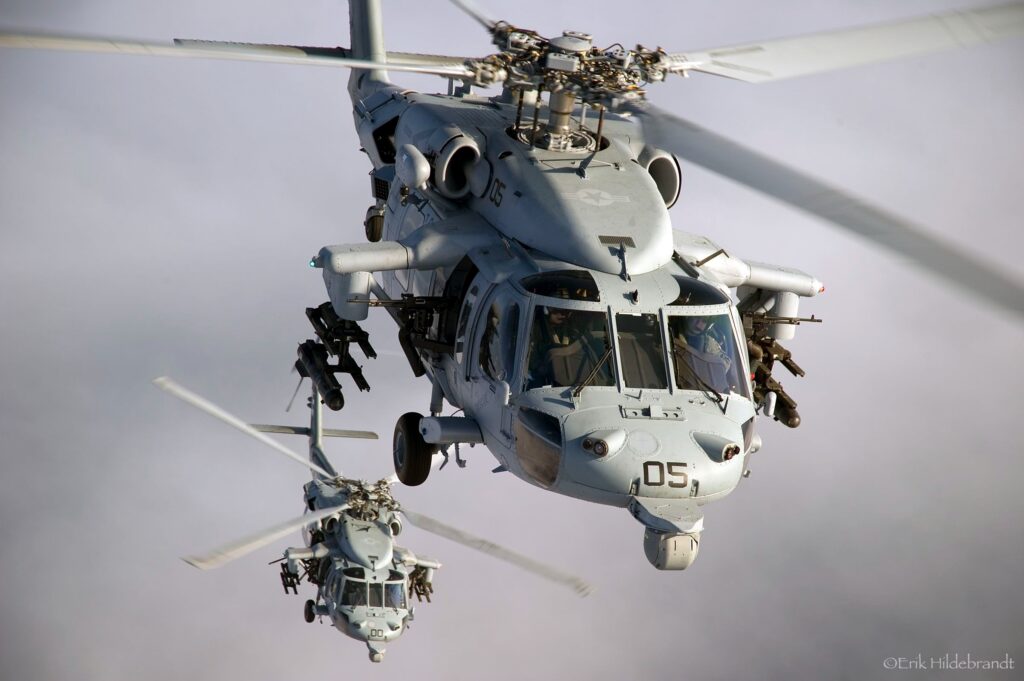
Crusader 05: LT Dan Rosborough HAC LTJG Kevin Teague H2P AWS1 Calah Sanchez Crewchief AWSC Hatler Riddle 2nd Crewman Crusader 00: LT Addison Daniel HAC LTJG Sean Rice H2P AWS2 James White Crewchief AWS2 Robert McCann
(NORFOLK, Va.) – The “Sea Knights” of Helicopter Sea Combat Squadron (HSC) 22 conducted their final flight on Wednesday, Feb. 15, 2023, almost 16 years after their first flight in 2006.
As one of the squadrons located on the “seawall” of Naval Station Norfolk, HSC-22 operated the MH-60S helicopter, the Navy’s multi-mission, rotary-wing helicopter, as well as the MQ-8B/C “Fire Scout”, an unmanned aerial vehicle (UAV) used for intelligence, surveillance and reconnaissance in the maritime environment.
Cmdr. Aaron “Dempsey” Berger is the last of 14 commanding officers who have led the squadron to work towards their core mission areas.
“When this squadron was established we were handed a challenge of living up to the standards set by other squadrons,” said Berger. “I believe we’ve risen above and set new standards for other squadrons to meet… I’ve challenged every Sailor as they depart for other commands to take their “get to yes” mentality, work ethic, and organizational standards onward so we, as a Naval Aviation Enterprise can continue to support the National Defense Strategy.”
HSC-22 was the first East Coast HSC squadron to pioneer the integration of rotary UAVs into the existing MH-60S mission sets. For over 5 years, HSC-22 operated three separate aircraft models in the squadron with many members being qualified to operate or perform maintenance on all three platforms.
Designated as one of three east coast expeditionary squadrons, HSC-22 has deployed detachments of personnel and aircraft on nearly every class of ship the U.S. Navy currently operates world-wide.
One of the squadron’s core mission areas in recent years was working with the U.S. Coast Guard under the Joint Interagency Task Force South. This unique opportunity enabled the squadron to exercise the manned-unmanned teaming concept to facilitate the interdiction of illicit trafficking.
Berger closed with acknowledging that even though they have performed their final flight, the “Sea Knights” have proudly lived up to their motto of “Praeses, Armis, Gero”, “Protect, Fight, Support”.
U.S. Coast Guard Cutter Interdicts Illegal Drugs Shipment in Arabian Sea
U.S. Coast Guard Cutter Interdicts Illegal Drugs Shipment in Arabian Sea
By U.S. Naval Forces Central Command Public Affairs | February 26, 2023
MANAMA, Bahrain —
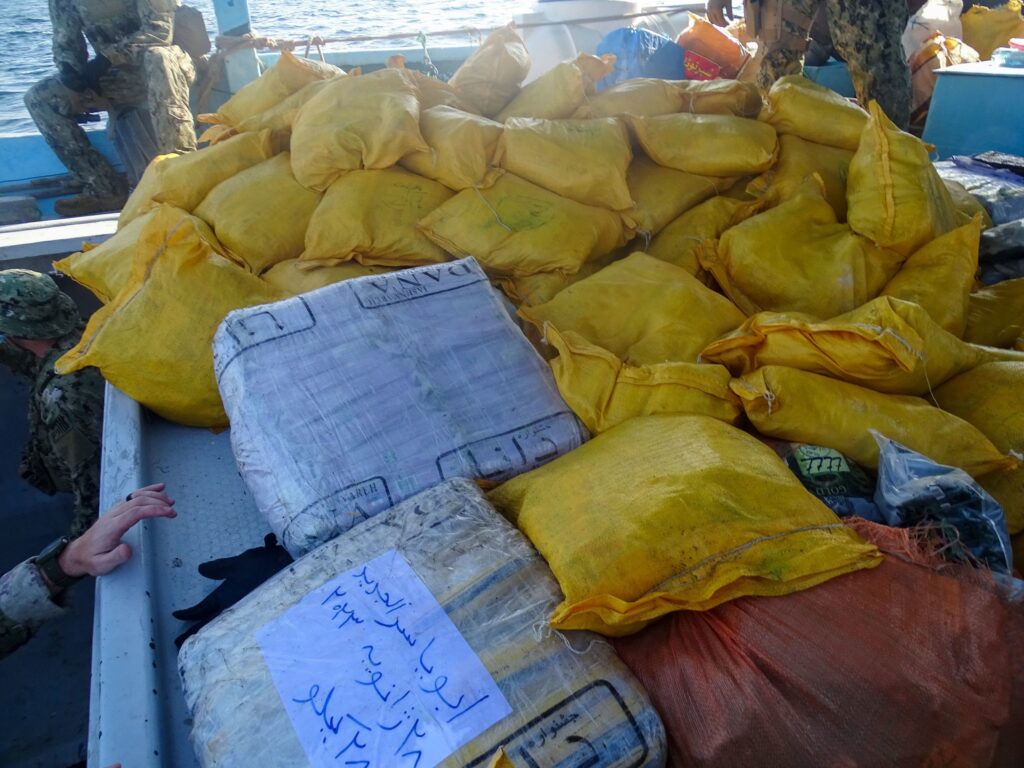
A U.S. Coast Guard ship seized illegal drugs worth $20 million in U.S. street value from a fishing vessel with four mariners transiting international waters in the Arabian Sea, Feb. 25.
Crewmembers from USCGC John Scheuerman (WPC 1146) discovered 1,350 kilograms of hashish, 276 kilograms of methamphetamine and 23 kilograms of amphetamine pills upon interdicting the vessel during a routine patrol.
“This is the result of excellent teamwork and multinational collaboration. It is important that we continue relentlessly pursuing any destabilizing maritime activity,” said U.S. Navy Capt. Anthony Webber, commander of Task Force 55, the staff responsible for U.S. 5th Fleet surface forces in the region. “The crew clearly demonstrated John Scheuerman’s motto of ‘selflessness and strength’ during this seizure and I couldn’t be more proud.”
John Scheuerman was operating in support of Combined Task Force (CTF) 150 at the time. Currently led by the United Kingdom Royal Navy, CTF 150 is one of four task forces organized under the Combined Maritime Forces (CMF).
CMF is the largest international naval partnership in the world, consisting of 38 member-nations and partners, and has interdicted over $1 billion worth of illicit narcotics during maritime patrols.
AUSTALUSA CHRISTENS CODY (EPF 14) – THE FIRST EPF FLIGHT II VESSEL
AUSTALUSA CHRISTENS CODY (EPF 14) – THE FIRST EPF FLIGHT II VESSEL
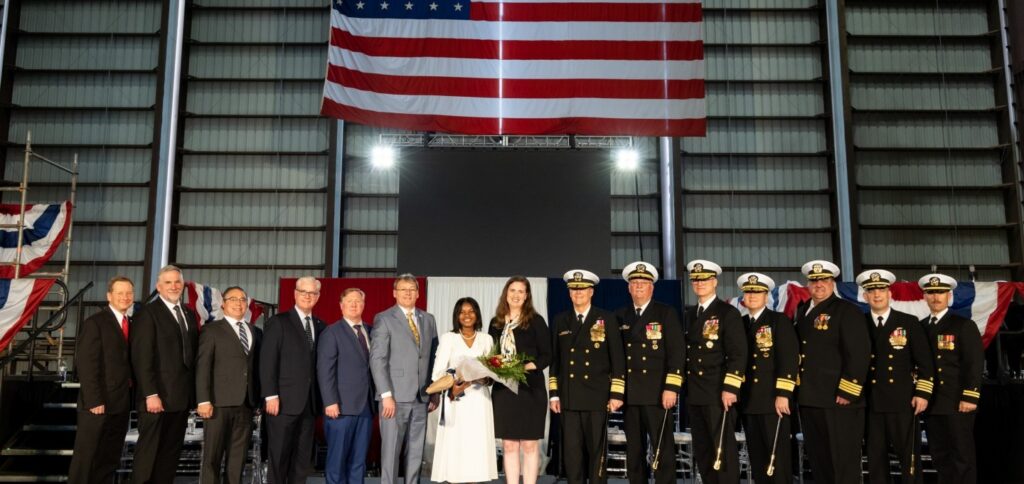
MOBILE, Ala. – Austal USA christened its 14th Expeditionary Fast Transport (EPF), USNS Cody, during a ceremony at its advanced manufacturing facility today. Cody is the first EPF Flight II as well as the first Navy vessel to honor the city of Cody, Wyo.
The ceremony for the Navy’s first Flight II EPF was well attended by Navy leaders and elected officials. Vice Admiral Francis Morley, principal military deputy to the assistant secretary of the Navy for research, development, and acquisition; Rear Admiral Bruce Gillingham, surgeon general of the U.S. Navy; Rear Admiral Michael Wettlaufer, commander, Military Sealift Command; Rear Admiral Tom Anderson, program executive officer, ships; Honorable Matt Hall, mayor of Cody, Wyo.; and Honorable Greg Reed, Alabama Senate President Pro Tempore all participated in christening events.
Ship sponsor Averil D. Spencer christened the ship with a ceremonial champagne bottle-break on the bow of the ship. Spencer, an avid philanthropist, is the Founder and Executive Director of Launch gURLs, a nonprofit that aims to close the gender gap in economic opportunities through entrepreneurship programming for adolescent girls globally.
“Cody represents the future of naval medicine afloat and the ability to provide critical combat care in austere and contested operating environments,” Austal USA President Rusty Murdaugh said. “With her medical capability, Cody will make a name for herself as a new asset to the global humanitarian cause very soon.”
EPF Flight II provides a Role 2E (expanded) medical capability which includes, among other capabilities, basic secondary health care built around primary surgery; intensive care unit; ward beds; and limited x-ray, laboratory and dental support. The EPF’s catamaran design provides inherent stability to allow surgeons to perform underway medical procedures in an on-board operating suite. The EPF’s catamaran design provides inherent stability to allow surgeons to perform underway medical procedures in an on-board operating suite. Enhanced capabilities to support V-22 flight operations and launch and recover 11-meter Rigid Hull Inflatable Boats complement the ship’s medical facilities. These Flight II upgrades along with EPF’s speed, maneuvrability and shallow water access are key enablers for mission support of future Distributed Maritime Operations and Expeditionary Advanced Base Operations around the world. Flight II retains the capability of the Flight I to support other missions including core logistics capabilities.
The USNS Cody is one of two EPF Flight II ships under construction at Austal USA with a third under contract. EPF Flight II ships will augment the future Expeditionary Medical Ships which will be capable of comprehensive, multidisciplinary hospital operations.
NAVWAR Highlights Information Warfare’s Role in Connecting a Joint Future Force at WEST 2023
NAVWAR Highlights Information Warfare’s Role in Connecting a Joint Future Force at WEST 2023
24 February 2023
From Kara McDermott
SAN DIEGO – Naval Information Warfare Systems Command (NAVWAR) leaders and technical experts highlighted digitization, automation, and agile software delivery as key tenants to connecting a joint future force during WEST 2023 at the San Diego Convention Center, Feb. 14-16.
Gathering with a contingent of other information warfare (IW) commands, the team shared the IW mission and priorities with attendees through speakers, panels, subject matter experts, and technology demonstrations at the three-day conference and exposition.
The lead for the IW community, Vice Adm. Kelly Aeschbach, commander, Naval Information Forces, touched on readiness, capability, and capacity by noting that people are the weapon systems in information warfare.
“Our biggest challenge right now is facing demand,” she said. “We are needed everywhere, and I cannot produce enough information warfare capacity and capability to distribute it everywhere that we would like to have it. That remains a real pressing challenge for me – how we prioritize where we put our talent and ensure that we have it in the most impactful place.”
As a part of the IW speakers’ series, Rear Adm. Doug Small, commander, NAVWAR, answered questions on a variety of subjects including risk management, future opportunities and constraints for continuous connectivity, and how unmanned systems play into Project Overmatch. As a Navy high-priority initiative, Project Overmatch is aimed at connecting platforms, weapons, and sensors together in a robust Naval Operational Architecture that integrates with Joint All-Domain Command and Control for enhanced Distributed Maritime Operations.
“Networking for unmanned systems is a core part of what we are trying to do,” said Small. “We are charged with making sure all the components of the architecture, what the CNO called the ‘connective tissue,’ reaches every single one of those platforms to include unmanned systems. Everything from networking to the computing plant onboard to how it communicates.”
Small also joined top leaders from across the Navy, Marine Corps, and Coast Guard on a panel to discuss what is being done to provide clarity in the requirements and acquisition processes, recruiting and retaining the right talent in a competitive hiring environment, and explaining their toughest challenges and areas of opportunities.
“As we continue to bring digital platforms to ships with modern methods of software delivery, we are using new ways to tap into our amazing talent pool,” said Small. “With events like script-a-thons and coding challenges, we are pushing to get the very best from our Sailors and Marines who are absolutely experts in their fields.”
Back at the IW Pavilion, attendees had the opportunity to meet informally with dozens of program managers, business portfolio managers and subject matter experts through the engagement zone program. Open to all registered attendees with no appointment needed, these one-on-one and small group conversations discussed capabilities, service offerings, and opportunities for partnerships.
“WEST and other similar industry forums are vital to program managers to ensure we’re aware of commercial technologies we can leverage for the Fleet,” said Capt. Kris De Soto, program manager, Communications and GPS Navigation Program. “I was excited to participate in the event and the engagement zone and very pleased that we were able to meet so many of our industry partners in one place.”
In addition to the engagement zone, the IW pavilion also hosted a variety of technology demonstrations as a way to share insights into Navy tools, capabilities, and tactics so attendees could understand opportunities for collaboration or support.
“This year, Naval Information Warfare Center (NIWC) Pacific is showcasing a wide breadth of our capabilities, with many of them showing the power of digitization and automation to the Fleet and for overall joint service readiness,” said Amanda George, business portfolio manager at NIWC Pacific.
One of those demonstrations was CyberKnight, a toolset that provides a method to automate the analysis of security technical implementation guides for command, control, communications, computers, intelligence, surveillance, and reconnaissance systems.
“CyberKnight is beneficial because the operating system type it analyzes is prevalent throughout the Department of Defense (DoD),” said Michael Price, cyber assessment and authorization branch head at NIWC Pacific. “It speeds up onerous requirements, allowing the security and engineering teams to address any security risks in a more timely fashion.”
NIWC Pacific also demonstrated their Space and Stratospheric Systems Program, where they have developed a small satellite and payload integration lab that enables rapid prototyping and demonstration of capabilities for Navy and other DoD sponsors in a government-owned and operated environment.
“Working jointly with other services is the best way to move fast,” said Jason Bousquet, NIWC Pacific space systems branch head. “Every organization has something of value to offer with contributions in technical expertise, experience, and valuable lessons learned. Knowledge gaps are filled quickly allowing for accelerated progress and increased success.”
Jara Tripiano, NIWC Pacific’s chief engineer, closed out the IW pavilion speakers’ series by acknowledging that there is increased recognition of the importance of how capabilities are developed and delivered, and how it truly matters at an operational level.
“In support of Project Overmatch, we recently delivered a software package via the Overmatch Software Armory’s continuous integration/continuous delivery pipeline over-the-air to an operational platform,” she said. “In the future, we want that to be the norm. That WILL be the norm.”
Co-sponsored by the Armed Forces Communications and Electronics Association (AFCEA) International and the U.S. Naval Institute (USNI), WEST 2023 is the premier naval conference and exposition on the West Coast.
About NAVWAR
NAVWAR identifies, develops, delivers, and sustains information warfighting capabilities and services that enable naval, joint, coalition, and other national missions operating in warfighting domains from seabed to space and through cyberspace. NAVWAR consists of more than 11,000 civilian, active duty and reserve professionals located around the world.
USCGC Vigilant’s crew returns home following 28-day Florida Straits patrol
USCGC Vigilant’s crew returns home following 28-day Florida Straits patrol
CAPE CANAVERAL, Fla. – The crew of the USCGC Vigilant (WMEC 617) returned to their home port in Cape Canaveral Saturday following a 28-day patrol in the Florida Straits.
Patrolling in support of Homeland Security Task Force – Southeast and Operation Vigilant Sentry in the Seventh Coast Guard District’s area of responsibility, Vigilant’s crew conducted maritime safety and security missions while working to detect, deter and intercept unsafe and illegal migrant ventures bound for the United States.
During the patrol, Vigilant assisted with the interdiction of a grossly overloaded vessel with 311 Haitian migrants on board. The crew provided migrants with food, water, shelter and medical aid until the migrants were repatriated back to their country of origin.
“This interdiction was a great example of the Department of Homeland Security’s outstanding interagency coordination and cooperation,” said Cmdr. Jay Guyer, Vigilant’s commanding officer. “I’m extremely proud of Vigilant’s crew in how they execute this dynamic and difficult mission with professionalism and humanity.”
Vigilant is a 210-foot Reliance-class medium endurance cutter. The cutter’s primary missions are counter drug operations, migrant interdiction, enforcement of federal fishery laws and search and rescue in support of U.S. Coast Guard operations throughout the Western Hemisphere.
Joint, Combined Exercise Shows Marine Littoral Regiment Idea is on ”Right Track’
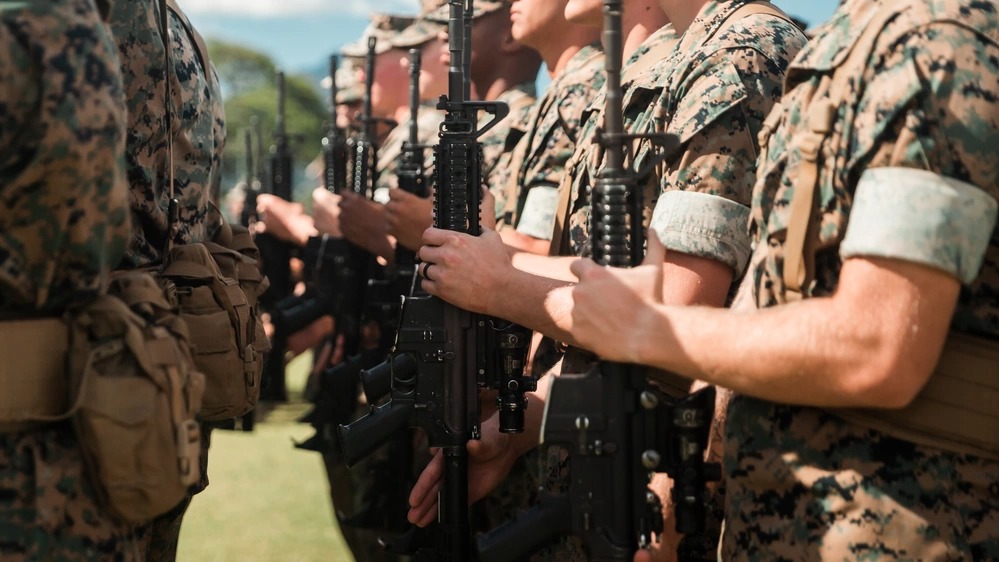
U.S. Marines with 3d Marine Littoral Regiment, 3d Marine Division present arms during the redesignation ceremony of 3d Marines to 3d MLR aboard Marine Corps Base Hawaii, March 3, 2022. The 3d MLR will serve as a key enabler for joint, allied, and partnered forces, will integrate with naval forces, and will enable multi-domain maneuver and fires within contested spaces. The transition of 3d Marines to 3d MLR is in accordance with Force Design 2030 and one of the first major steps to facilitating a shift as the Marine Corps divests in legacy capabilities and builds a force that is optimized for operations envisioned within the Commandant’s Planning Guidance. (U.S. Marine Corps photo by Cpl. Patrick King)
ARLINGTON, Va. — Now that the first Marine Littoral Regiment has been created, U.S. Marine Corps leaders say they’re experimenting to determine how best to equip the pioneering unit as the forward-based eyes and ears of the fleet inside a contested maritime environment.
The 3rd Marine Regiment was redesignated the 3rd Marine Littoral Regiment (MLR) in a March 3, 2022 ceremony at Marine Corps Base Hawaii, where the new regiment will continue to be headquartered. The first of three planned littoral regiments for the Indo-Pacific region, the 3rd MLR is a key part of the Marines’ ambitious force redesign to contend with near-peer militaries like China and Russia.
”We have not only built the organization, now we are equipping it, experimenting and doing the testing and evaluation with those concepts we’ve come up with,” Marine Corps Col. Lance Lewis told the National Defense Industrial Association (NDIA) Expeditionary Warfare Conference Feb. 22. ”We’re definitely on the right track when it comes with MLRs,” added Lewis, the Assistant Vice Chief of Naval Research at the Office of Naval Research (ONR), ”That is how we are going to enable the Stand-In Force.”
The Marines’ evolving Expeditionary Advanced Base Operations concept envisions littoral operations by specialized mobile, low signature units within larger distributed maritime operations areas. Plans call for the MLRs to be organized, trained and equipped to support sea control and sea denial operations as part of a larger naval expeditionary force integrated with the joint force and allied and partnered forces.
Currently the MLRs are divided into three elements: a littoral combat team made up of a one infantry battalion equipped with a ship-killing missile battery, an anti-aircraft battalion, and a combat logistics battalion. All three elements were dispersed over three separate islands in their debut inclusion in RIMPAC 22 , the huge joint multinational maritime exercise in Hawaii. The MLR provided multi-domain awareness to the Combined Task Force, the Combined Force Maritime Component Command, and the Combined Force Air Component Command.
As the “eyes and ears of the fleet,” Lewis said, ”You need not only to restructure, but how do you maneuver those forces around the battlefield so it’s not a standard set of battalions but a different task organization, and then how do you now equip those forces.”
The Navy will christen its Spearhead-class expeditionary fast transport, the future USNS Cody (EPF 14), during a 10:00 a.m. ceremony Saturday, February 25, in Mobile, Ala.
The Honorable Matt Hall, Mayor of Cody, Wyo., will deliver the ceremonial principal address. Additional speakers include Vice Adm. Francis Morley, principal military deputy to the Assistant Secretary of the Navy for Research, Development, and Acquisition; The Honorable Greg Reed, president pro tempore of the Alabama state senate; Rear Adm. Bruce Gillingham, Surgeon General of the Navy; Rear Adm. Michael Wettlaufer, commander, Military Sealift Command; Mr. Rusty Murdaugh, president, Austal USA; and Mr. Stan Kordana, vice president of Surface Systems, General Dynamics Mission Systems.
In a time-honored Navy tradition, Averil Spencer, the ship’s sponsor, will christen the ship by breaking a bottle of sparkling wine across the bow. Spencer is the daughter of the Honorable Richard V. Spencer, 76th Secretary of the Navy.
“This ship is the first to honor the city of Cody, Wyoming, a city that proudly embodies America’s independence and fighting spirit,” said Secretary of the Navy Carlos Del Toro. “The future USNS Cody will also be the first Flight II configuration in its class, bringing enhanced medical capabilities in addition to its high-speed sealift mobility and agility. I look forward to the depth that this expeditionary fast transport will add to our fleet.”
The future USNS Cody will join the fleet as one of nearly 100 U.S. Navy ships operating globally each day ensuring freedom of the seas, protecting international law, and strengthening relationships with Allies and partners.
The Navy’s Military Sealift Command will operate the future USNS Cody, the first Flight II configured Spearhead-class expeditionary fast transport (EPF). The ship is named in honor of Cody, Wyo., and is the first ship in naval service named after the city.
EPFs, formerly designated as Joint High Speed Vessels, are all-aluminum catamarans that provide high-speed, shallow-draft transportation capability to support the intra-theater maneuver of personnel, supplies, and equipment for the Navy, Marine Corps, and Army. EPFs enable the rapid projection, agile maneuver, and sustainment of forces in response to a wide range of military and civilian contingencies such as Non-Combatant Evacuation Operations (NEO), Humanitarian Assistance, and Disaster Relief (HADR).
The Flight II ships will enhance the medical mission capability of the EPF’s mission portfolio. With an embarked medical unit, the Flight II EPF will have two operating rooms, the ability to support approximately 41 medical patients, and 147 embarked forces. Flight II EPFs will have an 11M RIB and MV-22 capability.