Keel Laying Commemorated for Future Aircraft Carrier USS Enterprise 
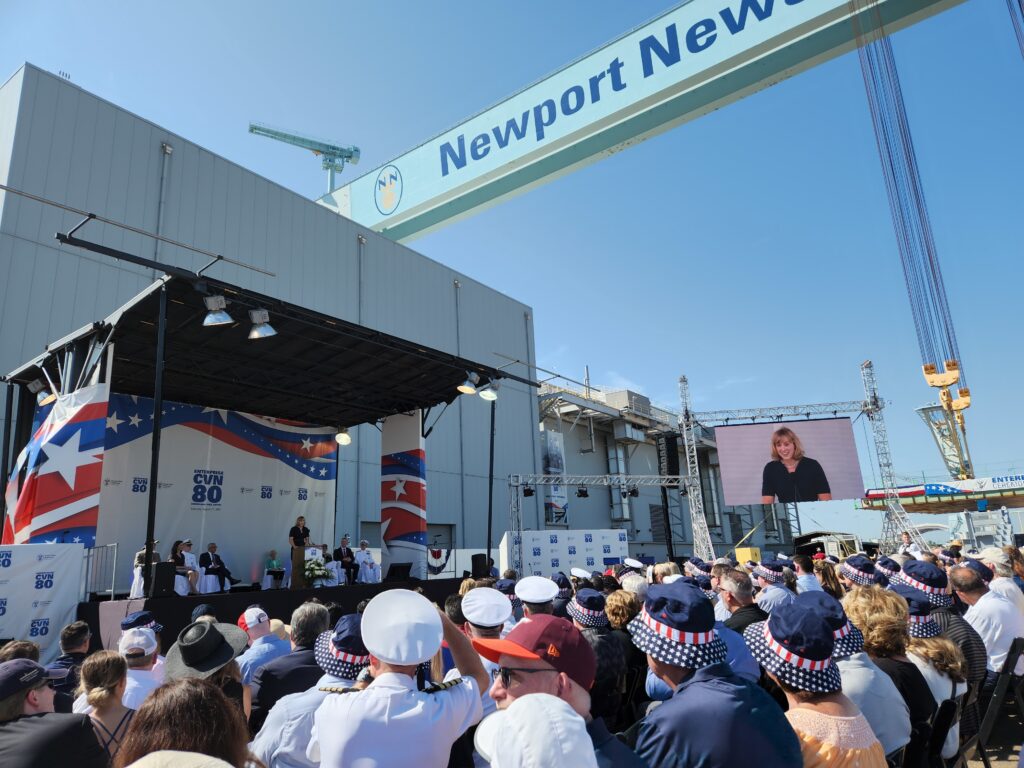
Katie Ledecky, CVN-80 co-sponsor and three-time Olympian delivers remarks at the future USS Enterprise (CVN-80) keel laying ceremony in Newport News, Virginia, Aug. 27. The future USS Enterprise will be the ninth U.S. Navy warship to bear the name. U.S. NAVY

NEWPORT NEWS, Va. — With the words, “I hereby declare the keel of the United States Ship Enterprise truly and fairly laid,” Olympians Simone Biles and Katie Ledecky chalked their initials on respective steel plates, which were then embossed by skilled welders and affixed to the keel of the future USS Enterprise (CVN 80), Aug. 28 at the HII-Newport News Shipyard, in Newport News, Virginia.
 
Ledecky attended the historic keel laying ceremony for the nation’s most advanced aircraft carrier in person, while Biles participated via a pre-recorded message from the World Champions Center in Spring, Texas, Program Executive Office Aircraft Carriers said in a release. Five years earlier, on Aug. 24, 2017, Biles and Ledecky attended CVN 80’s First Cut of Steel ceremony, marking the initial major construction milestone for the Enterprise — the third ship in the USS Gerald R. Ford (CVN 78)-class of aircraft carriers. 
 
On Saturday, after NNS welders Ephony King and Jonathan Rishor finished welding the athletes’ initials on small, steel plates, NNS Lead Rigger, Mike “Chile” Williams, passed a radio to Ledecky, who gave the command for NNS Crane Operator Charlie Holloway to lower the 688-ton keel unit into the dry dock. This section of the ship will support the forward half of the Enterprise, when the CVN 80 is fully assembled. The ceremonial plates will be affixed permanently to the ship’s keel. 
 
Work on the Enterprise has been progressing on schedule, since NNS loaded the Enterprise’s keel unit during the ship’s first “super-lift,” on April 5. With the first main structural member in place, workers have continued erecting the aircraft carrier in the dry dock by joining together a series of pre-outfitted modules. 
 
The future USS Enterprise will be the ninth U.S. Navy warship to bear the name, with the first being a sloop-of-war, commissioned in 1775, after its capture from the British during the American War of Independence. The last Enterprise (CVN 65), served as the world’s first nuclear-powered aircraft carrier from 1961–2017 and is currently moored nearby in the shipyard awaiting the results of an environmental impact statement and a Navy decision on disposal options. 
 
Under Secretary of the Navy Erik K. Raven delivered the keynote address. “The power of this ceremony — at this shipyard, in our country, on this day — is to mark another ship’s life being started to serve more generations of Americans, service members, friends, families, leaders, partners, and allies,” he said.
 
“Fittingly, in the presence of the previous Big E, we now lay the keel of the next Enterprise, the newest future naval warship, CVN 80.” 
 
The ship’s sponsors are internationally renowned. Ledecky is a three-time Olympian, participating in the 2012, 2016, 2020 Games, earning 10 medals. Biles is the most decorated U.S. women’s gymnast, with 32 World/Olympic medals.
 
The future USS Enterprise is scheduled to replace the USS Dwight D. Eisenhower (CVN 69), currently slated for inactivation in 2029. 


Iraq, Kuwait and U.S. Conduct Joint Patrol in Arabian Gulf 

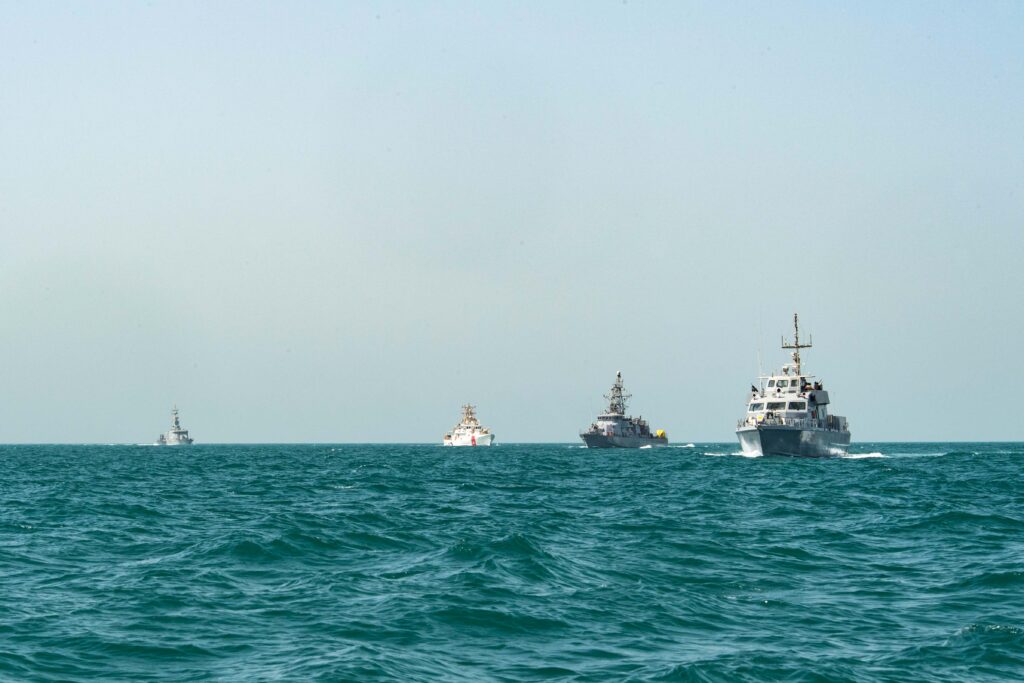
U.S. Navy coastal patrol ship USS Sirocco (PC 6), U.S. Coast Guard fast response cutter USCGC Charles Moulthrope (WPC 1141), Kuwait naval force ship Maskan (P 3717) and Iraq navy fast attack craft P-310 sail together during a joint patrol exercise in the Arabian Gulf, Aug. 25. U.S. NAVY / MC1 Anita Chebahtah

MANAMA, Bahrain — Maritime forces from Iraq, Kuwait and the United States conducted a joint patrol on Aug. 25 in the Arabian Gulf, U.S. Naval Forces Central Command said Aug. 28. Ships from the Iraq navy, Kuwait naval force, Kuwait coast guard, U.S. Navy and U.S. Coast Guard participated in maneuvering exercises and maritime security drills. 

U.S. ships included patrol coastal ship USS Sirocco (PC 6) and fast response cutter USCGC Charles Moulthrope (WPC 1141). Sirocco and Charles Moulthrope are forward-deployed to Bahrain where U.S. 5th Fleet is headquartered. 

“Trilateral engagements like this demonstrate the shared commitment of partner nations to safeguarding the seas,” said Capt. Robert Francis, commander of Task Force 55 whose staff oversees operations for U.S. 5th Fleet surface forces. 

Cooperation among regional partners at sea helps ensure maritime security and stability in nearby waters, he added. 

The U.S. 5th Fleet operating area includes 21 countries, the Arabian Gulf, Gulf of Oman, Red Sea, parts of the Indian Ocean and three critical choke points at the Strait of Hormuz, Bab al-Mandeb and Suez Canal. 


7th Fleet Cruisers Transit Taiwan Strait 

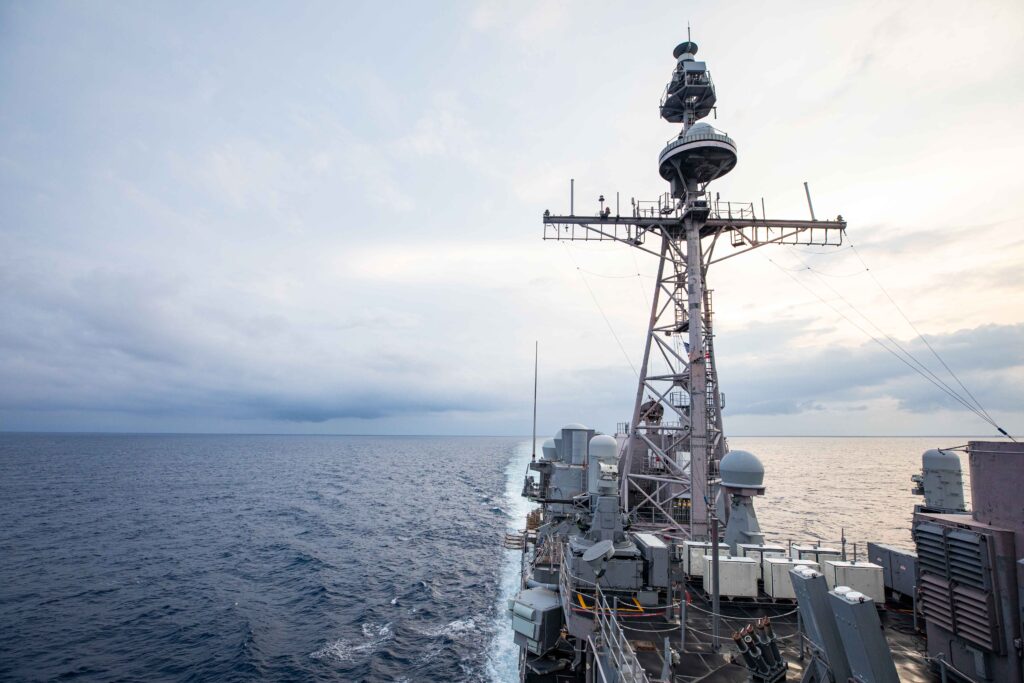
Ticonderoga-class guided-missile cruiser USS Chancellorsville (CG 62) transits the East China Sea during routine underway operations. Chancellorsville is forward-deployed to the U.S. 7th Fleet area of operations in support of a free and open Indo-Pacific. U.S. NAVY / Mass Communications Specialist 2nd Class Justin Stack

TAIWAN STRAIT — Ticonderoga-class guided-missile cruisers USS Antietam (CG 54) and USS Chancellorsville (CG 62) conducted a routine Taiwan Strait transit Aug. 28 (local time) through waters where high seas freedoms of navigation and overflight apply in accordance with international law, U.S. 7th Fleet Public Affairs said in a release. 

These ships transited through a corridor in the Strait that is beyond the territorial sea of any coastal state. The ship’s transit through the Taiwan Strait demonstrates the United States’ commitment to a free and open Indo-Pacific, the release said. The United States military flies, sails, and operates anywhere international law allows. 


CNO: U.S. Navy Brings to Bear ‘Global Maneuverability’   

The Chief of Naval Operations, Adm. Michael Gilday, second from right, visits Patrol Squadron Nine in Keflavik, Iceland, in June. U.S. NAVY / Lt. Joseph Reed

WASHINGTON — The chief of naval operations said the U.S. Navy’s forward presence and ability to move its forces, including its headquarter staffs, rapidly to an area where it is needed demonstrates its value to the maritime security of the nation and the world. 

“Do we have enough fleet headquarters to go around? One could argue that we don’t,” said CNO Adm. Michael Gilday, speaking on his Navigation Plan for the Navy Aug. 25 at The Heritage Foundation, responding to a question about the way the Navy’s numbered fleets are distributed around the world to respond to the actions of China and the need for the Navy to increase its operations in the Arctic. “One of the great things the Navy brings to bear — our headquarters included — is global maneuverability.”  

Gilday said his top regional focus is on the Pacific and the Atlantic, with the Indian Ocean “being a close third.” 

The admiral said “in terms of opportunities of the future, we absolutely have to look at the Arctic. As the ice cap continues to recede, think about trade routes in the next 25 years between Europe and Asia: fundamentally changing.” 

He pointed out NATO member Iceland is typically thought of in a trans-Atlantic fashion. 

“Think about it in a trans-polar fashion,” he said. “We need to think about that area much more deeply, particularly with both Finland and Sweden joining the alliance. I see opportunities in the high north that we need to continue to operate up there with allies and partners.” 

Gilday pointed that Iceland has graciously allowed Navy P-8 maritime patrol aircraft operate rotationally from Iceland, which hosted a maritime patrol aircraft presence during the Cold War.   

Regarding adding another numbered fleet, Gilday said he “would prefer to focus any monies I have on capabilities and more ships rather than more headquarters. What our Navy has done, as an example, with the newly formed U.S. 2nd Fleet out of Norfolk, is we’ve used them in an expeditionary manner. Their light, agile headquarters that has actually operated out of Iceland. They’ve travelled from Norfolk to operate on our command-and-control ship [the USS Mount Whitney] in the Mediterranean and in the high north up by Norway. They [also] have gone down to North Carolina and operated with the Marine Corps.” 


SAIC Wins Contract to Support U.S. Navy Networks 

RESTON, Va. — Science Applications International Corp. has been awarded a $163 million contract by the U.S. Navy to support design, development, integration, modernization, sustainment and life cycle support to shore networks, network components and network service solutions for the Naval Information Warfare Center Pacific Shore Networks Branch located in San Diego, the company said Aug. 25. 

Under the contract, SAIC will maintain Naval Enterprise Networks for all shore-based U.S. Navy commands and personnel critical to the Navy’s day-to-day operations, as well as supporting command and control of U.S. Navy units deployed by operational commanders. 

“SAIC is honored to build on our work supporting the U.S. Navy and NIWC Pacific,” said Bob Genter, SAIC president, Defense & Civilian Sector. “We are focused on delivering valuable support and solutions to a range of U.S. Navy network challenges and initiatives.” 

NIWC Pacific provides technological and engineering support critical to information warfare for the U.S. Navy, as well as for Marine Corps, Air Force, Army and Coast Guard programs. Systems development and support includes basic research and prototype development through systems engineering, and integration to life cycle support of fielded systems. 


George H.W. Bush Carrier Strike Group Enters the Mediterranean Sea 

Ships from the George H.W. Bush Carrier Strike Group (GHWBCSG) transit the Atlantic Ocean following a straits transit training event. U.S. NAVY / Mass Communication Specialist Seaman Apprentice Samuel Wagner

STRAIT OF GIBRALTAR — The George H.W. Bush Carrier Strike Group, embarked aboard the Nimitz-class aircraft carrier USS George H.W. Bush (CVN 77), transited the Strait of Gibraltar and entered the Mediterranean Sea as part of a regularly scheduled deployment in the U.S. Naval Forces Europe-Africa area of operations on Aug. 25, the group’s public affairs office said. 

The strike group ships, squadrons and staff departed from the United States earlier this month, aggregating as a strike group in the Atlantic Ocean before beginning the transit through the Strait of Gibraltar. 

“We are here to provide the flexibility and combat power that only a U.S. Navy carrier strike group can provide combatant commanders,” said Rear Adm. Dennis Velez, commander, George H.W. Bush Carrier Strike Group, Carrier Strike Group 10. “The Sailors of the George H.W. Bush Carrier Strike Group are clear-eyed about our mission, ready to execute, and prepared to reassure our partners and allies while allowing our diplomats to negotiate from a position of strength, knowing the U.S. Navy is on station.” 

While in the NAVEUR-NAVAF area of operations, the strike group will work alongside allied and partner maritime forces, focusing on theater security cooperation efforts to further regional stability and demonstrate the strong maritime partnership between the U.S. and these allies and partners. This marks the first time that USS George H.W. Bush has operated in the region since its 2017 deployment, after which it entered an extensive maintenance period. 

Prior to deployment, the carrier strike group completed its final certification exercise with the Italian Navy destroyer ITS Caio Duilio (D 554) as part of the team. Later in the same exercise, the strike group came under the leadership of Naval Striking and Support Forces NATO to flex command and control between U.S. and NATO chains of command, highlighting integration and interoperability between partners and allies. 

Carrier strike groups are an inherently flexible naval force capable of deploying across combatant commands to meet emerging missions, deter and defend against potential adversaries, enhance security, reassure allies and partners, and guarantee the free flow of commerce in the region. 


Ohio-Class Submarines Work with USAF and USMC During VERTREP 

An MH-60R Seahawk helicopter, assigned to the “Wildcats” of Helicopter Sea Combat Squadron 23, delivers supplies to the ballistic missile submarine USS Nevada (SSBN 733) during a vertical replenishment at sea. U.S. NAVY

NAVAL BASE KITSAP, BANGOR, Wash. — Two Ohio-class ballistic missile submarines demonstrated their ability to replenish while operating at sea during a series of vertical replenishment exercises off the coast of California July through August 2022, said Submarine Group 9 public affairs.
 
During the exercise, the Ohio-class ballistic missile submarines USS Nevada (SSBN 733) and USS Henry M. Jackson (SSBN 730) operated jointly with U.S. Navy MH-60R Seahawk helicopters, U.S. Marine Corps MV-22 Ospreys, and U.S. Air Force C-17 Globemaster IIIs. 
 
“Recently the Pacific SSBN submarine force exercised a vertical replenishment capability for at-sea SSBNs to prove our resiliency for worldwide operations and to replenish our ships with materials, food and operational gear,” said Capt. Kelly L. Laing, director of maritime operations for Commander, Task Group 114.3. “This allows us to maintain an unpredictable forward presence and continued demonstration of the unmatched strength of our strategic forces.” 
 
The event showcased the submarines’ ability to remain on mission and at sea while performing essential replenishment operations. 
 
“Our fundamental mission is to deter a strategic attack, which is an existential threat to the United States and our allies.” said Rear Adm. Mark Behning, commander of both Submarine Group 9 and Task Group 114.3. “Testing our readiness ensures we maintain a safe, secure and reliable strategic deterrent force.” 
 
The event was part of a U.S. Strategic Command exercise which highlights the interoperability of multiple U.S. military platforms in order to implement the strategic deterrence mission. 
 
“Exercising these VERTREPs was a joint operation involving Marine and Air Force assets,” Laing said. “This shows our commitment to joint operations worldwide and between combatant commanders. This is important so that we don’t stovepipe ourselves under one community or brand. We are committed to operating together as a global force.” 
 
This event is the latest in a series of efforts by the United States submarine force to look at alternative operations that previously required a submarine to be pierside to accomplish. For example, in May, the Ohio-class ballistic-missile submarine USS Alabama (SSBN 731) conducted an at-sea crew exchange, swapping out the blue and gold crews. This demonstrated the submarine’s ability to continuously operate and stay on mission for longer periods of time while sustaining quality of life for the crews and their families. 
 
“What this shows to our allies and adversaries is that we have the ability to keep our boats at sea,” Laing said. “This shows them that we are ready.” 


Bahrain Conducts Fifth Sentinel Shield Exercise with IMSC; Includes Saildrone USV  

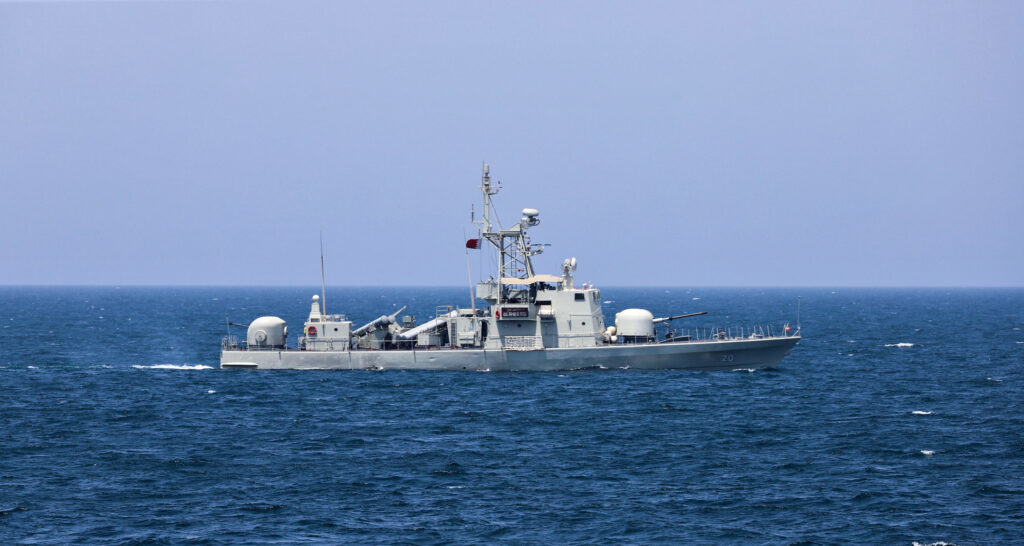
Royal Bahrain Naval Force patrol boat RBNS Ahmed Al-Fateh (P20) sails in the Arabian Gulf during exercise Sentinel Shield on Aug. 23. U.S. COAST GUARD / Electronics Technician 1st Class Jason Pickens

MANAMA, Bahrain — Forces from Bahrain and the United States completed a joint exercise in the Arabian Gulf on Aug. 23, led by a nine-nation coalition staff based in the Middle East, NAVCENT Public Affairs said Aug. 25.  

Royal Bahrain Naval Force ship RBNS Ahmed Al-Fateh (P20) and U.S. Coast Guard patrol boat USCGC Baranof (WPB 1318) participated in exercise Sentinel Shield with a Saildrone Explorer unmanned surface vessel from U.S. 5th Fleet.  

Sentinel Shield is a monthly exercise series organized by the International Maritime Security Construct (IMSC) to enhance communication and coordination among partner naval forces. This month’s iteration was the first designed to integrate unmanned systems.  

“The continued interoperability and coordination of U.S. and Bahraini naval assets are crucial to stability in the Arabian Gulf,” said Lt. Vaughn Gehman, commanding officer of Baranof. “Integration of unmanned systems is a force-multiplier for IMSC and its ability to detect and deter malign activity.”  

IMSC was formed in July 2019 in response to increased threats to freedom of navigation for merchant mariners transiting international waters in the Middle East. Coalition Task Force Sentinel was established four months later to deter state-sponsored malign activity and reassure the merchant shipping industry in the Bab al-Mandeb and Strait of Hormuz.  

The coalition is headquartered in Bahrain under U.S. 5th Fleet and includes forces from Albania, Bahrain, Estonia, Lithuania, Romania, Saudi Arabia, the United Arab Emirates, the United Kingdom and the United States.  

“I was delighted to see our host nation participating in this month’s exercise, and especially pleased to again see Bahrain leading the way in unmanned systems integration,” said British Royal Navy Commodore Ben Aldous, commander of IMSC and CTF Sentinel.  

In October, Bahrain was the first nation U.S. 5th Fleet partnered with after establishing a new unmanned systems and artificial intelligence task force. During a two-day training exercise, U.S. patrol craft and Bahrain Defense Force maritime assets sailed alongside Mantas T-12 unmanned surface vessels in the Arabian Gulf, marking the first time the platforms operated in regional waters.  

“Incorporating unmanned systems into Sentinel Shield enables the coalition to plan for the future by developing and exercising concepts of employment that most effectively utilize this new technology to benefit the Sentinel mission and strengthen our coalition,” said Aldous. 


Coast Guard Offloads $3.1M in Seized Cocaine, Transfers Custody of 8 Smugglers  

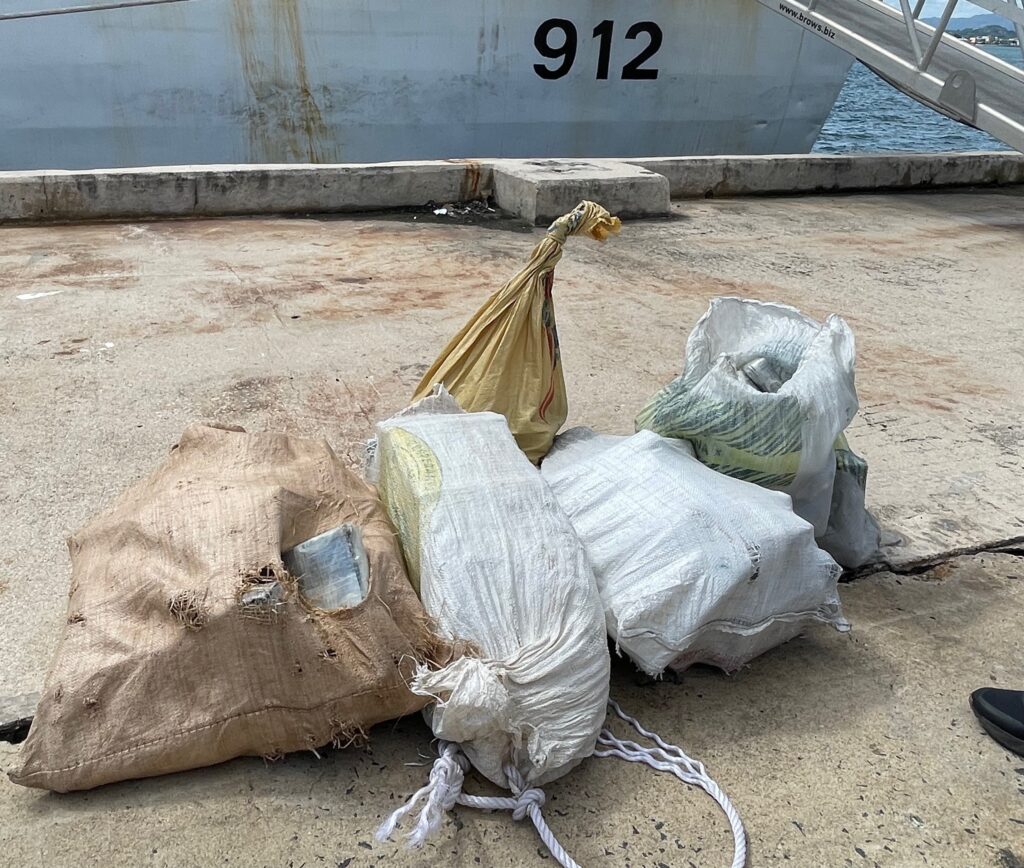
The Coast Guard offloaded 330 pounds of seized cocaine and transferred custody of eights suspected smugglers to Caribbean Corridor Strike Force agents in San Juan, Puerto Rico Aug. 24. U.S. COAST GUARD

SAN JUAN, Puerto Rico — The crew of the Coast Guard Cutter Legare and Caribbean Corridor Strike Force agents offloaded 330 pounds of seized cocaine Aug. 24 in San Juan, following the interdiction of a smuggling vessel near Puerto Rico, the Coast Guard 7th District said Aug. 25. 

The eight men apprehended in this case claimed to be Dominican Republic nationals and are facing federal prosecution in Puerto Rico. The seized contraband has an estimated wholesale value of approximately $3.1 million. 

Special Agents supporting the Caribbean Corridor Strike Force are leading the investigation into this case. The apprehended smugglers are facing federal prosecution in Puerto Rico on drug smuggling criminal charges of conspiracy to possess with intent to distribute a controlled substance aboard a vessel subject to the jurisdiction of the United States. The charges carry a minimum sentence of 10 years imprisonment and a maximum sentence of imprisonment for life.  

During the late night hours of Aug. 16, the aircrew of a Customs and Border Protection Air and Marine multi-role enforcement aircraft detected a 25-foot suspect vessel north of Isabela, Puerto Rico. During the interdiction, the smugglers jettisoned multiple bales of suspected contraband into the water. The Coast Guard Cutter Joseph Doyle stopped the suspect vessel, apprehended eight men and recovered five bales of the jettisoned cargo. 

“This interdiction is an example of how successful interagency cooperation can be through the use of our collective resources,” said Lt. Cmdr. Charles Wilson, cutter Joseph Doyle commanding officer. “Customs and Border Protection Caribbean Air Marine Branch and the Coast Guard worked seamlessly to detect and interdict this suspected narcotics trafficking operation before it reached the shores of Puerto Rico.”  

The seized contraband and the apprehended men were transferred to the cutter Legare for their final transport to Puerto Rico.


DARPA’s NOMARS Program to Build, Test, Demonstrate First Unmanned Ship 

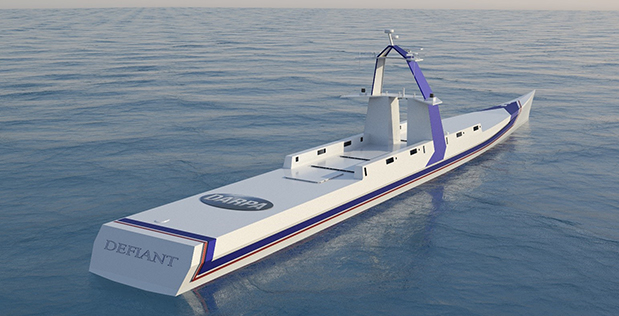
A concept design for the NOMARS Defiant unmanned ship. DARPA

ARLINGTON, Va. — DARPA is moving into Phase 2 of the No Manning Required Ship (NOMARS) program, which seeks to build and demonstrate a revolutionary new medium unmanned surface vessel that can go to sea and perform missions with unprecedented reliability and availability, while carrying a significant payload, the agency said Aug. 22. DARPA selected Serco Inc.’s design to move forward at the conclusion of Phase 1. 

NOMARS took a clean-sheet approach to ship design, holding to the requirement there will never be a human on board the vessel while it is at sea, including during underway replenishment events. By eliminating all constraints and requirements associated with humans, NOMARS opened up the design space to novel ship configurations and capabilities that could never be considered for crewed vessels. 

NOMARS is also pushing the boundaries on ship reliability. Because there is no crew on board to perform maintenance, NOMARS required new approaches for power generation, propulsion, machinery line-up, and control schemes to ensure continuous functionality throughout a long mission in all weather, temperature, and sea states. 

“NOMARS plans to demonstrate a next-generation completely unmanned ship that will enable entirely new concepts of operations,” said Gregory Avicola, program manager in DARPA’s Tactical Technology Office. “We will enable methods of deploying and maintaining very large fleets of unmanned surface vessels that can serve as partners, across the globe, for the larger crewed combatants of the U.S. Navy.” 

In Phase 1, Serco developed a new Design Space Exploration toolset that can evaluate spaces with a variety of parameters and outputs millions of ship designs to meet a diverse set of performance objectives and constraints. Serco used their DSX tool to create a set of ship designs ranging from 170-270 metric tons, then refined those into a single ship for the preliminary design review, which the company dubbed Defiant. In Phase 2, Serco will finalize ship design, build the ship and work through a series of rigorous testing activities before taking it to sea for a three-month demonstration event.

Defiant will be the first of its kind. The 210-metric ton medium USV-class ship aims to maximize performance, reliability, and maintenance efficiency while still carrying significant payload at tactically useful ranges. The goal is to achieve ultra-reliability objectives by integrating distributed hybrid power generation, podded propulsors and high-capacity batteries.

A key philosophy of NOMARS is “graceful degradation,” which allows individual equipment to fail over time by having enough system-level redundancy to meet full system requirements at speeds of at least 15 knots after one year at sea. The major system components of the selected design are modularized, so repairs can be conducted with equipment typically found in yacht yards worldwide. This maintenance philosophy supports rapid turnaround, allowing the ships to spend a majority of their lifetime at sea performing missions.