USS Whidbey Island Decommissioned after Nearly 38 Years of Service 
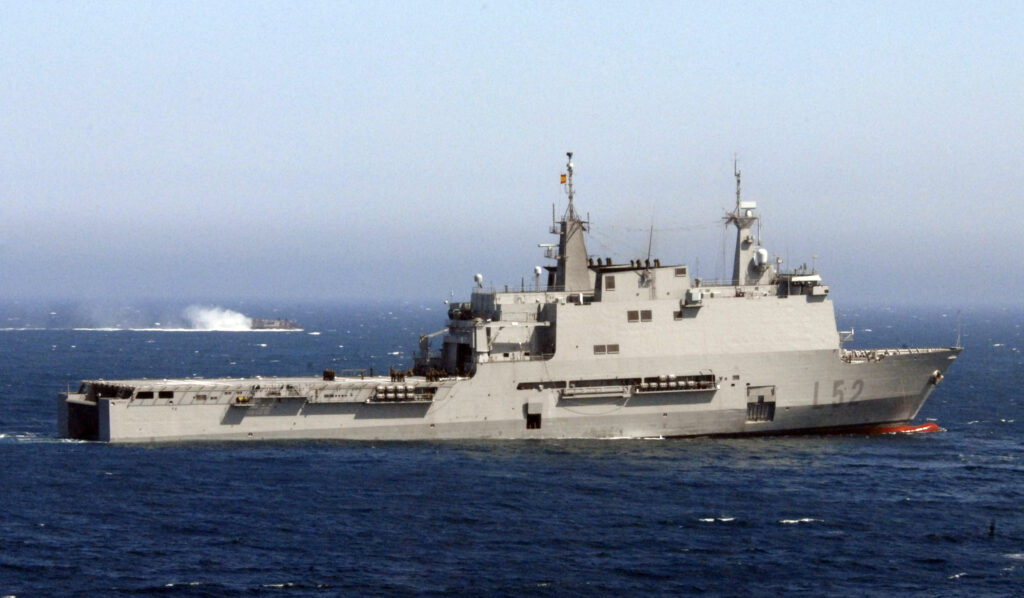
A landing craft air cushion from Assault Craft Unit 2, currently embarked aboard the amphibious assault ship USS Bataan (LHD 5), passes the Spanish landing platform dock Castilla (L-52), during a bilateral Spanish Amphibious Landing Exercise, June 21. U.S. NAVY / Petty Officer 1st Class Rachael L. Leslie

NORFOLK — Whidbey Island-class dock landing ship namesake, USS Whidbey Island (LSD 41) held a decommissioning ceremony at Joint Expeditionary Base Little Creek-Fort Story, Virginia, on July 22 before its inactivation next month, the Navy said in July 25 release. 

The ship’s decommissioning ceremony was held on the quay wall, alongside the moored USS Whidbey Island. The ceremony was attended by nine of her previous commanding officers and over 50 plankowners. “The last crew of Whidbey Island performed with great dignity and resiliency,” said Cmdr. Matt Phillips, the ship’s final commanding officer. “It’s been a privilege and an honor to lead this crew in executing her final mission.” 

Whidbey Island was commissioned Feb. 9, 1985, at Lockheed Shipyard in Seattle. The first ship in a class designed specifically to interface with the landing craft, air cushion, assisted in the operational and developmental testing of the amphibious assault craft from July to September 1985 and again in May and July 1986. 

Whidbey Island was the first amphibious ship from the East Coast to deploy to the European Theater with LCACs. In September and October 1989, it participated in Hurricane Hugo disaster relief operations in the Caribbean Sea. 

In August 1994, Whidbey Island rescued and transported over 8,100 Cuban migrants from the Straits of Florida during Operation Able Vigil and participated in the restoration of the legitimate government to Haiti during Operation Uphold Democracy. 

In June 2006, Whidbey Island deployed in support of Operation Enduring Freedom. While in-port Aqaba, Jordan in July of 2006, the ship was recalled through the Suez Canal to support contingency operations due to the crisis in Lebanon. Whidbey Island subsequently participated in the largest non-combatant evacuation conducted by the U.S. Navy since Vietnam. During July and August, the ship evacuated 817 American citizens via LCAC with personnel transport module. 

On Feb. 16, 2007, Whidbey Island was awarded the 2006 Battle “E” award. 

On June 24, 2016, USS Whidbey Island deployed from Joint Expeditionary Base Little Creek-Fort Story, for what would be its final deployment. It conducted eight Theater Security Port Visits, country visits vital to reassuring host nations of the commitment of the United States to their partnership. On July 21, 2016, USS Whidbey Island transited the Bosphorus Strait during a time of tension following the failed 2016 Turkish coup d’état attempt. 

Rear Adm. Tom Williams, commander, Expeditionary Strike Group (ESG) 2 presided over the ceremony, which included the remaining ship’s crew, several of its previous commanding officers, including the ship’s first commanding officer, Captain Pat Muldoon and many other special guests in attendance. 

“I am humbled to be with you on this bittersweet day as we gather here at Joint Expeditionary Base Little Creek – Fort Story to commemorate this ship’s near 38 years of commissioned service,” said Williams. 


HII’s Ingalls Shipbuilding Awarded DDG(X) Design Engineering Contract 

An aerial image of HII’s Ingalls Shipbuilding. Ingalls was awarded a design engineering contract from the Navy for the Next-Generation Guided-Missile Destroyer program. HII

PASCAGOULA, Miss. — HII’s Ingalls Shipbuilding division has been awarded a cost-plus-incentive-fee contract for engineering and design from the U.S. Navy for the next-generation guided-missile destroyer (DDG(X)) program, the company said July 22. 

“We are excited to continue on this path with our Navy and industry partners,” Ingalls Shipbuilding President Kari Wilkinson said. “It provides us a tremendous opportunity to bring best practices and innovation from our experienced engineering team to the design of this important future surface combatant.” 

Ingalls Shipbuilding is a major contractor and shipbuilding partner in the Arleigh Burke-class (DDG 51) program that has been in production for three decades. Arleigh Burke-class destroyers are multi-mission ships that can provide offensive and defensive capabilities, and can conduct a variety of operations, from peacetime presence and crisis management to sea control and power projection, all in support of the United States military strategy. 

DDG(X) will be the next generation large surface combatant for the U.S. Navy, and is being designed by a Navy-industry collaborative team consisting of the Navy and both large surface combatant shipbuilders. 


CNO Travels to RIMPAC, Meets with Exercise Participants  

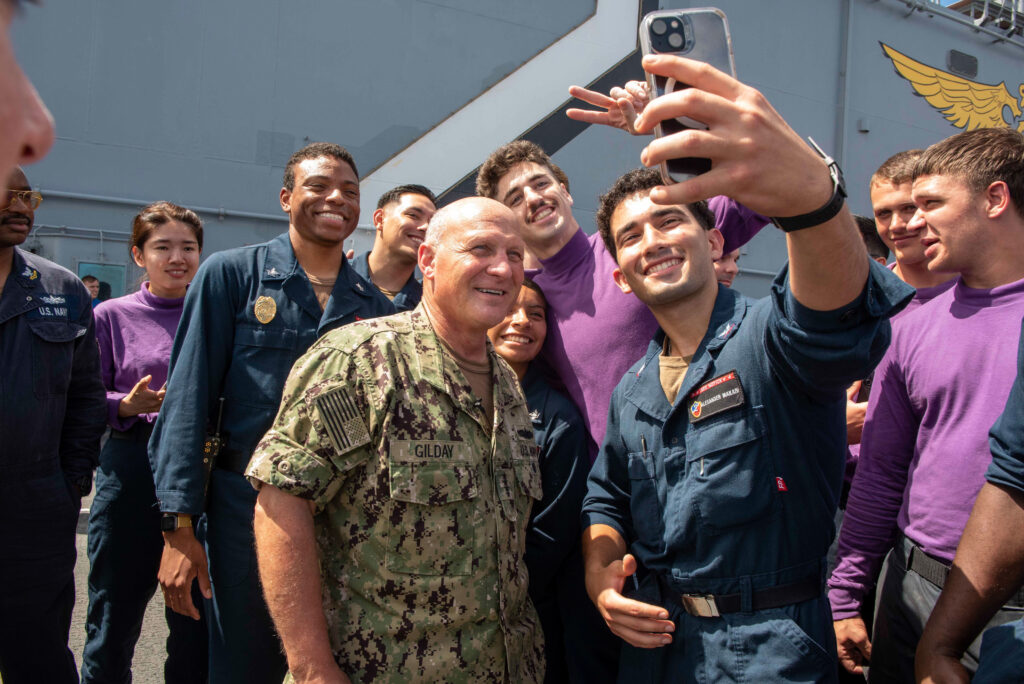
Chief of Naval Operations Adm. Mike Gilday meets with Sailors aboard the Wasp-class amphibious assault ship USS Essex (LHD 2) during Rim of the Pacific 2022, July 21. U.S. NAVY / Chief Mass Communication Specialist Amanda R. Gray

HONOLULU — Chief of Naval Operations Adm. Mike Gilday traveled to Hawaii June 20-23 to visit participants of the Rim of the Pacific Exercise, the CNO’s public affairs office said July 23.  

Gilday visited several U.S. and partner nation ships, where he spoke with Sailors and observed the ongoing exercise.    

“RIMPAC is the premier international maritime exercise and the largest multinational exercise,” Gilday said. “The complex warfighting exercise in this unique training environment across all combat domains strengthens our ability to work together, hone our skills and foster trust among nations.”   

“Building interchangeability among like-minded allies and partners demonstrates our solidarity, RIMPAC truly demonstrates the value of maritime partnership,” he said.   

While on Oahu, Gilday met with U.S. Indo-Pacific Commander Adm. John Aquilino and U.S. 3rd Fleet and RIMPAC 2022 Commander Vice Adm. Michael Boyle.  

Gilday also spent multiple days underway aboard ships participating in the exercise. He visited USS Essex (LHD 2), USS Abraham Lincoln (CVN 72), Japan Maritime Self-Defense Force helicopter destroyer JS Izumo (DDH-183) and the Republic of Korea navy amphibious assault ship ROKS Marado (LPH 6112), to thank Sailors, meet with leadership and observe the exercise first-hand.   

Gilday met with Commander of Combined Task Force (CTF) 176, Republic of Korea Rear Adm. Sangmin An, when he was aboard Essex. Additionally, he met with vice commander of Combined Task Force for RIMPAC, Japan Maritime Self-Defense Force Rear Adm. Toshiyuki Hirata, while aboard the Izumo.  

“Complex combined operations drive readiness, build confidence, and enhance interoperability among a diverse and highly capable international team,” Gilday said. “We are joined in our commitment to maintaining a free and open Indo-Pacific.”    

Unmanned systems are being used in different ways from humanitarian assistance to high-end warfighting. This year, more than 30 experiments were planned using multiple unmanned platforms from U.S. and partner nations.    

“We need to continue to put ourselves in a position where we can scale and really make unmanned assets on, below and above the sea an important part of the fleet,” said Gilday. “Unmanned systems provide Sailors with cutting edge capability now and into the future. It’s no longer a luxury. It’s a necessity if we want to operate in a distributed manner.”   

In its 28th iteration, the biennial event is the world’s largest international maritime exercise, providing a unique training opportunity to foster and sustain cooperative relationships critical to ensuring security on the world’s oceans. Capabilities exercised during RIMPAC range from disaster relief and maritime security operations to sea control and complex warfighting.       

This was Gilday’s first time attending RIMPAC as CNO. 


Four Unmanned Surface Vessels Being Demonstrated in RIMPAC 

The large unmanned surface vessel Ranger transits the Pacific Ocean to participate in Exercise Rim of the Pacific (RIMPAC) 2022. U.S. NAVY / Mass Communication Specialist 1st Class Tyler R. Fraser

WASHINGTON, D.C. — Four prototype unmanned surface vessels are participating in the Rim of the Pacific 2022 exercise, known as RIMPAC, delivering warfighting capabilities and extending the reach of the manned U.S. fleet with fewer risks to the warfighter, Program Executive Office Unmanned and Small Combatants Public Affairs said July 22.

Though unmanned systems have participated in exercises before, the involvement of four different vehicles, operating both autonomously and by manned teams, is a major milestone.

The vessels — Seahawk, Sea Hunter, Nomad and Ranger — will execute a range of missions. The prototypes will work side-by-side with exercise participants, carrying payloads, providing intelligence, and most significantly, gathering data in a real-world environment to determine how they will function in the larger fleet.

The significance of the occasion is not lost on Navy Capt. Scot Searles, program manager of the Unmanned Maritime Systems (PMS 406) program office.

“The integration of autonomous USVs with manned combatants will give fleet commanders much-needed enhancements to maritime domain awareness, thereby increasing decision speed and lethality in surface warfare.” Searles said.

PMS 406, the office responsible for the participating RIMPAC prototypes, is a program office within the Program Executive Office, Unmanned and Small Combatants.

“While our prototyping efforts have grown and matured significantly in the last four years, their performance in the RIMPAC exercise marks another significant milestone in manned-unmanned teams.” Searles said.

The manned-unmanned team, in the case of RIMPAC, will include service members and civilians supporting the mission from various organizations all over the country.

The PMS 406 assets participating in RIMPAC are the Overlord unmanned surface vehicles, Nomad and Ranger, and the medium unmanned surface vehicles, Sea Hunter and Seahawk. Though primarily operated and maintained under the control of PMS 406, personnel from Unmanned Surface Vessel Division One within Surface Development Squadron One control much of the practical execution.

RIMPAC is the largest joint maritime exercise in the world. Lasting over five weeks and spanning massive areas in the Pacific Ocean, the exercise will include hundreds of ships, submarines and aircraft, along with over 25,000 personnel.

Brian Fitzpatrick, PMS 406 principal assistant program manager for unmanned surface vessels, said, “RIMPAC is an incredible opportunity to not only show that we can develop these vessels, but we’re also showing the Navy’s commitment to unmanned and manned teams.”


Austal USA Delivers the Future USS Santa Barbara to the U.S. Navy 

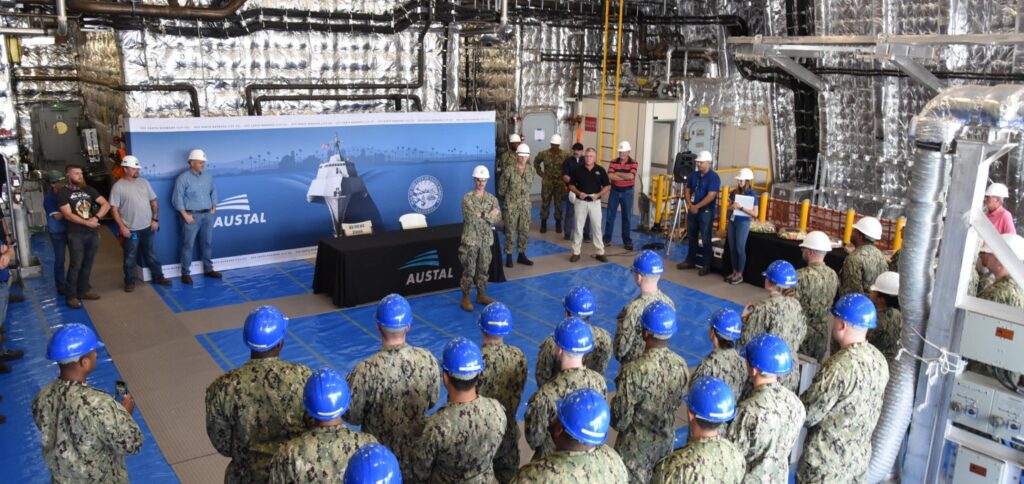
Austal USA delivered the future USS Santa Barbara (LCS 32) to the U.S. Navy on July 21. AUSTAL USA

MOBILE, Ala. — Austal USA delivered the future USS Santa Barbara (LCS 32) to the U.S. Navy on July 21, the company said July 22. LCS 32 is the 16th Independencevariant littoral combat ship delivered by the company. 

Delivery documents were signed on board the ship and followed the successful completion of acceptance trials during which the ship’s major systems and equipment were tested to demonstrate mission readiness. The ship’s pre-commissioning unit will now prepare the ship for fleet introduction. 

“Delivering the future USS Santa Barbara is a proud moment for Austal USA shipbuilders who worked extensively with Navy teammates and suppliers from across the nation to produce a capability that will serve our country for years to come,” said Rusty Murdaugh, president of Austal USA. “The fact that we’re delivering that capability on time and on schedule demonstrates our commitment to the warfighter and our nation’s defense.” 

LCS are built to operate in near-shore environments and support forward presence, maritime security, sea control and deterrence missions. Several Austal USA built Independence-variant LCS have deployed to the western Pacific within the last year including USS Jackson (LCS 6), USS Tulsa (LCS 16) and USS Charleston (LCS 18). 

Austal USA is currently constructing three LCS including the recently launched future USS Augusta (LCS 34). Final assembly is underway on the future USS Kingsville (LCS 36) and modules are under construction for the future USS Pierre (LCS 38). 


Navy F/A-18 Launches AARGM-ER for Third Live-Fire Test 

Northrop Grumman’s Advanced Anti-Radiation Guided Missile Extended Range (AARGM-ER) is launched from a U.S. Navy F/A-18 Super Hornet. U.S. NAVY

LOS ANGELES — Northrop Grumman Corp. successfully completed the third live fire test of its AGM-88G Advanced Anti-Radiation Guided Missile Extended Range (AARGM-ER), the company said July 21.

The U.S. Navy launched the missile from an F/A-18 Super Hornet aircraft recently at the Point Mugu Sea Range off the coast of California. Utilizing its advanced emitter acquisition system, the missile detected a land-based threat and engaged the threat system. 

“The Navy requirement for AARGM-ER is now,” said Captain A.C. Dutko, Navy program manager for Direct and Time Sensitive Strike (PMA-242). “AARGM-ER performed as expected and detected, identified, located and engaged a land-based air defense radar system. The continued success of our developmental testing moves the program closer to fielding and providing the aircrews with the protection they need to remain ahead of adversary threats.” 

Since achieving a Milestone C Decision in September 2021, AARGM-ER prime contractor Northrop Grumman has continued to lead its industry team in timely development of critically needed warfighting capability. LRIP Lot 1 AARGM-ER missiles are currently in-production to support initial operational capability fielding. LRIP Lot 2 missiles, under contract, will further augment the inventory in the fleet. 

AARGM-ER is being integrated on the Navy F/A-18E/F Super Hornet and EA-18G Growler aircraft as well as the F-35 aircraft. 


State Dept. Approves Possible Sale of JASSM-ER Missiles to Australia 

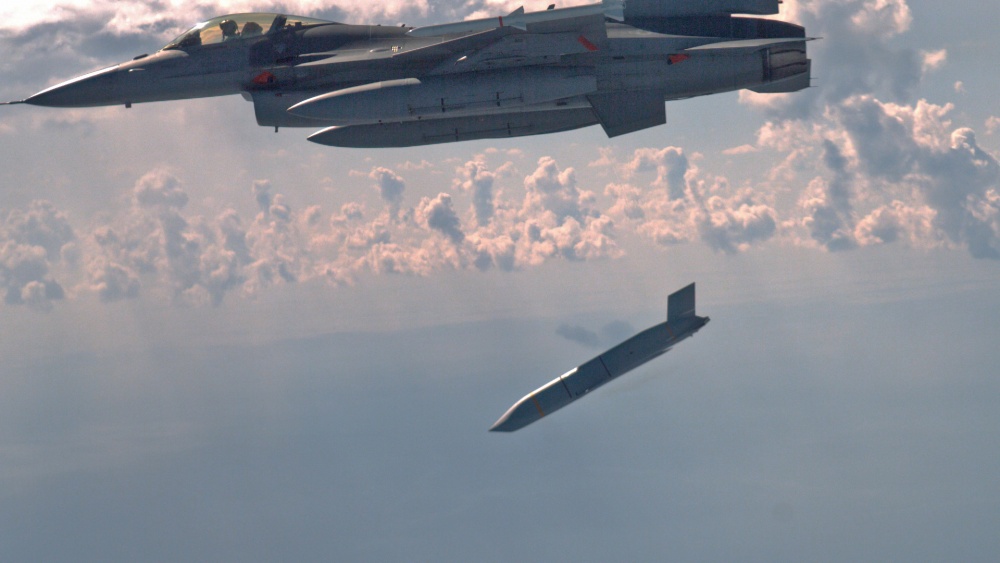
Maj. Jacob Rohrbach, a pilot assigned to the 40th Flight Test Squadron at Eglin Air Force Base, Florida, releases the first Joint Air-to-Surface Standoff Missile – Extended Range from an F-16 over the Gulf of Mexico on Sept. 19, 2018. U.S. AIR FORCE / Master Sgt. Michael Jackson

WASHINGTON — The State Department has approved a possible Foreign Military Sale to the government of Australia of Joint Air-to-Surface Standoff Missiles – Extended Range (JASSM ER) and related equipment for an estimated cost of $235 million, the Defense Security Cooperation Agency said July 21.  

Australia has requested 80 JASSM ERs (AGM-158B with telemetry kits and/or AGM-158B-2 configurations).   

“Also included are missile containers and support equipment; JASSM training missiles; weapon system support; spare parts, consumables, accessories, and repair/return support; integration and test support and equipment; personnel training; software delivery and support; classified and unclassified publications and technical documentation; transportation; U.S. government and contractor engineering, technical and logistics support services, studies and surveys; and other related elements of logistical and program support,” the release said.   

“The proposed sale will improve Australia’s capability to meet current and future threats by providing advanced, long-range strike systems for employment from Royal Australian Air Force air platforms including, but not limited to, the F/A-18F Super Hornet and F-35A Lightning II,” the announcement said.   

The principal contractor will be Lockheed Martin, Orlando, Florida. 


New Zealand’s First Boeing P-8A Poseidon Rolls Out of Paint Shop 

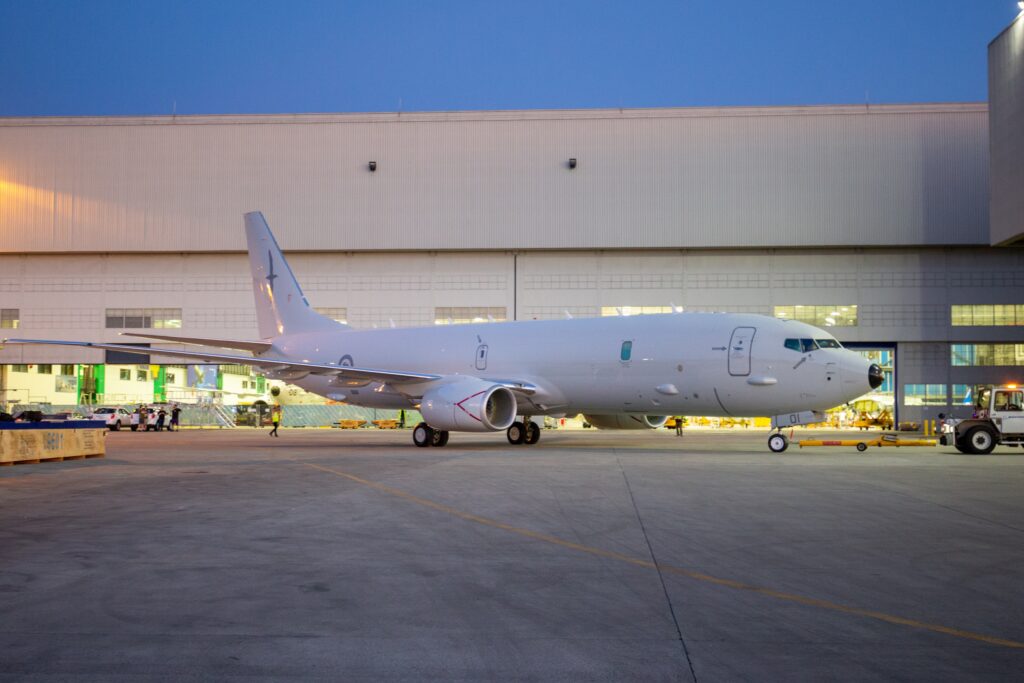
Boeing debuted the first P-8A Poseidon aircraft for New Zealand on July 21. BOEING

RENTON, Wash. — Boeing debuted on July 21 the first P-8A Poseidon aircraft for New Zealand in its Royal New Zealand Air Force livery, the company said in a release. New Zealand is one of eight nations to have acquired the P-8 as their new multi-mission maritime patrol aircraft.  

“The aircraft features the iconic Kiwi roundel, a native bird to New Zealand,” said Sheena Vince Cruz, Boeing P-8 Asia-Pacific region program manager. “Although flightless, the Kiwi bird is recognizable and will continue ‘flying’ as a symbol on the P-8A for decades to come.” 

The New Zealand government purchased four Boeing P-8A Poseidon maritime patrol and reconnaissance aircraft that will eventually replace the current fleet of six aging P-3K2 Orion aircraft. The P-8As will provide advanced capabilities to maintain situational awareness in neighboring waters on and below the surface of the ocean. 

First flight is scheduled in the coming weeks followed by mission systems installation. The aircraft is scheduled to be delivered to the New Zealand Ministry of Defence later this year. 


Coast Guard Cutter Seneca Returns to Homeport Following 54-Day Patrol 

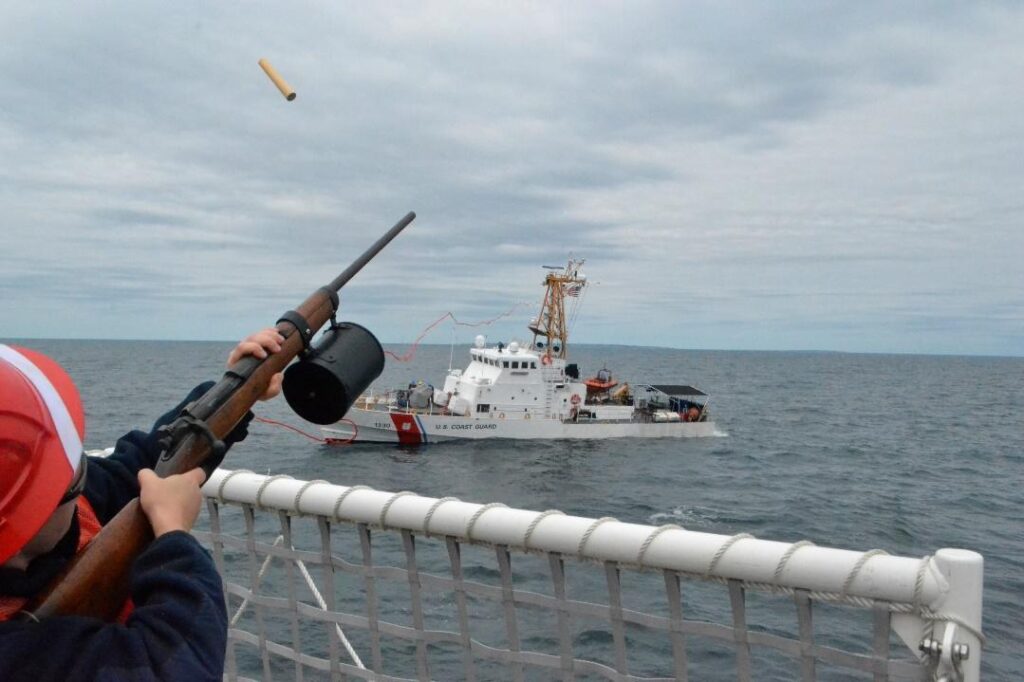
Petty Officer 3rd Class Vincent Isaiah Pangelinan, a Gunner’s Mate aboard Coast Guard Cutter Seneca, fires the messenger line to pass the towing line to CGC Tybee during a towing evolution off the coast of Massachusetts. A messenger line is used to assist in heaving the mooring to the shore or to another ship. U.S. COAST GUARD / Petty Officer 2nd Class Kyle Miller

PORTSMOUTH, Va. — The USCGC Seneca (WMEC 906) returned to homeport in Portsmouth July 21 after a 54-day deployment in the North Atlantic Ocean, the Coast Guard 5th District said July 22. 

The Seneca crew supported the U.S. Coast Guard 1st District as they conducted a series of commercial fishing vessel boardings from New York to Maine to ensure compliance with federal safety, fisheries, and environmental regulations. The boardings conducted by Seneca’s crew resulted in 17 notices of violation and two voyage terminations.  

“This rewarding patrol showcased the devotion and hard work of an amazing crew,” said Cmdr. James F. McCormack, commanding officer of Seneca. “The crew exhibited selfless service during a high-tempo patrol. The 53 boardings promoted safety at sea and sustainability of marine life for generations to come. Our presence strengthens trust between the Coast Guard and the fishing fleet, while setting the standard for Coast Guard operations in the North Atlantic Ocean.” 

Additionally, the Seneca’s crew responded to seven search and rescue cases, three of which resulted in lives saved or assisted.  

During one of the search and rescue cases, the crew of Seneca worked in partnership with a Coast Guard Air Station Cape Cod MH-60T helicopter crew to medically evacuate two critically injured people from a sailing vessel 350 nautical miles offshore. The Seneca crew also rescued the two remaining stranded sailors.  

During a second search and rescue case, the cutter crew rendered assistance and towed a disabled fishing vessel 70 miles.

The Seneca is a 270-foot medium-endurance cutter homeported in Portsmouth with 100 crew members. The cutter’s primary missions include search and rescue, living marine resources, illegal drug interdictions, counter narcotics, migrant interdictions, ensuring the safety of life at sea and enforcing international and domestic maritime laws in both the Atlantic and Pacific Oceans. 


MARTAC Demonstrates Surveillance Potential of USVs for U.S. Navy

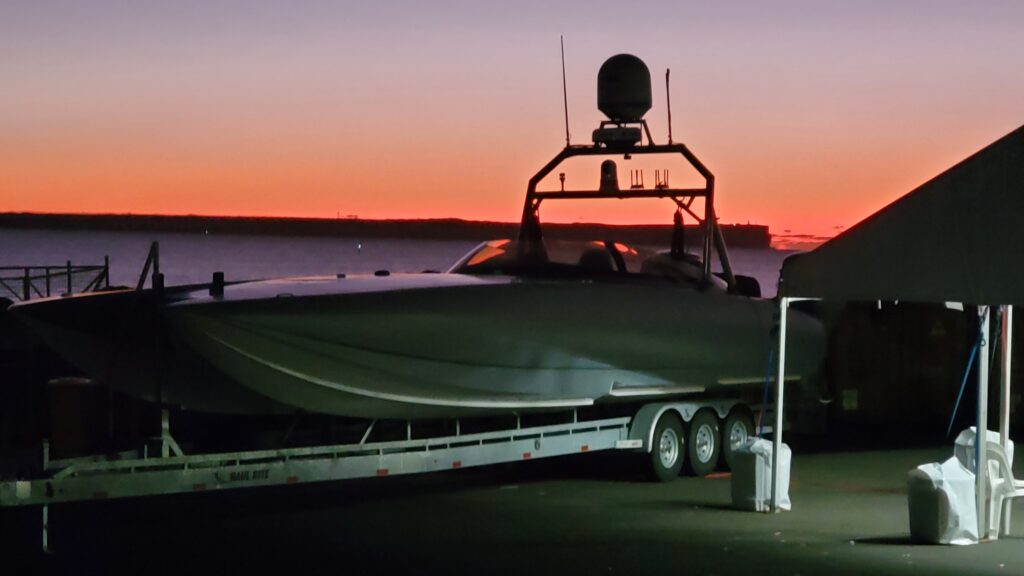
A Maritime Tactical Systems unmanned surface vessel used in Autonomous Warrior 22 in Australia. MARTAC

ARLINGTON, Va. — A family of high-speed unmanned surface vehicles has been getting a lot of play in naval exercises over the last year, helping the U.S. Navy to determine future requirements for USVs in roles such as maritime domain awareness.

Maritime Tactical Systems (MARTAC) operates a fleet of USVs the Navy has used in experimentation in such areas as the U.S. Naval Forces Central Command region and Australia.

The MARTAC USVs are contractor-owned and contractor operated. The small, fast craft can be operated in any weather. They are equipped with a forward-looking infrared sensor and can be fitted with various other sensors as the mission demands, such as signals intelligence sensors and sonars.

The missions being performed this summer require the MARTAC craft to be “a remote surveillance platform that can get places quickly and hang out for extended periods of time with high-res cameras,” said Bruce Hanson, CEO of MARTAC, a company based in Melbourne, Florida.

Hanson told Seapower that MARTAC’s USV’s participated in several demonstrations in International Maritime Exercise 22 under the control of Task Force 59, the U.S. 5th Fleet’s task force for experimentation of unmanned systems. The USVs also participated in Autonomous Warrior 22 in Australia.

“We’re too small, too dumb to realize what we can’t do, so we did a lot of stuff that people said we really couldn’t do, then we’re pretty successful at it, so some people are going to realize that these things operate pretty well,” Hanson said. “There are no going to replace people, but they are going to augment and enhance capabilities by a lot.” 

Hanson said the company’s Devil Ray USV has extended persistence and would be a good partner with Saildrone’s USVs, which also have operated with Task Force 59. With its high speed, the Devil Ray can intercept a contact detected by a Saildrone.

The Devil Ray “can also protect the Saildrone,” Hanson said. “We can do things like picket lines …  [and] non-lethal interdiction.”

He said the ranges on MARTAC’s USVs is greater than 1,000 nautical miles. MARTAC has sent its USVs, which are designed to be autonomous but can be optionally manned, on autonomous runs from Florida to the Bahamas and back.

The USVs can be shut down remotely and reactivated on command. Hanson said during Autonomous Warrior the company demonstrated the autonomous “launch and recovery of a T-12 USV off of the back of a T-38 USV.” He said the boats work very well in swarms or groups.

MARTACs family of USVs include the man-portable Manta series — 12 feet or less — which are battery and solar electric-powered. The Devil Ray series is 24+ feet long and can be diesel-or gasoline-powered. The company is working on hybrid versions, including fuel cells for power, which give exceptional range.

The various MARTAC craft have a high degree of component interchangeability, Hanson said. They are payload agnostic. They can be operated by different control systems with the flick of a switch, enabling the same craft to be operated by different nation’s navies.

Hanson said the MARTAC USVs will be participating in future large-scale exercises, including one in 2023.