Boeing, U.S. Navy Demonstrate Manned-Unmanned Teaming with Super Hornet
A Block III F/A-18 Super Hornet takes off from Lambert International Airport in St. Louis. As the most advanced Super Hornet ever built, the Block III is equipped to run the app-based solutions of the future. BOEING
ST. LOUIS — Boeing and the U.S. Navy have completed a series of manned-unmanned teaming (MUM-T) flight tests in which a Block III F/A-18 Super Hornet successfully demonstrated command and control of three unmanned aerial vehicles, the company said July 15.
Boeing system engineers connected Block III’s adjunct processor, known as the Distributed Targeting Processor – Networked (DTP-N), with a third-party tablet to team with the UAVs. Boeing developed new software loads for the DTP-N specific to running the third-party tablet and transmitting commands. The software development, tablet connection to the fighter and all flight tests were completed in less than six months.
“Block III Super Hornet is executing on its guarantee of hardware — installed today — that is ready to receive the software of the future,” said Ben LeGrand, Boeing director of Mission Systems. “Block III Super Hornet will integrate third-party systems and software with minimal modifications.”
Boeing partnered with the F/A-18 & EA-18G Program Office (PMA-265), Air Test and Evaluation Squadrons 23 and 31, Naval Air Warfare Center-Weapons Division at China Lake, California, and a third-party vendor on the demonstration. During the test flights, F/A-18 pilots entered commands into the tablet, which were processed and transmitted through Block III’s hardware. The UAVs executed all commands given by F/A-18 pilots during tests over a two-week period.
“This successful MUM-T demonstration represents a significant step toward the Navy’s vision for distributed maritime operations. It highlights the potential of unmanned concepts to expand and extend the Navy’s reach,” said Scott Dickson, Boeing’s director for Multi-Domain Integration. “As part of a Joint All-Domain Command and Control network, teams of UAV conducting ISR missions led by the latest Super Hornets equipped with network-enabled data fusion and advanced capabilities would provide warfighters across the Joint Force with significant information advantage.”
“Future fighter pilots will be the quarterback of the skies, orchestrating commands and controlling UAVs from the integrated Block III touch-screen cockpit,” said Mark Sears, Boeing vice president and program manager of F/A-18, EA-18G programs. “Block III Super Hornet is the bridge to the future and is a risk reducer for the Navy that is delivering on teaming, networking and interoperability now.”
Sikorsky Delivers Third Production CH-53K To U.S. Marine Corps
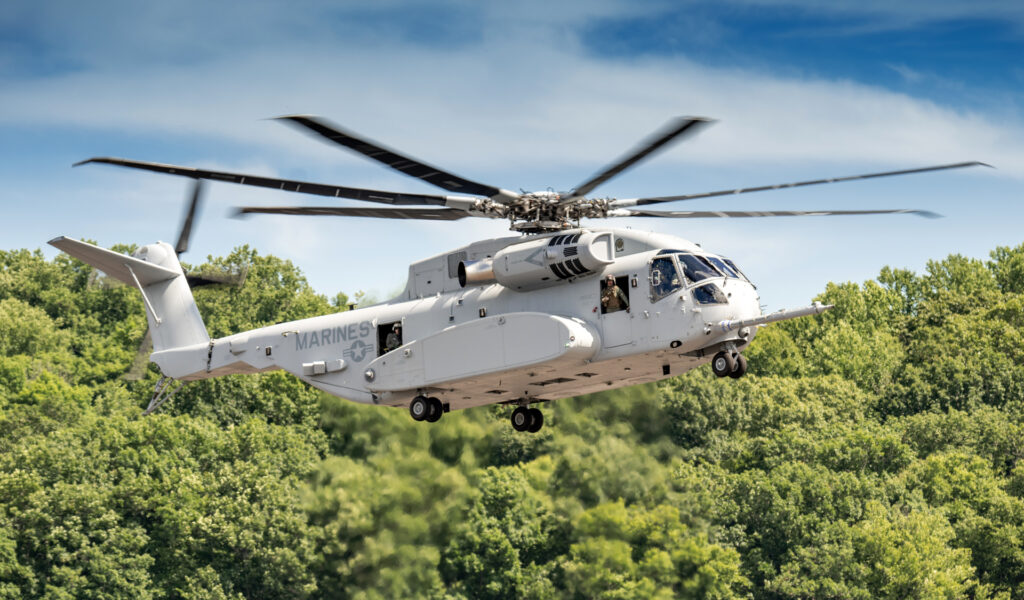
Sikorsky delivered a seventh CH-53K Helicopter to the U.S. Marine Corps. The heavy lift helicopter will be based at Marine Corps Air Station New River in Jacksonville, North Carolina. SIKORSKY
STRATFORD, Conn. — Sikorsky, a Lockheed Martin company, delivered the third low-rate initial production CH-53K King Stallion helicopter ahead of contract schedule to the U.S. Marine Corps, the company said July 14.
This aircraft, built in Sikorsky’s digital factory, is the first CH-53K from the Lot 2 LRIP contract awarded by the U.S. Navy in 2019, and the seventh overall delivered to the fleet. The CH‑53K’s heavy-lift capabilities exceed all other U.S. Department of Defense rotary wing platforms and is the only heavy-lift helicopter that will remain in production through 2032 and beyond.
This CH-53K heavy lift helicopter joins the six in operation at Marine Corps Air Station New River in Jacksonville, North Carolina. The CH-53K is the only sea-based, long range, heavy lift helicopter in production and will immediately provide three times the lift capability of its predecessor.
“This Connecticut-built CH-53K aircraft is a credit to our employees and their skills embracing digital tools and other advanced technologies to continue the Sikorsky legacy of building modern, safe, reliable rotorcraft. Our nationwide supply chain supports the active production line as we prepare to deliver two more CH-53K helicopters later this year,” said Bill Falk, director, Sikorsky CH-53K program. “We look forward to continuing our progress toward next year’s full rate production decision.”
The CH-53K helicopter was born in a digital environment, and now its digital thread connects design, manufacturing, training, and sustainment teams. This network, that includes everything from work instructions to maintenance manuals, is based on the helicopter’s single, continuous data thread that stays consistent from initial design all the way through sustainment. Today, all of Sikorsky’s aircraft programs are born in a digital environment. The power of this digital thread drives affordability, producibility and reliability across the aircraft lifecycle.
Earlier this year Sikorsky secured a contract to build 12 CH-53K heavy lift helicopters for Israel under a U.S. Navy Foreign Military Sales agreement.
The signed letter of offer and acceptance between the U.S. government and Israel states first deliveries of the baseline aircraft are planned for 2025.
The CH-53K helicopters will replace the Israeli Air Force fleet of modified CH-53D Yasur helicopters, which have been in Israel’s inventory for over 50 years.
Marine I-CsUAS Works to Defend Against Drones
Program Executive Officer Land Systems recently started fielding the Installation-Counter small Unmanned Aircraft Systems, depicted in this simulated graphic, to select Marine Corps installations. U.S. MARINE CORPS / Andrew Reynolds
MARINE CORPS BASE QUANTICO, Va. — The battle to keep Marines and their critical assets safe is constantly evolving. As technology advances, so does the need to field more cutting-edge equipment to counter threats, such as those posed by small unmanned aerial systems.
With these challenges in mind, Program Executive Officer Land Systems is fielding the Installation-Counter small Unmanned Aircraft Systems, the Marine Corps Systems Command Office of Public Affairs and Communication said July 14.
Known as I-CsUAS, the system is designed to protect Marine Corps installations by detecting, identifying, tracking and defeating small UAS.
“The Marine Corps, and DoD in general, required the capability to defend against SUAS years ago,” said Don Kelley, program manager for Ground-Based Air Defense at PEO Land Systems. “The threat of SUAS is only proliferating every day. The bottom line is, we need to provide this capability to our Marines as rapidly as possible.”
I-CsUAS features an integrated system equipped to carry out all phases necessary to counter small unmanned aerial systems such as commercially available drones, said Kelley. The system will primarily provide a service to ensure Marines or security forces have the capability to defend installations against sUAS at all times.
Maj. Kyle Yakopovich, fixed site project officer for Program Manager Ground Based Air Defense at PEO Land Systems, said I-CsUAS is intended to defeat commercial off the-shelf Group 1 and Group 2 UAS. I-CsUAS also provides detection, tracking and identification capabilities.
“What makes this system interesting is it fuses multiple modalities together into a single system,” Yakopovich said. “This allows us to more accurately detect, track and identify [small unmanned aircraft systems].”
Yakopovich said the program’s system is equipped with a few different components for better detection and ultimately, defense. The Long-Range Sentry Tower is comprised of a radar system and an optical sensor, and works in conjunction with a passive radio frequency detection capability to present the operator with a visual depiction of the threat’s flight path. While each of the towers’ sensor components are already widely in use, Yakopovich said I-CsUAS is special because it uses machine learning and artificial intelligence to constantly and autonomously analyze the sensor data faster and more accurately than a human operator. The system enhances the capability to detect, track, and identify the threat while reducing the amount of manpower previously required to perform these actions.
Yakopovich also said the I-CsUAS also has a separate non-kinetic defeat capability that has proven itself capable in other programs within PM GBAD. Using this capability, a Marine who has detected an intruding sUAS is able to disrupt the sUAS communication link. This enables Marines operating the LRST-42 or LSTR-82 tower will be able to determine the drone’s point of origin.
PM GBAD’s Fixed Site Product Manager Jessica McCauley said the Marine Corps plans to use this technology to defend critical assets, following the requirement set forth in Title 10 of the U.S. Code, which outlines the role and responsibilities of our nation’s armed forces.
“The I-CsUAS protects the facility by detecting, tracking identifying the drone and empowering law enforcement to defeat it,” McCauley said. “We are delivering a system to select installations, providing them the ability to conduct that kill chain in order to protect critical assets against small UAS threats.”
“These small commercial off-the-shelf drones — they’re everywhere,” Yakopovich said. “You can’t walk into a park without seeing them, and our enemies know how to use them. If you follow the news you can read articles about these drones being used as weapons of war in places like Ukraine, and those drones are capable of doing similar damage here at home. We’re delivering these systems to CONUS locations and defending certain assets aboard those installations that have been deemed critical to national security.
“Use your imagination of how much damage and chaos could be done by these small commercial off-the-shelf drones by attacking or otherwise harassing domestic Marine Corps installations. That’s why we’re doing this — to protect those assets and to enable the warfighter to do what the warfighter should be doing, which is keeping his focus oriented toward the enemy.”
Navy Rethinking ‘Full-Mission Capability’ Definition with F-35s in Distributed Ops, Whitesell Says
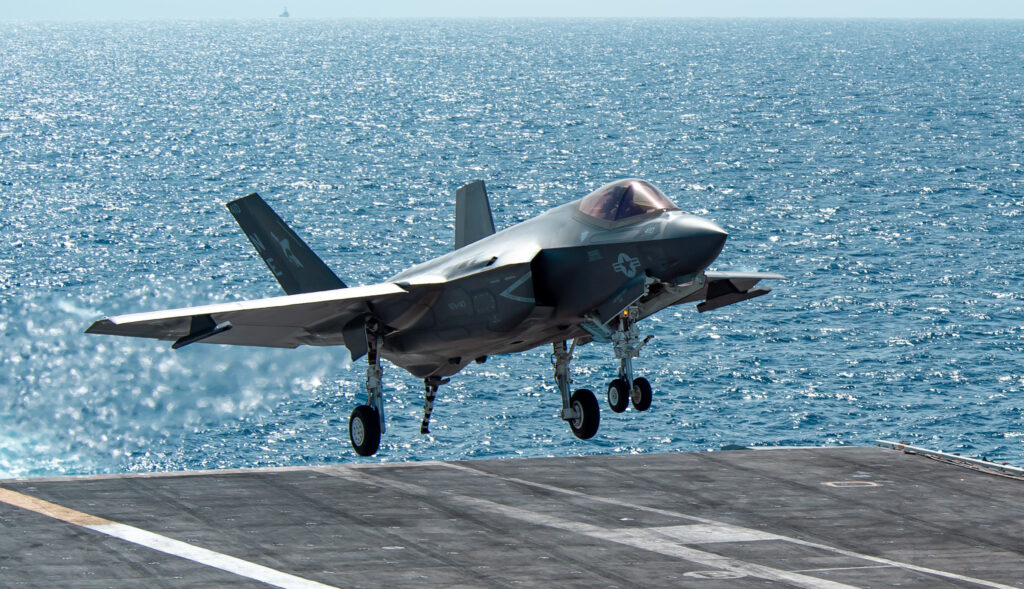
An F-35C Lightning II, assigned to the “Argonauts” of Strike Fighter Squadron 147 prepares to land on the flight deck of Nimitz-class aircraft carrier USS Carl Vinson (CVN 70) on June 17, 2021. U.S. NAVY / Mass Communication Specialist Seaman Caden Richmond
ARLINGTON Va. — The Navy’s “Air Boss” said fifth-generation strike fighters are redefining the concept of full mission capability and changing the way a four-plane division operates in distributed maritime operations.
Vice Adm. Kenneth Whitesell, commander, Naval Air Forces and commander, Naval Air Force, U.S. Pacific Fleet (the Air Boss), addressed the concept while speaking July 13 at a naval aviation seminar hosted by the Center for Strategic and International Studies and the U.S. Naval Institute and sponsored by HII.
Responding to a question from moderator Ward Carroll about the full-mission-capable rates of Navy F-35Cs during the 2021 deployment on board USS Carl Vinson, Whitesell said taking a “30,000-foot view of the way the [carrier] air wing is going to be employed is going to be completely different.”
“The air wing’s not going to be employed the same way [as before],” Whitesell said. “The F-35 is the perfect exemplar of that. The way we employ that platform. … There is no defensive and offensive combat spread [where] you break out into some of the traditional missions that we would have done five or 10 years ago. Employing the Joint Strike Fighter as they employed it as a [four-plane] division [was] definitely more spread out. The way information is shared amongst the platforms makes up for any deficits that an individual aircraft may have.
“The way we think of mission capability and full mission capability — we have to think about it in a distributed and in this case in a full division or greater employment mode through Distributed Maritime Ops,” the admiral said. “Fitting into the bigger vision of Distributed Maritime Ops, a single platform can have degradations, but because of the information sharing between the platforms, we have to think about how we’re going to define full mission capability, not platform-specific, but truly mission specific. It’s a different way of looking at things.”
Sev1Tech Proposes Solutions for Moving Navy Shipyards into the Digital Age
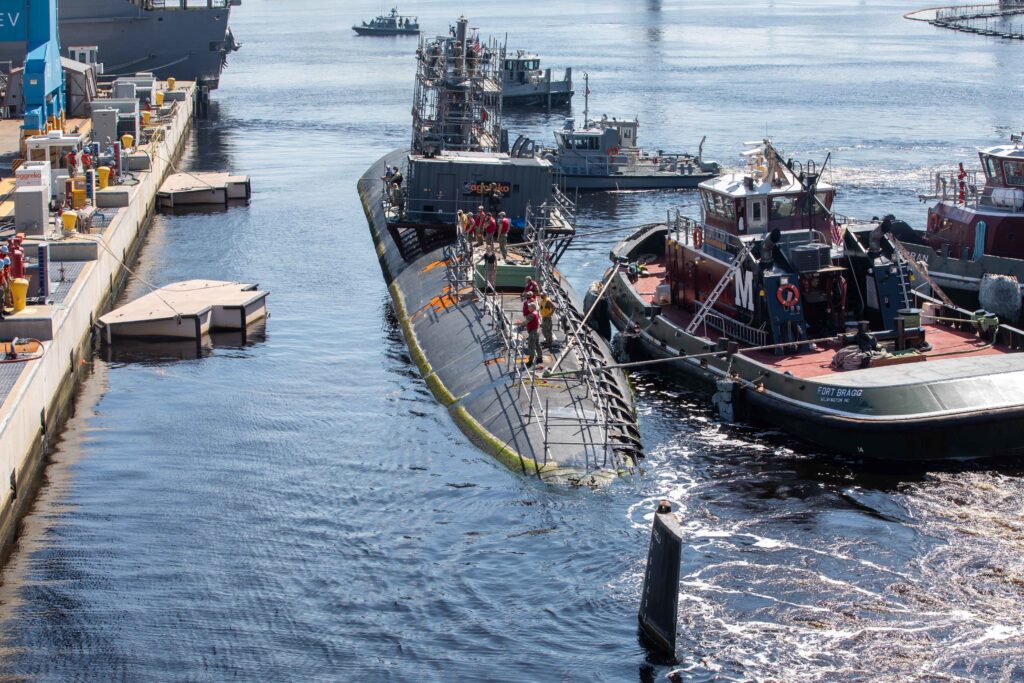
USS Pasadena (SSN 752) arriving at Norfolk Naval Shipyard in 2020 for a Drydocking Selected Restricted Availability. NORFOLK NAVAL SHIPYARD / Daniel DeAngelis
ARLINGTON, Va. — As the U.S. Navy makes a huge investment in upgrading and modernizing its four public shipyards, one company is proposing ideas to move shipyard processes from the Industrial Age to the Digital Age using digital information technology.
The Navy is investing more than $20 billion over 20 years to modernize its shipyards under the Shipyard Infrastructure Optimization Plan, or SIOP. Much of the effort involves modernizing century-old dry docks and other heavy infrastructure.
Patrick Fitzgerald, senior vice president for Navy Missions of Sev1Tech, is a former Naval Information Warfare Center Atlantic Enterprise Systems Department Head and a manager with a long background in information technology. He told Seapower his company is well positioned to contribute to the SIOP the digital transformation of the Industrial-Age processes of Navy shipyards and to “generate a really significant return on investment” and enable the shipyards to “get the ships out to the fleet when needed and fully ready to perform their mission.”
Fitzgerald said the SIOP is a “once-in-a-century thing that our country needs to safeguard itself. “Unfortunately, a lot of the federal government has not moved to the information age; it’s still very Industrial Age processing.”
Among the ideas Sev1Tech is floating is the use of augmented reality or virtual reality in training the shipyard workers. Fitzgerald said that technology makes for “much more effective training programs that improve knowledge retention.”
The workers “make fewer errors when they actually perform the maintenance. They can verify that a part is being installed in the correct space, [which] will help eliminate re-work for a variety of tasks.”
He also said applying data analytics would result in better parts-demand forecasting and help minimize issues with the global supply chain. Data analytics also would improve auditability, lower the warehousing complexity and costs and reduce or eliminate the time a ship waits for a part to arrive.
Digital twin modeling of the actual layout of the shipyard facilities as they evolve over time can improve shipyard processes.
“One we get that initial model set, you can start doing simulations on that for the evolving needs and the evolving capabilities,” Fitzgerald said. “It really optimized the layout for the workflow.”
Use of drones is one way to save time and improve productivity, he said.
“The walking that the folks at the four public shipyards do every day is absolutely insane,” Fitzgerald said. “At the end of the day you have to leave the security to get a part and then come back. That’s a lot of lost labor time not directly serving the mission and helping us get that ship out on time. Having the networks in place where a person working on a ship realizes they needed a part that they didn’t expect they needed — if it’s a lightweight part — a drone could potentially fly out a five-pound package to the edge of the ship so they don’t have to walk all the way across the base to get it from a warehouse.”
Fitzgerald pointed out that the Navy owns the airspace over its shipyards and therefore could set the policy of drome operations within the yard.
“We could save hours of an employee’s time every day walking back and forth to get parts or checklists,” he said. “That’s massive for what it could mean to getting a ship out of the shipyard on time and back to the fleet where it needs to be.”
He also advocates leveraging 5G and other wireless communications and use of tablets and other support devices.
With a tablet that can go classified when [a worker goes] into a classified space — and given access to the data and drawings they need dynamically, and as soon as they walk out of that space, no longer have access to that information. That would reduce the complexity of managing them, reduce the risk of that information getting compromised, and give them what the need at the right time when they need it,” he said.
“The investment in IT relative to the investment in the capital infrastructure is pretty small to get a really big yield,” Fitzgerald said.
Reservist’s Innovative Idea is a Winner in Navy Waypoints Contest
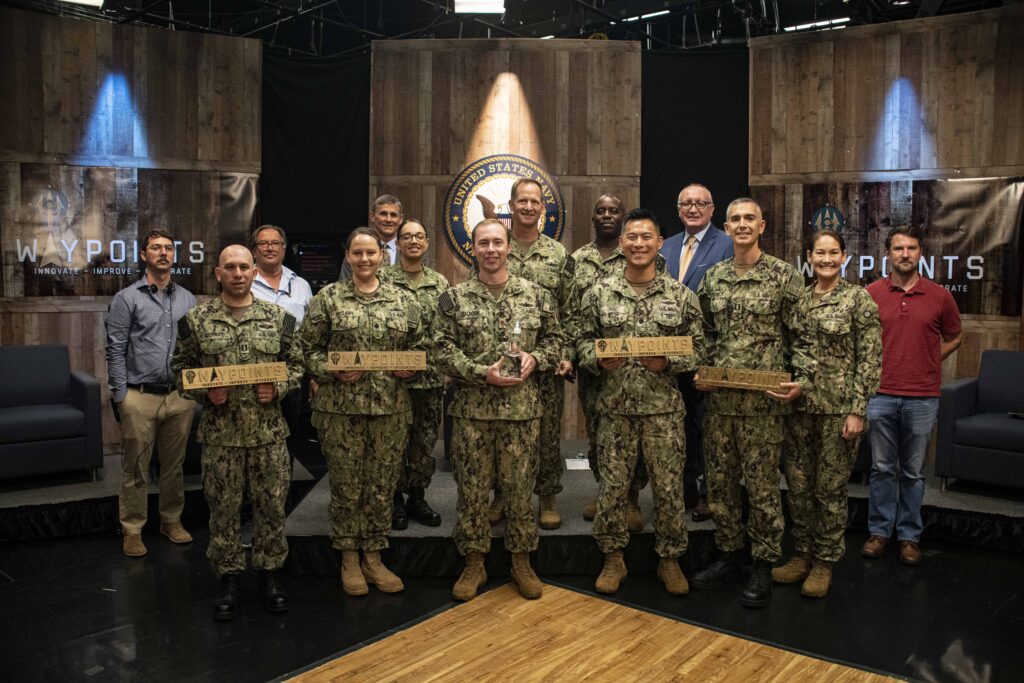
Lt. Cdr. Jonathan Calhoun (center) holds the i3 Waypoints trophy after Vice Adm. John Mustin (back row, middle) announced Calhoun’s “Leveraging Mobile Technology to Streamline Mobilization” as the winning entry of the inaugural i3 Waypoints. Calhoun is surrounded by the other final presenters (front row), the finalist panel and production staff (back row). U.S. NAVY / Chief Mass Communication Specialist Elisandro T. Diaz
FORT MEADE, Md. — A Navy Reservist’s innovative concept for adapting a mobile application to better enable mobilization is a winning idea.
Lt. Cdr. Jonathan Calhoun, a Selected Reserve member attached to U.S. Fleet Forces Command Maritime Operations Center (N3 FCC) in Norfolk, Virginia, submitted his entry, “Leveraging Mobile Technology to Streamline Mobilization,” as part of the “i3 Waypoints” effort to find new or better ways for the Navy Reserve to operate.
Vice Adm. John B. Mustin, chief of Navy Reserve and commander, Navy Reserve Force, announced the winning entry of the inaugural i3 Waypoints in a streaming broadcast on July 14.
Calhoun’s entry was one of 107 received and evaluated by a panel of judges.
Calhoun initially thought of his idea during a mobilization exercise where he realized shifting many of the mobilization requirements to a secure mobile platform would make the process faster and more efficient for both Sailors and Navy Reserve Center staff.
“Empowering Sailors to use their mobile device to complete a significant portion of pre-mobilization requirements will improve the overall experience for the modern-day Sailor and save critical time during mass mobilizations to get warfighting-ready Sailors on station faster,” said Calhoun.
Calhoun’s entry envisions a mobile application to reduce duplicative administrative requirements for both members and mobilization staff, save critical time by auto-populating data fields across multiple documents, provide real-time transparency and progress status for members and leadership throughout the process, and enable clear and customizable views and reports.
Additionally, the app could remove the difficulties some Reserve members have accessing Common Access Card-enabled sites outside an Navy/Marine Corps Internet environment and would “ensure our ability to mass mobilize, predictably, at scale, and with seamless administration activation workflows” as outlined in the Navy Reserve Fighting Instructions 2022.
“We are already moving out on the design for Lt. Cdr. Calhoun’s mobile application,” said Mustin. “His idea to add mobile technology to our distributed activation process helps us achieve our goal of mobilizing the entire Selected Reserve force of 50,000 in 30 days, if required.”
Mustin conceived of the i3 Waypoints program as an approach to “innovate something entirely new; improve on something already established; or integrate several ideas, products or processes rendering the former completely obsolete.”
The annual competition is designed to fast-track transformative ideas from across the Navy directly to the highest levels of the Navy Reserve, without filters or bureaucratic barriers.
The competition is open to anyone in the U.S. Navy–Selected Reserve, Training and Administration of the Reserve, Individual Ready Reserve, Active Duty and civilians, in all ranks, rates and grades.
Of the 107 entries received, five entries were subsequently chosen and presented to a panel hosted by Mustin, retired Vice Adm. Andrew “Woody” Lewis, Bruce E. Mosler, chairman, global brokerage of Cushman & Wakefield Inc., Navy Reserve Force Master Chief Tracy L. Hunt and 2021 Reserve Sailor of the Year Chief Yeoman (Select) Jasmyn Phinizy.
“The large number of creative, thoughtful strategic ideas submitted in a relatively short timeframe far exceeded our original expectations,” said Mustin. “It demonstrates our Reserve Force’s commitment to innovate, improve efficiencies, and reduce administrative burdens, allowing us to focus on warfighting readiness — our one and only priority. With such an enthusiastic response from the force, and so many great ideas to modernize the way we do business, we saw enough in this inaugural event to commit to making i3 Waypoints an annual program. Very little is more important to us than keeping the direct pipeline open for creative ideas to flow to top leadership without filter or disruption.”
The other i3 Waypoints finalists, and their winning ideas, are:
Lt. Brian Adornato, Naval Sea Systems Command, Surge Maintenance Sacramento: “Create a New Category of Personnel: Civilian Technicians”
Cdr. Bobby Hsu, Director of Navy Staff, Office of the Chief of Naval Operations: “Official Navy Reserve YouTube Channel”
Cdr. Sarah McGann, Navy Personnel Command (PERS-9), and Lt. Josh Didawick, Office of the Chief of Naval Operations for Manpower, Personnel, Training and Education: “New Policy for Reserve Retirement Education Across the Career Continuum”
Cdr. Scott Mericle, Navy Reserve Operations, Plans and Policy (N5), Commander, Second Fleet: “Improve Active to Reserve Transition.”
Analysts: Carrier Air Wings Need Sustained Extended Range to Counter China
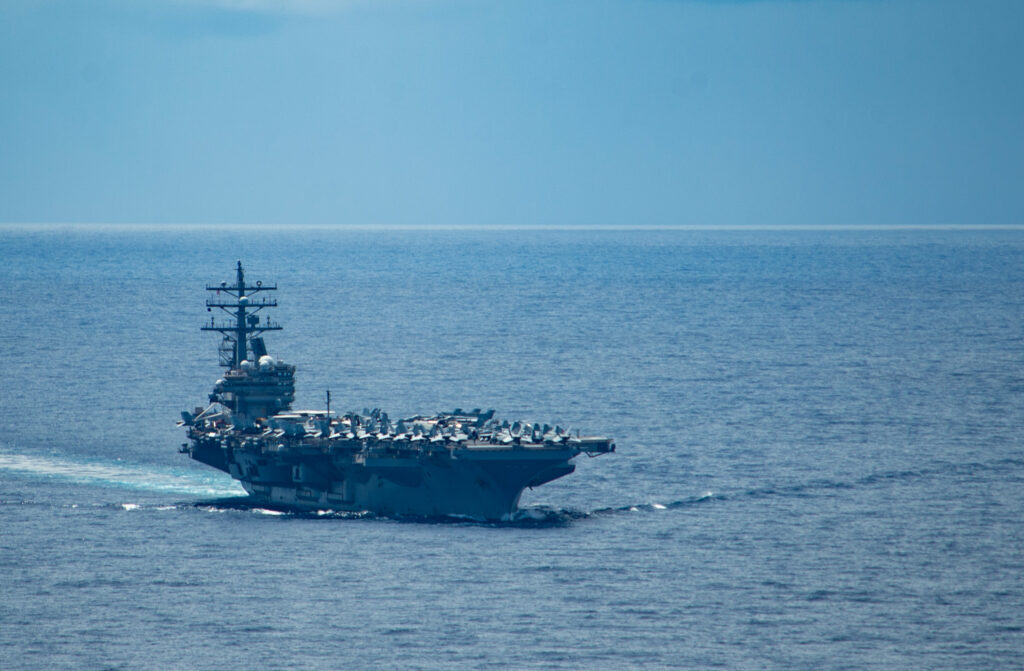
The U.S. Navy’s only forward-deployed aircraft carrier USS Ronald Reagan (CVN 76) steams through the Balabec Strait on July 12. Ronald Reagan, the flagship of Carrier Strike Group 5, provides a combat-ready force that protects and defends the United States, and supports alliances, partnerships and collective maritime interests in the Indo-Pacific region. U.S. NAVY / Mass Communication Specialist 2nd Class Askia Collins
WASHINGTON — The U.S. Navy’s carrier air wings lack some of the characteristics needed to counter China in the event of a conflict, two naval analysts said in a webinar.
Bryan Clark, senior fellow and director of the Center for Defense Concepts and Technology at the Hudson Institute, and Timothy Walton, a senior fellow at the center, discussed in a July 12 webinar their report “Regaining the High Ground Against China,” which presents their case that carrier strike groups are challenged by Chinese long-range missile threat and will need a longer-range carrier air wing to affect the battlespace.
The Chinese missile threat could force carrier strike groups to operate at ranges of 1,000 to 1,500 nautical miles away from China, reducing or negating the range with which carrier-based strike fighters could strike hostile forces, Clark said.
Clark noted that the carrier air wing is not set up for combat at sustained ranges and the U.S. Navy is “going to need some way to extend the range of the carrier air wing.”
The carrier air wing’s strike fighters, the F-35C Lightning II and the F/A-18E/F Super Hornet, need aerial refueling to operate at extended ranges. The forthcoming MQ-25A Stingray aerial refueling UAV will enhance the ranges of the strike fighters, relieve some Super Hornets from aerial refueling duties and provide a platform for sensors.
Fleet air defense also has become a capability demanding more attention in view of the Chinese missile threat. The F-14 Tomcat fighter and its Phoenix air-intercept missiles, designed during the Cold War to counter Soviet bombers carrying cruise missiles at long ranges, were retired from the fleet in 2006 and the F/A-18 and F-35 do not have a similar long reach. Clark said the CSG needs a layered defense.
“We need to regain the ability to attack bombers before they can launch their missiles,” Clark said.
He advocated the use of electronic warfare in a more offensive way, including the use of UAVs to confuse enemy defenses. This would involve shifting away from the EA-18G Growler electronic attack aircraft to long-range UAVs, even expendable ones.
The analyst said the Navy needs to change the way it conducts airborne early warning and intelligence, surveillance and reconnaissance. Possible platforms include the MQ-9 Reaper UAV, stratospheric balloons and satellites.
Clark said the P-8A Poseidon maritime patrol aircraft would need to keep away from enemy air defenses and shift from an anti-submarine search and attack role to one of command and control of unmanned platforms and distributed ASW sensors.
A pdf of “Regaining the High Ground Against China” can be found here.
Ronald Reagan Carrier Strike Group Operates in the South China Sea
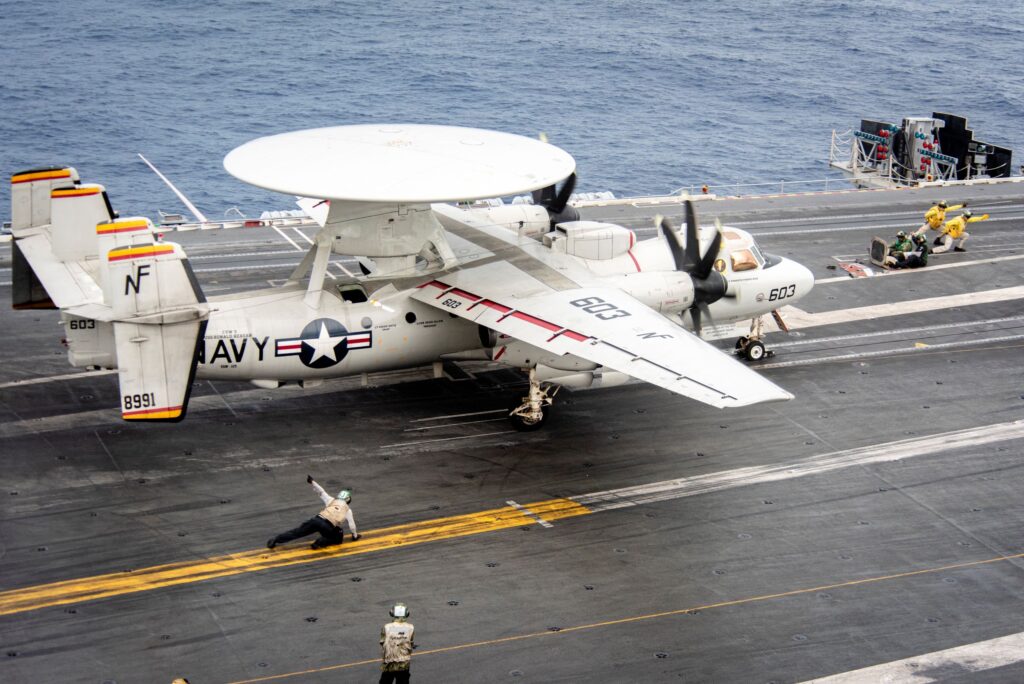
An E-2D Hawkeye attached to the “Tigertails” of Airborne Early Warning Squadron 125 prepares to take off from the flight deck of the USS Ronald Reagan (CVN 76). U.S. NAVY / U.S. Navy Mass Communication Specialist 2nd Class Markus Castaneda
SOUTH CHINA SEA — The Ronald Reagan Carrier Strike Group is operating in the South China Sea for the first time during its 2022 deployment, July 13, CTF 70/CSG 5 Public Affairs said in a release.
The carrier strike group includes the Navy’s only forward-deployed aircraft carrier USS Ronald Reagan (CVN 76), the embarked Carrier Air Wing 5, and embarked staffs of Task Force 70 and Destroyer Squadron 15, as well as the Ticonderoga-class guided-missile cruiser USS Antietam (CG 54) and the Arleigh Burke-class guided-missile destroyer USS Higgins (DDG 76).
While in the South China Sea, the strike group is conducting maritime security operations, which include flight operations with fixed and rotary-wing aircraft, maritime strike exercises, and coordinated tactical training between surface and air units. Carrier operations in the South China Sea are part of the U.S. Navy’s routine operations in the Indo-Pacific.
“Our strike group works consistently to stay capable and ready and we continue that focus during operations in the South China Sea to demonstrate our commitment to the region,” said Rear Adm. Michael Donnelly, commander, Task Force 70/Carrier Strike Group 5. “Building on the lessons and successes of exercises like Valiant Shield 2022, and our continuous opportunities to train and operate alongside allies and partners, we provide assured capability to uphold the rules-based international order in this body of water and anywhere else we will sail, fly and operate.”
Throughout the 2022 deployment, Ronald Reagan and accompanying units have routinely integrated with ally and partner naval forces to build high-end warfighting readiness through air defense, anti-submarine warfare, maritime strike, and force protection exercises. In early June this included operations with Republic of Korea navy ships for Carrier Strike Group Exercise 2022. Later that month in the Philippine Sea, the Sailors of CSG 5 worked with more than 200 aircraft and an estimated 13,000 personnel from the U.S. Navy, Air Force, Army, Marine Corps and Space Force during the Valiant Shield exercise, a U.S.-only, biennial field training exercise focused on integration of joint training in a multi-domain environment.
The strike group finished the month of June with a port visit to Guam, where Sailors were able to conduct several community relations events and enjoy recreation and tours across the island, marking the strike group’s first port visit since 2020.
“Our presence in the South China Sea demonstrates America’s commitment to a free and open Indo-Pacific,” said Capt. Fred Goldhammer, the commanding officer of USS Ronald Reagan. “Every Sailor onboard contributes to this important and enduring mission as we operate in this region, in accordance with international law to ensure that all nations can do the same.”
The Ronald Reagan Carrier Strike Group is forward-deployed to the U.S. 7th Fleet area of operations in support of a free and open Indo-Pacific region.
General Atomics EMALS, AAG Systems on CVN 78 Reach 10,000 ‘Cats and Traps’ Milestone
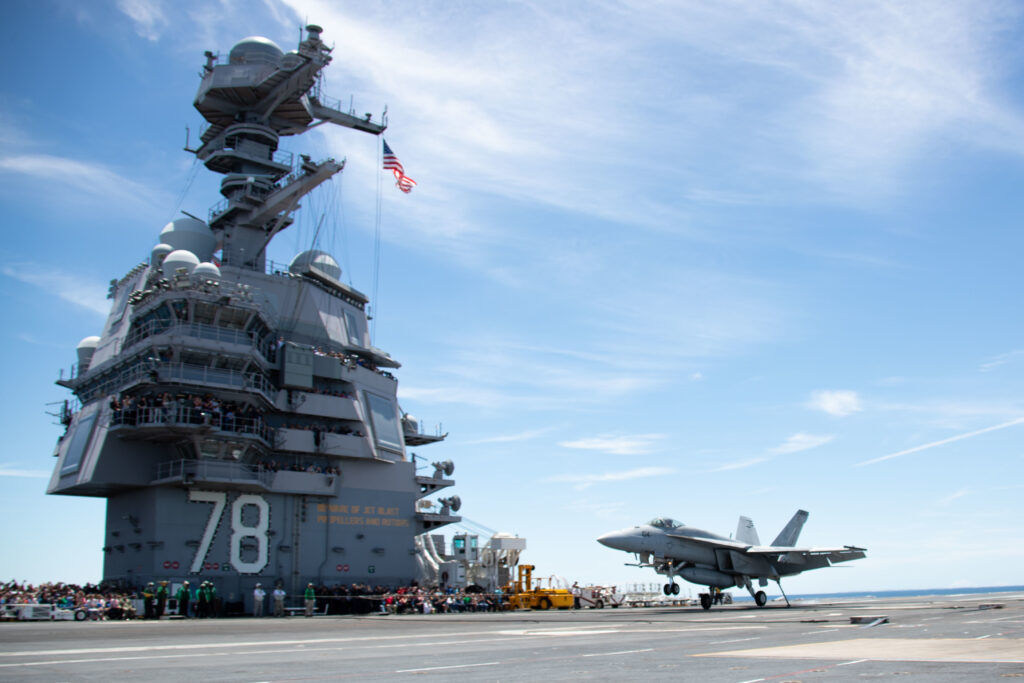
Sailors and their families and friends observe the USS Gerald R. Ford’s (CVN 78) 10,000th recovery from the flight deck, June 25. Friends and family members were invited aboard Ford to experience a day in the life of a Sailor at sea first-hand. U.S. NAVY / Mass Communications Specialist 2nd Class Jackson Adkins
SAN DIEGO — General Atomics Electromagnetic Systems announced July 12 that 10,000 catapult launches and arrested landings using the Electromagnetic Aircraft Launch System and Advanced Arresting Gear have been successfully and safely completed aboard USS Gerald R. Ford (CVN 78).
The first-in-class aircraft carrier completed planned incremental availability in March 2022 and is now preparing for its upcoming deployment.
“Over the past two years, EMALS and AAG have been rigorously exercised utilizing aircraft in the current air wing. The systems continue to perform successfully in operational, carrier qualification, and training environments and under all weather conditions,” said Scott Forney, president of GA-EMS. “EMALS and AAG offer robust capabilities that are proving transformative, providing greater availability, efficiency and flexibility to safely launch the air wing of today while standing ready to support new aircraft as they join the air wing of the future. We are extremely proud of our team and the ship’s crew as they continue to meet each new milestone and steadily work toward bringing ‘Warship 78’ to the fleet.”
Under multiple contracts with the Navy, General Atomics Electromagnetic Systems is now supporting CVN 78 sustainment requirements and delivering EMALS and AAG for the next two Ford-class carriers currently under construction, John F. Kennedy (CVN 79) and Enterprise (CVN 80). GA-EMS is also working with the Navy to determine EMALS and AAG contract and schedule requirements for the fourth Ford-class aircraft carrier,Doris Miller (CVN 81).
Fairbanks Morse Defense Launches Training and Service Center Campus
Fairbanks Morse Defense has invested $13 million to create a campus that expands service and hands-on training opportunities for technicians and customers. FAIRBANKS MORSE DEFENSE
BELOIT, Wis. — Fairbanks Morse Defense is launching a 45,000-square-foot training and service center campus in Chesapeake, Virginia.
The defense contractor will move its existing service center from Norfolk, Virginia, to the Chesapeake campus to add a state-of-the-art training facility and further expand advanced service support for its customers. The move represents a $13 million investment in the community.
“We are excited to have Fairbanks Morse Defense as the newest member of our business community,” said Rick West, mayor of Chesapeake. “The Hampton Roads region has a long and storied history in the defense industry and having Fairbanks Morse Defense locate its new state-of-the-art facility in the city of Chesapeake underscores the city’s commitment to our military and its partners. We look forward to working with Fairbanks Morse Defense as it continues to grow in Chesapeake.”
The company’s new training and service center campus, located at 733 Curtis Saunders Court, is near Norfolk, Virginia, the largest U.S. Navy and Military Sealift Command fleet concentration in the United States. The U.S. Coast Guard also has a strong presence in the area.
“Training is the forefront of good maintenance practices, and Fairbanks Morse Defense’s training center is incorporating our cutting-edge mixed reality training technology to provide the most comprehensive, interactive marine equipment training solution available,” said FMD President of Services Jamie McMullin. “This location will strengthen FMD’s position as the preferred service solutions and training provider for our core customers while enhancing our rigorous factory-certified training programs for our large network of field service technicians.”
The site also provides room for growth, allowing FMD and its expanded family of brands to use additional space as the company integrates new turnkey products, service solutions, and training programs into the training and service center offerings.
Upon completion in 2023, the site will create approximately 50 new jobs.