Navy Satellite Center Disestablished, Transferred to U.S. Space Force  
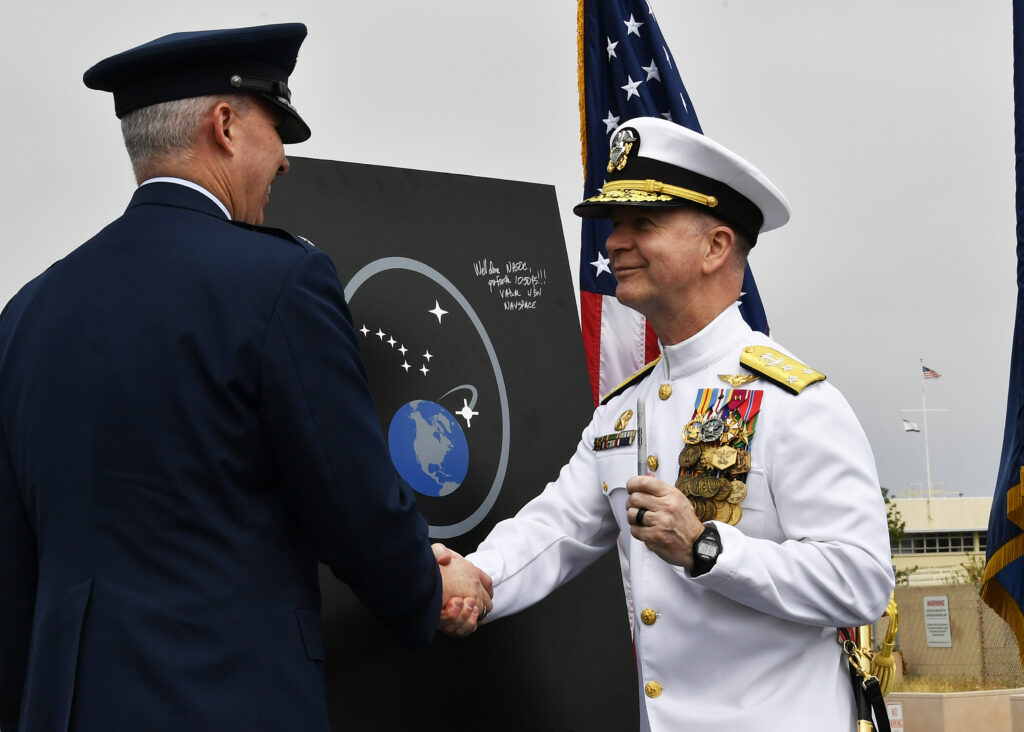
Vice Adm. Ross Myers, commander, U.S. Fleet Cyber Command/U.S. 10th Fleet, left, shakes hands with U.S. Space Force Lt. Gen. Stephen Whiting, commander, Space Operations Command, during the Naval Satellite Operations Center disestablishment ceremony. U.S. NAVY / Ensign Drew Verbis

POINT MUGU — Naval Satellite Operations Center, onboard Naval Base Ventura County, transferred to the U.S. Space Force under Space Delta 8 and was designated as the 10th Space Operations Squadron during a historic Disestablishment and Assumption of Command Ceremony June 6, said Naval Base Ventura County Public Affairs in a June 8 release. 

Vice Adm. Ross Myers, commander of U.S. Fleet Cyber Command and U.S. 10th Fleet, presided over the ceremony. 

“For 60 years NAVSOC has advocated and advanced American maritime superiority,” said Myers. “NAVSOC enabled satellite communications to afford the United States and her allies the crucial ability to provide defensive measures, conduct over the horizon monitoring and targeting, and project combat power in areas of conflict and instability around the globe.” 

NAVSOC was the first military space operations command in history, commissioned in April 1962 as the Navy Astronautics Group. Tasked with operating the Navy’s satellites, the unit commanded TRANSIT, the world’s first satellite navigation system. Navy Astronautics Group was re-designated as NAVSOC in June 1990. 

“As we look toward the future of space operations, we see the domain is both crowded and growing,” said Myers. “To lead this next phase of the space race, the United States established the Space Command with the budget and authorities to consolidate joint-capabilities and harness cross-cutting disciplines and services.” 

The Space Force is a separate and distinct branch of the armed services, organized under the Department of the Air Force in a manner very similar to how the Marine Corps is organized under the Department of the Navy. 

“It’s hard to overstate how impactful this mission is and the critical role this team plays in linking the force across air, land, and sea,” said U.S. Space Force Lt. Gen. Stephen Whiting, commander, Space Operations Command. “This activation marks the beginning of the Department of Defense’ consolidation of all narrow-band, wide-band, and protected SATCOM to include all associated responsibilities for training, acquisition, and sustainment activities under a single military service for the first time in history.” 

In addition to the command operation center, NAVSOC transferred the Laguna Peak Facility (three miles from the Point Mugu), which supports the Space-Ground Link System and satellite TT&C operations, and 13 satellites to include 1-FLTSAT, 5-UFO, 5-MUOS and 2-POLAR. 

According to Space Delta 8, the new unit is intentionally numbered the 10th Space Operations Squadron to pay honor to its heritage under U.S. 10th Fleet. 

“Space has become highly contested,” said U.S. Space Force Col. Matthew Holston, commander, Space Delta 8. “Our adversaries recognize our reliance on space, and they are actively seeking ways to create vulnerabilities to take away our competitive advantage. It is the 10th Space Force Operation Squadron that is on the front lines to guaranteeing our American way of life.” 

The Space Force is expected to grow from 2,400 active-duty service members to 6,400 by the end of the year, according to a statement made by Chief of Space Operations Gen. John Raymond. 

“Today we complete the first chapter in military space operations,” said Myers. “Our military stands better connected, more informed, faster, and able to operate with greater precision because of NAVSOC.”
Navy Air Reserve Begins Transition to P-8A Poseidon Aircraft 

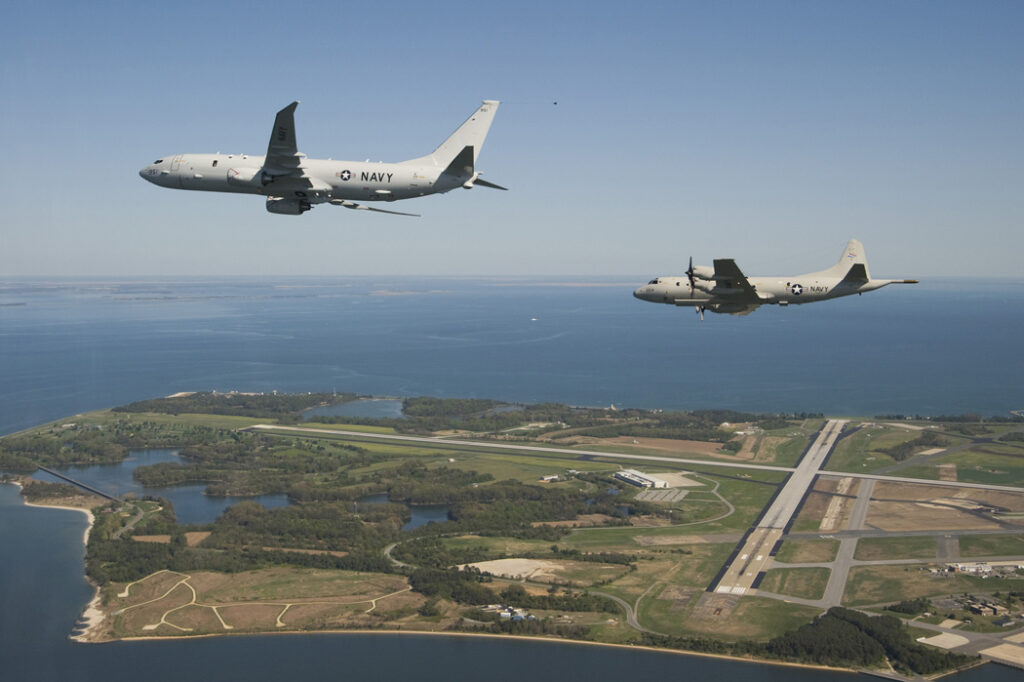
A P-8A and P-3C fly over Naval Air Station Patuxent River, Maryland, in 2010. U.S. NAVY / Liz Goettee

ARLINGTON, Va. — The Navy Air Reserve has begun to retire its P-3C Orion maritime patrol aircraft and upgrade to the P-8A Poseidon MPA. 

Current and former members of Patrol Squadron 62 (VP-62), based at Naval Air Station Jacksonville, Florida, gathered June 4 at the squadron’s hangar to bid farewell to the squadron’s P-3Cs as the squadron begins its transition to the P-8A. 

The transition will leave VP-69 at NAS Whidbey Island, Washington, as the last reserve VP squadron to operate the Orion. VP-69 is scheduled to begin transition to the P-8A in fiscal 2023. 

The 12 active-component fleet VP squadrons began transition in 2012 and completed the upgrade to the P-8A in 2020.  

For many years, the Navy was uncertain as to whether the two reserve VP squadrons would be able to upgrade to the P-8A. Eventually, the Navy’s program of record was increased to procure enough P-8As to equip the two reserve squadrons. 

The two reserve VP squadrons are very active in augmenting the fleet squadrons in operations and exercises. With more than 300 Sailors assigned, VP-62 is manned by a staff of full-time support personnel, selective reservists and a few active-component personnel. 

At the height of the Cold War, the Navy Reserve fielded 13 VP squadrons equipped with Orions. 


Coast Guard Cutter Spencer Returns to Portsmouth after Patrolling Eastern Pacific 

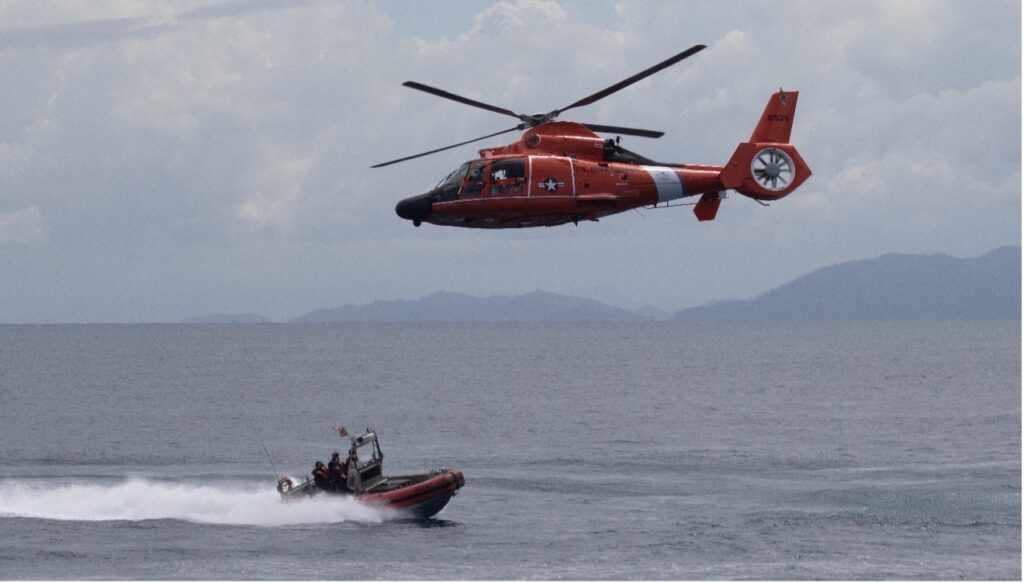
The crew of a small boat from Coast Guard Cutter Spencer conducting maneuvers with a Coast Guard HITRON helicopter off the coast of Honduras. U.S. COAST GUARD / Chief Petty Officer Katharine Ingham

PORTSMOUTH, Va. — The crew of U.S. Coast Guard Cutter Spencer returned to its homeport in Portsmouth, Virginia after a 78-day patrol off the shores of Central America, the Coast Guard 5th District said June 7. 

USCGC Spencer departed Portsmouth Feb. 12 and headed south, making a stop in Mayport, Florida, to bring aboard a Coast Guard Helicopter Interdiction Tactical Squadron crew. From Mayport, the medium endurance cutter steamed to Honduran territorial seas and conducted tactical demonstrations with members of the Honduran Naval Special Forces. 

After transiting through the Panama Canal, USCGC Spencer conducted operations in the Eastern Pacific ocean with the objective of disrupting illicit narcotics trafficking. Law enforcement teams from USCGC Spencer successfully interdicted a go-fast vessel with over 300 kilograms of cocaine and 1,000 pounds of marijuana. Later during the patrol, the embarked HITRON element spotted another smuggling vessel near USCGC Spencer’s location. The boat caught on fire and USCGC Spencer’s crew recovered three survivors along with several bales of cocaine that were thrown off the boat shortly before it sank. USCGC Spencer also assisted Costa Rican authorities in the detention of six suspected narco-traffickers who were caught smuggling laundered money on a fishing vessel in the region. 

Transnational criminal organizations pose a serious threat to the national security of the United States and are funded primarily through the trade of illicit narcotics. While in the Pacific theater, USCGC Spencer’s crew worked with regional law enforcement authorities to deter the flow of contraband to the United States and to hold lawbreakers accountable. 

“We were able to provide effective coverage of known drug smuggling routes alongside our domestic and foreign partners during this patrol,” said Cmdr. Corey Kerns, commanding officer of USCGC Spencer. “I am grateful that we were able to support the counter narcotics mission in the Eastern Pacific and most importantly that everyone returned home safely. These deployments are undoubtedly the most challenging for our members due to their stressful operational tempo and distance from home. The crew demonstrated incredible perseverance day in and day out, worked as a team, and had fun along the way, which made the experience meaningful and memorable for us all.” 

USCGC Spencer is a 270-foot medium-endurance cutter with a 100-person crew complement. 


Munsch Nominated for Admiral, Command of Naval Forces Europe/Africa 

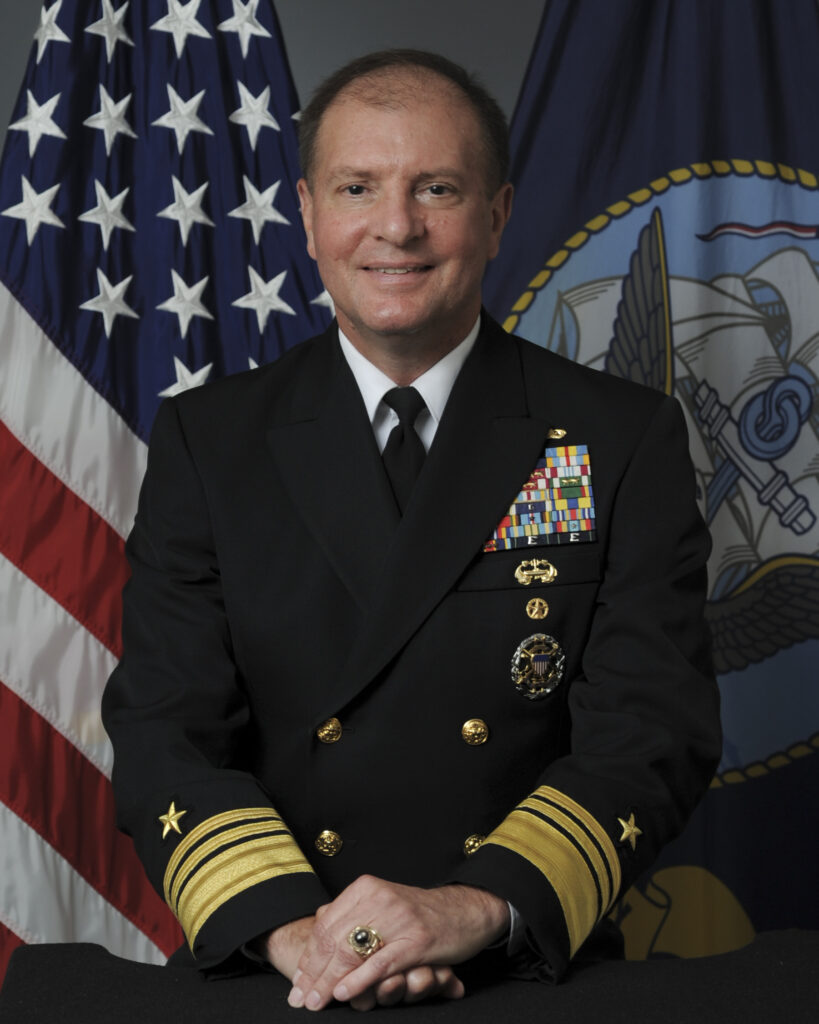
Vice Adm. Stuart B. Munsch. U.S. NAVY

ARLINGTON, Va. — Secretary of Defense Lloyd J. Austin III announced June 8 that the president has nominated Navy Vice Adm. Stuart B. Munsch for a fourth star and assigned commander, U.S. Naval Forces, Europe; commander, U.S. Naval Forces, Africa; and commander, Allied Joint Forces Command, Naples, Italy.

Munsch is currently serving as director for Joint Force Development, J-7, Joint Staff, Washington, D.C. 

Munsch, a native of North Dakota, graduated from the Naval Academy in 1985 with a Bachelor of Science in electrical engineering. At Annapolis, he was brigade commander of his class and an All-American and national champion pistol shooter. Selected for a Rhodes Scholarship, he attended Oxford University and earned a Bachelor of Arts and a Master of Arts in philosophy, politics and economics. 

He then was assigned to four consecutive sea duty assignments, serving on USS Will Rogers (SSBN 659), USS Jefferson City (SSN 759), USS Kitty Hawk (CV 63) on the staff of Commander, Cruiser Destroyer Group 5, and USS Tucson (SSN 770). In 1999, Munsch reported ashore to U.S. Pacific Command, where he served in the Plans and Policy Directorate (J5) prior to becoming deputy executive assistant to the commander. He then was selected for a White House Fellowship and served as special assistant to the Secretary of Agriculture. 

Munsch commanded USS Albuquerque (SSN 706) from 2002 to 2005, followed by duty in the Pentagon as the military assistant to the Deputy Secretary of Defense and then as executive assistant to the Director, Submarine Warfare, Office of the Chief of Naval Operations (OPNAV N87). 

Munsch commanded Submarine Development Squadron (DEVRON) 5 from 2008 to 2010 and then returned to the Pentagon to head the Navy Strategy branch (OPNAV N513). Selected for flag rank, he was reassigned as deputy director, Undersea Warfare (OPNAV N97). 

Sent overseas to Japan and Bahrain, Munsch commanded Submarine Group 7 and Task Forces 74 and 54 from 2013 to 2015, followed by duty in the Pentagon as the senior military assistant to the Deputy Secretary of Defense. In 2017 Munsch reported to OPNAV N3/N5 as the assistant and in 2018 became the deputy chief of naval operations for Operations, Plans and Strategy. In 2019 he established and served as the initial deputy chief of naval operations for Warfighting Development, N7. He assumed his role as director for Joint Force Development (J7) in 2020. 


Hamilton Returns From Multi-Mission Patrol in Caribbean Sea, Eastern Pacific Ocean 

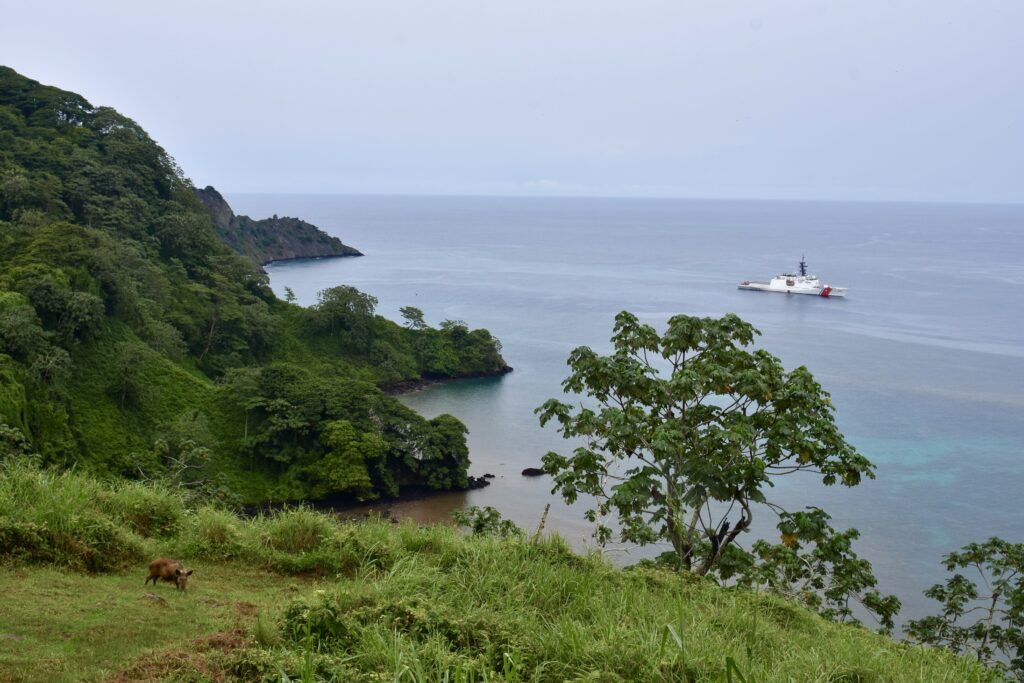
The Legend-class National Security Cutter USCGC Hamilton (WMSL 753) anchors in Chatham Bay of Isla del Cocos, the Republic of Costa Rica, on April 22. Hamilton’s crew conducted a 12-week multi-mission deployment in the Eastern Pacific Ocean and the Caribbean Sea. U.S. COAST GUARD / Ensign Joshua Romano

NORTH CHARLESTON, S.C. — USCGC Hamilton (WMSL 753) returned home June 3 following a 12-week multi-mission deployment in the Eastern Pacific Ocean and the Caribbean Sea, the Coast Guard Atlantic Area said in a release. 

The crew deployed in early March to participate in the Tailored Ship Training Availability, a three-week training program was testing the crew in naval warfare, damage control, engineering, navigation, and seamanship drills and exercises. Hamilton’s crew performed exceptionally well, achieving a 98% average score across all training categories. The team also interacted with the Coast Guard Office of Boat Forces and Aviation Forces to conduct necessary integration testing for future Coast Guard cutter boats and aircraft.  
 
After completing TSTA, Hamilton transited to Costa Rica. The crew hosted the Costa Rican minister of environment and energy and other government representatives and U.S. diplomats for an official visit to Isla del Coco, or Cocos Island. The Costa Rican government’s ceremonial announcements of three executive decrees to increase protection over one of the world’s most productive and biodiverse habitats highlighted the historic visit. The ceremony signified Costa Rica’s commitment to protecting the Cocos Island Marine Reserve and demonstrated the U.S. government’s support for marine conservation and protection.  
 
Hamilton’s crew proceeded to patrol the Eastern Pacific Ocean, conducting narcotics operations supporting the U.S. Coast Guard’s Western Hemisphere Strategy. The embarked Helicopter Interdiction Tactical Squadron aviation team, based out of Jacksonville, Florida, and Hamilton’s cutter boat teams collaborated to detect a go-fast vessel that jettisoned contraband. The crew interdicted a go-fast, detained four suspected smugglers, and recovered 811 kilograms (1,788 pounds) of cocaine worth over $24 million in street value.  
 
“I am extraordinarily proud of this crew and everything we accomplished during this deployment,” said Capt. Matthew Brown, the commanding officer of Hamilton. “We honed our capability to operate, defend, fight, and protect our cutter and applied it to directly combat the scourge of illicit narcotics and the destabilizing effects their presence has on the streets of our nation and those of our allies in the transshipment zone. Our partnerships with countries like Costa Rica and their coast guard strengthen our ability to dismantle transnational criminal organizations, protect the environment, and reinforce a rules-based maritime order.”  


Chief of Navy Reserve: Top Budget Equipment Priority is C-130J Transport Aircraft 

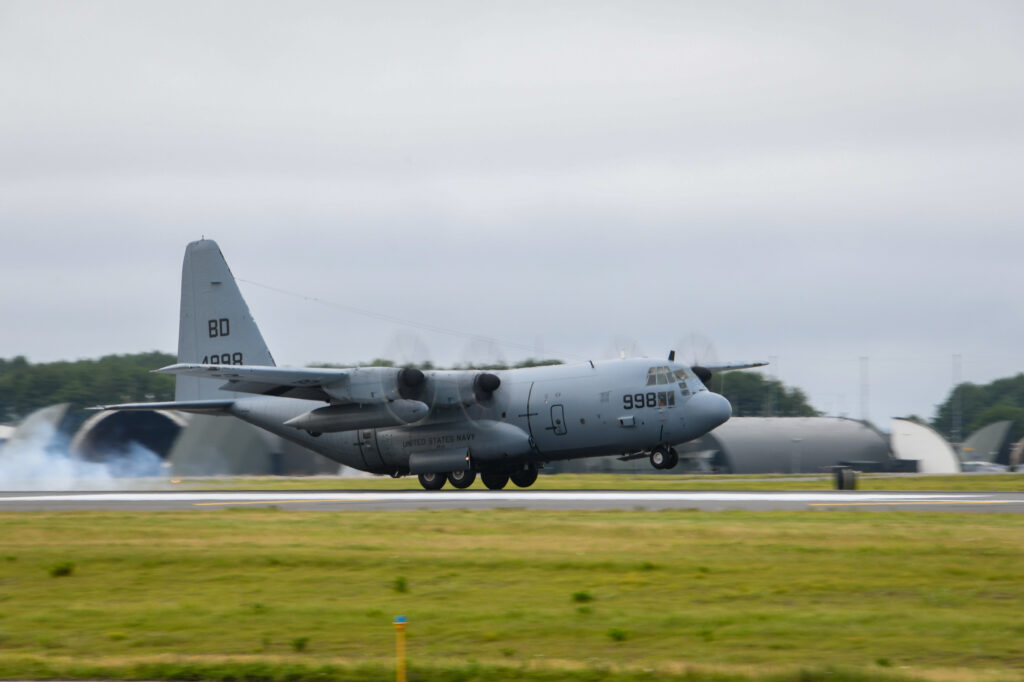
A C-130T Hercules, assigned to the “Condors” of Fleet Logistics Support Squadron (VR) 64, recovers at Naval Air Facility Misawa, Japan. U.S. NAVY / Mass Communication Specialist 3rd Class Benjamin Ringers

WASHINGTON — The admiral in charge of the Navy’s reserve force told Congress his top budget equipment priority is to acquire C-130J Super Hercules transport aircraft to recapitalize the legacy C-130T fleet. 

Testifying before the Senate Appropriations Committee’s Defense subcommittee, Vice Adm. John B. Mustin, chief of Navy Reserve, said the C-130J is necessary to replace the C-130Ts and KC-130Ts — with an average age of more than 30 years — serving in five of the Navy Reserve’s fleet logistics support squadrons. 

“Procurement of the more capable C-130J aircraft variant to replace the three-decade-old C-130 airframes is the Reserve’s number one equipment priority,” Mustin said. “Last year, Navy Reserve fleet logistics squadrons flew 26,000 hours and moved 24 million pounds of cargo at a cost avoidance of a billion dollars. However, the current C-130 fleet is challenged to meet sustained fleet logistics requirements. Modern KC-130Js will realize an additional $200 million in annual transportation cost savings. 

The five Navy Air Reserve fleet logistics squadrons operate 19 C-130Ts and 11 KC-130Ts. Five other KC-130Ts are operated by the two Navy test wings to support test and evaluation activities. The KC-130Ts were transferred from the Marine Corps Reserve when its two reserve Marine aerial refueler/transport squadrons upgraded to the KC-130J, a process completed in April 2021. 

“There is no active-duty counterpart to what we do [with the C-130] in the reserve force,” Mustin said. “That’s our intra-theater lift. Certainly, working with the Air National Guard and the Air Force, we’re able get from CONUS into theater whether that’s in the EUCOM area or INDO-PACOM. Once there, however, transition to strike groups and distributed U.S. Navy is impossible without C-130s. 

“We’ve got C-40s — smaller capability — but if we want to transfer an F-35 engine, we’ve got to have the C-130s,” he said. 

Mustin noted that with the age of the C-130 aircraft “our mission-capable rates are lower, and we struggle to maintain given that we are the only service — active or reserve — to continue to fly what is called the Tango variant [C-130Y/KC-130T]. The incessant demand from not only our fleet commanders but combatant commanders drive my urgency to recapitalize there.”    


HII Christens National Security Cutter Calhoun (WMSL 759) 

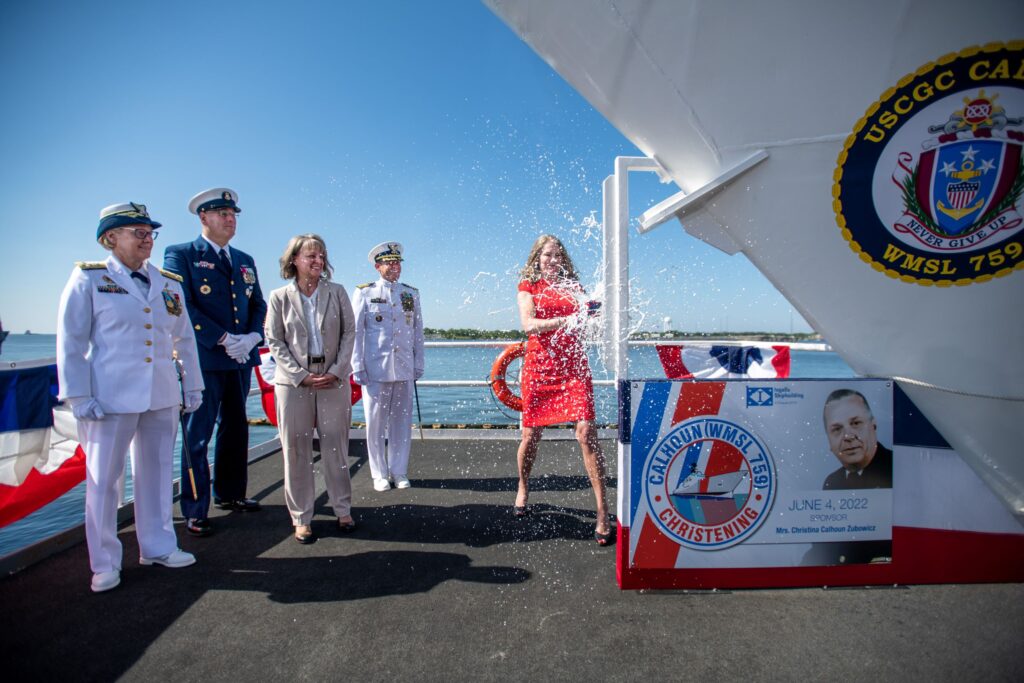
Christina Calhoun Zubowicz, ship sponsor and granddaughter of its namesake, christened the ship on June 4. HII

PASCAGOULA, Miss. — HII christened Legend-class national security cutter Calhoun (WMSL 759) June 4 at the company’s Ingalls Shipbuilding division, the company said in a release. 

Calhoun (WMSL 759) is named to honor Charles L. Calhoun, the first master chief petty officer of the U.S. Coast Guard. Calhoun served in the U.S. Navy for three years during World War II and was honorably discharged in 1946 as a torpedoman second class. He enlisted in the Coast Guard that same year and held varying positions of leadership over the course of his career. 

“Today’s christening is an acknowledgement of an important and valued partnership between our shipyard and the United States Coast Guard,” Ingalls Shipbuilding President Kari Wilkinson said. “We consider it a privilege to build these magnificent ships and as shipbuilders, we are humbled to further Master Chief Calhoun’s legacy.” 

The keynote speaker was commandant of the U.S. Coast Guard Adm. Linda Fagan, who was recently appointed to lead the Coast Guard and is the armed forces’ first female service chief. 

“I’m super proud of the Ingalls team, I know how much heart and soul goes into building a ship like this,” Fagan said. “These national security cutters are absolutely vital to our national security and economic prosperity. We are a global coast guard, forward deployed — conducting exercises with maritime forces, strengthening security partnerships and maritime governance in critical parts of the world right now.” 

Christina Calhoun Zubowicz, ship sponsor and granddaughter of the namesake, christened the ship by breaking a bottle of sparkling wine across the bow. 

“On behalf of the Calhoun family, I would like to extend our sincere appreciation for the tremendous work being done here at Ingalls Shipbuilding,” Zubowicz said. “Rest assured that my grandfather would be admiring this ship with great pride today knowing that his name would continue his life’s work of carrying out Coast Guard missions.” 

U.S. Rep. Steven Palazzo joined Ingalls Shipbuilding to celebrate the ship christening. 

“The national security cutters coming out of Ingalls are contributing greatly to our national security, stemming the flow of drugs throughout our oceans, and proving that we have the best shipbuilders right here in south Mississippi,” Palazzo said. “Congratulations to everyone at Ingalls on another successful christening, and I look forward to seeing the Calhoun (WMSL 759) in action.” 

Ingalls Shipbuilding is the sole designer and provider of the Coast Guard Legend-class national security cutter. The flagship of the Coast Guard fleet, national security cutters are capable of embarking and supporting a wide range of Coast Guard, Navy and NATO manned and unmanned aircraft. National security cutters have proven to be ideal platforms for drug interdiction, global illegal fishing, disaster relief and defense support operations. 

Ingalls has delivered nine Legend-class national security cutters, and two more are under construction. Calhoun, the 10th national security cutter, is scheduled to be delivered early next year. 


Raytheon Technologies Establishes Global Headquarters Office in Northern Virginia

Raytheon Technologies’ building in Arlington, Virginia. RAYTHEON TECHNOLOGIES

ARLINGTON, Va. — Raytheon Technologies announced today June 7 it will establish its global headquarters in Arlington, Virginia, just outside of Washington, D.C., a move similar to the one recently announced by Boeing.

The location increases agility in supporting U.S. government and commercial aerospace customers and serves to reinforce partnerships that will progress innovative technologies to advance the industry, Raytheon said in a press release, adding that Washington, D.C., serves as a convenient travel hub for the company’s global customers and employees.

The new global headquarters office will be in Arlington’s Rosslyn neighborhood alongside the Raytheon Intelligence & Space business. Each of the company’s four business units currently have operations in Virginia, the company said, and it will maintain its U.S. presence, which includes 600 facilities across 44 states and territories.

Raytheon Technologies said it has not accepted or sought any financial incentives from any state or municipality to support the establishment of the global headquarters office in Virginia.


DC Congresswoman Pushes DC Statehood at Keel-Laying for Navy Submarine 

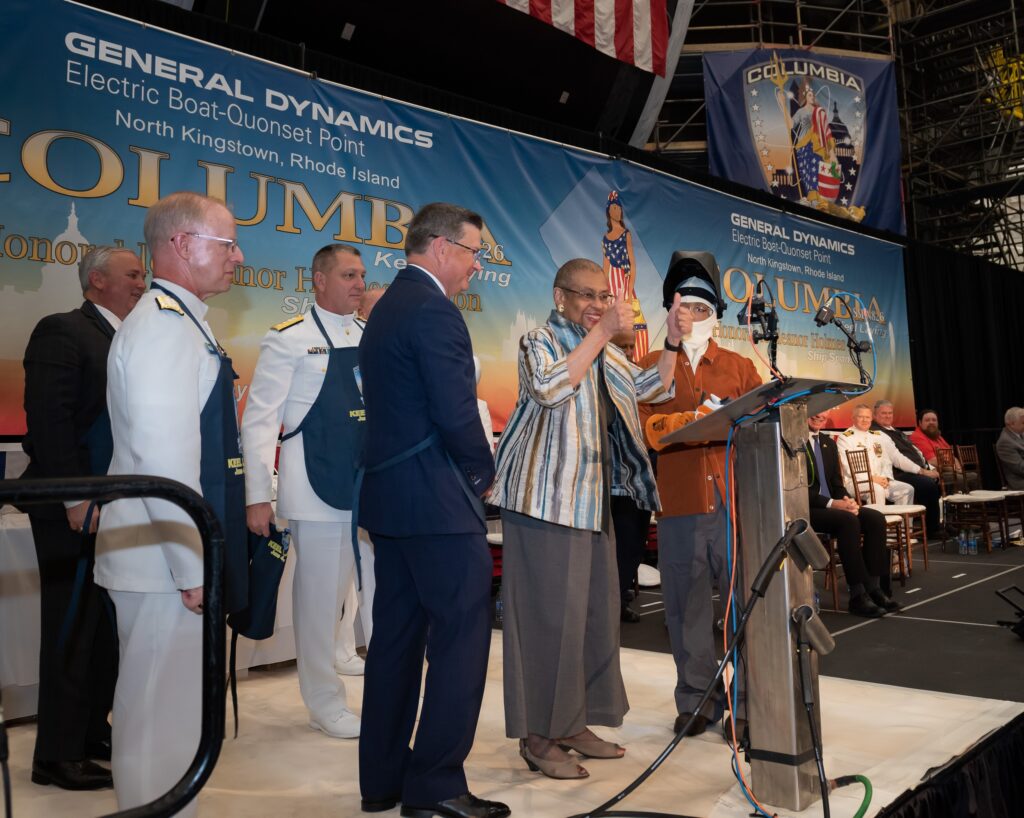
U.S. Rep. Eleanor Holmes Norton (D-District of Columbia), approves the welding of her initials onto a metal plate during a ceremony at the General Dynamics Electric Boat Facility at Quonset Point, Rhode Island, June 4. The congresswoman is the sponsor of the future U.S. Navy ballistic missile submarine District of Columbia. U.S. NAVY / GENERAL DYNAMICS ELECTRIC BOAT

ARLINGTON, Va. — The keel-laying of the U.S. Navy’s next-generation ballistic-missile submarine (SSBN) was celebrated June 4 in Quonset Point, Rhode Island, by the submarine’s designers and builders and the Navy that will operate it.

At the ceremonies for the future USS District of Columbia (SSBN 826), one of the ship’s two sponsors, Rep. Eleanor Holmes Norton, D-District of Columbia, also used the event as an occasion to advocate for the cause of her life: statehood for the District of Columbia. 

The day before the ceremonies, Navy Secretary Carlos Del Toro announced that the first ship of the Columbia class would be named USS District of Columbia, instead of Columbia. 

“The decision to name SSBN 826 is to alleviate any name conflicts with the already-commissioned USS Columbia (SSN 771). §10 U.S.C. 8662(a) states that not more than one vessel of the Navy may have the same name,” the secretary’s public affairs officer said in a June 3 release. “The Columbia program was named in 2016 with the lead ship projected to enter service in 2027, consequently overlapping with the existing USS Columbia (SSN 771). SSBN 826 will be named after the nation’s capital while SSN 771 is named after cities in South Carolina, Missouri, and Illinois named Columbia, following the naval tradition of SSNs being named after U.S. cities.” 

General Dynamics Electric Boat President Kevin Graney presided at the keel-laying ceremonies. Also speaking were Jennifer Boykin, president of Newport News Shipbuilding, a Huntington Ingalls company that builds sections of the Columbia-class submarines; Rep. Joe Courtney (D-Connecticut), in whose district the Columbia SSBNs will be assembled; Reps. David Cicilline and Jim Langevin and Sens. Sheldon Whitehouse and Jack Reed, all Democrats from Rhode Island, site of Electric Boats’ Quonset Point fabrication facility; Adm. Daryl Caudle, commander, U.S. Fleet Forces Command; Del Toro; and Norton.  

Graney said the new SSBN was going to be “the most capable and quiet submarine ever built.” 

He noted Electric Boat invested almost $2 billion in facilities and hired thousands of workers to build the Columbia class, and that as the program progressed the company would “need to hire and train many thousands more.”   

Graney called the Columbia class SSBN was “arguably be the greatest engineering achievement of the most advanced military in the world.” 

Boykin noted that “our Sailors’ lives depend on the quality of our product, and it is this responsibility that guides everything that we do.” 

She noted Newport News Shipbuilding has been allied with Electric Boat in the Virginia-class attack submarine program that began nearly 25 years ago. 

“As every ballistic-missile submarine has since the keel laying of USS George Washington (SSBN 598) here at Electric Boat in November 1958 — the District of Columbia, and all those in its class will continue to serve as the most survivable leg of the nuclear triad — standing constant watch far beneath the waves, as we have done for over 63 years, a stalwart deterrent against those who would seek to do the unspeakable,” Caudle said. 

Del Toro noted the Washington Navy Yard in the district is the Navy’s oldest shore facility. 

“While it’s common to refer to D.C. as our nation’s capital, I also like to think of it as our naval capital,” Del Toro said, in reference to notable Sailors and Marines who were born and raised in the district. “That’s why I want to make it clear that this boat honors the people and the spirit of the District of Columbia.”  

Norton — the boat’s sponsor along with the district’s mayor, Muriel Bowser — wrote her initials on a steel plate. The initials were then welded onto the plate by Electric Boat welder Maria Betance-Pizarro. The plate will be fixed to the structure of the submarine. 

“I can’t say how pleased I am today as we celebrate the USS District of Columbia-class submarine, commissioned in recognition of my hometown and the jurisdiction I represent in the Congress, the District of Columbia,” Norton said. 

Norton, who has been a staunch advocate for statehood for the district during her long career, used the occasion to plug her top political goal.  

Norton said the submarine’s name is “fitting that it recognizes the jurisdiction that will become the 51st state of the United States of America. … As we celebrate this keel-laying today, we also underline the Congress must no longer exclude the residents of our nation’s capital from the democratic presence, forcing residents to watch from the sidelines as Congress votes on laws that affect the nation or votes even on laws on the duly elected government. Democracy demands more, D.C. residents demand much more. They deserve statehood.”  


Mayflower Autonomous Ship Reaches Canada After Suffering Mechanical Issues

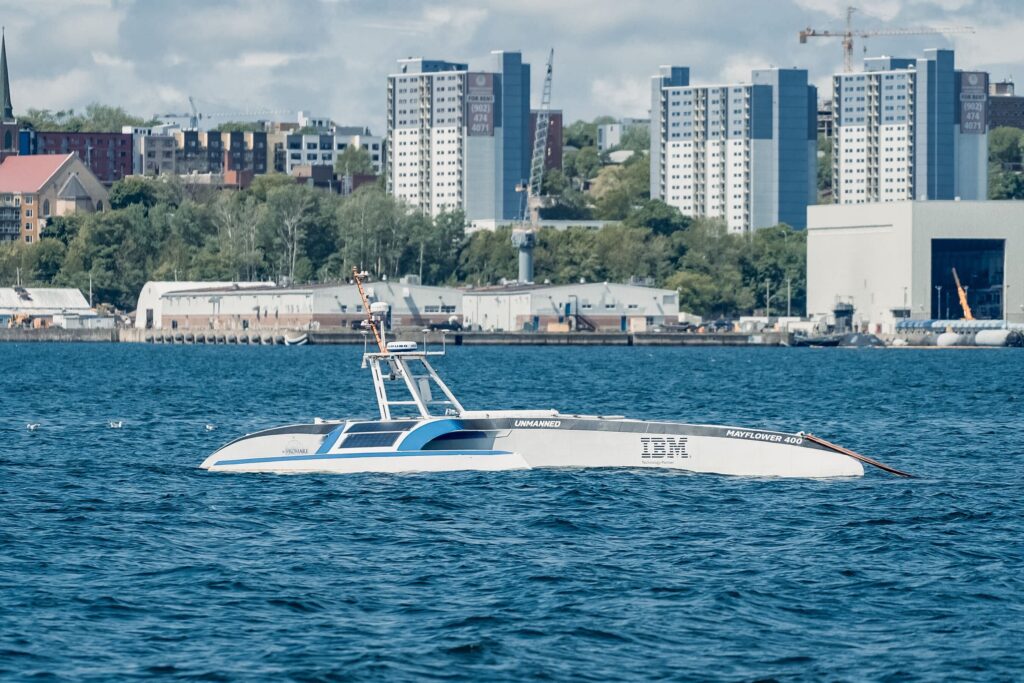
The Mayflower Autonomous Ship arrives in Halifax, Nova Scotia, for equipment troubleshooting before continuing its journey. IBM

HALIFAX, NOVA SCOTIA — After a 40-day voyage, and after more than year of delay due to a mechanical problem, the Mayflower autonomous ship arrived in North America, at Halifax, Nova Scotia on June 5, announced program partners IBM and ProMare.

The ship has been dogged by mechanical problems even as its artificial intelligence guidance system was able to guide it across the ocean.

The catamaran traveled from Plymouth, United Kingdom, to Halifax, and later is expected to make appearances in the Washington, D.C. area. According to IBM, it’s the first nautical vessel to complete an unmanned, crewless voyage across the Atlantic.

Mayflower was intended to reach Plymouth, Massachusetts. Over the May 28-29 weekend, the Mayflower developed an issue with the charging circuit for the generator starter batteries, according to IBM.

On May 30, the team had to switch to the back-up navigation PC. ProMare decided to divert to Halifax, Nova Scotia, as the closest viable port, to investigate and fix these issues.

The ship was designed and built by marine research nonprofit ProMare, with IBM acting as lead technology and science partner.

Artificial intelligence and edge computing technologies underpin the ship’s AI Captain, which uses six cameras, more than 30 sensors and 15 edge computing devices to help make decisions.

“This makes it possible for the AI Captain to adhere to maritime law while making crucial split-second decisions, like rerouting itself around hazards or marine animals, all without human interaction or intervention,” IBM said in a blog post.