Berger: Holistic Look Needed for Maritime Prepositioning Force 
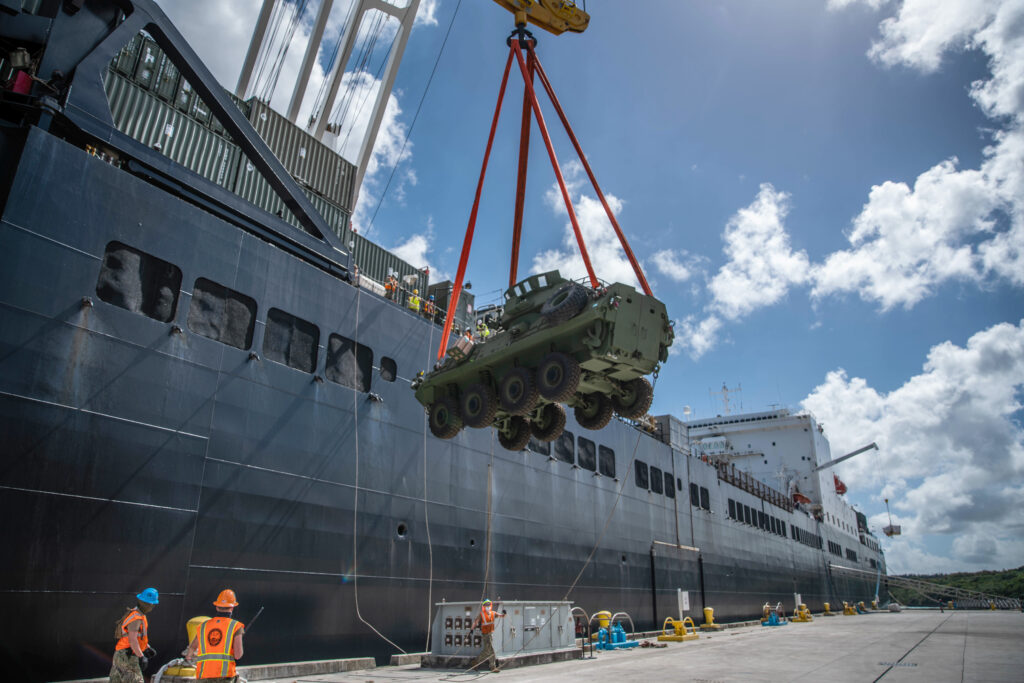
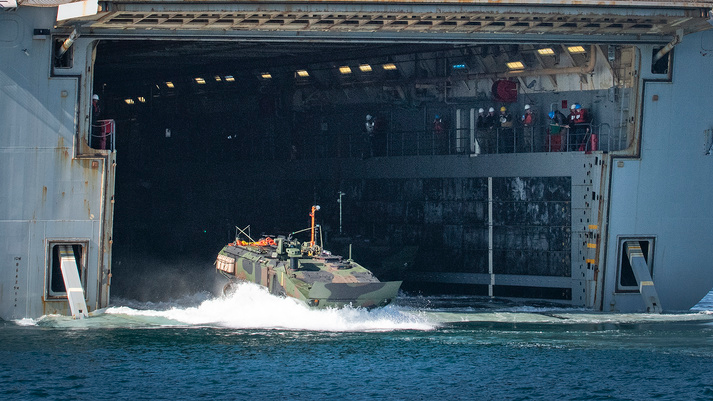
U.S. Marines with Combat Logistics Regiment 3, 3d Marine Logistics Group and Sailors with Navy Cargo Handling Battalion 1 offload a light armored vehicle from the Bob Hope-class vehicle cargo ship USNS Pililaau (T-AKR 304) during Hagåtña Fury 21 at Naval Base Guam, Feb. 21, 2021. U.S. MARINE CORPS / Lance Cpl. Moises Rodriguez

ARLINGTON, Va. — The Marine Corps’ commandant sees a continued need for the Maritime Prepositioning Force in the future as his Force Design 2030 initiative is implemented.  

The MPF, managed by the Military Sealift Command, is comprised of two squadrons of ships in full operating status. The squadrons are located at Guam and Diego Garcia. The squadrons carry enough carry enough equipment and supplies to sustain more than 16,000 Marine Expeditionary Brigade and Navy personnel for up to 30 days. The ships can offload equipment at established port facilities or while anchored, using onboard watercraft operated by naval support element forces. The MPS ships complement naval amphibious forces. 

Gen. David H. Berger, speaking to reporters May 5 about his update to Force Design 2030, said that “in conjunction with Army prepositioning and the other services’ prepositioning, we’re going to have to take a holistic look at prepositioning in the future. The current framework, like our current posture around the world, is not set optimally for what the National Defense Strategy requires us to do. So, as we adjust global force posture of the joint force — including the Marines — we’re also going to need to adjust maritime prepositioning.  

“I won’t speak for the Army, but I would think for the joint force, those adjustments have to be made in conjunction with each other,” Berger said. “There is no possible way you’re going to be able to generate all of the airlift that you need to lift all that we’re going to need anywhere in the globe. Prepositioning cuts the time frame to respond dramatically. We’re going to have to look at MPF and find out how it matches the adjustments we’re going to make with global force posture.”   


Marines Prep for ‘Stand-in Force’ Goal of Operating in Enemy Weapon Engagement Zones

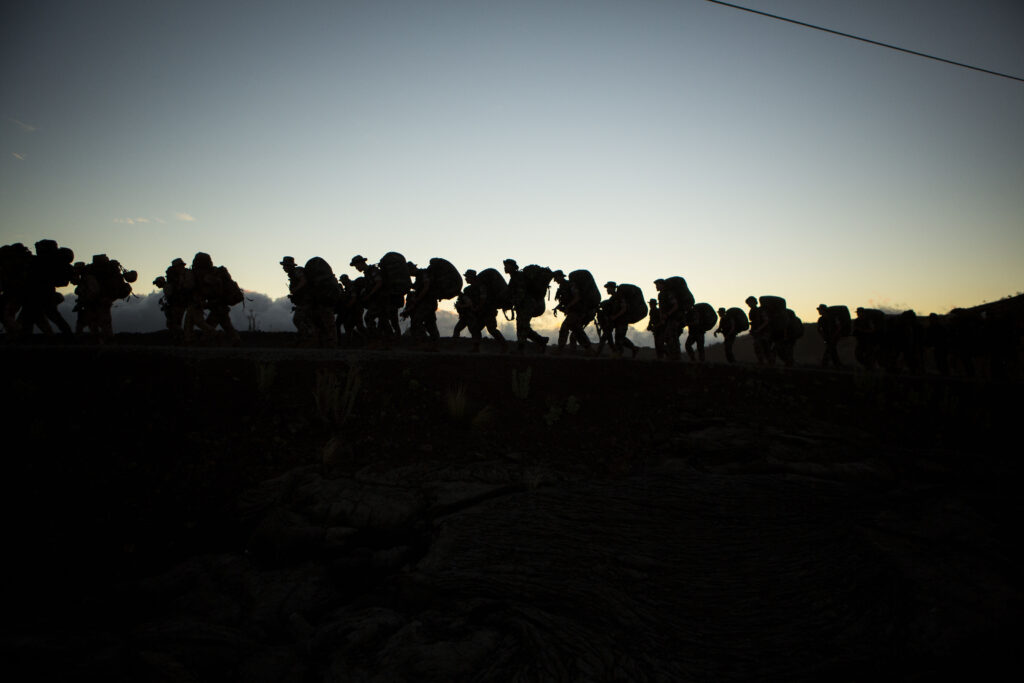
Col. Timothy Brady, commanding officer of the 3rd Marine Littoral Regiment said exercises like the upcoming Rim of the Pacific will play a part in the new regiment gaining full operational status in two years U.S. MARINE CORPS / Lance Cpl. Wesley Timm

WASHINGTON – A key part of the Marine Corps’ ongoing Force Design 2030 is creation of a “stand-in force,” which is intended to be relatively small, highly mobile but lethal units that are to operate well within the enemy’s “weapons engagement zone,” primarily in the Western Pacific. Although this would appear to be a radical, new and potentially dangerous task, a panel of senior Marine officers intensely engaged in the process argued May 11 that the Marines are inherently prepared for this mission and, they emphasized repeatedly, those Marine units would be fighting as part of the U.S. joint force and closely aligned with allies and partners in the Pacific theater.

Force Design 2030 and the concept of the stand-in force is a recognition of the rapidly changing character of war, driven by the fielding of high-tech sensors and precision weapon and the growing involvement of cyberwarfare, said Brig. Gen. Joseph Clearfield, deputy commander of Marine Forces Pacific. “I am so proud that the Marine Corps is out in front on this change,” Clearfield told an audience at the Modern Day Marine exposition at the Walter E. Washington Convention Center.

But Clearfield and his fellow panelists said the Marines traditionally train for the skills needed for the stand-in mission. “We are incredibly well positioned to assume this mission,” Clearfield said.

Col. Timothy Brady, commanding officer of the still-forming 3rd Marine Littoral Regiment, which is to be the first of the units specifically prepared for the stand-in mission, said his regiment “is a small element of MarForPac, part of what will fight inside the enemy’s weapons engagement zone” to set the stage for the joint force.

And Col. Stephen Fiscus, assistant chief of staff for Force Development in MarForPac, who said he is tasked with implementing Force Design, added that “we fight as part of the joint force” and are “already working with our allies and partners.” Clearfield noted that Australia and Japan, America’s closest Pacific allies, are starting to develop similar units.

Brady said his regiment, which was redesignated as the 3rd MLR last year, has its infantry battalion and is to add logistics and air defense battalions as it moves to full operational status in two years. But, he noted, the initial units already have conducted a large-scale exercise with Philippine forces and will engage in even larger tests during the massive Rim of the Pacific Exercise later this year.

While stressing the Marines’ inherent capabilities for the stand-in mission, the three officers acknowledged they need additional capabilities for “persistent stare” sensing and targeting and greater mobility, particularly at sea. Clearfield specifically cited the proposed light amphibious warships, which the Navy’s shipbuilding plan had delayed for at least another year.

Clearfield warned that although the Marines’ force design process is aimed at producing a new organization by 2030, “we may not have that much time,” because of the rapid change in the character of war.


Berger, Del Toro: New Technology Combined With Old Platforms Can Thwart Adversaries

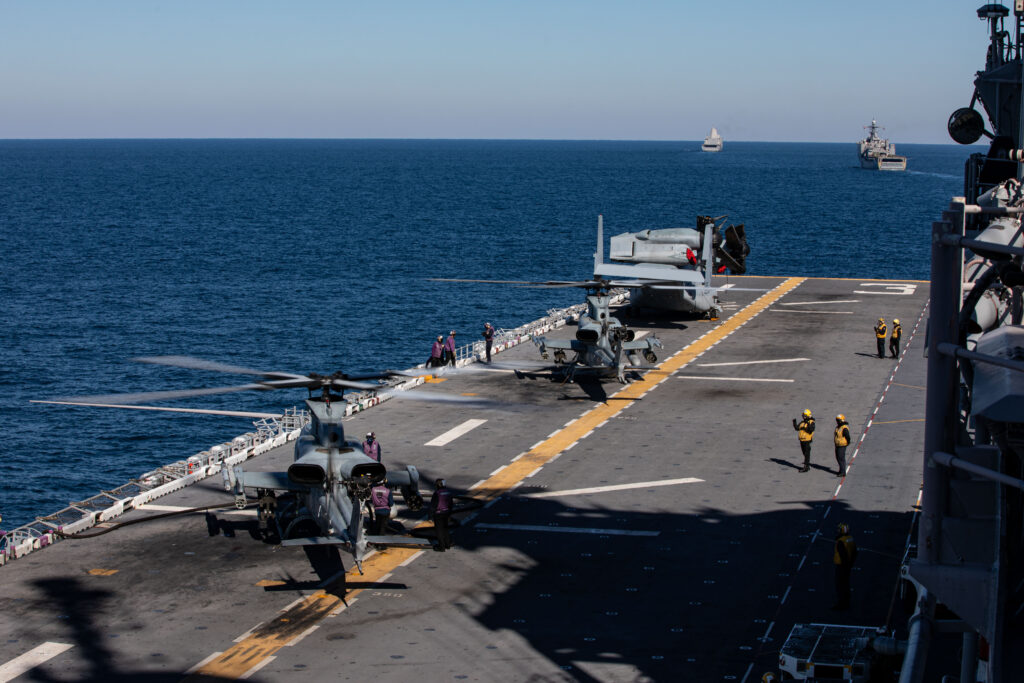
U.S. Navy Sailors refuel UH-1Y Cobras during Composite Training Unit Exercise aboard the USS Kearsarge (LHD 3), Jan. 24, 2022. The 22nd MEU and Amphibious Squadron 6 are underway for COMPTUEX in preparation for an upcoming deployment. COMPTUEX is the last at-sea period in the MEU’s Predeployment Training Program; it aims to test the capabilities of the ARG/MEU and achieve deployment certification. U.S. MARINE CORPS / Sgt. Armando Elizalde

WASHINGTON — U.S. Marine Corps Commandant Gen. David Berger and Secretary of the Navy Secretary Carlos Del Toro are promoting air, surface and undersea unmanned vehicles, and some new uses for old platforms, as a way for the redesigned force to keep adversaries off balance.

Discussing the state of the Marine Corps at the Modern Day Marine exhibition May 10, the two leaders also explained the importance of Berger’s Force Design 2030 plan to prepare the Corps for future challenges from near-peer competitors like China and Russia, and other adversaries in a rapidly changing environment.

“Today’s Marines confront a threat environment characterized by rapid mobility, anti-access/aerial denial systems and cyberwarfare,” Del Toro said, adding that he has “strongly supported Gen. Berger’s Force Design 2030 since his very first day as Navy secretary.

Critics of the force redesign have faulted Berger for shrinking the size of the Corps, eliminating all of its battle tanks and much of its towed artillery, but the 38th commandant has said he is investing in equipment and tech-savvy Marines that will be more effective in a widely distributed, highly mobile and stealthy force using unmanned systems, sensors, and anti-ship and anti-aircraft missiles to dominate the littorals of the Indo-Pacific region and other maritime choke points.

However, he told the Modern Day Marine audience there are existing platforms like amphibious ships, which can be used in innovative ways, especially when paired with unmanned systems. “As more and more uncrewed technology comes to maturity and the cost of production goes down, I think new capabilities are within reach,” Berger said.

“Drone technology over the last 20 years has been transformational on the battlefield,” Del Toro said, “and exactly the kind of technology we need to embrace.”

Berger suggested an Amphibious Ready Group-Marine Expeditionary Unit could launch unmanned undersea vessels from an amphib well deck for antisubmarine warfare, counter reconnaissance, finding minefields and ISR. “No platform, no unit, is capable of a more diverse set of missions across the range of military operations than an ARG-MEU,” he said.

Initial experimentation with the long-range unmanned surface vessel, armed with loitering munitions “has demonstrated the potency of that kind of capability,” Berger said, adding the potential use of UUVs launched from an amphibious well deck is limited “only by your imagination.” On the other hand, a well deck “taxes the imagination of the adversary,” because it conceals what’s on it, Berger said. “If you can’t figure out what’s on the inside, you’re going to spend a whole lot of time trying to do that. It slows down their decision-making. That’s what we want.” Another way to keep an adversary off balance is with drone-delivered loitering munitions. “There’s a psychological impact. You don’t know whether it’s got a camera system or a warhead on it,” Berger said.


Coast Guard Commissions Cutter Pablo Valent 

Crew members of the Coast Guard Cutter Pablo Valent man the ship during the commissioning ceremony at Coast Guard Sector St. Petersburg, Florida May 11, 2022. Pablo Valent, a Sentinel-class vessel, will be based in St. Petersburg and will operate throughout the Gulf of Mexico including the Florida Keys. U.S. COAST GUARD / Petty Officer 1st Class Ayla Hudson

ST. PETERSBURG, Fla. — The Coast Guard commissioned the 48th Sentinel-class fast response cutter Pablo Valent (WPC 1148) into service at Coast Guard Sector St. Petersburg, Florida, May 11, the Coast Guard 7th District said in a release. 

Rear Adm. Brendan McPherson, commanding officer of the Coast Guard 7th District, presided over the ceremony. Ms. Cecilia Guillot, Valent’s great-niece, is the ship’s sponsor.  

The cutter’s namesake Pablo Valent was originally from Corpus Christi, Texas, and joined the United States Life-Saving Service in 1912. In September 1919, Valent helped rescue the crew of the hurricane-damaged schooner Cape Horn off the coast of Texas. For his heroic efforts, Valent received the Silver Lifesaving Medal and the Grand Cross of the American Cross of Honor Society. Valent was one of the first Hispanic Americans to receive these honors.  

The Valent is the 48th FRC and is the first to be homeported in St. Petersburg with missions including search and rescue, maritime law enforcement, coastal security, and living marine resources. There are 12 other FRCs in Florida, which operate throughout the Caribbean Sea. 

Each cutter is designed for a crew of 24, has a range of 2,500 miles and is equipped for patrols up to five days. The FRCs are part of the Coast Guard’s overall fleet modernization initiative. 

FRCs feature advanced command, control, communications, computers, intelligence, surveillance and reconnaissance equipment as well as over-the-horizon response boat deployment capability and improved habitability for the crew. The ships can reach speeds of 28 knots and are equipped to coordinate operations with partner agencies and long-range Coast Guard assets such as the Coast Guard’s National Security Cutters. 


Ocean Craft Marine To Create First Maritime Innovation Lab to Accelerate Innovation in the Maritime Industry  

VIRGINIA BEACH, Va. — Ocean Craft Marine, a rigid-hull inflatable boat builder and maritime solution provider, will invest more than a quarter billion dollars over the next 10 years establishing the industry’s first independent maritime innovation laboratory, the company announced in a May 22 release. The goal of the laboratory, called the Accelerator for Innovation in the Maritime Ecosystem or AIME, will be to enable ideation, collaboration, cross-pollination and integration among and between maritime industry peers in order to accelerate industry innovation especially within, but not limited to, the professional and military segments. The announcement was made at the MARSEC/RBX Conference.  

“AIME may be the single most important development in the maritime industry since sails gave way to steam engines,” said Roy Nourha, Ocean Craft Marine CEO. “Not only will it help us explore and define the future of the maritime industry, it will change the way the industry operates, speeding the process significantly because we will all be choosing collaboration over siloed work, transparency over secrecy and partnership over competition.”  

“We have long been dedicated to being a solution provider for our professional, military and recreational users,” said Todd Salus, vice president of operations at Ocean Craft Marine. “This initiative is just the latest way we are driving that mission forward. We are accelerating the innovation process by giving everyone a place to experiment, learn and grow together faster than anyone could do on their own, including the U.S. military.”  

Ocean Craft Marine is inviting any and all maritime companies, including its existing partners, associates and peers, to collaborate in AIME. Ocean Craft Marine also seeks players from other industries who see a maritime application for their product.  

Nourha added, “We work in a collaborative environment, and we’re inviting anyone who wants to come play in our sandbox to do so. Innovation has been moving at a slow pace. If you make a maritime solution and you’re interested in driving the industry forward, we hope you will partner with us to accelerate innovation.”  

The AIME Lab is part of Ocean Craft Marine’s larger initiative to provide thought leadership to the global professional and military maritime community. Now with AIME, Ocean Craft Marine is available for all professional and military maritime consulting opportunities.  


Berger: Marines Need More MQ-9 Drones for ‘Organic ISR’

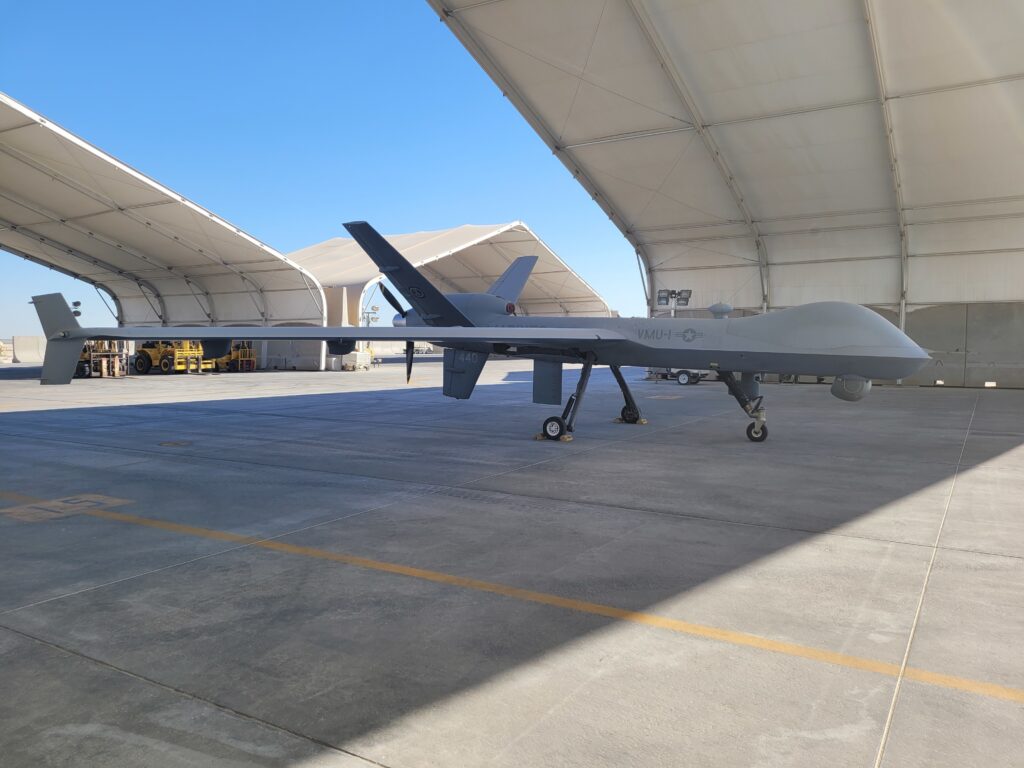
The Marine Corps’ first MQ-9A at an undisclosed location in the Central Command area of responsibility. U.S. Marine Corps

WASHINGTON — The U.S. Marine Corps will expand its fleet of MQ-9 Reaper drones to meet growing intelligence, surveillance and reconnaissance needs, the commandant said May 10.

“We’re going to move from three squadrons right now to perhaps double that,” Gen. David Berger told an audience at the Modern Day Marine exposition. “And the reason why is the need for organic ISR.”

The MQ-9A Block 5 aircraft can stay aloft for more than 26 hours, attain air speeds of 220 knots and can operate to an altitude of 45,000 feet. Manufactured by General Atomics Aeronautical Systems Inc., the Reaper has a 3,850-pound payload capacity that includes 3,000 pounds of external stores. It provides a long-endurance, persistent surveillance capability with full-motion video and synthetic aperture radar.

Berger said that ISR needs were increasingly critical for Marine Corps units, large and small. “So absolutely, we’re going to expand in Group 5, large-scale, big-wing, medium-altitude, long-endurance, uncrewed aircraft. That’s so we can have, for the naval force, persistent organic ISR access from the MEF [Marine Expeditionary Force] level on down to the squad level,” he said.

Over that last year-and-a-half, the Marines have conducted nine force-on-force exercises at the Marine Air Ground Task Force Training Command and Marine Corps Air Ground Combat Center at Twentynine Palms, California, Berger said. All of them showed that “small, distributed lethal teams that can employ organic ISR, loitering munitions, and weapons like the Javelin and Carl Gustav [recoilless rifle] are much more lethal than larger formations that are using traditional force structures and concepts,” backing up the concepts behind his Force Design 2030 plan to retool the way the Corps fights.

The Marines began leasing two Reapers in 2018 under a company owned/company operated agreement, later acquiring them from GA-ASI in 2021 as the first increment of the Marine Air-Ground Task Force unmanned aircraft expeditionary program of record. The Marines procured 16 more of the aircraft to operate in support of distributed maritime operations and expeditionary base operations, particularly in the Indo-Pacific region. 


Marine Panel: Existing Platforms Need Better Employment to Address Global Logistics Challenges

A CH-53K King Stallion helicopter, left, flies over the Chesapeake Bay after successfully connecting with a funnel-shaped drogue towed behind a KC-130J tanker aircraft during aerial refueling wake testing. Lt. Gen. Edward Banta, Deputy Commandant for Installations and Logistics, noted the Marines would need to improve their use of C-130J transports; CH-53K helicopters; and developing unmanned aerial, surface and subsurface systems to address logistics challenges as the threat of a conflict in the Indo-Pacific grows. U.S. NAVY / Erik Hildebrandt

WASHINGTON — The emerging difficult security environment, particularly with the growing threat from China in the Indo-Pacific theater, has placed greater importance on global logistics and created new challenges on how to sustain the deployed forces, a panel of senior Marine officers said May 10.

Improving global logistics in this new operating situation will require better knowledge of “what we have, where we have it and how best to support the Marines” operating across the vast distances of the Pacific, said Lt. Gen. Edward Banta, deputy commandant for Installations and Logistics. Meeting the requirements to sustain the deployed forces also will require reducing their demands for support, including the need for energy and information bandwidth, Banta said at the Modern Day Marine exposition at the Walter E. Washington Convention Center.

Meeting the need to sustain Marine forces in a potentially contested environment will require better employment of existing support platforms, such as the C-130J transports and CH-53K helicopters as well as developing unmanned aerial, surface and subsurface systems, he said.

Maj. Gen. Joseph Shrader, commanding general, Marine Corps Logistics Command, said the new challenges will require “extending the reach” of the U.S. based logistics installations, such as the depots at Barstow, California, and Albany, Georgia. That could include moving some of the depot capabilities to the operational levels, while modernizing the depots by “deciding what we need and getting rid of the rest.”

Schrader and other officer on the panel also stressed the demand to create greater security for the energy and communications requirements for all the Marine installation. To do that, the Corps has experimented with moving some of its installations off the commercial energy grid and will do more of that in the future, they said. They also are making concerted efforts to improve cybersecurity at the domestic installations and overseas bases.

The panel members echoed the statement by Marine Corps Commandant Gen. David Berger that better and more secure logistics was essential to the existence of the “stand-in forces,” which could be relatively small and mobile units operating on islands or isolated land positions within the enemy’s fire engagement zone. Those operations on what are called Expeditionary Advanced Bases, are among the concepts being developed under Berger’s Force 2030 reorganization drive

Brig. Gen. Adam Chalkly, assistant deputy commandant for Installations and Logistics also pointed out that 30 years of uncontested lines of global support is ending and the security of the forward-deployed operational and logistical support installations is no longer ensure, which puts new demands on the entire sustainment system.


CNO, Italian Defense Chief of Staff Meet, Discuss Maritime Strategy and Partnership

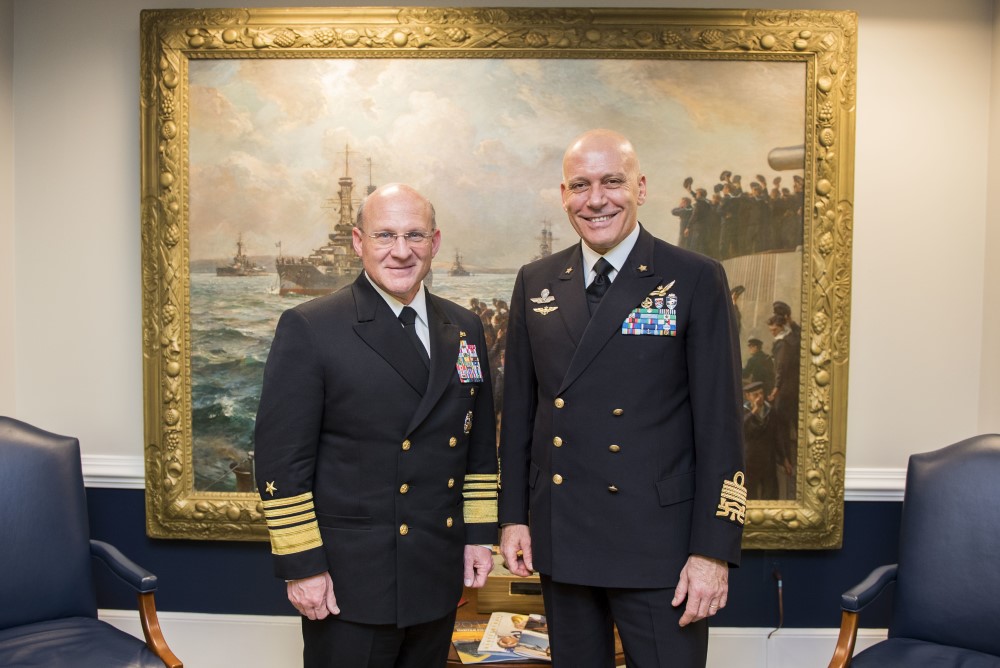
Chief of Naval Operations Adm. Mike Gilday, left, is shown hosting then-Chief of the Italian Navy Adm. Giuseppe Cavo Dragone at the Pentagon in this February 2020 picture. U.S. NAVY / Mass Communication Specialist 1st Class Raymond D. Diaz III

WASHINGTON — U.S. Chief of Naval Operations Adm. Mike Gilday met with the Italian Chief of Defense Staff Adm. Giuseppe Cavo Dragone at the Pentagon May 10, the CNO’s Public Affairs Office said in a release.

Gilday and Cavo Dragone discussed the long-lasting and vital maritime partnership between Italy and the United States, as well as the importance of global security.

“The very nature of our operating environment requires common values and a collective alliance,” said Gilday. “You have been a strong partner and gracious host to U.S. naval forces and our joint efforts in Europe. Working together is critical to regional security and stability.”

“We are ready to make further commitments in all domains, in what we consider an important portion of allied areas of responsibility, namely the wider Mediterranean region,” said Cavo Dragone.

Gilday and Cavo Dragone also spoke about strategic competition, China and Russia.

They both affirmed the close relationship of the U.S. and Italian navies and expressed appreciation for their partnership as NATO allies and as friends.

The U.S. and the Italian navy regularly operate together around the globe. In addition to conducting real-world tri-carrier operations, earlier this year the two navies also participated in exercises and activities such as Neptune Strike 2022, Obangame Express, and assorted bilateral drills. These exercises highlight NATO’s ability to integrate high-end maritime warfare capabilities to support the defense of the alliance.

Italy hosts American Sailors at Naval Support Activity (NSA) Naples, Naval Air Station Sigonella and NSA Naples Detachment Gaeta.

Gilday previously met with Cavo Dragone in February 2020 and October 2021, when he served as the chief of the Italian navy.


BAE Systems Testing ACV for Marine Corps Recon Program

BAE Systems is proposing the Marine Corps use its Amphibious Combat Vehicle for the Advanced Reconnaissance Vehicle program. BAE Systems

WASHINGTON – BAE Systems is offering the Marine Corps an alternative to its proposal to produce a new-start platform for the Advanced Reconnaissance Vehicle program by demonstrating a new version of its Amphibious Combat Vehicle, which is currently operational.

“We like to believe there is an advantage in a proven platform,” that has great land and water mobility and significant survivability, BAE representative Mark Brinkman said May 10. The advantages of adapting the ACV for the recon requirement include a single established parts supply line, a single school house for vehicle drivers and maintenance personnel, and an active production line, he said.

Brinkman discussed the BAE proposal next to a basic ACV that has been modified with an assortment of sensors and defensive systems required for the reconnaissance vehicle, on display at the Modern Day Marine exposition at the Walter E. Washington Convention Center.

The demonstration vehicle had optical and infrared sensors, a small tethered unmanned aerial vehicle, the ability to carry and command and control a larger class-two UAV, and counter-UAV systems. The modified ACV would support a vehicle commander, a driver and five sensor operators, each with a multi-function operating station, Brinkman said.

The Advanced Reconnaissance Vehicle program would replace the existing Light Armor Vehicle, which functions as a scout and troop support platform, but is nearing its end-of-service life. The Marine Corps has given contracts to General Dynamics Land Systems and Textron Systems to develop prototypes for the ARV. But BAE, on its own initiative, will test a modified ACV this summer, provide it for Marine testing and then submit a detailed proposal next year, Brinkman said.

A potential drawback for the BAE proposal is the Marines’ requirement for a vehicle weight limit of 37,000 pounds, set to allow four vehicles to be carried on an LCAC ship-to-shore connector. The BAE ACV weighs about 35 tons – 70,000 pounds.

Brinkman said the ACV’s weight is offset by its “ability to swim” from ship to shore, reducing the need for a connector, like the LCAC. 

But that could minimize the standoff distance for the amphibious shipping as the ACV swims at about 7 knots, compared to the 30-knot water speed of the LCAC.


Coast Guard Offloads $5.6 Million in Seized Cocaine in San Juan, Puerto Rico

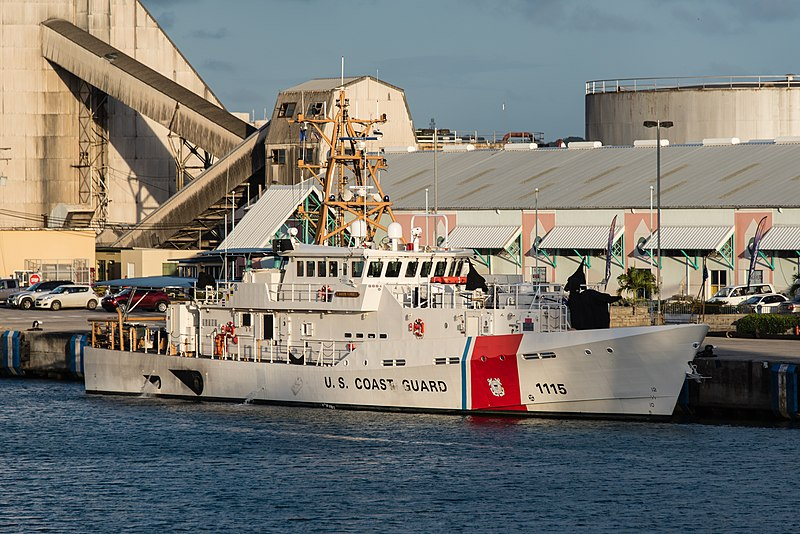
USCGC Joseph Napier, shown here in the Port of Bridgetown, Barbados.

SAN JUAN, Puerto Rico — The crew of the Coast Guard Cutter Joseph Napier and Caribbean Corridor Strike Force agents offloaded 626 pounds of seized cocaine Monday in San Juan, Puerto Rico, the Coast Guard 7th District said in a May 10 release. 

The offload of contraband resulted from a go-fast vessel interdiction April 28, 2022, in Mona Passage waters near the Dominican Republic. 

The interdiction is the result of multi-agency efforts involving the Caribbean Border Interagency Group and the Caribbean Corridor Strike Force. The seized cocaine has an estimated wholesale value of approximately $5.6 million dollars. 

During the morning of April 28, the crew of a Coast Guard HC-27J Spartan aircraft detected a suspect vessel north of Mona Island, Puerto Rico. Coast Guard watchstanders in Sector San Juan diverted the cutter Joseph Napier that arrived on scene with the suspect vessel. Upon detecting the presence of the Coast Guard cutter, the occupants of the suspect vessel were observed jettisoning multiple bales of suspected contraband into the water and attempting to flee the area toward Dominican Republic territorial waters. Once in Dominican Republic waters, the crew of a Dominican Republic navy vessel interdicted the suspect vessel and apprehended three Dominican Republic nationals who were aboard. Meanwhile, the crew of the cutter Joseph Napier recovered 11 bales of the jettisoned suspected contraband, which tested positive for cocaine.   

“Safeguarding the nation’s southernmost maritime border is among our top priorities,” said Capt. Gregory H. Magee, Coast Guard Sector San Juan commander. “You can expect to see many more of these interdictions from the Coast Guard, federal and local law enforcement, and from our Dominican Republic Navy partners as we work together to stop drug smuggling go-fast vessels at sea and prevent them from making landfall in Puerto Rico.” 

Special Agents supporting the Caribbean Corridor Strike Force are leading the investigation into this case.   

Cutter Joseph Napier is a 154-foot fast response cutter that is homeported in San Juan, Puerto Rico.