General Atomics Awarded Propulsor Demonstration Hardware Contract  

SAN DIEGO — General Atomics Electromagnetic Systems (GA-EMS) has been awarded a sole-source delivery task order from Naval Surface Warfare Center, Carderock Division to provide structural hardware for the propulsor of the Navy’s new Columbia-class submarine, the company said in a May 10 release. The delivery task order is part of a broad Indefinite Delivery Indefinite Quantity Propulsor Demonstration Hardware contract to develop and deliver critical components and hardware for installation on current and future U.S. Navy nuclear-powered submarines. 

“This is one of several task orders awarded to GA-EMS under the PDH contract that applies our advanced engineering and manufacturing expertise to deliver essential hardware components supporting existing and future submarines and other undersea vehicles,” stated Scott Forney, president of GA-EMS. “From engineering Virginia-class bearings to developing new propulsion techniques for the next submarine design, we facilitate the use of new techniques, unique materials, precision machining and extensive test procedures to deliver equipment that meets exacting specifications and the highest quality and reliability standards to support the warfighter.

“This task order involves the precision machining of components to extremely tight tolerances and demanding material specifications, and the delivery of approximately 10,000 pounds of hardware that will affix the Propulsor Bearing Support Structure, already provided by GA-EMS, to the submarine,” Forney said. “The delivery will meet the shipyard’s schedule for the installation of critical components onto the first Columbia-class submarine currently under construction, and it will provide the manufacturing template for these structures in follow-on ships of this class.”  

The hardware is scheduled for delivery in early 2023. Engineering is underway at GA-EMS’ San Diego and Tupelo, Mississippi, facilities, with all manufacturing occurring in Tupelo. 


Oshkosh Displays Vehicles at Modern Day Marine Expo 

The Pratt Miller Defense EMAV can carry a 6,000-pound payload capacity and flat rack and is designed to support most logistics missions. OSHKOSH DEFENSE

OSHKOSH, Wis. — Oshkosh Defense, a wholly-owned subsidiary of Oshkosh Corp., is displaying a Joint Light Tactical Vehicle and trailer and a Pratt Miller Defense Expeditionary Modular Autonomous Vehicle at the Modern Day Marine Expo 2022. The vehicles will be on display at the Walter E. Washington Convention Center in Washington, D.C. from May 10-12, 2022. 

The 4-door Heavy Guns Carrier JLTV will be equipped with the John Cockrill CPWS 2.0 turret and Northrop Grumman 25x137mm M242 Bushmaster chain gun. 

“The modular design of the Oshkosh Defense JLTV, which we’ve built over 16,000, can be adapted to dozens of military missions, from serving as battlefield ambulances to hosting antitank weapons,” said George Mansfield, Vice President and General Manager of Joint Programs for Oshkosh Defense. “The ability to easily integrate weapons that increase the JLTV’s firepower and lethality cost-effectively is yet another example of the vehicle’s flexibility and adaptability for next-generation warfare.” 

The Pratt Miller Defense EMAV on display is a tracked, autonomous vehicle developed for the Marine Corps Warfighting Lab. The EMAV’s hybrid-electric powertrain is capable of silent watch and silent mobility and provides exportable power capability. Furthermore, with a 6,000-pound payload capacity and flat rack, the EMAV is designed to support most logistics missions. 

“Oshkosh Defense’s advanced technology capabilities run the gamut from autonomous vehicles to hybrid-electric powertrains,” said Pat Williams, vice president and general manager of U.S. Army and U.S. Marine Corps Programs for Oshkosh Defense. “We partner with the U.S. Marine Corps and other customers to understand and analyze the challenges they face and explore solutions. This collaboration allows us to apply these next-generation defense technologies and advanced systems to our vehicles in order to meet their evolving mission needs.” 


Fuse Installs Permanent Remote Monitoring Solution at Navy’s Pacific Missile Range Facility  

WASHINGTON — Fuse Integration, a federal defense communications, networking and computing solutions provider, has completed the first permanent installation of its Tactical Technologies Toolset at a U.S. Navy shore facility, the company announced in a May 9 release. T3, a remote network monitoring and management solution for multidomain operations, was installed for the Naval Surface Warfare Center, Dahlgren Division, at the Pacific Missile Range Facility (PMRF) in Barking Sands, Hawaii. PMRF personnel will use T3 to monitor and manage the Aegis SPY radar at that facility.  

“Ballistic missiles are one of our nation’s fastest growing threats, and it’s imperative that the Navy’s air-and-missile-defense radar is working every moment of every day,” said Sumner Lee, CEO of Fuse. “We’re proud to support PMRF personnel with our T3 installation, so they can ensure that their Aegis SPY radar is working as needed, at all times.”  

Designed to provide an easier way to view the health and status of distributed fleet networks and systems, T3 presents commanders and decision-makers with a layout of tactical data link, network and radar settings and status. T3’s high-tech, intuitive user interface will support PMRF personnel to better troubleshoot, maintain and manage the radar at this facility during day-to-day operations as well as for special test events.  

For this landmark installation, the Fuse team coordinated planning and collaboration with PMRF personnel and Aegis subject matter experts at the NSWC Dahlgren Division.  

Fuse is a warfighter-focused engineering and design firm providing innovative communications, networking and computing solutions for defense customers. The company’s virtualized network systems, tactical edge virtual network and airborne networking gateway products improve the sharing of information, video, text and voice among warfighters throughout airborne, maritime and ground environments. Founded in 2010, Fuse is a service-disabled veteran-owned small business with headquarters in San Diego and a corporate office in Washington, D.C. 


Marine Corps Force Design Update Adjusts MV-22 Squadron Force Levels 

An MV-22B Osprey assigned to the Aviation Combat Element from Special Purpose Marine Air-Ground Task Force-Crisis Response-Africa 20.2, Marine Forces Europe and Africa, conducts deck landing qualifications aboard the amphibious assault ship USS Bataan (LHD 5), June 28, 2020. U.S. Marine Corps / Cpl. Tanner Seims

ARLINGTON, Va. — The Marine Corps’ Force Design 2030 annual report has announced adjustments in the force levels of its Marine medium tiltrotor (VMM) squadrons that fly the MV-22B Osprey assault transport aircraft.  

“We originally planned to divest three MV-22 medium tiltrotor squadrons from the Active Component, which would have resulted in a total of 14 squadrons of 12 aircraft each,” said the report, released May 9 by Marine Corps Commandant Gen. David H. Berger. “However, detailed analysis demonstrated that 16 squadrons of 10 aircraft each better satisfies joint force requirements and better supports service needs to organize, train and equip. In particular, this force structure simplifies the formation of a Marine Expeditionary Unit’s aviation combat element.” 

“Quite frankly, it was personnel-driven,” said Lt. Gen. Karsten S. Heckl, deputy commandant for combat development and integration, Headquarters, U.S. Marine Corps, and commanding general, Marine Corps Combat Development Command, Marine Corps Base Quantico, Virginia, speaking May 6 to reporters and amplifying the Corps’ reasoning for the change in VMM squadron aircraft complement.  

“There were many external factors to that primary factor of personnel,” Heckl said. “So, there a few levers the commandant can pull on to generate resources. The conclusion that the Headquarters, Marine Corps, staff came to was that manpower was the most appropriate because we were over-sized, we were at an unsustainable number, so that was the logical choice to make.” 

Heckl said the squadron size of 10 MV-22Bs would give the Corps the flexibility to add more F-35B Lightning II strike fighters to the ACE if it so chose. Currently the ACE typically deploys with six F-35B Lightning II strike fighters or AV-8B Harrier II attack aircraft.  

“Right now, the MEUs are going out — and it depends whether it’s 10 or 12 V-22s when the [MEUs] go out [on deployment],” he said. When we start making every deployment with [F-35Bs] and the possibility that the numbers [of F-35Bs] that would go out — those numbers changing — the 10- [V-22s per squadron] makes all the sense in the world. 

“Quite frankly, when you take into the equation the attrition rate, pipeline aircraft, training aircraft, the numbers work out pretty well,” he said.  

The Marine Corps has cut or is cutting four MV-22B squadrons. The stand-up of VMM-212 was canceled in fiscal 2019. VMM-264 and VMM-166 were deactivated in fiscal 2020 and 2021, respectively. VMM-164 will be deactivated in fiscal 2022. The remaining force will include 14 active-component fleet VMM squadrons, one active-component VMMT fleet replacement squadron and two reserve-component VMM squadrons. 

The Force Design annual report also called for an experiment in active-reserve integration of a reserve VMM squadron. The commandant directed the Corps to “perform Active Component/Reserve Component integration proof of concept in 2d MAW [Marine Aircraft Wing] by incorporating VMM-774 into an Active Component Marine Aircraft Group in [fiscal 2023].” 

VMM-774 is based at Naval Station Norfolk, Virginia, also the base of two Navy helicopter mine-countermeasures squadrons that have been combined active-reserve squadrons. 


Naval Safety Command to Conduct No-Notice, Short-Notice Inspections 

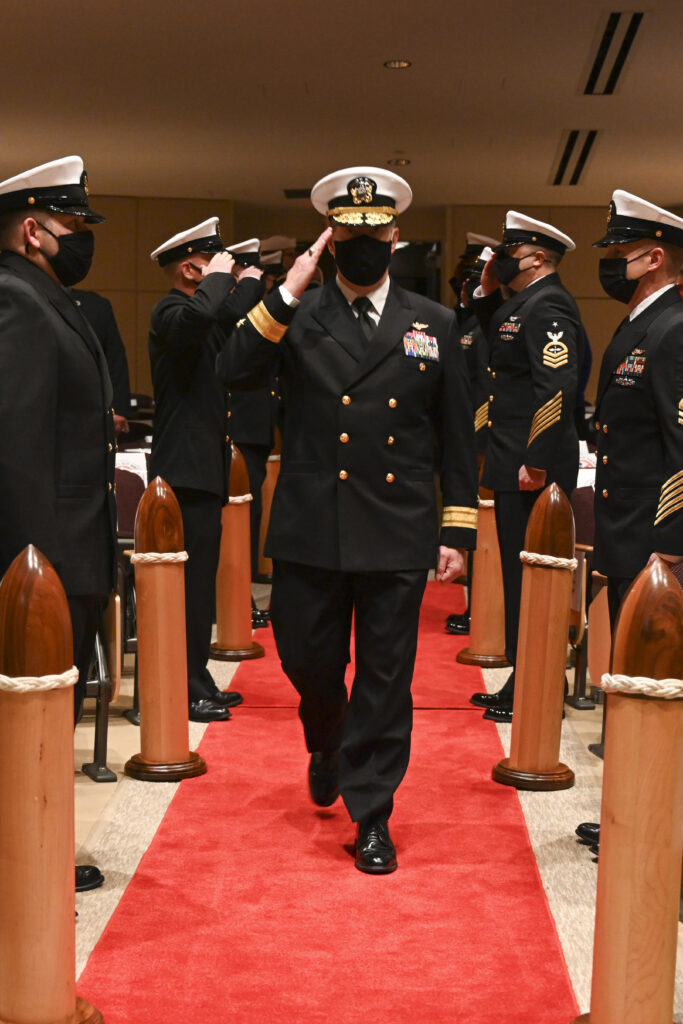
Rear Adm. Frederick R. Luchtman, commander, Naval Safety Command, salutes the sideboys during an establishment ceremony for the Naval Safety Command on Feb. 4. U.S. NAVY / Mass Communication Specialist 2nd Class (SW/AW) Weston A. Mohr

ARLINGTON, Va. — The new Naval Safety Command intends to hold no-notice and short-notice safety inspections of Navy commands to identify and understand risk and assess the safety posture of the fleet, the new command’s first commander said.   

One-star Rear Adm. Fredrick “Lucky” Luchtman, speaking May 5 in a session of the U.S. Navy Memorial’s SITREP Speaker Series, also said the new command will become a two-star billet soon, filled by a former carrier strike group or expeditionary commander, thereby giving greater perspective “on all things safety throughout the fleet.” 

The Naval Safety Command was established from the old Naval Safety Center on Feb. 7, 2022, to elevate the attention to safety, assessment of it and accountability for it in the fleet. All of the former directors of the Naval Safety Center since it was established in 1951 have been aviators, as is the first current commander of the Naval Safety Command, Luchtman. During the 1950s the mishap rate of naval aviation as it upgraded from piston-engine aircraft to jets skyrocketed and the Navy launched the center to assess the causes and propose solutions. 

Luchtman reports directly to the chief of naval operations, a reflection of the Navy’s increased emphasis on safety, especially in the wake of the fire that destroyed the amphibious assault ship USS Bonhomme Richard. 

The admiral estimates that mishaps cost the Navy $1 billion per year in loss of aircraft, steaming time for ships and personnel costs, among other costs. The year 2020 was even more costly with the loss of the Bonhomme Richard. 

The Naval Safety Command will be sending assessment teams out to the fleet to determine the effectiveness of the safety management systems. The command is developing “a cadre of professionals who can truly assess compliance.” Luchtman said one of his goals is to streamline and simplify the safety management system by identifying risk, communicating it and holding accountability at the right level.  

“The accountability piece is absolutely key,” he said. Referring the Bonhomme Richard incident, he said, “the system isn’t healthy as it could be.” 

Luchtman mentioned one demographic that has a bearing on automotive safety in the Marine Corps, a service that makes heavy use of motor transport. He said 25% of Marine Corps recruits did not have a driver’s license, a percentage far large than a generation ago. 

Luchtman’s successor will be a surface warfare officer, Rear Adm. Christopher M. Engdahl, currently commander, Expeditionary Strike Group 2 and commander, Amphibious Force, U.S. 7th Fleet.  


CNO Updates Professional Reading Program    

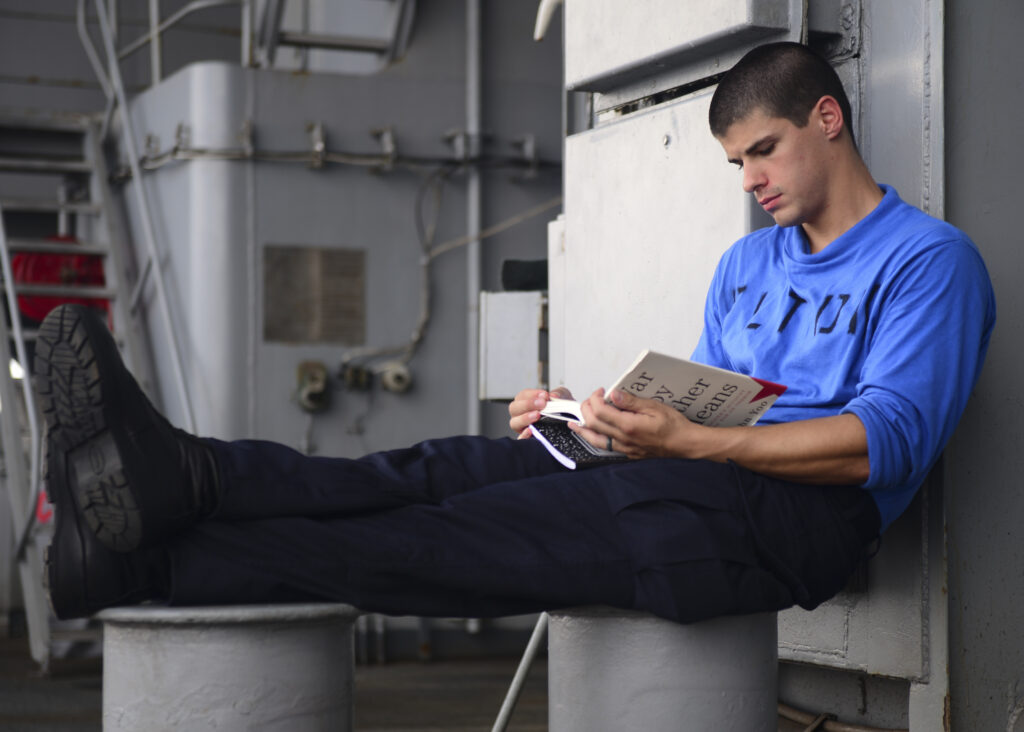
U.S. Navy Airman Benjamin Adams reads a book on the fantail of the aircraft carrier USS Nimitz (CVN 68), July 5, 2017, in the South China Sea. U.S. NAVY / Mass Communication Specialist 3rd Class Ian Kinkead

WASHINGTON — Chief of Naval Operations Adm. Mike Gilday released an update to the CNO Professional Reading Program, May 6, the CNO’s public affairs office said in a release.     

The CNO-Professional Reading Program consists of 12 books, and is a mix of writing genres including fiction, non-fiction, military, strategy, management, and technology, among others.    

“A learning mindset is essential to accelerating our warfighting advantage,” said Gilday. “A Navy that learns, adapts, and improves the fastest will be the most successful. Knowledge sharing is essential to creating a learning culture.”    

The goal of the program is to contribute to a culture dedicated to warfighting and learning, while simultaneously supporting the personal and professional development of Sailors beyond that of their primary designator or rating.    

“We are driving a fleet-wide campaign of self-improvement,” said Gilday. “We must foster an organization that supports and empowers Sailors to have an independent quest for knowledge through reading and information sharing. What you know and how fast you learn is relevant in this era of strategic competition.”   

The following books are included in the newly released update:   

  1. “To Rule the Waves” by Bruce Jones     
  2. “A Brief Guide to Maritime Strategy” by James Holmes     
  3. “China as a 21st Century Naval Power” by Michael. A. McDevitt     
  4. “Not One Inch” by Mary E. Sarotte     
  5. The Sailor’s Bookshelf: Fifty Books to Know the Sea” by Admiral James G. Stavridis    
  6. “Army of None: Autonomous Weapons and the Future of War” by Paul Scharre     
  7. “Fortune Favors Boldness” by Barry Costello     
  8. “The Last Stand of the Tin Can Sailors: The Extraordinary World War II Story of the U.S. Navy’s Finest Hour” by James Hornfischer     
  9. “World War II at Sea: A Global History” by Craig Symonds     
  10. “Ashley’s War: The Untold Story of a Team of Women Soldiers on the Special Ops Battlefield” by Gayle T. Lemmon    
  11. “Dare to Lead” by Brene Brown     
  12. “Mindset: The New Psychology of Success” by Carol Dweck   
  13. Link to CNO’s Professional Reading Program website:  https://www.navy.mil/CNO-Professional-Reading-Program/.     

Most of the books are available at no cost to Sailors in both e-Book and digital audio format from the Navy MWR digital library collection.  Eligible patrons can download the books through: https://www.navymwrdigitallibrary.org.    


Coast Guard to Commission Fast Response Cutter Pablo Valent 

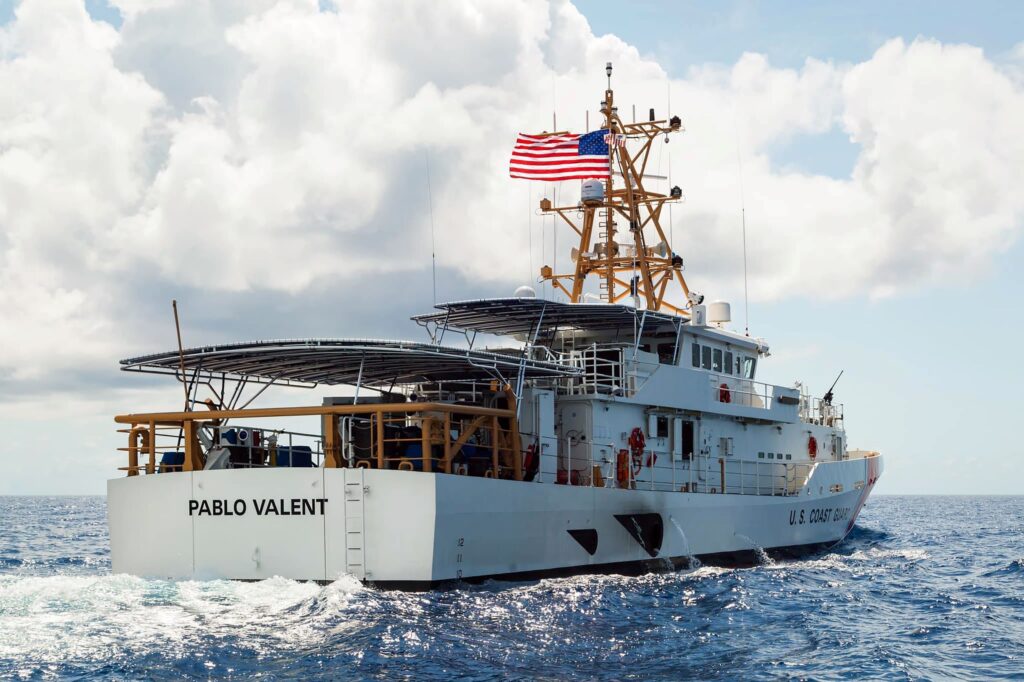
Coast Guard Cutter Pablo Valent, a 154-foot Sentinel-class vessel, is homeported at Coast Guard Sector St. Petersburg, Florida. U.S. COAST GUARD

ST. PETERSBURG, Fla. — The Coast Guard will commission the 48th Sentinel-class fast response cutter Pablo Valent (WPC 1148), into service at Coast Guard Sector St. Petersburg on May 11, the Coast Guard 7th District said May 6. 

Rear Adm. Brendan McPherson, commanding officer of the Coast Guard 7th District, will preside over the ceremony. Cecilia Guillot, Valent’s great-niece, is the ship’s sponsor.  

The cutter’s namesake Pablo Valent was originally from Corpus Christi, Texas, and joined the United States Life-Saving Service in 1912. In September 1919, Valent helped rescue the crew of the hurricane-damaged schooner Cape Horn off the coast of Texas. For his heroic efforts, Valent received the Silver Lifesaving Medal and the Grand Cross of the American Cross of Honor Society. Valent was one of the first Hispanic Americans to receive these honors.  

The Cutter Valent is the 48th FRC and is the first to be homeported in St. Petersburg with missions including search and rescue, maritime law enforcement, coastal security and living marine resources. There are 12 other FRCs in Florida, which operate throughout the Caribbean Sea. 

Sector St. Petersburg is one of the Coast Guard’s largest commands, with an area of responsibility encompassing over 400 nautical miles of coastline along Florida’s west coast. 


Navy to Christen Future Littoral Combat Ship Beloit 

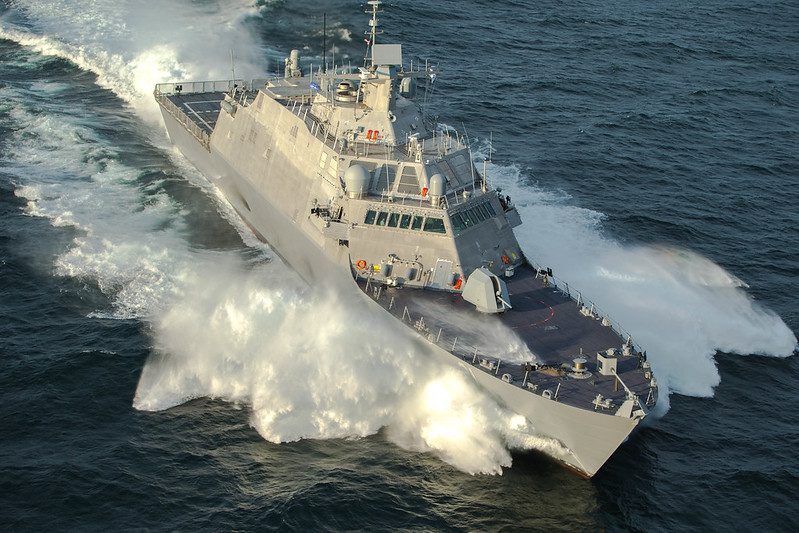
The future USS Beloit’s sister Freedom-class LCS, the USS Minneapolis-Saint Paul (LCS 21). LOCKHEED MARTIN

ARLINGTON, Va. — The Navy will christen its newest Freedom-variant littoral combat ship, the future USS Beloit (LCS 29), during a 10:00 a.m. CDT ceremony Saturday, May 7, in Marinette, Wisconsin, the Defense Department said May 6. 

The Sen. Tammy Baldwin (D-Wisconsin) will be the principal speaker. Also providing remarks are Rep. Mike Gallagher (R-Wisconsin), Vice Adm. John Fuller, Naval Inspector General, Vice Adm. Francis Morley, principal military deputy to the assistant secretary of the Navy for Research, Development, and Acquisition, Lori Curtis Luther, city manager of Beloit, Wisconsin, as well as shipbuilders Steve Allen, vice president, Small Combatants and Ship Systems, Lockheed Martin Integrated Warfare Systems and Sensors, and Mark Vandroff, CEO, Fincantieri Marinette Marine. 

In a time-honored Navy tradition, the ship’s sponsor, Beloit native and retired Army Maj. Gen. Marcia Anderson, will break a bottle of sparkling wine across the bow. 

“The future USS Beloit will be the first U.S. Navy ship honoring the proud naval contributions of Beloit, Wisconsin,” said Secretary of the Navy Carlos Del Toro. “I have no doubt the Sailors of USS Beloit will stand the watch with pride and be ready to respond to any mission, wherever, and whenever, there is a need.” 

The LCS class consists of two variants, the Freedom and the Independence, designed and built by two industry teams. Lockheed Martin leads the Freedom-variant team, or odd-numbered hulls, constructed in Marinette, Wisconsin. Austal USA leads the Independence-variant team in Mobile, Alabama, for LCS 2 and the subsequent even-numbered hulls. 

LCS 29 is the 15th Freedom-variant LCS and 29th in the LCS class. It is the first ship named in honor of the city of Beloit, Wisconsin. 


Coast Guard Cutter Cuttyhunk Decommissioned after 34 Years of Service 

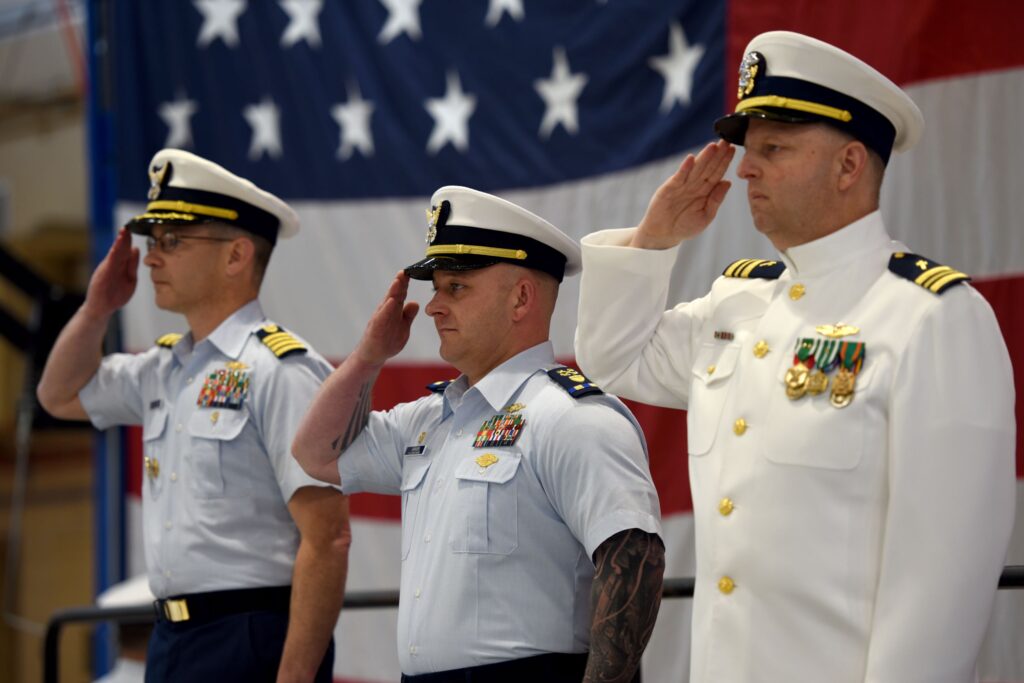
The official party renders solute during a ceremony held to decommission Coast Guard Cutter Cuttyhunk (WPB 1322) from service Thursday, May 5, at Air Station Port Angeles. Captain Mark McDonnell, District 13 Chief of Response, (left) oversaw the ceremony. U.S. COAST GUARD / Petty Officer 3rd Class Michael Clark

PORT ANGELES, Wash. — The Coast Guard decommissioned Coast Guard Cutter Cuttyhunk (WPB 1322) May 5 during a ceremony held at Air Station Port Angeles that was presided over by Capt. Mark McDonnell, 13th Coast Guard District Chief of Response. 
 
Cuttyhunk was one of the Coast Guard’s 37 remaining 110-foot Island-class patrol boats. The fleet of Island-class cutters is being replaced by 154-foot Sentinel-class cutters. 
 
Commissioned in 1988, the Cuttyhunk was the 22nd of 49 110-foot patrol boats built in support of the Coast Guard’s maritime homeland security, migrant and drug interdiction, fisheries enforcement and search and rescue missions. Cuttyhunk was built by Bollinger Shipyards in Lockport, Louisiana, and commissioned on Oct. 5. Cuttyhunk was named after Cuttyhunk Island, the site of the first English settlement in New England, located off the southern coast of Massachusetts. 
 
Over the past 34 years of service, Cuttyhunk’s crew conducted a wide range of operations. The cutter’s crews completed over 1,000 operations ranging from law enforcement boardings to search and rescue responses throughout the Pacific Northwest. Cuttyhunk assisted U.S. Naval Base Kitsap Bangor in several submarine escorts before Coast Guard Maritime Force Protection Unit Bangor was established to ensure the safe transport of Ship Submersible Ballistic Submarines. 
 
Nicknamed “The Pest of the West,” Cuttyhunk assisted in one of the largest maritime drug seizures in the Pacific Northwest, near Cape Flattery, Washington, in December of 1997. More than 3,500 pounds of marijuana, estimated at a street value of $15 million, was recovered from the OK Jedi, a 60-foot sailboat with three people onboard. 
 
“It has been an honor and privilege to serve alongside the final crew of Coast Guard Cutter Cuttyhunk,” said Chief Warrant Officer Daniel Garver, commanding officer. “During my time onboard, there have been many engineering challenges on our aging 110-foot ship, and I have witnessed the resiliency of our crew as they spent time away from families in selfless service to our country. I am grateful for the crew’s dedication which echoes the hard work put forth by our predecessors during the cutter’s 34 years of service.” 

Cuttyhunk’s crew is scheduled to transit to Ketchikan, Alaska. There, the crew will spend several weeks preparing to bring Coast Guard Cutter Anacapa (WPB 1335) south to Port Angeles. Anacapa is also a 110-foot Island-class patrol boat, and was previously stationed in Petersburg, Alaska. She will be shifting homeports to Port Angeles to serve the Pacific Northwest. The Anacapa will be arriving after completing an overhaul in Ketchikan. 


Marine Corps Plans to Activate Second Adversary Aircraft Squadron in 2023 

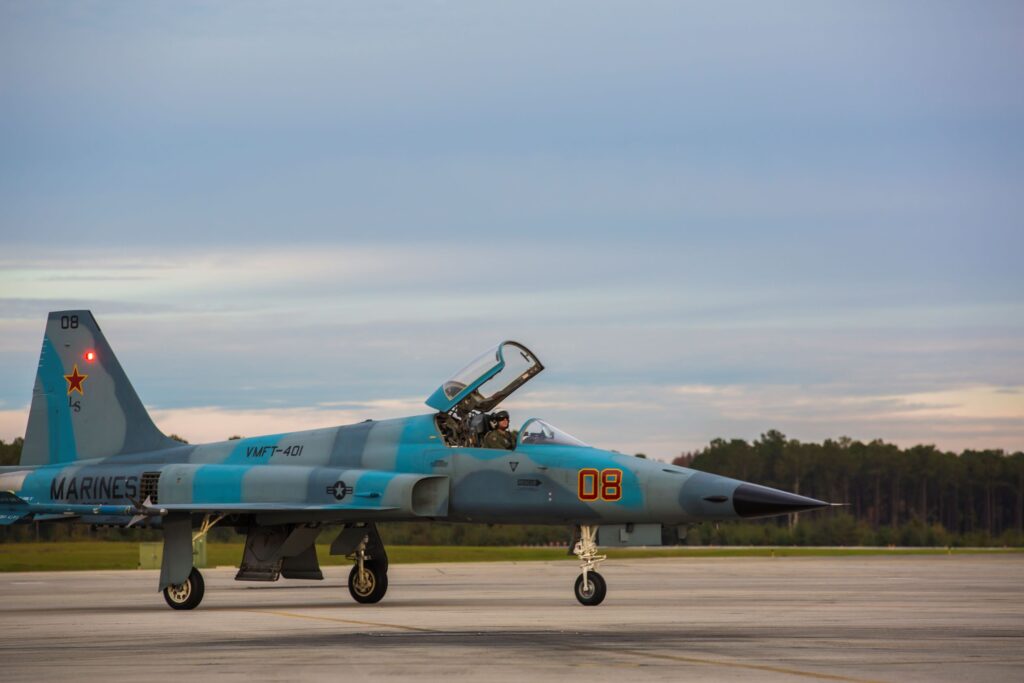
An F-5N Tiger II taxis after landing aboard Marine Corps Air Station Beaufort in South Carolina in 2015 to support Marine Fighter Attack Training Squadron 501 in air-to-air training. U.S. MARINE CORPS AIR STATION BEAUFORT / Sgt. Dengrier Baez

ARLINGTON, Va. — The Marine Corps plans to activate a second adversary aircraft squadron to meet the future aerial combat training needs of its fighter attack squadrons. The second squadron will provide the East Coast with similar training assets as the West Coast.  

According to the 2022 Marine Corps Aviation Plan released this week, Marine Fighter Training Squadron 402 (VMFT-402) will be activated in fiscal 2023 at Marine Corps Air Station Beaufort, South Carolina, scheduled to be safe for flight by the beginning of 2024. 

The Corps has long fielded reserve squadron VMFT-401 at MCAS Yuma, Arizona, which flies Northrop 11 single-seat F-5N and one F-5F Tiger II fighters. The squadron is upgrading to 11 F-5N+ and one F-5F+ aircraft. 

VMFT-402, which also will be a reserve squadron initially, will be equipped with three F-5N+ aircraft but eventually will operate eight F-5N+ and two F-5F+ aircraft.  

To equip the new squadron, the Marine Corps has acquired 11 additional F-5 aircraft from the Swiss air force through the Naval Air Systems Command. The aircraft will be delivered to the Corps over a four-year period beginning in the fourth quarter of 2023.  

The Navy and Marine Corps F-5 fleet is going through upgrades to increase capabilities and extend the service life. The fleet is being upgraded with digital cockpits at a rate of two or three aircraft per year. The Naval Air Systems Command plans to integrate TCTS II Tactical Combat Training System – Increment II (TCTS II) to “allow synthetic adversary injects to decrease the forecasted gap in adversary training.”    

“Serving as a training asset for the entire MAGTF, as well as the joint force, the F-5 has seen adversary requirements grow significantly over the past 13 years,” according to the aviation plan, in large part because of the pilot training requirements of the F-35 fleet replacement squadrons VMFA-501 and VMFA-502. “Annual fleet adversary requirements are expected to also increase for transitioning squadrons from 12,000 air-to-air sorties in [fiscal 2022 to 17,000 sorties per year in order to meet T2.0 requirements in [fiscal 2025].” 

The aviation plan said that “Adversary capacity is the greatest issue in Marine Corps air-to-air training, followed closely by range availability and modernization, and training simulator capabilities. VMFT-401 can source up to 3,300 sorties per year, restrained by aircraft utilization and numbers of F-5s assigned. Combining A/A [air-to-air] requirements for fleet training, FRS [fleet replacement squadron] production and weapon school support, the USMC builds an adversary requirement of nearly 15,000 sorties in 2022. Accordingly, the USMC suffers over an 11,000-sortie capacity gap. Aviation is looking at options to close this gap.” 

The U.S. military uses commercial air services which fly former military jets in the adversary role, but, according to the aviation plan, “commercial air services cannot satisfy all of the adversary requirements. The future lies in multiple solutions that include using the fleet of F-5s efficiently, exploring low-cost training opportunities, incorporating Live, Virtual, Constructive capability, and commercial air services to augment requirements.”