WASHINGTON — The keel for the future USNS Earl Warren (T-AO 207), the Navy’s 3rd John Lewis-class fleet replenishment oiler, was laid at General Dynamics National Steel and Shipbuilding Co. on April 30, Team Ships Public Affairs said May 2.
A keel laying is the recognition of the start of a ship’s construction. It is the joining together of a ship’s modular components and the authentication or etching of an honoree’s initials into a ceremonial keel plate. The ship’s sponsor, Supreme Court Justice Elena Kagan, had her initials etched into the keel plate by NASSCO welders.
“We are looking forward to getting these ships to the fleet to support at-sea operations,” said John Lighthammer, program manager, Auxiliary and Special Mission Shipbuilding Program Office. “This new class of oilers is bringing much needed capability and capacity to the fleet.”
The John Lewis-class T-AOs will be operated by Military Sealift Command to provide fuel and lubricating oil, and small quantities of fresh and frozen provisions, stores, and potable water to Navy ships at sea, and fuel for embarked aircraft.
The oilers feature the capacity to carry barrels of oil, a significant dry cargo capacity, aviation capability and a speed of 20 knots. NASSCO designed the new vessels with double hulls to protect against oil spills and strengthened cargo and ballast tanks. The new T-AOs will add capacity to the Navy’s Combat Logistics Force and become the cornerstone of the fuel delivery system.
USNS John Lewis Conducts Acceptance Trials
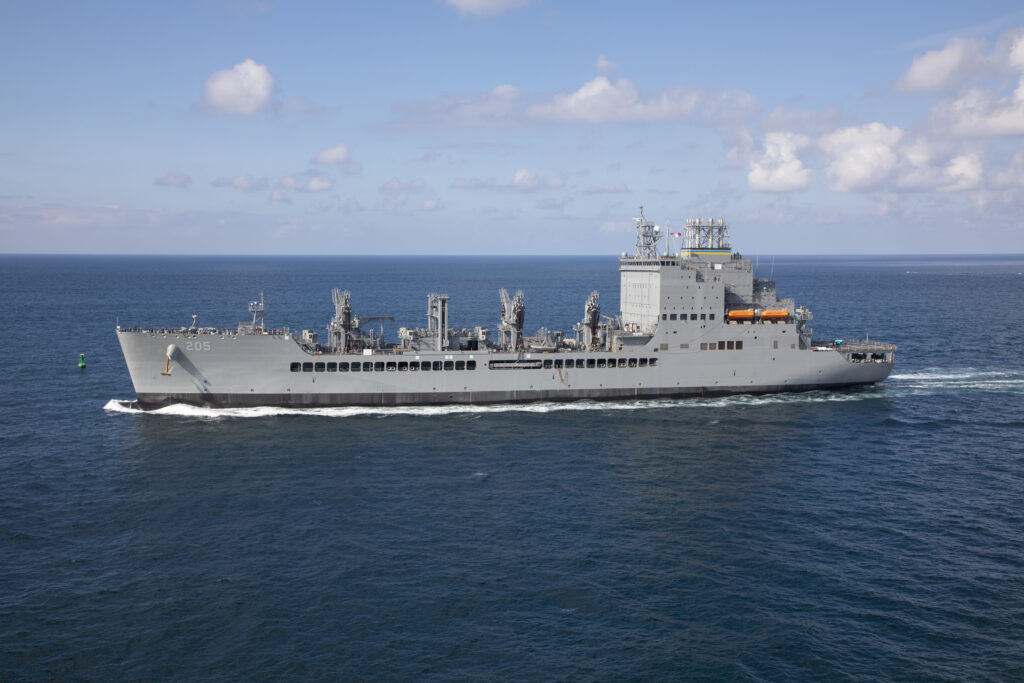
USNS John Lewis (T-AO 205), the Navy’s lead ship of its new class of fleet replenishment oilers, conducted acceptance trials on April 25. GENERAL DYNAMICS NATIONAL STEEL AND SHIPBUILDING CO.
WASHINGTON — USNS John Lewis (T-AO 205), the Navy’s lead ship of its new class of fleet replenishment oilers, conducted acceptance trials on April 25, Team Ships Public Affairs said May 2.
Acceptance trials consist of a series of in-port and at-sea demonstrations that allow the Navy and the shipbuilder, General Dynamics National Steel and Shipbuilding Co., to assess the ship’s systems and readiness prior to delivery to the Navy.
“The John Lewis-class oilers will add capacity to the Navy’s Combat Logistics Force and become the cornerstone of the fuel delivery system at sea,” said John Lighthammer, program manager, Auxiliary and Special Mission Shipbuilding Program Office. “We are excited to welcome the USNS John Lewis to the fleet.”
The John Lewis-class T-AOs will be operated by Military Sealift Command to provide fuel and lubricating oil, and small quantities of fresh and frozen provisions, stores, and potable water to Navy ships at sea, and fuel for the embarked aircraft.
The oilers feature the capacity to carry barrels of oil, a significant dry cargo capacity, aviation capability and a speed of 20 knots. NASSCO designed the new vessels with double hulls to protect against oil spills and strengthened cargo and ballast tanks.
NASSCO is currently in production on USNS Harvey Milk (T-AO 206), USNS Earl Warren (T-AO 207), and USNS Robert F. Kennedy (T-AO 208). The future USNS Lucy Stone (T-AO 209) and USNS Sojourner Truth (T-AO 210) are under contract. NASSCO is also currently in production of two Expeditionary Sea Bases (ESB) – the future USS John L. Canley (ESB 6) and USS Robert E. Simanek (ESB 7).
Keel Authenticated for Future USS John L. Canley
WASHINGTON — The keel for the future USS John L. Canley (ESB 6), the Navy’s fourth expeditionary sea base, was laid at General Dynamics National Steel and Shipbuilding Co. shipyard in San Diego on April 30, Team Ships Public Affairs said May 2.
The ship is named for Medal of Honor recipient retired Marine Corps Sgt. Maj. John L. Canley. Canley was awarded the nation’s highest honor 50 years after his actions serving as company gunnery sergeant, Company A, First Battalion, First Marines, First Marine Division in the Republic of Vietnam during the Battle of Hue City.
“Sergeant Major Canley’s story is one of service, honor, and commitment. All those who serve aboard his namesake ship will carry on his distinguished legacy,” said Tim Roberts, Strategic and Theater Sealift program manager, Program Executive Office, Ships. “These mobile, modular sea base ships are optimized to support the needs of our Sailors and Marines while providing critical access in the maritime domain.”
Expeditionary sea base ships are highly flexible platforms used across a broad range of military operations supporting multiple operational phases. Acting as a mobile sea base, they are a part of the critical access infrastructure that supports the deployment of forces and supplies to provide prepositioned equipment and sustainment with adaptable distribution capability.
In 2019, the Navy decided to commission all expeditionary sea base ships to allow them to conduct a broader and more lethal mission set compared to original plans for them to operate with a USNS designation. A Navy O-6 commands ESBs and a hybrid-manned crew of military personnel and Military Sealift Command civilian mariners. This crew makeup provides combatant commanders with increased operational flexibility in employing the platform.
Construction of the future USS Robert E. Simanek (ESB 7) and the Navy’s John Lewis Class Fleet Replenishment Oilers (T-AO) are ongoing at GD-NASSCO.
U.S. 4th Fleet and USNS Burlington Conduct Fleet Experimentation in Key West
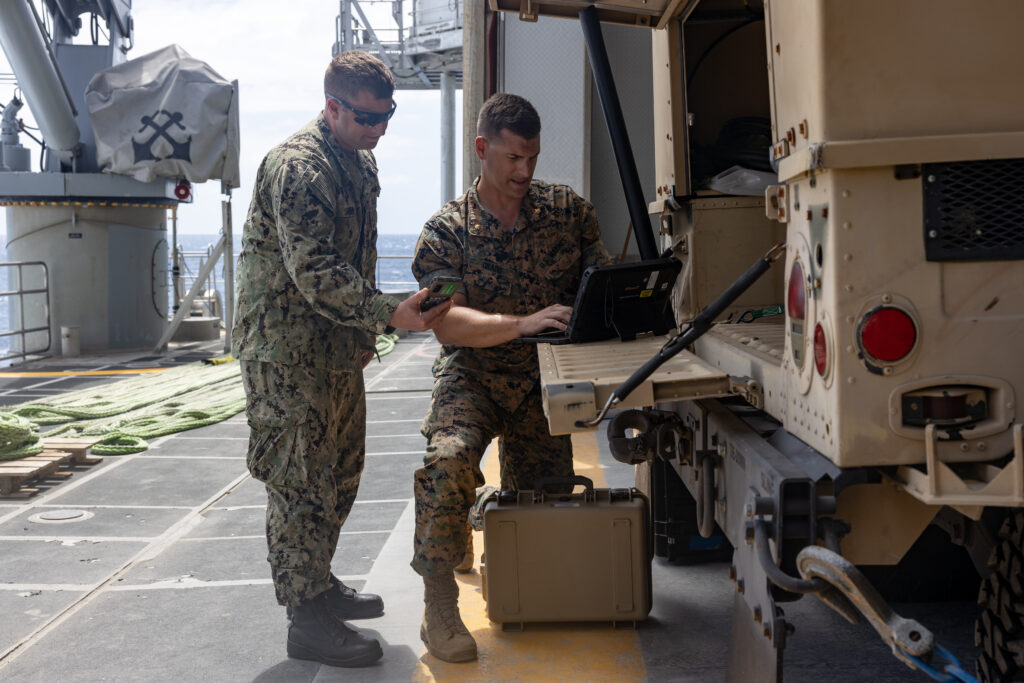
Marine Corps Maj. Brooks Grado, an intelligence officer with U.S. Marine Corps Forces, Southern Command and Navy Cmdr. Jonathan Saburn, a future operations officer assigned to U.S. 4th Fleet, discuss future operating concepts aboard the expeditionary fast transport vessel USNS Burlington (T-EPF-10) during a fleet experimentation period. U.S. MARINE CORPS / Cpl. Brendan Mullin
ATLANTIC OCEAN — The Spearhead-class expeditionary fast transport vessel USNS Burlington (T-EPF-10) completed U.S. Naval Forces Southern Command/U.S. 4th Fleet 2022 Fleet Experimentation events in Key West, Florida, April 22-27, 2022, said U.S. Naval Forces Southern Command / U.S. 4th Fleet said April 29.
The U.S. Southern Command area of responsibility provides a permissive environment to experiment with new technologies, tactics, techniques and procedures. U.S. Naval Forces Southern Command/U.S. 4th Fleet provides an annual experimentation venue for technology developers to embark with the operational force, evaluate new systems in the maritime environment, validate assumptions, and receive feedback from Sailors and Marines.
“The U.S. Navy must move faster, take smart risks, and focus on key operational problems to outpace our global threats,” said Dr. Christopher Heagney, NAVAIR Fleet/Force Advisor to U.S. 4th Fleet. “Our ability to establish maritime superiority in the littorals is foundational to deterring future conflict. Here, we are bringing together air, expeditionary, and information warfare to achieve that effect.”
During the week-long engagement, Burlington went to sea to perform a series of tests and demonstrations with the assistance of scientists and engineers from U.S. 4th Fleet, Office of Naval Research, Naval Information Warfare Center Atlantic, Naval Surface Warfare Centers, Naval Air Warfare Center Aircraft Division, among other science and research institutions.
Test concepts were selected based on operational needs and gaps. This year’s iteration aimed to demonstrate Navy/Marine Corps integration to protect naval assets during expeditionary advanced basing operations, by evaluating expeditionary systems for force protection and coordinated electronic warfare.
“These fleet experiments provide an important opportunity to test new ideas in a controlled environment. They also put technology experts in close contact with fleet operators to increase mutual understanding of operational problems and the state-of-the-art tools that can be leveraged to address them,” said Rear Adm. Doug Sasse, reserve vice commander of U.S. 4th Fleet. “This year’s experiments were expeditionary focused and demonstrated how spectrum dominance can provide great advantage for our forces operating in littoral waters in the U.S. 4th Fleet area of responsibility and around the globe.”
Experiments were conducted in a phased approach, with each segment building upon the previous one. A Humvee was embarked on Burlington as the primary vessel to facilitate experiments and ultimately evaluate capabilities in a contested environment.
In Phase 1, ingress, Burlington was at sea with a Humvee onboard to demonstrate electronic warfare support and establish command and control. Forces tested satellite connections, C2 through tethered aircraft, detection of simulated enemy forces, and the ship’s ability to protect itself with jamming.
Phase 2, the landing, offloaded the Humvee on Saddle Bunch Key en route to establish the EABO. The Humvee followed a route to the basing site, combating simulated attacks from unmanned aerial systems, simulated improvised explosive devices and other cyber and electronic attacks.
Finally, in Phase 3, inside force operations, the Humvee arrived at its basing site, where forces were able to establish a communications network, and conduct coordinated electronic attack tactics on simulated enemy forces.
“The ‘theater of experimentation’ is a well-earned name,” said Dr. Waleed Barnawi, ONR Program Officer. “Dr. Heagney and the 4th Fleet staff provided us a great venue to test cyber and electronic warfare capabilities, and a resilient communications architecture that will connect Navy and Marine Corps warfighters inside and outside the weapons engagement zone. I’m very grateful for Rear Adm. Sasse and his team for coming down as well. He and his team provided unique insight that only comes from an event like this.”
Coast Guard Sector St. Petersburg Will Receive First 154-Foot Fast Response Cutter
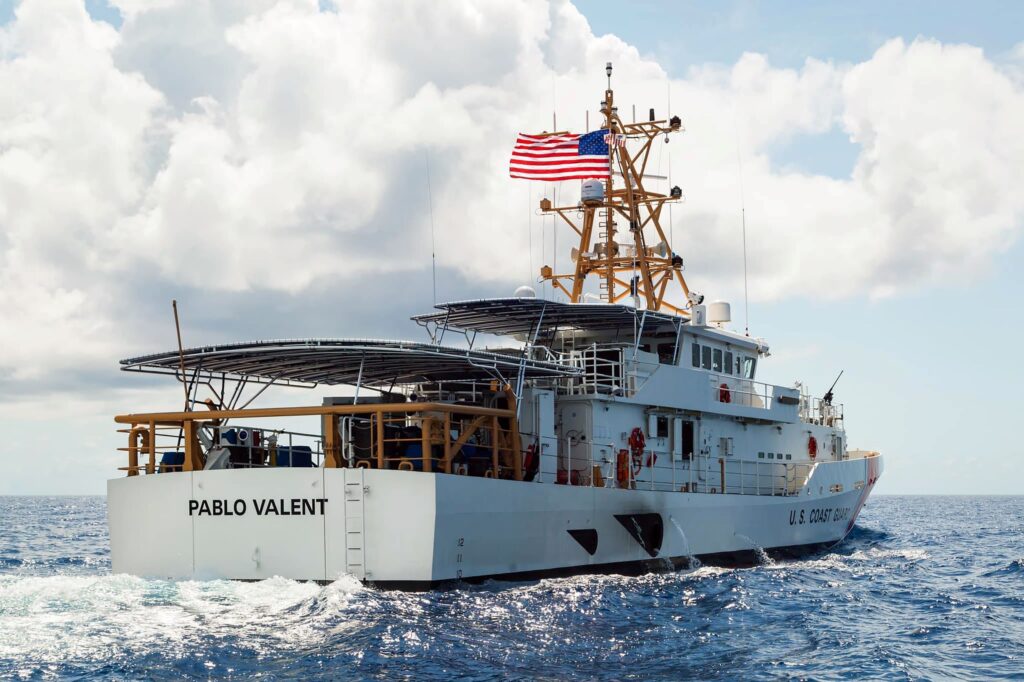
Coast Guard Cutter Pablo Valent, a 154-foot Sentinel-class vessel, is homeported at Coast Guard Sector St. Petersburg, Florida. U.S. COAST GUARD
ST. PETERSBURG, Fla. — Coast Guard Sector St. Petersburg received its first 154-foot fast response cutter on May 1.
Coast Guard Cutter Pablo Valent, a Sentinel-class vessel, will arrive at its new homeport where the crew will begin training to become certified in law enforcement and rescue operations. Pablo Valent is scheduled to be officially commissioned on May 11.
Pablo Valent will operate throughout the Gulf of Mexico and the Florida Keys. There are 12 other FRCs in Florida, which operate throughout the Caribbean Sea.
FRC’s are multi-mission ships designed to conduct drug and migrant interdictions; ports, waterways and coastal security operations; fisheries and environmental protection patrols; national defense missions; and search and rescue.
Each cutter is designed for a crew of 24, has a range of 2,500 miles and is equipped for patrols up to five days. The FRCs are part of the Coast Guard’s overall fleet modernization initiative.
FRCs feature advanced command, control, communications, computers, intelligence, surveillance and reconnaissance equipment as well as over-the-horizon response boat deployment capability and improved habitability for the crew. The ships can reach speeds of 28 knots and are equipped to coordinate operations with partner agencies and long-range Coast Guard assets such as the Coast Guard’s National Security Cutters.
HII Awarded Tactical Training Systems Contracts by the Naval Air Warfare Center
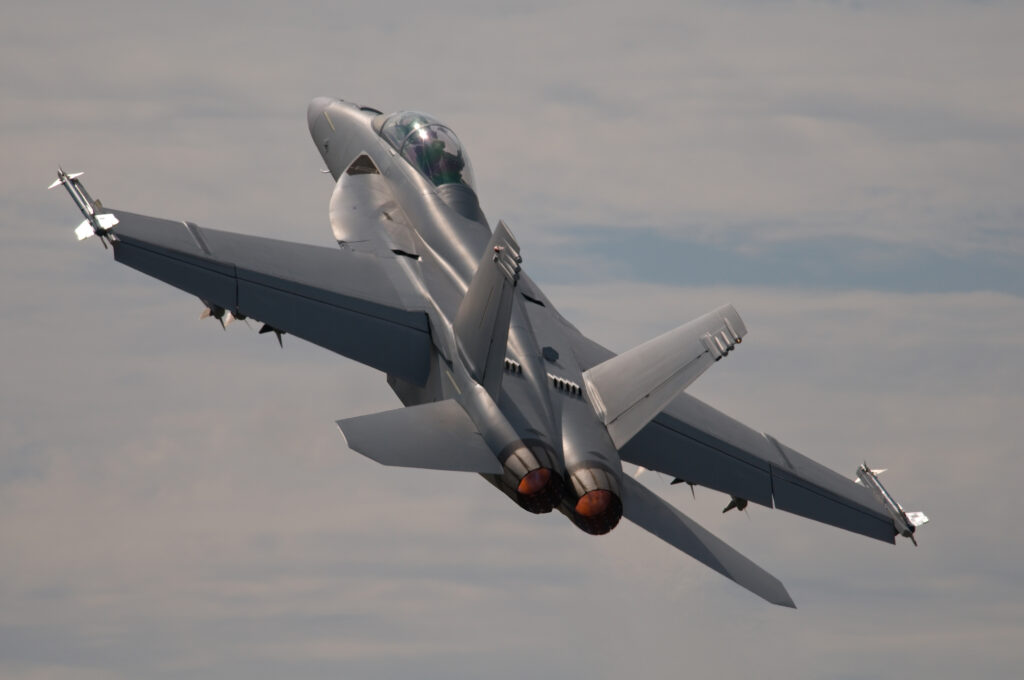
The Navy has awarded two tactical training systems contracts to HII for aircrew electronic warfare tactical training and tactical integrated threat/target training systems. HII
MCLEAN, Va. — HII has been awarded two tactical training systems contracts by the Naval Air Warfare Center China Lake, the company said May 2.
The first contract, for aircrew electronic warfare tactical training, is a multiple-award, indefinite quantity/indefinite delivery contract with a total ceiling value of $249 million. The second contract, for tactical integrated threat/target training systems, is also a multiple-award, IDIQ contract with a total ceiling value of $92 million. Both contracts have a five-year continuous ordering period.
Under these contracts, HII will have the opportunity to bid on task orders to provide research, development, engineering, sustainment, upgrades, integration, testing and cybersecurity for the U.S. Navy’s tactical and electronic warfare threat systems and tactical threat systems.
“For more than 20 years, HII has been dedicated to the Navy’s training missions, providing expertise in live, virtual, constructive cutting-edge software, modeling and simulation, engineering, systems integration, networking and virtual technology, as well as large-scale operations and maintenance,” said Glenn Goodman, president of LVC Solutions business group within HII’s Mission Technologies division. “It is imperative our nation’s training environments provide real world mission rehearsal support for our warfighters, and we look forward to continuing to provide the Navy with world class support to the mission.”
Surge Deployment of U.S. 2nd Fleet Destroyers Seen as OFRP, Agile C2 Success
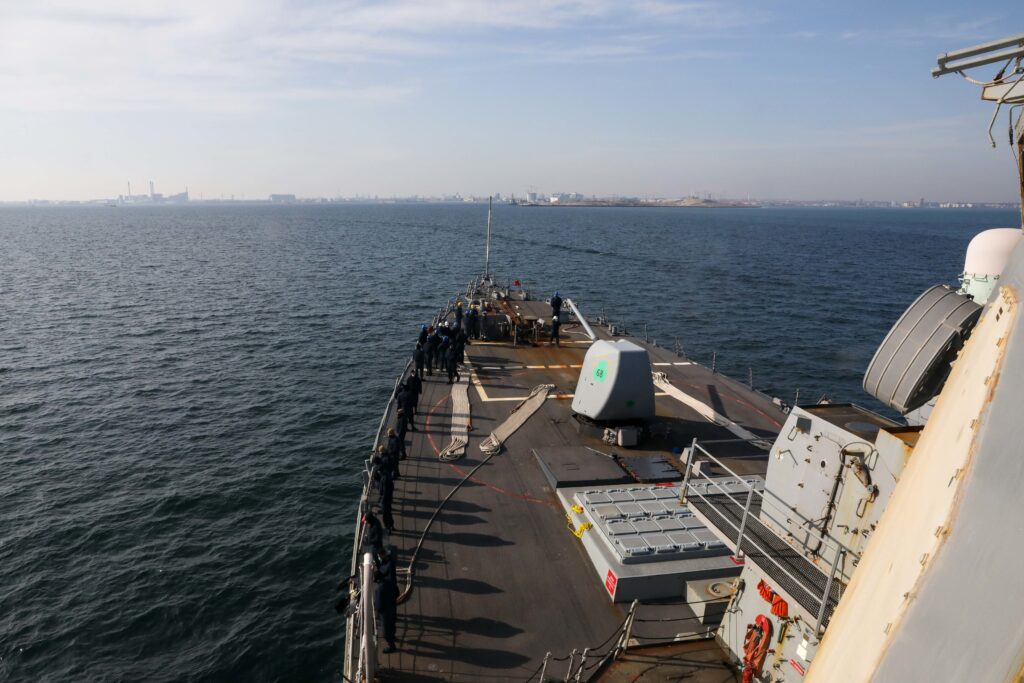
The Arleigh Burke-class guided-missile destroyer USS The Sullivans (DDG 68) pulls into port in Copenhagen, Denmark, March 21. The Sullivans was operating in the European theater of operations and participating in a range of maritime activities in support of U.S. 6th Fleet and NATO Allies. U.S. NAVY / Mass Communication Specialist 3rd Class Mark Klimenko
ARLINGTON, Va. — The recent surge of several guided-missile destroyers from the U.S East Coast to the North Atlantic Ocean and Baltic and North Seas was a successful demonstration of the flexibility of geographic command relationships and of the value with of the Optimized Fleet Response Plan, the commander of the U.S. Navy’s 2nd Fleet said.
Vice Adm. Daniel Dwyer, commander of U.S. 2nd Fleet, told reporters April 29 about the surge deployment of the destroyers under the operational control of Destroyer Squadron (DESRON) 22 support operations for the European Command and “to reaffirm our commitment to our NATO allies and partners.
“This historic task marked the first time since our re-establishment [in 2018] that U.S. 2nd Fleet provided command and control for forces operating in Europe, outside of an exercise,” Dwyer said.
Dwyer said his fleet showed the ability to “surge forces to provide the defense of Europe and to reassure our allies and partners of our commitment to the defense of the NATO alliance.”
The admiral declined to comment on whether the surge deployment from January to April 2022 was related to the Russian build-up and subsequent invasion of Ukraine.
The surging ships were the Arleigh Burke-class guided-missile destroyers USS The Sullivans (DDG 68), USS Donald Cook (DDG 75) the USS Forrest Sherman (DDG 98), and the USS Mitscher (DDG 57). Also attached was the command-and-control ship USS Mount Whitney (LCC 20), which normally serves as the flagship of the U.S. 6th Fleet in the Mediterranean Sea.
Dwyer said the surged DDGs were within the OFRP cycle, with each ship trained and certified.
“Some [DDGs] were at the beginning of their operational deployment cycle; some had just returned from an operational deployment and were in that sustained period which allowed me to use their certified and ready ships to meet mission,” he said. “Once we train and certify naval forces, we can deploy them right away as scheduled, or we can hold that readiness and deploy them later at time of need, or when they get back from a deployment and they are still trained, certified and ready in that sustainment phase if crisis occurs or need occurs. We can then deploy them and continue to leverage that training [and] certification and readiness. This shows that this OFRP cycle — the way it is built — allows us to move naval forces to the point of need and at the time of need with incredible agility.”
The fleet embarked DESRON 22 staff on one of the DDGs to act as the forward command element reporting back to the 2nd Fleet’s maritime operations center in Norfolk. When the USS Mount Whitney was assigned to the 2nd Fleet for the operation, the fleet was able to “use it to command and control forces in the North Atlantic with DESRON 22 embarked.” Dwyer said.
Operational Flexibility
The admiral stressed the operational flexibility of the number fleets to operate in different combatant commander areas of responsibility.
“Numbered fleet commanders are operational-level headquarters that can command and control naval forces at the point of need unconstrained by lines on a map,” he said. “This operation that we conducted showed that the 2nd fleet — [with the Western Atlantic up to the North Pole] — at time of need can surge forward to support a four-star naval headquarters with my maritime operations center commanding and controlling ships that are outside my normal area of responsibility.”
Dwyer said this operation was the first time the concept — with 2nd Fleet and 6th Fleet both supporting Naval Forces Europe — was put into practice.
“We showed and proved that unique, agile, mobile capability of a numbered fleet headquarters supporting another four-star naval headquarters, he said.
In an April 28 release, the 2nd Fleet said the ships operated with maritime forces from Denmark, France, Germany, Italy, The Netherlands, Poland, Sweden, and the United Kingdom.
CNO: Thinking on Unmanned Systems Changed by Experimentation
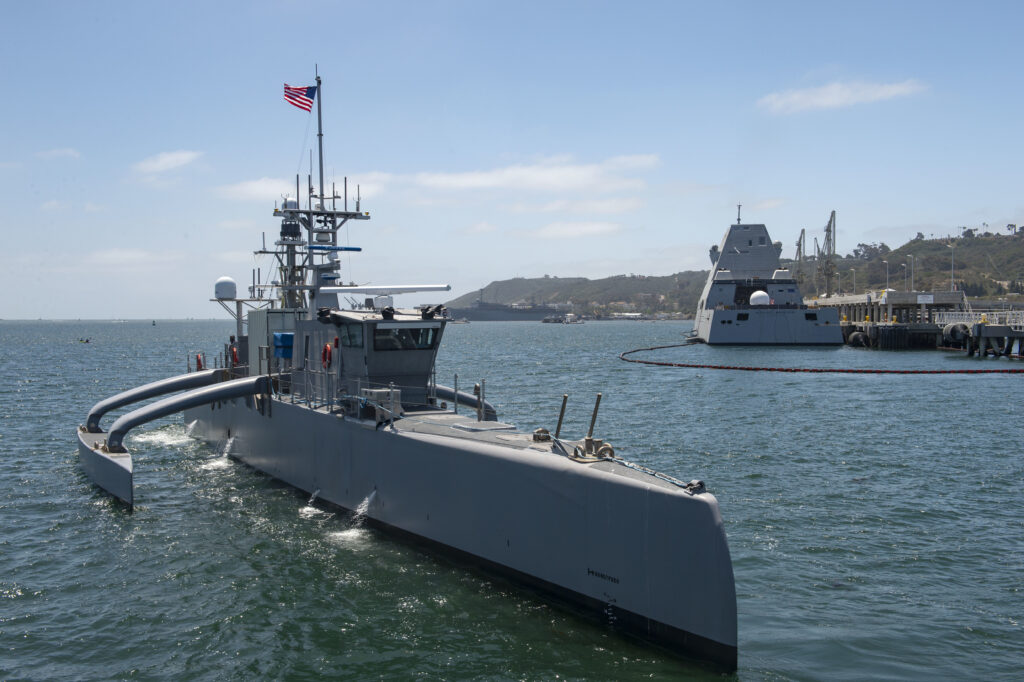
The Sea Hunter medium displacement unmanned surface vessel launches from Naval Base Point Loma for the U.S. Pacific Fleet’s Unmanned Systems Integrated Battle Problem 21, April 20, 2021. U.S. NAVY / Mass Communication Specialist 2nd Class Thomas Gooley
ARLINGTON, Va. — The Navy’s top officer said his thinking about integrating unmanned systems into the fleet has been changed by the observations of the service’s recent experimentation during fleet exercises.
“We are learning so fast in fielding these capabilities out to the fleet or potentially fielding them quickly inside the FYDP [Future Years Defense Plan] we may be able to close capability gaps with small, expendable unmanned [systems] off of any platform rather than thinking we have to build a larger [platform],” said Chief of Naval Operations Adm. Michael Gilday, speaking April 28 in a Maritime Security Dialogue event on the future of the U.S. Navy conducted by the U.S. Naval Institute and the Center for Strategic and International Studies, and sponsored by HII.
Gilday said by the time the DDG(X) program is underway “we will be in a better place with LUSV [large unmanned surface vehicle]. I don’t know if we’ll have an unmanned medium [USV] or not. The stuff that [U.S. 5th Fleet Commander Vice Adm. Brad] Cooper is doing with CTF-59 and using small, unmanned [systems] on the sea and in the air to sense the environment and make sense of it in order to yield a common operational picture for allies and partners as well as the 5th Fleet headquarters has changed my thinking on the direction of unmanned. … I’m not saying that we don’t need an MUSV [medium USV]; I’m saying it will cause us to consider numbers and what potential payloads they’re going to have.”
Gilday said unmanned systems have “so much potential, coupled with AI [artificial intelligence] software integration that it’s difficult to put a definitive number on the numbers we’re going to have in the air, on the sea, and under the sea. I like the way we’re going with the unmanned task force that has tied together acquisition specialists, requirements folks, scientists from the Navy research labs, and also the fleet with CTF-59 in terms of real-time exercising, experimenting, and developing CONOPS [concepts of operations]. It’s been a powerful awakening experience for us. Also, industry and foreign partners have dived in on this thing.”
Gilday said the Navy’s four experimental large and medium USVs — two Project Overlord vessels and the Sea Hunter MUSV and Sea Hawk USV — have accrued 41,000 nautical miles of autonomous travel so far.
“In terms of the mastery of COLREGS [Convention on the International Regulations for Preventing Collisions at Sea] and vessel avoidance, we think we’re in a really good place with that,” he said. “To send an unmanned [vessel] out into the ocean, with a mission, to expect that unmanned to come back and salute and say, ‘mission complete,’ is a different problem set. That’s something that we’re working on, but, quite frankly, that’s going to be a journey for us.”
Gilday said USVs may need to be “minimally manned for a while. I’d like to get to a place with large USVs where we can deploy them with strike groups and ARGs [amphibious ready groups] in the 2027-2028 time frame. A lot of the work we’re doing right now with the Unmanned Task Force and CTF-59 hopefully will buy down technical risk, make us an informed customer with respect to what we’re going to buy — both in engineering plant and a command-and-control framework — so that we can begin to deploy those things and do the same things we’re doing with CTF-59 to earn stuff out there as we’re using these LUSVs and perhaps medium USVs. I don’t want to wake up in 15 years and say, we bought the wrong kind of LUSV with the wrong engineering plant. … We’re trying to prove ourselves in an evolutionary, deliberate, informed kind of way.”
Navy Proposes Conversion of 2 Active P-8 Squadrons to Reserve
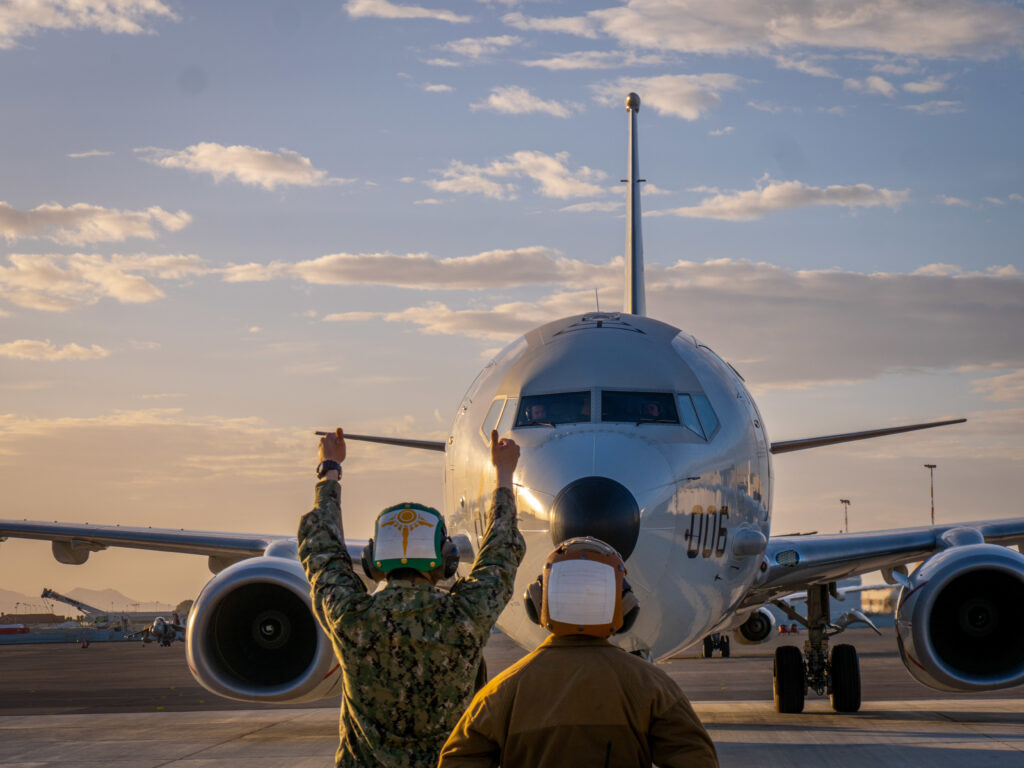
Aviation Structural Mechanic (Safety Equipment) 3rd Class Julian Marriagabossio, left, assigned to the “Grey Knights” of Patrol Squadron (VP) 46, signals to the pilots of a P-8A Poseidon maritime patrol aircraft, Jan. 7, 2021, at NAS Sigonella, Italy. U.S. NAVY / Mass Communication Specialist 2nd Class Austin Ingram
ARLINGTON, Va. — The U.S. Navy proposes to shift two P-8A Poseidon patrol (VP) squadrons from the active component to the reserve component in 2026, budget documents show.
The Navy’s 2023 budget highlights book published this month shows a proposal to shift two VP squadrons — one from each coast — to the Navy Reserve. The Navy currently fields 12 P-8A-equipped fleet VP squadrons, six each at Naval Air Station Whidbey Island, Washington, and NAS Jacksonville, Florida. In addition, the Navy Air Reserve operates two P-3C Orion-equipped VP squadrons, one each at Jacksonville and Whidbey Island. These two squadrons are planned for transition to the P-8A in the next few years, which, if the above conversion occurs, eventually would give the reserve component four P-8A VP squadrons.
The two current reserve VP squadrons, VP-62 at Jacksonville and VP-69 at Whidbey Island, frequently augment the active component force for operations and exercises.
“This force structure change supports the move to integrate the reserve component more towards a ‘total force’ solution in meeting steady state demands,” the budget highlights book says.
The Navy estimates the shift would result in savings of $55.5 million over the Future Years Defense Plan.
HII Launches Virginia-Class Submarine New Jersey
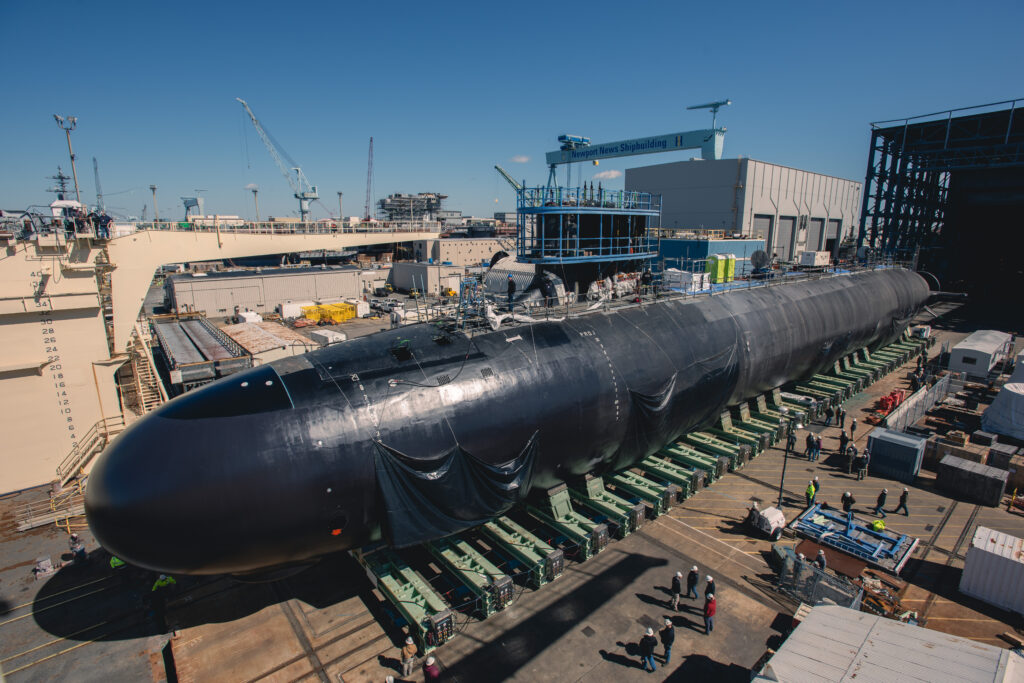
New Jersey (SSN 796) after its roll out to the floating dry dock. HII
NEWPORT NEWS, Va. — HII announced April 28 that Virginia-class attack submarine New Jersey (SSN 796) recently was launched into the James River at the company’s Newport News Shipbuilding division.
The 7,800-ton submarine, which had been in a floating dry dock since being transferred from a construction facility in March, was submerged and moved by tugboats to the shipyard’s submarine pier for final outfitting, testing and crew certification.
“Achieving this construction milestone is a very rewarding event to our shipbuilding team,” said Jason Ward, Newport News’ vice president of Virginia-class submarine construction. “Our shipbuilders and suppliers have dedicated years of hard work to this critical capability that will maintain our customer’s undersea superiority. We now look forward to executing our waterborne test program, and working toward sea trials so we can deliver to the Navy.”
Through the teaming agreement with General Dynamics Electric Boat, approximately 10,000 shipbuilders, as well as suppliers from 50 states, have participated in New Jersey’s construction since the work began in 2016. New Jersey is approximately 92% complete.
Virginia-class submarines, a class of nuclear-powered fast attack submarines, are built for a broad spectrum of open-ocean and littoral missions to replace the Navy’s Los Angeles-class submarines as they are retired. Virginia-class submarines incorporate dozens of new technologies and innovations that increase firepower, maneuverability and stealth to significantly enhance their warfighting capabilities. These submarines are capable of supporting multiple mission areas and can operate at speeds of more than 25 knots for months at a time.