Navy Awards Raytheon Up to $1.68B for Zumwalt DDG Engineering Services
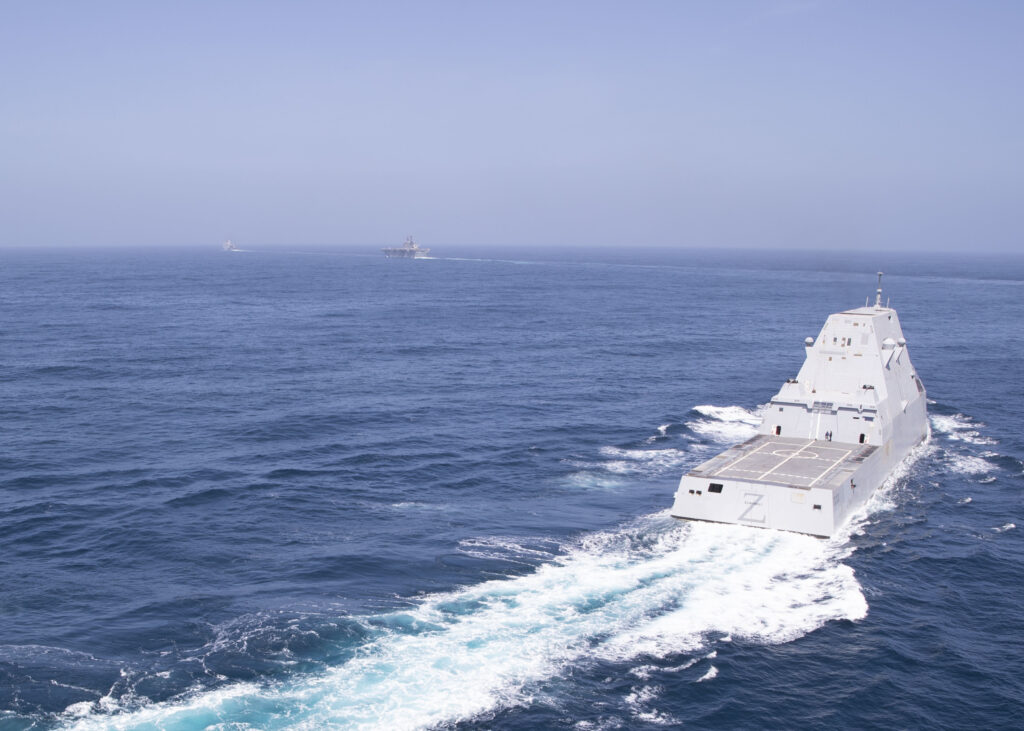
Guided-missile destroyer USS Zumwalt (DDG 1000), right, and amphibious assault ship USS Tripoli (LHA 7) sail behind amphibious transport dock USS Anchorage (LPD 23) in the Pacific Ocean, April 10. U.S. NAVY / Mass Communication Specialist 2nd Class Malcolm Kelley
TUCSON, Ariz. — The U.S. Navy awarded Raytheon Missiles & Defense an activation, sustainment and modernization contract for $483 million with options, if exercised, totaling $1.68 billion across five years, the company said April 20.
Under this contract, Raytheon Missiles & Defense will provide the U.S. Navy services and professionals to complete the activation and fleet introduction of the three Zumwalt-class destroyers, while continuing to develop technology and warfare capabilities.
“This contract underscores our role as a systems integrator, which goes beyond offering customers weapons and radars,” said Wes Kremer, president of Raytheon Missiles & Defense. “Our team provides Zumwalt destroyers extensive support, from engineering and cyber protection to software development and upgrades.”
Additional services will include design, integration, test and evaluation, system upgrade and replacement, logistics product development, configuration management and training systems.
The Zumwalt-class destroyers recently achieved initial operational capability in December 2021, with the inaugural fleet employment of USS Zumwalt scheduled for later this year.
Navy Proposes to Cut Five EA-18G Growler Electronic Attack Squadrons
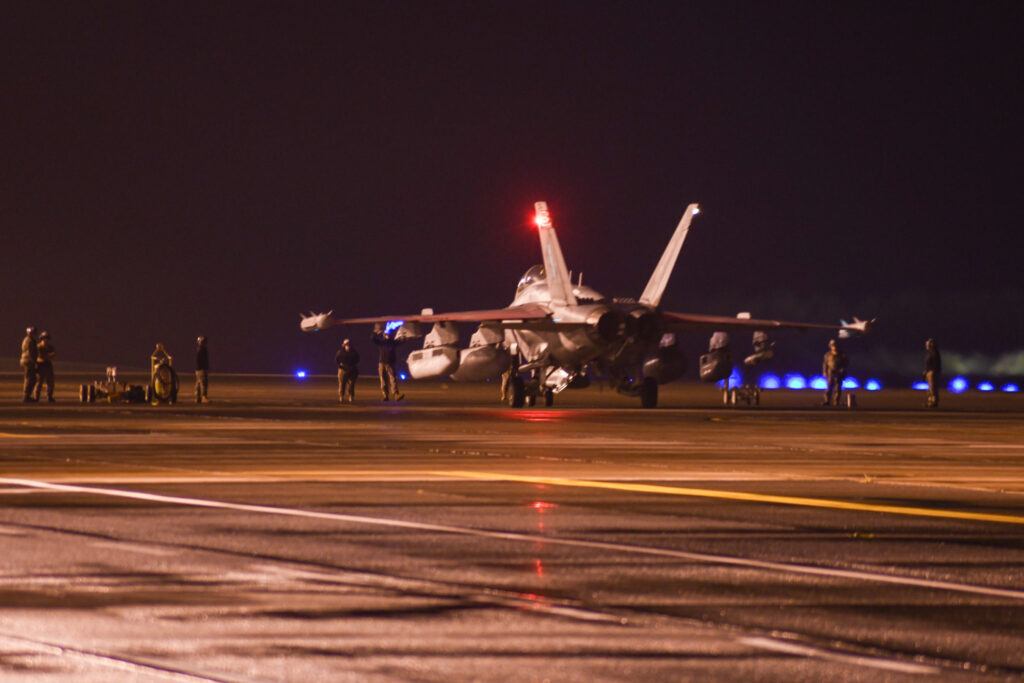
Sailors assigned to the “Lancers” of Electronic Attack Squadron (VAQ) 131 recover an EA-18G Growler during night operations in 2020. Under Navy plans, the squadron is one of several that would be deactivated. U.S. NAVY / Mass Communication Specialist Seaman Benjamin Ringers
ARLINGTON, Va. — The U.S. Navy is proposing to deactivate five electronic attack squadrons, or VAQs, that operate the Boeing EA-18G Growler electronic attack jet, roughly a third of the Defense Department’s tactical jet electronic attack force.
As laid out in the recently released Department of the Navy’s fiscal 2023 budget highlights book, the Navy proposes to deactivate its entire expeditionary VAQ force, which deploys to overseas bases to provide electronic attack capabilities to the joint force. The five expeditionary VAQ squadrons are separate from the Navy’s VAQ squadrons that deploy on aircraft carriers.
The Navy is the only provider of expeditionary electronic attack jets to the joint force. The Air Force retired its last EF-111A Raven jets in 1998 and the Marine Corps retired its last EA-6B Prowler tactical jets in 2019. The expeditionary VAQ squadrons have deployed to Southwest Asia, Japan and Italy over the years in support of U.S. and coalition forces. Last month, one squadron, VAQ-134, was deployed to the European Command as part of the build-up of forces in support NATO’s eastern flank after the Russian invasion of Ukraine.
The budget book says the five squadrons include a total of 25 EA-18Gs which would be placed in storage at the Aerospace Maintenance and Regeneration Group at Davis-Montham Air Force Base in Tucson, Arizona, half in fiscal 2024 and half in fiscal 2025. The cuts also would free up approximately 1,020 officer and enlisted personnel. The Navy estimates the savings over the Future Years Defense Plan would be 807.8 million.
The Navy’s five expeditionary VAQ squadrons are all based at Naval Air Station Whidbey Island, Washington: VAQs 131, 132, 134, 135, and 138. The Navy’s only reserve VAQ squadron, VAQ-209, also has been used in an expeditionary role.
The carrier-deployable VAQ squadrons are VAQs 130, 133, 136, 137, 139, 140, 141, and 142, with another, VAQ-144, set for establishment in October. All are based at Whidbey Island, except for VAQ-141, which is based at Marine Corps Air Station Iwakuni, Japan, as part of the forward-deployed Carrier Air Wing Five for USS Ronald Reagan.
The expeditionary VAQ squadrons are considered high-demand/high-value assets by the Joint Chiefs of Staff. The assessments of the various regional combatant commanders may be instrumental in reversing or mitigating the Navy’s proposal.
Navy’s LCS Decommissioning Proposals Would Bring Major Changes for Retained Ships
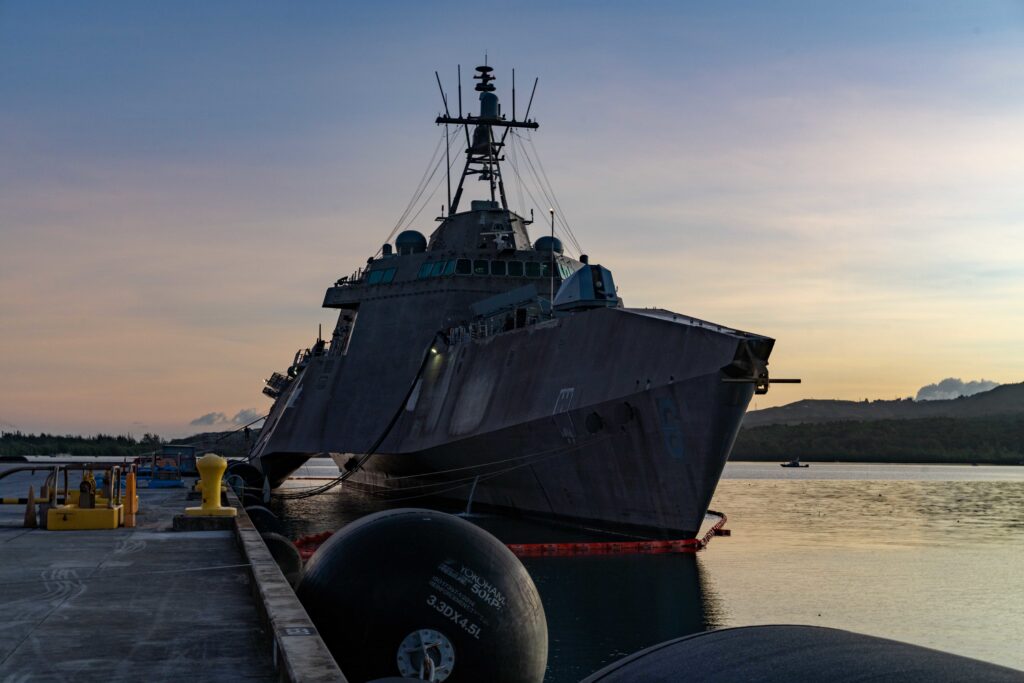
The Independence-variant littoral combat ship USS Jackson (LCS 6) pierside in Guam during routine operations in 2021. Under new Navy plans, it would be operated by a single crew in 2023 and decommissioned in 2024. U.S. NAVY / Mass Communication Specialist 3rd Class Andrew Langholf
ARLINGTON, Va. — The U.S. Navy’s 2023 budget proposal — including the Future Years Defense Plan — would result in profound changes to the missions, organization, force structure, training and crews of the Navy’s littoral combat ships in addition to the force reduction by decommissioning of many of the ships.
The LCS remaining in service would see a second order of effects that would further show a force dramatically changed from the original vision for the ships. The surface warfare mission and the mine countermeasures mission will be divided by coast instead of mixed on both.
The Freedom-class LCS would be most the most affected by the proposed budget. Including earlier decisions, the Navy would, because of fiscal constraints, decommission LCS 3, 5, 7, 9, 11, 13, 15, 17, and 19 across the FYDP. (LCS 1 was decommissioned in 2021.) Six Freedom-class ships (LCS 21, 23, 25, 27, 29, and 31) would be retained, having been or will be completed with the combining gear improvement installed.
The Independence-class LCS will not be unscathed. The Navy proposes to reduce LCS 6 and 8 to single crews (from dual Blue-Gold crews) in 2023, and then decommission the two ships in 2024. (LCS 2 was decommissioned in 2021, and LCS 4 is scheduled to be decommissioned in 2022.) A total of 15 Independence-class ships would be retained in the fleet.
All LCS assigned the surface warfare mission would be assigned single crews only. Such crews would see their manpower increased by approximately 25 Sailors each to help sustain readiness levels that a second off-hull provided.
Since the antisubmarine warfare mission package is being divested, all LCSs marked for the ASW mission will be shifted to the surface warfare or mine countermeasures mission. Because of the substantial reduction in the number of LCS planned, the ASW mission in small surface combatants will reside solely in the future Constellation-class guided-missile frigate (FFG 62), which the Navy says is a “foundational mission set for the FFG 62 program, which is a more suitable platform and Variable Depth Sonar [VDS] capability will be added to the fleet through the FFG 62 class.”
The Navy is proposing the East Coast littoral combat ships — which are of the Freedom class — be assigned only the surface warfare mission and the West Coast LCS — planned to be only Independence-class ships — be assigned only the mine countermeasure mission. As a result, there would be changes in the LCS command and support organization structure.
Accordingly, the LCS antisubmarine warfare divisions on both coasts would be disestablished in 2023 with the divestiture of the ASW mission. MCM Division 22 on the East Coast and SUW Division 11 on the West Coast also would be disestablished in 2023.
With the overall reduction in LCS ships and their crews, and a force of just 21 LCS planned (15 MCM ships and 6 SUW ships), the training infrastructure required for training would be reduced. The proposal calls for the disestablishment of LCS Training Facility Atlantic, consolidating all LCS training at LCS Training Facility Pacific.
All of these proposals will receive the scrutiny of the congressional armed services and appropriations committees.
If the total LCS changes were to be approved, the Navy estimates the savings to be $391.4 million for fiscal 2023, totaling $2.46 billion over the FYDP.
USS Hershel ‘Woody’ Williams Completes Gulf of Guinea Maritime Security Patrol
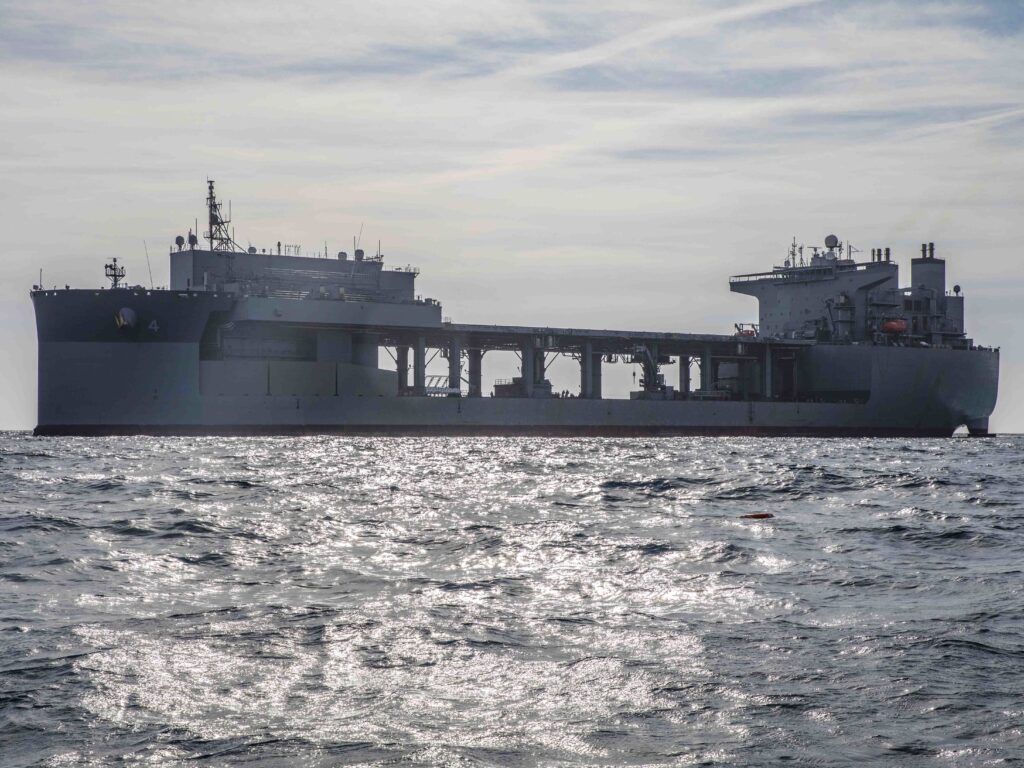
The Expeditionary Sea Base USS Hershel “Woody” Williams (ESB 4) sails the Adriatic Sea, Feb. 19. Hershel “Woody” Williams is on a scheduled deployment in the U.S. 6th Fleet area of operations in support of U.S. national interests and security in Europe and Africa. U.S. NAVY / Mass Communication Specialist 1st Class Fred Gray IV
NAVAL STATION ROTA, Spain — The Expeditionary Sea Base USS Hershel “Woody” Williams (ESB 4) arrived at Naval Station Rota, Spain, following a successful maritime security patrol in the Gulf of Guinea on April 18, 2022, said U.S. 6th Fleet Public Affairs.
From March to April, Hershel “Woody” Williams completed maritime security operations with African partners from Sierra Leone, Cabo Verde and Senegal as well as members of the U.S. Navy, Coast Guard and Marine Corps.
“The men and women that made this possible are a testament to our shared values and commitment to ensuring the safety, security, and freedom of navigation on the waters surrounding the African continent,” said Capt. Michael Concannon, commanding officer, USS Hershel “Woody” Williams.
In March, the joint U.S. and African maritime team interdicted an illegal, unregulated, and unreported fishing vessel operating in Sierra Leone’s economic exclusive zone.
In April, as part of the African Maritime Law Enforcement Partnership, the joint team, led by Cabo Verde, worked in coordination with the Maritime Analysis and Operations Centre – Narcotics, INTERPOL and Cabo Verde’s national Maritime Operations Center to conduct a compliant boarding of a Brazilian-flagged fishing vessel, which led to the seizure of approximately 6,000 kilograms of suspected cocaine with an estimated street value of more than $350 million.
“I couldn’t be more proud of the professionalism and integration of the U.S. tri-maritime services, partner nations and other supporting organizations during our maritime security operations,” Concannon said. “These maritime security events show the world that our African partners are poised and ready to strike against illicit activity.”
Hershel “Woody” Williams is the first warship permanently assigned to the U.S. Africa Command area of responsibility. The U.S. shares a common interest with African partner nations in ensuring security, safety and freedom of navigation on the waters surrounding the continent, because these waters are critical for Africa’s prosperity and access to global markets.
The ESB ship class is a highly flexible platform that may be used across a broad range of military operations. Acting as a mobile sea base, they are part of the critical access infrastructure that supports the deployment of forces and supplies to support missions assigned.
For over 70 years, U.S. 6th Fleet forces have forged strategic relationships with our allies and partners and solidified a foundation of shared values, experiences and vision aimed at preserving security and stability.
NGC to Develop Next-Gen Relay Ground Station for NIWC Pacific
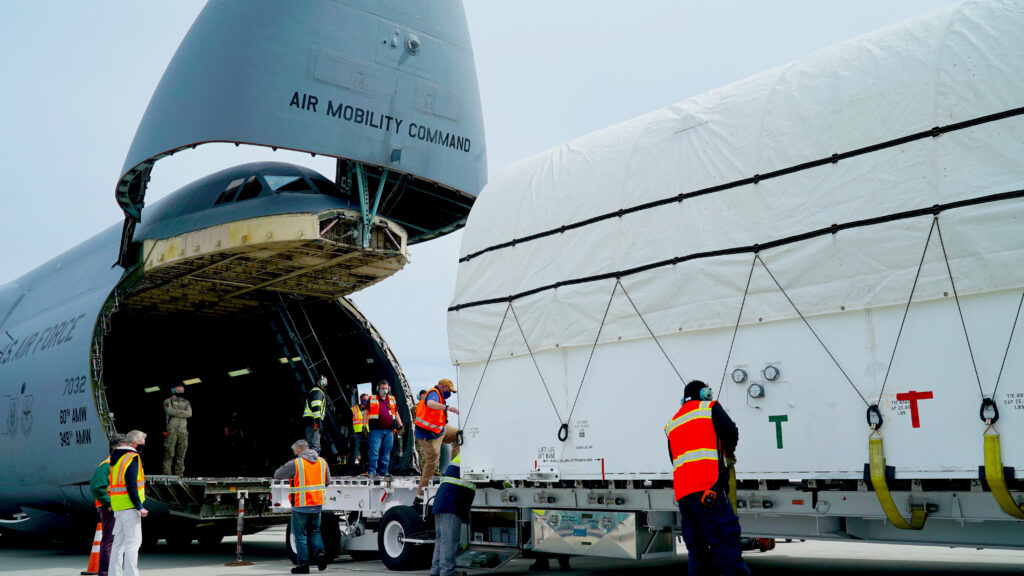
A ground crew loads the U.S. Space Force’s SBIRS GEO-5 satellite onto a C-5M Super Galaxy aircraft for transport operations at Moffett Federal Airfield, California, on March 17, 2021. U.S. SPACE FORCE / Walter Talens
BOULDER, Colo. — Northrop Grumman has been awarded a $99.6 million contract by U.S. Naval Information Warfare Center Pacific to provide mission-critical capabilities for Relay Ground Station-Asia (RGS-A), the company said April 19.
Northrop Grumman will design, develop, integrate, test and deliver the first of the next-generation relay ground stations to support legacy and future missile-launch and missile-warning detection satellites.
“The advanced technologies we bring to this mission build on our proven capabilities to provide existing and future missile warning systems that help keep our nation and its allies safe,” said Aaron Dann, vice president of strategic force programs at Northrop Grumman. “The model-based open-systems architecture provides the ability to rapidly deploy follow-on RGS systems in future locations around the world.”
The RGS-A award will help address the U.S. Space Force’s mission to revolutionize existing missile warning and missile defense systems with the Future Operationally Resilient Ground Evolution system. A key element of the FORGE architecture includes relay ground stations that support existing and new satellite constellations and the capability to handle changes in bandwidth and resiliency.
NIWC Pacific will develop six antennas for RGS-A to enable the Space Systems Command Next-Generation Space Based Infrared System (SBIRS) Ground System to operate the legacy satellites in geosynchronous orbit. The antennas will be deployed to the island of Guam and remotely monitored and operated from the United States.
Most of the work for the five-year contract will take place at Northrop Grumman’s campus in Boulder, where it just opened a 23,680-square-foot office building. Northrop Grumman has more than 2,200 employees across Colorado supporting key customers including the U.S. Space Force, Air Force, Missile Defense Agency and the intelligence community.
Navy Proposes Elimination of Snakehead LDUUV program
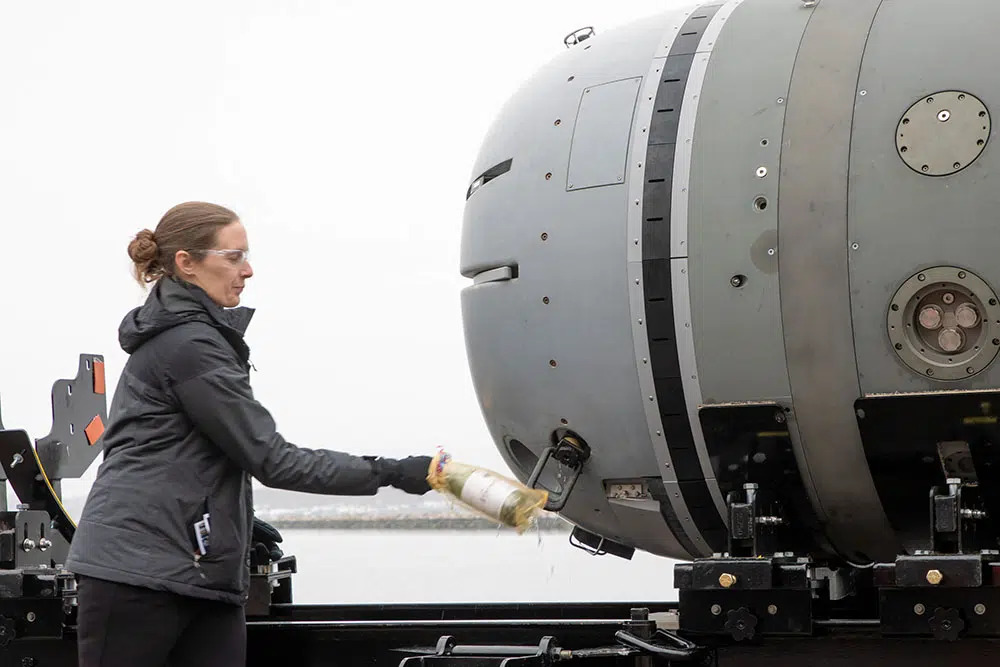
Cheryl Mierzwa, Naval Undersea Warfare Center Division Newport’s technical program manager for the Snakehead Large Displacement Unmanned Undersea Vehicle, christens the underwater vehicle at the Narragansett Bay Test Facility in Newport, Rhode Island, on Feb. 2. U.S. NAVY
ARLINGTON, Va. — Even as the U.S. Navy was christening the first prototype of the Snakehead large-diameter unmanned underwater vehicle (LDUUV) in February, planning was underway to cancel the program.
The Navy is proposing in its 2023 budget to eliminate the Snakehead program, according to the Navy Department’s recently released Fiscal 2023 budget highlights book.
The Snakehead is intended to be a major advance in UUVs and designed to be the largest UUV to be deployed on the interfaces of the Navy’s attack submarines. It is designed to be autonomous, modular and reconfigurable, equipped with a government-owned architecture. It features innovative hull materials and certified lithium-ion batteries. It is designed to be deployed from a modernized dry-deck shelter.
According to the budget highlights book, the major problem in the program was “Misalignment of Snakehead LDUUV design and procurement efforts with submarine hosting interfaces result[ing] in limited availability of host platforms to conduct Snakehead operations.”
The book also said that “cost and schedule delays associated with LDUUV development and Virginia Class SSN [attack submarine] integration prohibited further investment.”
The only alternative launch and recover interface for the Snakehead is the Modernized Dry Deck Shelter. The U.S. Special Operations Command in conjunction with the Navy is modernizing three Dry Deck Shelters between 2022 and 2026. They are scheduled to become available for use in 2022, 2023, and 2026, respectively.
Under Phase One of the Snakehead program, only one vehicle was built.
The Navy estimates the cancellation of Phase Two of the program and future Snakehead procurement will save the Navy $185.9 million in fiscal 2023, resulting in a total savings of $516.8 million over the Future Years Defense Plan.
The Snakehead Phase One prototype was christened on Feb. 2 at the Narragansett Bay Test Facility in Newport, Rhode Island, by a team from the Naval Undersea Warfare Center Division Newport and the Program Executive Office for Unmanned and Small Combatants.
CNO Visits Bath Iron Works, Meets with Sailors and Maine Congressional Leaders
BATH, Maine — Chief of Naval Operations Adm. Mike Gilday traveled to Bath, Maine on April 18, where he met with congressional leaders from Maine to visit General Dynamics Bath Iron Works, the CNO’s public affairs office said.
Gilday met with Sen. Susan Collins and other congressional leaders and together they visited shipyard facilities, toured and met with Sailors aboard the future USS Carl M. Levin (DDG 120).
“The work being done here in Maine is critically important to our Navy,” said Gilday. “The entire workforce of Bath Iron Works is delivering cutting edge capabilities at a critical time for our nation.”
“It was a pleasure to welcome back Adm. Gilday to Bath Iron Works, where he had the opportunity to see firsthand the tremendous skill and dedication of employees who are building the Navy’s most capable ships. We also met with the commander of the future USS Carl M. Levin. It is reassuring to know that the brave men and women of the Navy will crew a ship built by the world’s best shipbuilders,” said Collins. “Increasing the size of our Navy fleet is imperative to our national security in order to counter the rising aggression by Russia and China. As a senior member of the Defense Appropriations Subcommittee, I will continue to work to ensure that BIW has the resources it needs to support our Navy.”
During the tour they visited and received updates at the Bath Iron Works outfit facility, post-blast paint shop, and spoke with shipyard workers.
Gilday also met with BIW leaders to include the Interim President Robert Smith. They discussed the importance and challenges of the shipyard, which include material delays and connecting with a younger generation of shipyard workers.
Aboard the Arleigh-Burke guided-missile destroyer, Gilday presented an award to a Sailor and expressed his appreciation to everyone on board.
“Seeing a new warship being built is exciting, but what truly breathes life into a new ship is her crew,” said Gilday. “We are the finest fighting force in the world because of our people. I am confident USS Carl M. Levin Sailors will embrace a warfighting ethos with the integrity and uncompromising dedication that truly embraces their ship’s namesake, who helped ensure our nation’s armed forces remained the best in the world.”
The visit marked CNO’s second trip to Bath Iron Works.
Abraham Lincoln Carrier Strike Group Conducts Exercises with the JMSDF
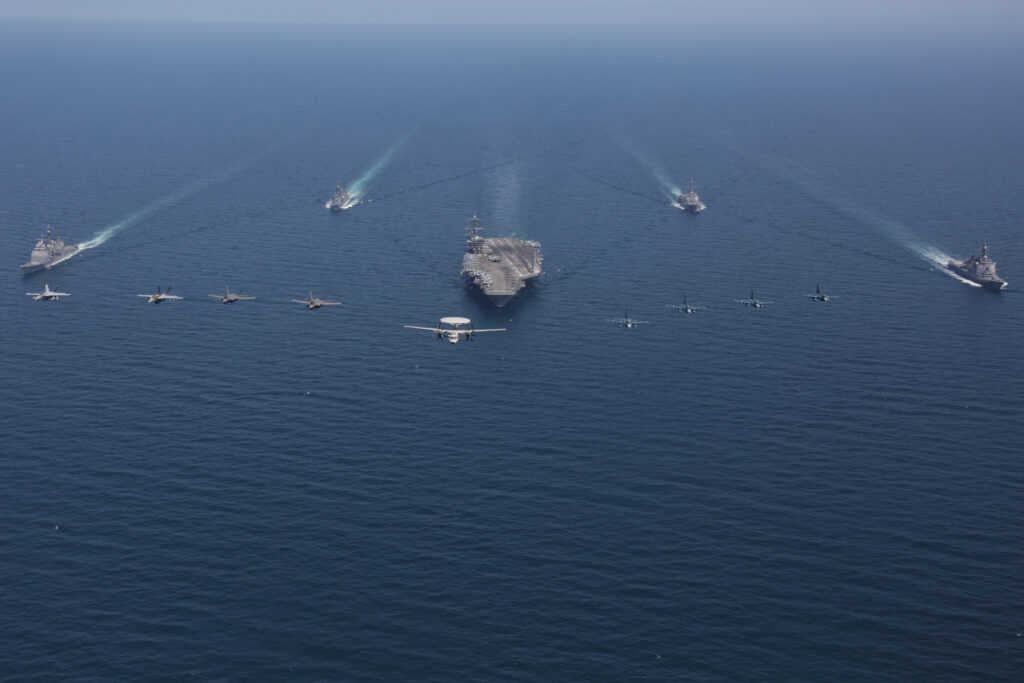
Aircraft from Carrier Air Wing 9 and Japan Air Self-Defense Force fly over the Sea of Japan as the Nimitz-class aircraft carrier USS Abraham Lincoln (CVN 72), center, the Ticonderoga-class guided-missile cruiser USS Mobile Bay (CG 53), left, JMSDF Kongō-class guided-missile destroyer JS Kongō (DDG 173), right, Japan Maritime Self-Defense Force Murasame-class destroyer JS Inazuma (DD 105), back left, and the Arleigh Burke-class guided-missile destroyer USS Spruance (DDG 111) sail in formation during a U.S.-Japan bilateral exercise. U.S. NAVY / Mass Communication Specialist Seaman Aleksandr Freutel
SEA OF JAPAN — The Abraham Lincoln Carrier Strike Group, along with JS Inazuma (DD 105) and JS Kongo (DDG 173), from the Japan Maritime Self-Defense Force, completed bilateral exercises in the Philippine Sea and East China Sea on April 18, said the strike group’s public affairs.
USS Abraham Lincoln (CVN 72), USS Mobile Bay (CG 52) and USS Spruance (DDG 111) of Carrier Strike Group 3 and JS Inazuma (DD 105) and JS Kongo (DDG 173) of JMSDF Escort Division 11 engaged in various joint events to include enhanced maritime communication operations, air warfare training, and various other drills to hone in on integrated maritime operations and combat readiness.
“Our enduring commitments to our relationships in the Indo-Pacific region continue to grow and blossom through integrated and bilateral at-sea exercises including the Japan Maritime Self Defense Force,” said Rear Adm. J. T. Anderson, commander, CSG 3. “These exercises demonstrate our collective combat-credible capabilities while safeguarding our shared interests and values.”
Coordinated maritime engagements and operations with international partners are part of the U.S. Navy’s routine presence in the Indo-Pacific. Since arriving in the U.S. 7th Fleet region in January, CSG 3 units have participated in multiple operations and exercises to include dual carrier operations with USS Carl Vinson (CVN 70), exercises Noble Fusion and Jungle Warfare 2022 and a long-range air demonstration.
The Abraham Lincoln Carrier Strike Group consists of CSG 3 and includes aircraft carrier USS Abraham Lincoln (CVN 72); Carrier Air Wing (CVW) 9; Destroyer Squadron 21; the Ticonderoga-class guided-missile cruiser USS Mobile Bay (CG 53); and the Arleigh Burke-class guided-missile destroyers USS Fitzgerald (DDG 62), USS Gridley (DDG 101), USS Sampson (DDG 102) and USS Spruance (DDG 111).
Abraham Lincoln’s embarked air wing consists of the “Wallbangers” of Carrier Airborne Early Warning Squadron (VAW) 117; “Titans” of Fleet Logistics Multi-Mission Squadron (VRM) 30; “Chargers” of Helicopter Sea Combat Squadron (HSC) 14; “Tophatters” of Strike Fighter Squadron (VFA) 14; “Black Aces” of VFA 41; “Wizards” of Electronic Attack Squadron (VAQ) 133; “Black Knights” of Marine Fighter Attack Squadron (VMFA) 314; “Vigilantes” of VFA 151 and “Raptors” of Helicopter Maritime Strike Squadron (HSM) 71.
ABECSG departed its homeport for a scheduled deployment to the Indo-Pacific on Jan. 3.
Coast Guard Offloads $11.7M in Cocaine, Transfers 6 Suspected Smugglers
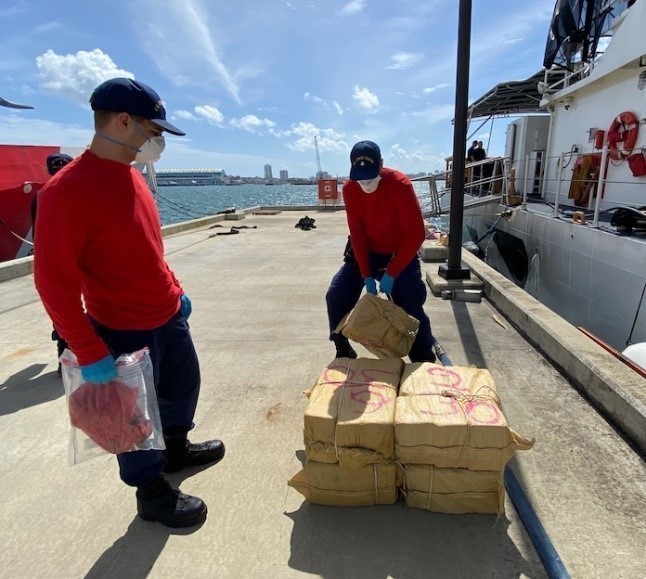
Coast Guard Cutter Heriberto Hernandez crewmembers offload six bales of cocaine, weighing approximately 463 pounds, at Coast Guard Base San Juan April 18, 2022, following the interdiction of a go-fast smuggling vessel near Puerto Rico April 11, 2022. U.S. COAST GUARD
Puerto Rico — Coast Guard Cutters’ Joseph Tezanos and Heriberto Hernandez crews offloaded approximately 1,289 pounds of cocaine and transferred custody of six suspected smugglers at Coast Guard Base San Juan April 18, following two separate vessel interdictions near Puerto Rico, the Coast Guard 7th District said in a release.
These interdictions are the result of multi-agency efforts involving the Caribbean Border Interagency Group and the Caribbean Corridor Strike Force. The seized cocaine has an estimated wholesale value of approximately $11.7 million.
The most recent interdiction occurred during a routine patrol April 11, 2022, after the crew of a Customs and Border Protection multi-role enforcement aircraft sighted a suspect vessel in waters northwest of Aguadilla, Puerto Rico. Coast Guard watchstanders in Sector San Juan diverted the cutter Heriberto Hernandez that arrived on scene and interdicted a 25-foot go-fast vessel. The vessel was carrying four men — Dominican Republic nationals — and six bales of suspected contraband, which tested positive for cocaine. The cutter crew apprehended the suspects and seized the contraband.
During a routine patrol April 6, 2022, the crew of a Customs and Border Protection multi-role enforcement aircraft sighted a suspect vessel north of San Juan, Puerto Rico. Coast Guard watchstanders in Sector San Juan diverted the cutter Joseph Tezanos that arrived on scene and interdicted a 30-foot go-fast vessel. The vessel was carrying three men — Dominican Republic nationals — and eight bales of suspected contraband, which tested positive for cocaine. The cutter crew apprehended the suspects and seized the contraband. One suspected smuggler from this group, who required medical care ashore, was medically evacuated Thursday to a hospital in Puerto Rico.
“Safeguarding the nation’s southernmost maritime border is among our top priorities,” said Capt. Gregory H. Magee, Coast Guard Sector San Juan commander. “You can expect to see many more of these interdictions from the Coast Guard and from our local and federal partners as we work together to stop drug smuggling go-fast vessels from making landfall in the Puerto Rico or the U.S. Virgin Islands.”
Special Agents supporting the Caribbean Corridor Strike Force received custody of the detainees and the seized contraband, and they are leading the investigation into this case. The apprehended smugglers are facing federal prosecution in Puerto Rico on criminal charges of Conspiracy to Import Controlled Substance and Conspiracy to Possess with Intent to Distribute a Controlled Substance Aboard a Vessel Subject to the Jurisdiction of the United States. The charges carry a minimum sentence of 10 years imprisonment and a maximum sentence of imprisonment for life.
Cutters Heriberto Hernandez and Joseph Tezanos are 154-foot fast response cutters homeported in San Juan, Puerto Rico.
USS The Sullivans Returns Home After Back-to-Back Deployments
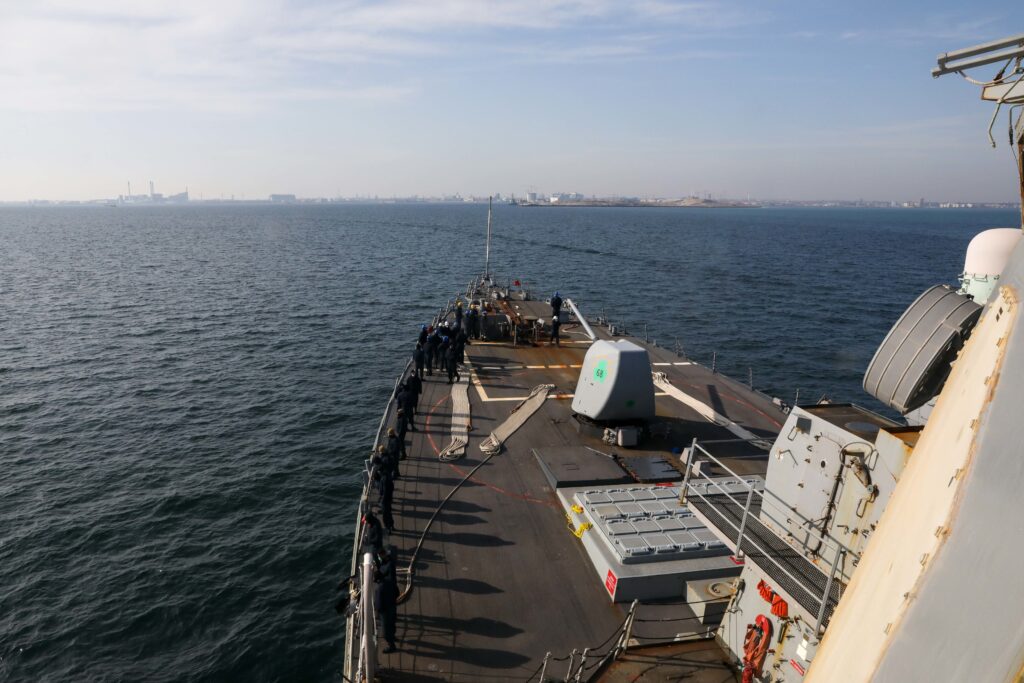
The Arleigh Burke-class guided-missile destroyer USS The Sullivans (DDG 68) pulls into port in Copenhagen, Denmark, March 21, 2022. U.S. NAVY / Mass Communication Specialist 3rd Class Mark Klimenko
JACKSONVILLE, Fla. — The Arleigh Burke-class guided-missile destroyer USS The Sullivans (DDG 68) returned to Naval Station Mayport after a three-month deployment to the European theater of operations on April 18, said U.S. 2nd Fleet Public Affairs.
This surge deployment follows a 2021 deployment with the Royal Navy’s HMS Queen Elizabeth Strike Group (CSG-21), from which The Sullivans returned home just before Thanksgiving.
The Sullivans was in sustainment when it departed Naval Station Mayport in January 2022. Ships in the sustainment phase of the Optimized Fleet Response Plan remain ready for contingency tasking before entering a maintenance phase.
“Despite the dynamic schedule and demanding operational tasking, The Sullivans crew displayed resiliency, grit and determined self-sufficiency to accomplish all missions,” said Cmdr. James Diefenderfer, Jr., commanding officer of The Sullivans. “We are incredibly proud of our team’s accomplishments.”
The crew navigated over 20,000 nautical miles, operating in the Irish, North and Baltic Seas, and conducted 12 sea and anchor details, 11 underway replenishments, and port visits to Copenhagen, Denmark; Rotterdam, The Netherlands; Ponta Delgada, Portugal; and Rota, Spain.
While deployed, The Sullivans participated in NATO Exercise Dynamic Guard 2022 in the North Sea. Dynamic Guard, hosted by Norway, is a biannual, multinational electronic warfare exercise series designed to provide tactical training for the NATO Response Force and NATO national units. For the first time in three years, two U.S. vessels participated to further enhance the ongoing cooperation, strength and interoperability between NATO Allies.
The Sullivans continued operations with three NATO countries within Standing NATO Maritime Group (SNMG) 1, which was comprised of the German navy Type 702 Berlin-class replenishment ship FGS Berlin (A1411), the Royal Netherlands Navy Karel Doorman-class multi-purpose frigate HNLMS Van Amstel (F831) and the Royal Danish Navy Iver Huitfeldt-class frigate HDMS Peter Willemoes (F362).
During the ship’s 2021 deployment, the crew operated with the Royal Danish Navy Absalon-class frigate HDMS Esbern Snare (F342) in the U.S. 6th Fleet area of operations. Almost a year later, Esbern Snare escorted The Sullivans through the Danish Strait, demonstrating expert seamanship, navigation and cooperation through one of the busiest waterways in the world.
“While we take time to recover and spend well deserved time at home, we are focusing our efforts on ensuring The Sullivans can continue to operate at peak performance for years to come,” said Diefenderfer. “Our immediate mission is the expert execution of our maintenance availability and continued training to prepare the ship and crew for future tasking. I know this crew will be ready for whatever comes next — we stick together.”