USS Forrest Sherman Returns to Norfolk from Surge Deployment 
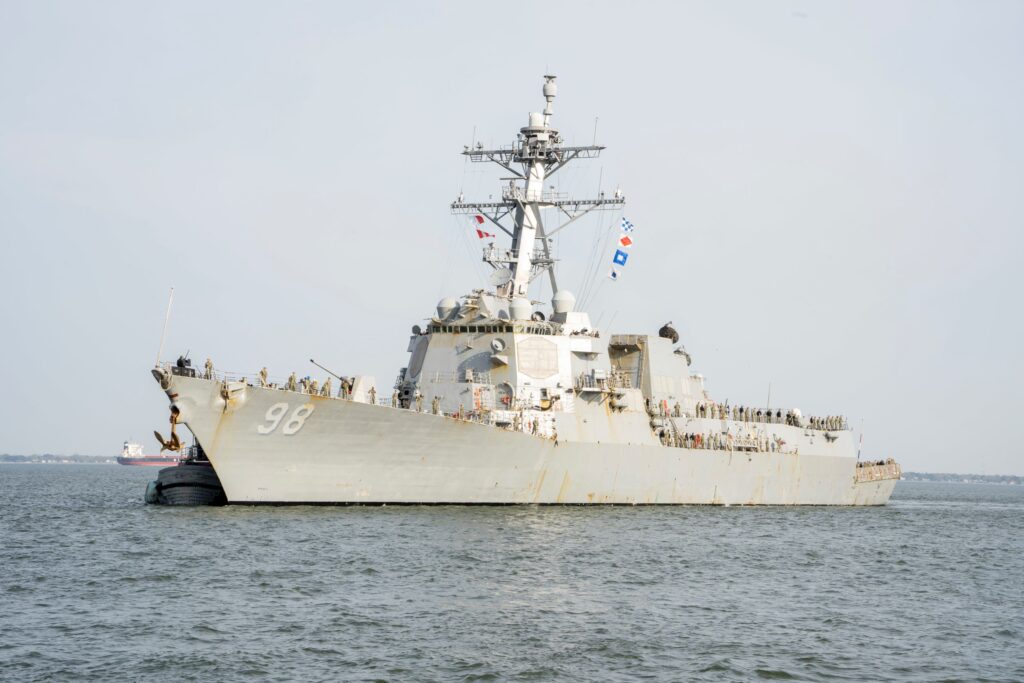
The USS Forrest Sherman (DDG 98) returned to Naval Station Norfolk on April 13 after a surge deployment. U.S. NAVY

NAVAL STATION NORFOLK — The Arleigh Burke-class guided-missile destroyer USS Forrest Sherman (DDG 98) returned home to Naval Station Norfolk on April 13 following a surge deployment, the U.S. 2nd Fleet said. 

Forrest Sherman operated with NATO Allies and partners in the Eastern Atlantic, North Sea and Baltic Sea over the past three months. 
 
The crew conducted over 200 hours of flight operations, 11 drills with NATO Allies and partners, six strait transits and six replenishments-at-sea. The drills required close coordination of maneuvering operations, cross-deck flight operations, and flashing light and flag-hoist drills with navies from Denmark, France, Germany, Italy, The Netherlands, Poland and Sweden. 
 
During the deployment, Forrest Sherman completed port visits to Stockholm, Sweden, and Gdansk, Poland, strengthening the U.S. commitment to security in the region. While in port Stockholm, the crew hosted Ambassador Erik Ramanathan, the U.S. ambassador to Sweden; Rear Adm. Ewa Skoog Haslum, chief of the Swedish navy and commander maritime component command; and several Swedish flag officers. In port Gdansk, members of the crew volunteered in a community relations event where they assisted in the packing, loading, sorting and distribution of donations to Ukrainian refugees in the Gdansk region. 
 
“The Forrest Sherman crew displayed their relentless fighting spirit during this deployment,” said Cmdr. Greg Page, commanding officer of the ship. “Their dedication to executing the mission is evident in their hard work. They are deeply committed to each other and this ship, which was evident when they were tasked to prepare for this deployment under a condensed certification timeline. The crew was excited to showcase our ship’s capabilities while operating with NATO Allies and European partners in theater.” 
 
U.S. 2nd Fleet, re-established in 2018 in response to the changing global security environment, develops and employs maritime forces ready to fight across multiple domains in the Atlantic and Arctic in order to ensure access, deter aggression and defend U.S., allied and partner interests. 
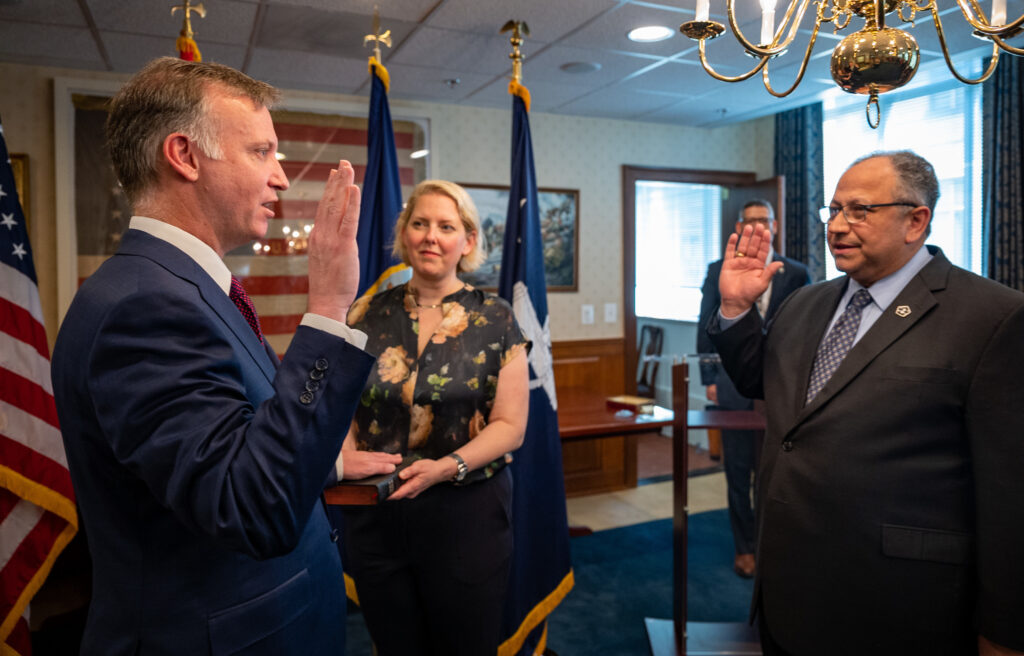


Erik K. Raven Sworn in as Undersecretary of the Navy 

Erik K. Raven, left, is sworn in as the 34th undersecretary of the Navy by Secretary of the Navy Carlos Del Toro April 13. U.S. NAVY / Mass Communication Specialist 2nd Class T. Logan Keown

WASHINGTON — Erik K. Raven was sworn into the Department of the Navy as undersecretary of the Navy during a private ceremony at the Pentagon on April 13, the Navy announced. 

It is such an honor to join the Navy and Marine Corps team after spending the last 24 years on Capitol Hill,” said Raven. “Throughout my career, I have established some great relationships within the Department of the Navy and I look forward to building more. I am thrilled to join Secretary Del Toro, the assistant secretaries of the Navy, the chief of naval operations, commandant of the Marine Corps and everyone else in the department on our shared priorities of strengthening our maritime dominance, building a culture of warfighting excellence and strengthening our relationships with strategic partners.” 

Born in San Francisco, Raven graduated from College of Marin with a Bachelor of Arts in international relations from Connecticut College and a Master of Arts degree in international history from the London School of Economics. 

Raven began his career in the offices of Sens. Dianne Feinstein, Edward Kennedy and Robert Byrd, serving in a variety of staff roles. In 2006, Raven became a professional staffer for the United States Senate Committee on Appropriations. He has since served as principal adviser to the Democratic chairs and vice chairs of the Committee on Appropriations and Subcommittee on Defense on budget matters relating to the Department of Defense and intelligence community. 

On Dec. 13, 2021, President Biden nominated Raven to be the next undersecretary of the Navy and he was confirmed by the Senate on April 7. 

“The Department of the Navy welcomes Undersecretary Raven with open arms. I have no doubt he will utilize his extensive congressional experience to benefit the Sailors, Marines and civilians in the Department,” said Del Toro. “I also want to thank Assistant Secretary for Energy, Installations and Environment Meredith Berger for performing the duties of undersecretary these last eight months. Her professionalism, thoughtfulness and recommendations have been critical when we announced the AUKUS partnership, collectively responded to the situation impacting Red Hill and the people of Hawaii, rolled out the [fiscal year 2022-2023] budget and handled countless other issues both internal and external to the department.” 


Navy Recovers E-2D from Wallops Island and Chincoteague 

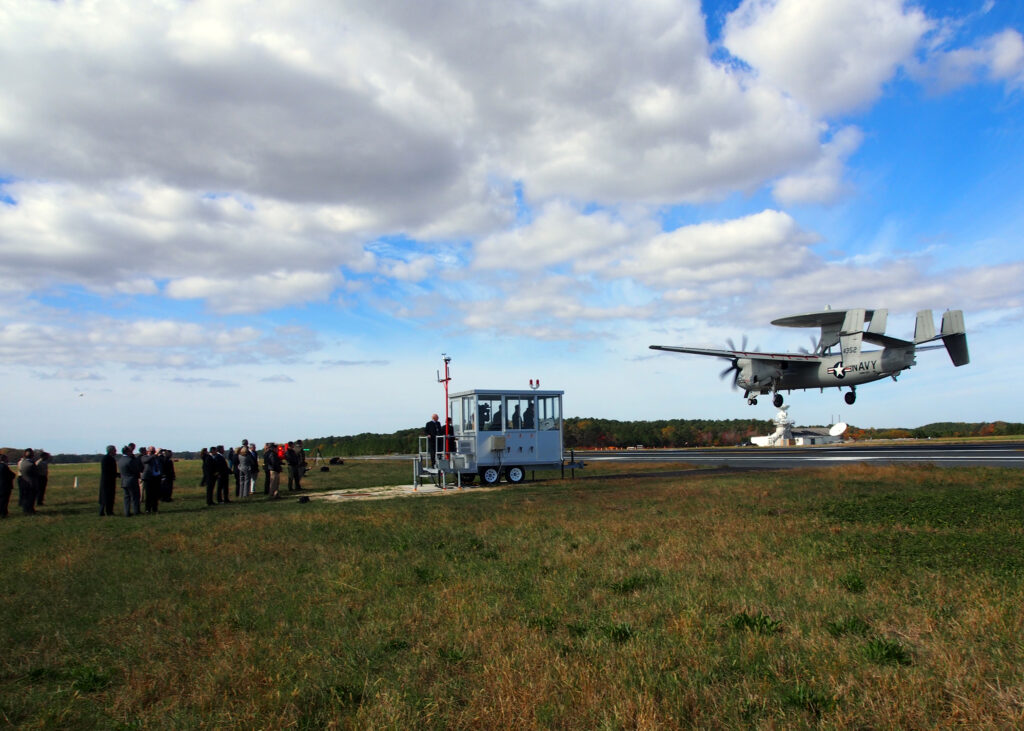
A Navy E-2 Hawkeye conducts field carrier landing practice at Wallops Flight Facility at its ribbon-cutting ceremony in 2013. U.S. NAVY

NORFOLK, Va. — The Navy successfully recovered the E-2D Advanced Hawkeye that crashed in the vicinity of Wallops Island and Chincoteague, Virginia, April 12, the service announced.   

U.S. Navy divers from Mobile Diving and Salvage Unit 2 recovered the aircraft with collaboration from other interagency partners, as well local and federal actors. MDSU 2 specializes in salvage, a Navy mission area that includes recovery of submerged objects.   

“As Navy divers, we stand ready to conduct diving and salvage operations in any environment,” said Cmdr. Steve Cobos, commanding officer of MDSU 2. “We are grateful we could use our salvage expertise to help clear the site and safely recover the aircraft for the community and the surrounding environment.”  

Safety of personnel and preservation of the environment and surrounding wildlife were top priorities in salvage efforts and the Navy consulted with various local, state and federal entities to ensure salvage efforts were safe for personnel, the environment and the community.  

Navy divers recovered the E-2D by cutting the aircraft into sections and preparing each section to be lifted with a sling. A crane lifted each section out of the water and barges transported the aircraft pieces offsite. MDSU 2 also surveyed the site and surrounding area to identify and recover aircraft debris.  

The E-2D aircraft, attached to Airborne Command and Control Squadron (VAW) 120, crashed March 30. The mishap, which left one service member dead and two injured, remains under investigation.  

“We really appreciate the support from MDSU 2 and from the numerous local and state officials who assisted with recovery operations,” said Cmdr. Martin Fentress Jr., commanding officer of VAW-120.    


Destroyer Frank E. Petersen Jr. Sailed Away From Ingalls Shipbuilding 

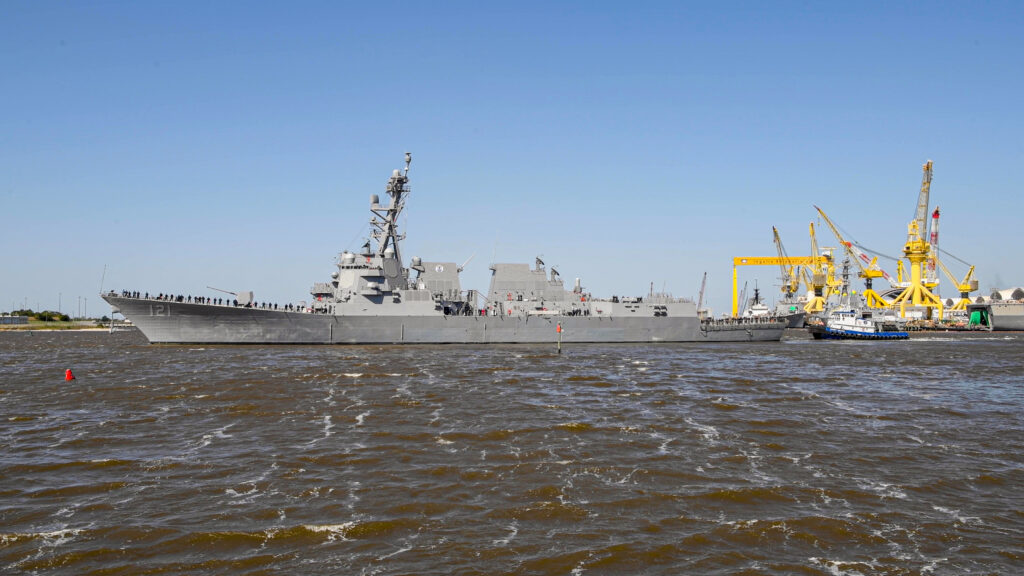
Arleigh Burke-class guided-missile destroyer Frank E. Petersen Jr. (DDG 121) departed HII’s Ingalls Shipbuilding division on Friday, April 8. HII

PASCAGOULA, Miss. — Arleigh Burke-class guided-missile destroyer Frank E. Petersen Jr. (DDG 121) departed from HII’s Ingalls Shipbuilding division on April 8, the company said April 13. Frank E. Petersen Jr. will be commissioned next month in Charleston, South Carolina, before sailing to its homeport at Hawaii’s Joint Base Pearl Harbor-Hickam. 

“I’m very grateful for the resilient and dedicated shipbuilders on our team, each is world class,” said Kari Wilkinson, president of the Ingalls Shipbuilding. 

“Watching Frank E. Petersen Jr. sail away demonstrates what this shipyard is capable of, even in the face of a pandemic,” said Donny Dorsey, Ingalls vice president of operations and previously DDG 121 ship program manager. “The Ingalls Shipbuilding team, and all those that contribute to the mission, are the best. Despite challenges, the hard work of the entire shipbuilding team enable this very proud day — watching the Navy sail this ship and join the fleet to support the defense of our nation.” 

Frank E. Petersen Jr. is the 33rd destroyer Ingalls has built for the U.S. Navy, with five more currently under construction at Ingalls, including Lenah Sutcliffe Higbee (DDG 123), Jack H. Lucas (DDG 125), Ted Stevens (DDG 128), Jeremiah Denton (DDG 129) and George M. Neal (DDG 131). Ingalls is working with the Navy to keep the destroyer line strong as the Navy transitions to the next generation of guided missile destroyers. 

Frank E. Petersen Jr. is named to honor the U.S. Marine Corps’ first African American aviator and general officer. After entering the Naval Aviation Cadet Program in 1950, Petersen went on to fly more than 350 combat missions during the Korean and Vietnam wars. 

Arleigh Burke-class destroyers are highly capable, multi-mission ships and can conduct a variety of operations, from peacetime presence and crisis management to sea control and power projection, all in support of the United States military strategy. Guided missile destroyers are capable of simultaneously fighting air, surface and subsurface battles. The ship contains myriad offensive and defensive weapons designed to support maritime defense needs well into the 21st century. 


Czech Republic Chief of Defense Signs Beams of AH-1Z and UH-1Y 

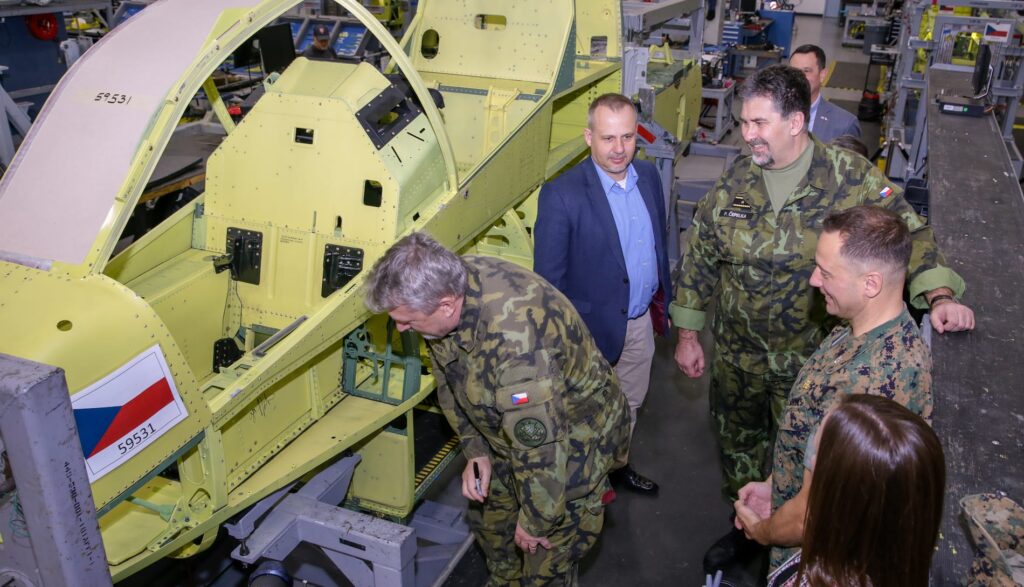
Czech Republic Chief of Defense Gen. Aleš Opata signs an H-1 aircraft beam. BELL TEXTRON

AMARILLO, Texas — Bell Textron Inc. completed another step in the production of AH-1Z and UH-1Y helicopters for international customers, the company announced April 14.

Czech Republic Chief of Defense Gen. Aleš Opata and delegates visited Bell’s Amarillo Assembly Center in a landmark meeting to observe the Czech Republic H-1 aircraft production line.  

“Hosting Gen. Opata at our Amarillo Assembly Center allows us to showcase the significant progress Bell has made in aircraft production to support this vital international program and customer,” said Mike Deslatte, H-1 vice president and program director. “We are honored to continue our great relationship with the Czech Republic as we prepare to provide them with leading defense aircraft and continue the success of the H-1 program.”  

During the visit, Gen. Opata signed the beams of the first AH-1Z and UH-1Y aircraft that will be delivered to the Czech Republic. Production continues on schedule with all 12 aircraft expected to be complete in 2023.  

“In military operations today, one of the key requirements is to be able to win in both aircraft capabilities and logistics support,” said Nate Green, H-1 program manager. “There is no better example of two complementary aircraft regularly operating from expeditionary locations and completing as many missions together as the AH-1Z and UH-1Y.” 

The Bell AH-1Z and UH-1Y offer advanced capabilities for defense missions and decrease the maintenance and operational footprint due to their 85% commonality. Bell is actively producing AH-1Zs for the U.S. Marine Corps and expects to complete deliveries this year, followed by production for international operators. Bell recently completed the first delivery of four AH-1Z helicopters to the Bahrain Defence Force and expects to complete the first international delivery of the AH-1Z this year. 


New Task Force 153 to Patrol Red Sea, Bab al-Mandeb Strait, Gulf of Aden 

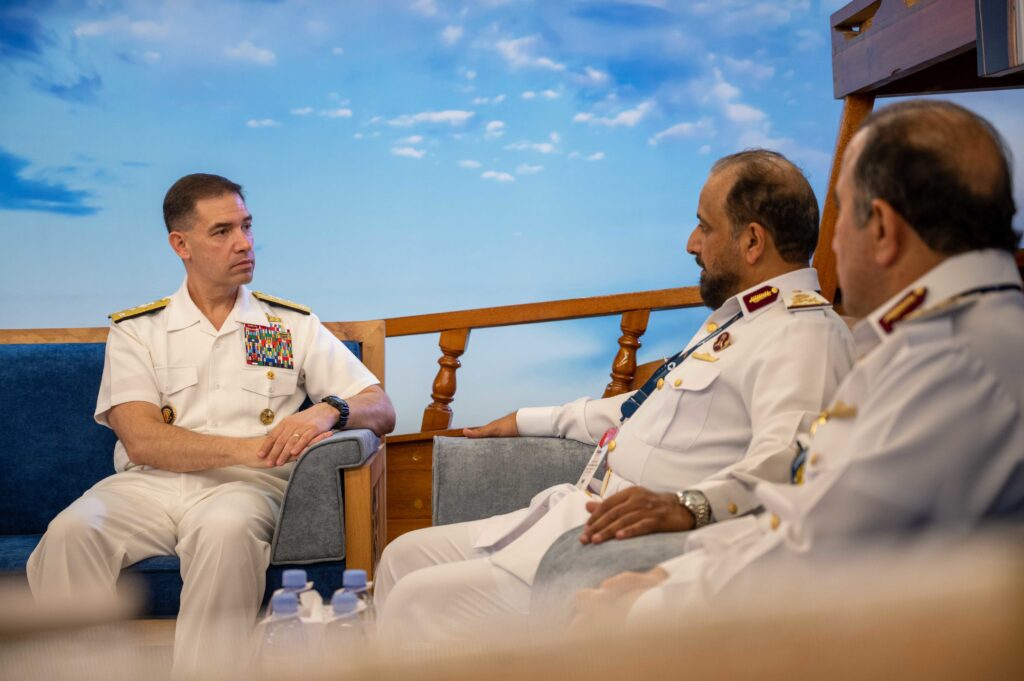
Vice Adm. Brad Cooper, commander of U.S. Naval Forces Central Command, U.S. 5th Fleet and Combined Maritime Forces, speaks to Maj. Gen. Abdullah Hassan Al-Sulaiti, commander of the Qatari Emiri Naval Forces, at the Doha International Maritime Defence Exhibition and Conference in Doha, Qatar, March 21. U.S. NAVY / Mass Communication Specialist 1st Class Mark Thomas Mahmod

ARLINGTON, Va. — Combined Maritime Forces, or CMF, the U.S.-led multi-national coalition of forces enforcing maritime security in the U.S. Central Command are of responsibility, is establishing a fourth task force to enhance the security of the region. 

CMF is establishing Commander Task Force 153 (CTF-153) on April 17, with ceremonies to be held at U.S. 5th Fleet headquarters in Manama, Bahrain, said Vice Adm. Brad Cooper, commander of the CMF, whose duties also include commander, U.S. 5th Fleet, and commander, Naval Forces, U.S. Central Command. Cooper briefed reporters on the new task force in an April 13 press teleconference. 

CTF-153 will patrol the waters of the Red Sea, the Bab al-Mandeb Strait and the Gulf of Aden in an effort to expand capacity to cover those regions to counter activities such as human trafficking and smuggling of weapons and illegal drugs. 

The region also has seen combat action from Iran-supported Houthi rebels in Yemen firing missiles at shipping in the areas and using explosives-loaded attack boats.  

Cooper said the new task force will “definitely increase our deterrence posture” in the region.  

As the CMF’s fourth task force, CTF-153 joins CTF 150, responsible for maritime security outside the Persian Gulf in the Gulf of Oman and North Arabian Sea; CTF-151, the counter-piracy task force; and CTF-152, responsible for maritime security inside the Persian Gulf.  

With 34 member nations, the CMF is the largest standing naval partnership in the world. The member nations rotate command of the task forces. Cooper said he had “sufficient forces” to meet the CMF’s commitments.  

Cooper said the maritime security efforts have “always been our best when we’re teamed with international partners,” and that the United States is “teaming with a lot of navies who are very capable.” 

He singled out mention of the Egyptian navy, which joined the CMF a year ago and will strengthen the efforts to patrol the Red Sea and protect the Suez Canal.  

CTF-153 will first be commanded by U.S. Navy Capt. Robert Francis, who with his staff soon will embark on the command ship USS Mount Whitney (LCC 20), which normally serves as the flagship of the U.S. 6th Fleet in the Mediterranean Sea. An officer from a partner nation will assume command of CTF-153 later this year, Cooper said. 

Cooper said that CTF-153 will typically include two to eight ships, plus maritime patrol aircraft as needed. The staff itself will be comprised of approximately 15 personnel. 

He said that with the additional task force the CMF will “be able to connect in ways we simply haven’t been able to do in the past.” 


Ultra, Sparton DLS Awarded $11.6M for Advanced SSQ-125A Sonobuoys 

COLUMBIA CITY, Ind. and DELEON SPRINGS, Fla. — Ultra Electronics Holdings and Sparton DLS have been awarded a $11.6 million contract to their ERAPSCO joint venture for the manufacture of next-generation sonobuoys for the U.S. Navy, the companies said April 13.

The new buoy type, the AN/SSQ-125A (Q-125A) which was recently officially qualified, was developed by ERAPSCO after 24 months of effort. The Q-125A will provide advanced active sonar capabilities to the U.S. Navy fleet of antisubmarine warfare aircraft and will further the U.S. Navy’s ability to counter stealthy modern submarines from foreign adversaries. 

ERAPSCO will award production subcontracts in the amount of $3.6 million and $8 million to Ultra Electronics USSI and Sparton. Production operations will take place at Ultra Electronics USSI’s Columbia City, Indiana, facility and Sparton’s DeLeon Springs, Florida, facility, and are expected to be completed by November 2023. 


Navy, Marine Corps Aircrew’s New Training Devices Improving Capability, Readiness 

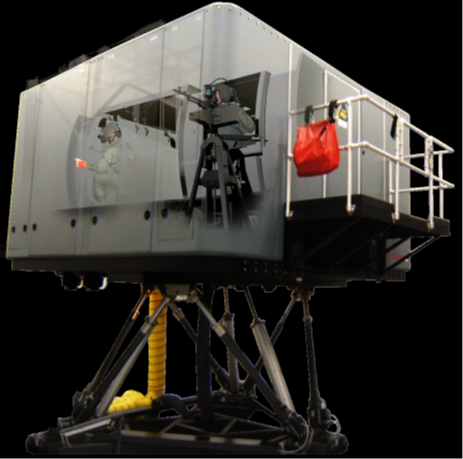
The Naval Aviation Training Systems and Ranges program office recently delivered the first fully capable Naval Aircrewman Training Systems and Marine Common Aircrew Trainers to the fleet. The graphic displays U.S. Navy aircrew conducting training in an aircrew virtual environment trainer. U.S. NAVY

PATUXENT RIVER, Md. — The Naval Aviation Training Systems and Ranges program office (PMA-205) recently delivered the first fully capable Naval Aircrewman Training Systems (NATS) and Marine Common Aircrew Trainers (MCAT) to the fleet, the Naval Air Systems Command said April 12.   

The NATS was delivered to Naval Air Station Mayport, Florida, and two MCATs were delivered to Marine Corps Air Station New River, North Carolina. Both the NATS and the MCAT devices are being used to conduct initial, integrated crew training and proficiency flights, ultimately reducing flight hours in operational aircraft, reducing and and in some cases eliminating ordnance expenditures, and reducing high-risk evolutions that could lead to mishaps.    

“This is long overdue” said Capt. Lisa Sullivan, PMA-205 program manager, who oversees the two programs. “In the past, H-60, H-53, H-1, and V-22 aircrew did not have an opportunity to start their training in a controlled simulator environment before entering into a dynamic aircraft environment. For our Marine Corps aircrew, it provides the ability to gain initial weapon engagement proficiency in a simulator before live fire training on operational flights.”    

The NATS device is the first of nine deliveries under the Aircrewman Training Optimization program, an effort enhancing their hardware and software capability baseline. It provides a blend of virtual and physical environments for training MH-60R aircrew in crew coordination; aerial gunnery; hoist operations; search and rescue; and vertical replenishment. The Navy is incorporating these enhanced environments into Navy helicopter Wing Training Manuals.   

The fleet will officially begin training in the MCAT this spring and during recent MCAT mission scenario testing, Marine Corps enlisted aircrew subject matter experts said the MCAT will be a training and readiness game-changer. Prior to the delivery of the new device, Marine Corps CH-53E, MV-22B, and UH-1Y enlisted aircrew trained on operational aircraft.   


Austal USA Celebrates Opening of Steel Facility 

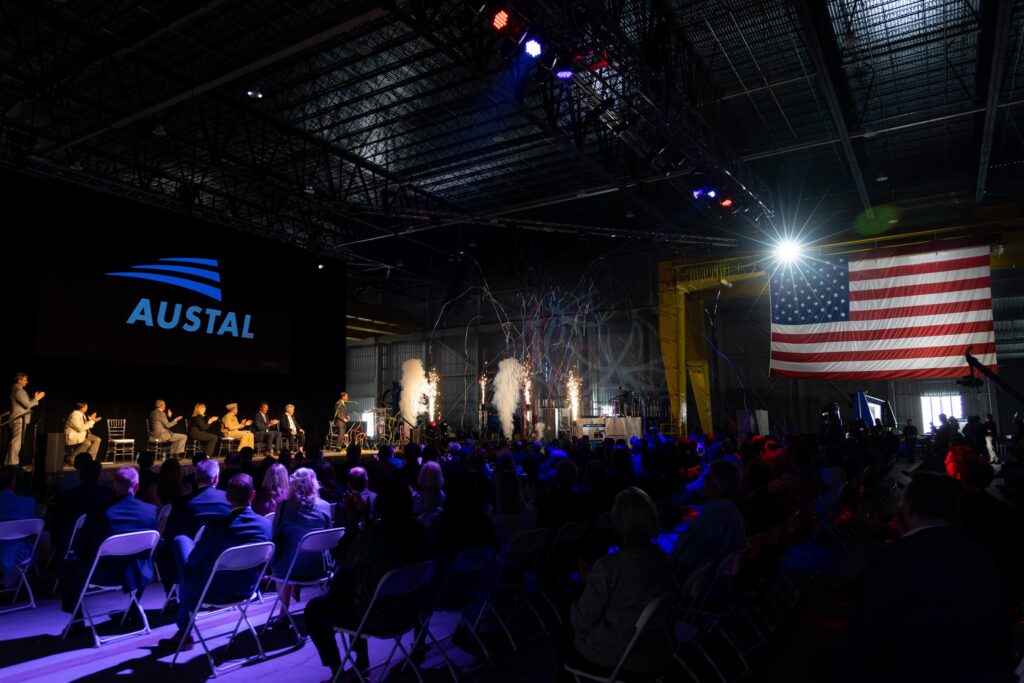
Austal USA hosted a curtain drop ceremony to celebrate the opening of its steel facility. AUSTAL USA

MOBILE, Ala. — Austal USA hosted a curtain drop ceremony April 12 to celebrate the opening of the company’s state-of-the-art steel facility in front of more than 200 guests, including representatives from the U.S. Navy, Coast Guard, federal, state and local government and the Embassy of Australia, the company said in a release.

The addition of steel shipbuilding capability complements the company’s aluminum shipbuilding expertise. 

“The opening of the new steel manufacturing line at Austal USA means south Alabama will be able to continue providing high-quality ships for the Navy,” said Rep. Jerry Carl (R-Alabama). “This massive $100 million investment will also create jobs and spur economic growth throughout the region, while continuing to develop and grow our local workforce with the hiring of countless folks in the trades to meet the demands of the new line.” 

“We are so excited to see our plans to add steel to our capabilities come to fruition,” said Austal USA President Rusty Murdaugh. “The addition of steel capability is a game changer as it opens up our capability to support the U.S. Navy, U.S. Coast Guard and other customers with high-quality ships. We appreciate the confidence the Department of Defense and the Department of the Navy have shown in us with the award of the DPA grant to get this project started and look forward to repaying that confidence with our future performance delivering high-quality steel ships.”  

The 117,000 square foot manufacturing addition will house computerized and robotic steel processing equipment to handle all of the current and future demands of the U.S. Navy and the U.S. Coast Guard.  A 60,000 square foot stock yard will be utilized for handling the raw steel and a 19,500 square foot paint facility will provide the ability to paint and blast simultaneously in two separate cells, or both cells can be combined providing the ability to paint super-modules.  

Financing for the new steel production line was provided in part by a Defense Production Act Title III Agreement between the U.S. Department of Defense, in support of the U.S. Navy shipbuilding industrial base, and Austal USA. The agreement, valued at $50 million, was announced in June 2020 and was part of the national response to COVID-19 to maintain, protect and expand critical domestic shipbuilding and maintenance capacity. Austal USA matched these funds and invested an additional $50 million into the completion of the steel facility. 


USS Annapolis Makes Fifth Submarine Homeported in Guam 

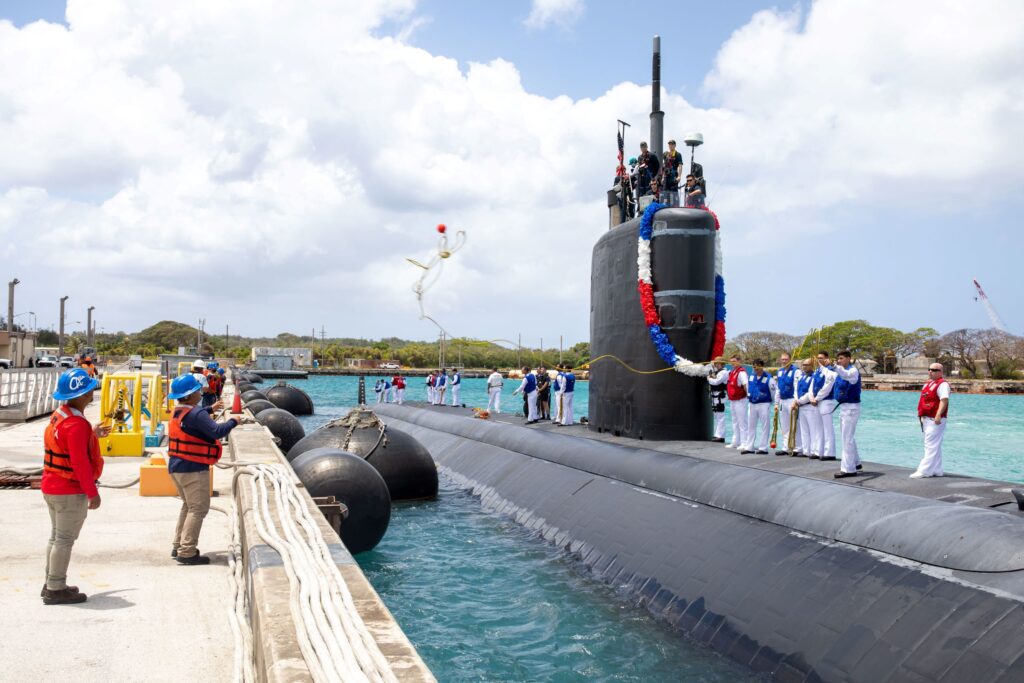
The Los Angeles-class fast-attack submarine USS Annapolis (SSN 760) arrived March 28 at Naval Base Guam from Naval Base Point Loma, San Diego. U.S. NAVY

APRA HARBOR, Guam — The Los Angeles-class fast-attack submarine USS Annapolis (SSN 760) arrived March 28 at Naval Base Guam from Naval Base Point Loma, San Diego, shifting its homeport as part of the U.S. Navy strategic laydown plan for naval forces in the Indo-Pacific region, Submarine Squadron 15 Public Affairs said April 10. 

“My crew is proud to join the submarine force team in Guam,” said Cmdr. James Tuthill, Annapolis’s commanding officer. “It’s an excellent place to live, with a strong sense of community and a clear mission. We worked hard to get the ship through a shipyard period ahead of schedule, and we’re ready to assume our place on the front line.” 
 
The security environment in the Indo-Pacific requires the U.S. Navy station the most capable ships forward. This posture allows rapid responses for maritime and joint forces and brings our most capable ships and submarines with the greatest amount of striking power and operational capability to bear in the timeliest manner. 
 
“I would like to personally extend a warm Hafa Adai to the Sailors and families of our fifth homeported submarine on Guam, USS Annapolis,” said Commander Joint Region Marianas Rear Adm. Benjamin Nicholson. “Guam and the Mariana Islands are incredibly important to the overall defense of the region, and this additional capability further underscores our commitment to a free and open Indo-Pacific.” 
 
In accordance with the strategic laydown plan of 2021, Annapolis makes the fifth Los Angeles-class fast-attack submarine to be homeported in Guam alongside USS Asheville (SSN 722), USS Key West (SSN 758), USS Jefferson City (SSN 759), and USS Springfield (SSN 761). USS Springfield arrived in Guam one week before USS Annapolis on March 21. 
 
“As part of the U.S. Navy’s plan to put the most advanced and capable units forward, USS Annapolis completed a homeport shift from San Diego, California to Guam in order to support Indo-Pacific initiatives and missions,” said Capt. Bret Grabbe, commodore, Submarine Squadron 15. 

Commissioned April 11, 1992, Annapolis is the fourth ship of the United States Navy named for the city of Annapolis, Maryland. Annapolis has a crew of approximately 16 officers and 127 enlisted Sailors.