International Maritime Security Construct Holds Conference 

MANAMA, Bahrain — The International Maritime Security Construct gathered in person at the Naval Support Activity Bahrain and virtually March 31 to discuss the latest regional threats and other issues that are critical to maritime commerce in and around the Middle East, Task Force Sentinel public affairs said in a release. 

The theme of the industry-focused biannual conference was “The Evolution of International Maritime Security Construct.” The event involved distinguished speakers and panelists who addressed a range of topics including safety measures, best practices, communication and strengthening collaboration. 

“IMSC has been on watch to assure freedom of navigation and safeguard the free flow of international merchant shipping.” said Commodore Don Mackinnon, commander of IMSC and Coalition Task Force Sentinel. “This stakeholders conference was an ideal forum for all of our partners, both international and commercial, to share their ideas, information, assessments and best practices to help us further refine and develop the mission.” 

IMSC was formed in July 2019 in response to increased threats to freedom of navigation for merchant mariners transiting international waters in the Middle East. Coalition Task Force Sentinel was established four months later to deter state-sponsored malign activity and reassure the merchant shipping industry in the Bab al-Mandeb and Strait of Hormuz. 

This coalition is comprised of nine member nations: the Republic of Albania, the Kingdom of Bahrain, the Republic of Estonia, the Republic of Lithuania, Romania, the Kingdom of Saudi Arabia, the United Arab Emirates, the United Kingdom and the United States. 


Heavy Icebreaker Polar Star Returns to U.S. After 147-Day Antarctic Deployment 

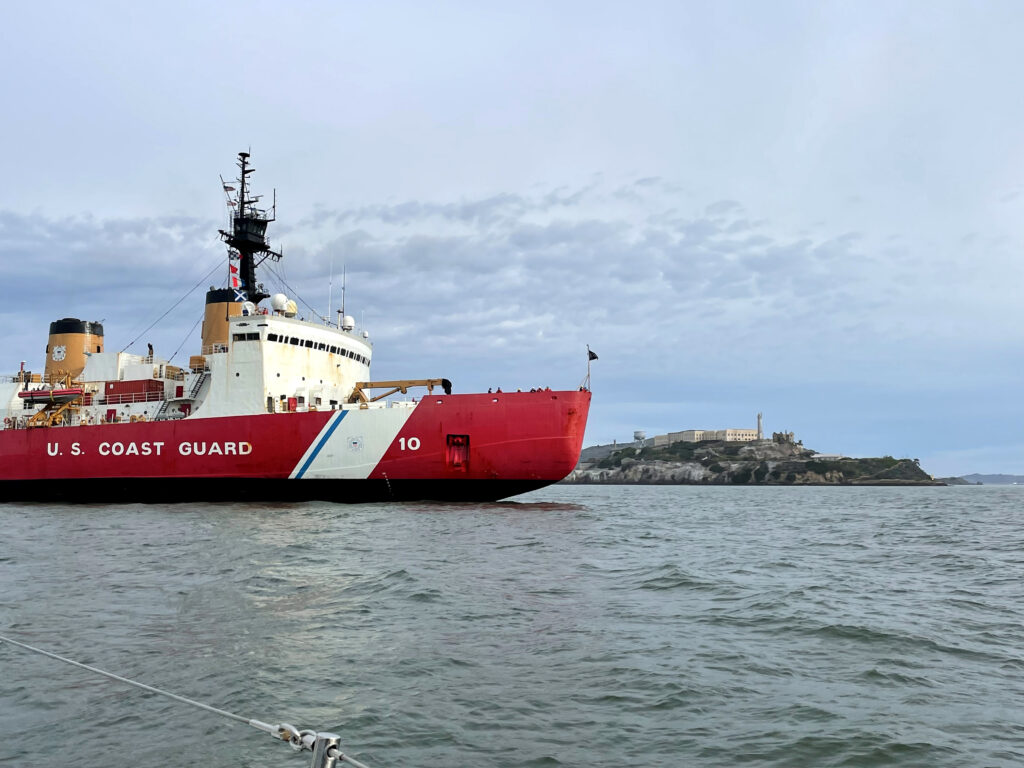
The U.S. Coast Guard Cutter Polar Star (WAGB 10) passes Alcatraz as the cutter transits the San Francisco Bay, April 4. Following its 147-day Antarctic deployment, the cutter will undergo annual maintenance in a Vallejo, California, dry dock. U.S. COAST GUARD / Sachiko Itagaki

ALAMEDA, Calif. — The 140-member crew of U.S. Coast Guard Cutter Polar Star (WAGB 10) returned to the United States and entered dry dock Friday after completing a 147-day deployment in support of the U.S. Antarctic Program and national interests in Antarctica and the Southern Hemisphere, the Coast Guard Pacific Area said April 8. 
 
The Polar Star’s crew departed their Seattle homeport on Nov. 13, 2021, for the cutter’s 25th Operation Deep Freeze deployment and traveled 24,300 nautical miles to Antarctica and back. 
 
This year marks the 66th iteration of Operation Deep Freeze, an annual joint military service mission in support of the National Science Foundation, the lead agency for the United States Antarctic Program. Since 1955, the U.S. Department of Defense and the Coast Guard have provided air and maritime support across and around the Antarctic continent. 
 
The cutter made several international port calls including stops in Wellington and Lyttelton, New Zealand, and Hobart, Tasmania, Australia. Polar Star’s crew hosted the U.S. Ambassador to New Zealand and members of the Royal New Zealand Navy while in New Zealand. 
 
While in Antarctica, Polar Star transited through more than 450 miles of pack ice and broke a 37-mile channel through seven-foot-thick fast ice to McMurdo Station to allow the safe transit and offload of supply vessels Ocean Giant and Maersk Peary.  
 
Polar Star also partnered with the Royal New Zealand Navy to escort the ice-capable logistics ship HMNZS Aotearoa for its first trip to McMurdo Station. 
 
Polar Star transited to the Bay of Whales Feb. 17, setting a record for the furthest south any vessel has navigated, reaching 78 degrees 44 minutes 1.32 seconds south latitude, keeping about 500 yards from the ever-shifting Ross Ice Shelf. The cutter also surveyed 396 nautical miles of the ice shelf for future navigational use. 
 
Polar Star spent a total of 65 days in Antarctica, making it the longest Operation Deep Freeze deployment completed by a Coast Guard polar icebreaker in 18 years. 
 
After completing operations in Antarctica, Polar Star moored in Hobart and hosted Tasmanian Gov. Barbara Baker, and U.S. Consul General Kathleen Lively, along with several other government and military officials that are dedicated to supporting scientific efforts in Antarctica. 
 
“I am so proud of this crew and their accomplishments,” said Capt. William Woityra, commanding officer of the Polar Star. “They overcame constant challenges to complete the mission and set records along the way. They epitomize the values on the Antarctica Service Medal: courage, sacrifice, and devotion. I can think of no better team to lead future expeditions and new icebreakers as the Coast Guard invests in Polar Security Cutters.” 
 
Polar Star did not return to its homeport of Seattle, instead the crew proceeded directly to dry dock in Vallejo, California, to immediately start work on the second phase of a five-year, $75 million Service Life Extension Program. The Coast Guard will replace antiquated technology to ensure the longevity of the nation’s only operational heavy icebreaker while in dry dock this year, supporting the Coast Guard’s enduring commitment to Antarctic operations. 


SENEDIA Marks National Submarine Day with Call for Next-Generation Workforce  

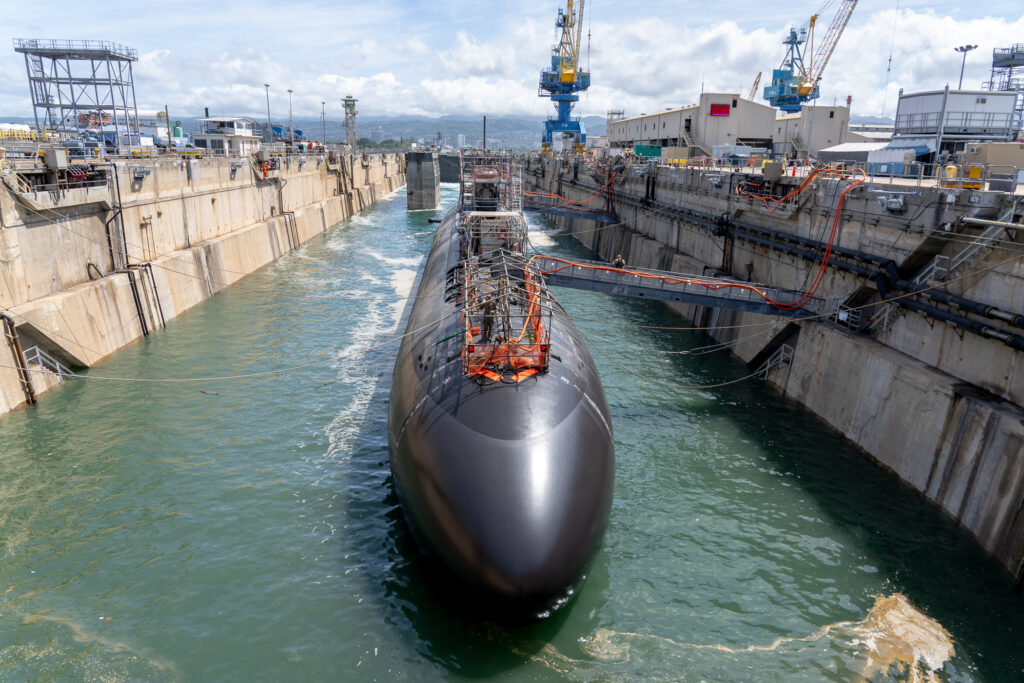
Pearl Harbor Naval Shipyard & Intermediate Maintenance Facility successfully undocked the Los Angeles-class fast-attack submarine USS Topeka (SSN 754) on time commencing a two-day evolution on July 27, 2021. U.S. NAVY / Amanda Urena

MIDDLETOWN, R.I. — SENEDIA, a membership alliance for defense tech, talent, and innovation, celebrated National Submarine Day on Monday, April 11, with a call to action for the future submarine shipbuilding workforce. The industry is facing a critical worker shortage, and SENEDIA is ramping up training and career exploration efforts to engage the next generation workforce.   

“Careers in submarine shipbuilding are high-wage, high-growth, high-demand, and those who choose this pathway gain a deep sense of fulfillment and patriotism knowing they are supporting our submarine sailors and protecting our country,” said Molly Donohue Magee, SENEDIA executive director. “Our current submarine shipbuilding workforce ranks are not sufficient to meet the extraordinary — and growing — demand, and SENEDIA is committed to engaging, training, and expanding the workforce to move our industry forward on a path to stability and growth.”  

The Navy’s need for new submarines to add to their fleet is significant, with two Virginia-class submarines and one Columbia-class submarine being built every year for the foreseeable future. To help meet that demand, SENEDIA has a two-pronged approach that includes incumbent worker training for individuals already in the workforce and career exploration and on-the-job learning for future workers.   

“The opportunities available in submarine shipbuilding are exciting and rewarding and can put people on a path to security and success,” said Rear Admiral Scott Pappano, Program Executive Officer – Strategic Submarines. “As individuals, those who work in the submarine shipbuilding industry find hands-on work that is constantly changing and have the ability to explore and advance innovative new technologies. We take great pride knowing that our work makes an important difference to our national security.”  

Since launching their incumbent worker training program in August 2020, funded through the Department of Defense Industrial Base Analysis and Sustainment Office, SENEDIA has trained more than 1,200 people, 800 of whom completed the program in the last year alone. These individuals are employed throughout the supply chain, with a critical mass at General Dynamics Electric Boat, the epicenter of the submarine shipbuilding industry. Electric Boat alone plans to hire over 2,200 employees over the next year.  

Being part of the submarine shipbuilding workforce requires only a high school diploma or equivalent and provides a career with strong wages and outstanding benefits.  

Carla Hall, a Marine Corps veteran who received training at the Westerly Education Center, Rhode Island, and is now a pipefitter at Electric Boat, calls the training “a lifechanging experience.”  

“You’re going to be able to find meaningful work; you’re going to be able to find a nice wage for you and your family; and you’re going to make lifelong friends,” she said.  

To grow the pipeline of workers, SENEDIA continues to expand its high school and middle school outreach. SENEDIA currently works with career and technical education programs in Rhode Island and Connecticut, engaging more than 100 high school students each year to explore potential careers in advanced manufacturing and submarine shipbuilding. SENEDIA is expanding our outreach throughout New England.  


Martin Defense to Develop Amphibious Autonomous Vehicle for Expeditionary Fuel Delivery  

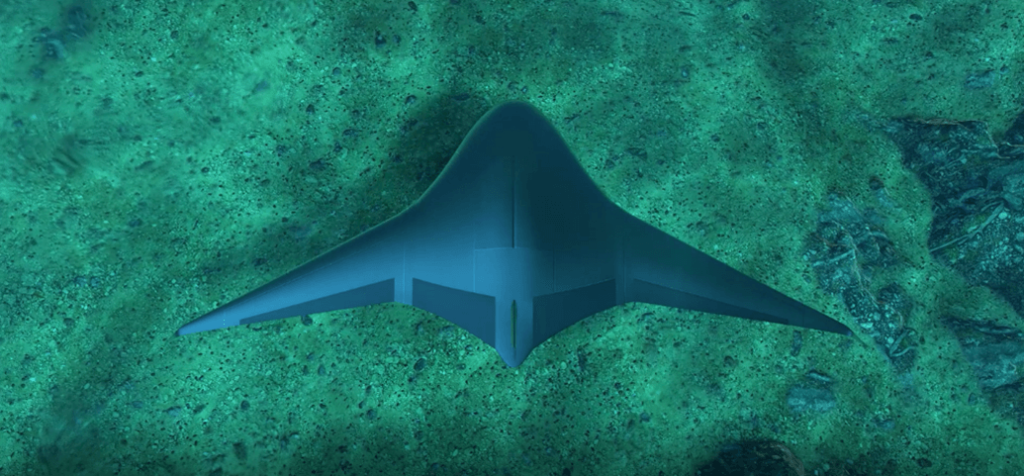
An artist’s conception of Martin Defense Group’s Manta Ray autonomous underwater vehicle. DARPA

ARLINGTON, Va. — A defense company in Hawaii has been tapped by the Office of Naval Research to develop an autonomous vehicle to deploy a fuel delivery system to support amphibious systems.  

Martin Defense Group LLC of Honolulu has been awarded a $15 million cost-plus-fixed-fee contract for the development of an Amphibious Vehicle for Unmanned Surface Mobility, the Defense Department said April 6.  

“The AVUSM system provides the capability of autonomously delivering a lay-flat fuel line hose from a floating embarkment platform, through the surf-zone, to above a high-water mark line for fuel delivery in support of expeditionary advanced base operations,” the announcement said. “This is also known as a reach-to-the-beach capability. This contract provides for technology development and maturation with the objective of transitioning the technology/capability to Navy and/or Marine Corps acquisition programs.” 

Martin Defense also is the developer of the Manta Ray autonomous underwater vehicle for the Defense Advanced Research Projects Agency. Work expected to be completed by April 5, 2025. 


Hunt Valve Awarded $2M by Newport News Shipbuilding for Ford CVN Parts 

BELOIT, Wis. — Fairbanks Morse Defense has been awarded a contract by Newport News Shipbuilding to provide essential parts through Hunt Valve for the Ford-class aircraft carriers CVN 78–CVN 81, the company said April 5. 

The contract, valued at approximately $2 million, covers parts that will be delivered during the second and third quarters of 2022. Hunt Valve, acquired by Fairbanks Morse Defense in 2021, manufactures valves and electromechanical actuators for naval defense applications.  

Having traditionally been a naval engine supplier, Fairbanks Morse Defense has expanded into a single-source product and service solutions provider for the entire vessel. Over the last 18 months, the defense contractor has been acquiring a number of companies, including Hunt Valve, and currently offers a large array of best-in-class marine technologies, original equipment manufacturer parts and turnkey services for the entire vessel.  

“Every ship and every shipyard play a crucial role in advancing American interests and countering our rivals at sea. Fairbanks Morse Defense and our sub-brands are deeply committed to supporting our country’s critical naval operations with American-made OEM parts throughout the ship,” said Fairbanks CEO George Whittier. “In light of the post-pandemic supply chain challenges and uncertainty about the war in Ukraine, NNS is being extremely prudent by stocking the parts necessary.” 


Ports Seen as ‘Vital Resource’ for National Security

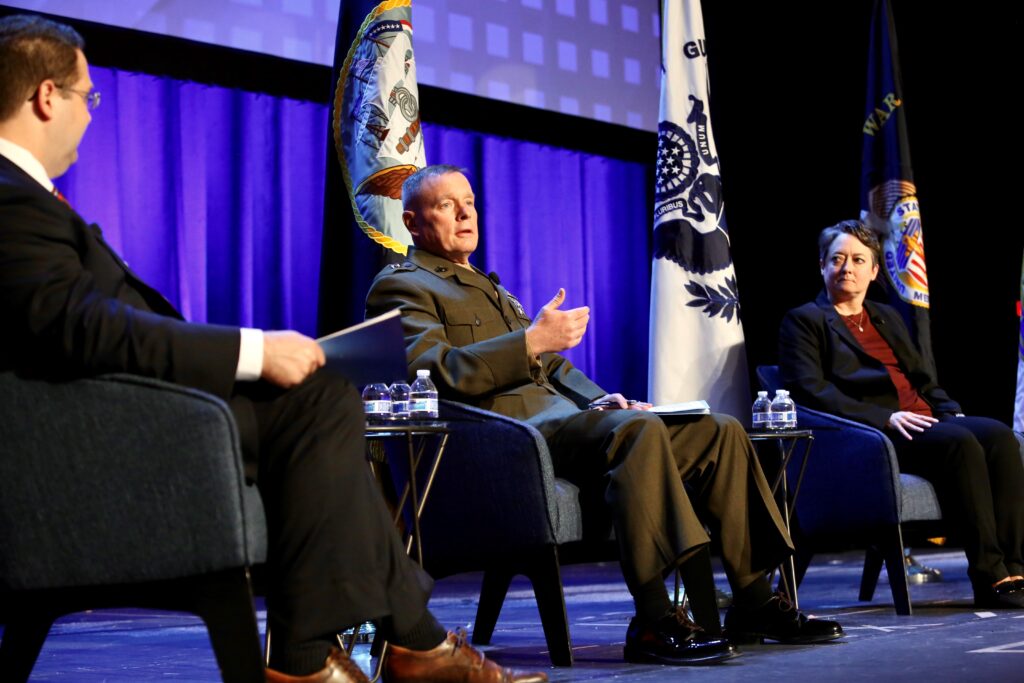
Rear Adm. John Mauger, Coast Guard assistant commandant for prevention policy, makes a point during a port security panel discussion at Sea-Air-Space 2022. LISA NIPP

NATIONAL HARBOR, Md. — The economic role U.S. ports play can’t be overstated because they are a vital resource, a Coast Guard official said in an April 6 panel discussion at Sea-Air-Space 2022.

“Twenty five percent of U.S. GDP and employment for one in seven Americans are generated because of port-based activity,” said Rear Adm. John Mauger, assistant commandant for prevention policy. “We also know this is a vital resource for our national security. It’s how we project power and [provide] humanitarian aid around the globe.” 

Tony Padilla, a senior adviser for maritime trade and development at the U.S. State Department, agreed on the importance of ports.

“International trade in our nation’s ports support the employment of nearly 31 million people, provide about $1.5 trillion in personal income and generate over $5.5 trillion in economic activity, thereby accounting for one quarter of the nation’s GDP,” Padilla said. “Many of our ports safeguard government owned vessels and commercial sealift vessels, so our military can project power abroad. Simply put, without seaports, our economy would be crippled.”

There’s also a dark side to ports that is difficult to monitor said Christopher Hickey, a senior systems engineer at the Naval Research Laboratory.

“There are about 250,000 ship tracks worldwide on a good day,” Hickey said. “But you have to add in the hundreds of thousands of dark ships — the ships not emitting AIS [automatic identification system] — that traverse the globe. While a fair amount of illicit maritime activity takes place aboard AIS-compliant ships, it is these dark ships, or dark targets, that typically pose the greatest threats.

“Domestically, the United States has long maritime borders that for the most part are not monitored on a 24/7 basis, creating a permissive environment that enables massive amounts of illicit goods and cargos to be imported and exported. Drugs. Money. Weapons. And, worst of all, the trafficking of people — all of this moving illegally across our maritime borders every day,” he said.


BAE Systems to Study New Amphibious Combat Vehicle Variant  

BAE Systems will study incorporating a C4/UAS payload on the Amphibious Combat Vehicle. BAE SYSTEMS

STAFFORD, Va. — BAE Systems has received task instructions from the U.S. Marine Corps to complete a study of incorporating Advanced Reconnaissance Vehicle-Command, Control, Communication and Computers/Unmanned Aerial Systems mission payload on an Amphibious Combat Vehicle (ACV) variant, the company said April 7.

Pending the results of the phase 1 study, the Marine Corps may pursue modification of an ACV to install the C4/UAS payload. This C4/UAS variant will provide the transformational technology Marines need to observe their surroundings, collect and integrate information, and sense new targets over the horizon. 

The ACV C4/UAS will feature a state-of-the-art battle management system and advanced sensing capabilities. Offering a substantial level of commonality with other ACV variants, BAE Systems will work toward a fully open-architecture approach, allowing for rapid technology refresh and upgrades, including seamless integration of future technologies and capabilities. This has the potential to provide the Marine Corps significant economies of scale in development and life-cycle management costs.   

“BAE Systems is dedicated to offering innovative combat system solutions to meet the multi-domain needs of the U.S. Marine Corps’ modernization efforts,” said John Swift, vice president of amphibious programs at BAE Systems. “Adding the C4/UAS variant to the ACV family of vehicles may offer development and life cycle cost savings. We look forward to continuing our commitment to the Marines’ ability to be unmatched on the battlefield.” 

The ACV is a highly mobile and proven solution capable of conducting rapid ship-to-objective maneuver, delivering enhanced combat power to the Fleet Marine Forces. The ACV was developed with teammate IVECO Defence Vehicles. 

BAE Systems has received two full-rate production contracts since the Marine Corps declared initial operational capability for the ACV family of vehicles program, which includes the ACV personnel variant (ACV-P) and the ACV command variant (ACV-C). The company is currently under contract to design and develop a 30mm cannon variant (ACV-30) and a recovery variant (ACV-R).  

ACV C4/UAS engineering, integration, and fabrication is taking place at BAE Systems locations in Stafford, Virginia.; San Jose, California; Sterling Heights, Michigan; and York, Pennsylvania. 


Flag Officer Nominations, Assignments Announced

ARLINGTON, Va. — Secretary of Defense Lloyd J. Austin III announced April 6 the president has made the following nomination:

Navy Vice Adm. Eugene D. Black III for reappointment to the grade of vice admiral, and assignment as deputy chief of naval operations for operations, plans, and strategy, N3/N5, Office of the Chief of Naval Operations, Washington, D.C. Black is currently serving as commander, Sixth Fleet; commander, Task Force Six; commander, Striking and Support Forces NATO; deputy commander, U.S. Naval Forces Europe; commander, U.S. Naval Forces Africa; and Joint Force Maritime Component Commander Europe, Naples, Italy.

The secretary of the Navy and chief of naval operations announced April 6 the following assignments:

Rear Adm. Daniel L. Cheever will be assigned as chief of staff, North American Aerospace Defense Command; and chief of staff, U.S. Northern Command, Colorado Springs, Colorado. Cheever is currently serving as director of plans, policy and strategy, North American Aerospace Defense Command; and director of plans, policy and strategy, U.S. Northern Command, Colorado Springs, Colorado.

Rear Adm. Paul J. Schlise will be assigned as director, Warfare Development, N72, Office of the Chief of Naval Operations, Washington, D.C. Schlise is currently serving as director, Surface Warfare Division, N96, Office of the Chief of Naval Operations, Washington, D.C.

Rear Adm. Douglas C. Verissimo will be assigned as director, Maritime Operations, U.S. Fleet Forces Command, Norfolk, Virginia. Verissimo is currently serving as director, Assessment Division, N81, Office of the Chief of Naval Operations, Washington, D.C.

Rear Adm. Dean A. VanderLey will be assigned as commander, Naval Facilities Engineering Systems Command; and chief of civil engineers, with additional duties as deputy commander for facilities and environment, Navy Installations Command; and deputy commander for facilities and environment, Marine Corps Installations Command, Washington, D.C. VanderLey is currently serving as commander, Naval Facilities Engineering Command Pacific; and director, Fleet Civil Engineer, U.S. Pacific Fleet, with additional duty as fleet civil engineer, N46, U.S. Pacific Fleet, Pearl Harbor, Hawaii.

Rear Adm. Peter G. Vasely will be assigned as deputy director for joint training, J-7, Joint Staff, Suffolk, Virginia. Vasely is currently serving as special assistant to director, Navy Staff, Norfolk, Virginia.

Rear Adm. John F. Wade will be assigned as deputy commander, U.S. Pacific Fleet, Pearl Harbor, Hawaii. Wade is currently serving as director of operations, J-3, U.S. Indo-Pacific Command, Camp H.M. Smith, Hawaii.

Rear Adm. (lower half) Jeffrey T. Anderson, selected for promotion to rear admiral, will be assigned as director of operations, J-3, U.S. Indo-Pacific Command, Camp H.M. Smith, Hawaii. Anderson is currently serving as commander, Carrier Strike Group Three, Bremerton, Washington.

Rear Adm. (lower half) Matthew J. Burns will be assigned as commander, Special Reconnaissance and Enabling Command, U.S. Special Operations Command, MacDill Air Force Base, Florida. Burns is currently serving as assistant commander-operations, Joint Special Operations Command, U.S. Special Operations Command, Fort Bragg, North Carolina.

Rear Adm. (lower half) Thomas M. Henderschedt will be assigned as director, J2, U.S. Indo-Pacific Command, Camp H.M. Smith, Hawaii. Henderschedt is currently serving as senior defense official and Defense Attaché – China, Beijing, China.

Rear Adm. (lower half) Lawrence F. LeGree will be assigned as deputy commander, Joint Interagency Task Force-South, U.S. Southern Command, Key West, Florida. LeGree is currently serving as assistant chief of staff (J-3), Joint Forces Command, Naples, Naples, Italy.

Rear Adm. (lower half) William P. Pennington, selected for promotion to rear admiral, will be assigned as chief of staff, U.S. Space Command, Peterson Air Force Base, Colorado. Pennington is currently serving as deputy commander, Tenth Fleet, Fort George G. Meade, Maryland.

Rear Adm. (lower half) Philip E. Sobeck will be assigned as director, Strategic Plans, Policy, Logistics, J-5/4, U.S. Transportation Command, Scott Air Force Base, Illinois. Sobeck is currently serving as commander, Logistics Group, Western Pacific; and commander, Task Force Seven Three, Singapore.

Capt. George E. Bresnihan, selected for promotion to rear admiral (lower half), will be assigned as director, Logistics Directorate, J-4, U.S. Africa Command, Stuttgart, Germany. Bresnihan is currently serving as chief of staff, Naval Supply Systems Command, Mechanicsburg, Pennsylvania.

Capt. Matthew Case, selected for promotion to rear admiral (lower half), will be assigned as commander, Naval Medical Forces Atlantic, with additional duties as director, Tidewater Market; and chief of the Medical Service Corps, Portsmouth, Virginia. Case is currently serving as executive assistant to the surgeon general of the Navy, Washington, D.C.

Capt. Carey H. Cash, selected for promotion to rear admiral (lower half), will be assigned as chaplain of the Marine Corps; and deputy chief of chaplains of the Navy, N097B, Office of the Chief of Naval Operations, Washington, D.C. Cash is currently serving as commanding officer, Naval Chaplaincy School and Center, Newport, Rhode Island.

Capt. Adan G. Cruz, selected for promotion to rear admiral (lower half), will be assigned as deputy director, Political-Military Affairs (Middle East), J-5, Joint Staff, Washington, D.C. Cruz is currently serving as deputy, Combat Systems and Integration, N96, Office of the Chief of Naval Operations, Washington, D.C.

Capt. John E. Dougherty IV, selected for promotion to rear admiral (lower half), will be assigned as commander, Naval Air Warfare Center, Aircraft Division; and assistant commander for research and engineering, Naval Air Systems Command (AIR-4.0). Dougherty is currently serving as major program manager, Program Executive Office for Tactical Aircraft Programs, Patuxent River, Maryland.

Capt. Keith A. Hash, selected for promotion to rear admiral (lower half), will be assigned as commander, Naval Air Warfare Center, Weapons Division; and assistant commander for Test and Evaluation, Naval Air Systems Command (AIR-5.0), Patuxent River, Maryland. Hash is currently serving as program manager for air warfare, PMA-298, Naval Air Systems Command, Patuxent River, Maryland.

Capt. Tracy L. Hines, selected for promotion to rear admiral (lower half), will be assigned as Navy Cyber Security Division director, Office of the Chief of Naval Operations, Washington, D.C. Hines is currently serving as executive assistant to the chief of naval operations, Office of the Chief of Naval Operations, Washington, D.C.

Capt. Stephen J. Jackson, selected for promotion to rear admiral (lower half), will be assigned as deputy director, Operations, and Integration Directorate, Defense Threat Reduction Agency, Fort Belvoir, Virginia. Jackson is currently serving as Navy programs and policy director, Expeditionary Combat Branch Head, Office of the Chief of Naval Operations, Washington, D.C.

Capt. Jeffrey J. Kilian, selected for promotion to rear admiral (lower half), will be assigned as commander, Naval Facilities Engineering Command Pacific; and director, Fleet Civil Engineer, U.S. Pacific Fleet, with additional duty as fleet civil engineer, N46, U.S. Pacific Fleet, Pearl Harbor, Hawaii. Kilian is currently serving as chief of staff, Naval Facilities Engineering Systems Command, Washington, D.C.

Capt. Ryan M. Perry, selected for promotion to rear admiral (lower half), will be assigned as Navy chief of information, Washington, D.C. Perry is currently serving as force public affairs officer, Naval Special Warfare Command, San Diego, California.

Capt. Mark B. Sucato, selected for promotion to rear admiral (lower half), will be assigned as commander, Navy Region Northwest, Silverdale, Washington. Sucato is currently serving as deputy director, Reserve Warfare Requirements and Capabilities, N9, Office of the Chief of Naval Operations, Washington, D.C.

Capt. Guido F. Valdes, selected for promotion to rear admiral (lower half), will be assigned as commander, Naval Medical Forces Pacific, with additional duties as director, San Diego Market; and chief of the Medical Corps, San Diego, California. Valdes is currently serving as deputy commander, Naval Medical Forces Atlantic, Portsmouth, Virginia.
L3Harris Forms Agile Development Group to Address Near-Peer Threats 

NATIONAL HARBOR, Md. — L3Harris Technologies has established a new entity, the Agile Development Group, or ADG, to foster rapid technology development to counter near-peer security threats through innovation and cooperation.  

Speaking to Seapower at Sea-Air-Space 2022, Sean Stackley, president of Integrated Mission Systems at L3Harris, introduced Dave Duggan, president of the new L3Harris Agile Development Group. The group is dedicated to overcoming inertia and rapidly developing the technology to address future threats with new ideas and acquisition of or partnering with enterprises and allies with high-potential technology. 

“Our mission is to deliver innovative, vital solutions within a fraction of the time and cost of industry norms,” Duggan said in a release announcing the group. “We’re listening to our customers and taking calculated risks to rapidly develop new capabilities that will urgently address emerging threats.” 

Duggan told Seapower that the group is comprised of “highly empowered development teams working with the latest digital tools with an agile development process that backs it up to enable us to respond to our customers need for doing business differently and developing new capabilities in a much faster timeline than historical norms.” 

Duggan said the building of the ADG began four to five years ago and has grown to about 2,500 employees, which the company described as “dedicated engineers, program managers, technicians and operations professionals focused on advanced, front-end and rapid capability development.” 

The ADG entity expects to add additional personnel as it grows. 

Initial projects of the ADG included broadband RF, advanced optics, and advanced unmanned systems and weapons, Duggan said.  

The ADG has facilities in Florida, Texas, Ohio, California and Virginia. 

“The ADG will have a designated internal investment fund to mature and burn down risk of critical enabling technologies. The ADG’s lean, empowered development teams and digital engineering development approach will deliver solutions at the expeditious pace the [Department of Defense], allies and other domestic and international customers demand,” the release said. 

L3Harris, headquartered in Melbourne, Florida, said the fiscal 2023 budget proposes a 10% increase in research and development funds which, if enacted, will provide opportunities for the ADG to demonstrate its value. 


COVID, War in Ukraine Complicate Global Supply Chain, Speakers Say

Maj. Gen. David Maxwell, vice director of logistics, Joint Staff, U.S. Marine Corps, speaks during a panel discussion on the global supply chain. LISA NIPP

NATIONAL HARBOR, Md. — The global shipping network is extremely fragile in the wake of the COVID pandemic and the war in Ukraine, speakers on a panel about supply chain logistics said April 6.

Maj. Gen. David Maxwell, vice director of Logistics, Joint Staff, U.S. Marine Corps, said current Navy and Joint Staff operations are focused largely on the Ukraine crisis and “the distribution side of the house,” while also addressing broader challenges.

“Over the last month and a half, what you see is U.S. TRANSCOM’s [U.S. Transportation Command’s] ability to leverage really both the military capacity and capability that we have, as well as significant support from the commercial industry in being able to both deploy forces in a very dynamic, responsive time, but also to deliver material in support of Ukraine and the nation’s efforts to sustain the Ukrainian forces,” Maxwell said.

“As we have been spending that time delivering the forces, posturing them, as well as delivering material, [we are] stepping back into the next part of the question, which is, where do we reconstitute? How quickly can we reconstitute supplies and materials that not only have been drawn down out of Department of Defense resources but also that have been drawn down from partners and allies who have contributed? And how quickly and effectively and efficiently can we get back and reconstitute those materials for those partners and allies and U.S. forces?”

Kurt Wendelken, vice commander of Naval Supply Systems, said the military faces the same distribution issues as the commercial world, but the products are very different.

“A lot of these systems that we operate are built for us by key partners, and they are very complex pieces of equipment,” Wendelken said. “Although we did get an education in supply chain during COVID about its general fragility, the products that we’re dealing with are very complicated. They are not shampoo, they are not Snickers, they are not things from Amazon. [For] partners like [Lockheed Martin], it can take them a year to two years to go make those things for us, and that is assuming they understand what our demand signal is.”

Abby Lilly, vice president of global supply chain at Lockheed Martin Rotary and Mission Systems, said human capital is also a big concern. In recent months, she said, there has been a 15% to 20% turnover in some companies that support Lockheed Martin.

“Those companies are struggling to hire new workers to train them to do what we need to do,” Lilly said. “Labor availability is one of the key things that we are concerned about. If you think about the great resignation that has happened in this country in the last several months and the number of people who have left the workforce, that is affecting the defense industrial base.”