SmartPower Boosts Epirus’ Leonidas Drone-Busting Directed Energy System
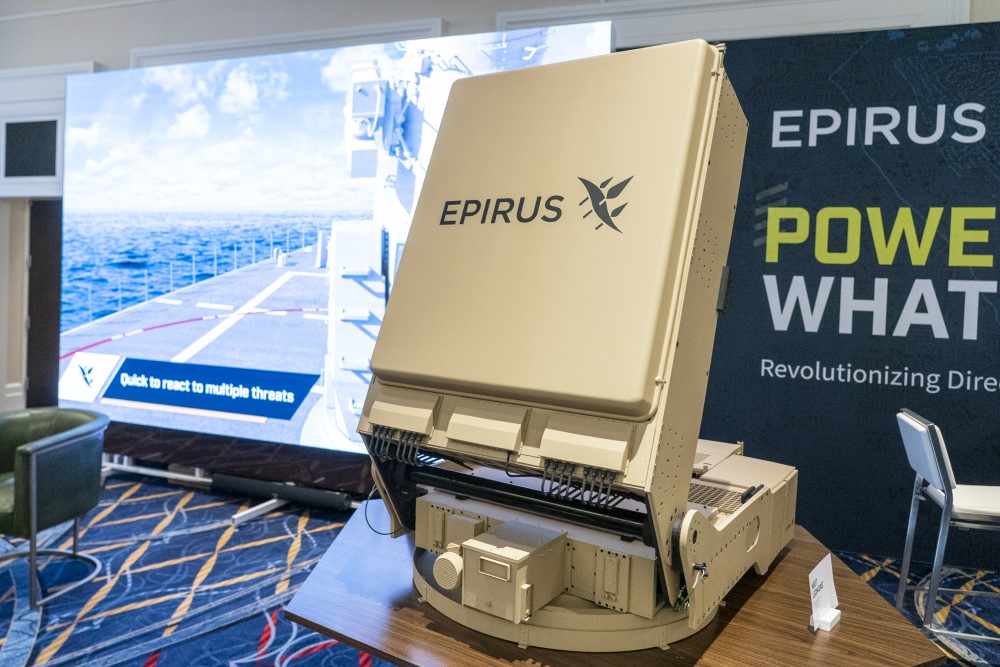
Epirus’ Leonidas directed-energy defense system, displayed in scale model form. SOLARES PHOTOGRAPHY

NATIONAL HARBOR, Md. — Epirus, a Southern California startup, has incorporated its SmartPower concept into a directed-energy system capable of disabling the electronics of threats such as drones, says Andy Lowery, the company’s chief product officer.

The company, located in the VIP Lounge near the Prince George’s Exhibit Hall, “started to take a look at embedded systems, especially when energy conversion was the process,” Lowery said. That means things like microwaves and lasers, where power is converted.

“We decided to see if we couldn’t digitize them and basically create a digital mind that controls the analog circuits that do the conversion,” he said. “We were able to very meaningfully improve the performance of those conversion circuits” while also solving heating issues that dogged earlier versions.

One result, on display in model form, is Leonidas, which the company describes as “an electronics system with the power and precision to neutralize a single [drone] system in tight, crowded spaces or disable multiple threats across a wide area.”

It’s not through traditional jamming, Lowery said, but instead “it’s literally just zapping it, like with such a high electrical field that the electronics can’t work.”

It’s also scalable, in the form of Leonidas Pod, a much smaller version that could be carried by drones and deployed from ships; that system has already had a sale.

Epirus, in existence for only about three years, is moving fast.

“We’re on our third-generation system … and we’re ready to start operationally deploying,” Lowery said. “We’ve had four to five companies express interest in being pilot customers on the defense side, looking to deploy upwards to half a dozen systems over the next 12 months or so, of the big ones.”

Cutter Dauntless Offloads More Than $160 Million in Illegal Narcotics

Coast Guard Cutter Dauntless recently seized 8,500 pounds of cocaine off the coast of Miami. U.S. COAST GUARD / Petty Officer 1st Class Ayla Hudson

MIAMI — Coast Guard Cutter Dauntless’ crew offloaded more than $160 million at Coast Guard Base Miami Beach, April 1, before returning to homeport in Pensacola, the Coast Guard 7th District said in a release.

Dauntless’ crew seized approximately 8,500 pounds of cocaine and apprehended 13 suspected drug smugglers with Dominican Republic and Colombian nationalities following a 45-day patrol in the Caribbean Sea.

The Dauntless’ crew worked alongside multiple U.S. Coast Guard assets and international assets, including the HNLMS Friesland of the Royal Netherlands Navy to interdict the illegal drug smuggling ventures.

“The Coast Guard’s strong international partnerships, counter threats in the maritime domain, protect each of our countries from transnational organized crime, and work to stabilize and promote good governance in the region,” said Lt. Paul Puddington, a District Seven duty enforcement officer. “We are thankful for coordinated efforts across the U.S. Coast Guard, the Department of Defense, Customs and Border Protection, as well as our international partners from the Netherlands and throughout Central and South America.”

The fight against drug cartels in the Caribbean Sea requires unity of effort in all phases from detection, monitoring and interdictions, to criminal prosecutions by international partners and U.S. Attorneys’ Offices in districts across the nation.

During at-sea interdictions, a suspect vessel is initially detected and monitored by allied, military or law enforcement personnel coordinated by Joint Interagency Task Force-South based in Key West, Florida. The law enforcement phase of operations in the Caribbean Sea is conducted under the authority of the Seventh Coast Guard District, headquartered in Miami. The interdictions, including the actual boardings, are led and conducted by members of the U.S. Coast Guard.

The Dauntless, a 210-foot Reliance-class medium-endurance cutter, patrols the Caribbean Sea and Eastern Pacific Ocean, performing counter-drug operations, migrant interdiction operations, search and rescue, and fisheries enforcement.


Collaboration on Information Warfare Needed, But So Is Cybersecurity to Thwart Prying Eyes

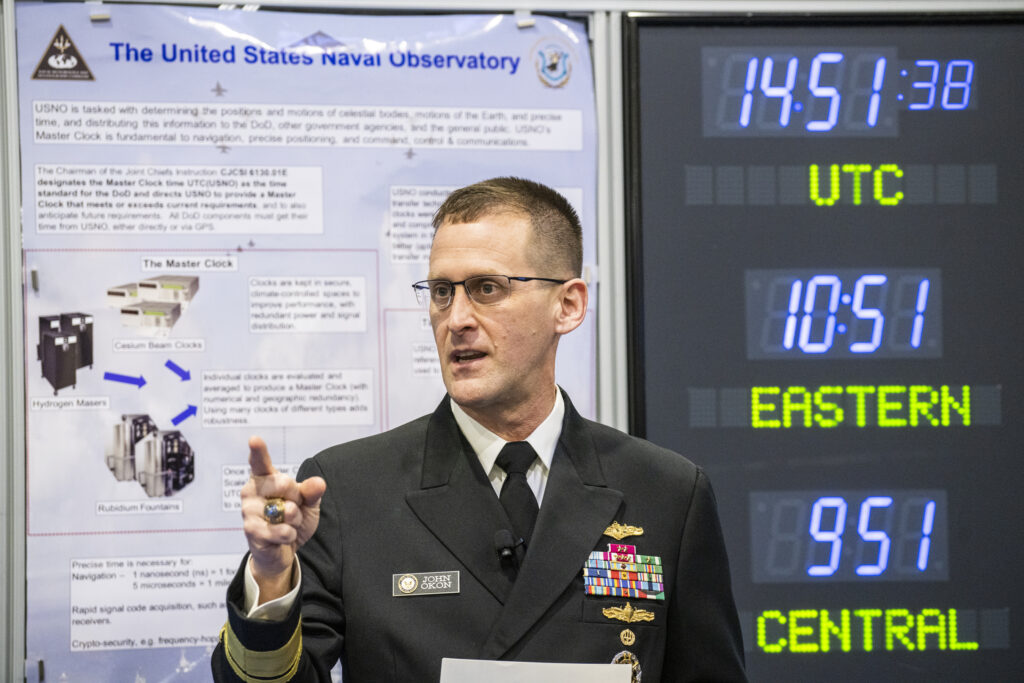
Rear Admiral John Okon discusses Warfare Integration during a session in the exhibit hall at Sea-Air-Space 2022. SOLARES PHOTOGRAPHY

NATIONAL HARBOR, Md. — The U.S. Navy has to shift its focus from warfighting platforms to warfighting knowledge gleaned from information warfare resources if it wants to maintain an edge over pacing competitor China, says the admiral in charge of integrating that vital information across the Navy.

“Everything we do in the Navy has IW [information warfare] capability,” Rear Adm. John Okon, head of the Warfare Integration Directorate (N2/N6F) in the Office of the Chief of Naval Operations, said at Sea-Air-Space 2022. “We speed the kill chain and deliver kinetic and non-kinetic effects to the enemy.”

When he sees a destroyer now, Okon said, “I don’t see a destroyer. I see a truck that carries information warfare capabilities. I see radars, communications, kinetic and non-kinetic effects.” The destroyer now is a platform with integrated technologies that “really deliver that warfighting capability.”

But precautions must be taken to ensure those capabilities don’t fall into an adversary’s hands. “The enemy is listening in on our phones and internet. We have to protect out intellectual capital,” Okon said, “Otherwise the next fighter from China will look exactly like ours.”

While the U.S. military lost its technological edge through the theft of its intellectual capital in previous decades, it still holds a knowledge edge with its smart and well-trained force. “China does not have a professional Navy. They don’t have professional sailors. That’s where our advantage lies,” Okon said.  “It’s not just the information but the application of that information into knowledge.”

To maintain the edge, however, requires collaboration among the military and civilians, academic and industry, and especially with partner nations. He cited the Warfare Development Center as a game changer and the Fleet Information Warfare Command-Pacific, recently stood up at Pearl Harbor, Hawaii.

“We cannot go it alone,” Okon said, adding that partner nations need to be included. “It doesn’t matter the size of the Navy but the capabilities of exquisite things that they are world class that we want to collaborate and leverage.”

But cybersecurity is key, especially in industry and academia. “It can’t be bolted on. It has to be there when you write the code,” said Okon. “China is watching us every day.”


BAE Systems’ San Diego Shipyard to Modernize the Destroyer USS Mustin

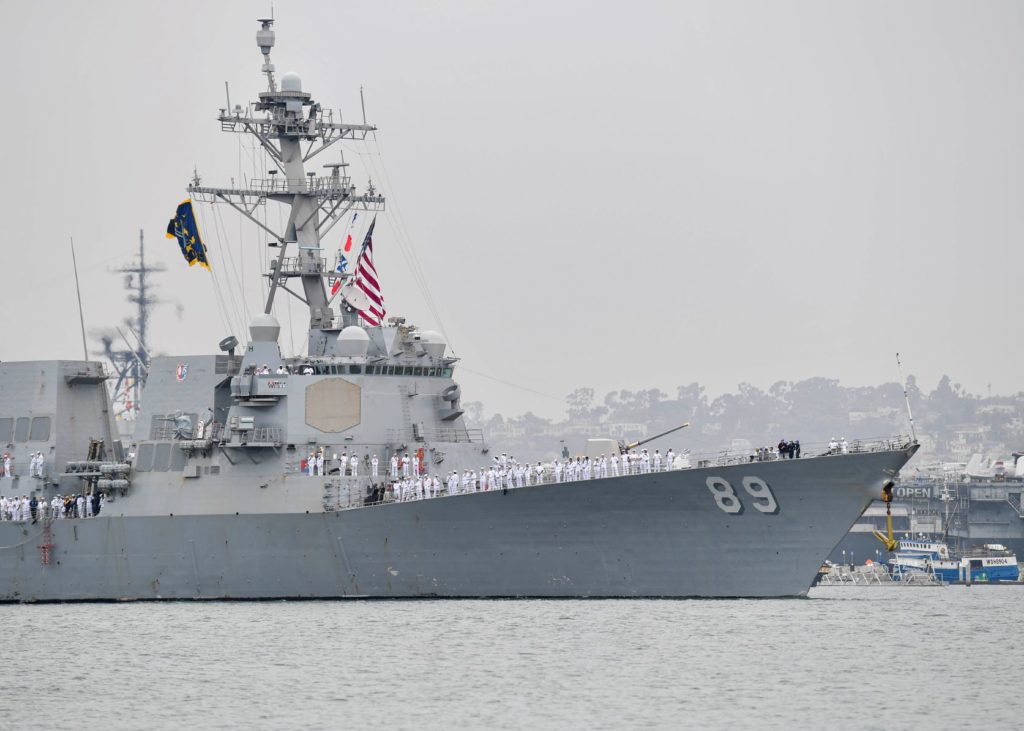
The modernization of USS Mustin will occur from May 2022 to November 2023. U.S. NAVY

SAN DIEGO — BAE Systems has received a $89.4 million contract from the U.S. Navy to perform major modernization work aboard the Arleigh Burke-class guided-missile destroyer USS Mustin (DDG 89), the company said in an April 5 release. The value of the competitively awarded contract could reach $95.2 million if all options are exercised. 

Under the depot maintenance period availability contract awarded, BAE Systems San Diego Ship Repair will dry-dock the ship, perform underwater hull preservation work, recondition the engineering spaces, upgrade its command-and-control equipment and refurbish the crew’s living spaces. The DMP work is expected to begin in May 2022 and be completed in November 2023. The company expects to dry-dock the ship at the San Diego Naval Base and then complete the remaining work at its Barrio Logan facility.  

“A depot maintenance availability is a significant project for upgrading the capability of Aegis destroyers,” said David M. Thomas Jr., BAE Systems San Diego Ship Repair’s vice president and general manager. “Our ship repair team has the critical know-how for repairing DDGs from our prior work. The DMP availability we’ll perform on the USS Mustin will usher the ship into a higher phase of fleet readiness.”  

BAE Systems’ San Diego shipyard is completing similar work aboard the guided-missile destroyer USS Preble (DDG 88) and has previously completed a DMP availability aboard USS Shoup (DDG 86).  

USS Mustin is the 39th ship in the Arleigh Burke class and was commissioned in July 2003. The ship is named in honor of the Mustin family who has more than a century of service in the U.S. Navy. One other U.S. Navy combatant has carried the family name, USS Mustin (DD 413).  


Space: The Next Warfighting Domain

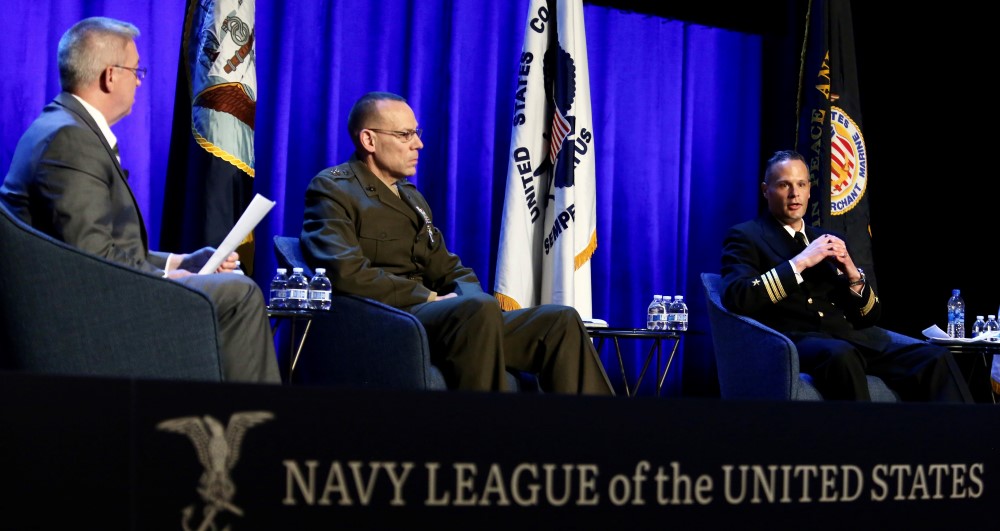
Navy Cmdr. Damon Melidossian said that teamwork among the combatant commands and commercial market will be critical in setting up the planned lower-orbit constellation of satellites. LISA NIPP

As space continues to emerge as a significantly important strategic domain, the armed services and industry alike are working together to ensure that the U.S. retains and expands its dominance. 

The job at hand entails several key areas, which four experts described at length during a April 4 panel discussion at the Navy League of the United States Sea-Air-Space conference at National Harbor, Maryland. 

The work performed by CAES Solutions to improve situational awareness, reduced cycle times and acceleration of technological developments, as described by Gregg Bell of the company’s Space Systems Division, would provide support for the identification and kill-chain issues Navy Cmdr. Damon Melidossian of the Defense Department’s Space Development Agency described. 

“We have a partnership with Lattice Semiconductors, where will bring our radiation-hardened electronics packaging to focus, which is going to be critical for learning in space,” Bell said. “We’ll be able to further advance some of the world’s most critical missions.” 

Additive manufacturing and artificial intelligence, he added, have enabled the company to deliver solutions quicker than ever before. 

Melidossian said that teamwork among the combatant commands and commercial market will be critical in setting up the planned lower-orbit constellation of satellites. When in place, he said, the constellation would reduce latency issues to mere seconds. 

“The architecture we’re building is done in different layers of satellites, processors and sensors, all to build out this architecture,” Melidossian said. “It constitutes initially 20 satellites. What they’re going to do is provide speed-of-light data transfer from anywhere on the planet to any warfighting element.”

Getting the satellites on orbit and on schedule is “a top priority,” Melidossian said. 

Ensuring that the preponderance of quick data can be put to good use is a key challenge for the software industry, said Dr. Angel Smith of Microsoft. 

“Anywhere you’ve got multidomain operations, you’ve got large data sets,” said Smith, a former Marine C-130 pilot, who manages mission solutions and customer expansion at Microsoft. “You need to move data fast, and you need to make decisions very quickly. That’s where I think the software industry is uniquely postured to be able to [provide] support.”

Maj. Gen. Ryan Heritage, commander of both the Marine Corps’ Forces Cyber Command and Forces Space Command, described how the service’s emphasis on space operations is a key contingent of the effort to divest itself of archaic missions and equipment and refocus on elements that would help with the future fight. 

“The Marine Corps is changing some of the training for our space staff officers — doubling down on the space operations officers.” Heritage said. 

During a recent vision to the Marine Corps Air-Ground Combat Center in Twentynine Palms, California, Heritage said he heard officers from all services brainstorm about integrating these new capabilities down to the company level. 

“You typically don’t associate Marines with space necessarily,” Heritage said, “but the personnel are coming.”

New Marine occupational specialties are focusing on space and cyber, he added. In time, these Marines will rise into leadership positions. 


Working With Allies and Partners Key to Maintaining Deterrence in Indo-Pacific, Speakers Say

Adm. Samuel Paparo, commander of the U.S. Navy’s Pacific Fleet, said it’s critical to continue to build strong partnerships around the world. LISA NIPP

NATIONAL HARBOR, Md. — The U.S. military, and its allies and partners, should make sure countries that would upend the international order in regions like the Indo-Pacific pay a steep price so it’s not worth the effort, Adm. Samuel Paparo, commander of the U.S. Navy’s Pacific Fleet, said April 4.

“Everything that we do must be underpinned by a profound and real capability to bring to bear overwhelming costs that exceed that which can be gained by those who would upend the international rules-based order,” he said at a panel on the Indo-Pacific region.

He added that “deterrence is not an activity, but it is an outcome.”

Paparo reinforced the importance of allies and partners. A critical line of effort is to continue to build strong partnerships around the world, and these relationships inform the Navy’s posture and presence in the Indo-Pacific region, he said.

“There is a saying that we can judge our character by the friends that we keep. And, I along with everyone in this room, are pretty proud of the wide-ranging international solidarity of actors with whom we are allied and partnered,” Paparo said.  “… It is the fact that our allies and our partners come as they are in accordance with their sovereign desires, in accordance with the international rules-based order, and we find ways that we can team together.”

Paparo said the final line of operation and the one that “encompasses all” is the importance of communicating effectively.  He said our adversaries must know what our intentions and what our capabilities are to build that deterrent force. 

“We must be aligned along with our allies and partners, and then the American people who support us with their hard work every day, who pay the bills for the security and the well-being that the joint force and all of government delivers, must know what we’re doing,” Paparo said.

Vice Adm. Michael F. McAllister, commander of Pacific Area and U.S. Coast Guard Defense Force West, said the Coast Guard’s role underscores Paparo’s emphasis on the importance of partnerships in and around the Indo-Pacific region. He said the Coast Guard has worked successfully to contribute to regional stability and security. 

“While we are a military organization, we also act as a civilian organization, we are law enforcement authorities, regulatory authorities, and, we are good at disaster response,” McAllister said. “The types of activities that would be familiar are capacity building in the region, joint operations, shared education and training, [and] information sharing, particularly in the unclassified realm, which allows us to engage with more partners. But we are really big on trying to build those bilateral and multilateral relationships that build confidence and capacity for regions in the nation to be able to exert sovereignty in their waters as best they can.”

Representing the State Department on the panel, Camille P. Dawson, deputy assistant secretary, Office of Public Affairs and Public Diplomacy, said the recently-released Indo-Pacific Strategy is the Administration’s policy that lays out the U.S. vision for the region. That is a vision of “a free and open Indo-Pacific that is connected, prosperous, secure and resilient,” she said.

Dawson said the State Department plays a fundamental role in the implementation of virtually every aspect of the Indo-Pacfiic Strategy. She described the five key pillars of the plan, which are to advance freedom and openness; build collective capacity within and beyond the region; promote shared prosperity; bolster Indo-Pacific security; and, build regional resilience.


Navy’s MQ-4C Triton UAV Back on Track With New Capability, Planned Orders 

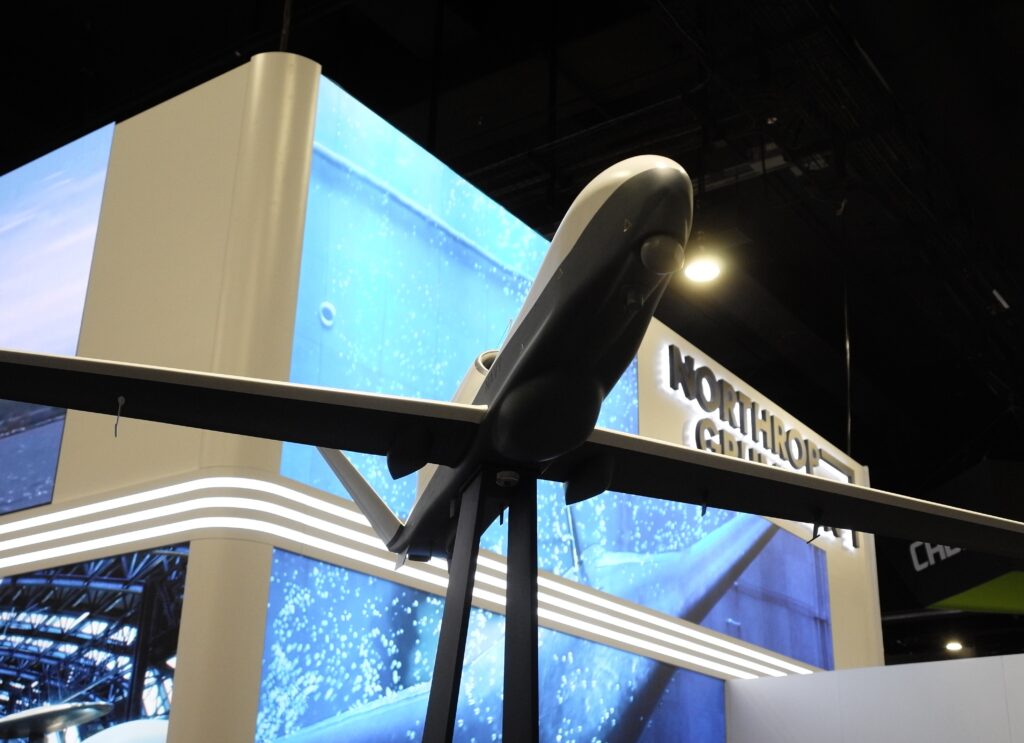
A model of the MQ-4C Triton at Northrop Grumman’s booth. Seapower

NATIONAL HARBOR, Md. — The Navy’s MQ-4C Triton high-altitude, long-endurance unmanned aerial vehicle is on track for initial operational capability with the new Integrated Functional Capability 4 (IFC-4) with a full orbit of four aircraft in fiscal 2023, a senior official said.  

Speaking April 4 to reporters in a roundtable at the Navy League’s Sea-Air Space expo, Rear Adm. Brian Corey, program executive officer for Unmanned and Strike Weapons, said IFC-4, which began flight testing in February, will give the Triton — built by Northrop Grumman (Booth 1300, Dock Space 2) — the capabilities needed to reach IOC and begin to replace the EP-3E Orion maritime reconnaissance aircraft. 

The Navy has had the MQ-4C with the baseline IFC-3 capability deployed in 2020 to the Western Pacific in an early operational capability. One aircraft assigned to Unmanned Patrol Squadron (VUP-19) remains deployed while a second has returned to the United States to give maintenance personnel more hands-on experience. 

Corey said with IFC-3 “the Navy was not ready to get the network right. We weren’t allowed to connect to the network. We’ve come a long way to an operationally relevant environment.” 

The number of planned regional orbits for the Triton originally was planned to be five, with four aircraft each. Beyond the first orbit, the future location and structure of the orbits is less defined and will be determined with regional combatant commander input.  

The Navy paused planned procurement of the MQ-4C for two years in 2021 and 2022, but the production line was sustained with an order of three Tritons for Australia and one for the U.S. Navy added in 2021 by Congress, followed by another congressional addition in 2022. The Navy has requested procurement of three Tritons for fiscal 2023. 

VUP-19, headquartered at Naval Air Station Jacksonville, Florida, moved its maintenance detachment to nearby Naval Station Mayport, Florida, last year from NAS Point Mugu, California. The future of Point Mugu as a future Triton base is yet to be determined. The second squadron, VUP-11, will be based at NAS Whidbey Island, Washington, but the location of its Tritons there or at Point Mugu or elsewhere will be decided later. 

The EP-3E aircraft has a large crew of signals intelligence analysts, and the Triton IFC-4 represents a significant change in the analysis, with onboard processing largely replaced by a wide distribution of the intelligence information across many sites of the intelligence community, Corey said. 

Corey said the RQ-4A Global Hawk Broad-Area Maritime Surveillance — Demonstration aircraft which have supported the U.S. 5th Fleet since 2009, remain in service, with Congress having funded the BAMS-D for 2022 despite the Navy’s plan to divest it. The Navy again in the 2023 budget request targets the BAMS-D for retirement, with budget pressures overcoming the utility of the aircraft. 


Defense Official: U.S. Needs to Improve Engagement With Industry, International Allies

Gabriel Perez Garces, second from left, makes a point during the Global Maritime Leadership panel on April 4. LISA NIPP

NATIONAL HARBOR, Md. — A defense official says the U.S. government needs to improve the way it works with both the defense industry and international allies to ensure U.S. allies are getting the military equipment they need.

Jed Royal, deputy director of the Defense Security Cooperation Agency, said during a panel discussion on global maritime leadership that the defense industry looks to the U.S. military as the primary customer, “as they should,” but that often means that allies and partners of the United States don’t get the prioritization for defense assets that they need.

The United States needs to find a way to take into account an ally’s needs early in the process, rather than waiting for when there’s a specific demand for missiles, aircraft, or some other defense industry product, Royal said.

“We need to think more creatively up front,” he said. “What I’m referring to here is a higher level of conversation both with allies and partners and with industry.”

Royal said it is not ideal for the defense industry to wait for the demand signal, and instead the conversation must be held well in advance of those needs arising — which in turn serves U.S. interests by ensuring strong allies, he said.

Also, while Royal argues that the United States is superior to its adversaries in terms of better systems, “where we are less competitive is how we manage our partners’ finances,” he said. “We are losing some opportunity for collective security interest by not being able to advance better terms and conditions for the purchase of U.S. equipment, so we need to be rethinking that.”

Finally, the United States also needs to think about developing capabilities that are better suited for allies’ requirements, Royal argued. The United States often buys heavy assets with long tails in sustainment, but that may not suit the needs of allies and partners, and so that needs to be factored in, he said.

“We need to establish investment opportunities and rhythms and habits of making sure the priorities of our allies and partners are at the [right] level,” he said.


Outdoor and Dock Exhibitors Offer Whatever Floats Your Boat

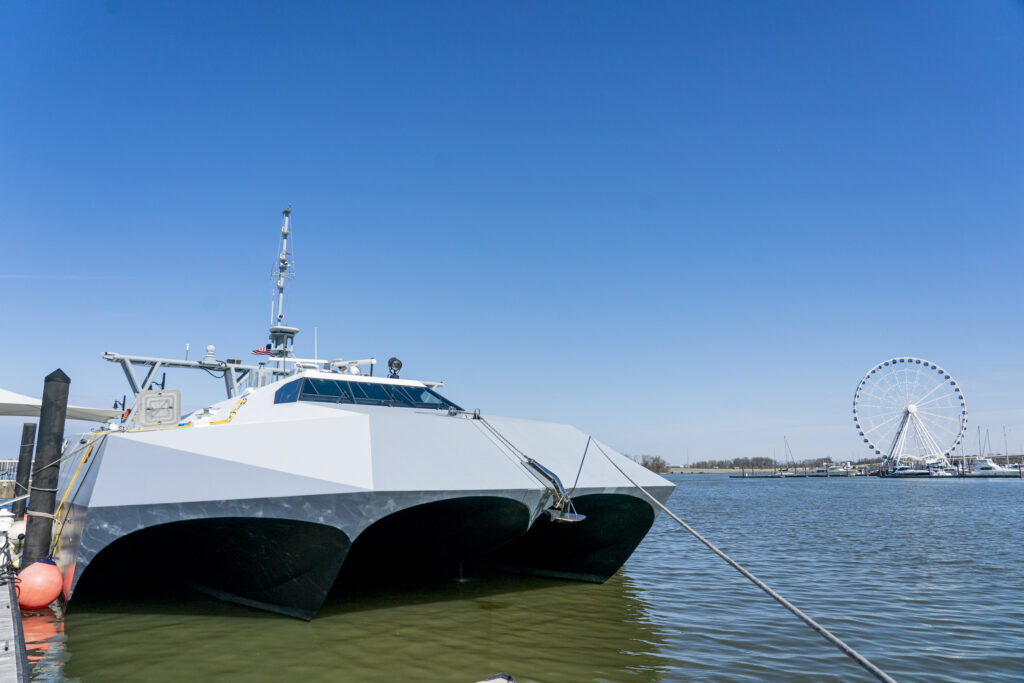
The M-80 Stiletto floating maritime experimentation platform in National Harbor. SOLARES PHOTOGRAPHY

NATIONAL HARBOR, Md. — From a Stiletto to a Rekognition Video Analyzer, outdoor and dock exhibitors are giving Sea-Air-Space attendees the opportunity to check out cutting-edge defense technology.

The carbon-fiber, 88-foot M-80 Stiletto is a floating platform devoted to maritime experimentation, with the goal of supporting the Joint Forces in countering emerging threats. Operated by Joint Prototyping & Experimentation Maritime, Stiletto allows its customers to evaluate and refine their technologies in realistic environments, using representative threats in tactics-based scenarios.

Stiletto tests about 60 to 65 different technologies every year, and more than half of its customers are small businesses, said Dennis Danko, JPEM-Stiletto joint prototyping maritime programming manager.

“We foster commercial innovation by giving small businesses and nontraditional system developers an opportunity to experiment on the water and gain a deep understanding of military missions and maritime operations,” he said.

Stiletto has the capability of working a few feet or hundreds of miles off the coast, and carries its own 11-meter rigid inflatable boat. It can also launch drones and other unmanned systems from its flight deck.

Danko said Stiletto has tested radar and cybersecurity technologies, network systems and even ergonomic seats for boats. It conducts environmental vulnerability assessments for technology systems and engineering evaluations, including various coatings to prevent marine growth.

The Rekognition Video Analyzer is part of a partnership between Amazon Web Services, Viasat and Federated Wireless.

The Viasat system can detect objects from water, piers, docks, land vehicles, paths and even clothing or other apparel, said Steve Conklin of Viasat. Amazon’s Rekognition system analyzes the data, protecting text, data and other communications. Federated Wireless provides secure 5G encryption and protection.

“We can set up in any kind of edge location or disaster environment,” Conklin said, noting that two weeks ago, the system was operational in Poland, on the front lines of the Ukraine conflict.

On Tuesday, April 5, L3Harris Technologies will give tours and rides from the dock on its autonomous boat to showcase its C5ISR-T technology.


Admiral: Navy Actively Experimenting With Cargo UAS Between Ships

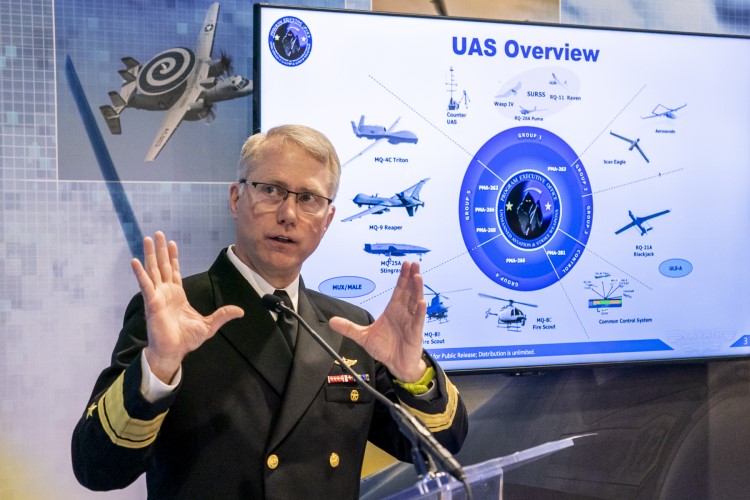
Rear Adm. Brian Corey, program executive officer for unmanned and weapons, discusses Navy UAS. SOLARES PHOTOGRAPHY

NATIONAL HARBOR, Md. — The Navy has been conducting flights between ships as part of an effort to experiment with a cargo unmanned aerial system for maritime use.

Recently, the Navy used an aerial vehicle to transport a part 200 miles between ships, said Rear Adm. Brian Corey, program executive officer for unmanned and weapons (PEO-U&W) at Naval Air Systems Command, during an address at the Navy League’s Sea-Air-Space symposium.

“That’s going to continue,” Corey said of the experiments, while noting that the question of when it could be fielded was up to Navy leadership. “It’s not a technology question, but there are some engineering choices and some work left to be done.”

The program has partnered with both the Navy and Military Sealift Command on the effort to demonstrate the capability to transport small parts ship to ship.

“We believe we could deliver those 200 miles with a relatively small, very inexpensive vehicle,” Corey said. “So that’s what we’re trying to do to enable that is to get the networks and interoperability down and get a small family of ground systems or maybe a single one — that’s unknown at this stage. And then how can we get the autonomous takeoff and landing?”

In a separate effort, the program is experimenting with a cargo UAS for the Marine Corps.

“It’s not yet come to a spot where we have decided to go forward with a program and field it,” Corey said of the Tactical Resupply Unmanned Aircraft System. “The decision will be coming before long depending on how well it works in the field.”

There are some clear advantages to such a system, he said.

“I think that’s some of the most innovative thinking we have going on right now,” he said. “Why drive down a road and potentially get an IED [improvised explosive device] … when you can fly?”