Builders, Suppliers of Navy Ships Facing Inflation Costs for Materials 
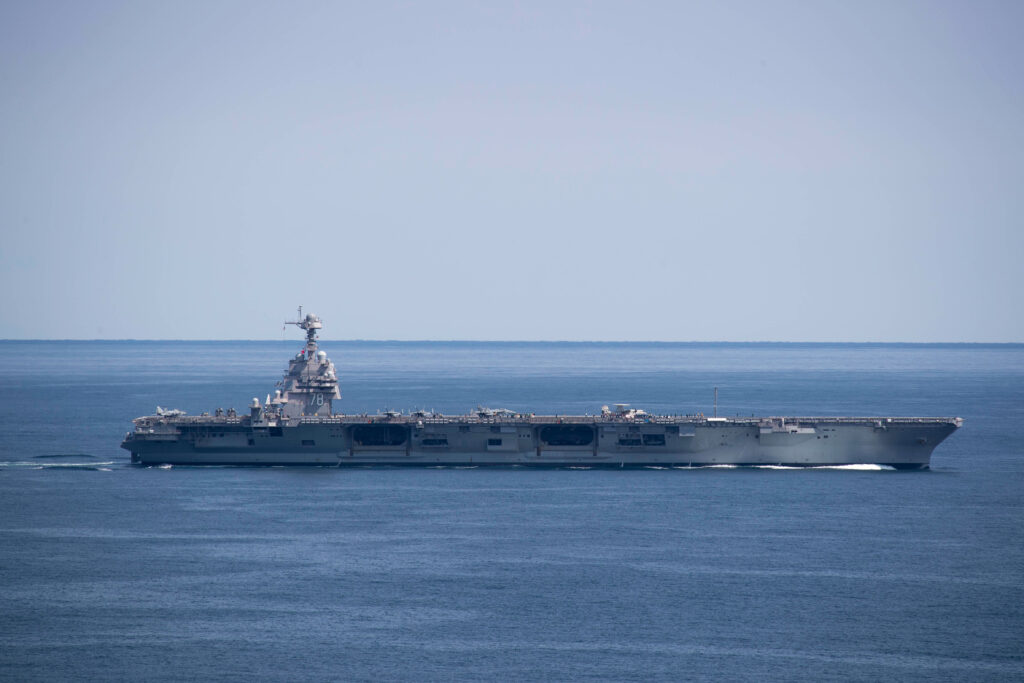
USS Gerald R. Ford (CVN 78) transits the Atlantic Ocean, March 30, 2022. U.S. NAVY / Mass Communication Specialist 3rd Class Jackson Adkins

ARLINGTON, Va. — The price inflation hitting American consumers also is hitting the shipyards that builds ships for the U.S. Navy, which are facing increased costs for the materials used to build the ships and their components, said two executives who chair shipbuilder and supplier industrial base coalitions.

Suppliers who were not given advance funding especially are vulnerable to price inflation, which could have long-term effects in driving up the cost of the ships the Navy plans to procure. In addition, the shipbuilders are facing daunting labor shortages in the current tight labor market. 

David Forster, a retired Navy captain, Global Strategy Executive of Naval Services, Rolls-Royce North America Inc., and chairman of the Amphibious Warfare Industrial Base Coalition, and Rick Giannini, chairman of the Aircraft Carrier Industrial Base Coalition and CEO of Milwaukee Valve, described the industrial base challenges of the fiscal 23 budget and Future Years Defense Plan in an April 1 interview with Seapower.  

Giannini said inflation is the top concern of the aircraft carrier industrial base, especially to those suppliers who did not receive advance funding during the COVID-19 pandemic. He said the block buy of CVNs 80 and 81 saved the taxpayers money because it allowed suppliers to order advance materials, which are now in hand and unaffected by the inflation now hitting the industry. 

Giannini’s company, Milwaukee Valve, uses a large amount of nickel and copper in its aircraft carrier components, which it ordered as soon as possible for two CVNs and was able to lock in the low costs before the current inflation. He said the prices of nickel have jumped and that suppliers that did not or could not order earlier were now facing the effects of inflation.   

The ACIBC chairman said the CVN block buy is going well from his perspective and the ACIBC is working to show Congress the benefits of a two-CVN buy, including the advance procurement of materials that helps the suppliers to have the materials on hand when the builder needs them, making for a smooth build rate. 

Forster said the Navy’s efforts to award contracts early during the first two years of the COVID pandemic “saved a lot of jobs” and gave credit to James “Hondo” Geurts, then assistant secretary of the Navy for research, development and acquisition, for his successful efforts to advance funding to shipbuilders and in turn to their suppliers.   

Forster said the three to 3.5 year build cycle for amphibious assault ships was in place and good for the stability of the industrial base, but the Navy’s 2023 budget plan to end procurement of the Flight II San Antonio-class amphibious transport dock ships after a “handshake deal” for a block buy was disappointing and illustrated the ambiguity of the plans, especially since Marine Corps Commandant Gen. David Berger supported a requirement of 31 large- and medium-size amphibious warfare ships. In concert with the 2023 budget calling for the decommissioning of four dock landing ships, the Navy’s budget is at odds with its plans to a build a force structure of 31 amphibious warfare ships.  

Forster also noted the procurement of the light amphibious warship had slid until 2025, a further challenge to stability for the workforce. 

He also advocates the Navy procure a replacement for the amphibious assault ship USS Bonhomme Richard, which was scrapped after a devastating fire in July 2020, having been modified for operation of the F-35B strike fighter. 

Giannini said the second major concern of the shipbuilders and its supplier industrial base was the workforce, which is stressed by the difficulty of hiring skilled labor. He cited the increasing age of the workforce and the retirements earlier than planned as a consequence of the COVID-19 pandemic.   

The Navy’s shipbuilding and ship retirement plans for 2023 and the Future Years Defense Plan and are likely to face intense scrutiny from the armed services committees in Congress, who have pushed back against retirement plans for several ships in the recent past and have been critical of the Navy’s “divest to invest” strategy. 


DoD Releases Fiscal Year 2021 Freedom of Navigation Report 

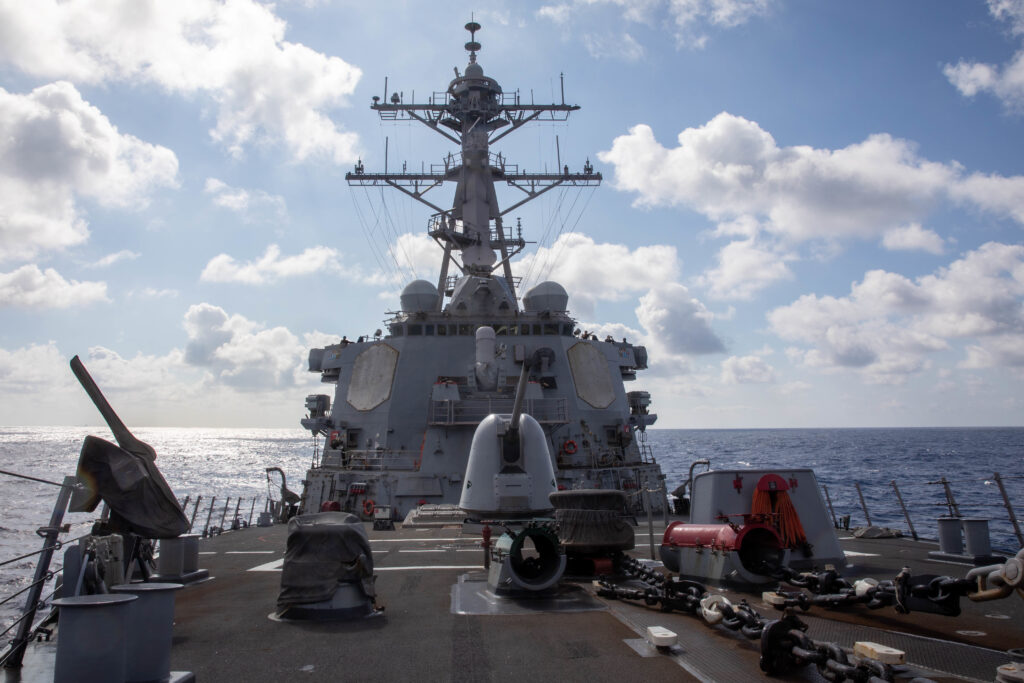
Arleigh Burke-class guided-missile destroyer USS Barry (DDG 52) transits the Taiwan Strait during a routine transit in 2021. U.S. NAVY / Mass Communication Specialist 3rd Class Justin Stack

ARLINGTON, Va. — The Department of Defense released on April 1 its annual Freedom of Navigation Report for fiscal year 2021. During the period from Oct. 1, 2020, through Sept. 30, 2021, U.S. forces operationally challenged 37 different excessive maritime claims made by 26 different claimants throughout the world. 

Excessive maritime claims are inconsistent with international law as reflected in the Law of the Sea Convention. They include a variety of restrictions on the exercise of navigation and overflight rights and other freedoms. Unlawful maritime claims — or incoherent theories of maritime entitlements — pose a threat to the legal foundation of the rules-based international order. If left unchallenged, excessive maritime claims could limit the rights and freedoms enjoyed by every nation.  

Upholding freedom of navigation as a principle supports unimpeded lawful commerce and the global mobility of U.S. forces. DoD’s freedom of navigation operations demonstrate the United States will fly, sail, and operate wherever international law allows. 

DoD’s regular and routine operational challenges complement diplomatic engagements by the U.S. State Department and supports the longstanding U.S. national interest in freedom of the seas worldwide.  

Each year, DoD releases an unclassified summarized FON Report identifying the broad range of excessive maritime claims that are challenged by U.S. forces. It also includes general geographic information to describe the location of FON assertions while still maintaining operational security of U.S. military forces. 

Click to see previous DoD FON Reports


CNO, Indonesian Navy Chief Meet; Discuss Maritime Security 

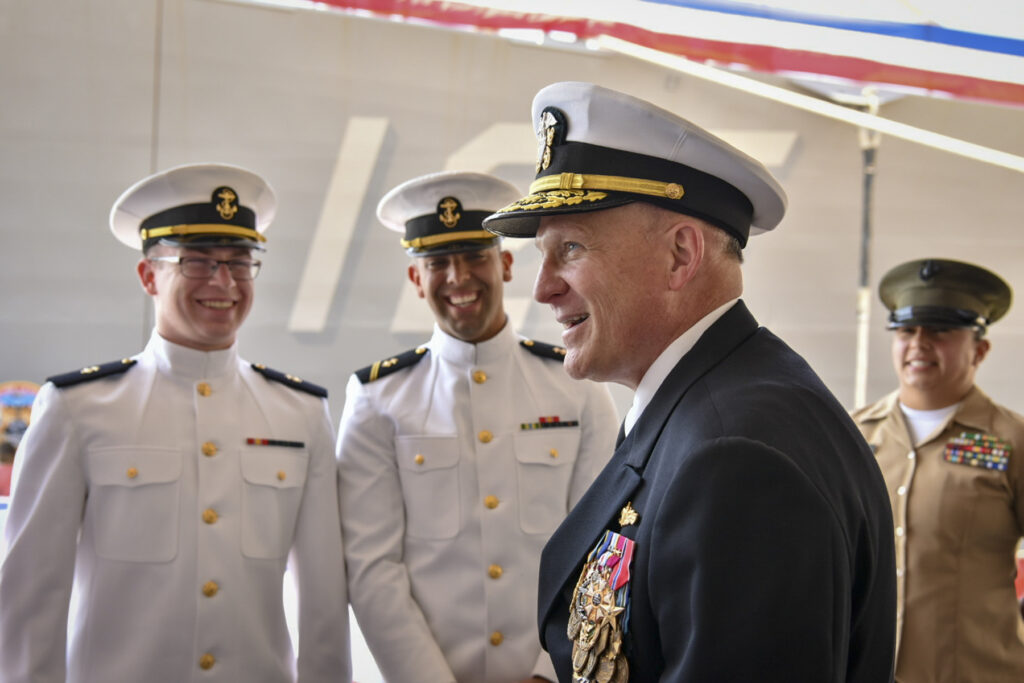
Chief of Naval Operations Adm. Mike Gilday, shown speaking to the U.S. Naval Academy’s Silent Drill Team at the christening ceremony for the future Jack H. Lucas (DDG 125) in Pascagoula, Mississippi, March 26. U.S. NAVY / Cmdr. Courtney Hillson

WASHINGTON — Chief of Naval Operations Adm. Mike Gilday met with Chief of the Indonesian Navy Adm. Yudo Margono, at the Pentagon, March 30, the CNO’s public affairs office said in a release. 

This was their first meeting, during which the two leaders discussed the importance of maritime security and exchanged views on regional and global security issues. 

“Working alongside our Allies and partners has never been so important. Today’s maritime challenges require interoperability and presence,” said Gilday. “Together we will continue to keep the maritime commons open and free as we promote the security, stability, and prosperity of the Indo-Pacific.” 

The two leaders exchanged views about security issues in the Indo-Pacific, underscoring the importance of the U.S.-Indonesian bilateral relationship. 

“The purpose of this visit is to enhance relationships and partnerships between the two navies that have been well established so far,” said Margono.  

Gilday emphasized a commitment to continuing dialogue and building upon our strong bilateral defense relationship. 

“For more than 70 years, Indonesia has been a valued partner,” said Gilday. “There is a strong strategic partnership between Indonesia and the U.S. and I am grateful for our long history of collaboration, cooperation, and training,” said Gilday.  

Gilday and Margono also reviewed progress made in recent years in military-to-military cooperation to increase exercises and training, as well as regular defense policy dialogues. 

U.S. and Indonesia operate together around the globe regularly. Indonesia has been part of the CARAT exercise series since it began in 1995. After 27 years of annual training events between the armed forces, CARAT Indonesia remains a model for cooperation that has evolved in complexity and enables both navies to refine operations and tactics in response to both traditional and non-traditional maritime security challenges. 

The U.S.-Indonesian relationship is strengthened through training. For the first time, Indonesia has two midshipman attending the U.S. Naval Academy. 


Mayflower Autonomous Ship to Attempt Second Ocean Crossing With AI Captain

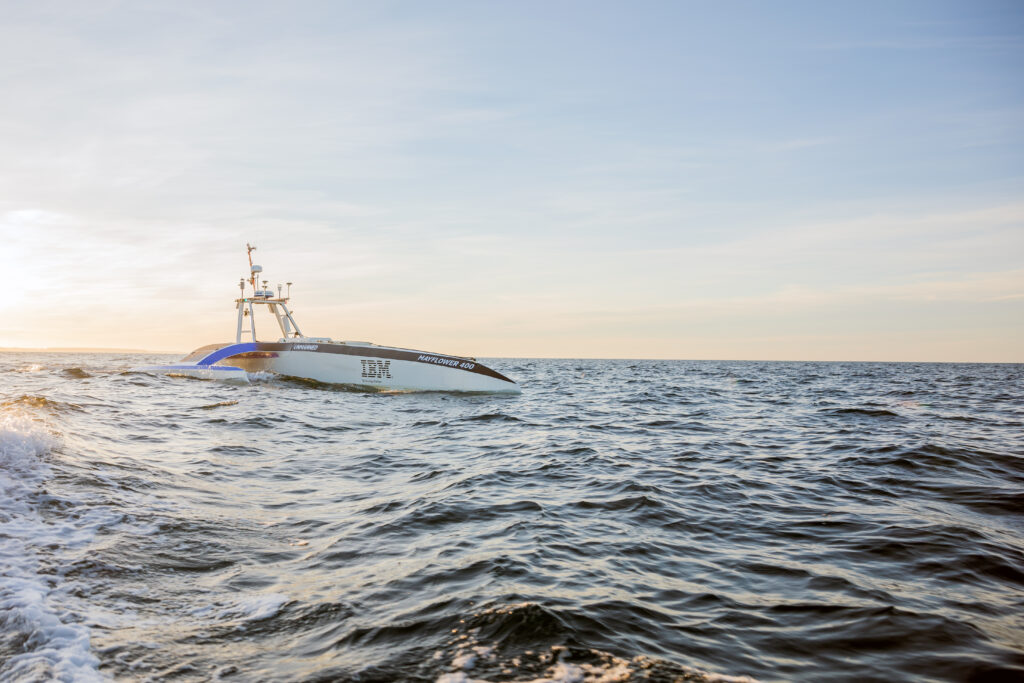
The Mayflower Autonomous Ship begins its first, ill-fated Atlantic Ocean crossing attempt. / IBM

Roughly a year after a mechanical problem forced it to turn around, the Mayflower Autonomous Ship is poised to cross the Atlantic, traveling autonomously from Plymouth, United Kingdom, to Plymouth, Massachusetts.

The voyage will showcase IBM’s AI Captain, the artificial brain of the operation that allows Mayflower to chart its own course across the ocean and see and avoid obstacles along the way. That’s what sets Mayflower apart from other unmanned surface vessels, says Ray Spicer, vice president for defense and intelligence at IBM Federal.

“I think the key difference is the autonomous part,” he told Seapower in an interview. “In a perfect world, we’re gonna set this baby on its way from Plymouth, U.K., and not have to interfere at all. We’ll just watch it with pride as it sails along and makes its own decisions based on how well we trained it. And then it appears in Plymouth, Massachusetts, at the end of the journey.”

The project is led by marine research nonprofit ProMare, with IBM as lead technology and scientific partner.

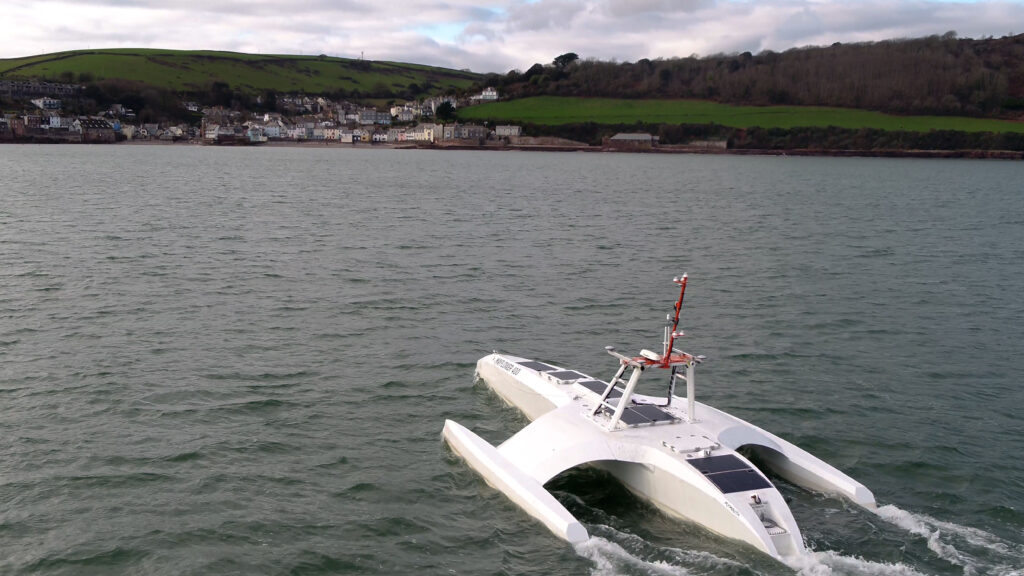
The boat, a catamaran, originally set out on the voyage last spring but was forced to turn around when a connector for the onboard generator failed, filling the interior with exhaust fumes. No one was hurt — there’s no human aboard — but the boat was slowed significantly so the team decided to turn it around.

The brains of the boat, the AI Captain, worked fine and continues to do so, Spicer said. The system was trained using millions of images to recognize potential hazards, from seagulls to paddleboarders to buoys.

“We taught it to recognize objects, and the more experience it gets doing that, the better the training,” Spicer said. “When we put it out there, if it ran into something that it didn’t recognize, then we taught it, OK, that’s a seagull … make sure you recognize that in going forward. I would say anytime that it encounters something that we didn’t anticipate, we can see it from the camera, and we can teach the system what it is actually looking at.”

The Mayflower conducts sea trials in March 2021. / IBM

AI and COLREGS

Once underway, Mayflower will rely on its artificial intelligence and sensors to abide by COLREGS, the laws that govern ship movement on the seas.

Human operators have to be updated on COLREGS after switching from shore assignments to sea assignments to make sure they’re current, but that’s an easier process with an AI system.

Sailors and other human operators “always had to go through COLREGS, pass the test, make sure you were current, you were refreshed. With an AI/ML [artificial intelligence/machine learning] system like this, you just feed it the COLREGs one time, it chews them up and it won’t forget,” Spicer said.

The 3,200-mile trip from Plymouth to Plymouth is expected to take 10 to 12 days, depending on weather and other conditions that might pop up.

Mayflower carries visual sensors, infrared, cameras and a navigation system that allows it to use dead reckoning if it loses satellite connection.

“It’s also mapping the environment as it goes, because really the primary purpose of the vessel is to do oceanographic research,” Spicer said. “So, it’s listening to underwater sounds and it’s taking temperatures and [measuring] salinity and all kinds of things in the environment,” including measuring the amount of microplastics in the ocean.

Once it arrives on the East Coast of the United States, Mayflower is expected to take a victory lap that could take it from Norfolk, Virginia, to Washington, D.C., to Boston.

Flexible AI

The Mayflower’s brains are descended from IBM’s pioneering work in artificial intelligence and machine learning, including the Deep Blue chess computer that beat Garry Kasparov to Watson, the AI system that won on “Jeopardy!” in 2011.

“The interesting part to me is we took technologies that were already existing within IBM, and we just adapted them to this vessel,” Spicer said, including an operational decision manager used in the financial industry to verify credit card transactions.

“You swipe your credit card, and it runs hundreds of algorithms to make sure you’re you, and you’re not a bad guy, and then it lets the transaction go through. We use that same technology, we just adapted it to this use case,” Spicer said.

The ship’s systems generate a data tree, so researchers can see why it made a given decision at any point along its route.

Ultimately, the AI Captain could be used for much more than just piloting a small boat across an ocean.

In a video series about the Mayflower project, Brett Phaneuf, managing director of the program, said he envisions it one day guiding spacecraft on other worlds.

“Years from now I’d love to see our AI Captain on another vessel in an ocean on Europa or orbiting another planet. That would be ideal, and I don’t know if I’ll live to see it, but this is the start.”

Spicer agrees, saying, “I think the sky’s the limit. I mean, we’re talking about an application of a surface vessel, but think about underwater, think about in the air, think about space. We’ve gotten lots of interest from organizations like NASA and NOAA [the National Oceanic and Atmospheric Administration] … this [the Mayflower] is just the tip of the iceberg, I think.”


SECNAV Names Future Replenishment Oiler Ship Ruth Bader Ginsburg 

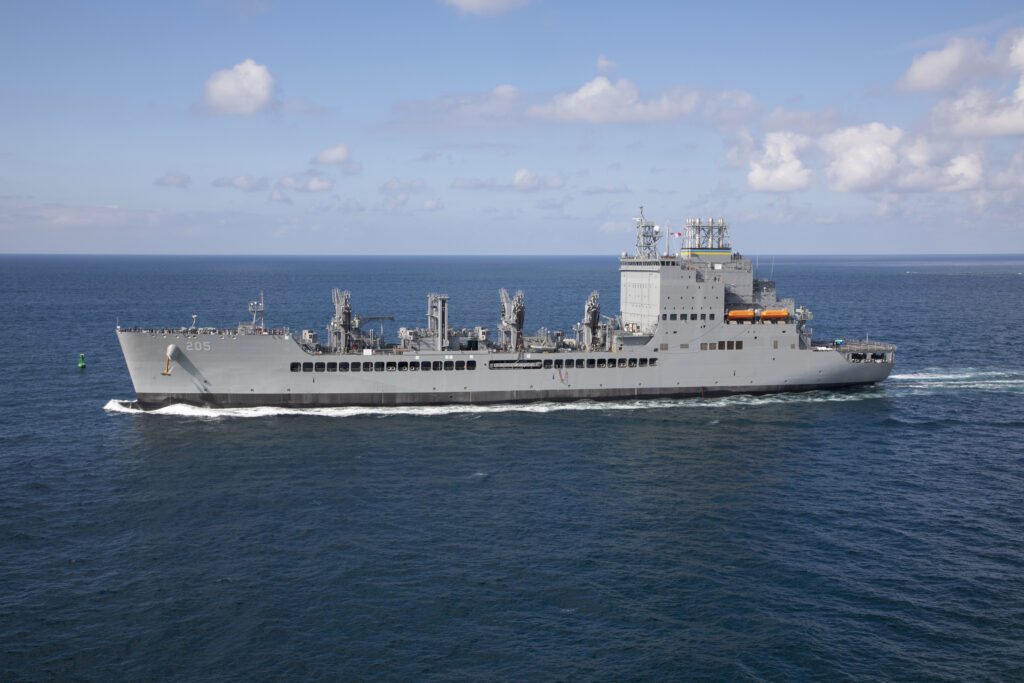
USNS John Lewis (T-AO 205), the Navy’s lead ship of its new class of fleet replenishment oilers. A future ship in the class will be named USNS Ruth Bader Ginsburg. GENERAL DYNAMICS NATIONAL STEEL AND SHIPBUILDING. CO.

WASHINGTON — Secretary of the Navy Carlos Del Toro announced March 31 that a future John Lewis-class replenishment oiler (T-AO) ship will be named USNS Ruth Bader Ginsburg to honor the former Supreme Court Justice and women’s rights activist. 

The future USNS Ruth Bader Ginsburg (T-AO 212) will be the first U.S. Navy ship to bear her name. 

“As we close out women’s history month, it is my absolute honor to name the next T-AO after the Honorable Ruth Bader Ginsburg. She is a historic figure who vigorously advocated for women’s rights and gender equality,” said Del Toro. “As Secretary of the Navy, it is my aim to ensure equality and eliminate gender discrimination across the Department of the Navy. She is instrumental to why we now have women of all backgrounds, experiences and talents serving within our ranks, side by side with their male Sailor and Marine counterparts.” 

The name selection for the John Lewis-class replenishment oiler follows the naming convention of honoring people who have fought for civil and human rights. Born in 1933, Ruth Bader Ginsburg was a pioneering advocate for women’s rights turned Supreme Court Justice. Ginsburg made history as the second woman to serve on the U.S. Supreme Court when she was nominated by President Bill Clinton and confirmed in 1993. Of her 27-year tenure on the Supreme Court, she is most noted for her work toward issuing the majority opinion for United States v. Virginia, a landmark 1996 case that struck down Virginia Military Institute’s male-only admissions policy. 

The future T-AO 212 is the eighth of the T-AO ships awarded to the Navy, with the first delivered in 2021. The class and lead ship T-AO 205 is named in honor of Rep. John Lewis (D-Ga).  

Del Toro also named Justice Ginsburg’s daughter, Jane Ginsburg, as the ship’s sponsor. 

T-AO ships are fleet oilers designed to transfer fuel to the Navy’s operating carrier strike groups. The oilers have the ability to carry a load of 162,000 barrels of oil, maintain significant dry cargo capacity, aviation capability and a speed of 20 knots. General Dynamics National Steel and Shipbuilding Company designed the vessels with double hulls that protect against oil spills as well as strengthened cargo and ballast tanks. The T-AO measures 742-feet in length with a full load displacement of 49,850 tons. 


HELIOS Laser Weapon System Delivered for Installation on USS Preble 

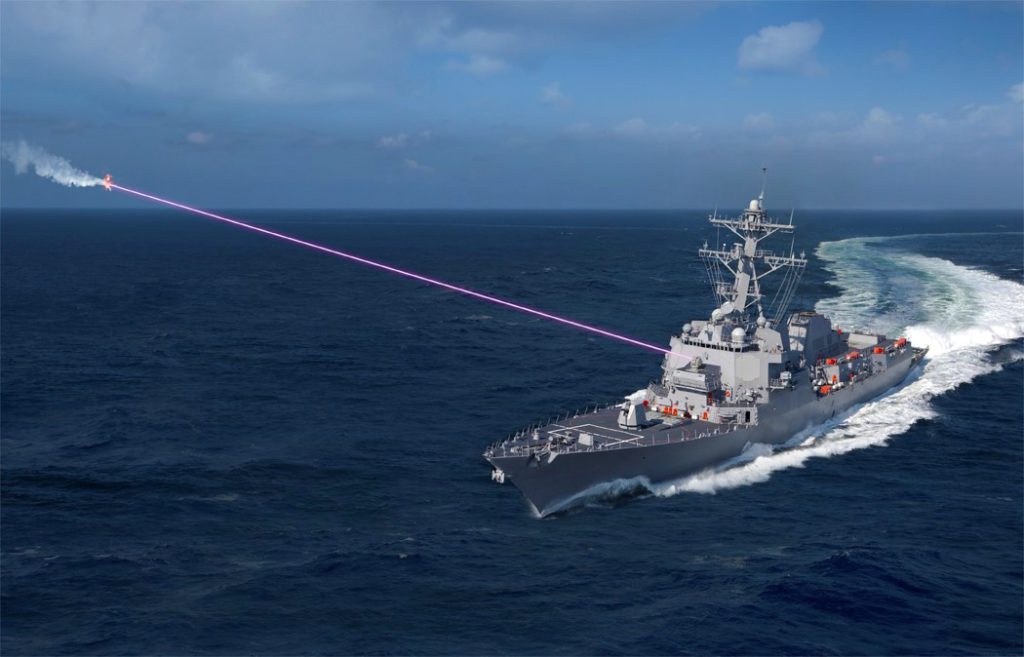
An artist’s rendering of Lockheed Martin’s HELIOS system. LOCKHEED MARTIN

ARLINGTON, Va. — The Navy’s newest laser weapon system has completed range testing at Wallops Island, Virginia, and is being installed on the U.S. Navy’s Flight IIA Arleigh Burke-class guided-missile destroyer USS Preble in San Diego. 

The first High-Energy Laser with Integrated Optical Dazzler and Surveillance, or HELIOS, built By Lockheed Mission Systems and Sensors, has started phased delivery to the Preble at the BAE Systems yard in San Diego. It will be the first laser weapon system to be integrated with a ship’s Aegis Combat System and power and cooling systems, said Jon Rambeau, Lockheed Martin’s vice president and general manager for Integration for Systems and Sensors, during a March 30 interview with Seapower

The 60-kilowatt HELIOS is scalable, Rambeau said, up to 120 kilowatts with minor modifications such as the addition of more fiber-optic laser modules. It has replaced the Preble’s forward Mk15 Close-In Weapon System.  

“We believe the 60- to 120-kilowatt-range systems can be effective against an ASCM [anti-ship cruise missile],” Rambeau said. “We’ve done some modeling that demonstrates that, we believe, and also looking soon to be able to back that up with some real-world test data. Watch for some news that should be coming soon as we continue the test program.”   

The 60-kilowatt HELIOS also can be used for surveillance and as a counter-unmanned aerial system dazzler. The HELIOS also is adaptable to the Ship Self-Defense System on aircraft carriers and newer amphibious warships. 

“After better than a decade of that question being out there, ‘When are these systems going to demonstrate that they’re tactically relevant,’ we’re really right at the threshold of that to the point where the conversation is not going to be anymore, ‘Are those going to work?’ and ‘Are they going to be useful on the battlefield?’” Rambeau said. “Rather, the question is going to turn more to funding priorities, price points, the capacity of our industry primes, and the supply chain that could build these things in full quantities and at scale and then, ultimately, conversations around doctrine and how they would actually be employed in combat. 

“It’s really exciting time in lasers and it has been a long time in coming,” he said. 

The HELIOS contract was awarded to Lockheed Martin in January 2018. The company is also developing a layered laser weapon system for the U.S. Army.   


Coast Guard Crew Offloads $223 Million Worth of Drugs in San Diego  

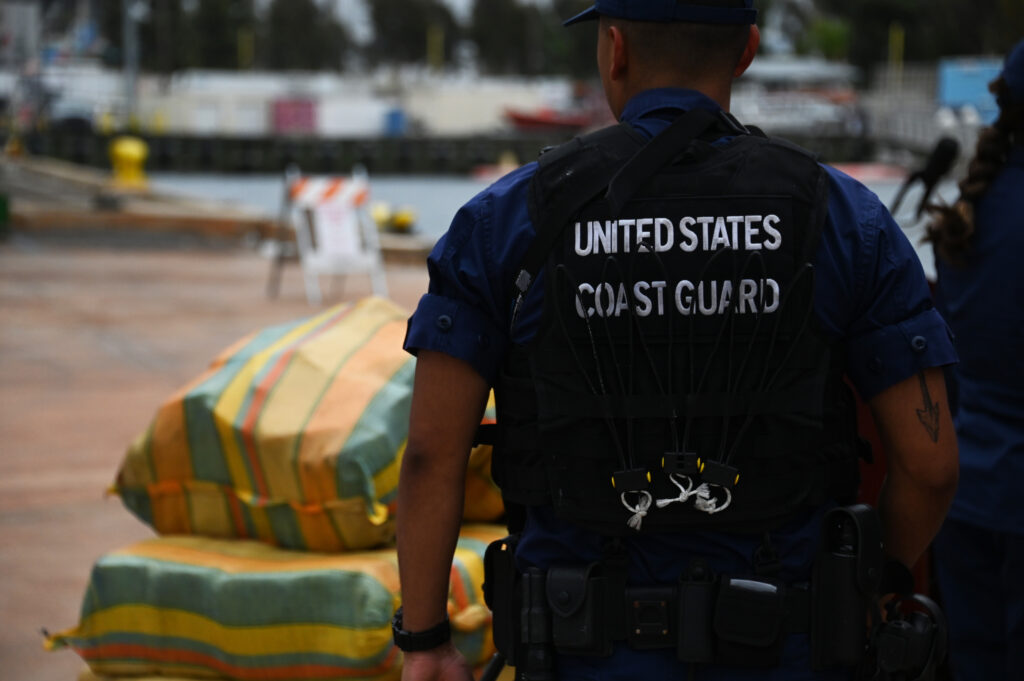
The Coast Guard Cutter Kimball (WMSL-756) crew offloads about 11,300 pounds of cocaine and roughly 4,000 pounds of marijuana worth more than $223 million on March 31 in San Diego. U.S. COAST GUARD / Petty Officer 3rd Class Alex Gray

SAN DIEGO — The  Coast Guard Cutter Kimball (WMSL 756) crew offloaded more than 11,300 pounds of cocaine and more than 4,000 pounds of marijuana worth more than $223 million March 31 in San Diego, the Coast Guard 11th District said in a release. 

The drugs were interdicted in international waters of the Eastern Pacific Ocean off the coasts of Central and South America, including contraband seized and recovered during eight interdictions of suspected drug smuggling vessels between late February and early March. 

“At-sea interdictions of pure cocaine are the most effective way to limit cartel’s destabilizing effects throughout the Western Hemisphere,” said Vice Adm. Michael McAllister, Coast Guard Pacific Area commander. “Coast Guard national security cutters like Kimball are the service’s most capable asset to strengthen maritime governance, but when team partners from the Royal Canadian Navy and U.S. Navy Littoral combat ships they leverage our network of international and interagency partners to reduce the availability of illicit drugs in the Western Hemisphere and facilitate U.S. Attorney’s efforts to close the cycle of justice.” 

The drugs were interdicted by the following ships (the total amount listed below is 11,301 pounds of cocaine and 4,076 pounds of marijuana): 

  • Kimball’s crew was responsible for one interdiction seizing approximately 2,295 pounds of cocaine. 
  • Coast Guard Cutter Legare’s (WMEC 912) crew was responsible for four interdictions, seizing approximately 4,714 pounds of cocaine and 1,826 pounds of marijuana. 
  • Coast Guard Cutter Spencer’s (WMEC 905) crew was responsible for one interdiction seizing approximately 635 pounds of cocaine and 2,250 pounds of marijuana. 
  • Jointly, Her Majesty’s Canadian Ship Yellowknife (MM 706) and Kimball’s crews were responsible for one interdiction, seizing approximately 331 pounds of cocaine. 
  • Jointly, the crews of the Kimball and Legare were responsible for one interdiction, seizing approximately 3,326 pounds of cocaine. 

“This marks the first of likely many counter-drug patrols for Kimball and I am extremely proud of our crew’s preparation and hard work to make this an extremely successful deployment. Kimball’s crew demonstrated that through teamwork we were able to remove over $100 million dollars of cocaine, preventing it from ever crossing our borders or entering our neighborhoods, and further removing a source of illicit revenue from transnational criminal networks,” said Capt. Thomas D’Arcy, commanding officer of the Kimball.

The Kimball is a 420-foot Legend-Class national security cutter and is homeported in Honolulu, Hawaii.


Students Help Coast Guard to Find Unmanned Smuggling Boats

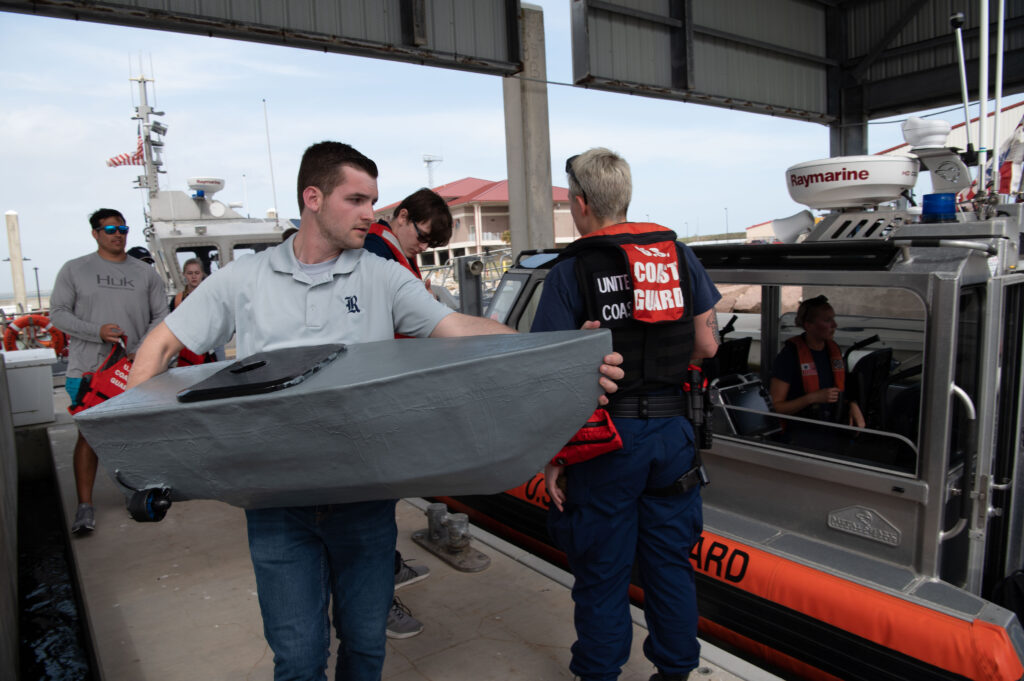
A student-built unmanned autonomous surface vessel is brought aboard a Coast Guard patrol craft to conduct detectability testing near Galveston, Texas. U.S. COAST GUARD / Petty Officer 3rd Class Alejandro Rivera

GALVESTON, Texas — A unique student project is helping the Coast Guard find small and hard to detect unmanned autonomous surface vessels that might be used to transport drugs into the U.S. 

Several USVs have been recovered attempting to transit drugs across the maritime border with Mexico and into California. The boats can carry about 90 pounds of cargo, which could be illegal narcotics or other hazardous cargo.

To learn how these boats might be detected by sensors, the Coast Guard engaged the National Security Innovation Network, a Department of Defense office which collaborates with major universities and the venture community to develop solutions that drive national security innovation. With Coast Guard Sector San Diego as the project sponsor, NSIN capstone students at San Diego State University and Rice University in Houston, Texas, have been prototyping boats this semester.

Four USVs have been seized by federal law enforcement authorities in Southern California. The first was found in March 2018, another in December 2020, and two more in February and March of 2021, suggesting a high likelihood there are many more that have gone undetected.

The vessels are three to four feet long and have a freeboard of just seven inches. They navigate autonomously and can travel for about 66 nautical miles at a speed of about 2.5 knots.

According to information provided by the U.S. Coast Guard, their above-water profile is minimal, which makes it hard for existing maritime domain awareness tools and detection capabilities to see them. Not only are they capable of reaching uninhabited shores with illegal narcotics, they could also penetrate defense layers surrounding coastal and harbor-based high value targets — military bases, power plants, or critical infrastructure — with explosives.

The purpose of the NSIN project is to improve coastal surveillance, detection and interdiction capabilities to threats posed by this evolving threat. The students were tasked with designing and testing a USV with similar characteristics to ones previously detected, and to test and demonstrate detection using an existing surveillance tool.

Students from Rice University built a replica boat that was “reverse engineered” and demonstrated in Galveston, Texas, March 29-30 to see how a special high-resolution and wide-angle camera called the WAV Surveillance System could be used to detect the boat in realistic conditions.

“The Rice student team designed and constructed a model that can be used to test existing systems leading to enhanced capabilities and also providing a roadmap for others to replicate similar platforms to routinely test their own system,” said Fritz Kuebler, Rice University’s Office of Research NSIN program director.

“This project has been underway for about two months and has involved extensive research, design and testing by the student team with regular interaction from the project sponsor,” Kuebler said.

Coast GuardSector Houston-Galveston has been an ardent supporter of this project and provided assets to assist with the testing including deploying and recovering the [unmanned vessel] on the testing days, and coordinated participation with local maritime security stakeholders,” said Kuebler. 

WAV is a long-range video surveillance solution for homeland security applications and other situations that require persistent visual-domain awareness of very wide areas. It was designed by and developed by Innovative Signal Analysis Inc., of Richardson, Texas, and has both commercial and military applications. WAV is uniquely able to function as both a wide-angle and zoom camera at the same time, and is currently deployed in San Diego Harbor. 

“The WAV surveillance system is capable of finding these low probability of intercept targets, because it can survey a wide area, 90-degrees, at a high resolution at a higher refresh rate than a standard point-to-zoom camera,” said Jonathan Ray of Innovative Signal Analysis of Richardson, Texas, the company that makes WAV. “We take advantage of these components in our algorithms to build a history of detects of the object to improve location accuracy and object detection confidence.”

WAV’s imagery led to the eventual discovery of the autonomous USVs. 

This project highlights the value of bright, dedicated STEM students working with national security experts to make a real difference,” Kuebler. “It also serves as a proof of concept and example for how creative thinking and new methodologies advances broader U.S. strategic objectives regarding maritime security and the value of this critical infrastructure.


Keel Authenticated for Future USS Patrick Gallagher 

The keel for the future USS Patrick Gallagher (DDG 127) was ceremonially laid at General Dynamics Bath Iron Works on March 30. GENERAL DYNAMICS BATH IRON WORKS

WASHINGTON — The keel for the future USS Patrick Gallagher (DDG 127) was ceremonially laid at General Dynamics Bath Iron Works on March 30, Team Ships Public Affairs said March 31.

The ship is named for Marine Corps Cpl. Patrick Gallagher, who received the Navy Cross for heroism during the Vietnam War when he managed to jump on and throw an enemy grenade into a river. He was killed in action just one year later.  The keel laying marks the 55th anniversary of his death. 

A contemporary keel laying ceremony recognizes the moment of a ship’s construction when two significant pieces of the hull structure are welded together and joined, constituting a major portion of the ship’s shape. The authentication or etching of the ship sponsors’ initials into a ceremonial keel plate will take place during the ceremony. The sponsors of DDG 127 are Gallagher’s three sisters: Teresa Keegan, Rosemarie Gallagher and Pauline Gallagher. 

“The future USS Patrick Gallagher will strengthen our maritime dominance and bring proven capability to the fleet,” said Capt. Seth Miller, DDG 51 class program manager, Program Executive Office – Ships. “This ship and all who serve aboard it will be a reminder of the steadfast commitment to our country that Cpl. Gallagher exhibited.” 

The final Arleigh Burke-class destroyer built in the Flight IIA configuration, DDG 127 is equipped with the Aegis Baseline 9C2 Combat System, which brings crucial Ballistic Missile Defense capabilities to the Fleet in addition to the ship’s primary missions of anti-air, anti-surface, anti-submarine, and strike warfare. 

BIW is also currently in production on the future USS Carl M. Levin (DDG 120), USS John Basilone (DDG 122), USS Harvey C. Barnum Jr. (DDG 124), USS Louis H. Wilson Jr. (DDG 126), USS William Charette (DDG 130), and USS Quentin Walsh (DDG 132). 


Norfolk-based E-2D Advanced Hawkeye Crashes, Two Injured, One Fatality 

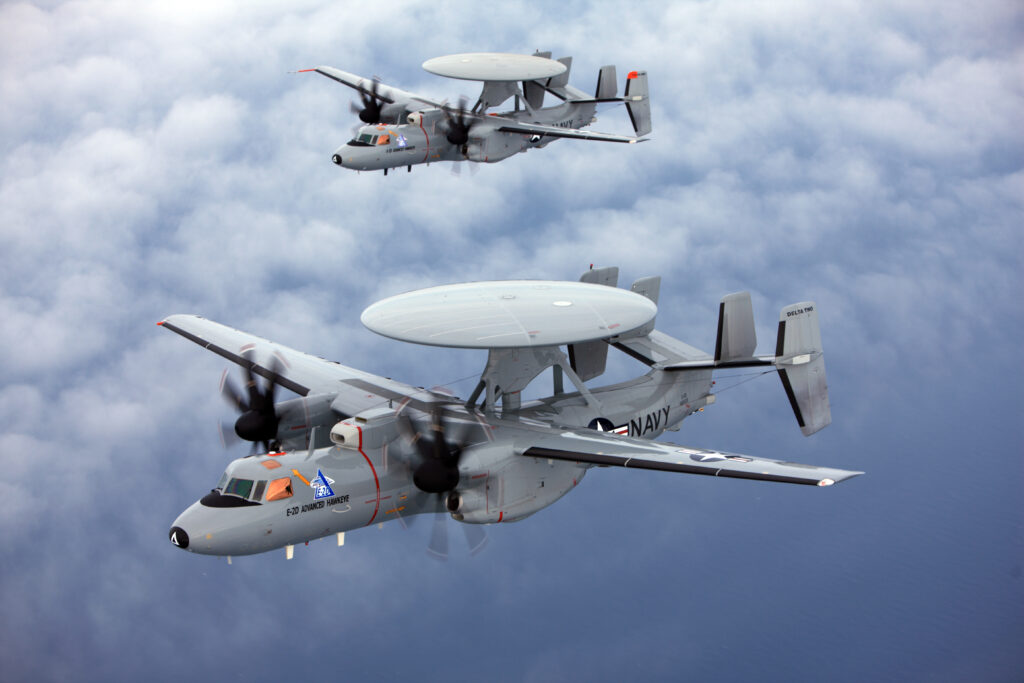
E-2D Advanced Hawkeye aircraft conduct a test flight near St. Augustine, Florida. U.S. NAVY

NORFOLK, Va. — A Navy E-2D Advanced Hawkeye assigned to an East Coast Airborne Command and Control Squadron (VAW) crashed in the vicinity of Wallops Island and Chincoteague, Virginia, March 30, the commander of Naval Air Force Atlantic public affairs said in a release. One crew member has died and two have been injured. 

The E-2D crashed at approximately 7:30 p.m. Two crew members were rescued by Maryland State Police and transported to Wallops Island for follow-on medical treatment for non-life-threatening injuries. The names of injured crewmembers will not be released due to privacy concerns. 

Unfortunately, the third crew member was found deceased in the aircraft. The Worcester County Fire Department Dive Team supported the search and recovery of the deceased. The name of the crew member killed will not be released at this time, pending primary next of kin notification.