USS St. Louis Returns from Deployment in Support of Southern Border Operations 

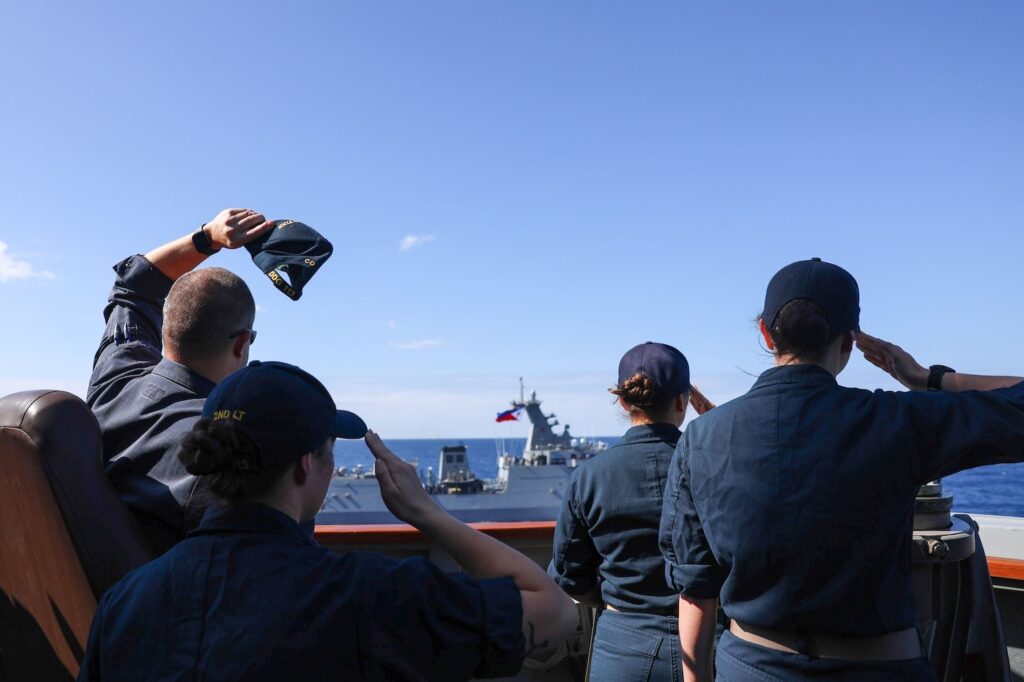
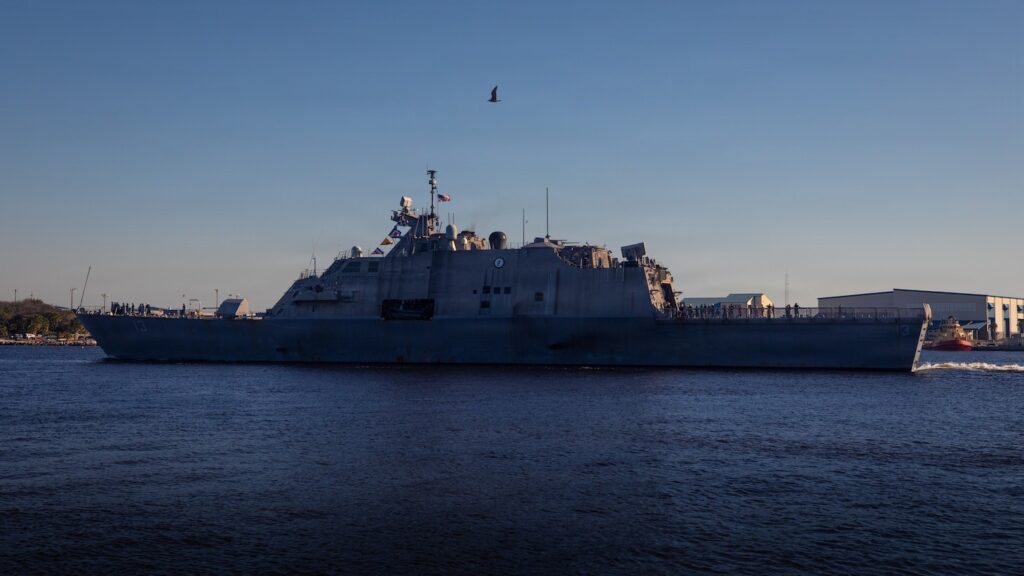
NAVAL STATION MAYPORT, Fla. (Nov. 10, 2025) — The Freedom-variant littoral combat ship USS St. Louis (LCS 19), operating under U.S. Northern Command (USNORTHCOM), returns to Naval Station Mayport, Fla., after completing a surge deployment, Nov. 10, 2025. (U.S. Navy photo by MC3 Jasmin L. Aquino) 

From Commander, U.S. 2nd Fleet, Nov. 11, 2025 

The Freedom-variant littoral combat ship USS St. Louis (LCS 19), operating under U.S. Northern Command (USNORTHCOM) in the Gulf of America, returned to Naval Station Mayport ), along with the “Valkyries” of Helicopter Maritime Strike Squadron (HSM) 50 Detachment 5 and embarked U.S. Coast Guard Law Enforcement Detachment (LEDET) 408 after completing a surge deployment on November 10, 2025 

U.S. Navy assets are deployed under U.S Northern Command’s maritime homeland defense authorities with a U.S. Coast Guard Law Enforcement Detachment embarked to enable maritime interdiction missions to prevent the flow of illegal drugs or other illegal activity. USNORTHCOM is working together with the Department of Homeland Security to augment U.S. Customs and Border Protection along the southern border with additional military forces. 

“The crew of St. Louis is grateful for the opportunity to support and defend the homeland,” stated Cmdr. Lee Shewmake, commanding officer, USS St. Louis (LCS 19). “We are always ready to demonstrate the U.S. commitment to international cooperation and supporting regional security and prosperity. Our Officers and Sailors onboard welcome every opportunity to collaborate with our partners, strengthening our interoperability and shared goals in the area.” 
 
In support of USNORTHCOM’s mission to restore territorial integrity at the U.S. southern border, St. Louis reinforced the nation’s commitment to border security by enhancing maritime efforts and supporting interagency collaboration. The ship’s deployment highlights the Department of War and Navy’s dedication to national security priorities, contributing to a coordinated and robust response to combating maritime-related terrorism, weapons proliferation, transnational crime, piracy, environmental destruction, and illegal seaborne immigration. 
 
“The U.S. Navy commends the crew of the St. Louis for their deployment in support of U.S. Northern Command’s mission,” stated Capt. Wade Smith, commodore, Littoral Combat Ship Squadron 2. “St. Louis reinforced our nation’s commitment to border security and 
interoperability with our partners and Allies.” 
 
St. Louis brought maritime capabilities in response to Presidential executive orders and a national emergency declaration and clarification of the military’s role in protecting the territorial integrity of the United States. 
 
A U.S. Coast Guard Law Enforcement Detachment (LEDET) was embarked aboard St. Louis. Coast Guard LEDETs carry out a variety of maritime interdiction missions, including counter- piracy, military combat operations, alien migration interdiction, military force protection, counter terrorism, homeland security, and humanitarian response. 
 
USS St. Louis (LCS 19) is assigned to Littoral Combat Ship Squadron (LCSRON) 2 and homeported in Mayport, Fla. The Littoral Combat Ship (LCS) is a fast, agile, mission-focused warship designed to operate in near-shore environments to counter 21st-century threats. It is a class of small surface combatants armed with capabilities to defeat challenges in the world’s littorals. LCS can operate independently or in high-threat scenarios as part of a networked battle force that includes larger, multi-mission surface combatants such as cruisers and destroyers. 
 
U.S. 2nd Fleet, reestablished in 2018 in response to the changing global security environment, develops and employs maritime ready forces to fight across multiple domains in the Atlantic and Arctic in order to ensure access, deter aggression and defend U.S., allied, and partner interests. 


Gerald R. Ford Carrier Strike Group Enters U.S. Fourth Fleet 

From USS Gerald R. Ford (CVN 78) Public Affairs, 11 November 2025 

The Gerald R. Ford Carrier Strike Group, led by the world’s largest aircraft carrier, USS Gerald R. Ford (CVN 78), entered the U.S. Southern Command area of responsibility (USSOUTHCOM AOR), Nov. 11. The maritime forces’ arrival comes after Secretary of War Pete Hegseth directed the Carrier Strike Group to support the President’s directive to dismantle Transnational Criminal Organizations and counter narco-terrorism in defense of the Homeland. 

The Gerald R. Ford Carrier Strike Group, led by the world’s largest aircraft carrier, USS Gerald R. Ford (CVN 78), entered the U.S. Southern Command area of responsibility (USSOUTHCOM AOR), Nov. 11. 
 
The maritime forces’ arrival comes after Secretary of War Pete Hegseth directed the Carrier Strike Group to support the President’s directive to dismantle Transnational Criminal Organizations and counter narco-terrorism in defense of the Homeland. 
 
“The enhanced U.S. force presence in the USSOUTHCOM AOR will bolster U.S. capacity to detect, monitor, and disrupt illicit actors and activities that compromise the safety and prosperity of the United States homeland and our security in the Western Hemisphere,” said Chief Pentagon Spokesperson Sean Parnell. “These forces will enhance and augment existing capabilities to disrupt narcotics trafficking and degrade and dismantle Transnational Criminal Organizations.” 
 
With more than 4,000 Sailors and dozens of tactical aircraft aboard, Gerald R. Ford provides combatant commanders and America’s civilian leaders increased capacity to project power through sustained operations at sea. The first-in-class carrier can simultaneously catapult launch and recover fixed-wing aircraft on its flight deck, day or night, in support of tasked operations. 
 
The carrier strike group will augment joint forces already in the area of responsibility, including the Iwo Jima Amphibious Ready Group and embarked marine expeditionary unit, under a Joint Task Force, created to defeat and dismantle criminal networks that exploit our shared borders and maritime domains. 
 
“Through unwavering commitment and the precise use of our forces, we stand ready to combat the transnational threats that seek to destabilize our region, said Adm. Alvin Holsey, Commander, SOUTHCOM. The USS Gerald R. Ford Carrier Strike Group’s deployment represents a critical step in reinforcing our resolve to protect the security of the Western Hemisphere and the safety of the American homeland.” 
 
Alongside Gerald R. Ford, the Carrier strike group brings additional capable, lethal, and adaptable warfighting assets including the nine embarked squadrons of Carrier Air Wing Eight, Destroyer Squadron Two’s Arleigh Burke-class guided-missile destroyers USS Bainbridge (DDG 96) and USS Mahan (DDG 72), and the integrated air and missile defense command ship USS Winston S. Churchill (DDG 81). 
 
The embarked squadrons aboard Gerald R. Ford include Strike Fighter Squadron (VFA) 31, VFA 37, and VFA 87, flying the F/A-18E Super Hornet; VFA 213, flying the F/A-18F Super Hornet; Electronic Attack Squadron 142, flying the E/A-18G Growler; Airborne Command and Control Squadron 124, flying the airborne command and control E-2D Advanced Hawkeye; Helicopter Sea Combat Squadron (HSC) 9, flying the MH-60S Seahawk; Helicopter Maritime Strike Squadron (HSM) 70, flying the MH-60R Seahawk; and a detachment from Fleet Logistics Support Squadron (VRC) 40, flying the Carrier Onboard Delivery C-2A Greyhound. 
 
The destroyers in company bring anti-air, anti-submarine, and anti-surface capabilities including the Aegis Combat System, missile vertical launch systems, and various large-mount guns. As the IAMDC, Winston S. Churchill leads the strike group’s air and ballistic-missile defense. 
 
The U.S. Southern Command Area of Responsibility encompasses 31 countries and 12 dependencies and areas of special sovereignty. The region represents about one-sixth of the landmass of the world assigned to regional unified commands. USSOUTHCOM´s Area of Responsibility includes the land mass of Latin America south of Mexico, the waters adjacent to Central and South America, and the Caribbean Sea. 
 
U.S. military forces are deployed to the Caribbean in support of the U.S. Southern Command mission, Department of War-directed operations, and the President’s priorities to disrupt illicit drug trafficking and protect the homeland. Inquiries may be submitted to [email protected].  


USS Jason Dunham Returns to Mayport Following Deployment to U.S. Fourth Fleet 

NAVAL STATION MAYPORT, Fla. (Nov 12, 2025) – Arleigh Burke-class guided-missile destroyer USS Jason Dunham (DDG 109) pulls into Naval Station Mayport after completing a 91-day surge deployment in the U.S. Fourth Fleet Area of Responsibility (AOR), Nov. 12, 2025. (U.S. Navy photo by MC1Brandon J. Vinson)

From U.S. 4th Fleet, Nov. 12, 2025 

Arleigh Burke-class guided-missile destroyer USS Jason Dunham (DDG 109) returned to Naval Station Mayport after completing a 91-day surge deployment in the U.S. Fourth Fleet Area of Responsibility (AOR). 

While assigned to Destroyer Squadron 40 (DESRON 40), the ship conducted a variety of multi-domain operations and joint training events. The crew qualified for both the U.S. Coast Guard Special Operations Ribbon and the Sea Service Ribbon for its support of interagency operations while deployed. 

“I am incredibly proud of my entire crew aboard Jason Dunham,” said Cmdr. Aaron Jefferson III, USS Jason Dunham’s Commanding Officer. “Successfully completing our surge deployment to Fourth Fleet is yet another example of their unmatched resilience and professionalism.” 

The ship’s embarked helicopter detachment, HSM-48 Detachment 7, flew 121 sorties while integrating airborne tactical scouting to extend the ship’s maritime domain awareness and reach. 

“Over the course of their deployment to the USSOUTHCOM AOR, Jason Dunham and her exceptional crew exemplified the strength of American naval sea power and international cooperation,” said Capt. Anthony James, commander, Naval Surface Group Southeast. “Their efforts reflect the strength of our commitment to maritime security and cooperation with allies and partners in the region.” 

Jason Dunham conducted port visits to Guantanamo Bay, Cuba; Ponce, Puerto Rico; and Charlotte Amalie St. Thomas, U.S. Virgin Islands, enhancing logistical sustainment and regional security cooperation. 

“Our team’s presence in the Caribbean is a clear demonstration of the Navy’s ability to deploy forces anywhere in the world to protect the interests of the American people,” said Jefferson. 

USS Jason Dunham (DDG 109) is assigned to Commander Naval Surface Group Southeast and homeported in Mayport, Florida. As an Arleigh Burke-class guided-missile destroyer, Jason Dunham is a multi-mission surface combatant capable of conducting anti-air, anti-submarine, and anti-surface warfare operations, supporting the U.S. Navy’s goals of forward presence, maritime security, and deterrence. 


U.S. Coast Guard Responds to Russian Military Vessel off Honolulu 

A Coast Guard HC-130 Hercules airplane crew from Air Station Barbers Point monitors a Russian military vessel approximately 15 nautical miles south of Oahu Oct. 29, 2025. Coast Guard personnel are monitoring the vessel’s activities near U.S. territorial waters, which extend to 12 miles offshore. (U.S. Coast Guard photo, courtesy Cutter William Hart) 

Coast Guard Oceania District External Affairs, Nov. 13, 2025 

HONOLULU — The U.S. Coast Guard detected and monitored a Russian military vessel operating near U.S. territorial waters approximately 15 nautical miles south of Oahu on Oct. 29. 
 
A Coast Guard HC-130 Hercules from Air Station Barbers Point and the Coast Guard Cutter William Hart (WPC 1134) responded to the Russian Federation Navy Auxiliary General Intelligence ship Kareliya, a Vishnya-class intelligence ship, by conducting a safe and professional overflight and transiting near the vessel. 
 
Acting in accordance with international law, Coast Guard personnel are monitoring the Russian vessel’s activities near U.S. territorial waters to provide maritime security for U.S. vessels operating in the area and to support U.S. homeland defense efforts. 
 
“The U.S. Coast Guard routinely monitors maritime activity around the Hawaiian Islands and throughout the Pacific to ensure the safety and security of U.S. waters,” said Capt. Matthew Chong, chief of response, Coast Guard Oceania District. “Working in concert with partners and allies, our crews monitor and respond to foreign military vessel activity near our territorial waters to protect our maritime borders and defend our sovereign interests.” 
 
Coast Guard Oceania District works in conjunction with U.S. Indo-Pacific Command and interagency partners to constantly monitor the activity of foreign military vessels operating near U.S. territorial waters, including the waters of U.S. territories Guam and American Samoa, to ensure homeland security and defense. 
 
Under customary international law, foreign military vessels are permitted to transit and operate outside other nations’ territorial seas, which extend up to 12 nautical miles from shore. 


General Dynamics NASSCO Awarded $1.7B to Construct T-AO 215 and T-AO 216  

NASSCO currently under contract to build 17 of the Navy’s 20-ship program of record, and has delivered four to date. 

 
From NASSCO 

SAN DIEGO, November 10, 2025 – General Dynamics NASSCO, a business unit of General Dynamics (NYSE:GD), announced today that it has been awarded $1.7 billion for the construction of T-AO 215 and T-AO 216. The ships are part of NASSCO’s current multi-ship contract from the U.S. Navy for the construction of up to eight additional John Lewis-class fleet replenishment oilers (T-AO 214 through 221).  

“The T-AO program holds significant importance to the men and women of NASSCO and is one we take great pride in – it’s the longest running Navy production series in NASSCO history,” said Dave Carver, president of General Dynamics NASSCO. “The timely funding for these two ships will act to stabilize the workforce by sustaining an important backlog and prevent future layoffs. Our entire NASSCO team is honored to continue to support the critical national security mission of the U.S.  Navy.” 

In 2016, the Navy awarded NASSCO with a contract to design and build the first six ships in the next generation of fleet oilers, the John Lewis-class. In 2022, that contract was modified to add an additional three oilers (T-AO 211 – 213). In 2024 NASSCO received an additional eight-ship contract to build T-AOs 10-17. 

Designed to transfer fuel to U.S. Navy ships operating at sea, the 742-feet vessels have a full load displacement of 49,850 tons, capacity to carry 162,000 barrels of oil and significant amounts of dry cargo, as well as providing aviation capability while traveling at speeds up to 20 knots. 

The first four ships of the program have been delivered to the U.S. Navy, with five additional T-AOs currently under construction in the NASSCO shipyard.  


SeeByte, BlueZone Group Ally to Strengthen Australian Naval Capabilities 

From Seebyte, Nov. 11, 2025 

SeeByte, a UK-based leader in advanced maritime defence and uncrewed systems technology, is proud to announce the signing of a representative agreement with BlueZone Group, a trusted Australian defence solutions provider. This partnership is a pivotal step in enhancing the Royal Australian Navy’s operational edge through cutting-edge autonomous maritime technologies. 

By appointing BlueZone Group as its official representative in Australia, SeeByte is reinforcing its commitment to supporting the Royal Australian Navy’s focus on future force readiness, autonomous systems integration, and maintaining strategic advantage in the maritime domain. 

Under this agreement, BlueZone Group will represent SeeByte in Australia, acting as its exclusive local representative across government, defence, and industry engagements. This includes supporting business development, strategic partnerships, and programme delivery in the maritime domain, with a focus on autonomous platforms, mission systems, C2 integration, and ISR capabilities. 

“As we expand our operational footprint in the Indo-Pacific, we are pleased to formalise this partnership with BlueZone Group” said Robert Johnson, Chief Commercial Officer at SeeByte. “Australia is a pivotal strategic region for SeeByte, and this collaboration helps empower them with cutting-edge technology, strengthening sovereign capability, and advancing combat readiness.” 

“We look forward to representing SeeByte and supporting their integration into the Australian defence ecosystem. Their cutting-edge technology and operational experience will add significant value to Australia’s future capability landscape”, said Neil Hodges, Managing Director at BlueZone Group. 

The agreement enhances SeeByte’s ability to engage directly with the Australian Defence Force (ADF) and key stakeholders supporting AUKUS Pillar II initiatives. 


RTX’s Raytheon, Avio Sign MoU for New Solid Rocket Motor Facility in U.S.  

Facility will be instrumental in meeting growing demand 

From RTX 

ARLINGTON, Va. (November 10, 2025) — Raytheon, an RTX (NYSE: RTX) business, has signed a Memorandum of Understanding to help Avio establish a state-of-the-art solid rocket motor (SRM) facility in the United States, serving Raytheon and other customers as a vertically integrated merchant supplier. Raytheon will have preferred access to a share of the Avio plant production capacity to meet future demand. 

This strategic partnership marks another significant milestone in the collaboration between the two companies, building on a contract signed in July 2024 for preliminary engineering work on the Mk 104 rocket motor and a recent purchase order to fund through Critical Design Review and procurement of long lead material for qualification. 

“This agreement will help establish an additional supplier of solid rocket motors within the U.S. and demonstrates our commitment to meeting the increasing demands of our customers,” said Bob Butz, vice president of Operations, Supply Chain and Quality at Raytheon. “By leveraging Avio’s experience and unique capabilities in solid rocket motor propulsion development and manufacturing, we’re strengthening our capacity for critical weapon systems.” 

The new Avio facility will be instrumental in meeting the growing demand for advanced SRMs and will contribute to the continued success of both companies in delivering high-quality defense products. Avio and Raytheon are committed to working together to ensure the successful implementation of this initiative and to support the defense needs of the United States and its allies. 

“We are proud to be partnered with Raytheon for their future production capacity needs at our new factory facility. We look forward to leveraging the incredible pedigree and experience of our parent company Avio S.p.A. as we build our factory and establish in the U.S. as a true vertically integrated merchant supplier,” said VADM Ret. Jim Syring, CEO of Avio USA. 


Houthi Militia Ceasing Attacks in Red Sea Would Have Seismic Impact on Container Shipping

From Xeneta 

OSLO – Norway, 11 November 2026 – Houthi militia have reportedly ceased attacks on Israel and shipping in the Red Sea (source: AP) – the impact would be seismic for global ocean container shipping, but an immediate largescale return to the region will require a series of further assurances, analysts warn. 

Peter Sand, Chief Analyst at Xeneta – the ocean and air freight intelligence platform – said: “Details are sketchy and you cannot base the safety of crews, ships and cargo on the word of Houthi militia. Carriers need far more assurance than that and, perhaps more importantly, so do insurance companies. 

“Different carriers have different tolerances to risk and we have seen some intermittently testing the water, with the CMA CGM Zheng He and CMA CGM Benjamin Franklin making voyages through the region in November, but generally the number of container ships transiting the Suez Canal has been trending downwards during 2025. 

“Transits may start to increase if there is a perceived lower risk, but we are unlikely to see an imminent return to 2023 levels.” 

Longer sailing distances around the Cape of Good Hope in Africa due to the threat of Houthi attacks in the Red Sea region is currently absorbing around 2 million TEU (20ft equivalent container units) of global container shipping capacity and increasing the transport demands on the fleet. 

A largescale return to the Red Sea would therefore reduce the transport work required of the fleet and potentially cause freight rates to plummet – unless carriers take drastic measures, such as idling, demolition, slow-steaming and widespread blank sailings. 

Sand said: “Average spot rates from Far East to North Europe, Mediterranean and US East Coast – three trades that would ordinarily transit the Red Sea – are all down more than 50% since the start of year. A largescale return of container ships to the Red Sea would flood the market with capacity and cause freight rates to plunge even lower across trades at a global level, not just those directly impacted by the diversions. 

“Carriers are already heading into loss-making territory and freight rates are expected to fall up to -25% globally in 2026, even with no change to the situation in the Red Sea. 

“Shippers should be making contingency plans because a largescale return would cause severe disruption across global ocean supply chains as services transiting Suez Canal are reinstated. 

“There are still many questions to be answered, but the impact of a largescale return would be seismic for shippers and carriers.” 


USCGC Frederick Hatch Returns to Guam Following Drydock in Honolulu 

The USCGC Frederick Hatch (WPC 1143) crew return to homeport Nov. 5, 2025, after a deployment of more than eight months that included scheduled drydock maintenance in Honolulu and activities in the Republic of the Marshall Islands. The cutter departed Guam on Feb. 24 and is the third Guam-based Fast Response Cutter to complete the significant systems overhaul. Crews and contractors restored full mission capability through a $4.5 million drydock addressing required maintenance and a major engineering upgrade. The crew also on loaded $750,000 in unit gear and steamed over 7,970 nautical miles.

From U.S. Coast Guard Forces Micronesia/Sector Guam, Nov. 11, 2025 

SANTA RITA, Guam — The USCGC Frederick Hatch (WPC 1143) crew returned to homeport Nov. 5, after a deployment of more than eight months that included scheduled drydock maintenance in Honolulu and activities in the Republic of the Marshall Islands. 
 
“The crew of Frederick Hatch stands among the finest Fast Response Cutter teams I have led,” said Lt. Cmdr. Vaughn Gehman, commanding officer. They continue to deliver reliable, safe operations across the Pacific. Their resilience and skill in extended operations are an inspiration for continued service afloat.” 
 
The cutter departed Guam on Feb. 24 and is the third Guam-based Fast Response Cutter to complete the significant systems overhaul. Crews and contractors restored full mission capability through a $4.5 million drydock addressing required maintenance and a major engineering upgrade. The vessel also onloaded $750,000 in unit gear and steamed over 7,970 nautical miles. 
 
En route to Hawai’i, the crew turned a weather delay into a security engagement during a March port call in Majuro, RMI. The crew conducted activities with the crew of the French navy frigate FS Prairial (F731), including a passing exercise to enhance interoperability and practice communication, navigation, and operational procedures to ensure effective cooperation in joint operations, a simulated fire response, and best practices for fisheries inspection and boardings. The exchange reinforced U.S. commitments with allies and partners in the region.  
 
On the return leg, the crew proved a new at-sea refueling concept. With four days to prepare for the complex evolution, Frederick Hatch received more than 12,000 gallons of fuel from a larger cutter while underway. The evolution extended endurance and reduced risk during long transits. The cutter crew also delivered 4,000 pounds of difficult-to-ship goods to forces in Guam, boosting regional readiness.  
 
The team qualified over a dozen members in roles such as underway officer of the deck, underway engineering officer of the watch, in-port officer of the deck, quartermaster of the watch, and onboard training team members, while also integrating seven new crew members. 
 
The return of the Frederick Hatch restores three fully operational Fast Response Cutters in Guam. Two additional cutters remain in pre-commissioning status with crews training on the island. The fleet, in concert with Forces Micronesia/Sector Guam, secures U.S. and territorial borders, ensures the flow of commerce, and stands ready to respond to crises across the Pacific.  


Future Attack Submarine Utah Christened at Electric Boat

By Richard R. Burgess, Senior Editor 

ARLINGTON, Va. — The future Virginia-class nuclear-powered attack submarine Utah (SSN 801) was christened during ceremonies at the General Dynamics Electric Boat shipyard in Groton, Connecticut, on October 25, 2025. 

According to a posting on X @GDElectricBoat “The Virginia-class assembly building at shipyard was all decked out on October 25 for the christening of PCU Utah (SSN 801). EB shipbuilders, the ship’s crew, U.S. Navy personnel and government officials joined both live and virtually to celebrate this significant milestone commemorated by a joint swing. Mrs. Sharon Lee (left) and Mrs. Mary Kaye Huntsman, co-sponsors of Utah, broke a bottle of sparkling cyser — a honey and apple cider wine from Utah — on the ship’s hull to commemorate the christening.” 

When commissioned, the USS Utah will be the 10th and final Block 4 version of the Virginia-class submarines to be built by General Dynamics Electric Boat and HII’s Newport News Shipbuilding.