HII Appoints Dorsey as VP of Operations at Ingalls Shipbuilding
Donny Dorsey, the new vice president of operations at Huntington Ingalls Industries’ Ingalls Shipbuilding. HII
PASCAGOULA, Miss. — Global engineering and defense technologies provider Huntington Ingalls Industries has appointed Donny Dorsey as vice president of operations at HII’s Ingalls Shipbuilding division, the company said March 10.
Dorsey, formerly ship program manager for all DDG waterfront efforts at Ingalls Shipbuilding, replaces George Jones, who will retire April 1 after 37 years of service.
“George’s expertise in shipbuilding has influenced generations of shipbuilders and the capabilities of the shipyard,” said Kari Wilkinson, president of Ingalls Shipbuilding. “We are grateful for his focus on execution excellence and for shaping our ‘shipyard of the future.’ Thank you, George. As we move forward, I am confident that Donny will continue the Ingalls legacy of strong execution and will focus on strategic innovation and transformation as we look to the future.”
In Dorsey’s new position, he will oversee all manufacturing operations through delivery, across all Ingalls Shipbuilding programs. He will also be responsible for working collaboratively with union partners, cost and schedule performance, process improvements and driving production strategies.
Dorsey joined Ingalls Shipbuilding in 2000 as a robotic operations technician and spent a portion of his career focused on the Gulfport composite operations for LPD/DDG 1000 serving as quality manager, operations director and then site director. Most recently, Dorsey served in program management with a focus on the DDG 51 class where he and his team managed the installation, test and activation of multiple complex ship systems.
He holds a bachelor’s degree in management from Nicholls State University, an MBA in project management from Capella University and is a graduate of the Gulf Coast Business Council’s Masters Leadership Program.
Saab to Provide U.S. Marine Corps with Training Systems
STOCKHOLM — Saab has received a contract modification from the U.S. Marine Corps within the Force-on-Force Training Systems-Next program, the company said March 9.
The modification value is approximately $122 million USD, where $54 million was booked during 2021. The original contract was announced in June 2021. The contract modification announced today also includes options, which increases the potential total contract value up to $248 million.
Saab will provide a deployable, live training capability to include equipment for individual Marine weapons and vehicles, as well as logistics, maintenance, and training exercise support.
The FoFTS-Next program will include U.S. Marine Corps Training Instrumentation Systems equipment for up to 10 battalion training sets, and the establishment of support operations at various Marine Corps Installations.
“The deployable and expeditionary MCTIS capability is an advanced training solution that will ensure Marines train and learn in the most realistic environment. The system will enhance Marines’ performance and survivability on the battlefield by developing and reinforcing proper tactics, techniques, and procedures. Saab is proud to be the U.S. Marine Corps training partner for the next generation of Marine warfighters,” said Erik Smith, president and CEO of Saab in the United States.
The expeditionary MCTIS capability is the premier land-based live training capability in the world and is fully interoperable with the land forces training of more than 30 NATO and partner nations.
Aquilino: Fuel Logistics to Be Dispersed in Wake of Red Hill Closure
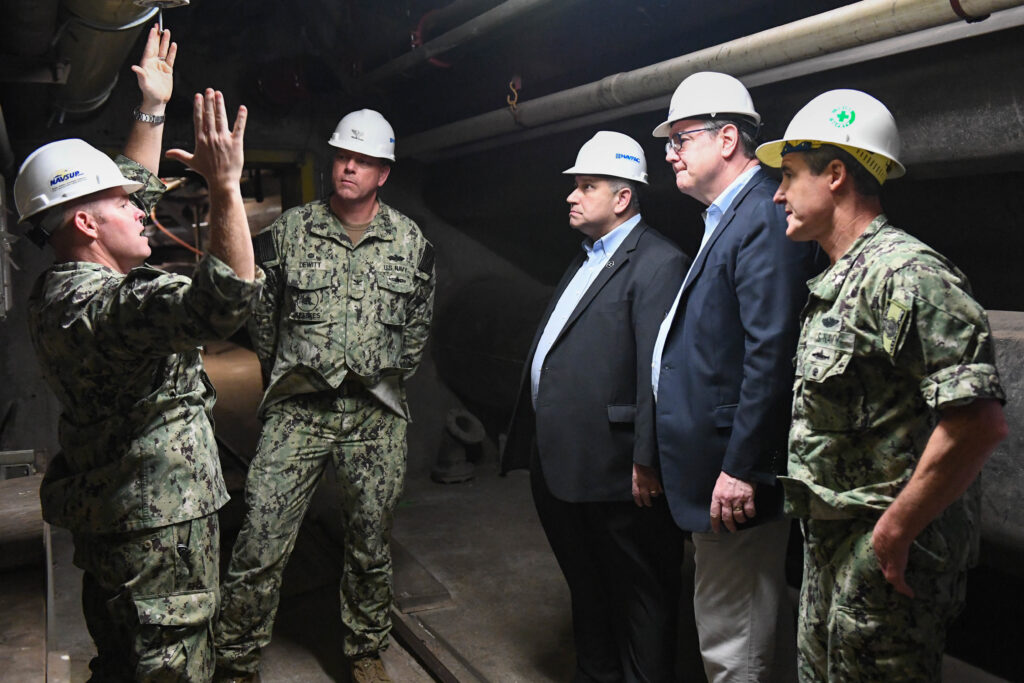
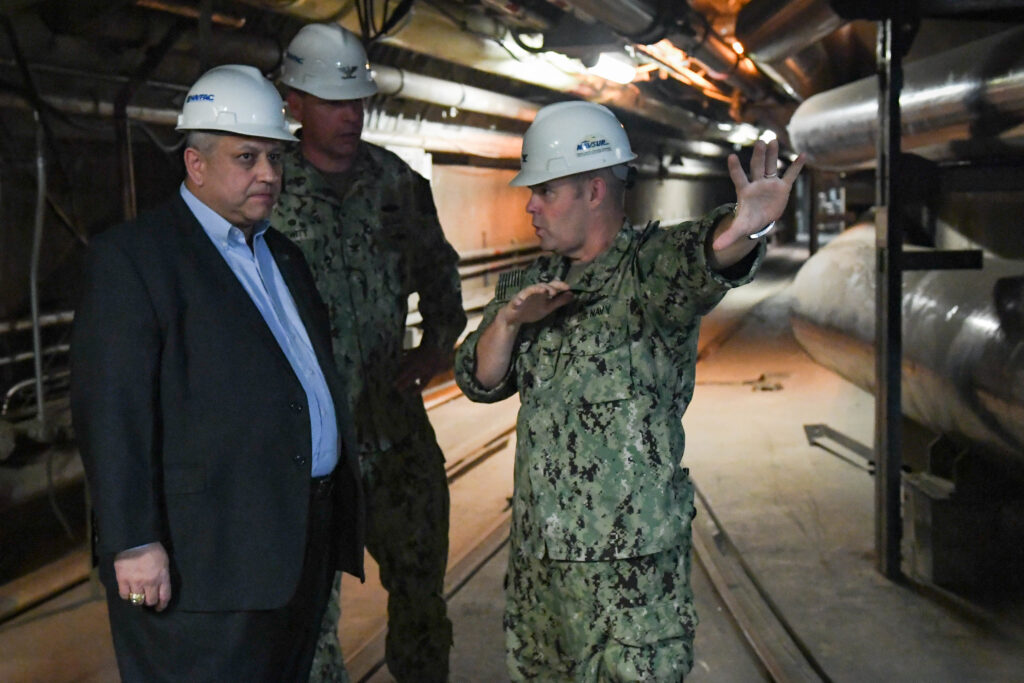
Secretary of the Navy Carlos Del Toro and General Counsel, Department of the Navy John P. “Sean” Coffey receive a brief on well operation and recovery initiatives from Capt. Burt Hornyak, commanding officer, Fleet Logistics Center Pearl Harbor during a tour of the Red Hill Well in Aiea, Hawaii, in February. U.S. NAVY / Mass Communication Specialist 2nd Class Chelsea D. Meiller
WASHINGTON — The commander of U.S. forces in the Indo-Pacific region addressed concerns from Congress about the impact of the closure of the Red Hill fuel depot in Hawaii during March 9 testimony on Capitol Hill.
Rep. Mike Rogers, ranking member of the House Armed Services Committee, said in his opening remarks that Navy Secretary Carlos Del Toro’s decision to close Red Hill was made “without laying out the resources to replace that capacity. That’s extremely short-sighted. The response from the department has been the same: the answer is just one policy announcement away. And that’s unacceptable.”
Rogers told Adm. John C. Aquilino, commander, U.S. Indo-Pacific Command, that “he wanted to hear how Indo-Pacific Command will implement new operational concepts and new systems to ensure that logistics support at new operating locations throughout the Indo-Pacific.
“But most importantly, I want to know how you intend to do that in the next five years,” Rogers said. “We all know China is not going to give us 10 to 20 years to prepare for conflict. We simply cannot procrastinate any further. The issue like Red Hill presents an opportunity to modernize beyond the World War II logistics model. But I’m deeply worried about the cycle of indecision and procrastination at the Pentagon.”
Aquilino said that as senior leadership looked at options with regard to Red Hill, three criteria had to be met: clean water for the people of Hawaii, service members and their families; meeting the war plan and warfighting requirements; and cost.
“We developed a plan that actually goes in alignment with a more distributed plan — both forward- and land-based — combined with a sea-based component to allow for a more distributed, survivable, resilient network of fuels, as well as meeting all of the security and the strategic fuel reserve requirements,” the admiral said. “I actually think that we’re going to be in a better place, and we meet all three requirements.”
Aquilino said the Department of Defense, the Environmental Protection Agency and the Hawaii Department of Health are working together toward a solution.
“We will go as fast as safe allows,” he said. “We have to make sure the facility is safe, to transfer that fuel into places that we’re going to end it, but we’re certainly not waiting. As soon as we can get it done, we’ll be ready to move, and as soon as we’re able to contract some of those other facilities, as well as the sea-based option.”
The Defense Department had announced the Red Hill facility would be closed within the year.
“That just allows us to be able to distribute that fuel with the contract requirements, the sea-based requirements, and the need to put it in the correct spots,” Aquilino said.
FRCSW Inducts Its First CMV-22 to Suffer Mishap
The VRM-30 CMV-22 Osprey inducted by FRCSW on January 13 is pictured in Building 333. The inner composite skin of the aircraft suffered a four-foot by two-foot crack during a mishap. FRCSW, FST, PMA-275 and industry partners developed a repair plan to return the aircraft to its squadron. U.S. NAVY
NAVAL AIR STATION NORTH ISLAND, Calif. — Fleet Readiness Center Southwest artisans and the Fleet Support Team recently joined industry partners and the V-22 Joint Program Office (PMA-275) to prevent the loss of an CMV-22 Osprey aircraft which had suffered damage during a mishap, the center said March 8.
The right-hand inner composite skin of the $75 million aircraft sustained a four-foot by two-foot crack with other, but minor, composite damage.
“A lot of people would have said, `Hey, we need to strike this aircraft,’ but the engineers at the FST and our industry partners decided to figure out a way to keep this asset in the fleet,” said Col. Brian Taylor, PMA-275 program manager.
John Sandoval, sheet metal mechanic work lead, said the repair required replacing the inner skin panel.
“We’ve removed over 1,200 fasteners separated by over 42 feet of composite inner skin to composite outer skin,” he said. “This proved to be difficult because this is the first of its kind repair.”
The V-22 is unique to other airframes serviced by the command because of its aluminum, carbon/epoxy composite fuselage and empennage. Its wings and nacelles are also composite and fiberglass.
The aircraft, assigned to Fleet Logistics Multi-Mission Squadron 30 (VRM-30), was inducted by FRCSW on Jan. 13 as an in-service repair, or repairs outside of scheduled maintenance.
“This is the first major ISR and first mishap aircraft my team has performed on a CMV-22,” said Michael Dixon, FRCSW V-22 production manager.
He said the labor-intense repair would require about 70 days and more than 2,800 man-hours to complete, with sheet metal work taking most of those hours.
In addition to four sheet metal mechanics, other artisans needed to ensure a successful repair include electricians, mechanics, quality assurance and planner and estimator personnel. All will work in conjunction with engineering departments from the FST and Boeing.
“These capabilities are what really makes Naval Air Systems Command, the FST and the PMA-275 program so incredibly important to this community because we have the ability to take care of our own stuff and keep these assets in the fight,” Col. Taylor said.
“The planning department estimated the repair will cost $390,500. Currently, we are tracking to complete the repair on schedule and under budget,” Dixon added.
The Osprey will be returned to VRM-30 when complete. In the meantime, a safety investigation relating to the mishap is underway.
Cutter Steadfast Returns Home Following Migrant-Interdiction, Counter-Narcotics Patrol
The Coast Guard Cutter Steadfast crew conducts cutter boat pursuit training with a crew from the Coast Guard Cutter Forrest Rednour on Feb. 8. U.S. COAST GUARD
ASTORIA, Oregon. — The Coast Guard Cutter Steadfast (WMEC 623) and crew returned to the cutter’s homeport in Astoria March 7 after a 48-day patrol of the California coast, the cutter’s crew said in a release.
The 54-year-old cutter and crew conducted drug and migrant interdiction, living marine resource protection and search and rescue operations along the U.S.-Mexico maritime border.
The Steadfast crew coordinated with Customs and Border Protection, Coast Guard aircraft and Mexican Navy vessels to interdict three boats suspected of attempting to illegally transport migrants into the United States, resulting in the safe recovery and repatriation of 75 people.
Additionally, the crew boarded 23 U.S. vessels operating in the area and participated in a multi-asset search operation following a flare sighting.
“This was a challenging yet successful patrol for the crew of Steadfast, highlighting the important interagency effort required to secure our maritime borders,” said Cmdr. Craig Allen, commanding officer of the Steadfast. “It was rewarding to work alongside our many partners during the patrol, including Customs and Border Protection, U.S. Border Patrol, and both Mexican and U.S. Navy assets.”
The Steadfast’s permanent crew makeup is 63 enlisted personnel and 12 officers. To aid in this patrol, the permanent party welcomed multiple temporary duty members from across the nation, including: Petty Officer 1st Class Bradley Kwasny and Petty Officer 2nd Class Christian Matranca, both from Maritime Safety and Security Team San Francisco; Petty Officer 2nd Class Aaron Holroyd from Training Center Yorktown,Virginia; and Lt. Ryan Guinee from the Surface Forces Logistic Center – Patrol Boat Product Line in Seattle.
“We had a top-notch team on this patrol, and I’m especially proud of them for overcoming some difficult equipment casualties that were necessary to keep the 54-year-old cutter mission capable,” Allen said. “The crew achieved noteworthy results due to superb skill and professionalism. We’re also thankful to the men and women at Coast Guard Sector Los Angeles for the excellent support they provided during multiple port visits.”
Commissioned in 1968, the Steadfast is a 210-foot Reliance-class medium-endurance cutter homeported in Astoria and routinely deploys in support of counter-drug, migrant interdiction, fisheries, and search and rescue and homeland security missions.
Patrol Ship USS Tempest Decommissioned in Bahrain
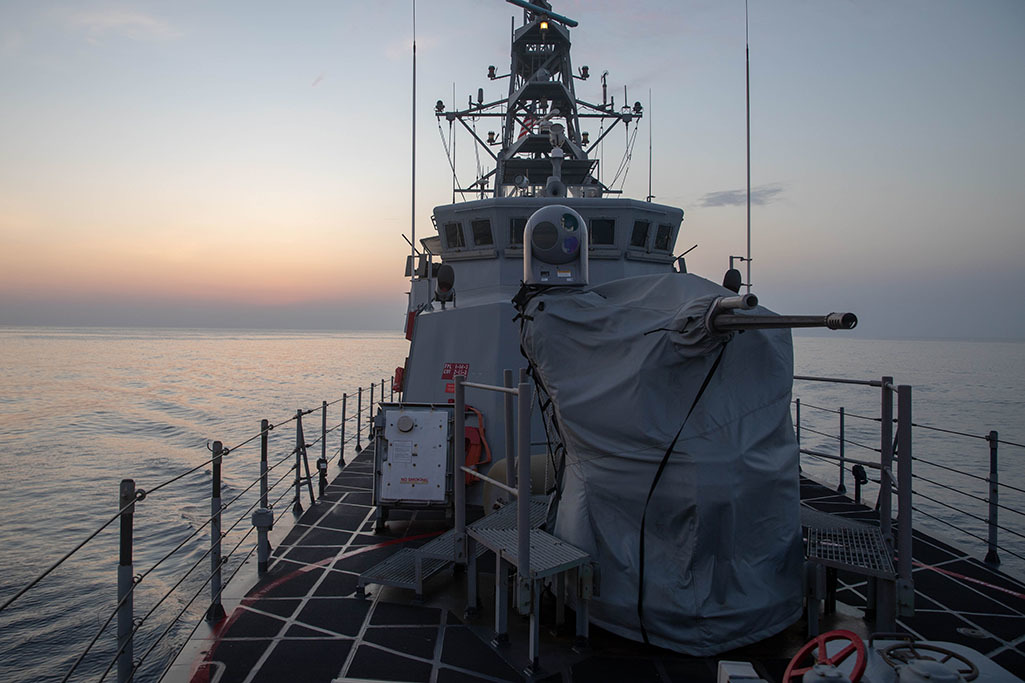
Patrol coastal ship USS Tempest (PC 2) transits the Arabian Gulf, July 20, 2021. U.S. ARMY / Spc. Joseph DeLuco
ARLINGTON, Va. — The coastal patrol ship USS Tempest (PC 2) was decommissioned in ceremonies held March 7 at Naval Support Activity Bahrain after 29 years of service.
The Tempest, the oldest serving PC, is the third PC of the U.S. 5th Fleet to be decommissioned this year. Its retirement was preceded in February by USS Firebolt and USS Typhoon. Lt. Cmdr. Matthew J. Intoccia was Tempest’s last commanding officer. Seven PCs remain in service in the 5th Fleet.
The 179-foot-long Tempest was built by Bollinger Shipyards in Lockport, Louisiana, and was commissioned Aug. 21, 1993. After serving off Haiti in 1994 in support of Operations Uphold Democracy and Restore Democracy. After 9/11, the Tempest patrolled the coast of the United States in support of Operation Noble Eagle.
With the Coast Guard needing more capacity for maritime security patrols, the Navy transferred five PCs to the Coast Guard, first in an “in commission, special” status, then decommissioned for full transfer to the Coast Guard. Tempest became WPC 2 on 1 October 2004. The ship was returned to the Navy on Aug. 22, 2008, and recommissioned into the Navy’s fleet as PC 2 on Aug. 23. 2008. The Tempest had been assigned to the 5th Fleet since 2013.
In an interview published on the 5th Fleet website, Intoccia said the “capstone of my time on Tempest is undoubtedly our last patrol. I consider it a culmination of all the hard work and dedication over our past 18 months. Together, with our battle buddy USS Typhoon and our embarked U.S. Coast Guard team, we conducted multiple interdictions with a high seizure yield. In my opinion, we reached the apex of the ship’s capability during that patrol, and I could not be more proud of my crew’s performance.
“I hope Tempest is remembered as a capable bastion of our nation’s commitment to free and unimpeded navigation in the maritime domain, and for her rich legacy of joint and multinational cooperation,” he said. “Small in stature and crew but mighty in deed, Tempest has been operated by our country’s best during 29 years of U.S. Navy service.”
Coast Guard, Partner Agencies Respond to Haitian Migration Venture off Florida Keys
Coast Guard, Customs and Border Protection and partner agencies crews respond to a suspected Haitian migrant venture, March 6, approximately 200 yards off Ocean Reef, Florida. The vessel grounded Sunday with no injuries reported. U.S. COAST GUARD
MIAMI — U.S. Coast Guard, Customs and Border Protection and partner agencies responded to a grounded Haitian vessel on March 6, approximately 200 yards off Ocean Reef in Key Largo, Florida, the Coast Guard 7th District said March 7.
Coast Guard, CBP and partner agencies rescued 356 Haitians from the vessel and no injuries were reported. A good Samaritan notified Coast Guard Sector Key West watchstanders March 6, at approximately 1 p.m., of a blue Haitian vessel grounded off Ocean Reef.
“We worked seamlessly with our state and federal partners to safely remove all the persons from this vessel.” said Capt. Jeffrey Randall, chief of Staff, Coast Guard 7th District. “The Coast Guard and partner agencies are continuously patrolling the Mona Passage, Windward Passage, Caribbean Sea and the approaches to the United States to stop these dangerous and unsafe voyages.”
“The coordinated and timely response of the U.S. Border Patrol and our federal, state, and local partners potentially saved the lives of these migrants today,” said Walter N. Slosar, chief patrol agent, U.S. Border Patrol, Miami Sector.
U.S. Navy Brings Back Baccalaureate Degree Completion Program
MILLINGTON, Tenn. — The Navy is bringing back the Baccalaureate Degree Completion Program. This program offers various benefits for college students looking for a new way to join the Navy as a commissioned officer, the Navy Recruiting Command said in a release.
BDCP will help prospective applicants commission as a Surface Warfare Officer, Special Warfare, Explosive Ordinance Disposal, Naval Aviation-Pilot and Naval Flight Officer.
“Implementing the BDCP is another Fleet recommendation from our Task Force One Navy,” Rear Adm. Dennis Velez, commander, Navy Recruiting Command said.
Those who enlist into the BDCP will start off receiving full pay and allowances of an Officer Candidate Petty Officer 3rd Class (OCPO3) (E-4). If an applicant provides a referral that results in an accession to an officer commissioning program, they will be eligible for a one-time advancement to the next paygrade. Another way to advance in paygrade is to make the dean’s list two consecutive semesters or three consecutive quarters.
“A lot of college students have a job on the side while they study,” Cmdr. Howard Bryant, director of Outreach and Diversity at Commander, Navy Recruiting Command said. “This program will help free up time so they can focus on their studies, as well as guarantee a job after they graduate.”
To apply for BDCP, applicants must be U.S. citizens, at least 19 years old and cannot exceed the age limit for the specific designator. It is required to have a 2.8 grade point average or higher on a 4.0 grade scale.
BDCP is also available to people enlisted in the Navy Reserves. Applicants must be currently enrolled or accepted for transfer to a regionally accredited four-year college or university that does not have an established Naval Reserve Officer Training Corps unit or NROTC cross-town agreement. Applicants must have at least 60 semester or 90 quarter hours of credit from an accredited college or university and fulfill baccalaureate degree requirements within 24 months.
“This program is meant for that person midway through college that is figuring out what’s next in their life,” said Lt. Cmdr. James Barfoot, the branch head of general accessions at Commander, Navy Recruiting Command. “Instead of having to delay and potentially run into a financial situation, they’ve got a pathway.”
Upon completion of the baccalaureate degree requirements, candidates will be advanced to OCPO2, if they haven’t been previously advanced. Candidates will keep their rank until they are enrolled into the next available Officer Candidate School class.
Navy Recruiting Command consists of a command headquarters, three Navy Recruiting Regions and 26 Navy Talent Acquisition Groups that serve more than 1,000 recruiting stations across the world. Their combined goal is to attract the highest quality candidates to assure the ongoing success of America’s Navy.
U.S. Naval Aviation No Stranger to Southeast Europe Operations
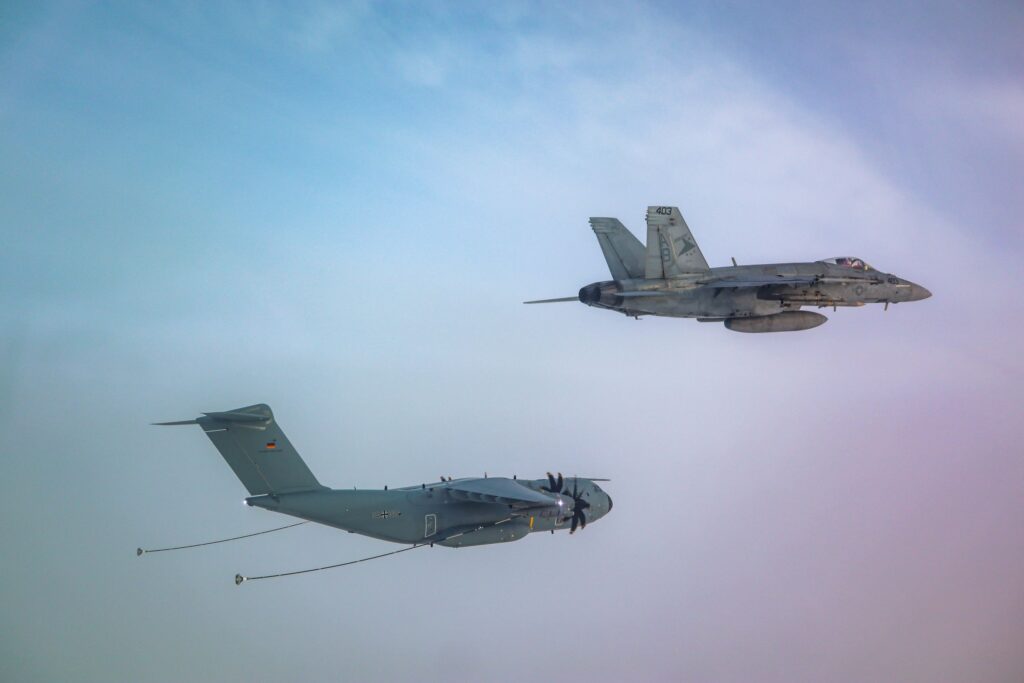
A German air force A400M tanker, left, and an F/A-18E Super Hornet, attached to the “Sunliners” of Strike Fighter Squadron (VFA) 81, fly over the north Aegean Sea March 4. ELECTRONIC ATTACK SQUADRON 137
ARLINGTON, Va. — The skies over southeast Europe are not normally associated with the history of U.S. naval aviation, but the current patrols being flown over the region by Navy aircraft from the aircraft carrier U.S Harry S. Truman are just the latest of at least three operations conducted by U.S. naval aviation in the region since the end of the Cold War. The Russian invasion of Ukraine has triggered the latest operations.
The USS Harry S. Truman carrier strike group, with Carrier Air Wing One (CVW-1) embarked in the carrier, is deployed to the Mediterranean, operating in support of NATO operations. The CSG has operated in the restrictive waters of the Adriatic Sea and the Aegean Sea on this deployment as well. The routine deployment also is showing the value of forward-deployed naval forces, available on short notice to respond to international crises.
“Conducting enhanced Air Policing from North Aegean waters further illustrates NATO’s continued ability to share and pool existing capabilities,” said Rear Adm. Curt Renshaw, commander, Carrier Strike Group Eight, in a March 7 release from the U.S. 6th Fleet. “We set out to prove that this dynamic employment of an aircraft carrier — in pretty restrictive waters — could be done, and in doing so, we have demonstrated the enduring U.S. commitment to Allies.”
U.S. carriers in the region provided air cover and close air support in the early-to-mid-1990s during Operations Deliberate Force and Deny Flight during the civil wars that broke out as Yugoslavia splintered eventually into seven separate nations.
In 1999, during Operation Allied Force, U.S. carriers in the Adriatic Sea launched strikes into Serbia and Kosovo to protect the Kosovars from Serbian action. Navy P-3C Orion patrol aircraft also launched Standoff Land-Attack Missiles against Serbian targets. Navy and Marine Corps EA-6B and F/A-18 aircraft operated from bases in Italy as well.
In recent years, Navy P-3, P-8, and EP-3 maritime patrol reconnaissance aircraft expanded patrols over the Black Sea region.
This week, CVW-1 aircraft, including F/A-18E/F Super Hornet strike fighters and EA-18G Growler electronic attack aircraft, have flown patrols in the region to defend NATO nations’ airspace as part of the NATO Response Force. The squadrons conducting the patrols include strike fighter squadrons VFA-11, VFA-34, VFA-81 and VFA-211 as well as electronic attack squadron VAQ-137.
In recent weeks, CVW-1’s squadrons also have flown in training exercises with the Romanian and Italian air forces.
SECDEF Orders Closure of Navy’s Red Hill Bulk Fuel Storage Facility in Hawaii
Secretary of the Navy Carlos Del Toro receives a brief on well operation and recovery initiatives from Capt. Burt Hornyak, commanding officer, Fleet Logistics Center Pearl Harbor during a tour of the Red Hill Well in Aiea, Hawaii, in February. Secretary Del Toro was in Hawaii to meet with families and see the progress that has been made in restoring and protecting the island’s safe drinking water. U.S. NAVY / Mass Communication Specialist 2nd Class Chelsea D. Meiller
ARLINGTON, Va. — Defense Secretary Lloyd Austin III made the following statement March 7 announcing the decision to close a Navy petroleum storage facility near Pearl Harbor, Hawaii, which recently leaked and affected the Navy’s drinking water system for the area:
“After close consultation with senior civilian and military leaders, I have decided to defuel and permanently close the Red Hill bulk fuel storage facility in Hawaii.
“This is a multi-step process. Throughout the process, we will work closely with the Hawaii Department of Health and with the Environmental Protection Agency to safely defuel the Red Hill facility. No later than May 31, the Secretary of the Navy and Director of the Defense Logistics Agency will provide an action plan for safe and expeditious defueling of the facility, with a completion date target of 12 months. Then, as soon as we have made corrective actions to ensure that defueling will be safe, we will begin defueling. Then we will move to permanently close the Red Hill facility, including conducting any and all necessary environmental remediation around the facility.
“This is the right thing to do.
“Centrally located bulk fuel storage of this magnitude likely made sense in 1943, when Red Hill was built. And Red Hill has served our armed forces well for many decades. But it makes a lot less sense now. The distributed and dynamic nature of our force posture in the Indo-Pacific, the sophisticated threats we face, and the technology available to us demand an equally advanced and resilient fueling capability. To a large degree, we already avail ourselves of dispersed fueling at sea and ashore, permanent and rotational. We will now expand and accelerate that strategic distribution.
“Moreover, when we use land for military purposes, at home or abroad, we commit to being good stewards of that resource. Closing Red Hill meets that commitment.
“We will continue our work with the Hawaii Department of Health, national and local elected officials, and other community leaders, to clean up the water at the Red Hill well. And we will develop an environmental mitigation plan to address any future contamination concerns. When we begin to consider land-use options for the property after the fueling facility is closed, we will stay in lockstep with communities in Hawaii. Nothing will be decided without careful and thorough consultation with our partners.
“The same goes for our workforce and their families. Your health has been impacted, your lives and livelihoods have been disrupted, and in many cases, your very homes have been rendered unavailable to you. We owe you the very best health care we can provide, answers to your many questions, and clean, safe drinking water. Quite frankly, we owe you a return to normal. And you have my commitment to that end.”
Throughout this process, and moving forward, we have remained grateful for the partnership and guidance of our federal, congressional, state, and community stakeholders. These consultations, which will continue, have both informed and strengthened our planning, and we are deeply appreciative of this support.
I set about achieving three priorities when I took this office: defend the nation, take care of our people, and succeed through teamwork. I believe my decision to shut down the Red Hill bulk fuel storage facility aligns with all three of these priorities.