Navy launches Ice Exercise 2022 in the Arctic Ocean 
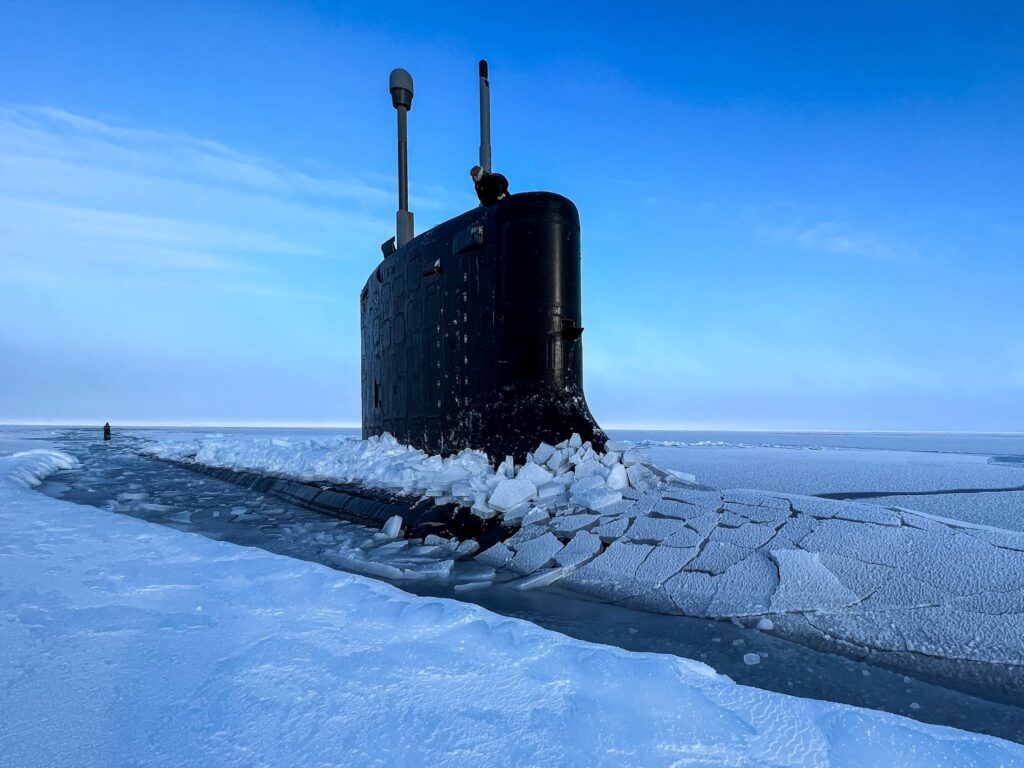
Virginia-class attack submarine USS Illinois (SSN 786) surfaces in the Beaufort Sea, kicking off Ice Exercise (ICEX) 2022. U.S. NAVY / Mike Demello

U.S. NAVY ICE CAMP QUEENFISH — Commander, Submarine Forces officially kicked off Ice Exercise 2022 in the Arctic Ocean on Friday, March 4, after the building of Ice Camp Queenfish and arrival of two U.S. Navy fast attack submarines, Submarine Force Atlantic Public Affairs said March 6. 

ICEX 2022 is a three-week exercise designed to research, test and evaluate operational capabilities in the Arctic region. 

“The Arctic region can be unforgiving and challenging like no other place on Earth,” said Rear Adm. Richard Seif, commander of the Navy’s Undersea Warfighting Development Center in Groton, Connecticut, and the ranking officer of ICEX 2022. “It’s also changing and becoming more active with maritime activity. ICEX 2022 provides the Navy an opportunity to increase capability and readiness in this unique environment, and to continue establishing best practices we can share with partners and allies who share the U.S.’s goal of a free and peaceful Arctic.” 

The Arctic is experiencing a trend of diminishing sea ice extent and thickness creating the likelihood of increased maritime activity in the region, including trans-oceanic shipping and resource extraction.

The Navy’s Arctic Submarine Laboratory, based in San Diego, serves as the lead organization for coordinating, planning and executing the exercise involving representatives from four nations and more than 200 participants over the five weeks of operations.

In addition to the U.S. Navy, Army, Air Force, Marine Corps and Coast Guard personnel who are participating in the exercise, personnel from the Royal Canadian Air Force, Royal Canadian Navy and United Kingdom Royal Navy are participating.

U.S. Marine Corps Capt. Dave Swensen is leading a team of six from the Marine Corps Mountain Warfare Center to assist in ICEX 2022. 

“Any opportunities we can get to provide our personnel access to experience in extreme cold conditions will be force multipliers to our institution and ultimately to the Marine Corps,” said Swensen, who added that five of the center’s personnel taking part in ICEX are instructors at the Bridgeport, California, cold weather center for excellence. “We will come back among the most cold weather-experienced personnel at the base.” 

A temporary ice camp is being established on a sheet of ice in the Arctic Ocean, known as an ice floe, to support testing submarine systems and other arctic research initiatives. 

The camp, named Ice Camp Queenfish, will serve as a temporary command center for conducting operations and research in the Arctic region. The camp consists of shelters, a command center, and infrastructure to safely house and support more than 60 personnel at any one time. 

“At Ice Camp Queenfish, our teams can test equipment in a very harsh and demanding environment,” said Howard Reese, director of the Arctic Submarine Laboratory. “It’s important that all the technology we’re testing can perform in all of the oceans of the world, including the Arctic. Here, we can learn what works well in the Arctic and what doesn’t work as well, and we can make changes and improvements.”

The camp gets its namesake from USS Queenfish (SSN 651), the first Sturgeon-class submarine to operate under ice and the fourth submarine to reach the North Pole when it surfaced there on Aug. 6, 1970.

Submarines have conducted under-ice operations in the Arctic regions in support of inter-fleet transit, training, cooperative allied engagements and operations for more than 60 years. USS Nautilus (SSN 571) made the first transit in 1958. USS Skate (SSN 578) was the first U.S. submarine to surface through arctic ice at the North Pole in March, 1959.

Since those events, the U.S. Submarine Force has completed 97 Ice Exercises — ICEX 2022 is the 98th — the last being conducted in 2020.


Essex ARG, 11th MEU Return from Indo-Pac Deployment 

Amphibious assault ship USS Essex (LHD 2) arrives pierside at Naval Base San Diego. Essex, a part of the Essex Amphibious Ready Group, returned to Naval Base San Diego, March 4, after a deployment to U.S. 3rd, 5th, and 7th in support of regional stability and a free and open Info-Pacific. U.S. NAVY / Mass Communication Specialist 3rd Class Melvin Fatimehin

SAN DIEGO — The Essex Amphibious Ready Group returned to port at Naval Base San Diego March 4, concluding a seven-month deployment to U.S. 3rd, 5th, and 7th Fleet areas of operation, U.S. 3rd Fleet said in a release. 

 Essex ARG is comprised of the multi-purpose amphibious assault carrier USS Essex (LHD 2), amphibious transport dock USS Portland (LPD 27), and dock landing ship USS Pearl Harbor (LSD 52) led by Amphibious Squadron (PHIBRON) 1. 

Marines with the 11th MEU, embarked aboard the ships of the ready group, arrived off the coast of Southern California March 2 to disembark to Camp Pendleton, California, with a small contingent of MEU personnel remaining aboard the ships for the pierside arrival. 

“It is a great honor to welcome the Essex ARG and the 11th MEU back to San Diego,” said Rear Adm. Wayne Baze, commander of Expeditionary Strike Group (ESG) 3. “I’m excited to have them home after a successful deployment. Their integrated operations while at sea are a testament to the Navy-Marine Corps team’s ability to face any challenge to accomplish the mission. I could not be more proud of the Sailors and Marines and am incredibly thankful for the families and friends they rejoin today who supported them.” 

The Essex ARG and 11th MEU provided numbered fleet and combatant commanders with a responsive, flexible and forward-deployed asset capable of maritime power projection, contingency operations, and crisis response. Their capabilities enabled shaping of the operational environment to protect the United States and allied interests in any threat environment. 

“Throughout the ARG-MEU’s 212-day deployment, I have been most humbled to have served alongside a highly skilled team of Sailors and Marines,” said Capt. Karrey Sanders, commander, PHIBRON 1. “Our integration as a combined blue-green team was nothing short of exceptional, and I am thankful to have not only showcased our amphibious capabilities throughout three Navy fleets together but to have created and shared countless memories that will last a lifetime.”

During deployment, Sailors and Marines supported Operation Freedom Sentinel and Operation Inherent Resolve. The ARG-MEU team also supported Large Scale Exercise 21, Exercise Indigo Defender 21, Red Sea Maritime Security Operations, Marine Exercise Philippines 22, and Noble Fusion 22. 

In U.S. 5th Fleet, from September 2021 to January 2022, the ARG-MEU team operated in the Gulf of Aden, Arabian Gulf, Red Sea, Arabian Sea, Gulf of Oman, and Indian Ocean. The team conducted theater amphibious combat rehearsals in Kuwait, sustaining their readiness and proficiency in multiple full mission profiles. During Exercise Indigo Defender, the Marines and Sailors spent two weeks with Saudi Naval Forces Western Fleet conducting bilateral training in amphibious operations, a mass casualty drill and integrated fires training to enhance proficiency and readiness while maintaining a tiered crisis response posture in the U.S. Central Command area of responsibility. 

While operating in U.S. 7th Fleet supporting U.S. Indo-Pacific Command from January to February 2022, the ARG conducted expeditionary strike force operations with the Carl Vinson Carrier Strike Group in the South China Sea. ESF operations demonstrate U.S. capability to quickly aggregate an integrated naval force to operate all-domain warfare anywhere international law allows. 


Coast Guard Cutter Midgett Returns Home from 3-Month Alaskan Patrol 

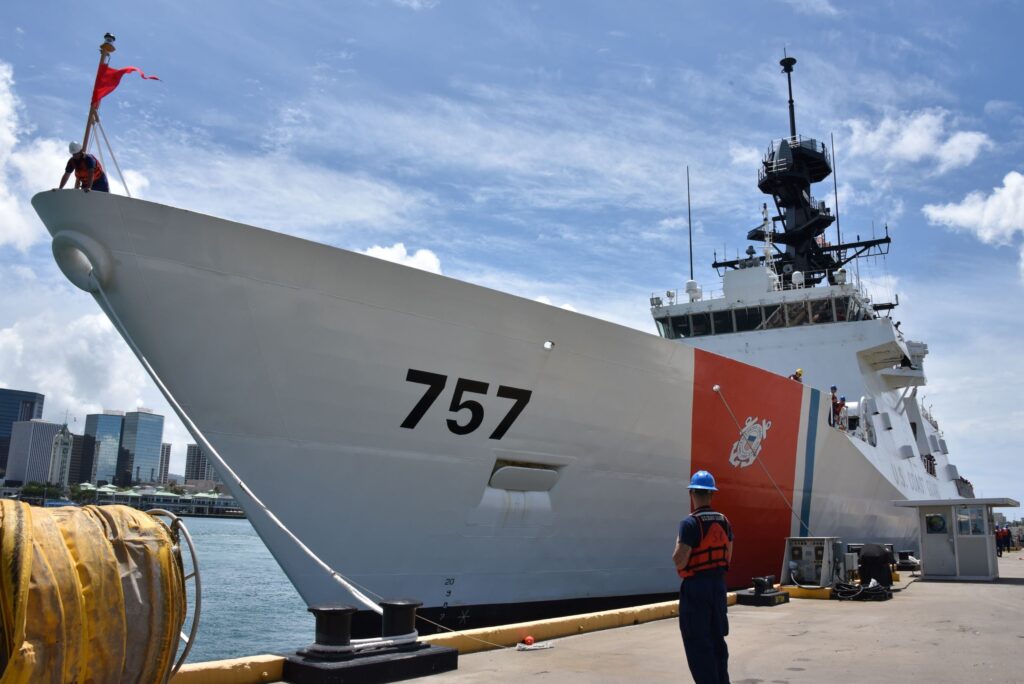
The U.S. Coast Guard Cutter Midgett (WMSL 757) moors at its new homeport at Base Honolulu Aug. 16, 2019. U.S. COAST GUARD / Chief Petty Officer Sherri Eng

KODIAK, Alaska — The crew of Coast Guard Cutter Midgett returned to homeport in Honolulu, Hawaii, Friday after a three-month long Bering Sea patrol, the Coast Guard 14th District said March 4. 

The crew of the Midgett enforced federal laws and regulations in the U.S. Exclusive Economic Zone near Alaska’s Aleutian Islands chain.

They played a strategic role in protecting the nation’s critical marine resources, enforcing fisheries and safety regulations, and were forward positioned to safeguard the U.S. commercial fishing fleet.

The crew of the Midgett also acted as a search and rescue platform while providing support to helicopter crews operating out of Dutch Harbor and Cold Bay, Alaska. This increased operational range for the aircrews and provided them with fuel for high-endurance missions.

The crew also conducted training and emergency response drills.

“Navigating Alaskan waters was extremely exciting and rewarding,” said the Midgett’s commanding officer, Capt. Willie Carmichael. “I’m proud and impressed by my crew’s service and commitment to promote safety and security in Alaskan fisheries that are so vital to the U.S. economy.” 


Marine Crew Ejects from F/A-18D Before Crash on Plantation 

An F/A-18D Hornet from Marine All-Weather Fighter Attack Squadron (VMFA) 533 conducts air operations and maritime surface warfare training with the guided-missile cruiser USS Monterey (CG 61), not pictured, in 2016. U.S. NAVY / Mass Communication Specialist 2nd Class William Jenkins

ARLINGTON, Va. — A Marine Corps F/A-18D Hornet strike fighter crashed shortly near Beaufort, South Carolina on March 3, according to the 2nd Marine Aircraft Wing. 

The two Marines in the crew ejected safely and incurred no injuries, the Wing said in a release, which said the crash occurred approximately 3:15 p.m. 

“The aircraft crashed in an unpopulated area near Marine Corps Air Station Beaufort, South Carolina, and there was no damage to civilian property,” the Wing said. 

According to television station WJCL, the Hornet crashed on the Coosaw Plantation owned by former South Carolina governor Mark Sanford. 

The Hornet, assigned to the Hawks of Marine All-Weather Fighter Attack Squadron 533 (VMFA(AW)-533), a unit of Marine Aircraft Group 31. The squadron is one of four Hornet squadrons based at MCAS Beaufort. 

The cause of the mishap will be investigated. 


The 3rd Marines Come in First, As the First Marine Littoral Regiment

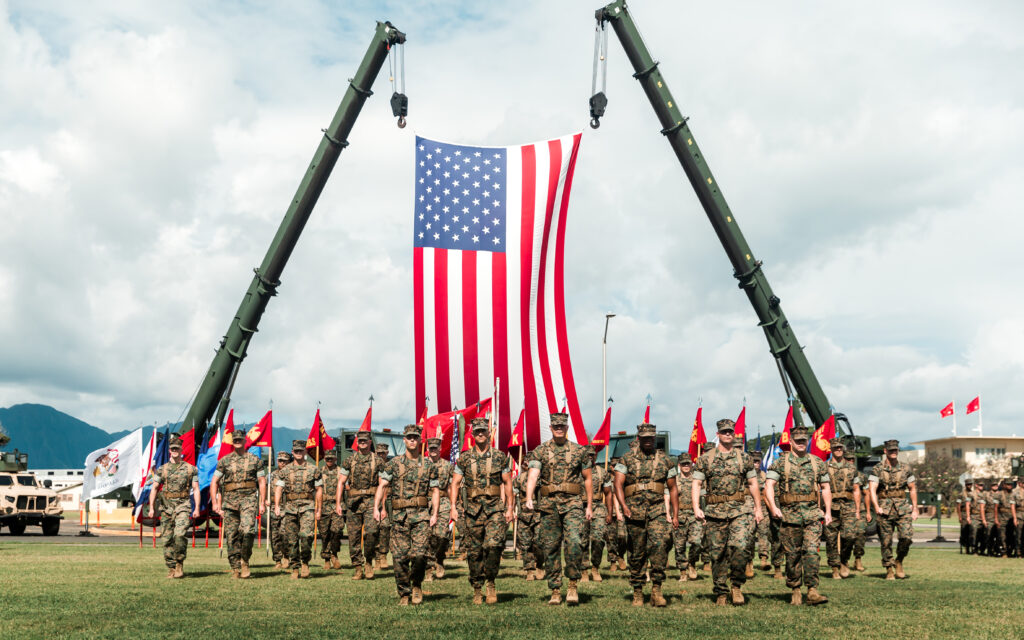
U.S. Marines with 3d Marine Littoral Regiment, 3d Marine Division march during the re-designation ceremony of 3d Marines to 3d MLR aboard Marine Corps Base Hawaii, March 3. U.S. MARINE CORPS / Cpl. Patrick King

ARLINGTON, Va. — The U.S. Marine Corps has taken another step in its ambitious force redesign to contend with near-peer militaries like China and Russia in the 21st century: Creating the first Marine Littoral Regiment.

After more than a year of planning, the 3rd Marine Regiment was redesignated the 3rd Marine Littoral Regiment in a ceremony at Marine Corps Base Hawaii, where the new regiment will continue to be headquartered.

While the 3rd MLR is not expected to be fully operationally capable for at least a year, its establishment demonstrates progress in the Marine Corps’ Force Design 2030 modernization effort, a key priority of Marine Corps Commandant David Berger’s 38th Commandant’s Planning Guidance.

“Marines on the leading edge of change is nothing new,” Maj. Gen. Jay Bargeron, commanding general of 3rd Marine Division, told attendees at the May 3 ceremony. “We are honing our capabilities to integrate and coordinate joint and combined fires and effects, extending the reach of and providing more options to our forces.”

The Marines’ evolving Expeditionary Advanced Base Operations concept envisions littoral operations by specialized mobile, low signature units within larger distributed maritime operations areas.

Marine Littoral Regiments will be uniquely designed to maneuver and persist inside a contested maritime environment. The MLR is organized, trained and equipped to support sea control and sea denial operations as part of a larger naval expeditionary force integrated with the joint force and allied and partnered forces.

Equipped with rockets, missiles and other long range fires, as well as sensors like the Ground/Air Task Oriented Radar, the MQ-9A Reaper unmanned aerial vehicle for extended range intelligence, surveillance and reconnaissance, long-range unmanned surface vessels and light amphibious warships to increase mobility in the littorals, EABO units will control access to choke points while limiting an adversary’s ability to target them.

The Marine Corps’ second in command, Assistant Commandant Gen. Eric Smith, also attended the re-designation ceremony. Before leaving Washington for Hawaii, Smith told a Feb. 28 reporters’ roundtable the Marines are “equipping, training and organizing [the MLRs] so they’re able to deploy tonight — and I mean tonight — to do what they need to do.”

The new MLR will be divided into three elements: a littoral combat team made up of a one infantry battalion equipped with a ship-killing missile battery, an anti-aircraft battalion and a combat logistics battalion. Unlike traditional Marine regiments that deployed with three large battalions, the new MLR will operate with much smaller groups, between 75 and 100 Marines, Smith said.

Plans call for two more infantry regiments, the 4th and 12th Marines to be converted to MLRs by 2030, but Smith told reporters the process could take longer than the 3rd MLR’s conversion did based on lessons learned going forward.


SCO Transfers Overlord Unmanned Surface Vessels to U.S. Navy 

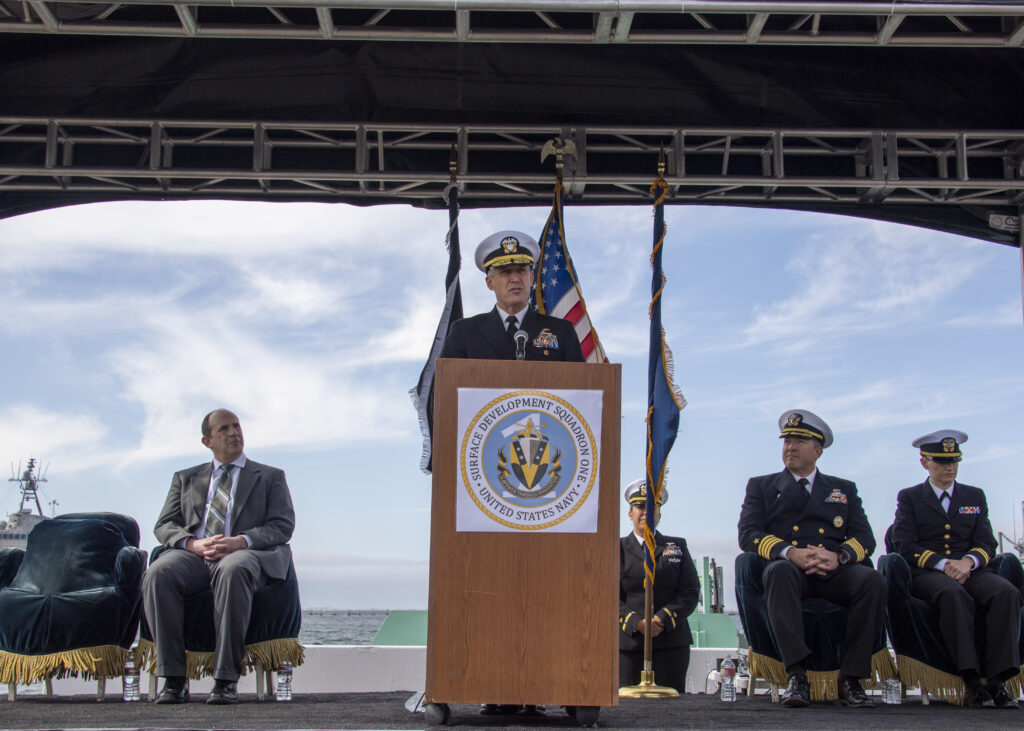
Vice Adm. Stephen Koehler, Commander, U.S. 3rd Fleet, gives remarks during the Ghost Fleet Overlord Transition Ceremony on Naval Base San Diego. U.S. NAVY / Mass Communication Specialist 2nd Class Kevin C. Leitner

SAN DIEGO — The Defense Department’s Strategic Capabilities Office officially transitioned the Ghost Fleet Overlord Program to the Navy Program Executive Office, Unmanned and Small Combatants during a ceremony at Naval Base San Diego on March 3, 2022, the PEO’s public affairs office said in a release.  

Navy Vice Adm. Stephen T. Koehler, commander, U.S. 3rd Fleet, was the keynote speaker.  

“The future of our fleet is a formidable manned and unmanned team,” said Koehler. “Where unmanned systems work in concert with, and enable enhanced capability of manned platforms; driving to an even more distributed and more lethal force.” 

SCO initiated the Ghost Fleet Overlord Program in 2018 to accelerate the Navy’s adoption of unmanned and autonomous systems.   

In partnership with the Navy, the objective of SCO’s Overlord Program was to convert large, commercially available vessels to autonomous operation. Designers installed perception and autonomy systems, automated and improved ship system reliability for extended missions and developed the command control and communications architecture. 

“The Strategic Capabilities Office partnered with the Navy, Unmanned Maritime Systems [PMS 406] specifically, from the beginning of the Ghost Fleet Overlord Program,” said Jay Dryer, director, Strategic Capabilities Office. “At transition, this enables PMS 406 and the larger team of operators, warfare centers and industry to not miss a beat, continue advancing this technology, and provide a real capability sooner. This is what SCO does best: Integrate mature technologies to accelerate service priorities and create new capabilities for the warfighter.” 

The program’s objective was achieved through long endurance transits and participation in fleet exercises. The fleet exercises demonstrated the feasibility of unmanned surface vessels. Specifically, the ability to host and employ modular payloads through a realistic set of concepts of operations.     

SCO was well positioned to mature unmanned systems using Other Transaction Authority agreements with industry-led development teams given the increasing commercial use of autonomous technology.   

SCO developed two prototype surface vessels to serve as test beds for the Navy’s Medium and Large Unmanned Surface Vessel programs of record.  

During the program, Overlord USV Prototypes 1 (Nomad) and 2 (Ranger) took part in multiple fleet level exercises and demonstrations, traveled 28,982 nautical miles in autonomous mode and tested numerous payloads.  

The advances achieved in autonomy, communications and payload integration by Nomad and Ranger are a catalyst for developing the Navy’s future USV programs of record, and in the acquisition of two additional Overlord USV prototypes for continued Navy experimentation and development.  

The SCO-led phase of this development culminates with the transfer of Nomad and Ranger to the Navy for follow-on development and fleet experimentation. The next phase will inform the Navy’s unmanned concept development and directly support the Department’s autonomy modernization priorities and Unmanned Campaign Framework.  


Navy Selects Northrop Grumman to Sustain and Modernize E-6B Mercury Aircraft 

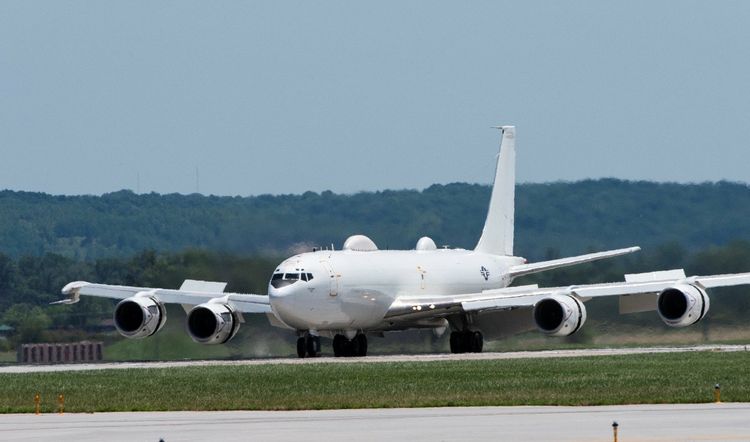
Northrop Grumman has been selected by U.S. Navy for sustainment and modernization of E-6B Mercury aircraft. U.S. AIR FORCE / Staff Sgt. Jacob Skovo

LAKE CHARLES, La. — Northrop Grumman Corp. was recently awarded the Integrated Modification and Maintenance Contract for the U.S. Navy’s E-6B Mercury aircraft, the company said March 3. The work will be performed at Northrop Grumman’s Aircraft Maintenance and Fabrication Center in Lake Charles.   

“We are laser focused on providing the most relevant capabilities while improving mission readiness,” said Mary Petryszyn, corporate vice president and president of Defense Systems at Northrop Grumman. “As leaders in aircraft sustainment and modernization, the U.S. Navy’s E-6B Mercury fleet is another example of our strong partnership with the Navy in achieving those goals.” 

Over the next five years, Northrop Grumman will perform modifications to the Navy’s E-6B aircraft improving command, control and communications functions that connect the national command authority with the United States’ Nuclear Triad. The company will establish a consolidated production line for core modifications required under the $111 million contract. Northrop Grumman may also take on additional, smaller modifications and select depot maintenance tasks as required. 

As part of the critical Take Charge and Move Out strategic communications mission, the E-6B operates across a wide frequency spectrum to transmit and receive secure and non-secure voice and data information. The aircraft provides survivable, endurable, reliable airborne command, control, and communications in support of the president, secretary of defense, and United States Strategic Command. 


CNO Gilday Honors Former CNO Adm. Thomas Hayward  

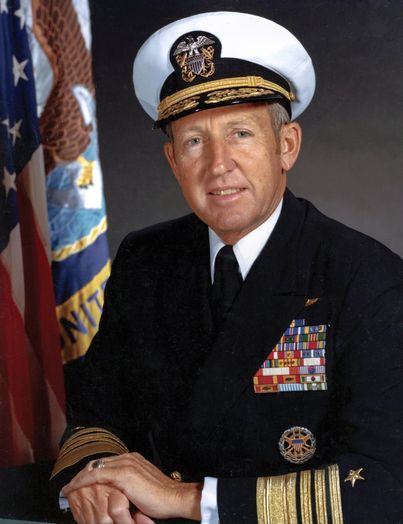
Former chief of naval operations, Adm. Thomas B. Hayward. U.S. NAVY

ARLINGTON, Va. — Former chief of naval operations Adm. Thomas B. Hayward died March 3.  

CNO Adm. Mike Gilday issued the following statement on Hayward, the 21st CNO: 

“Today, the Navy grieves alongside the family and friends of Adm. Thomas B. Hayward as we celebrate his legacy and service to our nation.  He was a Sailor, a warfighter, a man of honor and integrity, who served as the chief of naval operations from 1978 to 1982. As CNO, he expertly led the Navy during challenging times after the end of the Vietnam War and the transition to an all-volunteer force. Facing both the 1979 Iranian hostage crisis and renewed Soviet competition in the midst of the Cold War, he rebuilt the combat readiness of the Navy through significant personnel and material investments and restored ‘Pride in the Navy.’ Focused on operational superiority, he prioritized building sophisticated capabilities to support a global, offensive-minded maritime strategy. He enlisted in the Navy during World War II and as a naval aviator flew combat missions in Korea and Vietnam. We truly lost a great leader and shipmate. We are grateful for your leadership, mentorship and commitment to our Navy and nation. Fair winds and following seas, Sir.” 

Below is the biography of Hayward:  

Hayward was born in Glendale, California, on May 3, 1924, the son of Mr. and Mrs. E. Payson Hayward. A native Californian, Admiral Hayward attended Glendale Junior College and Occidental College at Los Angeles, and in 1943 was appointed a Naval Aviation Cadet in the V-5 Program of the U. S. Naval Reserve. He entered the U.S. Naval Academy in 1944 on appointment from the State of California and upon graduation was commissioned Ensign in the U. S. Navy on June 6, 1947.  

Following graduation from the U. S. Naval Academy, he served in the aircraft carrier USS Antietam until detached in September 1948 for flight training at Naval Air Station, Pensacola, Florida. Designated a Naval Aviator on July 26, 1950, he was assigned to Fighter Squadron 51. While with that squadron, he participated in combat operations in Korea, embarked in the carrier USS Essex (CV 9), and later in USS Valley Forge (CVA 45).  

In January 1954, he reported for test pilot training at the Naval Air Test Center, Patuxent River, Maryland, and upon completion of training remained there as a test pilot and project coordinator. He next attended the Aviation Safety Officers School at tile University o£ Southern California at Los Angeles, after which he served with All-Weather Fighter Squadron Three. In August 1958 he reported for instruction at the Naval War College, Newport, Rhode Island, and in December 1959, joined Fighter Squadron 211 as executive officer. In July 1961, he became administrative aide to the secretary of the Navy. He was next attached to Fighter Squadron 103 in December 1963, serving as executive officer and later as commanding officer. In July 1965, he assumed command of Attack Carrier Air Wing 10 which was deployed to the Mediterranean aboard the carrier USS Shangri-La (CVA 38), and later to Southeast Asia in the Vietnam conflict aboard the carrier USS Intrepid. (CVS 11).

From August 1966 to August 1967, he was a student at the National War College in Washington, D.C., and in 1967 he received a Master of Science degree in international affairs from George Washington University. He was next commanding officer of the USS Graffias (AF 29) operating off the coast of Vietnam. In August 1968, he reported as executive assistant and aide to the under secretary of the Navy.  

In December 1969, he assumed command of the attack carrier USS America (CVA 66), deploying to the 7th Fleet as the flagship of commander Task Force 77. Promoted to rear admiral in November 1970, he reported to Hawaii as commander, Sea Frontier and commandant of the 14th Naval District. He was assigned additional duty as commander Fleet Air, Hawaii, and commander Manned Spacecraft Recovery Forces, Pacific. He became director of the Office of Program Appraisal, Navy Department in December 1971, and on April 26, 1973, was promoted to vice admiral and reported as director, Navy Program Planning in the Office of the Chief of Naval Operations. On June 14, 1975, he assumed command of the U.S. 7th Fleet in the Western Pacific and was embarked in the guided-missile cruiser USS Oklahoma City. Promoted to the rank of admiral, he assumed duties as commander in chief, U. S. Pacific Fleet on August 12, 1976.  

Hayward became the 21st chief of naval operations on July 1, 1978 and continued in this assignment until 30 June 1982. He retired from active duty on 1 July 1982.  


Coast Guard Academy Cadets Prepare to Join the Fleet

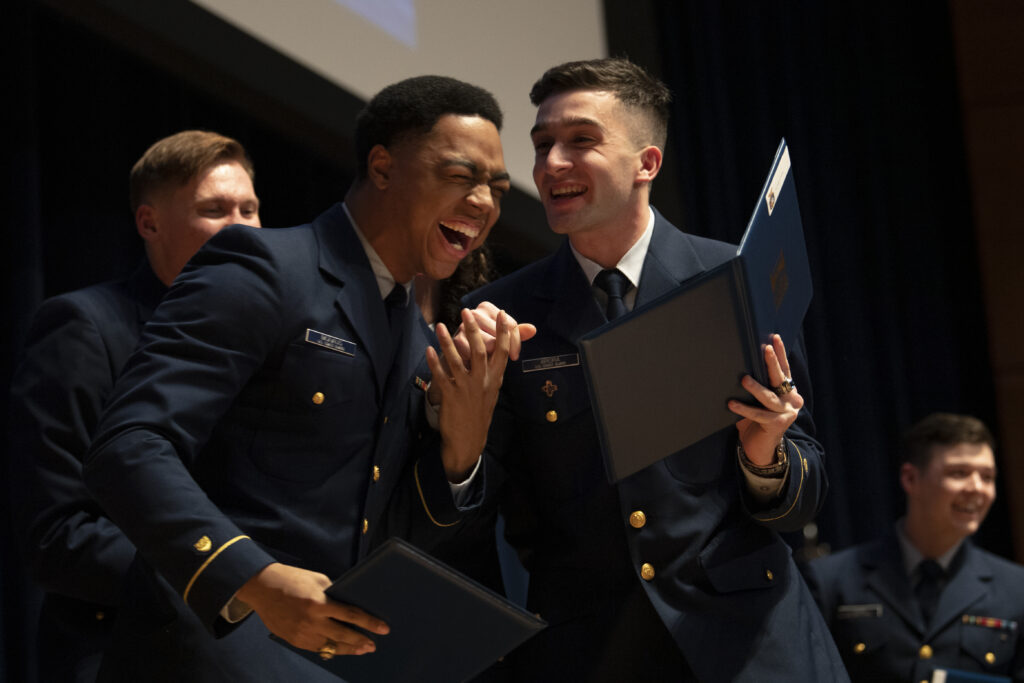
Cadets from the Class of 2022 at the U.S. Coast Guard Academy receive their first duty assignments during Billet Night, March 3, 2022. U.S. Coast Guard / Petty Officer 3rd Class Matthew Abban

NEW LONDON, Conn. ­­— Cadets from the Class of 2022 received their first duty assignments during Billet Night at the U.S. Coast Guard Academy, March 3, the Academy said.

One of the most anticipated events of the 200-week cadet program, Billet Night is a night of energy and excitement as the cadets are less than three months away from commencement when they commission as officers in the U.S. Coast Guard on May 18, 2022.

This year’s class is made up of 257 cadets, including nine international cadets. After graduation, more than 200 newly commissioned officers will report to cutters as near as Coast Guard Cutter Eagle homeported near the Academy in New London, Connecticut, to the Coast Guard Cutter Sequoia, homeported nearly 8,000 miles away in Apra Harbor, Guam.

Twenty others will report to flight school in Pensacola, Florida, to begin pilot training before reporting to Coast Guard Air Stations across the country.

Cadets will engage in a variety of Coast Guard operations at their new units upon graduation. Coast Guard units throughout the nation routinely conduct domestic missions as well as joint exercises with partner nations in which the Coast Guard assists fellow coast guards and navies to adapt or expand their maritime security capabilities.

The remaining graduates will report to various shore units, including the first graduates of the Academy’s Cyber Systems program. The newly established Cyber Systems degree provides graduates with the skills and ability to defend cyberspace, enable operations, and protect critical maritime infrastructure.

The Coast Guard protects America’s vast Maritime Transportation System as a ready, relevant, and responsive force engaging in defense operations, maritime law enforcement, search and rescue, marine safety, and environmental protection operations.

“Every day our graduates are leading vital missions across the globe,” said Rear Adm. Bill Kelly, Coast Guard Academy superintendent. “I’m excited that the members of the class of 2022 will soon take their places in the Coast Guard fleet and join our service’s efforts to address the nation’s complex maritime challenges.”

Founded in 1876, the Coast Guard Academy is one of the five U.S. service academies that emphasizes leadership, physical fitness and professional development leading to a guaranteed job upon graduation as a commissioned officer in the U.S. Coast Guard.


Rear Adm. Todd Assigned Chief of Navy Chaplains

Secretary of Defense Lloyd J. Austin III announced today the president has made the following nomination:

Navy Rear Adm. (lower half) Gregory N. Todd for appointment to the grade of rear admiral, with assignment as the chief of chaplains of the Navy, Washington, D.C. Todd is currently serving as chaplain of the Marine Corps and deputy chief of chaplains of the Navy, Office of the Chief of Naval Operations, Washington, D.C.