CNO Visits Philadelphia Navy Commands; Emphasizes Importance of Columbia-class Submarines  

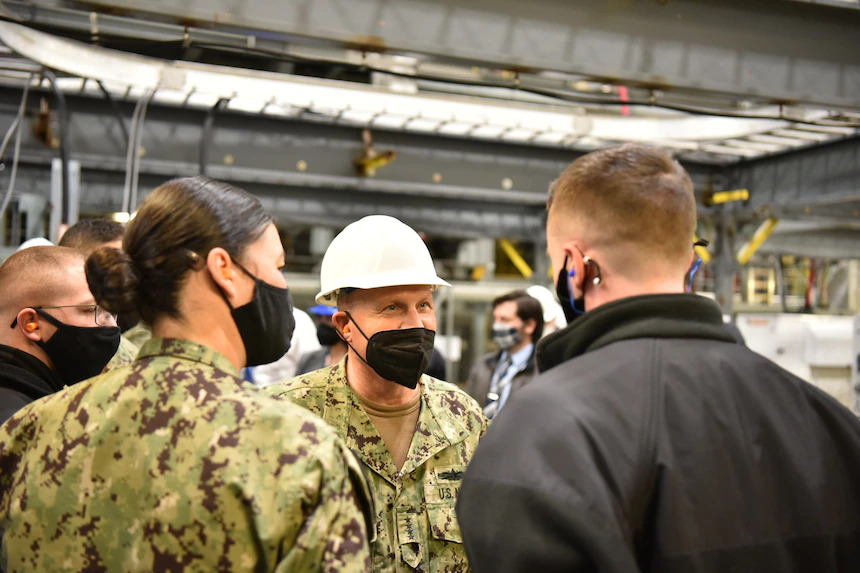
Chief of Naval Operations Adm. Mike Gilday speaks with Sailors assigned to the future USS Lenah H.S. Higbee (DDG 123) at Naval Surface Warfare Center, Philadelphia Division, Feb. 3. U.S. NAVY / Lt. Rachel Maul

PHILADELPHIA — Chief of Naval Operations (CNO) Adm. Mike Gilday and Rear Adm. Douglas Perry, director, undersea warfare division, visited Philadelphia-based Navy commands, Feb. 3, the CNO’s public affairs office said in a release. 

Together, they visited the Naval Foundry and Propeller Center and Naval Surface Warfare Command Center, Philadelphia Division, where Gilday toured the facilities, spoke with Sailors and Navy civilians, and received updates about Columbia-class submarine construction. 

“The impressive cadre of engineers here who are delivering world-class results are a national treasure,” said Gilday. “The work you are doing here is vital to national security, as well of that of our Allies and partners.” 

Columbia-class submarines are the Navy’s number one acquisition priority, Gilday added. 

“These submarines need to be delivered on time, on budget and ready for the fight — and that’s what we intend to do,” Gilday said. “Working together, we will get them off of the production line and into the fleet where they belong.” 

The Columbia-class submarine is the nation’s future sea-based strategic deterrent and will provide the most survivable leg of the Nation’s strategic triad. It replaces the currently serving Ohio-class submarines and must be constructed and delivered beginning in fiscal year 2028 to meet U.S. Strategic Command requirements. These ballistic missile submarines serve as an undetectable launch platform for submarine-launched ballistic missiles and are designed specifically for stealth and the precise delivery of nuclear warheads. 

Gilday toured the Naval Sea Systems Command Compatibility Test Facility where he saw the shipboard-representative Columbia Integrated Propulsion System prototypes in operation and the Arleigh Burke-class Land-Based Engineering Site. He also received updates about the developing electrical and propulsion test facility risk-reduction capabilities for newer classes of ships, including the next-generation destroyer (DDG(X)), Constellation-class frigates, and unmanned surface vehicles. 

“Fielding greater numbers of more affordable, smaller surface combatants, like the new Constellation-class frigates, allows us to operate in a more distributed manner — both in day-to-day competition and in high-end combat,” said Gilday. “Because of the work of our systems commands and our partnerships with industry, we will continue to successfully compete and win.” 

Throughout the visit Gilday expressed his gratitude for the innovation and dedication Sailors and civilians have shown to keep these manufacturing and testing efforts on track, especially amidst the pandemic. 

“To the entire workforce here, you directly support and generate warfighting readiness and have my profound thanks,” said Gilday. “Your hard work and commitment to the Fleet is appreciated, and what you are doing is critical for us to be able to protect our Nation.” 

The visit marked Gilday’s first trip to Philadelphia since he assumed his duties as CNO. 

NSWCPD’s mission is to provide research, development, test and evaluation, acquisition support, engineering, systems integration, in-service engineering and fleet support with cyber-security, comprehensive logistics and life-cycle savings through commonality for surface and undersea vehicle machinery, ship systems, equipment and material and to execute other responsibilities. 


Rear Adm. Okano: Modern Sensors Making Navy Ships ‘Data-Providing Monsters’ 

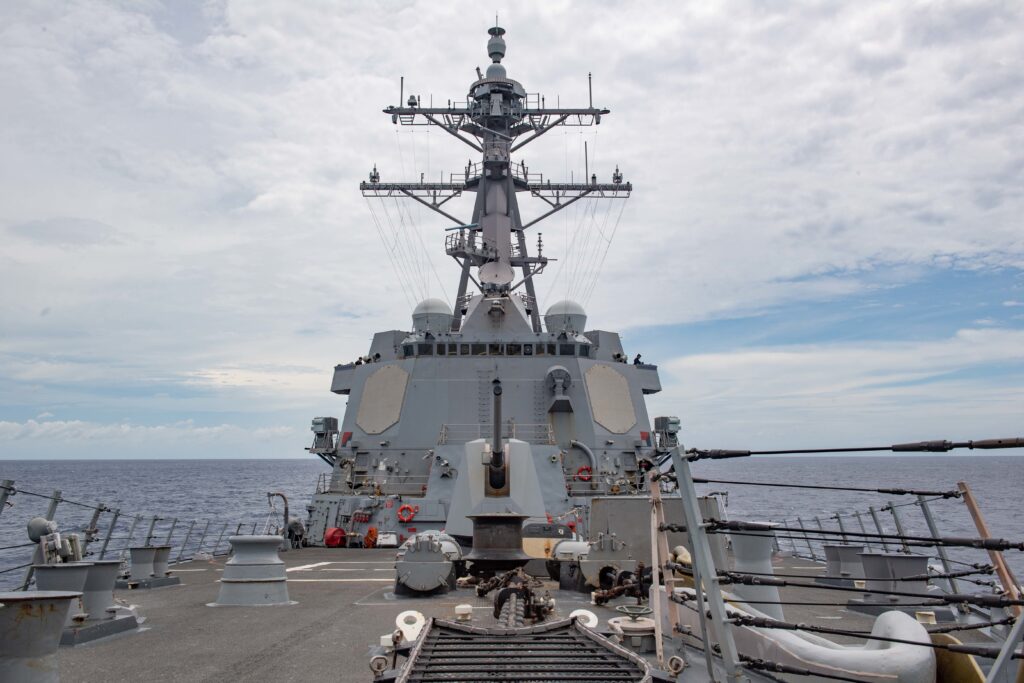
Arleigh Burke-class guided-missile destroyer USS Pinckney (DDG 91) transits the South China Sea in July 2021. Surface Electronic Warfare Improvement Program Block 3 is being installed on Pinckney, giving it an electronic attack capability. U.S. NAVY / Mass Communication Specialist 2nd Class Jeffery L. Southerland

ARLINGTON, Va. — Sensors on naval platforms are becoming multi-purpose — some even weapons — and are making the U.S. Navy’s surface ships the most data-rich platforms in the Department of Defense as their sensors become part of an analog-to-digital transformation, a senior Navy program executive said.  

Noting the amount of data that comes from modern surface-ship sensors, Rear Adm. Seiko Okano, program executive officer – Integrated Warfare Systems, speaking Feb. 3 during the Combat Systems Symposium conducted by the American Society of Naval Engineers, said the amount “is absolutely incredible. … Our surface ships are the most data-rich platforms ever. … We are data-providing monsters.” 

She noted that each array face of the SPY-6 radar for the Flight III Arleigh Burke guided-missile destroyer (DDG) is producing terabytes per minute of data. 

“We’re right now not digesting that to its full capacity,” she said. “We’re doing with that what we did 40 years ago, … which is why we’ve got to invest in digitizing our fleet and the power of AI/ML [artificial intelligence/machine learning]. There’s so much capability we’ve got to unleash from those sensors alone. 

“We’ve shifted to this digital era,” Okano said. “Where before, your hardware and software were really tightly coupled … now it is all software-programmable. And that’s the world we’re living with SEWIP [Surface Electronic Warfare Improvement Program], Aegis, SPY-6 and our sensors right now, which allows us to change and adapt a lot faster than we ever had before.” 

Okano pointed to examples of radars such as the SPS-48 and SPS-49 search radars as single-purpose sensors. The trend now, she said, is “we’re going multi-mission. These sensors are no longer just used for air search or surface search. 

“Are we really unleashing the power of what we are putting on board ships?” she asked. “Our infrastructure isn’t one that really we can manipulate that sensor to do whatever we want. We’re already behind the power curve.”  

The admiral noted new sensors “are absolutely fantastic and they are only getting more powerful.” 

She noted SEWIP Block 3 [SLQ-32(V)7] is being installed on the Arleigh Burke-class DDG USS Pinckney. This SEWIP block has an electronic attack capability.  

“Sensors [are] becoming weapon systems,” Okano said. “You’re both sensing and you’ve got a capability to react as well. [That] is the world we’re getting into.” 


First MQ-4C Triton with Multi-Intelligence Upgrade Delivered to the Navy 

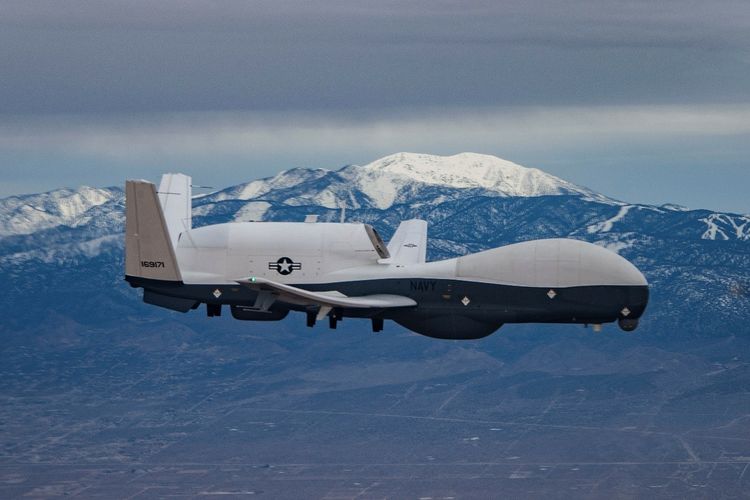
A Northrop Grumman Corp. MQ-4C Triton takes to the skies over the California desert as the Triton low-rate initial production schedule progresses. Known as B8, this is the first production Triton to be upgraded to the multi-intelligence configuration to meet the Navy’s critical maritime intelligence, surveillance, reconnaissance and targeting needs. B8 was delivered to Naval Air Station Patuxent River, Maryland, on Feb. 1.

ARLINGTON, Va. — The first production MQ-4C Triton unmanned aerial vehicle to be upgraded to the multi-intelligence configuration was delivered to the U.S. Navy at Naval Air Station Patuxent River, Maryland, on Feb. 1, Northrop Grumman said in a release. 

The MQ-4C’s new configuration Integrated Functional Capability Four is designed to bring an enhanced multi-mission sensor capability as part of the Navy’s Maritime Intelligence, Surveillance, Reconnaissance and Targeting transition plan.  

The Triton, designated B8 by the manufacturer, Northrop Grumman, went through a 30-month modification period to the new configuration.  

The two MQ-4Cs currently deployed to Guam for the U.S. 7th Fleet’s Task Force 72 by Unmanned Patrol Squadron 19 (VUP-19) as part of the early operational capability deployment are in the baseline IFC-3 configuration.  

The Triton in the IFC-4 configuration is designed to complement the Navy’s P-8A Poseidon maritime patrol aircraft and eventually will enable the Navy to retire its EP-3E Orion electronic reconnaissance aircraft. The initial operational capability for the Triton will be declared in 2023 when IFC-4-configured Tritons are deployed in one complete orbit. The Navy plans to deploy Triton to five orbits worldwide. 


Air-to-Air Missiles Program Office Names Italy as Partner 

The Air-to-Air Missiles Program Office has acquired Italy as its 28th Air Intercept Missile 9X international partner. LOCKHEED MARTIN

PATUXENT RIVER, Md. — The Air-to-Air Missiles Program Office (PMA-259) acquired Italy as its 28th Air Intercept Missile (AIM)-9X international partner Dec. 17, 2021, said Katie Ursitti, a spokesman for the Naval Air Systems Command. 

The Italian Embassy in Washington D.C. notified the Navy International Programs Office that the Italian air force accepted and signed the letter of offer and acceptance provided by the U.S. government. 

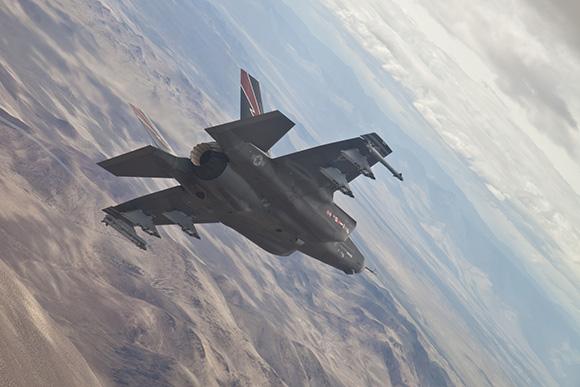
Italian air force officials signed the letter Nov. 19., and shortly after representatives from PMA-259 and Raytheon Missiles & Defense presented the AIM-9X Block II/II+ Classified Capabilities Briefing to Italian headquarters air force staff and F-35 Lightning II pilots. 

This LOA consists of a modest quantity of AIM-9X Block II/II+ missiles to complement Italy’s F-35 fleet. This procurement will be part of the U. S. Navy’s Lot 23 production contract, which will award in 2023 and deliver missiles in 2026. 

Additionally, the Italian navy, which also operates the fifth-generation fighter aircraft, has been provided with a separate letter of offer and acceptance for Lot 23 AIM-9X Block II/II+ missiles, and is expected to accept it soon. Italy will receive AIM-9X missiles that will employ the true fifth-generation Block II/II+ capabilities of lock-on-after-launch, data link and surface attack. 


Philippines Acquires BrahMos Supersonic Anti-Ship Missiles

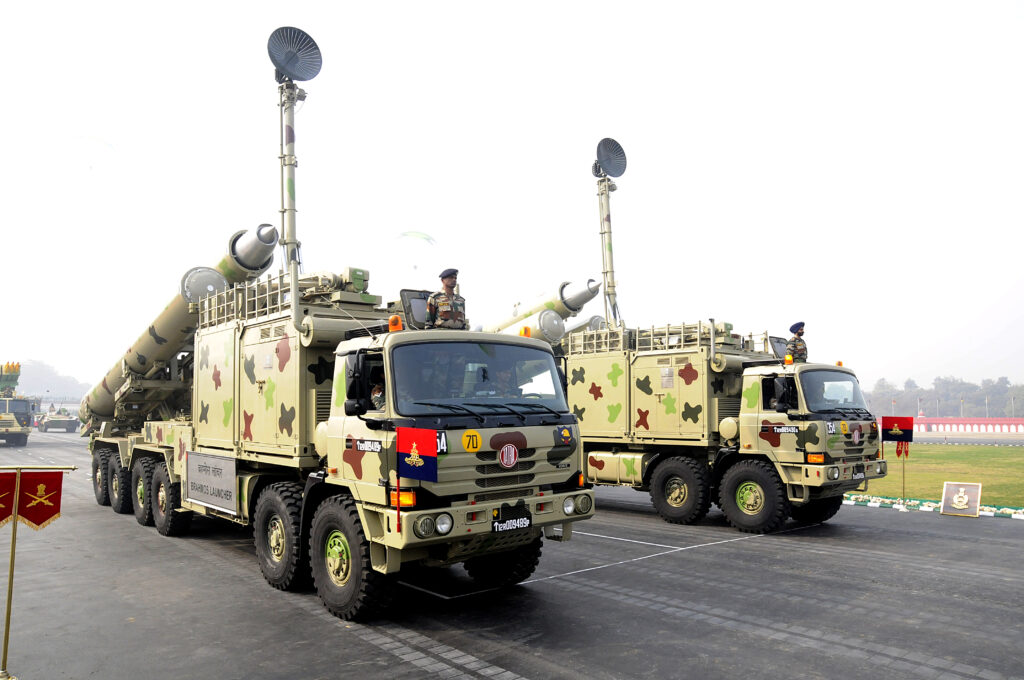
Indian army BrahMos missiles mounted on mobile autonomous launchers. WIKIPEDIA

The Philippines Department of National Defense has contracted for BrahMos shore-based anti-ship missile system. The $368 million contract is for three batteries, as well as launcher vehicles, command and control, training and support.

“Equipping our navy with this vital asset is imperative as the Philippines continues to protect the integrity of its territory and defend its national interests. As the world’s fastest supersonic cruise missiles, the BrahMos missiles will provide deterrence against any attempt to undermine our sovereignty and sovereign rights, especially in the West Philippine Sea,” said Defense Secretary Delfin N. Lorenzana.

The BrahMos uses either an active radar homing system or satellite targeting to deliver its 440-pound warhead. The missile travels at Mach 4 and can reach targets up to 180 miles away. The cruise missile can be used against fixed land targets as well as ships at sea.

The Philippines have been alarmed by Chinese claims to large portions of the South China Sea, including Philippine islands. India, as well, has been engaged in hostilities with China at the border in Ladakh. Both nations are modernizing their militaries, and China is a major motivation.

The BrahMos program began in 1998. BrahMos is a joint Russian-Indian project, and comes in land-based and ship-mounted versions. The weapon is operational with India’s navy and army. India has been seeking export customers for Brahmos for some time. The Philippines deal is the first.

The BrahMos anti-ship batteries will be operated by the Philippines marines. Additional BrahMos systems for precision strike land attack missions are being sought for the army artillery regiment.

The installed radar with the launcher system has limited range, nowhere near the range of the weapon. The system is best employed as part of an integrated with a intelligence, surveillance reconnaissance engagement network, which can include land, sea and space-based sensors, something the Philippines need to develop.


Vice Adm. Hill: MDA Pushes Space-Based Sensor for Tracking Hypersonic Missiles for Fleet Defense 

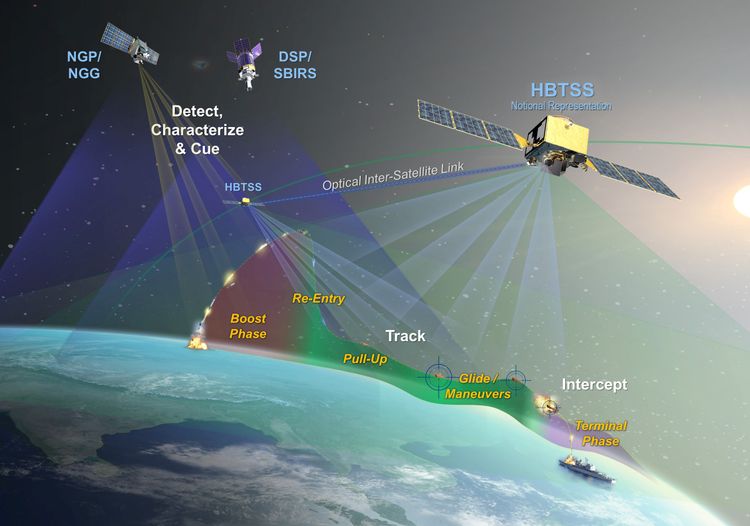
A graphic illustrates how Hypersonic and Ballistic Tracking Space Sensor satellites would provide continuous tracking and handoff to enable targeting of enemy missiles launched from land, sea or air. NORTHROP GRUMMAN

ARLINGTON, Va. — With hypersonic missiles emerging as a serious threat to U.S. Navy ships, the Missile Defense Agency is focused on the use of a space-based sensor for hypersonic regional defense to provide tracking of both hypersonic and ballistic missiles all the way to hand off to the terminal phase.  

The MDA has been designated the Defense Department’s executive agent for defense against hypersonic missiles. 

“It’s going to maneuver and come in at a high velocity,” said Vice Adm. Jon Hill, speaking Feb. 2 during the Combat Systems Symposium conducted by the American Society of Naval Engineers, noting the challenge of defeating hypersonic missiles. 

Hill said that tracking of a hypersonic missile in flight will be the job of the Hypersonic and Ballistic Tracking Space Sensor, a satellite with sensors to detect and track hypersonic missiles. Defense against the missiles in the terminal phase would be the job of the ship-based Aegis Combat System and Standard surface-to-air missiles. 

Hill said of hypersonic missiles that with existing sensors “we’re seeing them, we’re capturing data, we’re collecting on them, though noting that the U.S. sensors are “not always in the exact right place, because many of them are land-based and stationary because sensors are purpose built for a particular part of the battlespace. 

“We have that and the SM-6 missile with its nascent capability to take on a hypersonic [missile],” he said. “We didn’t call it that back when we got the letter from the CNO [chief of naval operations] to go develop this program. But the whole idea was to handle high-speed maneuver. [The SM-6] is really the nation’s only hypersonic defense capability.” 

“We can do warning today on hypersonics, so we’re not at zero,” he said. 

“We’re going to take those first hypersonic tracking space-based sensors in coordination with the U.S. Space Force and we’re going to get them on in orbit,” he said. “That’s through a competitive process and we’re really excited about that. We did so much risk-reduction on the ground we’re absolutely confident that those sensors are going to deliver what we need when we put them up.” 

The admiral said terminal defense is necessary but not sufficient to defeat hypersonic missiles. 

“We’re going to leverage space cueing and fire control from space because, to handle maneuvers across the globe, you’ve got to look down” he said. “Field of view is limited from radars and we’re running out of islands to put radars on. 

Under the concept, the HBTSS would detect a missile’s launch and the separation of the first and second stages of the rocket motors. The satellite’s data is continuously relayed and is used to create a track of the hypersonic glide vehicle. The remote track data passed via satellite to an Aegis ship to compute an intercept with a glide-phase interceptor.  


Official: Navy Interested in Moving Away from Towed Sensors for USVs 

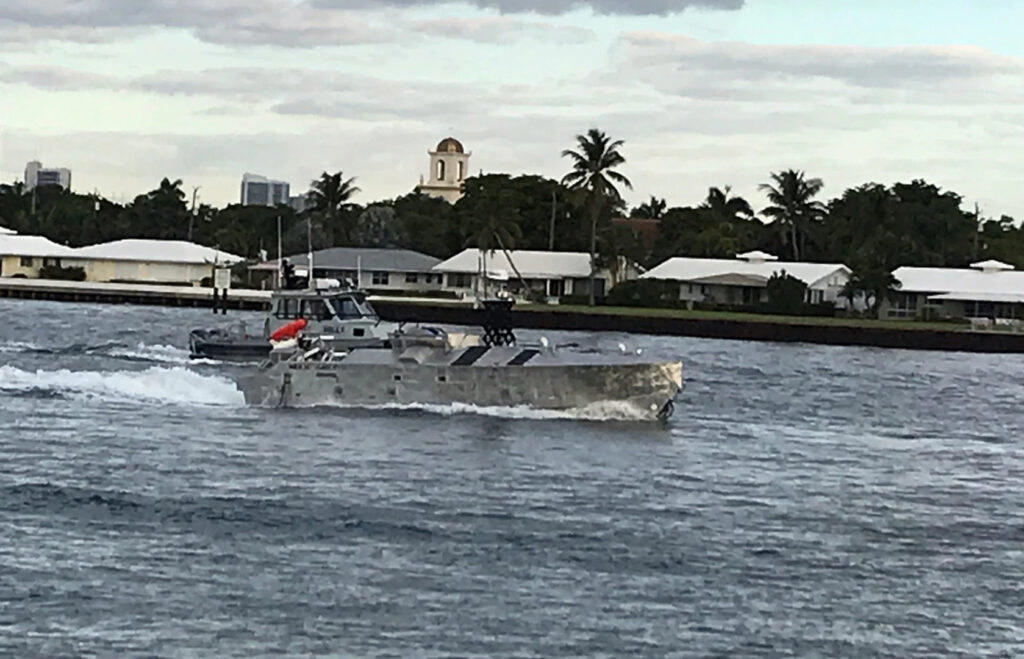
The Mine Countermeasures USV heads out for an operational assessment in this November 2019 photo. U.S. NAVY

ARLINGTON, Va. — The use of towed sensors provides a measure of survivability for small unmanned surface vessels but presents other problems such that the Navy is looking to move away from towed sensors in favor of onboard sensors, a Navy official said. 

The Navy is soon to award a production award for the Textron-built Mine Countermeasures USV, equipped with the Unmanned Influence Sweep System, a towed sensor, said George Saroch, director for unmanned surface vessels at Naval Sea Systems Command, speaking Feb. 1 during a panel discussion at the Technology, Systems and Ships Symposium conducted by the American Society of Naval Engineers. 

In 2017, Saroch said, the Navy recognized the versatility of the MCM USV and decided to build the boat to handle various payloads, which soon would include the AQS-20 mine-hunting towed sonar and eventually the Barracuda mine-neutralization munition. He sees these as building blocks to a single-sortie detect-to-engage mine countermeasures system. 

“So, fundamentally, it’s focused on building a boat, and then we have separate contracts for the payloads,” he said. 

The UISS has been through operational testing and shock testing, he said. The MCM USV with the mine-hunting AQS-20C system will be going through developmental and operational test this spring and summer.  

Saroch stressed the importance of automatic target recognition as necessary to avoid the expenditure of neutralization charges on objects other than mines. 

However, Saroch said the Navy is “very interested in getting away from towing things. You can snag a lot of things when you tow systems, a lesson from the [MH-53E MCM helicopter] community” which often snags objects while towing MCM systems through the water. 

“We’re learning that lesson over again about snagging things,” he said, noting that the Navy is trying to move sensors back aboard the boat, “which brings some other operational capabilities.” 


Meier: Ford CVN to Range Widely in the Atlantic for U.S. 2nd Fleet 

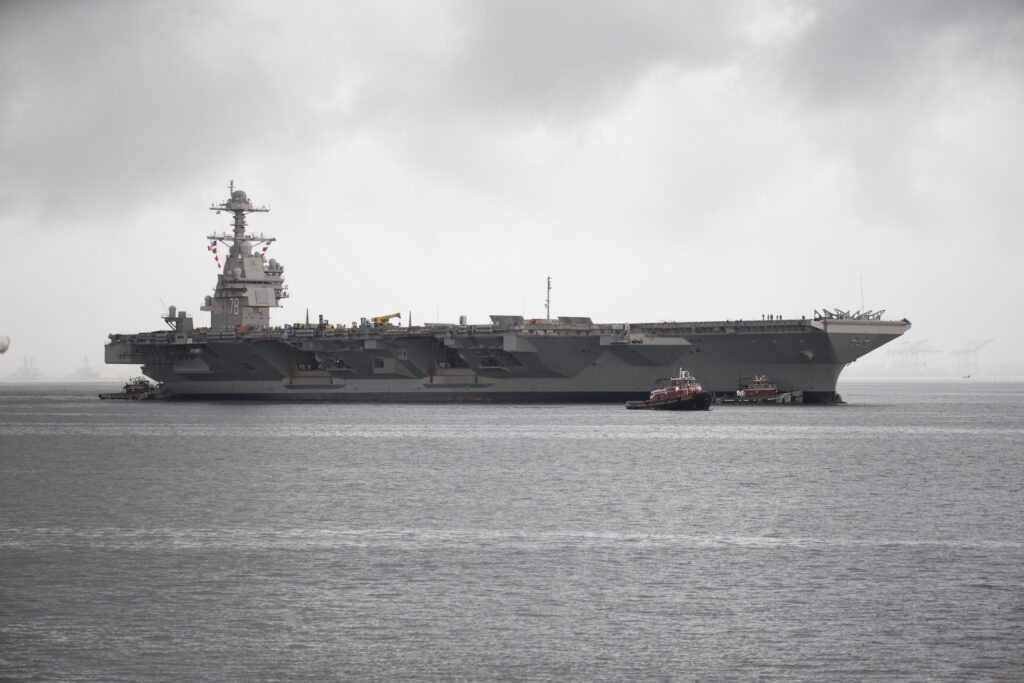
The aircraft carrier USS Gerald R. Ford (CVN 78) departed Naval Station Norfolk to transit to Newport News Shipyard in support of its planned incremental availability, a six-month period of modernization, maintenance, and repairs, Aug. 20, 2021. U.S. NAVY / Mass Communication Specialist 1st Class William Spears

ARLINGTON, Va. — The Navy’s newest aircraft carrier, the USS Gerald R. Ford (CVN 78), will operate all over the North Atlantic this year when it completes its current shipyard availability, a Navy admiral said, and will operate under the auspices of the U.S. 2nd Fleet. 

“Ford is doing amazingly well, coming out of the shipyard her for initial employment,” said Rear Adm. John F. Meier, commander, Naval Air Force Atlantic, speaking Feb. 1 during a panel discussion at the Technology, Systems and Ships Symposium conducted by the American Society of Naval Engineers. 

“I think it’s a great opportunity for us to demonstrate the new technology,” Meier said. “We’re going to do that as a service-retained employment, so not part of the normal global force deployment schedule, but we will be working with partners, we’ll be working all over the place as 2nd Fleet takes charge of that carrier and operates with a wide variety of operations up and down the coast, across the Atlantic [and] down in the Caribbean.” 

Meier said the Ford’s upcoming operations would be “a really great opportunity to show off that aircraft carriers are in fact extremely maneuverable, upwards of 700 [nautical] miles a day. And robust — most especially robust when you think about the refueled range of the aircraft that fly from them.”  

The Ford currently is in a planned incremental availability at Newport News Shipbuilding. All 11 weapon elevators have been certified as of December. Since it began flight operations, it has completed 8,100 catapult launches and the same number of arrested landings, said Rear Adm. Jim Downey, program executive officer for aircraft carriers, also speaking at the event. 


Future USS Fort Lauderdale Completes Acceptance Trials 

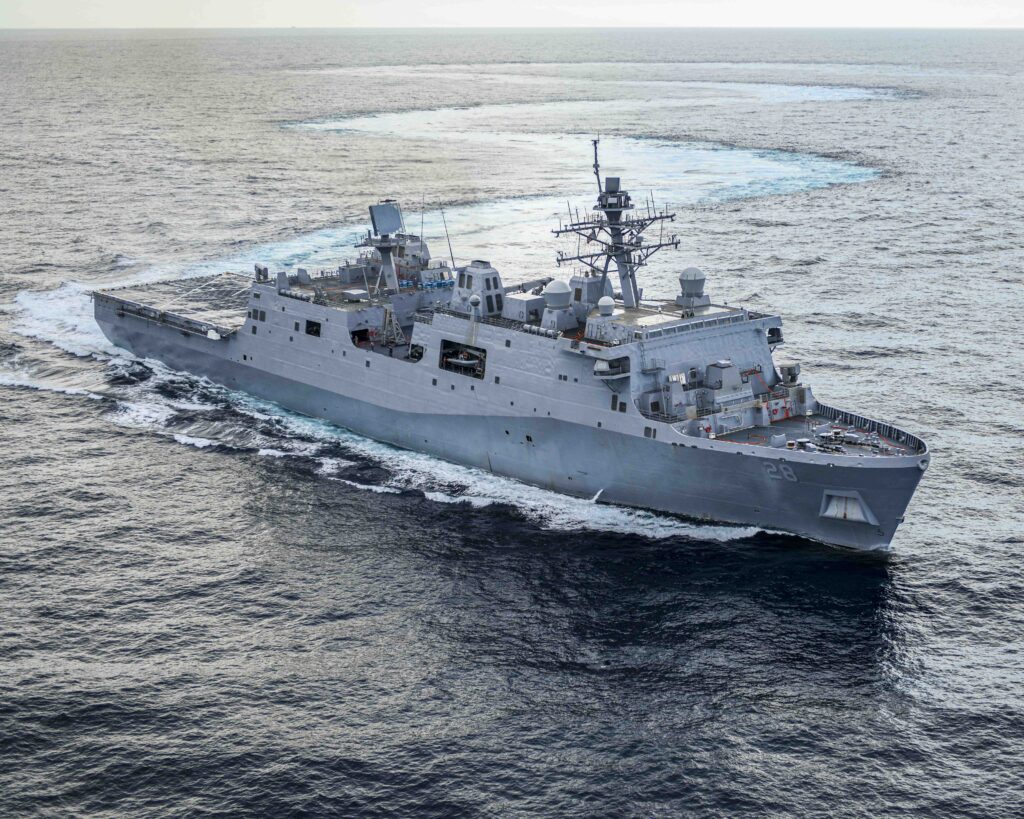
The San Antonio-class amphibious transport dock Fort Lauderdale (LPD 28), which has completed acceptance trials. HUNTINGTON INGALLS INDUSTRIES

WASHINGTON — The future USS Fort Lauderdale (LPD 28), the Navy’s 12th San Antonio class-amphibious transport dock ship, completed acceptance trials Jan. 31, Team Ships Public Affairs said in a release. 

Acceptance trials consist of integrated testing to demonstrate the capability of the platform and installed systems across all mission areas to effectively meet its requirements. These demonstrations are used to validate the quality of construction and compliance with Navy specifications and requirements prior to delivering the craft to the Navy. LPD 28 will now prepare for delivery in a few weeks. 

“With the completion of both builder’s and acceptance trials, we are confident that LPD 28 has proven the operational readiness of the vessel and the capabilities it will soon bring to the fleet,” said Capt. Cedric McNeal, program manager, Amphibious Warfare Program Office, Program Executive Office Ships. “The collaboration between the Navy and our industry partners ensures that we’ll have a capable and ready ship for our Sailors.” 

The San Antonio-class is designed to support embarking, transporting, and landing Marines and their equipment by conventional or air-cushioned landing craft. The ship’s capabilities are further enhanced by its flight deck and hangar, enabling the ship to operate a variety of Marine Corps helicopters and the Osprey tilt-rotor aircraft. Because of the ships inherent capabilities, they are able to support a variety of amphibious assault, special operations, expeditionary warfare, or disaster relief missions, operating independently or as part of amphibious ready groups, expeditionary strike groups, or joint task forces. 

In addition to LPD 28, Huntington Ingalls Industries’ Ingalls Shipbuilding Division is currently in production of the future USS Richard S. McCool (LPD 29) and the future USS Harrisburg (LPD 30), with LPD 31 planned for start of fabrication later this spring. LPD 28 and 29 will serve as transition ships to LPD 30 – the first LPD 17 Flight II ship. 

LPD 28 and LPD 29 will incorporate design innovations and cost-reduction strategies based upon lessons learned and improved technologies.  The ships will have a more traditional mast in place of the two Advanced Enclosed Mast/Sensors and an updated deckhouse and boat valley design. 


SECDEF Announces Flag Officer Nominations 

ARLINGTON, Va. — The Secretary of the Navy and Chief of Naval Operations announced Feb. 1 the following nominations for appointment to the rank of rear admiral lower half:

Capt. Brian H. Bennett for appointment to the rank of rear admiral (lower half). Bennett is currently serving as executive officer to commander, U.S. Special Operations Command, Tampa, Florida.  

Capt. George E. Bresnihan for appointment to the rank of rear admiral (lower half). Bresnihan is currently serving as chief of staff, Naval Supply Systems Command, Mechanicsburg, Pennsylvania.   

Capt. Matthew Case for appointment to the rank of rear admiral (lower half). Case is currently serving as executive assistant to the surgeon general of the Navy, Washington, D.C.   

Capt. Carey H. Cash for appointment to the rank of rear admiral (lower half). Cash is currently serving as commanding officer, Naval Chaplaincy School and Center, Newport Rhode Island.  

Capt. Maximilian Clark for appointment to the rank of rear admiral (lower half). Clark is currently serving as executive assistant, N98, Office of the Chief of Naval Operations, Washington, D.C.   

Capt. Adan G. Cruz for appointment to the rank of rear admiral (lower half). Cruz is currently serving as deputy, Combat Systems and Integration, N96, Office of the Chief of Naval Operations, Washington, D.C.  

Capt. John E. Dougherty IV for appointment to the rank of rear admiral (lower half). Dougherty is currently serving as major program manager, Program Executive Office for Tactical Aircraft Programs (PMA 230), Patuxent River, Maryland.   

Capt. Kavon Hakimzadeh for appointment to the rank of rear admiral (lower half). Hakimzadeh is currently serving as programs and policy director, Aircraft Carrier Branch Head, N980C, Office of the Chief of Naval Operations, Washington, D.C.   

Capt. Keith A. Hash for appointment to the rank of rear admiral (lower half). Hash is currently serving as program manager for Air Warfare, PMA-298, Naval Air Systems Command, Patuxent River, Maryland.   

Capt. Tracy L. Hines for appointment to the rank of rear admiral (lower half). Hines is currently serving as executive assistant to the chief of naval operations, Office of the Chief of Naval Operations, Washington, D.C. 

Capt. Stephen J. Jackson for appointment to the rank of rear admiral (lower half). Jackson is currently serving as programs and policy director, Expeditionary Combat Branch Head, N957, Office of the Chief of Naval Operations, Washington, D.C. 

Capt. Kevin M. Kennedy for appointment to the rank of rear admiral (lower half). Kennedy is currently serving as director, Surface Warfare Officer Distribution and Career Management Division (PERS 41), Millington, Tennessee.  

Capt. Jeffrey J. Kilian for appointment to the rank of rear admiral (lower half). Kilian is currently serving as chief of staff, Naval Facilities Engineering Systems Command, Washington, D.C. 

Capt. Brett W. Mietus for appointment to the rank of rear admiral (lower half). Mietus is currently serving as the director of the Chief of Naval Operations Strategic Integration Group, Office of the Chief of Naval Operations, Washington, D.C. 

Capt. Thomas P. Moninger for appointment to the rank of rear admiral (lower half). Moninger is currently serving as executive officer to commander, U.S. Southern Command, Miami, Florida. 

Capt. Martin J. Muckian for appointment to the rank of rear admiral (lower half). Muckian is currently serving as chief of staff to commander, U.S. Submarine Forces, U.S. Pacific Fleet; and chief of staff, U.S. Strategic Command Special Activities Pacific, Pearl Harbor, Hawaii.    

Capt. Gregory D. Newkirk for appointment to the rank of rear admiral (lower half). Newkirk is currently serving as executive assistant to commander, U.S. Indo-Pacific Command, Camp H. M. Smith, Hawaii. 

Capt. Matthew C. Paradise for appointment to the rank of rear admiral (lower half). Paradise is currently serving chief of staff, Naval Air Forces, U.S. Pacific Fleet, San Diego, California.   

Capt. Chase D. Patrick for appointment to the rank of rear admiral (lower half). Patrick is currently serving as director, Navy Senate Liaison Office, Office of Legislative Affairs, Washington, D.C. 

Capt. Ryan M. Perry for appointment to the rank of rear admiral (lower half). Perry is currently serving as force public affairs officer, Naval Special Warfare Command, San Diego, California.  

Capt. Bradley N. Rosen for appointment to the rank of rear admiral (lower half). Rosen is currently serving as chief of staff, Navy Installations Command, Washington, D.C. 

Capt. Jonathan E. Rucker for appointment to the rank of rear admiral (lower half). Rucker is currently serving as program manager, COLUMBIA, Washington, D.C. 

Capt. Christopher D. Stone for appointment to the rank of rear admiral (lower half). Stone is currently serving as executive assistant to the vice chief of naval operations, Office of the Chief of Naval Operations, Washington, D.C. 

Capt. Nicholas R. Tilbrook for appointment to the rank of rear admiral (lower half). Tilbrook is currently serving as executive assistant to deputy chief of naval operations for integration of capabilities and resources, N8, Office of the Chief of Naval Operations, Washington, D.C. 

Capt. Guido F. Valdes for appointment to the rank of rear admiral (lower half). Valdes is currently serving as deputy commander, Naval Medical Forces Atlantic, Portsmouth, Virginia.  

Capt. Alexis T. Walker for appointment to the rank of rear admiral (lower half). Walker is currently serving as commanding officer, Surface Warfare Officer School Command, Newport, Rhode Island.   

Capt. David P. Walt for appointment to the rank of rear admiral (lower half). Walt is currently serving as comptroller, Assistant Secretary of the Navy (Financial Management and Comptroller), Washington, D.C. 

Capt. Robert E. Wirth for appointment to the rank of rear admiral (lower half). Wirth is currently serving as director, Submarine/Nuclear Officer Distribution (PERS 42), Navy Personnel Command, Millington, Tennessee.   

Capt. Michael S. Wosje for appointment to the rank of rear admiral (lower half). Wosje is currently serving as executive assistant to deputy chief of naval operations for warfighting requirements and capabilities, N9, Office of the Chief of Naval Operations, Washington, D.C. 

Capt. Douglas L. Williams for appointment to the rank of rear admiral (lower half). Williams is currently serving as technical director for Strategic Systems Program, Washington, D.C. 

The board selected these officers to ensure the Navy has the right senior officers to employ, generate, and design the fleet for combat operations, recognizing that the continued preeminence of the Navy is inextricably linked to its ability to successfully change. To do so, the Navy needs innovative and bold leaders who think creatively and critically are their own toughest critic, challenge assumptions and take well-calculated risks that maximize effectiveness.

The board looked for officers with sustained, superior performance in O5 and O6 command who demonstrated key attributes such as: taking ownership while working collaboratively, looking at new ideas with an open mind, generating a culture of continuous learning, and showing absolute readiness to unleash the power of its people in leading men and women coming from widely varying backgrounds.