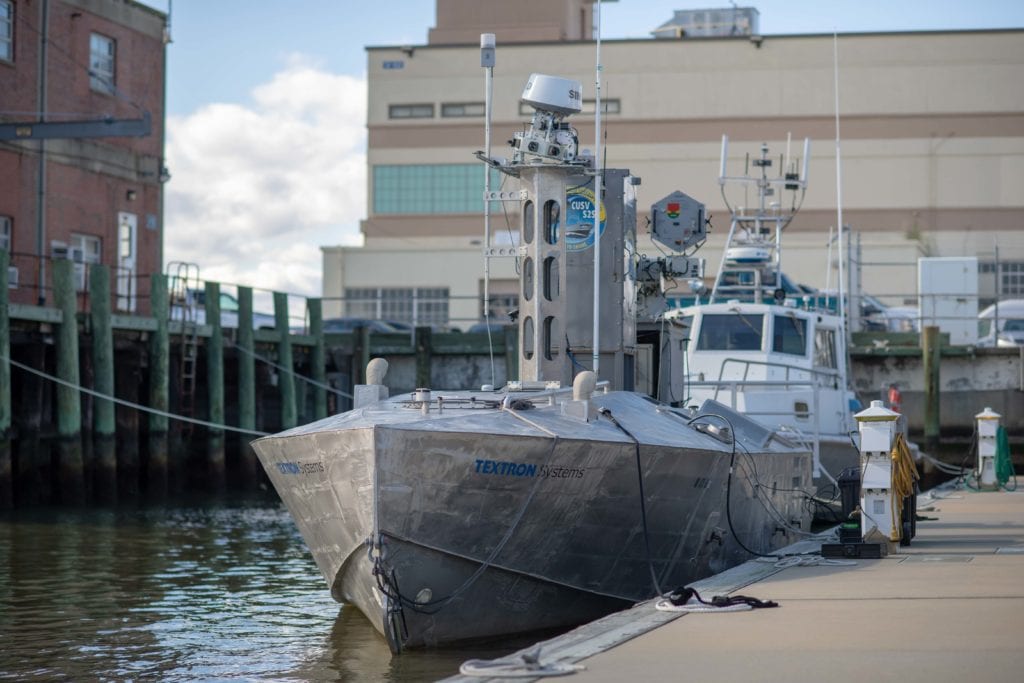
A developmental, early variant of the Common Unmanned Surface Vehicle (CUSV) autonomously conducts maneuvers on the Elizabeth River during its demonstration during Citadel Shield-Solid Curtain 2020 at Naval Station Norfolk. U.S. NAVY / Mass Communication Specialist 2nd Class Grant G. Grady
NATIONAL HARBOR, Md. — The Navy has wrapped up initial operational test and evaluation (IOT&E) for the Unmanned Influence Sweep System (UISS) and expects the platform to be ready for fielding by the end of this summer, according to an official.
Capt. Godfrey Weekes, program manager for Littoral Combat Ship mission modules (PMS-420), said Tuesday at the Navy League’s Sea-Air-Space expo in National Harbor, Maryland, that initial operational capability (IOC) for the platform is the fourth quarter of fiscal 2021, which ends Sept. 30, 2021.
The UISS platform is designed for the LCS’s mine countermeasures mission package (MCM). It “consists of a mine countermeasures unmanned surface vehicle (USV) and a towed minesweeping payload for influence sweeping of magnetic, acoustic and magnetic/acoustic combination mine types,” according to a Navy statement.
The UISS’s Minehunt USV is currently in contractor verification testing. Low-rate initial production of that platform should begin sometime in late fiscal 2022, Weekes said.
The MCM mission package itself is scheduled to achieve IOC in the fourth quarter of fiscal 2022.
IBM Leverages Hybrid Clouds and AI to Enable New Technology
Ray Spicer, shown here in IBM’s space in the Maryland pre-function lobby, says the company is focusing on hybrid cloud computing and AI. NAVY LEAGUE
IBM is leveraging hybrid cloud computing and AI — what it calls augmented intelligence — to create new technology systems, such as its Mayflower unmanned surface vehicle, capable of making its own decisions while far from port.
Ray Spicer, a retired U.S. Navy rear admiral who is now vice president of defense and intelligence at IBM, says “hybrid cloud and AI is where the company is really focused these days, very heavily.”
Rather than concentrating data into one large cloud, IBM is able to work with various types of clouds, whether they are personal or public, small or massive.
“Having all those clouds being able to uplink together is the way to go,” Spicer said.
A hybrid cloud scenario allows the company to “containerize” apps that can pluck the data they need from a cloud where it resides, which “allows you to move the workloads to the data” rather than the other way around.
An example is the computing system Watson, which famously won on “Jeopardy!” in 2011. It has only gotten smarter since then and has been broken into component segments aimed at different markets, from financial operations to customer service to health care.
This sort of flexibility contributed to Mayflower, which leveraged technology from other industries. For example, software aimed at enabling rapid fraud detection can also be used to help Mayflower make rapid decisions on the high seas.
This sort of AI is helpful for things like collision regulations, or colregs, the rules of the sea, Spicer said. Sailors forget them from time to time and have to be retrained, but “you teach AI one time, and it doesn’t forget.”
Transition Connection Brings Together Job Seekers and Industry Wanting Workers
Navy Lt. j.g. Sarena Padilla and Eric Padilla participate in Transition Connection, a first-time hiring event that debuted at Sea-Air-Space 2021. SOLARES PHOTOGRAPHY
NATIONAL HARBOR, Md. — In the three years that Navy Lt. j.g. Sarena Padilla and Eric Padilla have been married, they’ve lived in four different states. Sarena has changed her career from a nuclear officer to a meteorology and oceanography research officer, which necessitated the moves. But now that she’s ensconced at the U.S. National Ice Center in Suitland, Maryland, the couple is looking to settle down. And that means a more permanent job for Eric.
Eric, who has a physics and engineering background, took advantage of Sea-Air-Space’s inaugural Transition Connection hiring event on Tuesday. Military members, spouses and civilians had the opportunity to interact with more than a dozen companies, and were also able to upload their resumes and virtually chat with potential employers through the Transition Connection page on the Sea-Air-Space website.
“I’ve had contract jobs during our marriage, but it’s been hard to find opportunities to further my career,” said Eric, who’s interested in space-oriented work. “It’s been great to be able to talk to potential employers about my career intentions.”
Employers said there has been plenty of interest in their companies. Gianna Lamanna of Manassas, Virginia-based Hepburn and Sons said her company, which does advisory work for the maritime industry, received about 150 resumes through the Transition Connection portal prior to the hiring event. She and her Bill Lewis colleague conducted back-to-back job interviews throughout the day.
“We really appreciate the opportunity to meet with so many people,” Lamanna said. “To have a [show like Sea-Air-Space] with a connected hiring event is unique.”
Lamanna estimated that about 75% of the people who sent her resumes are either planning or thinking about transitioning out of the military to civilian life.
Navy Lt. Cmdr. Collin Fox is one of those potential transitioners. Fox, who has served for 17 years, most recently in the Navy Foreign Area, comes from a military family. Both his father and grandfather served, and Fox is certainly open to continuing his career after he hits the 20-year mark. But Transition Connection gave him opportunity to evaluate civilian career options as well.
“I do a lot of writing, so I’m interested in jobs that involve analysis and concept development,” he said.
At the Amazon booth, one of the recruiters had firsthand experience in moving from military to civilian life. Madeleine Caballero served in the Army for two and a half years before retiring for medical reasons.
“I understand how hard the transition can be,” she said. “I had someone tell me today how anxious they are.”
Amazon is committed to hiring 100,000 military veterans and spouses by 2024, Caballero said. The company currently employs more than 43,000 veterans and spouses in areas such as operations, human resources, safety, onsite medical facilities and Amazon Web Services.
Not all of the job seekers at Transition Connection were military, however. Faisal Munshi, who works in marine engineering, moved to the United States from India four months ago. He found the Transition Connection event on LinkedIn and decided to attend with his wife, Afroz Indorewla, a health information management student at Northern Virginia Community College.
“This is the first job fair I’ve been to since I moved to the U.S.,” Munshi said. “I’ve found many opportunities in my industry.”
After 3 Explosive Events of its Shock Trial, USS Gerald R. Ford Will be on Track for Operational Tasking in 2022, NAVSEA Says
USS Gerald R. Ford (CVN 78) successfully completed the second of three scheduled explosive events for full ship shock trials (FSST), July 16, 2021. U.S. NAVY / Mass Communications Specialist Seaman Jackson Adkins
NATIONAL HARBOR, Md. — With a third and final Explosive Event of a Full Ship Shock Trial (FSST) to go, and after an analysis and repairs if needed, the U.S. Navy’s newest aircraft carrier, USS Gerald R. Ford (CVN 78), will be ready for operational tasking by 2022, according to a Program Executive Office – Carriers official.
Upon completion of the last Explosive Event later this summer, Ford will enter a planned incremental availability for six months of modernization, maintenance and repairs prior to its operational use.
The Ford, the first of a new super carrier class, currently cannot accommodate the Navy’s carrier-based F-35C Lightning II joint strike fighter without upgrades. The Navy plans to complete the upgrades for the F-35C before the carrier is scheduled to operate with the aircraft.
Last year, the Navy announced F-35C modifications to the future USS John F. Kennedy (CVN 79), the second Ford-class carrier, under a contract employing a single-phase acquisition strategy, instead of the originally planned two-phase strategy.
The Navy previously planned to build CVN 79 in two phases, putting the ship’s combat systems in “at the last minute to avoid obsolescence,” said Kevin Cormier, deputy program manager, PEO Aircraft Carriers told an exposition floor briefing at the Navy League’s Sea-Air-Space Expo in National Harbor, Maryland, Aug. 3.
After considering the combat systems’ delivery schedule, however, “the Navy made a decision that it was more prudent” to deliver a whole ship in 2024, Cormier said. “Right now, we are on track for 2024 delivery with the new Enterprise Air Surveillance Radar (EASR) and new Joint Strike Fighter models.”
Cormier said the next Ford-class carrier, CVN 80, is about 10% complete with keel laying expected in February 2022. CVN 80, slated to be the future USS Enterprise, is part of a two-ship one buy Cormier said saved taxpayers $4 billion. The next Ford carrier, CVN 81, is “tracking for a 2032 delivery,” he said.
FRCs Gets Hornets Back in Action Quickly, Now Turning Attention to Other Aircraft
An F/A-18 Hornet assigned to the Gladiators of Strike Fighter Attack Squadron (VFA) 106 prepares to launch from the flight deck of the aircraft carrier USS Theodore Roosevelt (CVN 71) in this 2014 photo. U.S. NAVY
NATIONAL HARBOR, Md. – Intense and extended efforts by the command of naval aviation’s Fleet Readiness Centers have cut the time to get F/A-18 Hornet fighters out of maintenance and back to the flight line by half.
Those efforts are now are being used to do the same with other Navy aircraft, and to reduce the cost of those updates and maintenance, officials at the command said Aug. 3.
The series of reforms to accelerate the turn-around of aircraft were driven by the chronic shortfall of tactical planes, particularly fighter jets, a decade ago. The program also stemmed from the revised National Defense Strategy, which turned the military’s focus to the return of great power competition due to rising threats from China and Russia, Rear Adm. Joseph Hornbuckle, Fleet Readiness Centers commander, told a Navy League Sea-Air-Space 2021 briefing.
The initial effort was focused on the F/A-18, the key to the carrier air wings’ strike capabilities. By applying industry best practices, largely copied from the airlines, FRCs were able to cut the typical 120 to 150 day average turnaround time in half, said Roy Harris, the command’s executive director.
The command established an operations center that looked at all elements of FRC’s operations and prioritized allocation of resources, Harris said. A key element of the reforms was setting targets for the centers to meet important milestones in the repair and maintenance process and pushing the centers to meet those goals, Hornbuckle said.
One of its early achievements was meeting the chief of naval operations’ goal of putting 341 mission-capable Hornets on the flight line. The effort then turned to the EF-18G Growler electronic warfare aircraft and now is extending to other Navy aircraft, including E-2C Hawkeyes and H-60 helicopters.
The reform efforts now are focusing not only on producing “mission-capable aircraft quicker, but also at the lowest possible cost,” Hornbuckle said.
FRC operates nine readiness centers and 25 other tenant sites and employs nearly 22,000 individuals, Navy, civilians and contractors, Hornbuckle said. It annually works on 300 aircraft and 150,000 aviation components.
As with most naval systems, a major problem for FRC is fighting corrosion, which “can eat our lunch,” Harris said. They are working to collect data on the problem to find the most effective and efficient solutions.
Coast Guard Sees Many Uses for Unmanned Systems in the Arctic Environment
Coast Guard Cutter Healy deckhands prepare to lower an unmanned underwater vehicle, operated by the Woods Hole Oceanographic Institute, into the Beaufort Sea during a simulated spilled oil response and recovery exercise, Sept. 10, 2013. WHOI scientists used the UUV to monitor ice conditions from below during the simulated exercise. U.S. COAST GUARD / Petty Officer 3rd Class Grant DeVuyst
NATIONAL HARBOR, Md. — First sought to extend the reach of Coast Guard cutters in the Pacific Ocean, the service is exploring the use of unmanned aerial, surface, and undersea systems in the harsh and distant environs of the Arctic.
“Numerous types of platforms could be extremely valuable in the Arctic,” U.S. Coast Guard Capt. Thom Remmers told a, exposition floor briefing Aug. 2 at the Navy League’s Sea-Air-Space expo in National Harbor, Maryland.
Remmers, the Unmanned Cross-Functional team lead for the Coast Guard’s Directorate for Capabilities (CG-7), said underwater vehicles could “very easily and capably look for environmental spills.”
The Coast Guard partnered with Woods Hole Oceanographic Institution in Massachusetts to operate a 250-lb. long-range autonomous underwater vehicle (LRAUV), Polaris, developed by the institute for just purpose, he said. “It demonstrated a search for oil spills under the ice in the Arctic,” he added.
Remmers said the Coast Guard has also deployed unmanned aerial vehicles on some icebreakers, like the Coast Guard Cutter Healy, “primarily by tactical commanders to look for ice floes,” he added.
“Those types of needs are not unique to the Arctic,” Remmers said, “but they’re much more valuable when you start looking at access in that region.” Unmanned systems could also provide “a long-range persistent MDA [maritime domain awareness] type of capability that we need up there,” he said.
Emerging Capabilities Like Unmanned and AI Can Aid Cyber Threat
Capt. Jeff Morganthaler, Maritime Operations Center director at the Navy Expeditionary Combat Command, speaks at The Future of Naval Expeditionary Warfare in All-Domain Operations panel. NAVY LEAGUE / Lisa Nipp
NATIONAL HARBOR, Md. — The challenge for naval expeditionary forces in the emerging threat environment is how to integrate all the elements operating in a distributed role when they may not be able to control the communications domain, a panel of experts said Tuesday. All the challenges of mobility, survivability and combat effectiveness in distributed expeditionary operations are aggravated by the threat of cyberspace interference, the panel told a Navy League Sea-Air-Space forum.
“We’ve been talking about distributed ops for a long time,” but doing that in a large geographic area “introduces serious challenges to our architecture on how we knit that together, particularly in a distributed environment where we may not control the spectrum. … We may not control the cyberspace environment,” said Gregory Breazile, a retired Marine colonel, now CEO of Breazile Cyber & C4I Solutions. “We want to dominate, but we have to work through that competitive space,” and it becomes more complicated, Breazile said.
But industry is working to bring capabilities, including artificial intelligence, that can help overcome those challenges, Breazile said. The good news, he said, “is that AI is making it able to bring things together. … All these AI capabilities are there.”
Navy Capt. Jeff Morganthaler, Maritime Operations Center director at the Navy Expeditionary Combat Command (NECC), and Col. David Odom, director Expeditionary Warfare on the Navy staff, also cited the emerging capabilities, including artificial intelligence and unmanned systems, that can ensure the integrated, multi-domain operations they are working to achieve.
Morganthaler listed the ability to supply integrated information and communications systems among the capabilities that NECC brings to the integrated expeditionary operations. In talking about assured command and control, “I’m confident of what we have today.” But for the future, “I don’t need it bigger. I need it smaller and more capable.” He described a proposed communications and intelligence system that could be flown in on a MV-22 Osprey and mounted on an unmanned vehicle.
Among the other advances the expeditionary forces need, Odom mentioned bringing the fifth-generation F-35 capabilities to the big-deck amphibious ships, the less expensive but capable LPD Flight II amphibs and the proposed light amphibious ships. The challenge for the smaller amphibs, he said, is to make them “affordable, so we can get as many as possible. We are working with industry to bring what we need.”
Navy’s Triton UAV’s IFC-4 Sensors, Systems ‘Performing Better Than Expected’
A MQ-4C Triton taxis at Andersen Air Force Base. U.S. AIR FORCE / Senior Airman Michael S. Murphy
National Harbor, Md. — The mission systems on the first MQ-4C Triton unmanned aerial vehicle (UAV) equipped with a signals intelligence capability functioned well on the first test flight, a Navy official said.
The first MQ-4C equipped with Integrated Functional Capability-Four (IFC-4) made its first flight on July 29, mainly to test the aerodynamic characteristics of the new configuration. The test team, while evaluating such aspects as stability and control, also checked out the performance of the mission systems and sensors. The IFC Triton featured more antennas than the baseline IFC version.
“The sensors and systems are performing better than expected,” said Capt. Dan Mackin, the Navy’s Persistent Maritime Unmanned Aircraft Systems program manager, speaking Aug. 3 at the Navy League’s Sea-Air-Space expo at National Harbor, Maryland.
The IFC-4 hardware and software configuration introduces a signals intelligence capability to the Triton. It will enable the Triton to become an integral part of the Navy’s Maritime Intelligence, Surveillance, Reconnaissance and Targeting (MISR&T) transition plan. As such, it will eventually replace the Navy’s EP-3E Orion electronic reconnaissance aircraft beginning in the fall of 2023 when the first full orbit is established. The IFC-4 upgrade also includes the Minotaur mission system now used on the EP-3E.
Mackin said the Navy expects to introduce artificial intelligence and machine learning capabilities during later upgrades. Other upgrades planned for 2025 include Wideband Tactical Targeting Network Technology, enhanced radar identification modes, protected satellite communications. M-Code and counter-electronic attack.
Upgrades planned for 2027-2028 include enhancements to enable the Triton to perform without access to the GPS and satellite communications. These include command from afloat units, more robust navigation and communications, increased power, among others.
Mackin said that when the IFC-4 configuration joins the fleet, the mission control centers will be modified with special compartmented intelligence facilities for protection of intelligence and its sources and methods.
The Royal Australian Air Force (RAAF) is partnered with the U.S. Navy on the Triton program and has accelerated its acquisition of three MQ-4Cs to keep the production line going during the U.S. gap in production, said Doug Shaffer, Northrop Grumman’s’ Triton program manager.
Mackin said the RAAF Tritons will be in the IFC-4 configuration and will be identical to those of the U.S. Navy.
Diversity Helps Foster Warfighting Readiness, Panelists Say
Marine Corps Brig. Gen. A.T. Williamson, right, says the service is modernizing how it manages and recruits talent. NAVY LEAGUE / Lisa Nipp
Less than 30% of youth today are available for military service, said Michelle Godfrey, senior advisor for diversity and inclusion, U.S. Coast Guard. As the nation becomes more diverse, one of the keys to attracting and retaining that scarce talent is to foster equity and inclusion efforts, said Godfrey and other panelists during the Aug. 3 session on Inclusion and Diversity as a Force Multiplier.
“The data backs it up — the more diverse team you have, the higher your performance,” Godfrey said.
In the Navy, diversity, equity and inclusion (DEI) efforts help foster warfighting readiness, said Vice Adm. John Nowell Jr., deputy chief of naval operations for manpower, personnel, training and education and chief of naval personnel.
“If you want to outfight the enemy, you have to outthink them, and the way you do that is by leveraging diverse and inclusive leadership,” he said.
Nowell said the Navy is currently implementing 56 recommendations from a DEI task force. For instance, recruiters now look at applicants’ whole personality rather than just quantifiable measures like SATs. Navy leader trainer development is taking DEI into account and is looking at bias in terms of decision science. Navy classrooms are also using a bias mitigation tool. The key, Nowell said, is to use data analytics while still being able to rely on intuition as well.
The Marine Corps is modernizing its manpower system, including talent management, said
Brig. Gen. A.T. Williamson, director, Manpower Plans & Policy Division, U.S. Marine Corps. Along with ethnic inclusivity, diversity of thought, experience and background also helps build a cohort of inclusive teams, he said.
The Marine Corps is currently working on and vetting a DEI framework, Williamson said. It’s also conducting a survey to see if there’s bias within the personnel evaluation system, and asking questions about inclusion during exit surveys.
The Coast Guard has a DEI action plan with 36 distinct actions, Godfrey said. The organization has completed a women’s retention study and expects a study to be published this month on recruitment and retention of underrepresented minorities. In April, the Coast Guard deployed a virtual mentoring program that helps foster DEI efforts. Close to 1,000 people have signed up for the program’s mentoring app, she said.
The Coast Guard also offers tools on how to have DEI conversations, Godfrey said. It’s trained more than 100 diversity and inclusion change agents, who offer coaching for various DEI situations. Performance appraisals also include diversity and inclusion competency.
The Department of the Navy has exceeded its social and economic DEI goals for the past six years, said Jimmy Smith, director, Office of Small Business Programs, Department of the Navy. During the last fiscal year, it spent $17.3 billion on small businesses that were in diverse socioeconomic categories, he said. It’s also working with historically black colleges and universities on recruitment efforts.
“We’re fighting to attract talent,” Smith said. “We’re spending money in places we haven’t before.”
In terms of equity, only some companies can perform jobs like shipbuilding, Smith pointed out. But the Department of the Navy is committed to doing a better job of enforcing how those companies are distributing funding to their subcontractors.
“We need to change our bias from always going to certain places to get certain things done,” he said. “We need to create more competition. At the end of the day, it’s all about fairness.”
All of the speakers emphasized that DEI efforts encompass more than just race, religion, age and sexuality. They also include factors like inclusivity of education and viewpoints, and diversity of thought and problem-solving.
Smith believes DEI initiatives should be deeply personal as well. “Being a father of three girls, there are things women in our workforce go through today that I never want to see my girls ever have to go through,” he said.
US Facing ‘Pearl Harbor Moment’ From Cyber Attacks, Vice Adm. Trussler Says
Vice Adm. Jeffrey Trussler says cyber attacks are something that now threaten every American. NAVY LEAGUE / Lisa Nipp
NATIONAL HARBOR, Md. — Vice Adm. Jeffrey Trussler, deputy chief of naval operations for information warfare and director of naval intelligence, said cybersecurity threats to the United States are such that “frankly, where we sit today in 2021, we ought to be having one of those Pearl Harbor moments without the Pearl Harbor.”
Trussler spoke on a panel at Sea-Air-Space 2021 panel on “Cyber Today’s Fight, Tomorrows Capabilities,” along with Rear Adm. Michael Ryan, commander of U.S. Coast Guard Cyber Command, Karen Van Dyke, director for positioning, navigation, and timing and spectrum management at the Department of Transportation, and Ryan Roberts, senior manager of cyber and strategic risk at Deloitte.
Trussler said cyber attacks — such as the one that disabled the Colonial Pipeline, affecting the flow of oil along the East Coast and Southeast — shows that the threat is no longer just about defense and security, but “you could be impacted personally from anywhere around the world, based on our dependency on technology … I’m worried that enough people aren’t hearing, wow, it’s a new world.”
Ryan said the Coast Guard is issuing an update to its Cyber Strategic Outlook and wants to embrace innovation on the cybersecurity front, which is where industry can help.
“We understand the value of partnerships, particularly with those in the room,” he said.
Van Dyke said from her point of view, a big fear is the jamming and spoofing of Global Positioning System signals.
“It’s a weak signal coming from space,” she said of GPS, and “it doesn’t take much power to jam GPS over a wide area.”
Jamming is a temporary threat, but spoofing can actually permanently disrupt communications, as a GPS user might lose access to their receiver for good.
“This is an increasing concern,” Van Dyke said, and DoT is working with the Department of Defense to counter these and other threats.
Roberts said automation will take on a larger role when responding to future cyber attacks, as eventually humans will be too slow.
If a major attack happens “and we convene a committee to decide what we’re going to do, we’ve already lost,” he said. “Over time, we’re going to have to remove that human in the loop and get to autonomous decision making.” It’s a scary thought, but “humans are not going to be able to respond quickly enough.”
Interagency cooperation is key to fighting cyber attacks, the panelists said. Trussler said he learned new things just by being on the panel, and said “Sea-Air-Space has done a really good job” in bringing together different viewpoints.
Ryan said the Coast Guard is already working with commercia shipping ports to assess their facilities so they can harden their infrastructure.
That’s a niche area for the service, he said, “but reflective of the fact this is a joint fight.”