Textron Submits Concept for Marine Corps Advanced Recon Vehicle

Textron Systems’ Cottonmouth concept for the Marine Corps’ Advanced Reconnaissance Vehicle. TEXTRON SYSTEMS

ARLINGTON, Va. — Textron Systems has submitted to the Marine Corps its proposal for the competition to build the Advanced Reconnaissance Vehicle (ARV), a Corps requirement for an amphibious scout vehicle that will serve as a sensor node in the Corp’s planned modernization to meet the challenges of great power competition with expeditionary advanced base operations in the Indo-Pacific region.  

The ARV proposal, called Cottonmouth by Textron, is designed to be a “next -generation Naval Sensor Node,” fitted with “cutting edge sensor technology,” the company said in a May 4 release. “Cottonmouth delivers advanced maneuverability and a synergized sensor system to enhance reconnaissance operations.” 

The Cottonmouth has a 6×6 compact build that will allow four ARVs to fit on an LVAC 100-class ship-to-shore connector, also built by Textron. The Cottonmouth would be “equipped with multi-spectrum sensors, providing seamless communication between the Navy and Marine Corps to employ unmanned systems and joint-warfighting weapons systems. This provides the next-generation decision dominance needed to defeat threats beyond line of sight.” 

The Cottonmouth’s sensors would include Elbit Systems of America’s IronVision, “which uses “see-through” technology to provide the vehicle with advanced visibility and 360-degree situational awareness,” the release said.  

The Cottonmouth is a six-wheeled vehicle designed to operated by two personnel and to carry five additional mission personnel. It is designed for rugged land operations and water operations — using waterjets — in waves of 2 to 3 feet. 

Dave Philips, Textron System’s vice president for Land Systems, said the ARV would serve as a “quarterback” of a new platoon concept, which may include five other variants of the ARV. He said company is focused on Cottonmouth as a naval sensor node, but the company expects to build an infantry fighting vehicle version of the vehicle equipped for direct and indirect fire in the future.  

Marketing imagery of the vehicle shows a notional weapon system mounted atop the vehicle, in this case a remote-operated Kongsberg CROWS-J with a .50-caliber machine gun and an anti-tank missile system, said Luke Wright, Textron’s ARV program manager.  

For the prototype, the government is providing the competing contractors Lockheed Martin Stalker unmanned aerial vehicles to be integrated within their vehicles.  

The Marine Corps plans to replace its fleet of approximately 600 LAV-25 Light Armored Vehicles with 500 ARVs. 

The Cottonmouth Alpha purpose-built, open-architecture prototype was developed using more than $6 million so far, Philips said, and is a vehicle not required by the initial phase of the program, which is being put through requirements validation testing at the National Automotive Test Center in February 2021. Amphibious capabilities are being evaluated during the current quarter. As of May 3, the vehicle had logged 748 hours of operation in testing. 

Philips said the Marine Corps will select up to three competitors for the prototype phase of the ARV program. Up to two contractors will be chosen for the engineering and manufacturing development (EMD) phase. He estimates the EMD phase will be conducted in 2024. 


India Approved for Six More P-8 Maritime Patrol Aircraft

U.S. Navy, Indian navy, and Royal Australian Air Force P-8 Poseidons are staged at Joint Base Pearl Harbor-Hickam for Rim of the Pacific (RIMPAC) exercise 2018. U.S. NAVY / Mass Communication Specialist 1st Class Kevin A. Flinn

WASHINGTON — The State Department has approved a possible Foreign Military Sale to the government of India of P-8I patrol aircraft and related equipment for an estimated cost of $2.42 billion, the Defense Security Cooperation Agency said in an April 30 release.  

India has requested six P-8I Patrol aircraft, including mission systems, support equipment and spares; publications; repair and return; transportation; aircraft ferry; training; U.S. government and contractor engineering, software, technical, and logistics support services; and other related elements of logistical and program support.  

The Indian navy procured eight P-8I aircraft from Boeing in January 2009, via direct commercial sale, and contracted for an additional four aircraft in July 2016. The first P-8I aircraft were delivered to the Indian navy in 2013, providing interoperability and critical capabilities to coalition maritime operations. This proposed sale of an additional six P-8I aircraft will allow the Indian navy to expand its maritime surveillance aircraft capability for the next 30 years. 

The prime contractor will be the Boeing Co., Seattle, Washington.   


Navy Receives Production Approval for Next-Generation Air Combat Training System

The Tactical Combat Training System Increment II (TCTS II) achieved Milestone C on April 27 and has been approved for limited production. U.S. NAVY

PATUXENT RIVER, Md. — The Naval Aviation Training Systems and Ranges program office (PMA-205) received Milestone C approval for its next-generation air combat training system, the Tactical Combat Training System Increment II (TCTS II) on April 27, the Naval Air Systems Command said in a May 3 release. 

Approved by Program Executive Officer for Aviation Common Systems and Commercial Services (PEO(CS)), Gary Kurtz, Milestone C clears the way for the TCTS II program to transition into limited production with the support of industry partner, Collins Aerospace Systems (Collins), Cedar Rapids, Iowa. 

Going into production of this capability comes after many years of work and planning done by the PMA-205 and Collins team. “I could not be more proud of this team’s achievement revolutionizing the way we train,” said Kurtz. 

“This is an exciting time for the program and the fleet as we start production on the next Tactical Combat Training System,” said Capt. Lisa Sullivan, PMA-205 program manager. “The Navy, Marine Corps and Air Force all identified a critical need for a common, encrypted and multiple-level security range training system, and PMA-205 will be delivering TCTS Inc II to meet those requirements on schedule.“ 

The TCTS II system is an open architecture system enabling highly secure air combat training across fourth- and fifth-generation aviation and maritime platforms, replacing and advancing the existing range training infrastructure. The Collins-developed training pod is the first to meet the services’ requirements and communicates with both airborne and ground equipment. 

“The TCTS II system is also built with future growth in mind and includes key components to achieve Live, Virtual, and Constructive (LVC) capabilities,” said Sullivan. 

LVC blended training is a cost-effective solution for developing and testing emerging technologies and is critical for providing aviators and weapon system operators with realistic mission rehearsal training for the complex challenges they might face during actual combat scenarios. 

“The fleet has been asking for this type of capability for some time and we, along with Collins, have worked diligently to develop, test and mature this training capability, while maintaining schedule,” said Chuck Kaylor, PMA-205 TCTS II team lead. “Obtaining Milestone C approval is a culmination of our efforts.” 

Performance and flight testing will be conducted by Air Test and Evaluation Squadron 23 (VX-23) at Naval Air Station Patuxent River, in Maryland, on the F/A-18E Super Hornet. 

The Air Force teamed up with the PMA-205’s TCTS II program, leveraging investments made by the Navy to enable delivery of these training capabilities sooner and at a lower cost, helping our warfighter best prepare for real-world threats. 

PMA-205 provides full life-cycle acquisition of naval aviation platforms, general training systems, training range instrumentation systems, and distributed mission training centers to provide USN and USMC pilots, naval flight officers, aircrew, and maintainers with the training equipment required to provide lethal capability and operational readiness.  The program office manages flight simulators, part-task trainers, maintenance trainers, airborne and underwater training range instrumentation, threat systems, and associated curricula to ensure optimum performance for naval aviation.  

Responsibilities include execution of naval aviation’s Live, Virtual Constructive training strategy, execution of the Naval Aviation Simulator Master Plan, commonality and interoperability across training systems, procurement and sustainment of training products and services to include equipment overhaul and/or replacement, engineering changes, modernization and technology refreshes, and future technology advancements for training systems and training ranges. 


Milestone KC-130J Super Hercules Delivery Includes Capability Upgrade

The 60th USMC KC-130J aircraft takes off from Lockheed Martin production facilities in Marietta, Georgia, on March 31 on its way to VMGR-252 in Cherry Point, NC. U.S. NAVY

PATUXENT RIVER, Md. — The U.S. Marine Corps received its 60th KC-130J aircraft in March; the aircraft includes improved navigational performance, a modernized cockpit, and other key upgrades, the Naval Air Systems Command said in an April 29 release. 

The Tactical Airlift Program Office (PMA-207) accepted delivery of the aircraft outfitted with the Block 8.1 updated cockpit and AN/AAQ-24 DoN Large Aircraft Infrared Countermeasure (DoN LAIRCM). These upgrades address obsolescence issues and improve survivability. 

Produced by Lockheed Martin, the KC-130J aircraft have undergone numerous adaptations since entering Marine Corps service in September 2000. 

The Block 8.1 cockpit upgrade includes a new flight management system that complies with Communications, Navigation, Surveillance and Air Traffic Management mandates. It also boasts enhanced GPS capabilities, improved communications systems, and improvements to the KC-130J’s friend-or-foe identification technology. 

The addition of DoN LAIRCM, a laser-based self-protection system designed to defend against surface-to-air infrared missile threats, increases survivability of the aircraft and aircrew in the event of an airborne attack. 

“Both these systems increase the aircraft’s combat effectiveness to perform the KC-130J core mission essential tasking,” said Navy Capt. Steve Nassau, PMA-207 program manager. “The KC-130J is a global workhorse, and the Block 8.1 upgrade clears the path for the aircraft to have world-wide access, while the DoN LAIRCM allows the aircraft to operate under expanded threat environments.” 

The aircraft will become part of Marine Aerial Refueler Transport Squadron (VMGR) 252 at Marine Corps Air Station Cherry Point, North Carolina. 

“Our team has worked hard to make sure the Marine Corps is ready to utilize and support this aircraft,” said Joanna Sockoloskie, PMA-207 KC-130J integrated product team lead. “We have been involved from the start and it is our mission to ensure our Marines have the latest and finest equipment available.” 

The Marine Corps will receive the remaining 26 aircraft over the next five years reaching their program of record 86 KC-130Js. 


Navy Announces New Assignments for Flags

Adm. William D. Byrne Jr., assigned as director, warfare development, N72, Office of the Chief of Naval Operations, one of several assignments announced April 30. U.S. NAVY

ARLINGTON, Va. — The acting secretary of the Navy and chief of naval operations announced on April 30 the following assignments: 

Rear Adm. William D. Byrne Jr. will be assigned as director, warfare development, N72, Office of the Chief of Naval Operations, Washington, D.C.  Byrne is currently serving as vice director, Joint Staff, Washington, D.C. 

Rear Adm. Ronald C. Copley will be assigned as director, National Maritime Intelligence Integration Office; and commander, Office of Naval Intelligence, Washington, D.C.  Copley is currently serving as deputy director of operations, National Security Agency, Fort Meade, Maryland. 

Rear Adm. Douglas G. Perry will be assigned as director, Undersea Warfare Division, N97, Office of the Chief of Naval Operations, Washington, D.C.  Perry is currently serving as commander, Submarine Group Nine, Silverdale, Washington. 

Rear Adm. (lower half) Christopher C. French, selected for promotion to rear admiral, will be assigned as deputy judge advocate general of the Navy, Washington, D.C.  French is currently serving as legal counsel to the Chairman of the Joint Chiefs of Staff, Washington, D.C. 

Rear Adm. (lower half) George M. Wikoff, selected for promotion to rear admiral, will be assigned as vice director, Joint Staff, Washington, D.C.  Wikoff is currently serving as special assistant to the deputy chief of naval operations for operations, plans and strategy, N3/N5, Office of the Chief of Naval Operations, Washington, D.C. 

Rear Adm. (lower half) Craig C. Clapperton will be assigned as commander, Combined Joint Task Force, Cyber, U.S. Tenth Fleet, Fort Meade, Maryland.  Clapperton is currently serving as commander, Carrier Strike Group Twelve, Norfolk, Virginia. 

Rear Adm. (lower half) Douglas C. Verissimo will be assigned as director, Assessment Division, N81, Office of the Chief of Naval Operations, Washington, D.C.  Verissimo is currently serving as commander, Carrier Strike Group Nine, San Diego, California. 

Capt. Maria L. Aguayo, selected for promotion to rear admiral (lower half), will be assigned as commander, Naval Facilities Engineering Systems Command Atlantic, with additional duties as fleet civil engineer (N01CE), U.S. Fleet Forces Command, Norfolk, Virginia.  Aguayo is currently serving as chief of staff, Naval Facilities Engineering Systems Command, Washington, D.C. 

Capt. Erik J. Eslich, selected for promotion to rear admiral (lower half), will be assigned as deputy commander, Seventh Fleet, Yokosuka, Japan.  Eslich is currently serving as executive assistant, U.S. Fleet Forces Command, Norfolk, Virginia. 

Capt. Joseph B. Hornbuckle, selected for promotion to rear admiral (lower half), will be assigned as commander, Fleet Readiness Centers, Naval Air Systems Command, Patuxent River, Maryland.  Hornbuckle is currently serving as chief of staff, Naval Air Warfare Center Aircraft Division, Patuxent River, Maryland. 

Capt. Christopher A. Kijek, selected for promotion to rear admiral (lower half), will be assigned as director, operations and plans, N3, Office of the Chief of Naval Operations, Washington, D.C.  Kijek is currently serving as executive assistant, U.S. Indo-Pacific Command, Camp H. M. Smith, Hawaii. 

Capt. Stuart C. Satterwhite, selected for promotion to rear admiral (lower half), will be assigned as director, My Navy Career Center, Millington, Tennessee.  Satterwhite is currently serving as deputy director, enterprise support, Office of the Chief of Naval Personnel, Arlington, Virginia. 

Capt. Ralph R. Smith III, selected for promotion to rear admiral (lower half), will be assigned as vice director for intelligence, J-2, Joint Staff, Washington, D.C.  Smith is currently serving as director, Maritime Operations Center, U.S. Tenth Fleet/U.S. Fleet Cyber Command, Fort Meade, Maryland. 


Martin UAV Selected to Prototype U.S. Navy Unmanned Aerial System

Martin UAV’s V-BAT unmanned aircraft, selected by the U.S. Navy to meet threats in austere operating environments. MARTIN UAV

PLANO, Texas — The Navy selected Martin UAV’s V-BAT for a VTOL UAS prototyping and development effort in order to fulfill new technological requirements driven by the changing nature of threats in austere operating environments, Martin UAV said in an April 28 release. 

Martin UAV was one of 13 respondents to the Navy’s Mi2 Challenge and was later down selected with L3Harris Technologies to compete in a technology demonstration at the Yuma Proving Grounds in Yuma, Arizona. 

The merit-based competition that included technology questionnaires, performance summaries, and in-depth supporting artifacts in accordance with established criteria, sought maximum portability, self-sufficiency and modularity in UAS hardware and payload capabilities without the need for ancillary support equipment. 

The V-BAT was selected to meet these requirements as a result of its minimal logistic support requirements and maximum versatility. The system offers vertical takeoff with a single-engine ducted fan, automatic transition to straight and level flight, easily commanded hovers and stares, interchangeable payloads, and an open architecture.  

Since its founding in 2015, Martin UAV has always maintained a focus on the true needs of the warfighter and worked to develop the V-BAT to meet those exact needs. Now, as a result of winning the Mi2 Challenge, Martin UAV has a clear path to continuing those development efforts and deliver a leading edge ISR technology with operator input included. 

“Martin UAV’s V-BAT was designed to address the needs of the warfighter in an ever-changing landscape and is now an integral part of reshaping mission requirements and capability offerings to better equip the Navy in future operations,” said Heath Niemi, Martin UAV’s chief development officer and retired U.S. Army colonel. 

“Without Martin UAV CEO Ruben Martin’s commitment to innovation, the team’s relentless dedication to superior product development, and the support and expertise of our partner Broadhead Consulting throughout the entire process; offering this unique UAS solution would not have been possible.” Niemi added. 

“The awarding of this opportunity does not just benefit Martin and its partners, it truly benefits the warfighter and everyone involved in support of defense mission sets, and we couldn’t be more appreciative of the opportunity,” said Niemi. 


U.S. Indo-Pacific Command Holds Change of Command Ceremony

Adm. John Aquilino, left, relieves Adm. Philip Davidson, right, as commander of U.S. Indo-Pacific Command (USINDOPACOM). Aquilino becomes the 26th Commander of USINDOPACOM, the nation’s oldest and largest combatant command. U.S. NAVY / Mass Communication Specialist 2nd Class Anthony J. Rivera

PEARL HARBOR, Hawaii – U.S. Indo-Pacific Command (USINDOPACOM) held a change of command ceremony April 30 at Pearl Harbor, Hawaii, where Adm. Philip Davidson relinquished command to Adm. John Aquilino, the Defense Department said in a May 1 release. 

Aquilino becomes the 26th Commander of USINDOPACOM, the nation’s oldest and largest combatant command. As the USINDOPACOM commander, he is charged with leading more than 380,000 Soldiers, Sailors, Marines, Airmen, Guardians, Coast Guardsmen, and Department of Defense civilians and is responsible for all U.S. military activities in the Indo-Pacific, covering 36 nations, 14 time zones, and more than 50 percent of the world’s population. 

The Indo-Pacific region is the U.S. Department of Defense’s priority theater for U.S. national security. In his remarks, Davidson noted the continued challenges in the region. 

“The strategic competition in the Indo-Pacific is not between two nations, it is a contest between liberty — the fundamental idea behind a Free and Open Indo-Pacific — and authoritarianism, and the absence of liberty,” said Davidson. “The United States has always demonstrated a willingness to stand up for, to defend, and to put our lives on the line in the name of liberty.” 

Davidson thanked the service members who have been at the forefront of defending liberty throughout the region, while also recognizing the crucial role our allies and partners have played in maintaining a free and open Indo-Pacific. 

“We have spent much of our time at INDOPACOM focused on strengthening our alliances and enhancing our emerging partnerships across the Indo-Pacific region,” noted Davidson. “The United States is deeply committed to advancing and expanding these vital relationships further to help promote our collective peace and prosperity while enhancing security and stability in the Indo-Pacific.” 

Secretary of Defense Lloyd J. Austin III, who presided over the ceremony, praised Davidson’s tenure as the USINDOPACOM commander and his more than 38 years of service. 

“Admiral Davidson has done the nation a great service with his focus on deterrence in the region and the investments he’s made in our network of allies and partners,” said Austin. “The Indo-Pacific Command is better prepared, better trained, and better equipped today than it ever was. 

“You’ve always believed in something bigger than yourself, and you’ve put your life on the line to protect the country you love. It is my honor to thank you for your lifetime of distinguished service,” stated Austin. 

Austin said today’s rapidly changing environment is going to demand new thinking and action from the Defense Department to create an integrated deterrent across all realms of potential conflict. 

“Throughout American history, deterrence has meant fixing a basic truth within the minds of our potential foes, and that truth is the costs and risks of aggression are out of line with any conceivable benefit,” said Austin. “To make that clear today, we’ll use existing capabilities, and build new ones, and use all of them in networked ways — hand in hand with our allies and partners.” 

Austin also addressed the many challenges facing the region and his confidence in Aquilino’s leadership to address those challenges. 

“Your new commander knows the stakes, he knows the people, and he knows the challenges,” said Austin. “Admiral Aquilino, you are the right leader at the right time.” 

Aquilino, who was previously the U.S. Pacific Fleet commander, acknowledged USINDOPACOM’s critical role in providing regional peace and security. 

“The Indo-Pacific is the most consequential region for America’s future, hosts our greatest security challenge, and remains the priority theater for the United States,” said Aquilino. “We will compete to achieve our national interests, cooperate where we can, and confront where we must to ensure we maintain a Free and Open Indo-Pacific.” 

Aquilino emphasized he will continue to focus on working alongside allies and partners to address collective security issues. 

“For more than over 75 years, the U.S. in partnerships with like-minded allies and partners have created an environment where all nations could thrive and prosper,” said Aquilino. “I am honored and humbled to take on this important position during a most consequential time.” 

General Mark A. Milley, the Chairman of the Joint Chiefs of Staff, reflected on the significance of Davidson’s service of leading the joint force in the region and passing the title of commander to Aquilino. 

“The Indo-Pacific is the globe’s crossroads.  We the United States of America, and your Joint Force, safeguards the transit of the goods and information that keep the world running,” said Milley. “We are a team of teams and this country, as well as the many nations who are represented here today, are thankful for Phil’s leadership and look forward to the guiding hand of Adm. Aquilino to bridge the Indo-Pacific into the future.” 

During the ceremony, Davidson was presented with the Defense Distinguished Service Medal, and Aquilino was presented the Distinguished Service Medal. Their spouses, Tracy Davidson and Laura Aquilino, were both presented the Distinguished Public Service Award. 


U.S. Coast Guard FRCs Visit Partners in Athens, Greece

USCGC Charles Moulthrope (WPC 1141) arrives in Athens, Greece on April 26, 2021. Charles Moulthrope and USCGC Robert Goldman (WPC 1142) are en route to their new homeport in Bahrain in support of the Navy’s U.S. 5th Fleet and U.S. Coast Guard Patrol Forces Southwest Asia. While in the U.S. Navy’s 6th Fleet area of responsibility, the crews will support engagements with partner countries strengthening relationships and demonstrating our continued commitment to global maritime security and stability. U.S. COAST GUARD / Petty Officer 1st Class Sydney Niemi

ATHENS, Greece — The Sentinel-class fast response cutters USCGC Charles Moulthrope (WPC 1141) and USCGC Robert Goldman (WPC 1142) arrived in Athens for a routine logistics visit and key leader engagements, April 29, 2021, the Coast Guard Atlantic area said in an April 30 release. 
 
“A common theme discussed throughout our engagements with the Hellenic Coast Guard, government, and industry leaders is the long-standing history of cooperation between the United States and Greece, particularly in the maritime sector. The exercises and exchanges between our crews and the Hellenic Coast Guard continued this tradition of partnership between both nations,” said Lt. Cmdr. Steve Hulse, commanding officer of Charles Moulthrope.  
 
This port visit marks the cutters’ third stop while conducting operations in the U.S. 6th Fleet region en route to their new homeport of Manama, Bahrain. 
 
“It was a pleasure working alongside our Greek partners, celebrating the 200th anniversary of their independence, and gaining an understanding of the similarities in our services’ missions and responsibilities,” said Lt. Cmdr. Samuel Blase, commanding officer of Robert Goldman. 
 
The Moulthrope and Goldman Athens stop highlights the enduring partnership between the United States and Greece. It also provided exchanges between U.S. Coast Guard members and the Hellenic Coast Guard and Greek ministries before a planned underway exercise. The joint effort enhances the collective ability to respond to any number of maritime threats and challenges and builds familiarization across services. 
 
“I’m very happy to welcome the U.S. Coast Guard fast response cutters Robert Goldman and Charles Moulthrope to the port of Piraeus following their historic transatlantic voyage in support of Operation Trailblazer,” said U.S. Ambassador to Greece Geoffrey R. Pyatt. “For 200 years, the United States and Greece have stood shoulder-to-shoulder to uphold our shared democratic values and promote peace and stability in the region. Maritime ties have been at the heart of that relationship, starting with the relief ships that sailed from New England to Greece in the 1820s and continuing to the global partnership today between the U.S. Coast Guard and Greek shipping.” 
 
The U.S. Coast Guard worked with the Greek navy earlier this year in the Arabian Gulf under U.S. Naval Forces Central Command. The Greek ship HS Hydra joined cutters and patrol boats of the U.S. Coast Guard Patrol Forces Southwest Asia to operate alongside the two NATO partners. The U.S.-Greece relationship dates back more than 200 years, emphasizing democracy, partnership, and shared values. 
 
“The Coast Guard compliments efforts from the Navy and Marine Corps by providing critical security expertise in shallow water environments, specializing in law enforcement missions and techniques,” said Rear Adm. Wayne Baze, director, Maritime Headquarters, U.S. 6th Fleet. “Moulthrope and Goldman’s operations follow the aircraft carrier USS Dwight D. Eisenhower’s (CVN 69) visit to Souda Bay and work with the Hellenic Navy and Air Force. This dedicated, steady partnership demonstrates our shared commitment to security and stability across the entire maritime operations spectrum.”  
 
Moulthrope and Goldman are en route to their new homeport in Bahrain to support the Navy’s U.S. 5th Fleet and U.S. Coast Guard Patrol Forces Southwest Asia. While in the U.S. Navy’s 6th Fleet area of responsibility, the crews will support engagements with partner countries strengthening relationships and demonstrating our continued commitment to global maritime security and stability.  
 
Moulthrope and Goldman are the first two of six Sentinel-class ships headed to U.S. Patrol Forces Southwest Asia (PATFORSWA). Established in 2002 to support Operation Iraqi Freedom, PATFORSWA played a critical role in maritime security and maritime infrastructure protection operations. It is the U.S. Coast Guard’s largest unit outside of the United States. 


USCGC Hamilton Conducts Operations with Turkish Navy

Turkish naval members conduct flight procedures in an Agusta Bell AB 212 helicopter with the USCGC Hamilton (WMSL 753) in the Black Sea, April 30, 2021. Hamilton is on a routine deployment in the U.S. Sixth Fleet area of operations in support of U.S. national interests and security in Europe and Africa. U.S. COAST GUARD

BLACK SEA — The Legend-class national security cutter USCGC Hamilton (WMSL 753) conducted a series of maritime exercises with the Turkish navy, April 30, 2021, in the Black Sea, U.S. 6th Fleet Public Affairs said in a release. 
 
Hamilton’s crew conducted a passing exercise and cross-platform helicopter operations with the Turkish navy’s Yavuz-class frigate TCG Turgutreis (F 241). 
 
During flight operations, helicopters from both nations landed on each other’s vessel’s flight decks. An Agusta Bell AB 212 helicopter from Turgutreis landed aboard USCGC Hamilton, while a U.S. Coast Guard MH-65 Dolphin helicopter landed on Turgutreis. These maneuvers and operations enhanced both crews’ ability to communicate and conduct precise ship handling. 
 
“It was a great honor to work alongside the Turkish navy today. They are professional mariners committed to ensuring safe and secure access to the sea,” said Capt. Timothy Cronin, commanding officer of USCGC Hamilton. “We look forward to more interactions like this to reinforce our partnership and shared interests in the maritime environment.” 
 
The U.S. Coast Guard has been a consistent partner with European nations, strengthening and enforcing robust maritime governance. Hamilton is the first U.S. Coast Guard cutter to visit the Black Sea since 2008. The last U.S. Coast Guard cutter to visit the Black Sea, USCGC Dallas (WHEC 716), sailed to the Black Sea twice, in 2008 and 1995. 
 
U.S. Ambassador to Turkey David Satterfield welcomed the exercise. “We are pleased that the U.S. Coast Guard has returned to the Black Sea. Cooperation between U.S. and Turkish forces improves our ability to work together to advance our shared security interests in the region. The United States and Turkey will continue to stand together as NATO Allies,” he said. 
 
Hamilton is the fourth national security cutter and is the fifth named for the father of the U.S. Coast Guard, Alexander Hamilton, the first secretary of the treasury and advocate for creating the U.S. Revenue Cutter Service. 
 
The U.S. Coast Guard remains operational during COVID-19, following all COVID-19 safety precautions and regulations. 


Berger Touts Vehicle-Mounted Naval Strike Missile for Marine Corps

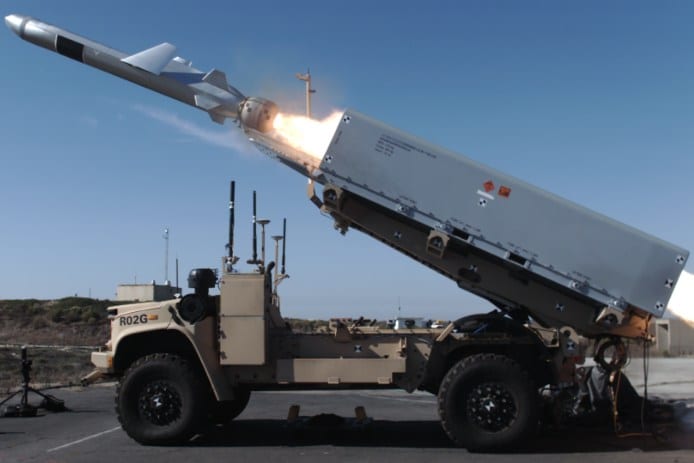
A Naval Strike Missile being fired from a modified, unmanned Joint Light Tactical Vehicle. U.S. NAVY

ARLINGTON, Va. — The vehicle-mounted Naval Strike Missile was highlighted by the Marine Corps’ commandant as an example of rapid development to meet the challenges of great power competition and enable the Corps to hold enemy naval units at risk from expeditionary bases.   

While testifying April 29 before the defense subcommittee of the House Appropriations Committee, Gen. David H. Berger, commandant of the Marine Corps, held up a recently released photo of a Naval Strike Missile (NSM) being fired from a modified unmanned Joint Light Tactical Vehicle (JLTV) known as ROGUE. 

The Navy Marine Expeditionary Ship Interdiction System, or NMESIS, successfully fired a Naval Strike Missile off the California coast, the system’s builder, Raytheon Missiles & Defense, a Raytheon Technologies business, said in an April 28 release. “The inaugural test proved the system’s ability to fire a Naval Strike Missile, or NSM, from a U.S. Marine Corps ground launcher and score a direct hit against a surface target at sea. The Marines will use NMESIS to support the U.S. Navy from the shore against enemy ships. NMESIS is comprised of the Raytheon Missiles & Defense-made NSM and a Remotely Operated Ground Unit for Expeditionary (ROGUE) Fires vehicle, produced by Oshkosh Defense.” 

“Our Naval Strike Missile is a vital weapon for denying enemies the use of key maritime terrain,” said Kim Ernzen, vice president of Naval Power at Raytheon Missiles & Defense. “This test further demonstrates our partnership for advancing the Marine Corps’ modernization priorities of enabling sea control and denial operations.” 

“Our role in contributing to [freedom of the seas] is, where [sea] denial, where [sea] control has to happen from a tactical to operational perspective, we can do that by moving the capability around that hold an adversary’s navy at risk from sip and from shore,” Berger said.  

“This is the speed at which we have to develop a capability like that,” he said. “This is the brilliance of a couple of young officers and Oshkosh [Defense], and a few other people creating other capabilities long before they’re even thought all the way through. This Joint Light Tactical Vehicle is unmanned. The people at Oshkosh and these two [Marine Corps] majors thought, ‘We can do this.’ They took the cab off the back and they put [the NSM] on the back and a fire control system. Now we can move this around on vessels, put it ashore, and hold an adversary’s navy at risk in order to ensure that the lines of the sea are kept open. 

“Our job is to support the fleet commander,” Berger said. “The fleet’s job is to support the joint force commander.”  

Berger also said a benefit of the NSM is that it is common to the Navy and Marine Corps and can be shifted to where it is needed most.