CNO: Hypersonic Missiles First on Zumwalt DDGs Before Block 5 Virginia SSNs
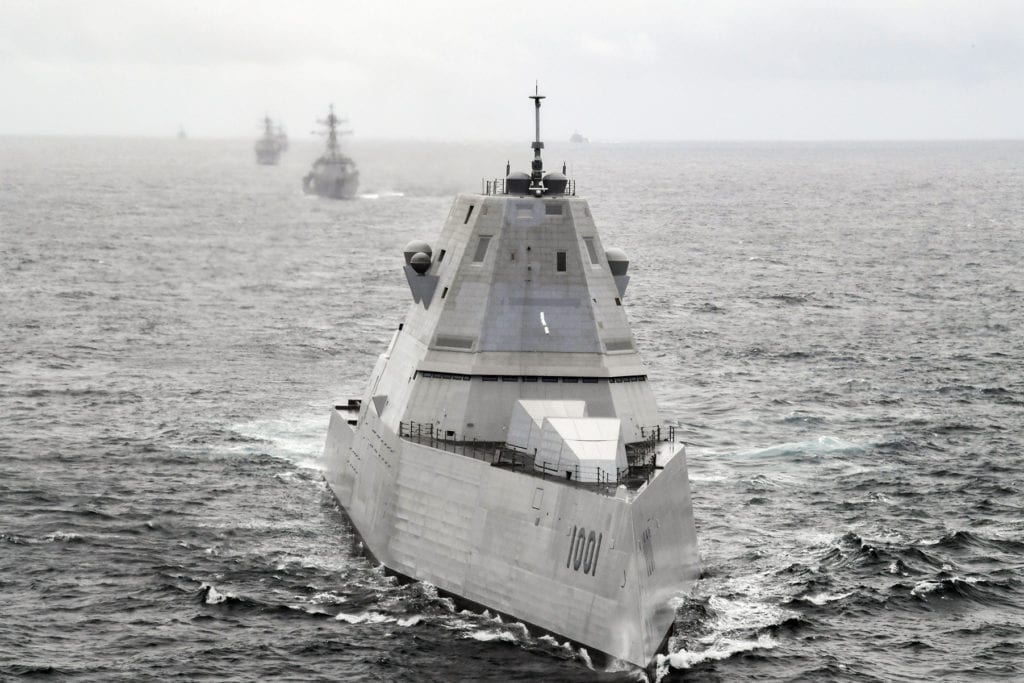
The Zumwalt-class guided-missile destroyer USS Michael Monsoor (DDG 1001) leads a formation including the Arleigh Burke-class guided missile destroyers USS Fitzgerald (DDG 62), USS Spruance (DDG 111), USS Pinckney (91), and USS Kidd (DDG 100), and the Independence-variant littoral combat ship USS Coronado (LCS 4) during U.S. Pacific Fleet’s Unmanned Systems Integrated Battle Problem (UxS IBP) 21, April 21. U.S. NAVY / Chief Mass Communication Specialist Shannon Renfroe
ARLINGTON, Va. — The Navy’s top officer said Zumwalt-class guided-missile destroyers will be the first U.S. Navy ships to be armed with hypersonic missiles.
“With respect to our research and development budget, hypersonics is our top priority, so we are working closely with the Marine Corps, with the Army, and with the Air Force to reach a capability that we can deliver to the fleet in 2025,” said Adm. Michael Gilday, chief of naval operations, testifying April 29 before the defense subcommittee of the House Appropriations Committee.
“We intend to do that on the latest and greatest destroyers we have, the Zumwalt-class destroyer,” Gilday said. “Our intent is to first put the weapon on those destroyers and then on our Virginia-class Block 5 submarines. Right now, our projection is that capability will be on our submarines by 2028.”
As recently as November, Vice Adm. Johnny Wolfe, director of Strategic Systems Programs, said the plan was to deploy the Conventional Prompt Strike (CSP) capability hypersonic missiles first on the four Ohio-class guided-missile submarines (SSGNs)
The CSP will be deployed by the U.S. Army first in 2023. Wolfe said the Initial Unit Training of Army units without the All-Up Round will begin in 2021. A canister hot-launch operational demonstration is planned for 2022. Delivery of the Army’s prototype truck-hauled delivery system is scheduled for 2023. The delivery of the All-Up Round — including the hypersonic glide body — is planned for 2024.
Gilday said a hypersonic weapon was successfully tested last year with the Army, being fired thousands of miles at very high speed and with very high precision.
“We’re very excited about the path we are on right now in hypersonics,” he said. “We’re very confident of the delivery timeline.”
Cutter Tampa Returns Home after Interdicting More than $94M of Illicit Drugs
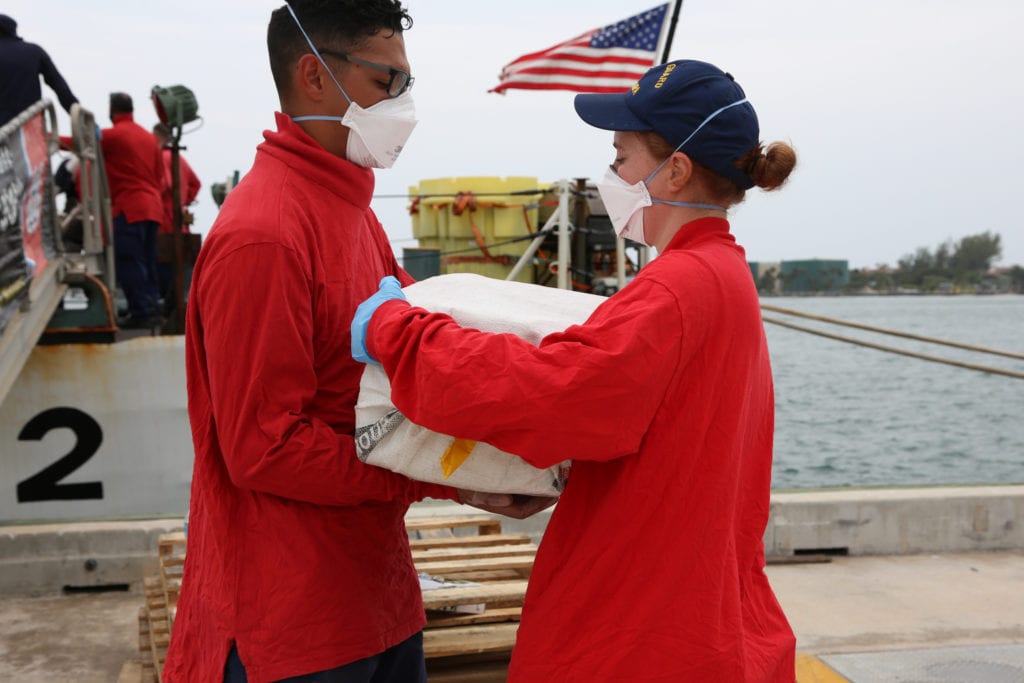
Two Coast Guard Cutter Tampa crewmembers pass a bale of cocaine during a drug offload at Base Miami Beach, Miami, Florida, April 20, 2021. The Tampa crew interdicted a low profile vessel off the coast of Punta Gallinas, Colombia, which resulted in 87 bales of cocaine, weighing approximately 5,500 pounds, and worth an estimated $94.6 million. U.S. COAST GUARD / Chief Petty Officer Charly Tautfest
PORTSMOUTH, Va. — The Coast Guard Cutter Tampa returned to its homeport in Portsmouth after completing a 56-day counter narcotics patrol in the Central Caribbean, April 25, the Coast Guard 5th District said in an April 29 release.
The crew of the Tampa began their patrol by embarking an armed helicopter aircrew from the Coast Guard’s Helicopter Interdiction Tactical Squadron in Mayport, Florida, which the crew used in conjunction with their over-the-horizon-capable pursuit boat to stop suspected drug smuggling vessels.
During their patrol, a maritime patrol flight spotted a vessel on April 9, and a law enforcement team from the Tampa detained three suspects and discovered 87 bales of cocaine, totaling approximately 5,500 pounds of cocaine, worth an estimated $94.6 million.
The crew of the Tampa’s efforts to combat drug smuggling in the Caribbean are part of Operation Martillo, a larger effort to increase regional stability and undermine the influence of Transnational Criminal Organizations, who routinely attempt to smuggle drugs throughout the region.
The Tampa crew prioritized readiness during the COVID-19 pandemic and incorporated a series of precautionary measures to include personal protective equipment, as well as the incorporation of vaccinations for members to ensure its crew, family members and community continue to remain safe while achieving mission excellence.
“This was our third patrol we have conducted during the COVID-19 pandemic, and the crew of the Tampa never ceases to impress me with their incredible perseverance, devotion, and adaptability that they use to tackle each patrol and achieve mission success,” said Capt. Michael Cilenti, Tampa’s commanding officer. “Of course, I would be remiss in not mentioning the true heroes of this patrol, and every patrol: our family and friends back at home, who constantly support us and give us the inspiration to work that much harder. Our success in interdicting the first Caribbean low profile vessel is a testament to that teamwork and focus on mission excellence that makes Tampa so special.”
Cutter Diligence Returns to Homeport after 59-day Caribbean Sea Patrol
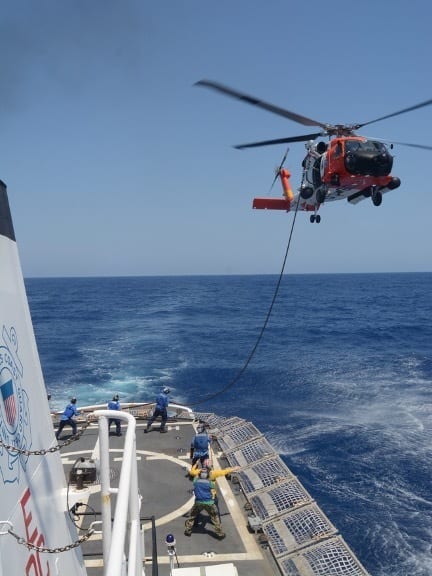
Flight Deck crew on Coast Guard Cutter Diligence conducts helicopter refueling operations in the Windward Passage during a 59-day patrol in the Caribbean Sea. The Diligence patrolled through the Straits of Florida to the Windward Pass between Cuba, the Bahamas, and Haiti alongside interagency and international partners to prevent and respond to dangerous illegal maritime migration and narcotics smuggling. U.S. COAST GUARD photo by Ensign Ashley Hatfield
PENSACOLA, Fla. — The crew of Coast Guard Cutter Diligence returned to homeport in Pensacola Thursday after a 59-day Caribbean Sea patrol, the Coast Guard 8th District said in an April 29 release.
The Diligence crew performed search and rescue, counter-drug and alien migrant interdiction operations in support of Coast Guard 7th District.
During the patrol, the crew of Diligence received 14 migrants apprehended by other U.S. law enforcement agencies and orchestrated their successful transfer to Cuban and Bahamian immigration officials for processing. The crew also facilitated the transfer of three suspected drug smugglers apprehended by another Coast Guard cutter to U.S. law enforcement authorities in Puerto Rico and accomplished vital intra-agency training with multiple Coast Guard helicopters, to include landings, a helicopter in-flight refueling evolution and rescue swimmer hoist operations to the flight deck and from the cutter’s small boat.
Additionally, the Diligence crew partnered with Bahamian authorities to respond to a report of a capsized vessel near Cay Sal Bank. The crew searched more than 24 hours in conjunction with Bahamian and Cuban assets for seven reported missing persons. The 59-day patrol was also critical in building proficiency through shipboard drills, training, and qualifications to enhance operational readiness and effectiveness.
“The Diligence’s crew continued to impress with their steadfast resiliency and professionalism in carrying out this challenging and dynamic patrol, despite difficult weather conditions for the majority of the patrol,” said Cmdr. Luke Slivinski, cutter Diligence commanding officer. “The cutter and crew performed admirably and overcame constant mission changes and unexpected challenges with signature ease. I cannot thank Diligence’s crew enough for the hard work and sacrifices they made under my tenure the last two years.”
The cutter Diligence is a 210-foot medium-endurance cutter homeported in Pensacola with a crew of 78. The cutter’s primary missions are counter-drug operations, migrant interdiction, enforcing federal fishery laws, and search and rescue in support of Coast Guard operations throughout the Western Hemisphere.
Curtiss-Wright Selected by SRC to Provide Flight Recorders for T-6 Aircraft
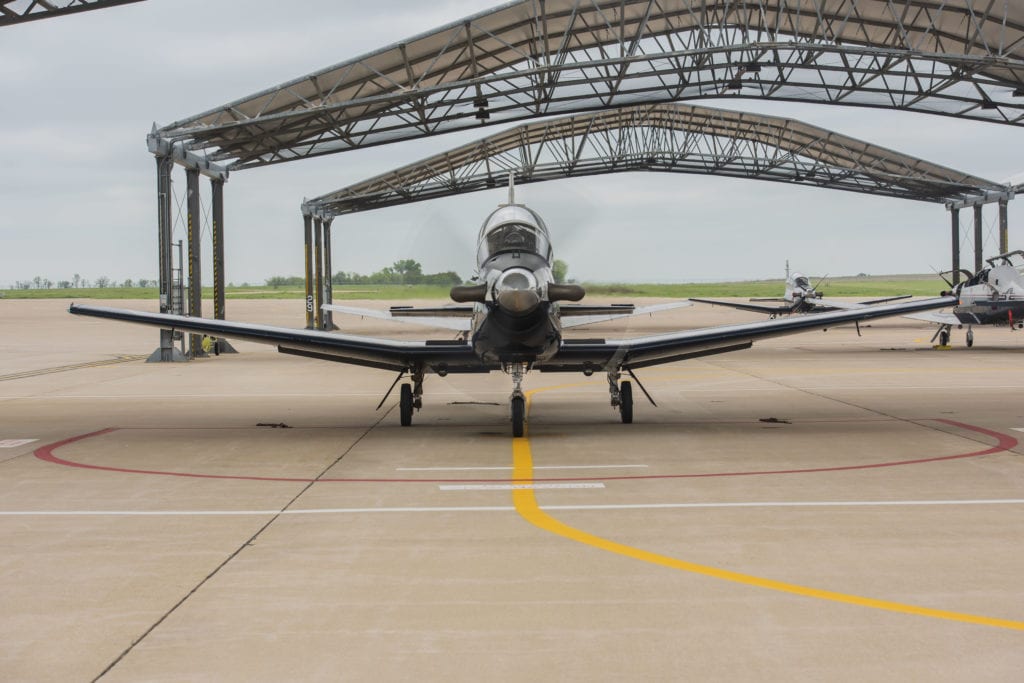
Curtiss-Wright’s Defense Solutions division will provide a version of its Fortress flight recorder system to upgrade T-6 Texan II trainer aircraft used by the U.S. Navy and Air Force. U.S. AIR FORCE / Airman Zoe T. Perkins
ASHBURN, Va. – April 28, 2021 – Curtiss-Wright’s Defense Solutions division, a supplier of rugged avionics solutions, today announced that it was selected by Scientific Research Corp. (SRC) to provide a version of its Fortress flight recorder system to upgrade the T-6 Texan II trainer aircraft used by the U.S. Air Force and Navy, Curtiss-Wright said in an April 28 release.
Under the agreement, Curtiss-Wright is providing SRC with a new variant of the Fortress CVR25, developed for use on military fixed wing and rotorcraft airborne platforms. The Fortress CVR25 combines a CVR, FDR, integrated data acquisition, and an independent power supply in a single lightweight, compact unit. The Fortress recorder’s ability to acquire additional data as customer needs evolve has helped further establish Curtiss-Wright as one of the leading suppliers of modern flight data recorders. Under the contract, shipments began in the first quarter of 2021 and are scheduled to continue through the first half of 2023.
“We are very proud to have been selected by Scientific Research Corporation to provide our innovative Fortress cockpit voice recorder and flight data recorder to upgrade the important T-6 Texan II trainer used by the U.S. Air Force and Navy,” said Chris Wiltsey, senior vice president and general manager, Defense Solutions. “SRC and Curtiss Wright intend to further explore other flight recorder applications within the DoD where our unique experience can assist in liberating the benefits of modern-day flight recorder technology for the military aircraft market.”
Lawmakers Introduce SHIPYARD Act to Support National Defense Infrastructure
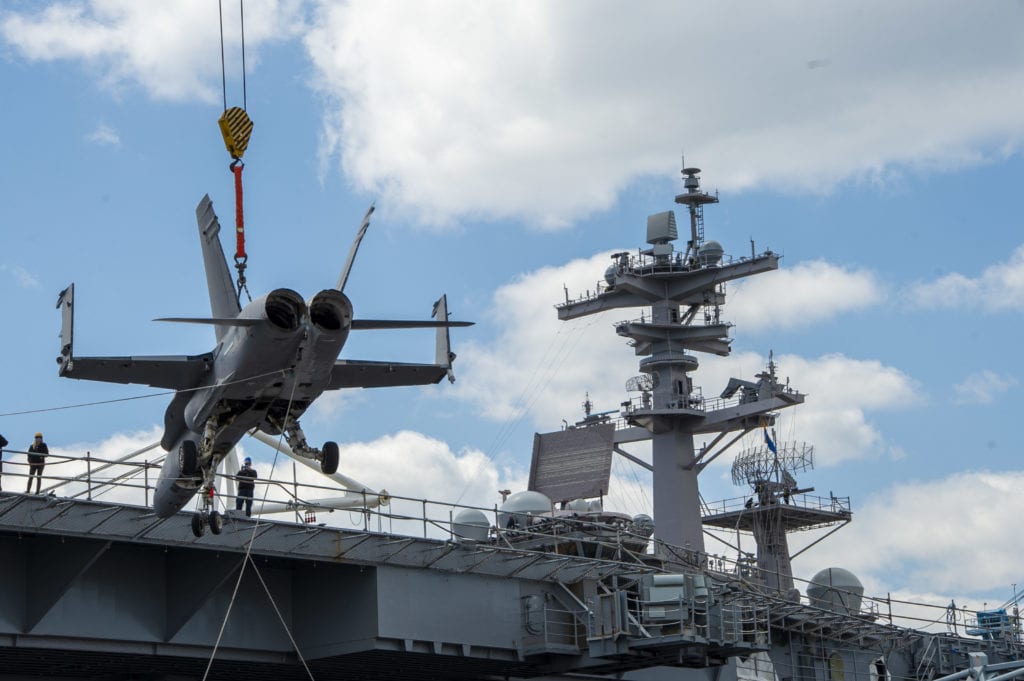
A dud aircraft is loaded by a crane to the aircraft carrier USS George H. W. Bush’s (CVN 77). GHWB is at Norfolk Naval Shipyard undergoing its Docking Planned Incremental Availability. U.S. NAVY / Mass Communication Specialist Seaman Bayley McMichael
WASHINGTON – Several U.S. Senators and Representatives introduced the Supplying Help to Infrastructure in Ports, Yards, and America’s Repair Docks (SHIPYARD) Act of 2021, which would provide $25 billion to make investments needed to optimize, improve, and rebuild shipyard facilities, electrical infrastructure, environmental systems, and the equipment of public and private shipyards in the U.S. that support the U.S. Navy fleet.
Introducing the bill were Sens. Roger Wicker, R-Mississippi; Tim Kaine, D-Virginia; Susan Collins, R-Maine; Angus King, I-Maine; and Jeanne Shaheen, D-New Hampshire, along with Reps. Rob Wittman, R-Virginia, and Mike Gallagher, R-Wisconsin.
The act would designate $21 billion for the Navy’s four public shipyards in Virginia, Maine, Hawaii, and Washington, $2 billion for major Navy private new construction shipyards, and $2 billion for Navy private repair shipyards.
“As lawmakers consider ways to improve our nation’s infrastructure, the facilities that support our Navy fleet should be a part of the conversation,” Wicker said. “Congress has already taken the important step of committing to a larger Navy, but our shipyards are having trouble servicing today’s 296-ship fleet and are clearly insufficient to maintain the 355-ship or larger fleet we need to counter China, Russia, and other adversaries. Now is the time to provide our Navy leaders the support they need to grow and preserve our fleet for generations to come.”
“Virginia’s public and private shipyards are crucial to strengthening our national security,” said Kaine. “This legislation would ensure that our sailors, shipbuilders, and ship repairers have the most up-to-date tools, equipment, and facilities to ensure our Navy remains ready to protect our nation.”
“The importance of our naval assets to our national security and global stability has never been greater, which is why it is so critical that our defense industrial base has the capacity to build and maintain a larger fleet,” said Collins. “If we are serious about the United States competing against and deterring China, we have to consider our vital defense infrastructure. For example, the Navy has specifically identified a critical lack of dry dock capacity at our nation’s four public shipyards. I have long advocated for modernization of Portsmouth Naval Shipyard and Bath Iron Works in Maine to help the highly skilled employees continue to successfully carry out their essential missions in modern, streamlined facilities. Our bipartisan legislation would support infrastructure improvements at shipyards across the country to help reduce maintenance backlogs, increase safety and efficiency, and accommodate growth to counter China’s growing naval ambitions. As a member of the Military Construction Appropriations Subcommittee, I will continue to advocate for infrastructure projects at shipyards to keep our Navy strong.”
“Portsmouth Naval Shipyard and Bath Iron Works play critical roles in both our nation’s national defense and Maine’s economy,” said King. “The contributions of these yards are absolutely essential to the Navy’s ability to operate and create thousands of good-paying jobs across Maine, both on-site and with contractors who provide additional support. As the Navy seeks to grow its fleet to address an array of challenges across the globe, and the associated maintenance requirements continue to expand, it is absolutely essential that we provide these shipyards with the modern tools and technologies they need to meet growing demand. This bipartisan legislation will make much-needed investments in a critical part of our national security infrastructure — including adaptations to prepare for the potential impacts of climate change — ensuring that these storied yards will be able to continue to fulfill their important duties for decades to come.”
“The Portsmouth Naval Shipyard is an economic engine of New Hampshire’s Seacoast region and brings immense pride to our state by bolstering its role in support of our national defense. The oldest, continually operating shipyard in the nation, the stability and security of PNSY and its workers are of critical importance,” said Shaheen. “That’s why I’m glad to partner with Senator Wicker and this bipartisan group of lawmakers on this legislation to make robust federal investments in the facilities, infrastructure and equipment at shipyards across the country, including New Hampshire. Modernizing the structures and capabilities of our shipyards is crucial for both our military readiness and our local economies, which is why I urge members on both sides of the aisle to join us in this effort.”
“At a time when China is commissioning three ships in a single day, we desperately need to strengthen the American shipbuilding industrial base to expand, support, and service the fleet,” said Rep. Gallagher. “The bipartisan, bicameral SHIPYARD Act makes critical investments to better ensure shipyards across the country, such as Marinette Marine, can build the Navy the nation needs.”
The legislation would help to address a backlog of modernization, maintenance, and expansion projects the U.S. Navy has identified at public shipyards and provide the Navy flexibility to support capital improvement projects and other investments at yards that are critical to maintaining and growing the fleet. Projects identified by the Secretary of the Navy would include improvements to shipyard infrastructure, construction of new dry docks, and other items to enable these shipyards to keep pace with Navy needs for decades to come.
Among other provisions, the legislation would:
Fully fund the Navy’s $21 billion Shipyard Infrastructure Optimization Program (SIOP) at the nation’s four public shipyards in Portsmouth, Virginia, Kittery, Maine, Pearl Harbor, Hawaii, and Bremerton, Washington.
Invest $2 billion in commercial repair shipyards, subcontractors and suppliersthat maintain the U.S. Navy fleet, allowing the Secretary of the Navy to fund key upgrades and infrastructure modernization projects to address current and future maintenance needs.
Invest $2 billion in commercial new construction shipyards, subcontractors and suppliers that build the U.S. Navy fleet, allowing the Secretary of the Navy to fund key upgrades and infrastructure modernization projects to meet current and future Navy capability and capacity needs.
Provide all funds via the Defense Production Act,removing typical fiscal year constraints on appropriations and increasing flexibility to enable the Secretary of the Navy to accelerate contract awards.
Click here to read a white paper on the legislation and here to read the full legislative text.
SECDEF Announces Navy Flag Nominations
ARLINGTON, Va. — Secretary of Defense Lloyd J. Austin III announced today that the president has made the following nominations:
Capt. Dennis E. Collins has been nominated for appointment to the rank of rear admiral (lower half). Collins is currently serving as officer in charge, Navy Reserve, U.S. Indo-Pacific Command, Detachment 401, Camp H.M. Smith, Hawaii.
Capt. Bradley D. Dunham has been nominated for appointment to the rank of rear admiral (lower half). Dunham is currently serving as chief of staff, Navy Reserve, U.S. Fleet Forces Command, Norfolk, Virginia.
Capt. Mark F. Haigis has been nominated for appointment to the rank of rear admiral (lower half). Haigis is currently serving as commanding officer, Navy Reserve, Naval Leadership and Ethics Center, Newport, Rhode Island.
Capt. Scott W. Ruston has been nominated for appointment to the rank of rear admiral (lower half). Ruston is currently serving as deputy commander, Navy Region Southwest Reserve Component Command, San Diego, California.
Capt. Douglas W. Sasse III has been nominated for appointment to the rank of rear admiral (lower half). Sasse is currently serving as commanding officer, Navy Reserve, Fourth Fleet, Mayport, Florida.
Capt. Michael J. Schwerin has been nominated for appointment to the rank of rear admiral (lower half). Schwerin is currently serving as commanding officer, Navy Reserve, Officer Training Command, Newport, Rhode Island.
Capt. David R. Storr has been nominated for appointment to the rank of rear admiral (lower half). Storr is currently serving as manager, Navy Reserve, Rapid Research and Development Detachment, Patuxent River, Maryland.
Navy Orders Three SPN-50(V)1 Radars from Saab
SAAB’s AN/SPN-50(V)1 radar. Saab
STOCKHOLM — Saab has been awarded a second Low-Rate Initial Production (LRIP) contract for three of its AN/SPN-50(V)1 radar systems for the U.S. Navy’s Shipboard Air Traffic Radar program, the company said in an April 28 release. The order value for the LRIP Phase Two contract is $37.1 million USD, with the first delivery scheduled for 2022. Radar manufacturing, delivery, test, and integration will take place at Saab’s Syracuse, New York facilities.
The AN/SPN-50(V)1 radar system, which is one of the U.S. versions of Saab’s Sea Giraffe Agile Multi Beam radar, will function as the primary air traffic control surveillance radar for manned and unmanned aviation aboard the Navy’s nuclear-powered aircraft carriers and amphibious large decks.
“By leveraging Saab’s radar technology already in operational service with the U.S. Navy, the Naval Air Traffic Management Systems Program Office and Saab is addressing shipboard air traffic control capability to ensure readiness and cost-efficiency,” said Erik Smith, president and CEO of Saab in the United States.
Delivery of the Navy’s advanced air traffic control and landing capability is overseen by the Naval Air Traffic Management Systems Program Office. In cooperation with Saab, they are responsible for the radar system’s acquisition, deployment, and through life sustainment while in service within the U.S. Navy fleet.
‘Old Tar’ Designation Passes to Master Chief Bill Smalts
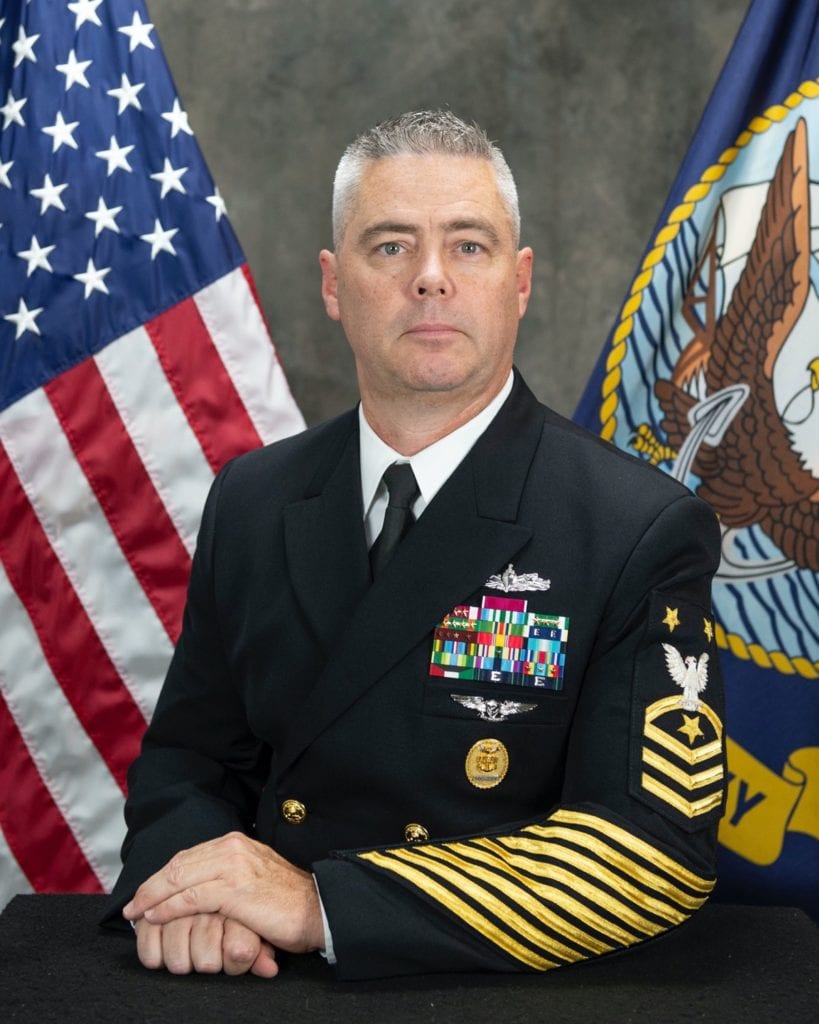
Fleet Master Chief Bill Smalts. U.S. NAVY
The Surface Navy Association’s (SNA) ”Old Tar” designation, honoring the U.S. Navy Enlisted Surface Warfare Specialist (ESWS) serving on active duty with the earliest qualification date, has passed to Fleet Master Chief Bill Smalts. Smalts is currently assigned as the Fleet Master Chief, Commander, United States 2nd Fleet, Norfolk, Virginia.
Smalts is now the 14th individual to receive the Old Tar honor having relieved Force Master Chief David B. Carter, who has recently retired.
“This award is a recognition of the leadership, experience and expertise possessed by a knowledgeable mariner. Master Chief Smalts is such a Sailor and has earned the title an ‘Old Tar,” said Vice Adm. Rick Hunt, U.S. Navy (retired), president of SNA. “This award acknowledges our lore, customs and traditions, and honors the most senior of all our active duty Enlisted Surface Warfare Specialists with the ‘Old Tar’ designation.”
Smalts completed his qualification as an E3 aboard the USS L.Y. SPEAR (AS 36) but was not allowed to be pinned until he was a Third Class Petty Officer on Oct. 18, 1990.
The term comes from the days of sail and wooden ships, when Sailors would board enemy ships in battle and engage in hand to hand combat. Since long hair was the fashion of the era, they would often wear it tied in a knot at the base of the neck. Before entering battle, they would dip this knot in tar that would soon harden and protect their necks from blows from behind. Sailors, therefore, became known as “tars,” and an “Old Tar” was clearly one honored and respected for his knowledge, wisdom, and long experience at sea.
The honor is accompanied by a replica of “The Chief” statue that stands at the Senior Enlisted Academy in Newport, Rhode Island, with all the names of the “Old Tars.” In a ceremony held at the awardees’ command, a miniature replica of the statue was presented to CMDCM Smalts to display at his command and will be permanently retained by him upon retirement.
SNA also recognizes the “Old Salt” award to honor the Surface Warfare Officer with the earliest date of receiving the coveted warfare qualification.
GA-ASI Participates in U.S. Pacific Fleet’s Unmanned Integrated Battle Problem
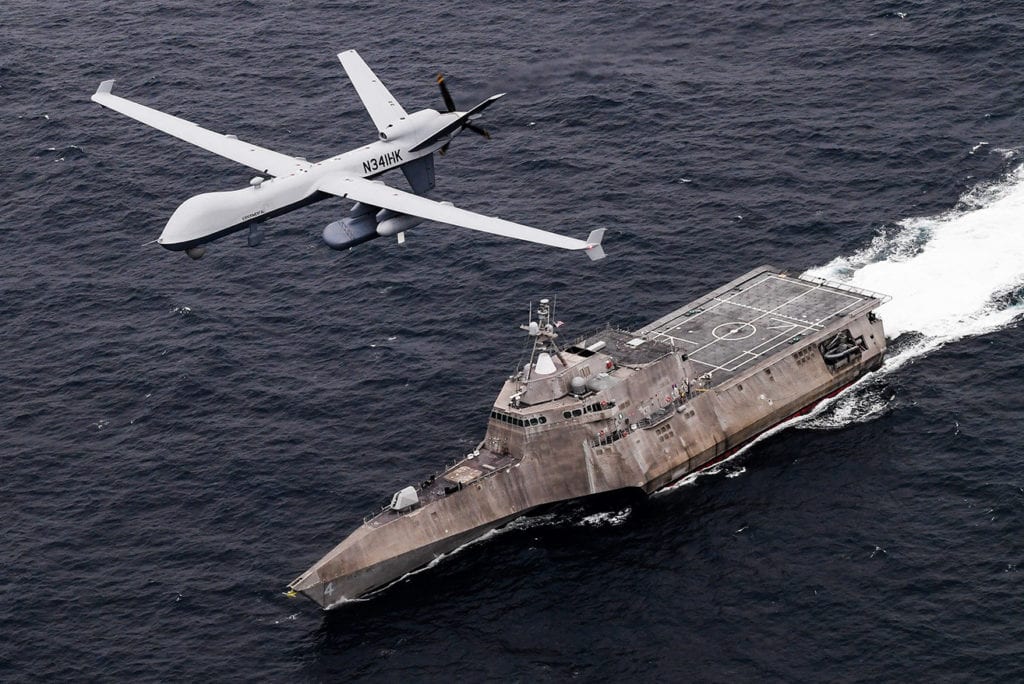
An MQ-9 Block 5 unmanned maritime surveillance aircraft system, acting as a surrogate for the MQ-9A SeaGuardian, flies over Independence-variant littoral combat ship USS Coronado (LCS 4) during U.S. Pacific Fleet’s Unmanned Systems Integrated Battle Problem (UxS IBP) 21, April 21. UxS IBP 21 integrates manned and unmanned capabilities into challenging operational scenarios to generate warfighting advantages. U.S. NAVY / Chief Mass Communication Specialist Shannon Renfroe
AN DIEGO — General Atomics Aeronautical Systems Inc. (GA-ASI) participated in U.S. Pacific Fleet’s (PACFLT) Unmanned Integrated Battle Problem ‘21 (UxS IBP 21), April 21-26, 2021, the company said in an April 28 release.
The UxS IBP 21 integrated manned and unmanned capabilities into the most challenging operational scenarios to generate war fighting advantages. The exercise aimed to directly inform warfighters, warfare centers, and developers to further incorporate unmanned capabilities in day-to-day Fleet operations and battle plans.
During UxS IBP 21, a GA-ASI MQ-9A Block 5 unmanned aircraft system (UAS) acted as a surrogate for the MQ-9B SeaGuardian and was able to demonstrate for the first time: successful Link connectivity with U.S. Navy surface ships and aircraft; cooperative anti-submarine warfare (ASW) operations, to include the first successful high-altitude sonobuoy drop from a UAS; Automatic Identification System (AIS) correlation with a U.S. Navy P-8 Poseidon and MH-60R Seahawk; exchange of Link 16 data over Global Command and Control System – Maritime (GCCS-M) from a UAS; and long-range over-the-horizon targeting from a UAS to a U.S. Navy destroyer.
“Our partnership and collaboration with the U.S. Navy during this exercise has been extremely beneficial and helped set the stage for a revolutionary change in how the U.S. Navy and our foreign partners address the increasing challenges and complexities for accomplishing distributed maritime operations,” said J.R. Reid, GA-ASI’s vice president for Defense Department Strategic Development. “We successfully demonstrated several groundbreaking capabilities for the first time, and we look forward to leveraging this momentum to continue to develop and test more advanced capabilities that provide immense value to the warfighter, both domestically and abroad.”
GA-ASI has expanded the traditional role of the MQ-9 for its U.S. government and foreign customers to support maritime intelligence, surveillance, and reconnaissance missions, including ASW, with the development of the expeditionary MQ-9B SeaGuardian that can safely operate in adverse weather and non-segregated airspace.
Logos Successfully Tests WAMI Sensor on RQ-21A Blackjack UAV
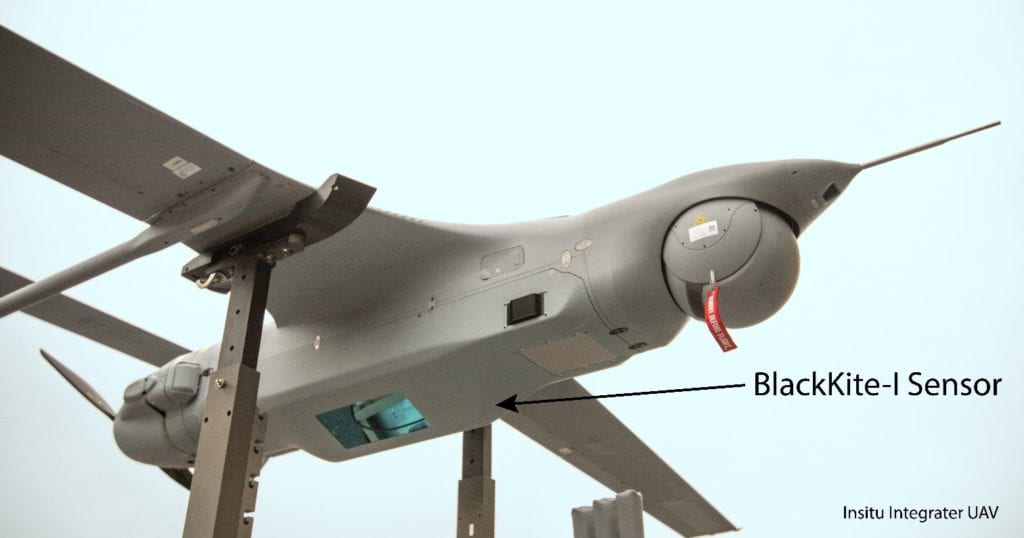
Logos Technologies LLC’s BlackKite-I sensor, shown mounted on an Insitu Integrator unmanned aircraft. LOGOS TECHNOLOGIES LLC
FAIRFAX, Va. – Logos Technologies LLC has successfully flown its wide-area motion imagery (WAMI) sensor aboard an RQ-21A Blackjack unmanned aircraft at a test range in Boardman, Oregon, the company said in a release.
The two-week-long test — which included preparatory groundwork in Bingen, Washington — comes on the heels of a $5.3 million contract the U.S. Naval Air Systems Command had recently awarded to Logos, to develop more WAMI sensors for Navy and Marine users.
“We are very excited by our recent test aboard the RQ-21A Blackjack,” said Doug Rombough, vice president for Business Development at Logos Technologies. “Our ongoing effort to develop an ultra-light WAMI capability for the Blackjack and other small, tactical unmanned aircraft is clearly paying off.”
Logos has created a U.S. military version of BlackKite, currently called Cardcounter, an ultra-light (26 pounds) infrared WAMI system developed by Logos. Despite its low SWaP, BlackKite can detect and track in real time every significant target moving within a city-sized area, giving tactical operators a powerful, hereto unheard of, capability.
In addition, thanks to the WAMI system’s multi-modal edge processor — which can store six or more hours of mission data — users on the ground can also access recorded imagery for on-the-fly forensic analysis.
“No military in the world has anything like the Logos WAMI sensor on their tactical unmanned aircraft,” said Rombough. “This WAMI system views and records the entire area and can stream multiple real-time and recorded video ‘chip-outs’ down to handheld devices.”
Logos was first tasked with converting their BlackKite system to meet government requirements in September 2019, with two units being produced for the U.S. Naval Air Systems Command. The follow-on $5.3 million development contract and March test flight are part of the same effort.
“In total, we will be producing four modular WAMI systems for the Navy,” Rombough said, “with the hope that this will open the door for a wider U.S. military adoption of WAMI, both for the Blackjack and other Group 3 unmanned aircraft.”