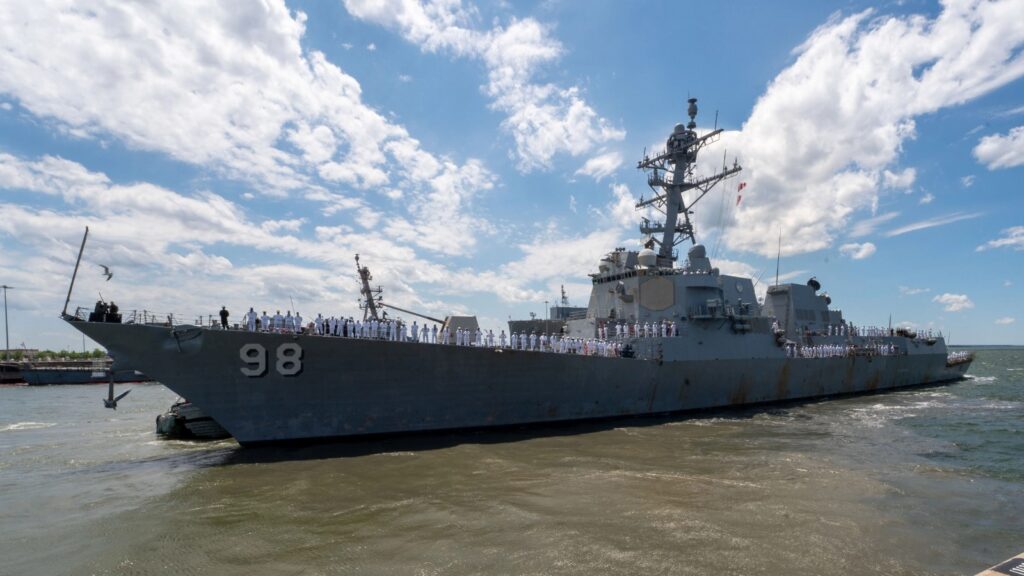
U.S. Navy to Christen Future USS Louis H. Wilson Jr.
From the U.S. Department of War, Sept. 26, 2025
The U.S. Navy will christen the future USS Louis H. Wilson Jr. (DDG 126), during a ceremony at General Dynamics Bath Iron Works (BIW) on Saturday, September 27, at 10:30 a.m. (EST).
The principal address will be delivered by Commandant of the Marine Corps, Gen. Eric Smith; Additional speakers include Governor of Maine, Janet Mills; U.S. Senator of Maine Angus King; Assistant Secretary of the Navy for Research, Development, and Acquisition, Jason Potter; Deputy Chief of Naval Operations for Integration of Capabilities and Resources, Vice Adm. Brad Skillman; Medal of Honor Recipient, Col. Harvey C. Barnum, Jr.; and President of General Dynamics Bath Iron Works, Chuck Krugh.
In a time-honored tradition, ship sponsors Janet Wilson Taylor, daughter of the namesake and Susan J. Rabern, former Assistant Secretary of the Navy for Financial Management and Comptroller, will christen the ship by breaking a bottle of sparkling wine across the bow.
The ship is named after Gen. Louis Hugh Wilson Jr., a World War II and Vietnam War veteran who was awarded the Medal of Honor for his heroism during the Battle of Guam. Following his service in Vietnam, he served as the 26th Commandant of the Marine Corps from 1975 to 1979.
The christening of DDG 126 symbolizes the Navy’s 250-year commitment to innovation and maritime dominance. From seabed to space, the Navy delivers power for peace – always ready to fight and win. This milestone marks the Navy’s enduring legacy and commitment to shaping the future of maritime power.
Arleigh Burke-class Flight III destroyers feature the AN/SPY-6(V)1 Air and Missile Defense Radar and incorporate upgrades to the electrical power and cooling capacity plus additional associated changes to provide enhanced warfighting capability to the fleet. Future destroyers Harvey C. Barnum Jr. (DDG 124), Patrick Gallagher (DDG 127), William Charette (DDG 130), Quentin Walsh (DDG 132), John E. Kilmer (DDG 134), Richard G. Lugar (DDG 136), and J. William Middendorf (DDG 138) are also in production at BIW.
HII Successfully Completes Builder’s Sea Trials for Destroyer Ted Stevens
From HII
PASCAGOULA, Miss., (Sept. 27, 2025) — HII’s (NYSE: HII) Ingalls Shipbuilding division successfully completed builder’s sea trials for guided missile destroyer Ted Stevens (DDG 128), marking a major milestone in the construction of the second Flight III destroyer built at Ingalls. The trials were conducted over several days in the Gulf of America, and tested the ship’s engineering, navigation, and combat systems to ensure readiness for the future acceptance trials and eventual delivery to the U.S. Navy.
“The Ingalls and Navy team worked diligently to get DDG 128 ready for sea, and I want to recognize the team’s determination in reaching this major milestone,” Ingalls Shipbuilding DDG Program Manager Ben Barnett said. “Their efforts reflect the urgency we all share in delivering these ships with the highest quality and technological advancements needed to support the U.S. Navy fleet and to protect our national security.”
During builder’s trials, the Ingalls test and trials team completed a full range of hull, mechanical and electrical tests, as well as Flight III AN/SPY-6 (V)1 radar array testing. These tests are designed to validate critical system performance and ensure the ship meets or exceeds Navy requirements.
Flight III Arleigh Burke-class destroyers represent the next generation of surface combatants for the U.S. Navy and incorporate a number of design modifications that collectively provide significantly enhanced capability. Upgrades include the AN/SPY-6(V)1 Air and Missile Defense Radar (AMDR) and the Aegis Baseline 10 Combat System required to keep pace with the threats well into the 21st century.
Ingalls has delivered 35 Arleigh Burke-class destroyers to the U.S. Navy including the first Flight III, USS Jack H. Lucas (DDG 125), in June of 2023 and currently has five Flight IIIs under construction including Ted Stevens (DDG 128), Jeremiah Denton (DDG 129), George M. Neal (DDG 131), Sam Nunn (DDG 133) and Thad Cochran (DDG 135).
Earlier this month, HII announced that the company would be partnering with several shipyards and fabricators in multiple states to grow its throughput and meet the requirements of increased demand for ships by the U.S. Navy. This effort included Ingalls Shipbuilding selecting outfitted structural units for Arleigh Burke-class destroyers to be constructed, inspected and accepted at partner locations and later delivered to Ingalls for final integration.
As the largest manufacturing employer in Mississippi, Ingalls Shipbuilding has designed, built and maintained amphibious ships, destroyers for the U.S. Navy for over 86 years.
Coast Guard Cutter Polar Star Returns to Seattle After 308 Days
After 308 days away from its Seattle home port, the 49-year-old U.S. Coast Guard Cutter Polar Star (WAGB 10) and crew returned home, Sept. 23, 2025. Upon completing Operation Deep Freeze 2025, Polar Star returned directly to Mare Island Dry Dock in Vallejo, Calif., to complete the final year of a five-year Service Life Extension Program prior to returning to Seattle. U.S. Coast Guard photo by Petty Officer 3rd Class Annika Hirschler.
From U.S. Coast Guard Northwest District, Sept. 25, 2025
SEATTLE — After 308 days away from its Seattle home port, the 49-year-old U.S. Coast Guard Cutter Polar Star (WAGB 10) and crew returned home Tuesday.
Upon completing Operation Deep Freeze (ODF) 2025, Polar Star returned directly to Mare Island Dry Dock in Vallejo, Calif., to complete the final year of a five-year Service Life Extension Program (SLEP).
Polar Star’s SLEP completion comes at a time when the Polar Regions are becoming more consequential, and the demand for U.S. Coast Guard presence, leadership, and vigilance continues to grow.
The maintenance work completed over the past five years recapitalized integral systems, including propulsion, communication, and machinery control systems. These efforts are designed to extend the cutter’s service life as the Coast Guard begins construction of its first Polar Security Cutter. Until PSCs becomes operational, Polar Star will remain the only U.S. icebreaker capable of completing the annual breakout of McMurdo Sound, Antarctica in support of the U.S. Antarctic program (USAP).
“Much has been asked of this ship over the past five decades,” said Capt. Jeff Rasnake, Polar Star’s commanding officer. “The completion of this extensive five-year maintenance and recapitalization project is a major milestone in enabling Polar Star’s operations into the future.”
Polar Star’s SLEP has been completed in five phases to maintain its operational capability to complete annual polar deployments. Phase Five, the last phase in its SLEP, began March 30, 2024, focusing on these projects:
Gyro repeater recapitalization to ensure that these critical pieces of navigation equipment are updated to modern standards, enabling safe navigation of the cutter.
Ancillary pumps and motors recapitalization through the replacement of critical main propulsion and auxiliary systems with modern supportable units.
Heating, ventilation, and air conditioning systems refurbishments; multiple zones were refurbished with ventilation trunks, fans, and heaters to improve air circulation and maintain a comfortable living environment for the ship’s crew during extended deployments.
The completion of Polar Star’s five-year SLEP underscores the importance of the annual ODF mission, the U.S. military support mission for the USAP, which facilitates the transport of personnel, equipment and supplies required to maintain the U.S.’s strategic presence in Antarctica. Having participated in a majority of these missions since they began in the 1950s, the U.S. Coast Guard will continue to support the U.S.’s continued presence on the Antarctic continent as part of the Joint Task Force – Support Forces Antarctica.
Work completed in Phase Five took 175 days and represented an additional $12.7 million investment in the U.S. Polar capability. While at Mare Island, Polar Star received support from both Coast Guard Base Seattle and Base Charleston’s Naval Engineering Departments to perform a center section overhaul on one of Polar Star’s nine main diesel engines. In parallel with this work, members from the Coast Guard Yard in Baltimore completed vital work on the ship’s sanitary systems.
Additional major work completed includes removing the centerline shaft for servicing and inspection, exchanging all three propellers, and renewing both forward and aft main deck surfaces.
“This is a tremendous ship, and it is in better shape today than it was ten years ago,” said Rasnake. “That’s a testament to the unrelenting efforts of the crew, the enduring support of our mission partners, and the renewed enthusiasm and investment in our nation’s polar icebreaking capabilities.”
Commissioned in 1976, Polar Star is 399 feet, weighing 13,500 tons with a 34-foot draft. Despite reaching nearly 50 years of age, Polar Star remains the world’s most powerful non-nuclear icebreaker with the ability to produce up to 75,000 shaft horsepower.
Coast Guard offloads more than $156 million worth of cocaine in San Diego
Crew members of the U.S. Coast Guard Cutter Midgett (WMSL 757) stand at parade rest on the flight deck of the cutter in San Diego, Sept. 25, 2025. The Midgett’s crew prepared to offload drugs interdicted in the Eastern Pacific during counter-narcotic patrols, eliminating 21,126 pounds of cocaine worth an estimated $156 million in value. (U.S. Coast Guard photo by Petty Officer 3rd Class Roberto A. Nieves Felix)
SAN DIEGO — The crew of U.S. Coast Guard Cutter Midgett (WMSL 757) offloads approximately 21,126 pounds of cocaine, with an estimated value of more than $156.4 million, Thursday in San Diego.
The offload resulted from four separate interdictions of suspected drug-smuggling vessels in international waters off the coasts of Mexico, Central America, and South America. Midgett’s crew conducted the interdictions during counter-narcotics patrols during the months of August and September 2025.
“This offload represents the hard work and dedication of our crew and the strength of our partnerships in keeping dangerous drugs from reaching our communities,” said Capt. Brian Whisler, commanding officer of the Coast Guard Cutter Midgett. “Maritime interdiction remains one of the most effective ways to disrupt narcotics trafficking, and together with our partners, we are holding transnational criminal organizations accountable.”
This operation is part of Operation Pacific Viper, a Coast Guard led surge effort to counter the flow of illicit narcotics in the Eastern Pacific Ocean. The operation leverages the Coast Guard’s Title 14 maritime law enforcement authorities and capabilities, supported by interagency and international partners.
This offload reflects the combined efforts of multiple agencies working together to combat illegal narcotics from entering the United States. Partners include the U.S. Navy, Customs and Border Protection, FBI, Drug Enforcement Administration, and Immigration and Customs Enforcement, working closely with allied and regional maritime forces.
Currently, 80% of all narcotics seized in the transit zone are interdicted at sea, underscoring the impact of Coast Guard operations. The fight against cartels and transnational criminal organizations requires unity of effort at every stage, from detection and monitoring to interdiction and prosecution by U.S. Attorneys’ Offices and international partners.
Midgett is one of two Legend-class national security cutters homeported in Honolulu. These cutters are built to operate in the most challenging open ocean environments and play a vital role in protecting the maritime approaches of the Pacific, where much of the world’s illicit narcotics trafficking occurs.
U.S. Navy Decommissions Avenger-class Mine Countermeasures Ships in Bahrain
MANAMA, Bahrain (Sept. 3, 2025) U.S. Sailors man the rails of the Avenger-class mine countermeasures ship USS Dextrous (MCM 13) during a decommissioning ceremony for the ship in Manama, Bahrain. The recently decommissioned Avenger-class mine countermeasures ships USS Sentry (MCM 3), USS Dextrous (MCM 13) and USS Gladiator (MCM 11), and their crews, were recognized during the final decommissioning ceremony for USS Devastator (MCM 6) on board Naval Support Activity Bahrain, following nearly 40 years of active service. (Official U.S. Navy photo)
From Commander U.S. Naval Forces Central Command Public Affairs, Sept. 25, 2025
After nearly 40 years of active service, three recently decommissioned U.S. Navy Avenger-class mine countermeasures ships and their crews were recognized in conjunction with a final decommissioning ceremony for USS Devastator (MCM 6) on board Naval Support Activity (NSA) Bahrain, Sept. 25.
“As you carry the plank you own of Douglas fir away with you today, remember that with it you carry the legacy of the thousands of Sailors who come before you,” said Lt. Cmdr. Alex Turner, commanding officer, USS Devastator. “Today, Devastators’ watch has ended; her service is complete, but her legacy will endure… and in every Iron Man who is honored to call this wooden ship home, there are truly no greater heroes.”
U.S. Navy Vice Adm. George Wikoff, commander, U.S. Naval Forces Central Command (NAVCENT) and U.S. 5th Fleet (C5F) presided over the final decommissioning ceremony that recognized the proud history of not only Devastator, but also USS Sentry (MCM 3), USS Dextrous (MCM 13) and USS Gladiator (MCM 11).
“For more than three decades, USS Devastator, USS Dextrous, USS Gladiator and USS Sentry have been critical to maritime missions around the globe – defending the freedom of navigation, promoting stability and deterring and defeating efforts by adversaries to harm the innocent,” said Wikoff. “To all, past and present, who have served on [these ships], thank you for standing the watch, being true trailblazers in the fleet and maintaining a constant presence in our area of operations… what a proud legacy you leave in your wake.”
Avenger-class ships were designed as mine sweepers/hunter-killers capable of finding, classifying and destroying moored and bottom mines. The ships used sonar and video systems, cable cutters and a mine detonating device that could be released and detonated by remote control. They were also capable of conventional sweeping measures. The ships were a fiberglass-sheathed, wooden hull construction.
U.S. 5th Fleet’s Task Force 55/Destroyer Squadron (DESRON) 50, responsible for surface forces across the U.S. Central Command area of responsibility, including patrol craft, independently deploying ships and now, littoral combat ships, is charged with the mine countermeasures mission.
Four littoral combat ships (LCS) are slated to deploy to Bahrain to replace the decommissioned MCM ships that have operated forward in 5th Fleet area of operations for decades.
USS Canberra (LCS 30) was the first Independence-variant LCS to deploy with the mine countermeasures mission package to the region and arrived at NSA Bahrain, May 22. Canberra has an integrated suite of unmanned maritime systems and sensors, and is designed to locate, identify and destroy mines while increasing the ship’s standoff distance from a threat.
NAVCENT/C5F is the maritime component commander of U.S. Central Command, whose area of responsibility encompasses about 2.5 million square miles of water area and includes the Arabian Gulf, Red Sea, Gulf of Oman and parts of the Indian Ocean. This expanse, comprised of 21 countries, includes three critical chokepoints at the Strait of Hormuz, the Suez Canal, and the Bab al-Mandeb Strait at the southern tip of Yemen.
US, French In-Flight Refueling Extends Advanced Hawkeye’s Reach
This summer, the French Navy and Air Force conducted qualitative aerial refueling testing with French Rafale, MRTT and A400M tankers as a part of a collaborative effort between the E-2/C-2 Airborne Command & Control Systems Program Office (PMA-231) and France’s Direction Générale de l’Armement.
From Naval Air Systems Command, Sept. 25, 2025
NAS PATUXENT RIVER, Md. — The E-2D Advanced Hawkeye (AHE) achieved a breakthrough in global airpower this summer, successfully refueling mid-air from three French-made tankers – a historic first that dramatically extends the Advanced Hawkeye’s reach and for seamless joint operations while providing unprecedented airborne surveillance capabilities.
The French Navy and Air Force conducted qualitative aerial refueling testing with French Rafale, MRTT and A400M tankers as a part of a collaborative effort between the E-2/C-2 Airborne Command & Control Systems Program Office (PMA-231) and France’s procurement agency, known as Direction Générale de l’Armement (DGA).
DGA and the French Navy will continue additional aerial refueling testing and pilot training in France as they replace their E-2Cs beginning in 2028. France became the second international customer of the E-2D AHE in December 2020, procuring three French variant E-2D aircraft from the U.S. Navy.
The E-2D AHE represents a two-generation leap in technology compared to its predecessor, the E-2C Hawkeye. The aircraft features a state-of-the-art radar and upgraded aircraft systems that improve supportability and increase readiness. The centerpiece of the E-2D AHE is the APY-9 radar system, designed specifically to provide enhanced surveillance detection and tracking capability against advanced threat aircraft and cruise missile systems in the overland, littoral and open ocean environments.
With the addition of aerial refueling capabilities, the E-2D remains the most advanced command and control platform in the world. Aerial refueling increases the range and endurance of the platform, and enhances its ability to provide continuous, long-range surveillance and battlefield management.
USS America to Return to United States
(Aug. 2, 2025) Sailors assigned to the forward-deployed amphibious assault ship USS America (LHA 6) and U.S. Marines with the 31st Marine Expeditionary Unit (MEU) stand in formation for a photo commemorating 250 years of naval service, while conducting operations in the Coral Sea, Aug. 2. America, lead ship of the America Amphibious Ready Group, is operating in the U.S. 7th Fleet area of operations. U.S. 7th Fleet is the U.S. Navy’s largest forward-deployed numbered fleet, and routinely interacts and operates with allies and partners in preserving a free and open Indo-Pacific region. (U.S. Navy photo illustration by Mass Communication Specialist 3rd Class Kenneth Melseth)
From Commander, Naval Surface Force, U.S. Pacific Fleet, Sept. 23, 2025
CALIFORNIA, UNITED STATES — America-class amphibious assault ship USS America (LHA 6) departed Sasebo, Japan for San Diego, California as part of a scheduled rotation of forces in the Pacific. This will be executed as a permanent change of station for the crew and family members.
The United States values Japan’s contributions to the peace, security and stability of the Indo-Pacific and its long-term commitment and hospitality in hosting U.S. forces forward deployed there. These forces, along with their counterparts in the Japan Self-Defense Forces, make up the core capabilities needed by the alliance to meet our common strategic objectives.
The security environment in the Indo-Pacific requires that the U.S. Navy station the most capable ships forward. This posture allows the most rapid response times possible for maritime and joint forces and brings our most capable ships with the greatest amount of striking power and operational capability to bear in the timeliest manner.
Maintaining forward-deployed naval forces capability with the most advanced ships supports the United States’ commitment to the defense of Japan and the security and stability of the vital Indo-Pacific region.
Coast Guard Offloads Nearly $65M in Illicit Narcotics Interdicted in Western Caribbean Sea
The crew of Coast Guard Cutter Diligence (WMEC 616) poses for a group photo during a drug offload at Coast Guard Sector St. Petersburg, Florida, Sept. 22, 2025. Diligence’s crew offloaded nearly $65 million in illicit narcotics interdicted in the Western Caribbean Sea. (U.S. Coast Guard photo by Petty Officer 1st Class Riley Perkofski)
From U.S. Coast Guard Southeast District, Sept. 24, 2025
ST. PETERSBURG, Fla. — The crew of Coast Guard Cutter Diligence (WMEC 616) offloaded approximately 8,700 pounds of cocaine worth an estimated $64.5 million, Monday, at Coast Guard Sector St. Petersburg.
Diligence deployed in support of Joint Interagency Task Force – South to the Coast Guard District Southeast area of responsibility, where crew members interdicted more than 10,000 pounds of illicit narcotics.
“I am remarkably proud of the crew and appreciative of the efforts of JIATF-S and Coast Guard District Southeast,” said Cmdr. Colin McKee, commanding officer Diligence. “This joint effort helped us prevent more than four tons of illegal drugs from entering the United States. While this offload marks another milestone in our efforts to counter narco-terrorism, the Coast Guard remains relentless in our operations to control, secure, and defend U.S. borders and maritime approaches.”
The seized contraband was a result of two interdictions in international waters of the Caribbean Sea.
On Aug. 7, Diligence’s crew detected and boarded a suspicious go-fast vessel approximately 136 miles southwest of Negril, Jamaica. Diligence’s boarding team interdicted the vessel, seizing 1,500 pounds of marijuana. The contraband was transferred to and offloaded by Coast Guard Cutter Hamilton (WMSL 753), as part of the largest quantity of drugs offloaded in Coast Guard history, in Port Everglades, on Aug. 25.
On Sep. 6, a maritime patrol craft spotted a suspicious go-fast vessel approximately 240 miles north of Panama. Diligence’s boarding team interdicted the vessel, seizing more than 8,700 pounds of cocaine. The cocaine was offloaded by Diligence’s crew and transferred to case agents in St. Petersburg, Monday.
The following assets and crews were involved with the interdiction operations:
Detecting and interdicting narco-terrorism on the high seas involves significant interagency and international coordination because 80% of U.S.-bound drugs are interdicted on the high seas. U.S. Southern Command’s JIATF-S, based in Key West, conducts the detection and monitoring of aerial and maritime transit of illegal drugs. Once interdiction becomes imminent, the law enforcement phase of the operation begins, and control of the operation shifts to the U.S. Coast Guard throughout the interdiction and apprehension. Interdictions in the Caribbean Sea are performed by members of the U.S. Coast Guard under the authority and control of Coast Guard District Southeast, headquartered in Miami.
The Coast Guard continues increased operations to interdict, seize and disrupt transshipments of cocaine and other bulk illicit drugs by sea. These drugs fuel and enable foreign terrorist organizations and transnational criminal organizations to produce and traffic illegal fentanyl, threatening the United States.
Diligence is a 210-foot, Reliance-class medium-endurance cutter. The cutter’s primary missions are counter-drug and alien interdiction operations, enforcement of federal fishery laws, and search and rescue in support of U.S. Coast Guard operations throughout the Western Hemisphere. The cutter falls under the command of U.S. Coast Guard Atlantic Area, based in Portsmouth, Virginia.
Coast Guard to Invest $350M in Robotics, Autonomous Systems
From Headquarters, U.S. Coast Guard, Sept. 24, 2025
WASHINGTON— The Coast Guard announced Wednesday it will invest nearly $350 million to expand robotics and autonomous systems, strengthening mission execution and operational capabilities.
The funding, provided under the One Big Beautiful Bill Act (OBBBA), includes $11 million in fiscal year 2025 for immediate upgrades to critical autonomous systems.
Initial investments include:
$4.8 million to procure 16 VideoRay Defender remotely operated vehicles (ROVs) to replace Deployable Specialized Forces’ aging fleet.
$2 million to procure six Qinetiq Squad Packable Utility Robot (SPUR) and 12 mini-SPUR robots to replace outdated unmanned ground vehicles (UGVs) at Strike Teams.
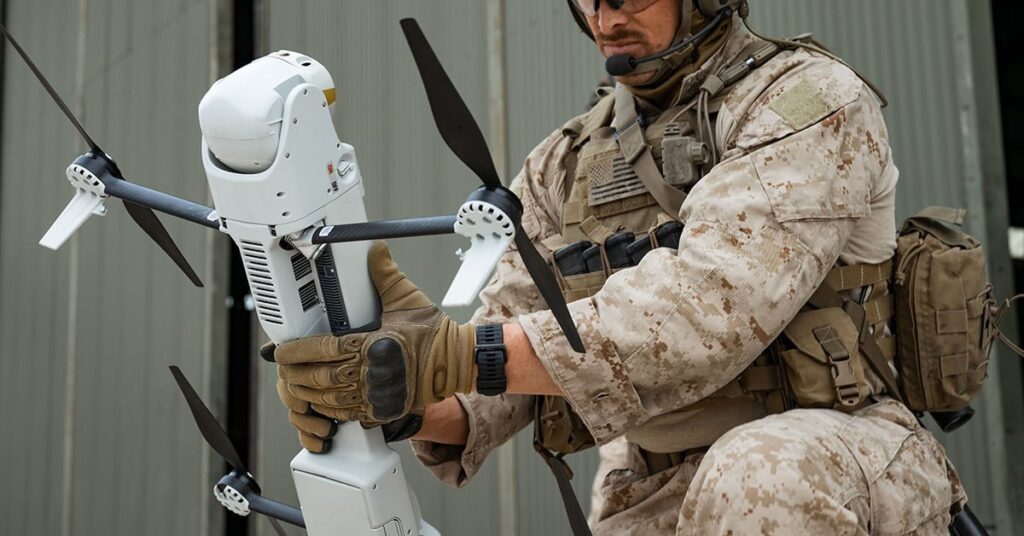
$4.3 million to purchase 125 SkyDio X10D short-range unmanned aircraft systems (SR-UAS).
These investments are the first in a series of robotics and autonomous systems projects the Coast Guard will pursue using OBBBA funding. The technologies will meet immediate mission needs, improve personnel safety and strengthen the Coast Guard’s capabilities to control, secure, and defend U.S. borders and maritime approaches.
“These unmanned systems provide increased domain awareness, mitigating risk and enhancing mission success as the Coast Guard continues to operate in hazardous environments,” said Anthony Antognoli, the Coast Guard’s first RAS program executive officer. “The Coast Guard’s mission demands agility, awareness and adaptability. Robotics and autonomous systems deliver all three, enabling us to respond faster, operate smarter and extend our reach where it matters most. We are not waiting for the future to arrive. We are delivering it to the fleet today.”
The Coast Guard’s Deployable Specialized Forces will use the new ROVs for waterfront and pier inspections, hull assessments, subsurface infrastructure surveys, disaster response and search and rescue missions. Their use will reduce reliance on Coast Guard divers, improving efficiency and safety.
Coast Guard Strike Teams, which respond to hazardous materials spills, major marine casualties, groundings, natural disasters, chemical, biological, radiological or nuclear (CBRN) incidents and national special security events, will use the new UGVs to access and sample air in confined spaces aboard commercial vessels.
The SR-UAS will support operations including infrastructure inspections, environmental observation, pollution response, post-storm surveys, ice surveys and communications.
The Program Executive Office for Robotics and Autonomous Systems is part of the Coast Guard’s Force Design 2028 plan, which aims to fully integrate capabilities across the service. Focused on four campaigns – people, organization, contracting and acquisition and technology – Force Design 2028 is an accelerated effort to establish a blueprint for change and transform the Coast Guard into a more agile, capable, and responsive force.
Navy’s NEPTUNE Program Energizes Innovation from Lab to Fleet
“The NEPTUNE program exemplifies the kind of innovative partnerships we need to accelerate defense technology development,” commented Dr. Scott Higgins, ONR program officer, and NEPTUNE lead.
By funding university research teams that include military or veteran students, and focusing on energy-related domains like energy storage, power generation and micro-grids. NEPTUNE rapidly transitions lab concepts toward operational naval solutions. The program has established strategic partnerships with institutions including Stanford, MIT, Purdue University, UC Davis, and others. The results of such partnerships align with the Secretary of the Navy’s priorities of people, capabilities, and processes.
NEPTUNE’s approach emphasizes moving research along the technology readiness scale by advancing basic science (TRL 2-4) to prototype demonstrations in real-world environments (TRL 7). This is done by fostering connections between the Department of the Navy, colleges and universities, and industry.
“These collaborations are proving instrumental in rapidly transitioning innovative technologies from laboratory concepts to operational naval assets” said Dr. Jeff Decker, managing director of Stanford’s Tech Transfer for Defense and a Hacking for Defense program director.
Programs like NEPTUNE are accelerating the time between the lab and real-world impact,” said Justin Fanelli, chief technology officer for the Department of the Navy. “By embedding operational needs directly into university projects, we’re not just moving new technologies forward, we’re ensuring it’s deployable where it matters most – at sea and in the field.”
From Purdue Lab to Startup: EnergyMind Takes Flight
A prime example of NEPTUNE’s impact is the technology transition from Professor Vikas Tomar’s lab at Purdue University into a new startup called Primordis, Inc. Supported by NEPTUNE-funded research at Purdue, Dr. Tomar’s team developed a suite of artificial intelligence algorithms for energy management of autonomous systems, mobile robots, and data centers. His work has resulted in three related patents and now forms the core of Primordis’ EnergyMind platform. Founded in late 2024, Primordis.ai is bringing Purdue University technology to market, targeting applications in both defense and industry.
“This is about bridging the gap between what we demonstrate in the lab and what the warfighter needs on the field,” explains Dr. Tomar, a professor of aeronautics and astronautics and Primordis co-founder.
Primordis describes EnergyMind as a new form of Autonomous Energy Intelligence (AEI) – essentially, a real-time AI decision agent for operators and platforms. Unlike conventional monitoring systems that merely track usage or give static forecasts, EnergyMind proactively guides decision-making on energy use in dynamic environments. It integrates mission timeline goals, operational range priorities, and immediate power consumption into a single predictive gauge. Backed by machine learning, the system continuously learns from context and predicts energy bottlenecks before they occur, suggesting or automatically executing adjustments in real time.
At the individual asset level (say, an unmanned vehicle or a server), EnergyMind can reschedule tasks or rebalance loads to extend runtime without sacrificing performance. At the fleet or enterprise level, it manages charging cycles, route planning, and load distribution across multiple assets to optimize overall energy availability and resilience. Crucially, the platform is hardware-agnostic as it is compatible with any battery chemistry and neutral to OEM, and works in standalone devices or networked across an entire operation. By blending predictive energy “survivability” analytics with the commander’s intent, EnergyMind aims to extend operational reach, reduce downtime, cut sustainment costs, and enhance the endurance of systems ranging from autonomous drones to data centers.
Transitioning this technology out of academia was enabled by NEPTUNE’s support, noted Dr. Tomar. “NEPTUNE allowed us to de-risk the early research and focus on a solution for real naval problems.”
The NEPTUNE framework connected his team with Navy stakeholders who provided feedback during development, ensuring the resulting technology addresses operational pain points like limited battery life and unpredictable power demands in the field. With ONR’s backing, what began as a basic research project on AI-driven battery health monitoring quickly evolved into a deployable capability. In November 2024, Dr. Tomar and colleagues launched Primordis to commercialize EnergyMind and related innovations. The startup is already securing pilot contracts, including with Navy and Marine Corps end-users to integrate EnergyMind into next-generation platforms. This trajectory from lab to spin-off exemplifies how NEPTUNE accelerates the naval “innovation pipeline,” turning university research into products for Sailors and Marines.
AI Power Management for the Fleet
Primordis’s technology is arriving at a pivotal moment, as the Navy and Department of Defense push to electrify platforms and improve energy efficiency across the board. The EnergyMind platform provides a critical piece: AI-powered energy management that can dramatically extend the endurance and reliability of electrically propelled systems. Military and commercial stakeholders are taking note of its potential.
Jeff Wright is CEO of SplashOne Robotics, and the former CTO of Special Operations Command Pacific (SOCPAC), where he led the development of INDOPACOM’s un-manned systems strategy. “We believe this integration [EnergyMind on drones] will create a decisive edge in contested environments where energy autonomy is just as critical as speed, agility, and firepower” he stated. “Single digits of improvement in system life can be decisive: 20% increases are quantum leaps and a ‘no brainer’ to include in our designs.”
Kevin Murray, senior director of Strategic Growth at Anduril Industries shared, “As the former director of S&T and CTO for the U.S. Marine Corps, I see application of this technology across numerous DoD robotic and autonomous system programs at all levels, all the way down to soldier borne mission command and FPV drone operations. I’m unaware of anything similar that could be as impactful.”
Front-line requirements are driving interest as well. A Program Executive Officer at NAVWAR, the Navy’s warfare systems command, underscored the need for greater endurance in unmanned systems. “I need on-station time doubled or tripled for certain USVs. EnergyMind is the type of solution we are looking for,” the PEO remarked. Even industry partners echo this enthusiasm – the CEO of one UAV manufacturer noted that a mere 2% range increase in their drones would be game-changing, so “a 20% increase using Primordis’ technology will be phenomenal.” Such testimonials highlight how advanced energy-management AI could fundamentally improve combat effectiveness: longer loiter times for uncrewed vessels, more patrol hours per battery, and reduced logistics for fuel or battery resupply.
Primordis is positioning EnergyMind to support a wide array of defense systems. In the near term, the company is working with original equipment manufacturers (OEMs) of battery-powered unmanned aerial, surface, and underwater vehicles to embed AI energy controllers in their platforms. The technology is equally relevant to operational energy at the enterprise level – for example, managing the micro-grids powering expeditionary bases, command-and-control hubs, or even directing energy usage for high-power systems like radar and directed-energy weapons. By extending battery life and optimizing power use, tools like EnergyMind can bolster concepts such as Expeditionary Advanced Base Operations (EABO) by reducing the logistics burden and increasing platform uptime. Navy and Marine Corps initiatives that depend on swarms of autonomous systems or long-endurance sensors could see immediate benefits. As one Air Force special operations architect observed, an AI energy management layer can dramatically extend the performance of emerging technologies like high-density batteries and wireless power beaming – multiplying the impact of those innovations in the field. In short, the EnergyMind solution born from NEPTUNE research is poised to give U.S. forces a tactical advantage: the ability to outlast and outmaneuver by intelligently managing every watt.
A Broader NEPTUNE Impact
The Purdue-Primordis story is just one illustration of NEPTUNE’s broader impact on naval technology. Across the country, NEPTUNE-sponsored projects are yielding tangible results in surprisingly short timeframes. A standout example comes from the Massachusetts Institute of Technology, where Professor Steven Leeb’s team, also part of NEPTUNE, developed a groundbreaking Combat Power Monitor (CPM) for shipboard use. Leveraging advances in energy sensing and analytics, Leeb’s group created a system to continuously monitor a ship’s electrical consumption and power quality, enabling real-time insights for condition-based maintenance and fuel economization. With NEPTUNE backing, the MIT researchers moved this concept from the lab to a prototype installed on active Navy and Coast Guard vessels in only 24 months.
“With Professor Leeb’s work, the ability to monitor and manage energy usage on ships ensures that our vessels can operate longer, with greater endurance, and with reduced logistical footprints,” noted Fanelli. “Put simply, Leeb’s work improves naval readiness by keeping ships afloat and out of drydock, which is a focal point for the chief of Naval Operations.”
Such enhancements are crucial in scenarios where at-sea resupply is challenging or when minimizing energy signatures is vital for stealth[19]. The CPM’s rapid transition to ship trials, made possible by NEPTUNE’s university partnerships, underscores how this program speeds up innovation.
As the NEPTUNE initiative continues, it represents a strategic investment in future naval capabilities. By funding promising ideas in academia and teaming scientists with warfighters early, ONR is compressing the timeline from discovery to deployment. Dr. Scott Higgins emphasizes that its mission is not just to invent new technologies but to ensure those innovations make a difference for sailors and marines. The program’s success stories – from smart battery AI at Primordis to MIT’s combat power sensors – are proving the model.
“We stand at an inflection point – an era marked by great power competition, proliferating threats, rapid technological convergence and an increasingly contested maritime domain. To prevail, we must build and sustain a Navy that is ready to fight and win – today, tomorrow and well into the future.” said Admiral Daryl L. Caudle, United States Navy, 34th chief of Naval Operations. “NEPTUNE’s university partnerships are answering that call, delivering energy-smart solutions to the Fleet and fueling a culture of innovation that will help the Navy sail stronger into the future.”
“The unique construct of the NEPTUNE program allows Navy and DoD stakeholders to share capability gaps and technology needs with academic researchers and engages veteran, active duty, reserve and ROTC students in mission-focused research,” noted Corey Love, senior science and technology manager for Power and Energy at the U.S. Naval Research Laboratory and former NEPTUNE program officer. “The positive impact on workforce development hits on two levels: first it provides opportunities to support advanced degrees in science and engineering for veterans, with many who will go on to military civilian or defense industry research positions; and second, it exposes our future military leaders with an appreciation of energy challenges and the importance of making energy-informed decisions on the battlefield. Combined with the focus on advancing technology to promote entrepreneurship to develop the industry required for the future Navy, the tenants of NEPTUNE address Navy priorities outlined by senior leadership.”
To learn more about the ONR NEPTUNE program, visit onr.navy.mil; for more information on the Technology Transfer for Defense program at Stanford University, visit techtransferfordefense.stanford.edu or on the Hacking for Defense Program, visit h4d.stanford.edu.