Naval Academy Increasingly Affected by Rising Tides, Superintendent Says

The U.S. Navy Flight Demonstration Squadron, the Blue Angels, fly over the U.S. Naval Academy commissioning ceremony May 20, 2020. The academy’s waterfront is being affected by rising sea levels. Video still by U.S. Navy / Petty Officer 1st Class Jess Gray.

WASHINGTON — The waterfront of the U.S. Naval Academy is more frequently being affected by rising sea levels, the academy’s superintendent said. 

Vice Adm. Sean Buck, testifying March 2 before the House Appropriations Committee’s Defense subcommittee, said that rising sea level is causing more high-tide flooding of the academy’s campus. 

The Naval Academy, in Annapolis, Maryland, is located at the estuary of the Severn River at the Chesapeake Bay. 

“We’re built on a lot of reclaimed land, Buck said. “We’re at the confluence of one of Maryland’s major rivers and the Chesapeake Bay, and we’re also affected throughout the entire day, 365 days of the year, by the prevailing winds that have existed for centuries, easterly and southeasterly winds which, when you combine that weather with sea-level rise, with subsidence, which is pretty significant in the Chesapeake Bay area … we are continuously experiencing negative effects of high tide almost on a regular basis.”

Buck said in the entire decade of the 1990s the academy experienced 41 events of high-tide flooding.  

“Now, we’re experiencing 41 instances of high-tide flooding per year,” he said. “As we look at all of the projections from all of the science, and those who are looking at this, especially on the East Coast looking at it for naval infrastructure, it is projected by 2050 that we will see this high-tide flooding negative effect every single day of the year.” 

Buck said some of the effects of the flooding are flooded-out roads — including commuting routes — parking lots, and entrances and exits to some of the campus buildings.  

Buck said his predecessor formed the U.S. Naval Academy Sea-Level Rise Advisory Council in 2015, comprised of Naval Academy scientists and engineers and stakeholders in the Naval academy team, the city of Annapolis, and the state of Maryland. He said the council is informed by the Army Corps of Engineers and other experts who are working on a study expected to be completed by the end of 2021 “to help us create a military installation resiliency plan. 

“They are going to present to us different courses of action — engineering solutions — that we can take around the yard,” he said, noting the solutions might include building up sea walls, creating earthen berms, raising the level of roads and upgrading storm water drainage. 


MARMC, Blue Water, USS Gerald R. Ford Partner for UAS Exercise

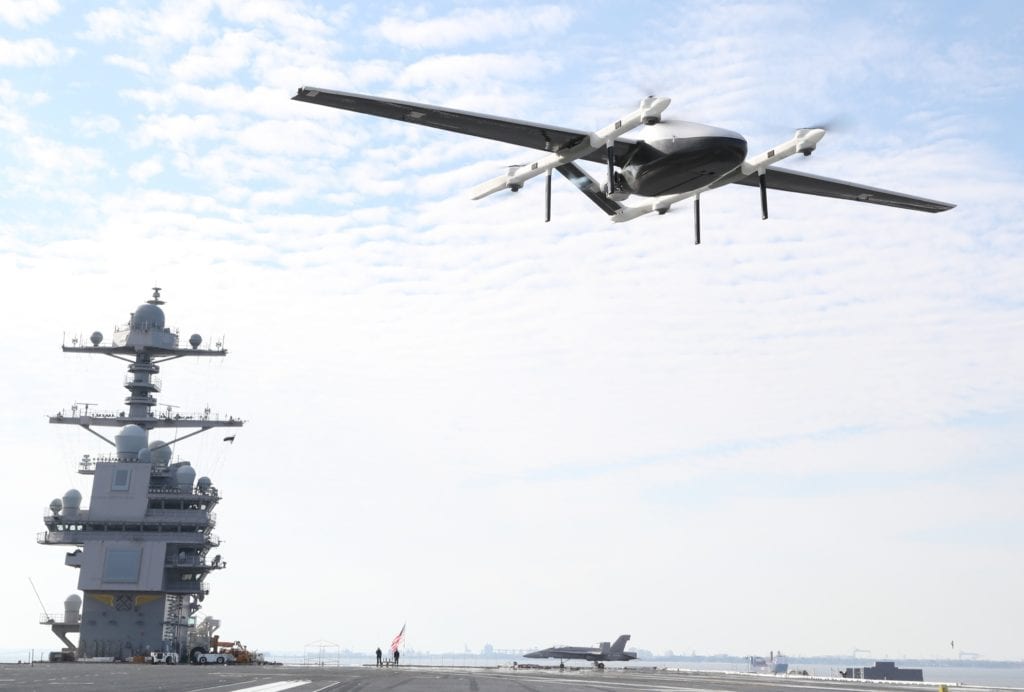
A logistics Unmanned Air System (UAS) prototype, called Blue Water UAS, approaches to deliver cargo on USS Gerald R. Ford’s (CVN 78) flight deck during supply demonstration Feb. 21, 2021. The test was successfully conducted by transporting light-weight logistical equipment from one part of Naval Station Norfolk aboard Ford while the aircraft carrier was in port. U.S. Navy / Chief Mass Communication Specialist RJ Stratchko

NORFOLK, Va. — Mid-Atlantic Regional Maintenance Center (MARMC) hosted the Blue Water Unmanned Aerial System (UAS) Skyways team for an exercise that could impact the way the Navy handles transporting parts for repairs needed aboard forward deployed ships, Chris Wyatt, MARMC public affairs specialist, said in a March 2 release. 

MARMC, in collaboration with the USS Gerald R. Ford (CVN 78) Beach Detachment and the Blue Water team, tested the abilities of a Maritime Logistics UAS to deliver a part to the ship from MARMC Headquarters. 

“The UAS departed the MARMC parking lot with a simulated package pickup and took the part needed for repair over to the Ford,” said MARMC Logistics Department Head, Cmdr. Kevin Borkert. “For this evolution MARMC handed the part to the UAS crew and they placed it in the cargo bay along the underside of the UAS.” 

In October 2020, the US Navy acquired a commercial unmanned vehicle developed by Skyways of Austin, Texas, to further develop and demonstrate long-range naval ship-to-ship and ship-to-shore cargo transport. Navy engineers and test pilots continue to organically enhance the system with developments like folding wings for better handling and ship storage and consider alternative air vehicle designs with advanced propulsion systems to provide greater range and payload performance, optical and infrared collision avoidance and landing systems, and navigation systems not only dependent on GPS. 

“Our motto is ‘We Fix Ships’ and we feel like they chose the right place to show this innovation in action,” said MARMC Commanding Officer Capt. Tim Barney. “I want MARMC to be a part of any program that uses advancements in technology, which could potentially save time, money and reduce the Navy’s carbon footprint, while helping to keep the fleet mission ready.” 

Moving forward, if MARMC is chosen as a pivot point in the procurement process for parts needed for repairs, it could potentially have a large and lasting impact on how business is done. 

MARMC provides surface ship maintenance, management and oversight of private sector maintenance and fleet technical assistance to ships in the Mid-Atlantic region of the United States and provides support to the fifth and sixth Fleet Area of Responsibilities. They are also responsible for the floating dry-dock Dynamic (AFDL-6). 


NOAA Begins Transition Exclusively to Electronic Navigation Charts

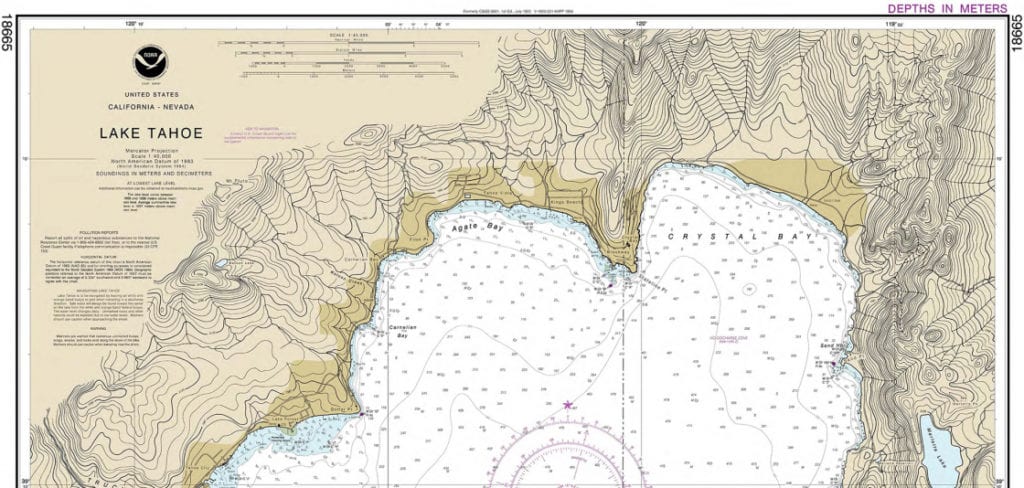
A paper chart of Lake Tahoe, the first paper chart to be entirely replaced with electronic navigational charts. NOAA

WASHINGTON — NOAA will begin to implement its sunset plan for paper nautical charts this month, starting with the current paper chart 18665 of Lake Tahoe, the agency announced in a Feb. 26 release. After August, NOAA’s electronic navigational chart will be the only NOAA nautical chart of the area. 

This is the first traditional paper chart to be fully supplanted by an electronic chart as part of NOAA’s Office of Coast Survey Raster Sunset Plan, which includes a new process to notify mariners of the transition of individual paper charts to electronic charts. These charts are easier to update and maintain, keeping mariners safer with up-to-date information on marine hazards.  

As part of the sunset plan, released in 2019, mariners will be officially notified of this chart’s cancellation in the U.S. Coast Guard Local Notice to Mariners. A note in the lower left corner of the chart will state that it is the last paper edition and it will be canceled six months later on August 26.   

NOAA will continue to announce the cancellation of additional paper charts as the sunset plan progresses, initially based on volume of sales or downloads, and in regions with improved NOAA electronic navigational chart coverage. Cancellation of all traditional paper and associated raster chart products will be completed by January 2025.  

NOAA announced the start of a five-year process to end traditional paper nautical chart production in late 2019 via a Federal Register Notice. While NOAA is sunsetting its traditional nautical chart products, it is undertaking a major effort to improve the data consistency and provide larger scale coverage within its electronic navigational chart product suite.  

Over the next four years, NOAA will work to ease the transition to electronic products by providing access to paper chart products based on electronic data. The online NOAA Custom Chart tool enables users to create their own paper and PDF charts from the latest NOAA ENC data.   


Second Navy Squadron Ready for F-35C Transition

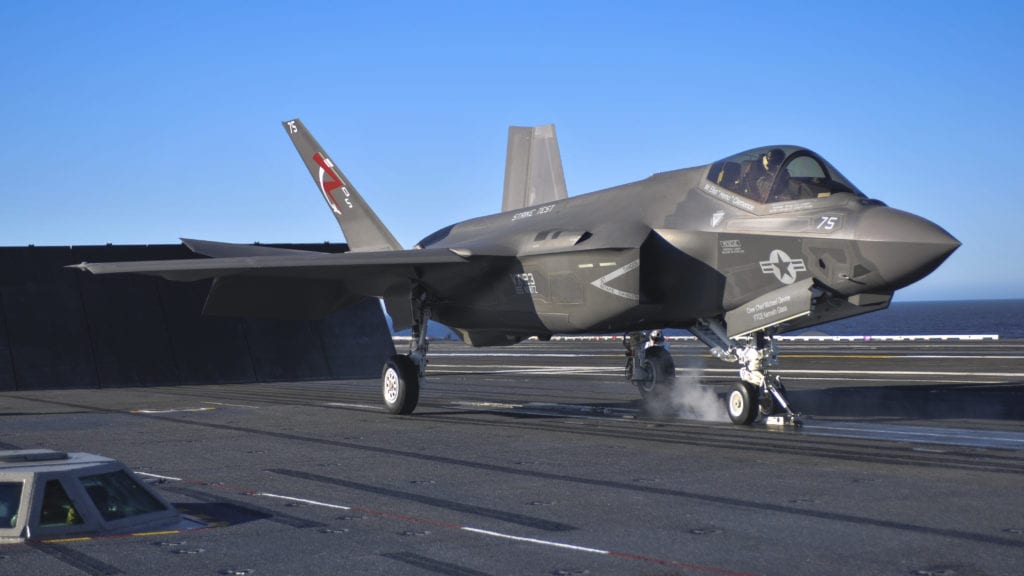
An F-35C Lightning II carrier variant joint strike fighter launches from the flight deck of the aircraft carrier USS Nimitz (CVN 68). U.S. Navy / Mass Communication Specialist Seaman Shauna C. Sowersby

ARLINGTON, Va. — The second Navy strike fighter squadron (VFA) slated for transition to the F-35C Lightning II strike fighter has made its last flight in the F/A-18E Super Hornet. 

The Warhawks of VFA-97, based at Naval Air Station Lemoore, California, flew the Super Hornet for the last time on Feb. 26. For more than a year, the squadron has operated older F/A-18Es in an adversary role to help train sister VFA squadrons in aerial combat.  

The Warhawks will receive transition training at Lemoore from VFA-125, the fleet replacement squadron for the F-35C. 

VFA-97 will become the Navy’s second fleet F-35C squadron. The first, VFA-147, is scheduled to deploy later this year with Carrier Air Wing Two on USS Carl Vinson (CVN 70). 

VFA-97 had operated the F/A-18 Hornet since 1991, and the F/A-18E Super Hornet since 2013. 

Marine Fighter Attack Squadron 314 (VMFA-314) also has completed transition to the F-35C and is scheduled to deploy on a carrier in fiscal 2022.  


Boeing Loyal Wingman Uncrewed Aircraft Completes First Flight

Boeing Australia and the Royal Australian Air Force have successfully completed the first test flight of the Loyal Wingman uncrewed aircraft. Boeing

AUSTRALIA — Boeing Australia and the Royal Australian Air Force (RAAF) have successfully completed the first test flight of the Loyal Wingman uncrewed aircraft, the company said in a March 1 release. 

The flight of the first military aircraft to be designed and manufactured in Australia in more than 50 years flew under the supervision of a Boeing test pilot monitoring the aircraft from a ground control station at the Woomera Range Complex. 

“The Loyal Wingman’s first flight is a major step in this long-term, significant project for the Air Force and Boeing Australia, and we’re thrilled to be a part of the successful test,” said Air Vice-Marshal Cath Roberts, RAAF head of Air Force Capability. “The Loyal Wingman project is a pathfinder for the integration of autonomous systems and artificial intelligence to create smart human-machine teams. 

“Through this project we are learning how to integrate these new capabilities to complement and extend air combat and other missions,” she said. 

Following a series of taxi tests validating ground handling, navigation and control, and pilot interface, the aircraft completed a successful takeoff under its own power before flying a pre-determined route at different speeds and altitudes to verify flight functionality and demonstrate the performance of the Airpower Teaming System design. 

“Boeing and Australia are pioneering fully integrated combat operations by crewed and uncrewed aircraft,” said Boeing Defense, Space & Security President and CEO Leanne Caret. “We’re honored to be opening this part of aviation’s future with the Royal Australian Air Force, and we look forward to showing others how they also could benefit from our loyal wingman capabilities.” 

With support from more than 35 Australian industry teams and leveraging Boeing’s innovative processes, including model-based engineering techniques, such as a digital twin to digitally flight-test missions, the team was able to manufacture the aircraft from design to flight in three years. 

This first Loyal Wingman aircraft is serving as the foundation for the Boeing Airpower Teaming System being developed for various global defense customers. The aircraft will fly alongside other platforms, using artificial intelligence to team with existing crewed and uncrewed assets to complement mission capabilities. 

Additional Loyal Wingman aircraft are currently under development, with plans for teaming flights scheduled for later this year. 


Fairbanks Morse Delivers Four Common Rail Technology Engines for ESB 6

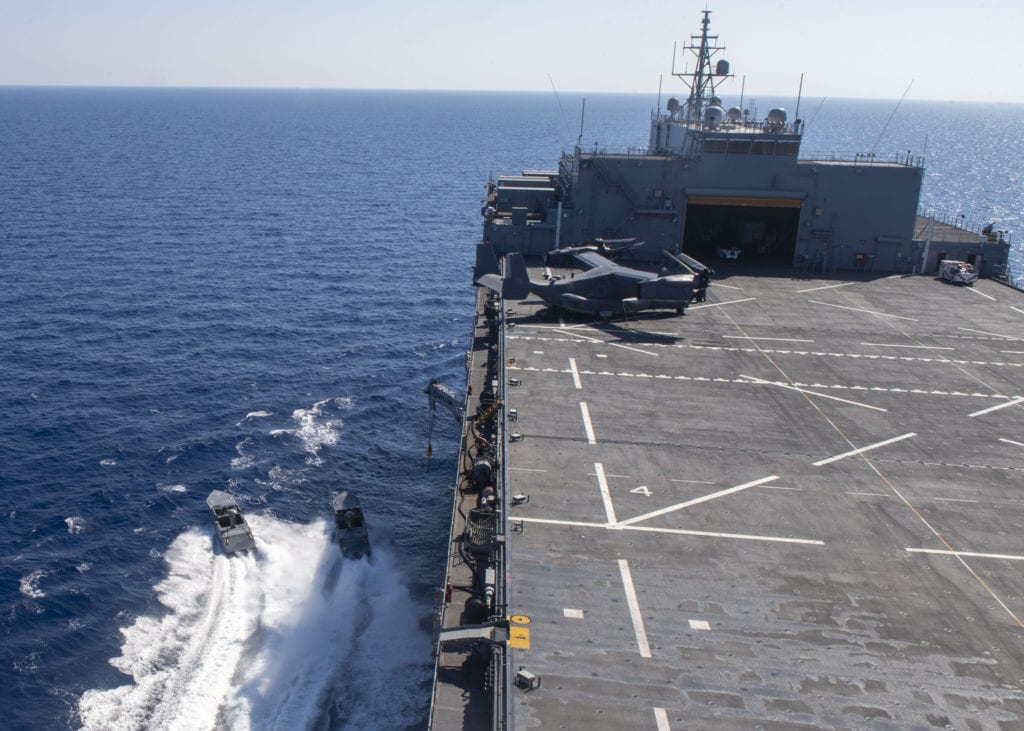
Fairbanks Morse recently delivered four engines to General Dynamics NASSCO for use on the future expeditionary sea base ship USS John L. Canley (ESB 6). Show in this 2020 photo is ESB USS Hershel “Woody” Williams (ESB 4). U.S. Navy/ Mass Communication Specialist Seaman Apprentice Conner Foy

BELOIT, Wis. — Fairbanks Morse, a portfolio company of Arcline Investment Management, recently delivered four FM 6L48/60CR engines to General Dynamics NASSCO in San Diego for Military Sealift Command on the future expeditionary sea base ship USS John L. Canley (ESB 6).

The ship is the sixth in the U.S. Navy’s Military Sealift Command Expeditionary Transfer Dock (ESD)/Expeditionary Sea Base (ESB) program and is designed to serve as a mobile sea base that provides access to critical infrastructure for the deployment of forces and supplies. 

“We are proud to once again deliver American-made power and propulsion systems that support critical operations for the U.S. Navy’s global missions,” said George Whittier, Fairbanks Morse’s CEO. “Our common rail technology solution is one of the most fuel-efficient and reliable maritime power solutions available and will generate significant cost savings for the U.S. Navy over the operational lifetime of the engines.” 

The four FM 6L48/60CR engines are rated at 6,480 kW and will deliver a total of 25,920 kW of installed power. The engines use common rail technology to deliver high fuel efficiency throughout the ships’ operational conditions. Common rail technology uses a high-pressure header, high-pressure pumps, electronically controlled fuel delivery, electronic governing system and an advanced control system to deliver precise amounts of fuel throughout all engine operations. This results in improved performance increased fuel efficiency and lower emissions. 

ESB class ships are used for a wide range of military operations and may support multiple operational phases. Among these are Airborne Mine Counter Measures (AMCM), counter-piracy operations, maritime security operations, humanitarian aid and disaster relief missions, and U.S. Marine Corps crisis response.  

ESB 6 honors Marine Corp Sergeant Major (retired) John L. Canley, a Medal of Honor Recipient for his actions serving during the Battle of Hue City in Vietnam Jan. 31 – Feb. 6, 1968. The Medal of Honor is the nation’s highest military honor. 

General Dynamics NASSCO started construction on ESB 6 in June 2020 and is also contracted to build ESB 7. Fairbanks Morse will begin construction on engines for ESB 7 later this year.  

Fairbanks Morse has served the U.S. Navy for more than 70 years, providing high-quality engines for marine propulsion and ship service systems. Today, Fairbanks Morse engines are installed on approximately 80% of U.S. Navy ships with a medium speed application.  


Navy Orders Four Additional CMV-22B Osprey COD Aircraft

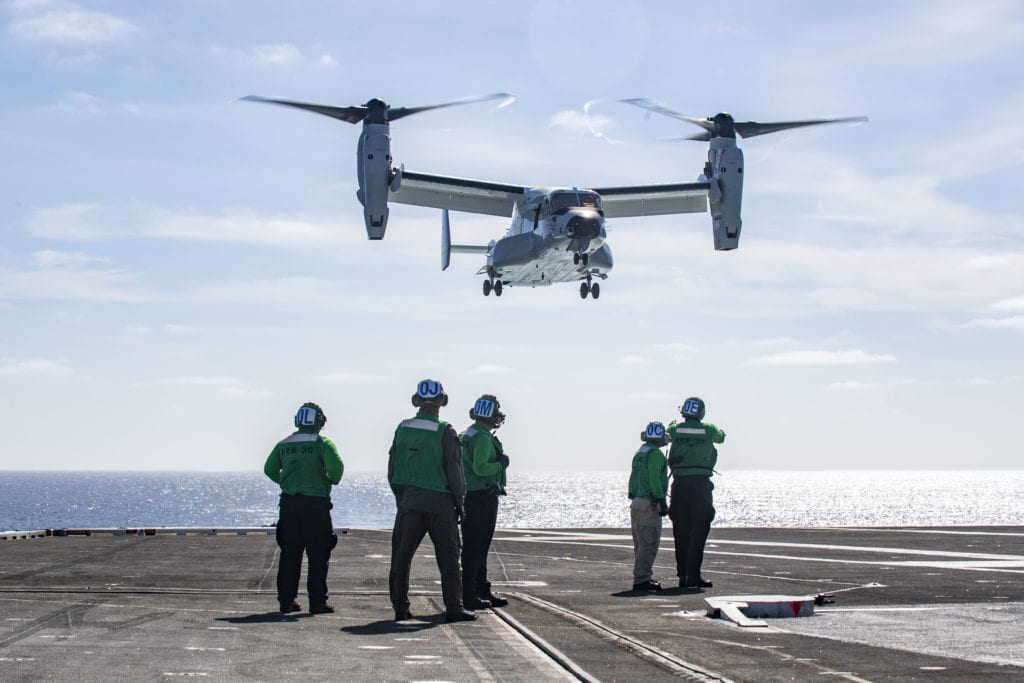
A CMV-22B Osprey from the “Titans” of Fleet Logistics Multi-Mission Squadron (VRM) 30 approaches the flight deck of Nimitz-class nuclear aircraft carrier USS Carl Vinson (CVN 70). U.S. Navy / Mass Communication Specialist 3rd Class Aaron T. Smith

ARLINGTON, Va. — The U.S. Navy has ordered four additional CMV-22B Osprey carrier-onboard delivery aircraft, according to a Feb. 26 Defense Department contract announcement.  

The Bell Boeing Joint Project Office, Amarillo, Texas, was awarded a $309.6 contract modification by the Naval Air Systems Command for the four CMV-22Bs,” the announcement said.  

The Navy’s CMV-22B replaces the C-2A Greyhound for the Carrier On-Board Delivery (COD) mission. Its mission is to transport personnel, mail, supplies and cargo from shore bases to aircraft carriers at sea. Forty-four of the 48 Navy program of record aircraft will be delivered under the June 2018 multiyear procurement contract.     

The CMV-22B differs from the MV-22B by having a high-frequency radio, extra fuel capacity, improved fuel dump capability, improved lighting for cargo handling and a public address system. The aircraft can carry up to 6,000 pounds up to a range of 1,150 nautical miles. It is capable of internally carrying the F-135 engine power module for the F-35 Lightning II.    

The CMV-22B made its first flight on Dec. 19, 2019 at Bell Flight’s Amarillo, Texas assembly facility and later flew to Naval Air Station Patuxent River to continue flight testing in February 2020. The first CMV-22B squadron, VRM-30, is working up a detachment to deploy on board USS Carl Vinson (CVN 70).    

Operational Test and initial operation capability are scheduled for 2021; full operational capability is scheduled for 2024.    


DoD Adds Two Mark VI Patrol Boats to Ukraine Aid Package

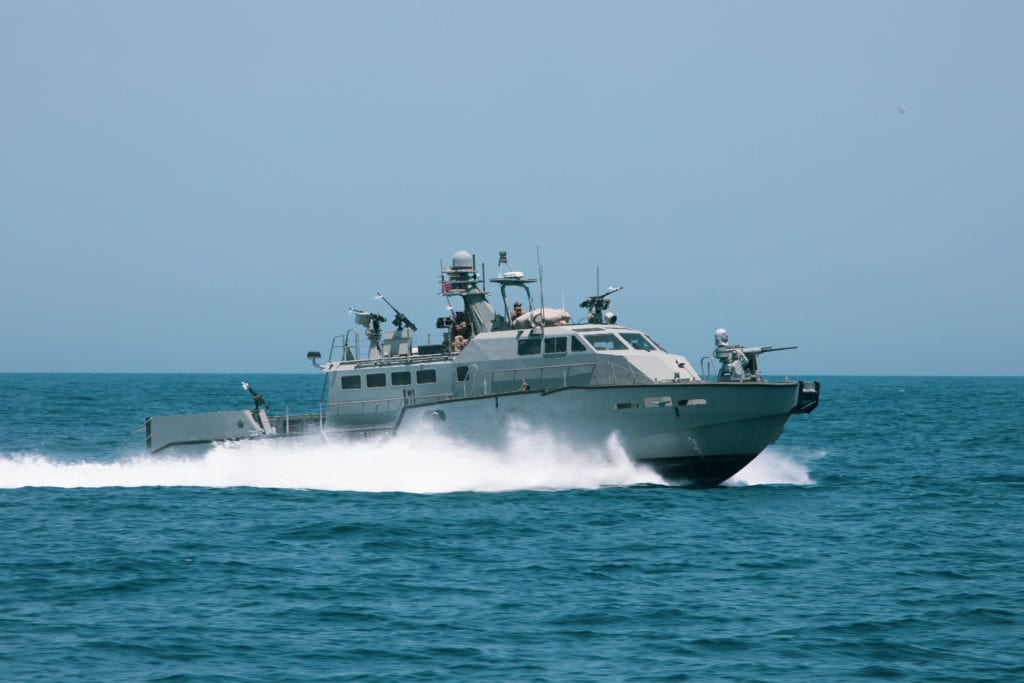
A Mark VI patrol boat, shown here in the Arabian Gulf in March 2020. U.S. Army / Pfc. Christopher Cameron

ARLINGTON, Va. — The Department of Defense has added two more modern patrol boats for Ukraine in a new security assistance package. 

“The Department of Defense announces a new $125 million package for the Ukraine Security Assistance Initiative that includes training, equipment, and advisory efforts to help Ukraine’s forces preserve the country’s territorial integrity, secure its borders, and improve interoperability with NATO, the department said in a March 1 release. “This action reaffirms the U.S. commitment to providing defensive lethal weapons to enable Ukraine to more effectively defend itself against Russian aggression.  

“The USAI package includes two additional armed Mark VI patrol boats to enhance Ukraine’s capacity to patrol and defend its territorial waters,” the release said.  “To date, the U.S. has committed a total of eight Mark VI patrol boats.”   

The Mark VI boats are being built by SAFE Boats International LLC of Bremerton. Washington.  

The U.S. State Department has approved the possible foreign military sale of up to 16 Mark VI patrol boats and related equipment to Ukraine for an estimated cost of $600 million, the Defense Security Cooperation Agency (DSCA) said in a June 17, 2020, release.   

The patrol boats will be operated by the Ukrainian navy to defend territorial waters and other maritime interests. They each will be armed with two MSI Seahawk A2 gun systems and two Mk44 cannons and equipped with electro-optical/infrared sensors and loud-speaker systems.  

The sale will “improve Ukraine’s capability to meet current and future threats by providing a modern, fast, short-range vessel,” the DSCA said.   

Mark VI patrol boats are used by the Navy Expeditionary Combat Command for escort of high-value ships, coastal patrol, and other maritime security missions.  


Admiral Praises Marine Corps’ Last Hornet Carrier Deployment

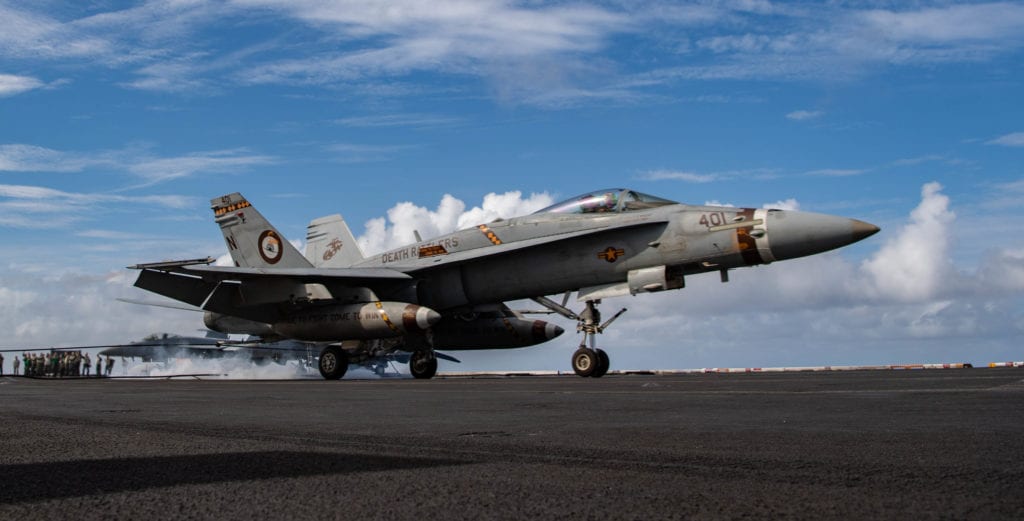
An F/A-18C Hornet, from the “Death Rattlers” of Marine Fighter Attack Squadron (VMFA) 323, makes an arrested landing on the flight deck of the USS Nimitz (CVN 68). Nimitz, flagship of Nimitz Carrier Strike Group, is currently conducting routine operations in U.S. 3rd Fleet. U.S. Navy / Mass Communication Specialist 3rd Class Charles DeParlier

ARLINGTON, Va.—The last deployment of the F/A-18C Hornet on an aircraft carrier ended last week with the return of the “Death Rattlers” of Marine Fighter Attack Squadron 323 (VMFA-323) from a deployment with Carrier Air Wing 17 on board USS Nimitz (CVN 68). 

The Death Rattlers returned to their home base, Marine Corps Air Station Miramar, California on Feb. 25, the day before Nimitz arrived at San Diego to offload CVW-17 personnel before heading to is homeport of Bremerton, Washington. 

Rear Adm. James Kirk, commander, Carrier Strike Group 11 and the Nimitz Carrier Strike Group, told reporters in a Feb. 26 teleconference that VMFA-323, despite flying the oldest jets deployed on a carrier, “performed fantastic yeoman work. Obviously with older aircraft, they do have challenges, but they rose to those challenges. Those maintainers did a great job, and those Marine pilots executed those missions, whether it was in support of Operation Inherent Resolve, Operation Octave Quartz, or Operation Resolute Support, or the just-presence missions we did or the operations we did during dual-carrier ops in the South China Sea with the Ronald Reagan Strike Group of the TR [Theodore Roosevelt] Strike Group. 

“That Marine squadron met the mark, hit the mission,” Kirk said. 

The deployment of Marine Corps F/A-18A and F/A-18C squadrons on carriers over the last two decades was a manifestation of the TACAIR Integration Plan, originally designed to provide one Marine VMFA squadron for each of 10 carrier air wings. Because of heavy commitments to wars in Afghanistan and then Iraq, the plan never fielded more than four VMFAs in the carrier air wings. With the transition of some VMFA squadrons to the F-35B and F-35C Lightning II strike fighters, the number of VMFAs on carriers dwindled to just one, VMFA-323. 

The program is alive, however, with VMFA-314 — the Corps’ first F-35C squadron — preparing to deploy with a carrier air wing in 2022. The Corps is procuring 67 F-35Cs, a number that will allow it eventually to field four VMFAs equipped with the type in carrier air wings.  

VMFA-323 will continue to operate the F/A-18C and will from a fleet replacement detachment to assume the role of training pilots and maintainers for Marine Corps F/A-18C/D squadrons after the fleet replacement squadron, VMFAT-101, is deactivated during fiscal 2023, as the Hornet training load decreases as the type is retired in 2030. According to the Marine Corps’ latest training plan, promulgated in 2019, VMFA-323 will be the Corp’s last active-duty Hornet squadron and will upgrade to the F-35B. 

The Death Rattlers were activated in 1943 with F4U Corsair fighters and flew combat missions against Japanese forces during World War II. They flew Corsairs again in the Korean War and F-4B Phantom II fighters in the Vietnam War. They flew Phantoms from carriers after the Vietnam war and were one of the Corps’ first Hornet squadrons. Together with VMFA-314, they made the Corps’ first carrier deployment in the type, flying in combat from USS Coral Sea (CV 43) in 1986 against Libyan targets during Operations Prairie Fire and El Dorado Canyon.    

The last F/A-18C carrier deployment of a Navy squadron ended in April 2018 with the return of Strike Fighter Squadron 34 (VFA-34) with Carrier Air Wing Two from USS Carl Vinson (CVN 70). VFA-34 was the Navy’s last active-duty deploying squadron to operate the legacy Hornet and has since upgraded to the F/A-18E Super Hornet. 

The Navy is divesting itself of the legacy Hornets as fast as procurement of the F/A-18E/F and F-35C permit. The Blue Angels flight demonstration squadron recently completed the transition to the Super Hornet and soon the Navy’s sole reserve VFA squadron will make the transition.   


Navy Orders 15th Expeditionary Fast Transport from Austal

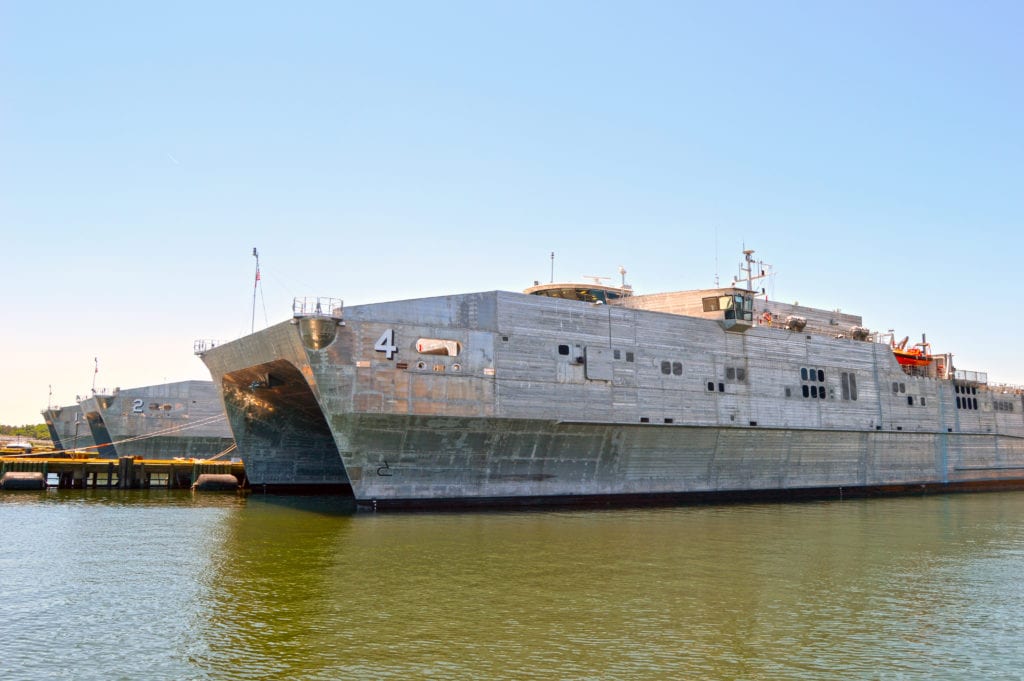
Expeditionary Fast Transport vessels, USNS Spearhead (T-EPF 1), USNS Choctaw County (T-EPF 2) and USNS Fall River (T-EPF 4) shown at Joint Expeditionary Base Little Creek-Fort Story in this 2015 photo. U.S. Navy / Brian Suriani

ARLINGTON, Va. — The U.S. Navy has awarded Austal USA a contract to build the 15th Spear-head-class expeditionary fast transport (EPF).  

The Naval Sea Systems Command awarded Austal a $235 million “undefinitized” contract action modification on Feb. 26, 2021, for the detailed design and construction of EPF 15, the company said in a release. 

The EPF, designated T-EPF in service to the Military Sealift Command, originally was designated a joint high-speed vessel, but has proven versatile in performing a number of roles in support of regional combatant commanders. Those roles have included humanitarian assistance, disaster relief, maritime security, surveillance, command and control, and counter narcotics, among others.  

“With a draft of only 13 feet and waterjet propulsion, the EPF is able to access austere and degraded ports with minimal external assistance providing flexibility to fleet and combatant commanders,” the Austal release said. “With its maneuverability, large open mission bay and ability to achieve speeds greater-than 35-knots, the EPFs have the capability to support additional missions such as special operations and medical support.” 

The Spearhead class originally was intended to be 10 ships: five for the U.S. Army and five for the Navy. The five Army ships later were reallocated to the Navy. The lead ship was delivered in December 2012. As the utility and success of the ships was demonstrated in operations, Congress has approved an increase in the number of hulls authorized, now at 15 ships. Austal has delivered 12 to the Military Sealift Command to date.  

EPF 15, like EPFs 13 and 14, will include an expeditionary medical capability. The EPFs are operated by civilian mariners of the Military Sealift Command.  

“At its core, the EPF is designed to be highly capable, flexible and affordable,” said Rusty Murdaugh, Austal USA’s chief financial officer and interim president. “With this baseline, we’ve been able to deliver multiple ships that are performing different missions for the U.S. military. The award of EPF 15 allows the Navy to leverage a hot production line and highly trained workforce to continue producing ships that are meeting the needs of warfighters today and into the future.”