With Crew Vaccinations Increasing, Newest Navy COVID-19 Guidance Looks to Ease Liberty Restraints
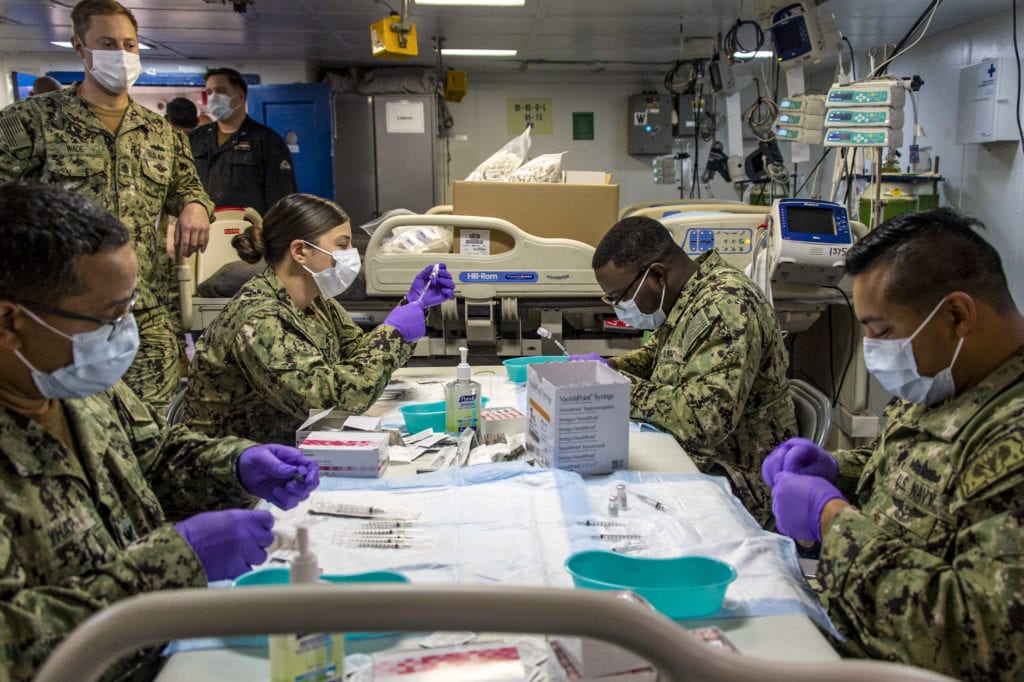
Sailors prepare syringes of the Pfizer COVID-19 vaccine aboard Wasp-class amphibious assault ship USS Essex (LHD 2). This marked the first time personnel received vaccines aboard a Pacific Fleet warship. Essex is homeported in San Diego. U.S. Navy / Mass Communication Specialist 3rd Class Brett McMinoway

ARLINGTON, Va. — The U.S. Navy’s newest operational guidance for dealing with the coronavirus pandemic includes provisions for more Safe Haven ports like Guam and Rota, Spain to provide secure  liberty opportunities for crews on increasingly lengthy deployments, according to senior officers.

COVID-19 Standardized Operational Guidance (SOG) 4.0 is the first directive for commanders since vaccines against the novel coronavirus became available in January. Although predominantly focused on shipboard environment, SOG 4.0 applies to all uniformed Navy personnel at home and deployed.

Fully immunized Sailors enable the Navy “to begin to unwind the limits” placed on Sailors at sea, where the consequence of a wide-spread outbreak is greatest, the Guidance issued Feb. 16, noted.

“Where a ship at sea can be a challenge to contain the spread, having a high immunization rate [among crew] could cause the disease to have nowhere to go and burn itself out,” Rear Adm. Karl Thomas, Assistant Deputy Chief of Naval Operations for Operations, Plans, and Strategy, (N3/N5B), said Feb. 19.

In a roundtable with reporters, Thomas said 35,000 Sailors have received at one vaccine injection and  45,000 are totally immunized. Rear Adm. Bruce Gillingham, the Surgeon General of the Navy, said those numbers amounted to about 23% of the Fleet having at least one dose of the vaccine. Whether immunized Sailors can still transmit the virus remains “the $64,000 question,” Gillingham said.

Since a COVID outbreak in early 2020 infected more than 1,000 crew members of the USS Theodore Roosevelt and sidelined the aircraft carrier at Guam for months, deployed ships have spent nearly all their time at sea. Additionally, increased operational tempo has led to longer deployments and quick turn arounds, or double pumps, for carrier strike groups, causing stress for crews and their families. The carrier USS Dwight Eisenhower, at sea for seven months in 2020, was deployed again in February.

“Up until this point, we’ve really had to restrict the Sailors to liberty on the pier,” Thomas said, adding. “In Guam there’s a beach right next to the pier and we’re able to keep it segregated from the population so they can get some liberty on the pier as well as get down to the beach.”

But in SOG 4.0, he said “we actually put a paragraph in there about Safe Haven ports in places like Guam, Yokosuka, Bahrain.” Officials hope that crews with higher immunization rates will be able to have more quality liberty opportunities at ports with more services like Exchanges and Morale, Welfare and Recreation facilities.

The final decision on safe haven ports will be up the geographically dispersed Navy component commanders “but we wanted to put [the opportunity] into the guidance for them to be able to do that type of thing,” Thomas said.
Taking COVID into account, NATO presses on with ambitious ASW exercise in Mediterranean

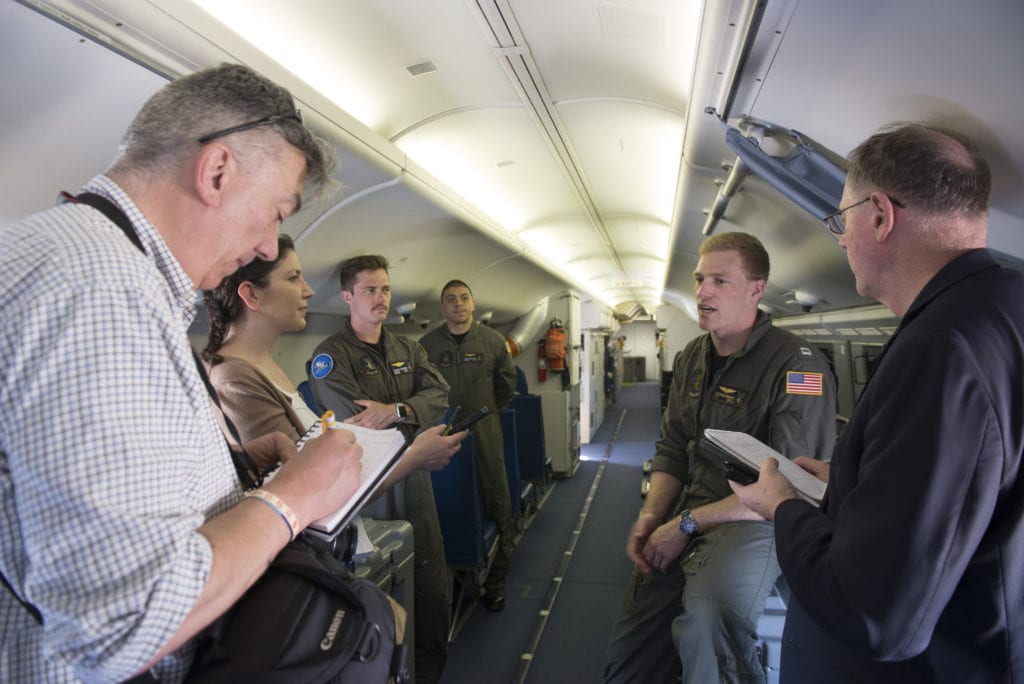
Lt. Stefan Knight, a naval flight officer assigned to Patrol Squadron (VP) 4, speaks to the press about VP-4’s involvement in Dynamic Manta 2020, Feb. 25, 2020. Dynamic Manta is an annual exercise hosted by NATO’s Allied Maritime Command to provide training in anti-submarine warfare and anti-surface warfare in order to enhance overall multi-lateral operations among NATO allies. U.S. Navy / Mass Communication Specialist 2nd Class Juan Sua

NATO will exercise its anti-submarine warfare and anti-surface warfare capabilities of allied naval units from Feb. 22 to March 5 during Exercise Dynamic Manta in the central Mediterranean.

Dynamic Manta 2021 includes five surface combatants with their organic helicopters from France, Greece, Italy, Spain and Turkey; six submarines from France, Germany, Italy, Turkey and the U.S.; five land-based maritime patrol aircraft from France, Germany, Greece, Italy and the U.S.; and the French Navy’s Charles De Gaulle Carrier Strike Group, with escorts from France, Germany, Greece and the U.S. 

Spanish navy Rear Adm. Manuel Aguirre Aldereguía, commander of Standing NATO Maritime Group Two (SNMG 2), is the on-scene commander of Exercise Dynamic Manta.

Last year, Dynamic Manta 2020 began just as the global pandemic was gripping Italy and the world. This year, the exercise was planned and is being executed with all the precautions and health regulations to keep people safe.

According to French navy Vice Adm. Didier Piaton, deputy commander of NATO Allied Maritime Command, Dynamic Manta in the Mediterranean is one of two major anti-submarine warfare exercises held each year, along with Dynamic Mongoose in the high North Sea.

“Like all MARCOM exercises, this one will demonstrate NATO’s willingness and capacity of keeping resilience and readiness, and to maintain the security of our allied nations,” Piaton said.

This year, the French navy’s Charles DeGaulle carrier strike group will join for training for a limited time, and will enhance its own ASW skills on its way to its operational deployment. This interaction is an opportunity for NATO and allied units to train together to enhance interoperability and build expertise.

The Italian navy is hosting the exercise in waters near the Sicilian city of Catania, not far from the naval air station at Sigonella. Rear Adm.Andrea Petroni, commander of the Italian navy’s submarine service, said the central Mediterranean and its location on the southern flank of Europe represents a realistic and valuable training opportunity.

“It’s important to participate in this kind of advanced International training activity to exchange knowledge and share lessons learned in order to increase the operational capabilities and professional development of the crews,” Petroni said.

Aldereguía said COVID-19 was a new factor in exercise planning process.  Procedures were instituted to prepare the units of SNMG 2 so the task group can maintain its high degree of readiness while taking care of the health and well-being of the crews and staff members.

“We are in a COVID-limited environment, “said U.S. Navy Rear Adm. E. Andrew Burcher, Commander Submarines, NATO, and exercise director.  “A year ago, we became aware of the virus just as Dynamic Manta 2020 was starting. We had to make adjustments as we went. We were able to hold Dynamic Mongoose 2020 later in the summer. And we’re going ahead and conducting this exercise, with no material impact on the operation or the exercise. It shows how well the NATO Alliance and the countries have adapted to this new reality and travel-restricted environment. We’re doing the best we can under the circumstances, and that’s a testament to how great this organization is.”

While NATO is technically able to complete the exercise and have a productive training experience, Burcher said the pandemic has precluded a lot of personal interaction compared to previous years.

“What’s lost are the personal connections that make the alliance stronger,” he said. “Our center of gravity of NATO is alliance cohesion, and the reason alliance cohesion exits is because of the friendships and partnerships exist when we meet personally on ships and shake hands with each other.” 

Burcher said there are other differences between the 2020 and 2021 event.  Although NATO’s Science and Technology Organization Center for Maritime Research and Experimentation (CMRE) will not join the ships at sea with its research ship, the Alliance, and its group of unmanned vehicles as they did in 2020, CMRE will still be involved this year. “We will be utilizing CMRE for technical analysis capability to improve our training as well as our understanding of the operating environment,” Burcher said.

“Most importantly, we’re going to have the benefit of having the Charles de Gaulle carrier strike group go through the exercise area,” Burcher said. “This is an important and unique opportunity for both the submarines and the surface ships to engage in a high threat environment. The submarine will be looking at how they prosecute a high-value unit as it transits in a typical transit scenario, while at the same time the CSG will be able to proceed through a submarine-dense environment and practice their ASW skills. That is a unique opportunity. We are taking advantage of integrating the schedules of national operations with NATO operations.

“Even in the COVID environment we are advancing and moving forward with our ASW skills,” Burcher said.


Navy Begins Retirement of Cyclone-Class Patrol Ships Without Replacement

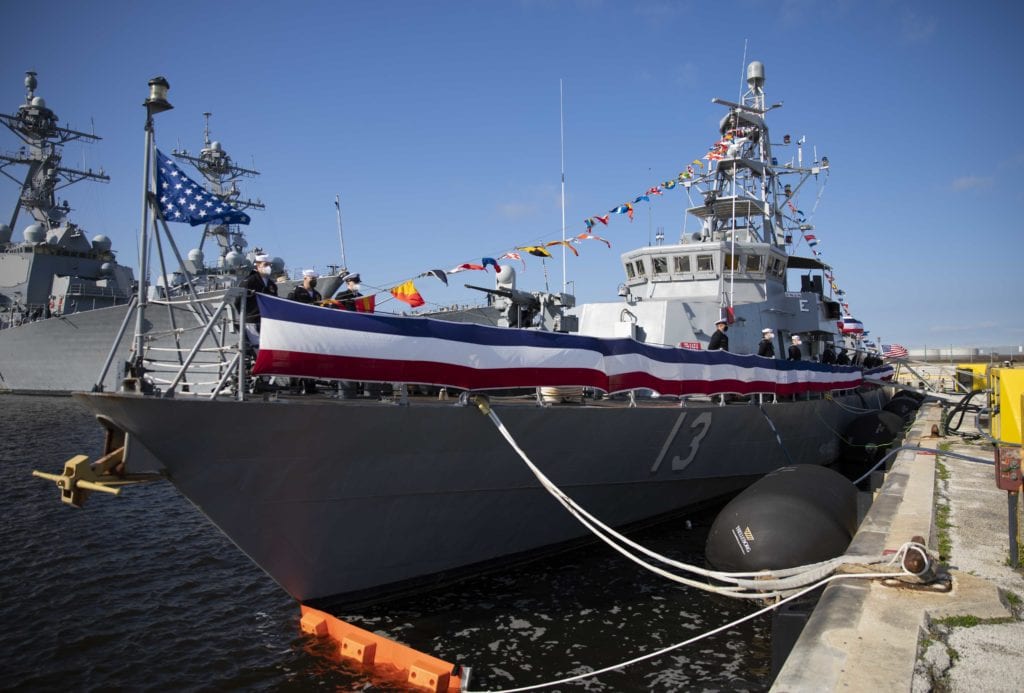
Sailors conduct a decommissioning ceremony aboard the Cyclone-class patrol ship USS Shamal (PC 13) at Naval Station Mayport, Florida. Shamal is one of three Cyclone-class patrol ships being decommissioned at Naval Station Mayport. U.S. Navy / Mass Communication Specialist 3rd Class Austin G. Collins

ARLINGTON, Va. — The Navy held ceremonies this week to mark the decommissioning of three Cyclone-class coastal patrol ships this week, beginning the retirement of the class which has no direct replacement. 

The three decommissioning ceremonies held over three days — Feb. 16, 17, and 18 — marked the imminent retirement of the Cyclone-class coastal patrol ships USS Shamal (PC 13), USS Zephyr (PC 8) and USS Tornado (PC 14), respectively, at Naval Station Mayport, Florida. 

In recent years, the three PCs were used to train crews for the 10 PCs forward deployed to the Persian Gulf. They also participated in homeland security missions such as drug interdiction countering illegal immigration. 

The Navy commissioned 14 Cyclone-class PCs between 1993 and 2000. They were built by Bollinger Shipyards and designed for coastal interdiction and support of special operations forces such as SEALs. They were built with a 15-year service life and even the newest already has operated for six years beyond that. 

The lead ship, USS Cyclone, was transferred to the Philippine Navy after being briefly transferred to the U.S. Coast Guard, which did not operate the ship.  

Several PCs operated in support of Operation Iraqi Freedom and ultimately 10 were forward deployed to the U.S. Fifth Fleet in the Persian Gulf. 

During 2004, five PCs were transferred to the U.S. Coast Guard to perform homeland security missions. All five were returned to the Navy by August 2008.  

“The decision to decommission these three ships [Shamal, Zephyr and Tornado] stems from the fact that they have all exceeded their designed service life,” the Navy said in a Feb. 17 web article. “Based on the rising cost of modernization efforts, the Navy will receive a better return by decommissioning and freeing up funds to invest in other platforms.” 

The PCs offer rare command-at-sea opportunity for lieutenants, one reason the ships will be missed. The ships will have no direct replacements, but their presence in the Persian Gulf eventually will be assumed by littoral combat ships. 

“These three warships have served our Navy and our country well,” said Capt. Mike Meyer, commander, Naval Surface Squadron Fourteen, in the Navy release.  “Each of them has operated well past their designed service life, with their crews contributing demonstrably to meeting our national objectives.” 

The three PCs being retired are being transferred to the Navy’s inactive ship facility in Philadelphia, where they will be decommissioned officially. The official decommissioning dates are Feb. 25, March 2 and March 4 for Shamal, Zephyr and Tornado, respectively. Tornado will be held for Foreign Military Sales; the other two will be scrapped. 


MDSU 2 Hosts Ice Dive Training for Arctic Training

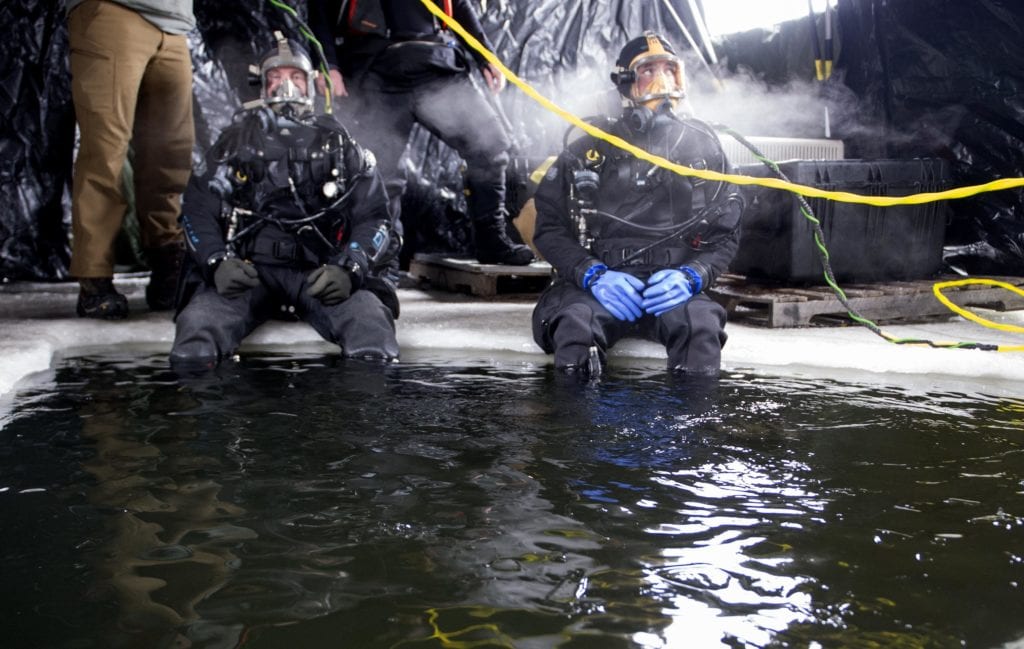
Navy divers assigned to Mobile Diving and Salvage Unit (MDSU) 2 prepare to enter the water during ice dive training at Camp Ripley in Little Falls, Minnesota. The training hosted by MDSU 2, is in its third iteration and has become more relevant, showcasing how Navy divers are assisting in building a more capable arctic naval force. U.S. Navy / Chief Mass Communication Specialist Jeff Atherton

VIRGINIA BEACH, Va. – Mobile Diving and Salvage Unit (MDSU) 2, headquartered at Joint Expeditionary Base Little Creek-Fort Story, hosted the third iteration of ice dive training for Navy divers and explosive ordnance disposal (EOD) technicians at Camp Ripley in Little Falls, Minnesota, in February, the group said in a Feb. 16 release. 
 
The course, run by qualified Navy divers and civilian instructors, teaches the fundamentals of operating on and diving under the ice. 

Ice diving is unique and it can be hazardous without the proper training. Dry suit familiarization dives must be completed prior to diving under the ice, and scuba cold-water set-up training and familiarization must also take place prior to the operation.

Familiarization and training on all aspects must be conducted prior to operating in an Arctic environment, which is why civilian instructors are used who have a wealth of experience operating in these cold environments. The courses hosted by Dive Rescue International are introductory and provides the tools necessary for Navy divers to execute ice diving operations in an Arctic environment. The extensive logistical considerations, medical considerations, emergency evacuation procedures, and topside personnel considerations are also taken into account prior to execution. 

Camp Ripley is an outstanding site to conduct ice and cold weather dive training. The site allows Navy divers to train in a subzero temperature and arduous conditions at training ranges that provide bodies of water similar to operating in the Arctic environment. The Army National Guard has been a tremendous help in supporting with base facilities and logistical support making it an ideal location to train in the Arctic environment now and in the future. 

In the course, the divers are responsible for dive setup, which includes building tents, heating the tents and cutting holes in the ice before diving. 

While the Arctic environment is not outside of the skill set of Navy divers, it is a significant difference from the comparatively warmer waters of Virginia Beach and the significantly warmer waters of Key West, Florida, where many divers are accustomed to training. 

With the recent release of the Department of the Navy’s strategic blueprint for the Arctic, this annual training event has become even more relevant, showcasing how Navy divers are assisting in building a more capable arctic naval force. 

MDSU 2 is part of Explosive Ordnance Disposal Group (EODGRU) 2, which oversees all East Coast explosive ordnance disposal and a mobile diving and salvage unit which are capable of providing skilled, capable, and combat-ready deployable forces around the globe to support a range of operations.

Article by Chief Petty Officer Jeff Atherton, Explosive Ordnance Disposal Group Two


Lawmakers Renew Push for Navy to Procure 3 Virginia Submarines Per Year

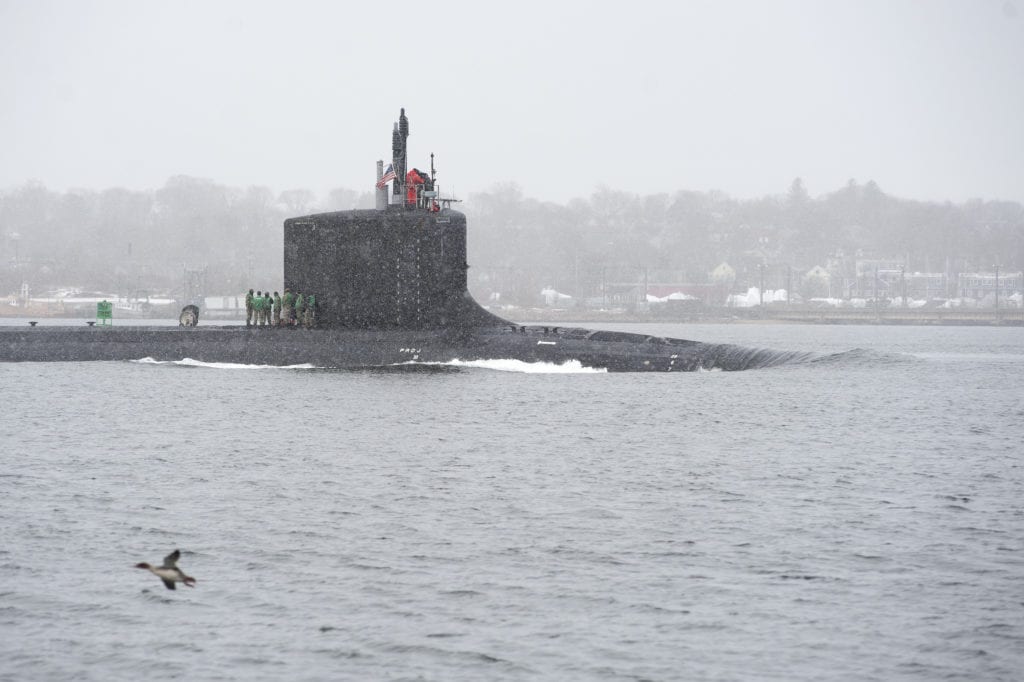
The Virginia-class attack submarine USS Vermont (SSN 792) makes its way up the Thames River and past New London, Connecticut on Feb. 3. Leaders of the House Armed Services Committee’s Seapower subcommittee want the Navy to increase its procurement of Virginia-class boats to three per year. U.S. Navy / John Narewski

ARLINGTON, Va. — The Navy needs to increase procurement of its Virginia-class attack submarines (SSNs) to three per year in order to pace the potential threat of China and Russia, said the congressmen who lead the Seapower subcommittee in the House Armed Services Committee. The U.S. Navy also needs to push ahead with development of the follow-on to the Virginia class, they said.  

Speaking Feb. 19 in a webinar sponsored by the Hudson Institute, Rep. Joe Courtney, D-Connecticut, chairman of the Seapower subcommittee, and Rep. Rob Wittman, R-Virginia, ranking member, were united in their reiteration of the need for more attack submarines and have renewed the push to include three in the 2022 defense budget, a level that nearly was achieved in the 2021 final budget.  

Wittman noted a recent study that reinforced how “incredibly important getting to building three attack submarines per year will be for this nation going forward.” 

Wittman said it was critical the Navy request a third SSN in the president’s 2022 budget proposal because “it is extraordinarily difficult to add things to the president’s budget.” 

He recounted the effort to increase the procurement of a third SSN in the 2021 budget, which was ultimately unsuccessful when the proposed amendment was defeated in the House in a floor vote for the appropriations bill.  

Wittman is optimistic the third submarine will be included in the 2022 budget, saying, “I think the glass is half full.” 

Courtney also is optimistic, noting the recent statements by Defense Secretary Austin — a retired Army general — and Gen. Mark Milley, chairman of the Joint Chiefs of Staff — an Army general — that the budget “pie” may need to be sliced more in favor of naval, aerial, and cyber capabilities. 

The construction of the Columbia ballistic-missile submarine that began recently is pressuring the budget of the Navy and capacity of the submarine industrial base.  

“Frankly, we’re going to need more facilities if we’re really going to get serious about going for three [SSNs] per year on a regular basis,” Courtney said.

The nation’s two submarine builders are General Dynamics Electric Boat in Courtney’s district and Huntington Ingalls Newport News Shipbuilding in Virginia, Wittman’s home state.  

Courtney said he also has concerns about the work force but is “bullish” on solving that challenge. He stressed the need to “keep performance of the shipyards at uppermost.” 

Wittman supports the Navy’s plan to extend the service lives of some Los Angeles-class SSNs as part of the formula to a submarine force large enough to meet the potential threat from near-peer competitors like China and Russia.  

He also stressed the need for the Navy to focus on development of the next-generation of attack submarines to assure no gaps as the production of the Virginia-class SSNs ends.  


15th MEU Supports Operation Inherent Resolve from Makin Island ARG

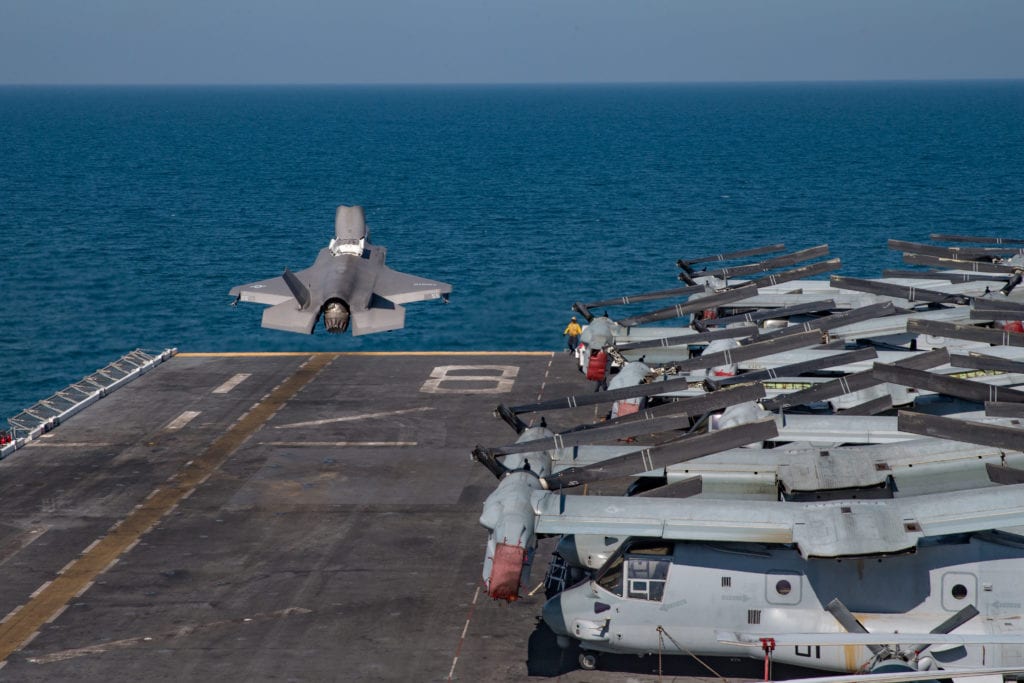
A Marine Corps F35B Lightning II assigned to Marine Medium Tiltrotor Squadron 164 (Reinforced), 15th Marine Expeditionary Unit (MEU), launches from the flight deck of the amphibious assault ship USS Makin Island (LHD 8) during flight operations in support of Operation Inherent Resolve, Feb. 13. U.S. Marine Corps / Sgt. Sarah Stegall

PERSIAN GULF — The Makin Island Amphibious Ready Group (ARG) and the 15th Marine Expeditionary Unit (MEU) began air operations in support of Operation Inherent Resolve (OIR), Feb. 13, the 15th MEU Public Affairs said in a Feb. 16 release. 

Close air support operations and defensive counter air support operations were carried out by Marine Medium Tiltrotor Squadron (VMM) 164 (Reinforced), the aviation combat element of the 15th MEU, as part of broader U.S. Central Command counterterrorism operations in the region. 
 
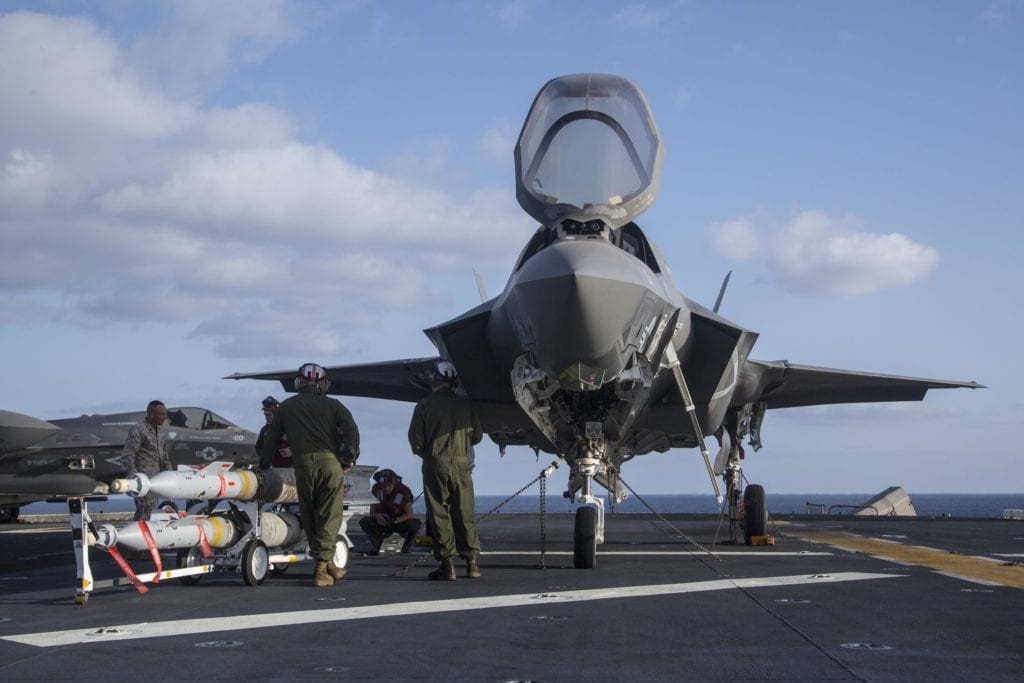
U.S. Marine Corps F-35B Lightning II aircraft departed from the amphibious assault ship USS Makin Island (LHD 8), flagship of the Makin Island Amphibious Ready Group, to execute the long-range strike. 
 
“Long range F-35B Lightning II strike operations demonstrate the ARG/MEU’s ability to project air power well beyond the shore,” said U.S. Marine Corps Col. Christopher J. Bronzi, the 15th MEU commanding officer. “We look forward to exercising the capabilities in our arsenal while in theater and remain ready to deliver those capabilities at any time if called upon.” 
 
The Makin Island ARG transited through the Strait of Hormuz and into the Arabian Gulf on Feb. 8. The Makin Island ARG and 15th MEU’s presence in the U.S. 5th Fleet area of operations demonstrates the U.S. and its regional partners’ commitment to the free flow of commerce, regional maritime security and freedom of navigation. 
 
“This mission is a strong example of the value a deployed naval expeditionary force brings to combatant commanders and joint partners in the region,” said U.S. Navy Capt. Stewart Bateshansky, Makin Island ARG commodore. “The MEU’s ability to source combat sorties from the Makin Island, while simultaneously supporting training and operations, is a testament to the flexibility and responsiveness of our Navy and Marine Corps team.” 
 
The Makin Island ARG and embarked 15th MEU provide the combatant commander with a responsive, flexible and forward-deployed asset capable of maritime power projection, contingency operations and crisis response, shaping the operational environment to protect the United States and allied interests in any threat environment. 
 
“We are proud and excited to be able to support missions in areas of the world where we are most needed,” said U.S. Marine Corps Lt. Col. Christopher Kelly, VMM-164 (Rein.) executive officer. “Conducting a long range strike mission with fifth generation F-35B fighters from amphibious assault ships demonstrates the versatility this platform brings to the joint force.” 
 
The U.S. 5th Fleet AOO encompasses about 2.5 million square miles of water and includes the Persian Gulf, Gulf of Oman, Red Sea and parts of the Indian Ocean. The expanse is comprised of 20 countries and includes three critical choke points at the Strait of Hormuz, the Suez Canal and the Strait of Bab al Mandeb at the southern tip of Yemen.  


Cubic to Deliver P5 Combat Training System for the F-35

U.S. Marines with Marine Fighter Attack Squadron 211, 13th Marine Expeditionary Unit (MEU), guide ordnance toward an F-35B Lightning II aboard the Wasp-class amphibious assault ship USS Essex (LHD 2), Sept. 22, 2018. Cubic Mission and Performance Solutions will provide two more production lots of the P5 Combat Training System for the F-35. U.S. Marine Corps / Cpl. Francisco J. Diaz Jr.

SAN DIEGO —Cubic Mission and Performance Solutions (CMPS) business division was awarded a contract worth $32 million from Lockheed Martin for two more production lots of the P5 Combat Training System (P5CTS) for the F-35 Lightning II, Cubic announced in a Feb. 19 release.

Under the contract, Cubic will deliver over 150 training subsystems for Lockheed Martin’s F-35 Air Combat Maneuvering Instrumentation (ACMI) system. This new order increases the total number of F-35 P5 on contract to over 1,150 and ensures fielding of F-35 P5 out to 2025. 

Unlike traditional P5 podded solutions for fourth-generation fighter aircraft, the F-35 P5 is an internal subsystem configuration that relays time, space and position information between participating aircraft and range ground stations during training sorties.  

“Our advanced and interoperable P5CTS is used on more than 30 ranges worldwide and continues to set the standard for joint, multiservice and coalition training,” said Mike Knowles, president of Cubic Mission and Performance Solutions. “Training for today’s advanced threats to air combat operations requires adaptable, high-fidelity training tools. Cubic’s P5CTS provides secure and scalable instrumentation solutions that enable integrated fourth- and fifth-generation training for our U.S. forces, allies and partners.” 

The worldwide P5 infrastructure includes the integration of P5 pods and internal subsystems, ground stations and software, and is an investment shared by 17 countries.  A recent upgrade to this training infrastructure is the integration of decryptors in the P5 ground stations to enable F-35 live monitoring at training ranges. 

Cubic and its principal subcontractor, Leonardo DRS, will continue to produce and maintain the F-35 P5 internal subsystem. The Leonardo DRS Airborne and Intelligence Systems business division is responsible for the design and production of the airborne P5CTS Internal Subsystem. 


State Dept. Approves Possible Sale of RAM Block 2 Missiles for Egyptian Navy

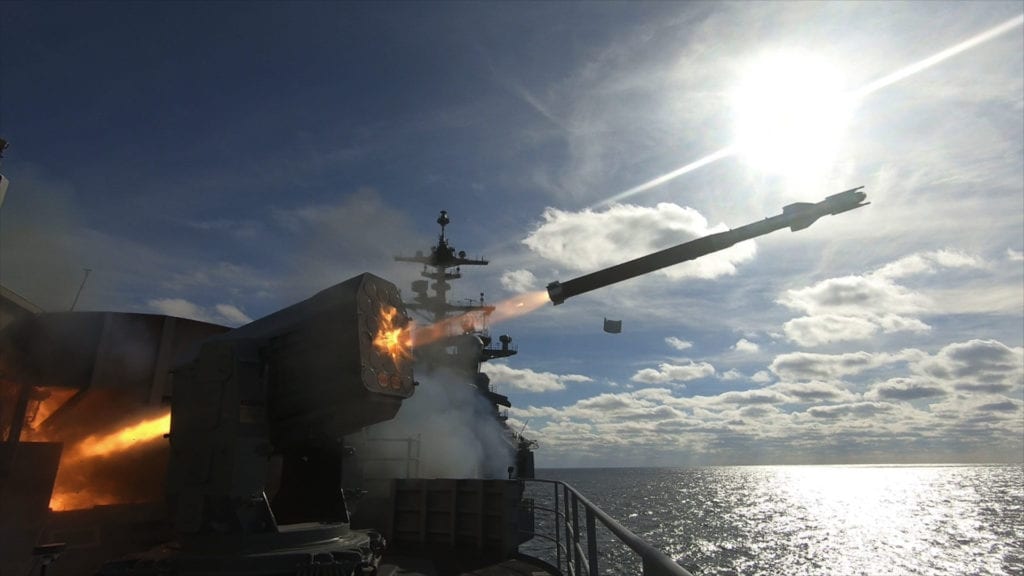
The Nimitz-class aircraft carrier USS Abraham Lincoln (CVN 72) launches a Rolling Airframe Missile (RAM) during combat system ship qualification trials in this 2018 photo. U.S. Navy photo

WASHINGTON—The U.S. State Department has approved a possible Foreign Military Sale to the government of Egypt of Rolling Airframe Missile (RAM) Block 2 tactical missiles and related equipment for an estimated cost of $197 million, the Defense Security Cooperation Agency (DSCA) said in a Feb. 16 release.

Egypt has requested to buy up to 168 RIM‑116C RAM Block 2 missiles, according to the release. “Also included in the possible sale are RAM Guided Missile Round Pack Tri-Pack shipping and storage containers; operator manuals and technical documentation; U.S. government and contractor engineering, technical and logistics support services; and other related elements of logistical and program support.”  

The proposed sale will support the Egyptian navy’s fast missile craft to provide “significantly enhanced area defense capabilities over Egypt’s coastal areas and approaches to the Suez Canal. Egypt will have no difficulty absorbing this equipment into its armed forces since Egypt already operates previously procured RAM Block 1A missiles,” the release said. 

The principal contractor will be Raytheon Missiles & Defense, Tucson, Arizona.   


KBR to Reinforce the US Navy’s Counter-Unmanned Air Systems

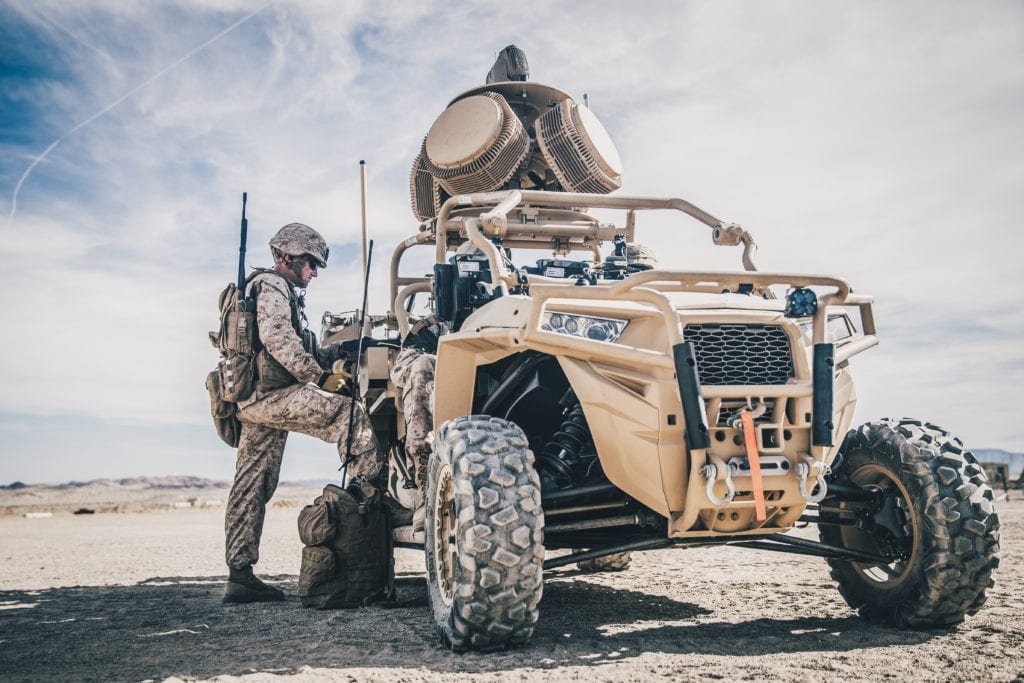
1st Lt. Taylor Barefoot, a low altitude air defense officer with Marine Medium Tiltrotor Squadron 163 (Reinforced), 11th Marine Expeditionary Unit, programs a counter-unmanned aircraft system on a Light Marine Air Defense Integrated System (LMADIS) during a predeployment training exercise at Marine Corps Air Ground Combat Center Twentynine Palms, Calif., Nov. 13, 2018. U.S. Marine Corps / Lance Cpl. Dalton S. Swanbeck

HOUSTON — KBR has been awarded a $92.6 million contract to perform engineering, integration and sustainment services on counter unmanned air systems (C-UAS) for the Combat Integration & Identification Systems unit within the U.S. Naval Air Warfare Center Aircraft Division (NAWCAD), the company said in a Feb. 16 release. 

This cost-plus-fixed-fee, indefinite-delivery/indefinite-quantity contract is a new opportunity for KBR to help the U.S. military with ground-based air defense. 

KBR will provide its expertise to various Navy identification and data link systems, which include the Negation of Improvised Non-State Joint Aerial-Threats (NINJA) system; Counter-Remote Control Model Aircraft Integrated Air Defense Network (CORIAN) system; SkyTracker UAS detection and tracking suite; Light Marine Air Defense Integrated System (LMADIS); Marine Air Defense Integrated System (MADIS); and ANDURIL artificial intelligence platforms. 

The Department of Defense uses these C-UAS systems to strengthen homeland security and address potential threats in the U.S. and abroad. The systems can scan the skies for enemy aircraft and take appropriate action to deny airspace access. 

KBR’s specific tasks will include the integration and installation of systems; the characterization of system and subsystem components; development of training curriculum and materials, as well as delivery of formal training programs; supply system management and material control; testing and repair of C-UAS; and laboratory maintenance and quality assurance. The company will perform the five-year contract primarily at Webster Outlying Field in St. Inigoes, Maryland.  

KBR’s services supporting NAWCAD will also benefit programs sponsored by the Naval Air Systems Command; Naval Sea Systems Command; Naval Inventory Control Point – Mechanicsburg; U.S. Coast Guard; commercial and Foreign Military Sales customers; and other DoD and government entities. 

 “Our work through this new win will have wide-reaching impacts within the DoD and international allied community,” said Byron Bright, KBR Government Solutions president. “We are excited to join NAWCAD as it advances C-UAS technology and, ultimately, strengthens national security and protects our armed forces around the globe.” 


Astronics Awarded Boeing Contracts to Support Navy’s MQ-25 Unmanned Tanker

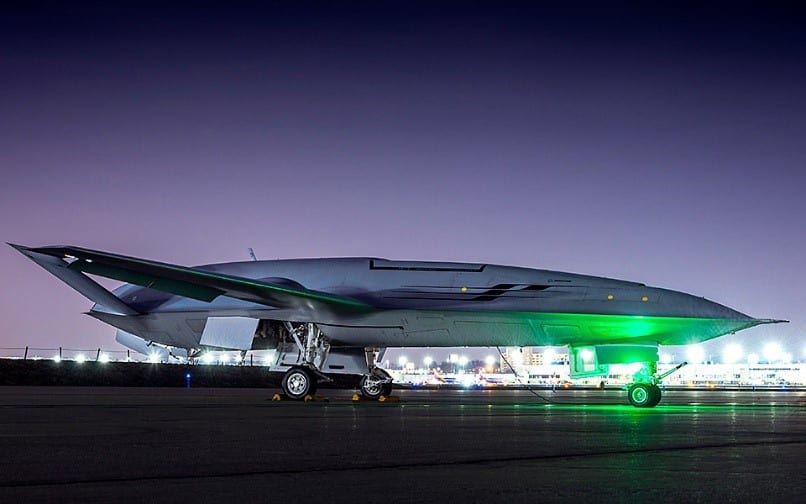
The MQ-25 unmanned aerial refueling tanker. Boeing

EAST AURORA, N.Y. — Astronics Corp. has been awarded contracts by Boeing to supply CorePower aircraft power distribution units and custom-engineered exterior lighting for the MQ-25 unmanned aerial refueling program, Astronics said in a Feb. 17 release. 

“Our CorePower Electronic Circuit Breaker Unit (ECBU) technology is ideally suited for use in unmanned aircraft. This COTS [commercial off the shelf] power distribution technology will support the success of the MQ-25 program by providing intelligent control and visibility of the on-board power systems,” said Pete Gundermann, president and CEO of Astronics. “Additionally, we are proud to bring our exterior lighting expertise for military programs to Boeing on this project.” 

The CorePower system replaces pilot-operated, thermal mechanical breaker systems with intelligently controlled, solid-state switches to provide safe, reliable performance remotely. The system planned for the MQ-25 incorporates the use of Astronics’ latest generation ECBU products to create an evenly distributed system at a fraction of the wire weight and increased reliability compared with traditional systems. 

Astronics is also currently working with Boeing to design custom lighting for the MQ-25 that to provide for safe operations for flight deck personnel and aid in the aerial refueling process. 

The MQ-25 is the U.S. Navy’s first operational carrier-based unmanned aircraft and is designed to provide a much-needed refueling capability. The contract supports Boeing’s engineering and manufacturing development program. 

“The MQ-25 program is vital because it will help the U.S. Navy to extend the range of the carrier air wing and Boeing and our industry team is all-in on delivering this capability,” said Dave Bujold, Boeing’s MQ-25 program director. “The work we’re doing is also foundational for the future of Boeing — where we’re building autonomous systems from seabed to space.”